FOCUS POINTS
• Iloperidone was shown to be effective, safe, and relatively well tolerated at doses of either 12 mg qhs or 12 mg bid (24 mg/d) for up to 29 weeks.
• The most common treatment-emergent adverse events seen with iloperidone in this open-label extension study were headache, weight gain, and dizziness.
• Glucose, lipids, and prolactin did not increase over the 29 weeks studied.
• This study provides further data in addition to the approved prescribing information for iloperidone to help clinicians regarding dosing (including the use of 12 mg/d, given qhs only) and longer term effects in adult patients with schizophrenia.
Introduction
Schizophrenia is a debilitating and chronic mental illness with a high socioeconomic burden.Reference McEvoy1, Reference Rössler, Salize and van Os2 Because lifelong pharmacotherapy is required for treatment of schizophrenia, establishing long-term safety and efficacy is important for all antipsychotics.
Iloperidone is an atypical antipsychotic indicated for the treatment of schizophrenia in adults at recommended doses of 12–24 mg/d. Short-term evaluations of iloperidone were accomplished in four 4- or 6-week, placebo-controlled, double-blind, Phase 3 studies in which iloperidone significantly reduced both positive and negative symptoms of schizophrenia compared with placebo.Reference Potkin, Litman, Torres and Wolfgang3, Reference Cutler, Kalali and Weiden4 Further, no medically important effects on lipid profiles, prolactin, or glucose were seen in these trials, and extrapyramidal symptom (EPS) and akathisia rates were similar to placebo.Reference Cutler, Kalali and Weiden4, Reference Weiden, Cutler and Polymeropoulos5
Three long-term (52-week), randomized, double-blind, haloperidol-controlled, Phase 3 trials of iloperidone have been conducted.Reference Kane, Lauriello and Laska6 The efficacy of iloperidone in relapse prevention, the studies’ primary efficacy variable, was comparable to that of haloperidol, and iloperidone offered advantages in terms of fewer treatment discontinuations due to adverse events (AEs) and a better EPS profile.Reference Kane, Lauriello and Laska6 These studies provided the initial long-term analyses of iloperidone therapy; however, the iloperidone dosage in these trials did not exceed 16 mg/d. The study described herein was a 25-week open-label evaluation of iloperidone 12–24 mg/d given either once daily at bedtime (QHS; 12 mg/d total dose) or twice daily (BID; 24 mg/d total dose), following a 4-week double-blind, placebo- and ziprasidone-controlled evaluation.Reference Cutler, Kalali and Weiden4
Methods
Patients
Eligible patients had completed a 4-week double-blind, placebo- and ziprasidone-controlled trial of iloperidone.Reference Cutler, Kalali and Weiden4 Detailed inclusion/exclusion criteria for entry into the initial double-blind study have been published previously,Reference Cutler, Kalali and Weiden4 but in brief, men and nonpregnant, nonlactating women aged 18–65 years with a Diagnostic and Statistical Manual of Mental Disorders, 4th Edition (DSM-IV) diagnosis of schizophrenia, a Clinical Global Impression of Severity (CGI-S) score ≥ 4 at baseline, a Positive and Negative Syndrome Scale (PANSS)-Total score (PANSS-T) ≥ 70, and a rating ≥ 4 (moderate) on at least 2 PANSS-Positive (PANSS-P) subscale symptoms (delusions, conceptual disorganization, hallucinations, and suspiciousness/persecution) were eligible to enroll. To participate in the long-term extension study, patients had to provide written informed consent, have a Clinical Global Impression of Change (CGI-C) score < 4 (indicating improvement), and be deemed appropriate by the investigator for treatment with iloperidone and for participation in a long-term outpatient study.
Study design
This study was conducted at 35 centers in the United States and 9 in India in accordance with the Declaration of Helsinki, the United States’ Code of Federal Regulations governing the protection of human subjects and obligations of clinical investigators, and the International Conference on Harmonization Guidance for Good Clinical Practice. The study protocol was approved by the appropriate institutional review boards or independent ethics committees.
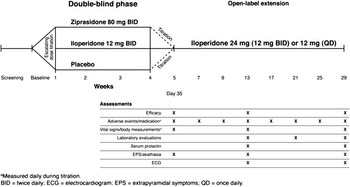
In the double-blind study, patients were randomized 2:1:1 to receive iloperidone 12 mg BID, ziprasidone 80 mg BID, or placebo (Figure 1). Treatment was initiated with a 7-day dose-titration period (days 1–7) followed by a 3-week fixed-dose period (days 8–28). Patients switching from ziprasidone and placebo to iloperidone underwent a second double-blind, 7-day, fixed-titration phase during which patients received iloperidone 1, 2, 4, 6, 8, 10, and 12 mg BID (days 29–35), respectively, to maintain blinding of the previous treatment. Patients who had received iloperidone during the short-term, double-blind phase continued to receive double-blind iloperidone 12 mg BID during days 29–35. On day 36 (day 8 of the open-label extension), all patients were switched to open-label treatment, when the dose of iloperidone could be reduced to 12 mg/d (given QHS) at the discretion of the investigator at any time throughout the remainder of the study (days 36–203).
Study design.

Assessments and analysis
The primary objective of the open-label study was to evaluate the safety and tolerability of flexibly dosed iloperidone for the treatment of schizophrenia over the extension phase of 25 weeks. Evaluations occurred at various time points during the open-label extension phase (Figure 1). Assessments of safety included AEs and concomitant medication use; changes in vital signs and body weight; standard laboratory evaluations; measurement of serum prolactin levels; the Extrapyramidal Symptom Rating Scale (ESRS)Reference Chouinard and Margolese7; the Barnes Akathisia Scale (BAS)Reference Barnes8; and electrocardiograms (ECG). Evaluations of efficacy included mean change from baseline in scores from PANSS-T, CGI-S, and CGI-C measures.
Except where indicated, results for the open-label phase were summarized by patients’ original double-blind treatment group assignment. The safety population was composed of all patients who received at least 1 dose of study medication in the open-label extension. Changes in safety parameters were measured from the end of the initial 4-week, double-blind, placebo-controlled study (open-label baseline) to week 29, the end of the open-label phase.
Efficacy analyses were based on the modified intent-to-treat (mITT) population, composed of all patients who received at least 1 dose of study medication and from whom a baseline and at least one PANSS score measurement were obtained during open-label treatment. Efficacy results were summarized for the mITT population, as mean changes from the original double-blind baseline and were observed cases. Safety and efficacy results at week 29 were for patients who completed the study, while results at study endpoint included all patients who entered the open-label phase; endpoint was defined as the last nonmissing observation recorded during the open-label extension prior to discontinuation or end of study.
Results
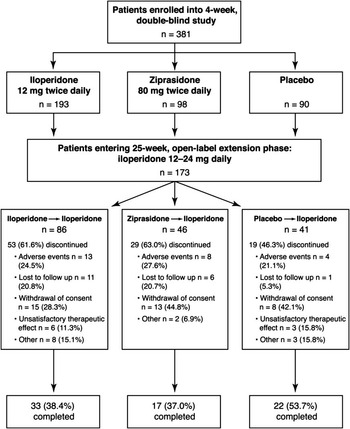
A total of 381 patients completed the short-term, double-blind study,Reference Cutler, Kalali and Weiden4 and 173 patients went on to participate in the open-label extension (Figure 2). Of those who entered the open-label extension, 72 (41.6%) completed the 25 weeks of treatment (53.7% of patients originally on placebo, 38.4% on iloperidone, and 37% originally on ziprasidone).
Patient disposition.

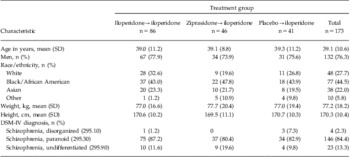
The demographic and clinical characteristics of the patients who entered the open-label phase were similar between groups, except for a lower percentage of patients of white race in the ziprasidone group (Table 1). Patients had a mean age of 39.1 years and were predominantly male. The majority of the population (84%) had a DSM-IV diagnosis of paranoid schizophrenia (2.3% disorganized schizophrenia; 13.3% undifferentiated schizophrenia). The mean dose of iloperidone received was 21.6 mg. The duration of exposure by dose varied because the dose could be changed at the discretion of the investigator over the 25-week period to mimic real-world clinical practice. Most patients received iloperidone 24 mg/d given as 12 mg BID over the course of treatment. A total of 39 patients (23%) received iloperidone 12 mg QHS during the course of the study; 29 patients received 12 mg QHS for at least 4 weeks, and 10 received this dose for >20 weeks.
Patient demographic and clinical characteristics

DSM-IV = Diagnostic and Statistical Manual of Mental Disorders, 4th Edition.
Safety
Adverse events
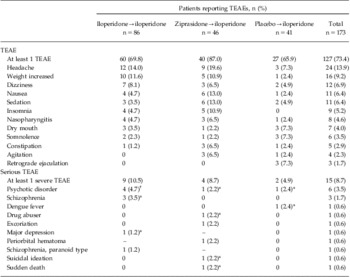
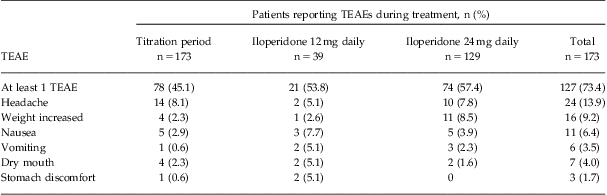
Treatment-emergent AEs (TEAEs) were reported by 73.4% of patients, and most were mild to moderate in intensity. The most common TEAEs were headache, weight increase, dizziness, nausea, sedation, and insomnia (Table 2). Headache, nausea, sedation, and insomnia occurred with higher incidence in the group that switched from ziprasidone to iloperidone than in the groups that received iloperidone throughout the study or switched from placebo. The incidence of weight gain was lower in the group switching from placebo to iloperidone compared with the other groups. The only notable dose-related AEs were weight increase and headache (Table 3).
TEAEs occurring in >5% of patients in any treatment group and all serious adverse events occurring during 25 weeks of open-label iloperidone treatment (safety population, patients who entered the open-label phase)

*Led to patient discontinuation; †led to 2 patient discontinuations. Additional AEs leading to discontinuation in the iloperidone→iloperidone group were auditory hallucination, headache, drug abuse, urinary incontinence, elevated glycosylated hemoglobin, hyponatremia, weight increase, and muscle tightness (n = 1 each). Additional AEs leading to discontinuation in the ziprasidone→iloperidone group were schizophrenia, headache, throat tightness, and dizziness (n = 1 each). Additional AEs leading to discontinuation in the placebo→iloperidone group were renal impairment and somnolence (n = 1 each).
AEs = adverse events; TEAEs = treatment-emergent adverse events.
TEAEs reported by >5% of patients in either iloperidone dose group during open-label treatment, by iloperidone dose received (safety population)
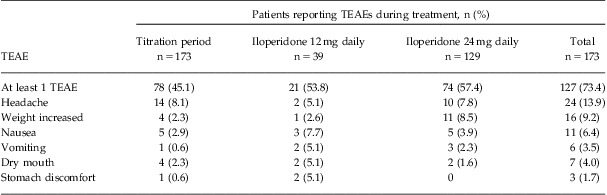
TEAEs = treatment-emergent adverse events.
There were 26 AEs that resulted in treatment discontinuation in 25 patients (Table 2). A total of 15 patients experienced serious AEs during the study, none of which were considered to be related to the study drug (Table 2). There was 1 death: a 30-year-old man who had received double-blind ziprasidone before being switched to iloperidone died suddenly on study day 65, during week 10. His iloperidone dose had been changed to 12 mg QHS 2 days prior to his death due to mild akathisia and restlessness. The patient's last laboratory results (on day 28) did not indicate any significant clinical abnormalities. The patient's family reported that he lost consciousness and experienced labored breathing about 30 min after returning from a walk. He did not have a history of anaphylaxis, allergy, asthma, physical disorder, or of drug abuse or dependence, and there was no family history of sudden death or of myocardial infarction. The patient's ECG readings were normal throughout the study. The investigator was unable to assess any relationship to the study drug because the patient had not been seen in the clinic or hospitalized, the body was cremated, and no autopsy was performed.
Laboratory values
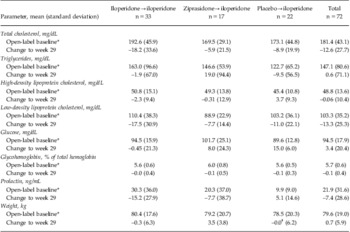
Mean changes in laboratory values from the end of the double-blind phase to the end of the study generally varied little over time and were similar across treatment groups (Table 4). Among patients who participated in both the double-blind and open-label extension portions of the study, lipid, glucose, and prolactin values generally decreased or were unchanged. In particular, patients on iloperidone during the entire 29-week study experienced decreased lipids and prolactin and unchanged glucose and glycosylated hemoglobin levels during the open-label phase (Table 4). Although very few patients experienced clinically notable abnormalities in laboratory values during the open-label extension, increases in triglycerides and glucose (mean changes 19.0 mg/dL and 8.0 mg/dL, respectively) were observed in patients who had switched from ziprasidone. No patients experienced clinically notable elevations in total cholesterol, triglyceride, or prolactin levels.
Laboratory values of interest during the open-label extension (safety population, patients who entered the open-label phase)

*End of the short-term, double-blind phase of the study.
†Rounded to zero.
Weight
Patients on iloperidone or placebo during the double-blind phase did not experience any additional mean weight gain during the open-label phase, while patients switching to iloperidone from ziprasidone experienced a mean weight gain of about 3.5 kg (Table 4). This is similar to the magnitude of weight gain that was seen with iloperidone during the study's double-blind phase (3.3 kg). Thus weight gain on iloperidone stabilized over time, and mean [standard deviation (SD)] kg weight was similar for all groups at week 29: 76.1 (15.6) for iloperidone→iloperidone, 76.8 (25.5) for ziprasidone→ iloperidone, and 73.3 (19.6) for placebo→iloperidone. Clinically significant weight gain (≥7% increase from baseline) during the double-blind phase occurred in 21.3% of patients receiving iloperidone, 7.4% of those receiving ziprasidone, and 3.4% of those receiving placebo. During the open-label phase, clinically significant weight gain was experienced by 47.7%, 34.8%, and 19.5% of patients in the iloperidone→iloperidone, ziprasidone→iloperidone, and placebo→iloperidone treatment groups, respectively. Increases in weight from baseline to week 29 for African American patients who entered the open-label extension were numerically higher than that for non–African American patients: 2.68 kg (n = 77) vs 2.26 kg (n = 96).
Orthostatic hypotension
During assessment of vital signs, an orthostatic response (systolic blood pressure decrease of ≥30 mm Hg from supine to standing position at 3 min) was reported by 9.3% of iloperidone→iloperidone, 8.7% of ziprasidone→iloperidone, and 14.6% of placebo→iloperidone patients, though only 2 patients (1.2%; 1 in the iloperidone→iloperidone group and 1 in the ziprasidone→iloperidone group) exhibited an orthostatic response on 2 consecutive visits. A total of 24.4%, 26.1%, and 17.1% of patients in these respective treatment groups experienced a raised 3-min standing pulse rate during the study.
Electrocardiogram results
The most frequently occurring abnormalities during the open-label study among all treatment groups were flat T-waves (14/173; 8.1%), sinus tachycardia (10/173; 5.8%), first-degree atrioventricular block (9/173; 5.2%), premature ventricular complexes (6/173; 3.5%), and inverted T-waves (6/173; 3.5%). Overall mean maximum heart rate decreased by 3.8 bpm. Mean (SD) changes in the QT interval corrected by Fridericia's formula (QTcF) from the beginning of the open-label extension to endpoint were 0.7 (21.0) msec in the iloperidone→iloperidone group, 3.8 (19.4) msec in the ziprasidone→iloperidone group, and 6.3 (22.1) msec in the placebo→iloperidone group. Mean (SD) maximum QTcF changes for these respective groups were 5.8 (20.2), 6.4 (19.0), and 10.8 (23.1) msec. One patient in the iloperidone→iloperidone group had a QTc interval change >15% of his or her baseline value that occurred after discontinuation of study medication. No patients experienced a QTc interval > 500 msec during the long-term study, and no patients experienced a severe cardiac AE.
Extrapyramidal symptoms and akathisia
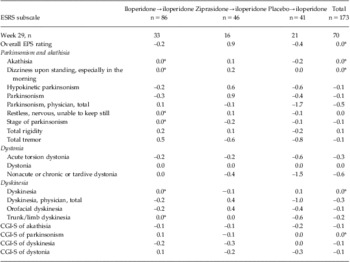
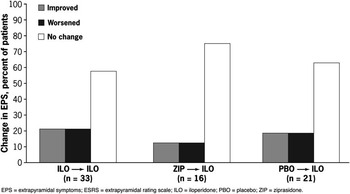
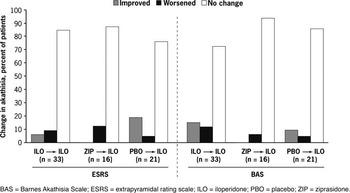
An extrapyramidal disorder AE was reported during the open-label study in 1 patient (0.6%) who received iloperidone during both study phases. Akathisia was reported in 1.7% of patients (1 patient on iloperidone during both phases and 2 patients switching to iloperidone from double-blind ziprasidone). Changes in EPS during the study were quantitated using the ESRS. Akathisia was evaluated using both the ESRS and BAS. Overall, mean changes in ESRS items showed no change or improvement during the open-label phase (Table 5). Most patients on iloperidone experienced no change in overall rating of EPS (Figure 3). Akathisia scores on the akathisia subscales of the ESRS (restless, nervous, unable to keep still, CGI-S of akathisia and general akathisia; data for general akathisia subscale are shown in Figure 4) and BAS (Figure 4) showed mainly improvement or no change. Benztropine, the sole allowed medication for EPS symptoms, was newly prescribed during the open-label period for 6 patients receiving iloperidone→iloperidone, 4 patients receiving ziprasidone→iloperidone, and 1 patient receiving placebo→iloperidone.
Mean change from open-label baseline to week 29 in ESRS subscale scores (safety population, patients who entered the open-label extension)

Note, the end point was the last observation from the long-term, open-label phase.
*Rounded to zero.
CGI-S = Clinical Global Impression of Severity scale; EPS = extrapyramidal symptoms; ESRS = Extrapyramidal Symptoms Rating Scale.
Mean change in overall EPS rating on ESRS during open-label treatment; proportion of patients responding (safety population).

Mean changes in ESRS akathisia score and BAS total scores during open-label treatment: proportion of patients responding (safety population).

Efficacy
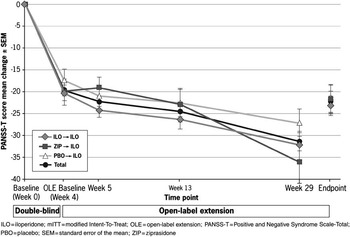
Clinical symptoms, as demonstrated by the PANSS-T, showed no signal of worsening over the course of the open-label extension (Figure 5). At the end of the double-blind phase, mean CGI-S scores ranged from 3.6–3.8 among the treatment groups. Mean (SD) changes in CGI-S scores from the beginning of the double-blind period to endpoint were –1.3 (1.3) for patients who received iloperidone during both phases, –1.3 (1.2) for patients who switched to iloperidone from ziprasidone, and –1.2 (1.2) for patients who switched from placebo. Corresponding mean (SD) changes at week 29 for completers in each of the 3 treatment groups were –1.9 (1.2), –2.1 (1.3), and –1.6 (1.1), respectively.
Mean (SEM) changes from baseline in the PANSS-T following 25 weeks of open-label iloperidone treatment (mITT population, observed cases).

On the CGI-C, 94/167 patients (56.3%) were very much improved or much improved from the end of the double-blind phase; 38 (22.8%) were minimally improved; 21 patients (12.6%) had no change; and 14 patients (8.4%) exhibited worsening of scores at end point. Among completers at week 29, 56/71 (78.9%) were very much or much improved according to the CGI-C; 13 (18.3%) were minimally improved; and 2 (2.8%) exhibited no change in CGI-C scores. None of the patients who completed exhibited worsening of CGI-C scores.
Discussion
The present study supports the long-term safety and tolerability of iloperidone 12–24 mg/d for the treatment of schizophrenia. There was no signal of worsening of efficacy based on changes from baseline on the PANSS-T during the 25-week, open-label treatment period. For all efficacy measures, improvements in symptoms were numerically greater among completers at week 29 than for the entire mITT population.
The safety profile in this study was consistent with that in other iloperidone studies, with low incidences of EPS and akathisia and a lack of medically important lipid and glucose changes. The overall rate of treatment discontinuation with iloperidone in this trial (58.4%) was higher than the previously reported rate of 36% in other 1-year trials of iloperidone, which were double-blind, had different designs, and were conducted outside of the United States,Reference Kane, Lauriello and Laska6 yet was in keeping with the 47% to 70% discontinuation rates reported in 6-month trials of other atypical antipsychotics.Reference Breier, Berg and Thakore9–Reference Kinon, Lipkovich and Edwards12 The most common TEAEs were headache, weight increase, dizziness, nausea, sedation, insomnia, nasopharyngitis, and dry mouth. Most AEs were mild to moderate in severity. The incidence of TEAEs was higher in the ziprasidone→iloperidone group (87.0%) than in either the iloperidone→iloperidone group (69.8%) or the placebo→iloperidone group (65.9%) and was similar to that occurring with iloperidone during the lead-in 4-week double-blind study (85%).Reference Cutler, Kalali and Weiden4 The AE profile of iloperidone in the present study is similar to that reported in previous 52-week studies of iloperidone 4–16 mg/d,Reference Kane, Lauriello and Laska6 though the frequency of some AEs in the present study was notably less (eg, insomnia, anxiety, and schizophrenia/psychosis aggravated).
A concern with many antipsychotics is their ability to contribute to the development of cardiovascular disease through weight gain and elevated lipids and glucose.Reference Kiraly, Gunning and Leiser13 In short-term (4- to 6-week) double-blind studies, iloperidone was associated with a modest weight gain of 2.4 kg.Reference Cutler, Kalali and Weiden4, Reference Weiden, Cutler and Polymeropoulos5 Mean weight increases from the end of the double-blind phase to week 29 in this study were in the range of 1.5–3.2 kg, and consistent with these prior trials. The current study and other long-term iloperidone studiesReference Kane, Lauriello and Laska6 demonstrate that weight gain that occurs with iloperidone appears to plateau after an initial 4- to 6-week treatment period. This is in contrast to olanzapine, where mean weight gain is cumulative during long-term treatment.Reference McEvoy, Lieberman and Perkins14 During the open-label phase, mean weight increases were higher for patients switching from ziprasidone (3.5 kg) than for those remaining on iloperidone (–0.3 kg) or switching from placebo (0 kg). In the double-blind phase of the current study, a greater proportion of patients treated with iloperidone at a fixed dose of 24 mg/d demonstrated clinically significant weight gain (21%), compared with other short-term double-blind iloperidone studies that used lower doses and in which clinically significant weight gain occurred in 12% of patients receiving iloperidone.Reference Cutler, Kalali and Weiden4, Reference Weiden, Cutler and Polymeropoulos5 Of note, there appears to be a dose relationship, as clinically significant weight gain was greater in this trial and in the highest iloperidone dose group in the pooled double-blind trials.Reference Weiden, Cutler and Polymeropoulos5 In addition, almost half of the patients who entered the open-label extension were African-American, and these patients gained numerically more weight on iloperidone during the 29-week trial than did non–African American patients. The effects of dose and race on weight gain with iloperidone are currently being investigated.
Weight gain with olanzapine and clozapine has also been reported to be associated with the C-allele of the 759C/T polymorphism of the 5-HT2c receptor.Reference Reynolds, Zhang and Zhang15, Reference Ellingrod, Perry and Ringold16 A pharmacogenetic analysis of the 4-week double-blind phase was conductedReference Thompson, Lavedan and Volpi17 to determine the relationship between weight gain and this polymorphism in patients treated with iloperidone; however no association was observed. These results suggest that the biological mechanisms that contribute to antipsychotic-induced weight gain differ between antipsychotic agents.
It is notable that weight gain with iloperidone was not associated with dyslipidemia or medically important changes in glucose. Mean total cholesterol and LDL levels were reduced in all three groups (iloperidone→iloperidone, ziprasidone→iloperidone, placebo→iloperidone), with glycosylated hemoglobin levels unchanged. Triglyceride levels were increased in patients who switched from ziprasidone, with increases in glucose levels observed in this group of patients as well as in those who switched from placebo. This latter group also showed increases in HDL levels. The above findings suggest that some patients may have different metabolic responses to these two medications, particularly when iloperidone is titrated rapidly to a maximum dose of 24 mg/day as was done in this study. Blood pressure was not increased during treatment. Prolactinemia is another common adverse effect of some antipsychotics (eg, risperidone and haloperidol), which can lead to gynecomastia, galactorrhea, sexual dysfunction, amenorrhea, or abnormalities in bone metabolism.Reference Torre and Falorni18 In the present study, as well as in other studies,Reference Cutler, Kalali and Weiden4, Reference Weiden, Cutler and Polymeropoulos5 prolactin levels generally decreased or remained unchanged with iloperidone treatment.
Akathisia and EPS are distressing AEs that contribute to long-term treatment nonadherence to antipsychotic therapy.Reference Weiden19, Reference Lieberman, Stroup and McEvoy20 Though often attributed to conventional antipsychotics, EPS and akathisia also have been reported in patients taking second-generation antipsychotics.Reference Lieberman, Stroup and McEvoy20, Reference Weiden21 The present study supports the low EPS and akathisia burden of iloperidone seen in other clinical studies.Reference Cutler, Kalali and Weiden4–Reference Kane, Lauriello and Laska6 The majority of patients experienced no change or improvement in the overall rating of EPS, akathisia scores from the ESRS, and BAS total score. The propensity for antipsychotics to cause EPS and akathisia is an important consideration when prescribing antipsychotic medication. For example, in the CATIE study,Reference Lieberman, Stroup and McEvoy20 10.5% of patients (for whom reasons for discontinuation were known) stopped treatment due to EPS-related concerns. No patients discontinued iloperidone treatment in the present study because of EPS-related AEs. In several 1-year trials of atypical antipsychotics, AEs related to EPS were reported for 5% to 25% of patients, and akathisia AEs were reported for 5% to 15% of patients.Reference Kinon, Lipkovich and Edwards12, Reference Arato, O'Connor and Meltzer22–Reference Samalin, Garnier and Llorca25 Although these studies used different inclusion criteria for EPS-related AEs, the less than 2% incidence of extrapyramidal disorder and of akathisia AEs seen with iloperidone during the present trial compares favorably with these antipsychotics, as does the lack of worsening seen on EPS and akathisia scales.
Antipsychotics have also been associated with prolongation of the QTc interval.Reference Glassman and Bigger26 The mean maximum change in QTcF during the study was about 6 msec for patients on continuous iloperidone or switching from ziprasidone, while patients switching from placebo experienced increases of about 11 msec, similar to the 10 msec maximum increase in QTcF seen with iloperidone during the short-term, double-blind phase of the study.Reference Cutler, Kalali and Weiden4 In general, iloperidone QTc changes are similar to the QTc increase of about 10 msec seen with ziprasidone (Geodon® [ziprasidone] prescribing information, New York, NY: Pfizer, Inc.; 2010), an atypical antipsychotic whose potential for QT-interval prolongation has been widely studied and has not been shown to contribute to mortality.Reference Strom, Eng and Faich27 Importantly, no patients had a QTc interval > 500 msec, which is the FDA threshold of particular clinical concern,28 and no patients had a severe cardiac AE during the long-term, open-label phase.
Agents like iloperidone that have α-adrenergic antagonistic activity can cause dizziness or orthostatic hypotension. Consequently, the prescribing information for iloperidone recommends that it be titrated to a target dose of 12–24 mg/d over 4–7 days to avoid orthostatic hypotension (FanaptTM [iloperidone] tablets prescribing information, East Hanover, NJ: Novartis Pharmaceuticals Corporation; 2011). In the present study, an orthostatic response occurred in 9% to 15% of patients in each treatment group, but sustained orthostasis was very infrequent, with no more than 1 patient in each group experiencing a sustained orthostatic response. The frequency of dizziness was also low in this study; only 1 patient discontinued from the study because of dizziness, and this occurred during the titration period.
A limitation of this study is its open-label design that lacks a control group; however, neither study personnel nor patients were aware of treatment randomization from the double-blind treatment phase in order to minimize bias in the open-label extension. Another limitation in this study, and with other 6-month studies of antipsychotics, is the relatively high discontinuation rate. One factor to consider is that patients discontinuing early due to safety or tolerability issues (such as weight gain) may have affected the results. It is also possible that the abrupt discontinuation of ziprasidone and initiation of iloperidone without a cross-taper may have impacted the findings of this study.
Conclusion
The results of this study add to the body of evidence supporting the long-term safety and tolerability of iloperidone for the treatment of schizophrenia. Because of its unique profile—efficacy with minimal risk for EPS and akathisia, and a favorable metabolic profile—iloperidone could be an important option for the treatment of schizophrenia.
Disclosures
Andrew J. Cutler has received research support from Abbott, Alkermes, AstraZeneca, Bristol-Myers Squibb, Forest, Genentech (Roche), Janssen, Lilly, Lundbeck, Merck, Novartis, Otsuka, Shire, Sunovion, Targacept, and Vanda. He has been on speakers’ bureaus for Merck, AstraZeneca, Bristol-Myers Squibb, Forest, Genentech (Roche), Janssen, Novartis, Otsuka, Shire, and Sunovion, and he is or has been a consultant for Abbott, AstraZeneca, Forest, Genentech (Roche), Janssen, Lilly, Lundbeck, Novartis, Otsuka, Shire, Sunovion, and Targacept. Greg Mattingly has received research support from AstraZeneca, Ayerst, Sunovion (formerly Dainnipon-Sumitomo Pharma America, Inc.), Eli Lilly and Co., Forest, GlaxoSmithKline, Janssen (including Ortho-McNeil), Johnson & Johnson, Lundbeck, Merck & Co., Inc., New River Pharmaceuticals, Novartis Pharmaceuticals Corporation, Organon, Pfizer Inc., Sanofi-Synthelabo, Schwabe/Ingenix, Sepracor, Shire, Solvay, Takeda, Vanda Pharmaceuticals, and Wyeth. He is or has been on speakers’ bureaus for Abbott Laboratories, Eli Lilly and Co., Forest, GlaxoSmithKline, Janssen, and Shire. He is or has been a consultant for Eli Lilly and Co., Forest, McNeil, Pfizer Inc., Shire, and Vanda Pharmaceuticals. Jelena Kunovac has received research support from Abbott, Alkermes, AstraZeneca, CeNeRx BioPharma, Cephalon, Dainippon-Sumitomo, Eli Lilly and Co., EnVivo, Evotec, Forest, Hoffman LaRoche, Merck, Novartis Pharmaceuticals, Janssen, Otsuka, Pfizer, Schering Plough, Sepracor, Shire, Sunovion, Takeda, and Vanda. She is or has been on speaker's bureaus for Novartis Pharmaceuticals, Sunovion, and Wyeth. She is also the Founder of Altea Research. None of the other authors has anything to disclose.