INTRODUCTION
Abnormal test morphology and developmental defects are known to occur in certain foraminifer genera and species (Geslin et al., Reference Geslin, Debenay and Lesound1998; Stouff et al., Reference Stouff, Debenay and Lesourd1999a,Reference Stouff, Geslın, Debenay and Lesourdb). Such anomalies have been reported from many locations worldwide (Cushman, Reference Cushman1929; Cimerman & Langer, Reference Cimerman and Langer1991; Loeblich & Tappan, Reference Loeblich and Toppan1994). Salinity variations, anthropogenic heavy metal pollution or heavy metals carried by groundwater are suggested to be the causes of this phenomenon (Almogi-Labin et al., Reference Almogi-Labin, Perelis-Grossovicz and Raab1992; Yanko et al., Reference Yanko, Ahmad and Kaminsky1998; Stouff et al., Reference Stouff, Debenay and Lesourd1999a, Reference Stouff, Geslın, Debenay and Lesourdb; Geslin et al., Reference Geslin, Stouff, Debenay, Lesourd and Martin2000, Reference Geslin, Debenay, Duleba and Bonetti2002; Elberling et al., Reference Elberling, Knudsen, Kristansen and Asmund2003). Boltovskoy et al. (Reference Boltovskoy, Scott and Mediol1991) state that temperature, salinity, solubility of calcium carbonate, depth, nutrition, substrate type, dissolved oxygen content, illumination, pollution, water motions, trace elements and rapid changes in ecological parameters can all be responsible for abnormal test development.
Besides the morphological abnormalities, twins and triplets are common anomalies observed in benthic foraminifera. Twin and triplet forms of benthic foraminifers from various locations and depths and their relation with past and modern environmental conditions have been investigated by many researchers worldwide (Le Calvez, Reference Le Calvez1950; Berthold, Reference Berthold1971; Röttger & Spindler, Reference Röttger, Spindler, Schafer and Pelletier1976; Sharifi et al., Reference Sharifi, Croudace and Austin1991; Almogi-Labin et al., Reference Almogi-Labin, Perelis-Grossovicz and Raab1992; Meriç, Reference Meriç1996; Yanko et al., Reference Yanko, Ahmad and Kaminsky1998; Stouff et al., Reference Stouff, Debenay and Lesourd1999a,Reference Stouff, Geslın, Debenay and Lesourdb; Geslin et al., Reference Geslin, Stouff, Debenay, Lesourd and Martin2000, Reference Geslin, Debenay, Duleba and Bonetti2002). In Turkey, conjoined twin, triplet and quadruplet individuals from the western Black Sea, the Gulf of İzmit and from Antalya have been reported (Meriç, Reference Meriç1996; Meriç et al., Reference Meriç, Görmüş, Avşar, Yokeş and Dinçer2008a). But the most exciting findings of abnormal test development were the Peneroplis pertusus (Forskål) and Peneroplis planatus (Fichtel & Moll) individuals showing Coscinospira characteristics, which were commonly observed in sediment samples from Ayvalık, Çeşme and Antalya (Sellier & Civrieux, Reference Sellier and Civrieux1970; Meriç et al., Reference Meriç, Yokeş, Nielsen, Görmüş, Avşar and Dinçer2008b).
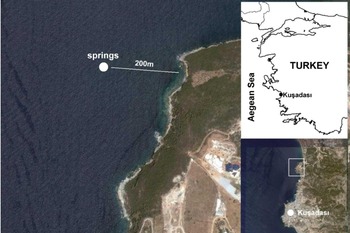
Two submarine springs are found off the coast of Pamucak Cove (north-west Kuşadası, Aydın), at a depth of 12.40 m (Figure 1). They are approximately 5 m away from each other and located about 200 m off the shore. The region is well known for the springs that surround the Gulf of Kuşadası. The temperatures of the thermal mineral springs around the gulf vary between 38 and 70°C, with a radioactivity range of 29.23–2809.41 bequerels (Türkiye Maden Sulari 3, 1974). The temperature of the mineral water coming out of the submarine springs in Pamucak Cove is 19.6°C. The temperature is not very high, but the fresh waters flow steadily all through out the year, which suggests that the spring waters can have an influence on the biota of the region. In autumn 2007, the vicinity of one of the submarine springs was investigated by skin diving to determine foraminiferal fauna and the abundance of morphologically abnormal individuals.
Map of the study area.

MATERIALS AND METHODS
The spring was taken as the centre and four vertical lines were set on south, north, east and west directions. A total of 45 sediment samples were collected at different points on the lines. On the south and north lines samples were collected at each 5, 10, 15, 20, 25, 30, 35, 40, 45 and 50 m distances according to the spring. Because of the suitable benthic structure, it was able to collect more samples on the east line; samples were collected at 5, 10, 15, 20, 25, 30, 35, 40, 45, 50, 60, 70, 80, 90 and 100 m distances. The 50 m distance could not be collected on the west line and samples were taken at 5, 10, 15, 20, 25, 30, 35, 40 and 45 m distances. One sample was also taken from the spring.
Five grams of wet sediment samples were weighed and treated with 10% H2O2 for 24 hours. The samples were washed with pressurized water on a 0.063 sieve and dried at 50°C in an oven. The dried samples were further sieved with 2.00, 1.00, 0.500, 0.250 and 0.125 mm mesh sizes. The foraminifer individuals were separated under binocular microscope.
Temperature and depth of the seawater were manually measured on the site.
RESULTS
Foraminiferal assemblages
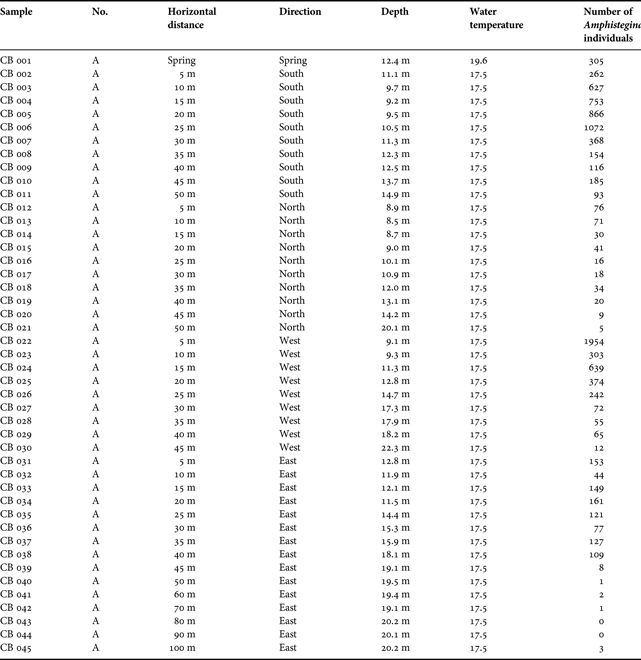
It was observed that all the samples contained Amphistegina lobifera Larsen individuals with 2.00, 1.00 and 0.500 mm of sizes. Foraminifers were abundantly observed over the 0.250 and 0.125 mm sieve sizes (Table 1).
Depth, temperature recordings, locations of the samples according to spring and the number of Amphistegina lobifera Larsen individuals observed in collected samples.

Samples were found to contain locally rich foraminiferal assemblages. A total of 59 genera and 103 species were identified according to Cimerman & Langer (Reference Cimerman and Langer1991); Hatta & Ujiie (Reference Hatta and Ujiie1992); Hottinger et al. (Reference Hottinger, Halicz and Reiss1993); Sgarrella & Moncharmont-Zei (Reference Sgarrella and Moncharmont-Zei1993); Avşar et al. (Reference Avşar, Meriç and Ergin2001); Meriç & Avşar (Reference Meriç and Avşar2001); and Meriç et al. (Reference Meriç, Avşar and Bergin2004a,Reference Meriç, Avşar, Nazik, Eryilmaz and Yücesoy-Eryilmazb, Reference Meriç, Görmüş, Nielsen, Avşar and Ünsal2005, Reference Meriç, Yokeş, Nielsen, Görmüş, Avşar and Dinçer2008b,Reference Meriç, Avşar, Yokeş, Tuğrul, Bayari, Özyurt, Balkis, Barut, Uysal and Kamc). Taxonomic classification was based on Loeblich & Tappan (Reference Loeblich and Tappan1988). The identified species are. Lagenammina fusiformis (Williamson), Iridia diaphana Heron-Allen & Earland, Haddonia sp., Eggerelloides advenus (Cushman), E. scabrus (Williamson), Textularia bocki Höglund, T. truncata Höglund, Cornuspira foliacea Philippi, Vertebralina striata d'Orbigny, Nodopthalmidium antilarum (Cushman), Nubecularia lucifuga Defrance, Adelosina carinata-striata Wiesner, A. cliarensis (Heron-Allen & Earland), A. duthiersi Schlumberger, A. mediterranensis (le calvez J. & Y.), A. partschi (d'Orbigny), A. pulchella d'Orbigny, Spiroloculina angulosa Terquem, S. depressa d'Orbigny, S. dilatata d'Orbigny, S. excavata d'Orbigny, S. ornata d'Orbigny, Siphonaperta agglutinans (d'Orbigny), S. aspera (d'Orbigny), S. dilatata (le Calvez J. & Y.), S. irregularis (d'Orbigny), Hauerina diversa Cushman, Cycloforina contorta (d'Orbigny), C. villafranca (le Calvez J. & Y.), Lachlanella undulata (d'Orbigny), Massilina gualteriana (d'Orbigny), M. secans (d'Orbigny), Quinqueloculina berthelotiana d'Orbigny, Q. bidentata d'Orbigny, Q. disparilis d'Orbigny, Q. jugosa Cushman, Q. laevigata d'Orbigny, Q. lamarckiana d'Orbigny, Q. limbata d'Orbigny, Q. seminula (Linné), Quinqueloculina sp. C, Miliolinella semicostata (Wiesner), M. subrotunda (Montagu), M. webbiana (d'Orbigny), Pseudotriloculuina laevigata (d'Orbigny), P. oblonga (Montagu), P. rotunda (d'Orbigny), Triloculina affinis d'Orbigny, T. bermudezi Acosta, T. marioni Schlumberger, T. plicata Terquem, T. schreiberiana d'Orbigny, T. tricarinata d'Orbigny, Triloculina sp. A, Sigmoilinita costata (Schlumberger), S. edwardsi (Schlumberger), Sigmoilopsis schlumbergeri (Silvestri), Parrina bradyi (Millet), Euthymonacha polita (Chapman), Laevipeneroplis karreri (Wiesner), Peneroplis pertusus (Forskal), P. planatus (Fichtel & Moll), Sorites orbiculus Ehrenberg, S. variabilis Lacroix, Laevidentalina inflexa (Reuss), Lenticulina cultrata (Montfort), Pyramidulina catesbyi (d'Orbigny), Polymorphina sp. 1, 2, 3, Brizalina simpsoni (Heron-Allen & Earland), B. spathulata (Williamson), Bulimina elongata d'Orbigny, Reussella spinulosa (Reuss), Fursenkoina acuta (d'Orbigny), Valvulineria bradyana (Fornasini), Eponides concameratus (Williamson), Neoeponides bradyi le Calvez, Gavelinopsis praegeri (Heron-Allen & Earland), Neoconorbina terquemi (Rzehak), Rosalina bradyi Cushman, R. floridensis (Cushman), R. globularis d'Orbigny, Conorbella imperatoria (d'Orbigny), Discorbinella bertheloti (d'Orbigny), Cibicides advenum (d'Orbigny), Lobatula lobatula (Walker & Jacob), Cyclocibicides vermiculatus (d'Orbigny), Planorbulina mediterranensis d'Orbigny, Cibicidella variabilis (d'Orbigny), Cymbaloporetta plana (Cushman), Sphaerogypsina globula (Reuss), Asterigerinata mamilla (Williamson), Amphistegina lessonii d'Orbigny, A. lobifera Larsen, Nonion depressulum (Walker & Jacob), Astrononion stelligerum (d'Orbigny), Ammonia compacta Hofker, A. parkinsoniana (d'Orbigny), A. tepida Cushman, Challengerella bradyi Billman, Hottinger & Oesterle, Cribroelphidium poeyanum (d'Orbigny), Porosononion subgranosum (Egger), Elpidium aculeatum (d'Orbigny), E. advenum (Cushman), E. complanatum (d'Orbigny), E. crispum (Linné), E. depressulum Cushman and E. macellum (Fichtel & Moll).
Abnormal foraminiferal assemblage
Individuals with coloured test were specifically observed in the samples collected from the east line. However, the ratio of the coloured individuals in the foraminiferal assemblage was very small. Abnormal test morphologies were observed only in 15 individuals from 9 species: Adelosina pulchella d'Orbigny, Spiroloculina angulosa Terquem, Miliolinella webbiana (d'Orbigny), Peneroplis pertusus (Forskål) (3 individuals), Peneroplis planatus (Fichtel & Moll) (4 individuals), Lobatula lobatula (Walker & Jacob), Planorbulina mediterranensis d'Orbigny, Cibicidella variabilis (d'Orbigny) (2 individuals) and Elpidium crispum (Linné). Twin or triplet formations were not observed in any specimen. But the most noteworthy abnormal individual was collected from the east line sample 39, showing an abnormal Vertebralina striata d'Orbigny specimen with two apertures, of which one showed Coscinospira hemprichii Ehrenberg characteristics (Plate 1, section 3). This individual with Vertebralina striata d'Orbigny and Coscinospira hemprichii Ehrenberg is unique and observed for the first time.
(1) Coscinospira hemprichii Ehrenberg. Side view, Kaş, Antalya, Station 131, 12 m. (2) Vertebralina striata d'Orbigny. (a) Side view, normal individual; (b) view of the aperture, Kuşadası, Aydın, Station 4, 9.2 m. (3) Abnormal individual showing Vertebralina striata d'Orbigny and Coscinospira hemprichii Ehrenberg togetherness. (a) Side view; (b &c) detailed view of the Coscinospira hemprichii Ehrenberg characteristics, Kuşadası, Aydın, Station 39, 19.1 m.

DISCUSSION
Morphological abnormalities of foraminifer tests are considered to be indicators of stressed environments, and some species are used as bioindicators for anthropogenic pollution. However, it has been shown that the environmental stress may also be exerted by natural factors such as, hypersalinity, periodical acidification and strong hydrodynamics. Short-term changes in the salinity of seawater could result in morphological anomalies in benthic foraminifer tests (Geslin et al., Reference Geslin, Debenay, Duleba and Bonetti2002; Nigam et al., Reference Nigam, Saraswat and Kurtarkar2006; Meriç et al., Reference Meriç, Avşar, Nazik, Tunoğlu, Yokeş, Barut, Yücesoy-Eryılmaz, Tuğrul, Görmüş, Öncel, Orak, Kam and Dinçer2008d). Thus, high ratios of abnormal to normal tests can also be observed in environments protected from human impact.
In this study a rich foraminiferal assemblage, represented by 59 genera and 103 species were observed. Morphologically abnormal individuals were also found. However, only 15 individuals from 9 species were morphologically abnormal, and the ratio of the abnormal individuals was too small compared to the fauna, indicating the presence of a healthy environment.
Examples of abnormal togetherness in Peneroplidae between Coscinospira hemprichii and Peneroplis pertusus and Peneroplis planatus have been previously reported (Meriç et al., Reference Meriç, Yokeş, Nielsen, Görmüş, Avşar and Dinçer2008b). However, the specimen from Kuşadası presents togetherness between two different families, Vertebralina striata d'Orbigny (Ficherinidae: Nodobacularinellinae) and Coscinospira hemprichii Ehrenberg (Peneroplidae), which is something not expected to happen under normal circumstances. The reproduction methods of the recent foraminifers, schizogony and gamogony, have been studied by many researchers (Le Calvez, Reference Le Calvez1950, Reference Le Calvez and Grassé1953; Grassé, Reference Grassé1953; Berthold, Reference Berthold1971; Röttger & Spindler, Reference Röttger, Spindler, Schafer and Pelletier1976). Schizogony is asexual production of macrospheric individuals from microspheric ones which takes place in cold seasons. Alternatively, gamogony is the production of microspheric individuals from the fusion of the gametes of two parental individuals, which is observed in summer. Abnormal individuals with morphological characteristics of two separate species are very rare events, which may be formed not by pollution but by chance. In this case, the gametes of Vertebralina striata might have been combined with those of Coscinospira hemprichii or, juvenile of Vertebralina striata might have been fused with Coscinospira hemprichii juveniles. Laboratory experiments or genetic analysis may solve the mystery of abnormal togetherness among different species of foraminifera.
ACKNOWLEDGEMENTS
The authors would like to thank Murat Dündar (R&D Manager, ASSAN A.Ş.) and Hüsnü Öztürk (Technician, ASSAN A.Ş.) for SEM (Jeol JSM-5600) photography.