INTRODUCTION
Limited use of mechanisation has been considered as one of the major obstacles for enhancing agricultural productivity in sub-Saharan Africa (SSA) (Sims and Kienzle, Reference Sims and Kienzle2016). This is also the case for rice cultivation in this region. Agricultural intensification and area expansion in SSA can be obtained by increasing amounts of inorganic fertiliser use and the introduction of labour-saving technologies such as herbicides and mechanisation (Ollenburger et al., Reference Ollenburger, Descheemaeker, Crane, Sanogo and Giller2016; Rickman et al., Reference Rickman, Moreira, Gummert, Wopereis, Wopereis, Johnson, Ahmadi, Tollens and Jalloh2013; Saito et al., Reference Saito, Nelson, Zwart, Niang, Sow, Yoshida, Wopereis, Wopereis, Johnson, Ahmadi, Tollens and Jalloh2013). However, rice farmers in this region are predominantly smallholders (Diagne et al., Reference Diagne, Amovin-Assagba, Futakuchi, Wopereis, Wopereis, Johnson, Ahmadi, Tollens and Jalloh2013), and this type of farmers have limited financial resources or access to credits and can therefore often not afford such technologies (Rickman et al., Reference Rickman, Moreira, Gummert, Wopereis, Wopereis, Johnson, Ahmadi, Tollens and Jalloh2013; Rodenburg and Johnson, Reference Rodenburg and Johnson2009). Even in case herbicides are accessible by farmers, they might have limited knowledge of effective and safe application procedures (Rodenburg and Johnson, Reference Rodenburg and Johnson2009). If such procedures are not observed, herbicide use might result in environmental hazards (e.g., water contamination, herbicide resistant weeds) and turn detrimental to human health. Research and development should therefore focus on developing, testing and promoting safe and efficient labour-saving technologies that can be easily used and afforded by smallholder farmers (e.g., Ogwuike et al., Reference Ogwuike, Rodenburg, Diagne, Agboh-Noameshie and Amovin-Assagba2014).
Smallholder farmers frequently indicate that weeds are one of the major constraints to rice cultivation (Niang et al., Reference Niang, Becker, Ewert, Dieng, Gaiser, Tanaka, Senthilkumar, Rodenburg, Johnson, Akakpo, Segda, Gbakatchetche, Jaiteh, Bam, Dogbe, Keita, Kamissoko, Mossi, Bakare, Cissé, Baggie, Ablede and Saito2017). In smallholder rice production systems, weeding is the activity with the highest seasonal labour requirement (Lodin-Bergman et al., Reference Lodin-Bergman, Paulson and Mugenyi2012; Ogwuike et al., Reference Ogwuike, Rodenburg, Diagne, Agboh-Noameshie and Amovin-Assagba2014). The reason for this high labour requirement is that weeding is mainly conducted manually, i.e., by hand or traditional hoe (Rodenburg and Johnson, Reference Rodenburg and Johnson2009). Due to its labour-intensive nature, weed control is often delayed or otherwise suboptimal, resulting in substantial yield reduction or crop failure (e.g., Becker et al., Reference Becker, Johnson, Wopereis and Sow2003). Improving competitiveness of rice against weeds through genetic improvement was considered as one of the potential options for reducing the weeding labour input (Dingkuhn et al., Reference Dingkuhn, Jones, Johnson and Sow1998). However, these breeding efforts did not generate rice varieties as competitive as expected and varieties combining superior weed competitiveness with adaptation to the environmental conditions of SSA are scarce (e.g., Rodenburg et al., Reference Rodenburg, Saito, Kakai, Toure, Mariko and Kiepe2009; Saito and Futakuchi, Reference Saito and Futakuchi2014; Saito et al., Reference Saito, Sokei and Wopereis2012).
An alternative approach to reduce the burden of weeding is through the introduction of mechanical weeders. The use of these implements could reduce labour requirements for weeding as well as the use of herbicides and therefore be instrumental in downsizing overall production costs. Use of such weeders, however, requires uniform transplanting/dibbling or drilling of the crop. In cases where such crop establishment practices are not commonly used already, they could be introduced to farmers alongside the introduction of the weeders.
Mechanical weeders are not yet commonly used by farmers in SSA, apart from Madagascar. Recent studies reported results of effectiveness and farmers’ perceptions of such weeders for rice cultivation (Gongotchame et al., Reference Gongotchame, Dieng, Ahouanton, Johnson, Alognon, Tanaka, Atta and Saito2014; Krupnik et al., Reference Krupnik, Shennan, Settle, Demont, Ndiaye and Rodenburg2012; Rodenburg et al., Reference Rodenburg, Saito, Irakiza, Makokha, Onyuka and Senthilkumar2015). Participatory weeder selection in Benin showed that farmers’ choice of weeders depends on water regimes (Gongotchame et al., Reference Gongotchame, Dieng, Ahouanton, Johnson, Alognon, Tanaka, Atta and Saito2014), and results from a trial in Tanzania indicated that their efficacy depends on water management and weeder types (Rodenburg et al., Reference Rodenburg, Saito, Irakiza, Makokha, Onyuka and Senthilkumar2015). In Benin, the ring hoe was identified as the most suitable weeder in rain-fed lowland rice, because of its ease of operation and high efficiency (Gongotchame et al., Reference Gongotchame, Dieng, Ahouanton, Johnson, Alognon, Tanaka, Atta and Saito2014). However, farmers’ preference for this weeder can be different across countries, rice growing environments and water management regimes. Data from participatory testing across diverse countries in SSA could provide the necessary information on target domains for out-scaling of this technology.
Therefore, the objectives of this study were to (i) investigate farmers’ preferences among different weeder types, (ii) compare the use of mechanical weeders with current farmers’ weed management practices in a wide range of countries in SSA and to (iii) test whether the preference was related to rice growing environments, water management and other biophysical parameters, as well as socio-demographic conditions.
MATERIALS AND METHODS
Description of study sites and mechanical weeders
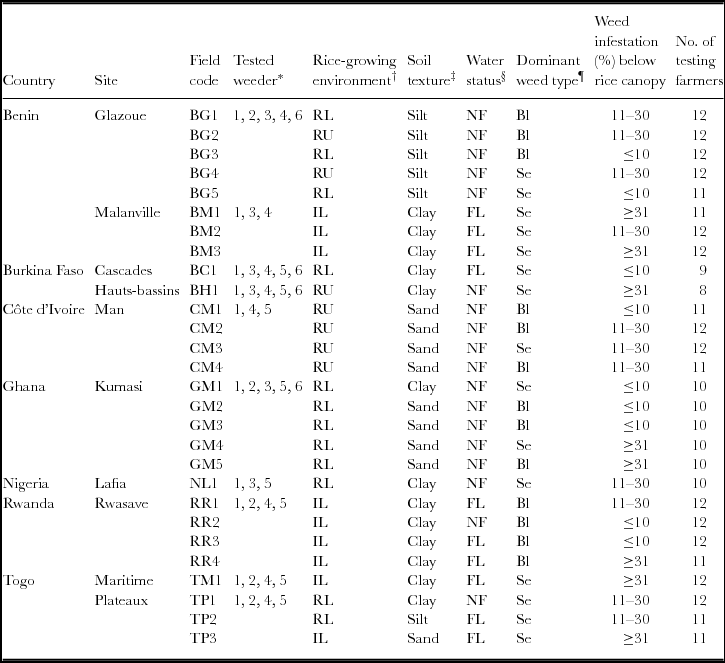
This study was conducted at 28 fields divided over 10 sites in Benin, Burkina Faso, Côte d'Ivoire, Ghana, Nigeria, Rwanda and Togo (Table 1). The sites were selected by national agricultural research institutes and their partners as priority intervention areas for rice sector development in their countries. The sites represent a wide range of rice growing environments in SSA, ranging from irrigated rice systems with full water control to upland rice systems entirely depending on rainfall for water inputs.
Tested weeders at each site, characteristics of a total of 28 fields in 10 sites in 7 countries in sub-Saharan Africa, and number of farmers participating in participatory weeder testing.

* 1 = ring hoe; 2 = twisted-spike floating weeder; 3 = curved-spike floating weeder; 4 = straight-spike floating weeder; 5 = straight spike weeder; 6 = simple rotary weeder.
† IL = irrigated lowland; RL = rain-fed lowland; RU = rain-fed upland.
§ FL = flooded; NF = non-flooded.
¶ Bl = broad-leaf weed species; Se = sedges.
On each site, three to five weeder types were tested: (1) the ring hoe, (2) the twisted-spike floating weeder, (3) the curved-spike floating weeder, (4) the straight-spike floating weeder, (5) the straight spike weeder and (6) the simple rotary weeder, all with different characteristics (Table 1 and Supplementary Figure S1, available online at https://doi.org/10.1017/S001447971700059X). As technical characteristics and drawings were described in a previous study (Gongotchame et al., Reference Gongotchame, Dieng, Ahouanton, Johnson, Alognon, Tanaka, Atta and Saito2014) and on a website (http://www.ricehub.org/RT/weeds/weeders/), here, we only briefly describe differences among them. The ring hoe does not have any rotating parts, like other weeders. The simple rotary weeder has a single rotating weeding drum with a ring hoe in front. Weeders 2, 3 and 4 have two rotating weeding drums and a floater in front, and the difference between them primarily concerns the shape and curvature of the spikes. Weeder 5 does not have a floater, as it was originally developed for upland crops (Gongotchame et al., Reference Gongotchame, Dieng, Ahouanton, Johnson, Alognon, Tanaka, Atta and Saito2014). All the tested weeders were fabricated locally or acquired from Africa Rice Center, Cotonou, Benin. The number of tested weeder types differed among sites, according to their availability, but the ring hoe was included in all the sites. A follow-up study was conducted at the sites Glazoue (Benin) and Lafia (Nigeria).
Participatory testing of mechanical weeders
The on-farm testing of weeders followed a farmer participatory approach similar to methods used by Gongotchame et al. (Reference Gongotchame, Dieng, Ahouanton, Johnson, Alognon, Tanaka, Atta and Saito2014). At each site, one to five fields were selected in consultation with farmers. We purposely selected fields in which rice was sown or planted in rows or grids by farmers, which is a requirement for the use of these weeders. Water status and weed infestation (weed cover ≤10%; weed cover >10% and ≤30%; weed cover >30%) were visually scored in a similar way as done by Gongotchame et al. (Reference Gongotchame, Dieng, Ahouanton, Johnson, Alognon, Tanaka, Atta and Saito2014). Soil texture was roughly determined in each field following Defoer et al. (Reference Defoer, Wopereis, Idinoba, Kadisha, Diack and Gaye2009). Information on production system and crop management practices in selected fields was collected by interviewing the farmers.
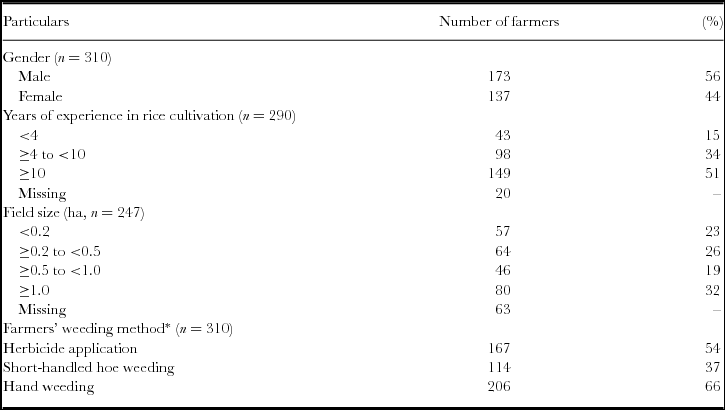
In each test field, 8–12 participating farmers were conducting the tests. The total number of participants were 310 (173 male; 137 female) (Tables 1 and 2). Socio-demographic information (gender, years of experience in rice cultivation and rice cultivation area) was collected from each participant (Table 2). We explained to the participants how to use the mechanical weeders one by one, and then asked all the participants to test each weeder in the field and to evaluate its effectiveness and ease of operation. Once all the weeders had been tested by each of the participants, they were free to try any of the weeders again for any further assessment if they deemed this necessary.
Characteristics of the participating farmers (n = 310).

*Categories are non-exclusive, implying that individual farmers may combine two or three weeding methods.
After the participants tested the weeders, they were asked to provide scores for each weeder. There were five possible scores: 1 = very bad; 2 = bad; 3 = fairly good; 4 = good; 5 = very good. The participants were also asked to compare each mechanical weeder with their own weed management practices (i.e., herbicide application, traditional hoe weeding and hand weeding) using a structured survey form. Key statistics of participants are shown in Table 2.
Follow-up study
A follow-up study was conducted in Benin and Nigeria to assess farmers’ appreciation of their most preferred weeder when they used it during an entire cropping season on their own farm. Additionally, it was tested whether their appreciation was related to biophysical or socio-demographic factors. For this follow-up study, we used the ring hoe, which was identified as the most preferred one in the first study (participatory testing of mechanical weeders) both in Benin and in Nigeria. In total, 186 farmers received the ring hoe in the two countries. Villages and farmers for the follow-up study were randomly selected in each target sites. In total, eight and seven villages were selected in Benin and Nigeria (with rain-fed upland and rain-fed lowland fields), respectively. In each village, 1–29 farmers received a ring hoe. Among the farmers who received a ring hoe, 101 were male and 85 were female farmers and all received training on how to use it. After the rice cropping season, farmers were asked the following questions:
1. Was the weeder used during this rice growing season? 1. yes, 2. no
2. How many people (number of persons) used the weeder you received?
3. Who used the weeder mainly? 1. male, 2. female farmer
4. What was the rice cultivation area (in ha) for which the weeder was used?
5. How much was weeding time reduced by using the weeder compared to the usual weeding method? 1. less than 30%, 2. more than 30% but less than 50%, 3. more than 50% but less than 80%, 4. no difference, 5. use of the weeder took more time than required previously (Only one answer can be selected here.)
6. In which other crops was the weeder used?
7. Is there an intention to use the weeder in the following season? If yes, why?
8. Compared to the usual weeding method the use of the weeder 1. is easier, 2. results in better weed control, 3. is labour- or time-saving, 4. increases rice yield, 5. has other advantages. (More than one reason can be selected here.)
9. What should the weeder cost (costs in local currency)?
Statistical analysis
To examine variation in farmers’ scores for each tested weeder, we used a three-level multinomial linear model including two random intercepts after taking into account (i) variation across fields and among farmers within the same fields, (ii) variation across production system and site combination (referred to as ‘environment’) and among fields within the same environment. We started with an unconditional model for each tested weeder, i.e., a model containing no predictors. In the participatory testing of mechanical weeders (first study), there were in total 28 test fields within 12 distinct environments (i.e., rice production system × geographical site; 2 out of 10 geographical sites comprised two rice production systems, resulting in 12). The field factor includes effects of individual farmer's crop management practices, soil type and water condition, and considers that each field was different, whereas the environment factor considers that fields in the same production system within a given site are similar and they are grouped. The estimate of the intercepts in the unconditional model represents the log odds of scores of a tested weeder at a typical field or environment. Predicted probabilities (PPs) at a typical field from our sample are calculated as below.
 $$\begin{equation}
{\rm{PP}} = \frac{{{e^{{\eta _{ij}}}}}}{{1 + {e^{{\eta _{ij}}}}}},
\end{equation}$$
where e ηij is the odds of rating a tested weeder for farmer i in field j.
The unconditional model provides information on the degree of clustering (dependence) in the data, which can be summarised by the intraclass correlation coefficient (ICC). The ICC at field-level measures the expected correlation between two farmers in the same field and the ICC at the environment-level measures the expected correlation between two fields from the same environment. The ICCs are calculated as follows:
 $$\begin{equation}
{\rm{IC}}{{\rm{C}}_{{\rm{field}}}} = \frac{{{\tau _f} + {\tau _e}}}{{{\tau _f} + {\tau _e} + 3.29}},
\end{equation}$$
 $$\begin{equation}
{\rm{IC}}{{\rm{C}}_{{\rm{environment}}}} = \frac{{{\tau _e}}}{{{\tau _f} + {\tau _e} + 3.29}},
\end{equation}$$
where τf is the variance for the field-level, τe the variance for the environment-level and 3.29 the farmer-level error variance, which is π/3 (Snijders and Bosker, Reference Snijders and Bosker1999).
As in a previous study by Gongotchame et al. (Reference Gongotchame, Dieng, Ahouanton, Johnson, Alognon, Tanaka, Atta and Saito2014), the ring hoe was the most preferred weeder, we computed a binary response variable indicating whether the ring hoe received a higher score than any other weeder in this study. With this binary variable, we performed again an unconditional model. Then, we estimated a full model by including both farmer-level predictors (socio-demographic information: gender and experience) and field-level predictors (water status, weed infestation below the canopy and soil texture) as fixed effects to identify predictors that could explain farmers’ preference for the ring hoe over the other weeders. We also examined the relationship between farmers’ socio-demographic characteristics, the field size and their likelihood of preferring the ring hoe compared to their own weed management practices (i.e., herbicide application, traditional short-handled hoe weeding and hand weeding). For each of these management practices, we also ran unconditional and full models. For the unconditional model, we did not consider field size, as we assumed that it does not affect farmers’ scoring for each weeder.
In the follow-up study, we used multiple regression analysis to identify factors affecting the farmers’ willingness to purchase the ring hoe. We included different socio-economic parameters (country, production system, use of herbicide, number of persons who used the weeder in a farm household, gender and age of the main person using the weeder, average rice field size, weeding time difference in comparison with the conventional weeding method and use for other crops) as predictors and computed the Akaike's information criteria (AIC) (Akaike, Reference Akaike, Petrov and Csaki1973) for all possible subsets of multiple regression models. The model with the best subset of variables that minimises the AIC among all possible subsets is considered as the best model. SAS GLIMMIX procedure was used (SAS 9.2, SAS Institute Inc., Cary, NC, USA) for these computations.
RESULTS
Participatory testing of mechanical weeders
Among 28 fields, 9 were irrigated lowland, 11 were rain-fed lowland, and 8 were rain-fed upland (Table 1). With respect to soil texture, 13 fields had a clay soil, 6 fields had soils with a dominant percentage of silt and soils of the remaining 9 fields were characterized as predominantly sandy. At the time of the weeder testing, 36% of the fields were flooded and 64% were not flooded. Fields were dominated by either sedges (dominant weed category in 54% of the fields) or broad-leaf weed species (46%). Weed infestation below the rice canopy varied between less than or equal to 10% (32% of the fields), between 11 and 30% (39% of the fields) and more or equal to 31% (29%). Of the farmers, 44% were female (Table 2). While weed control by hand was the dominant farmer practice (66%), more than half of the farmers (54%) indicated to use herbicides, and a substantial share of the farmers (37%) use the traditional short-handled hoe at some point in time (Table 2). A substantial number of farmers used combinations of any of those three methods.
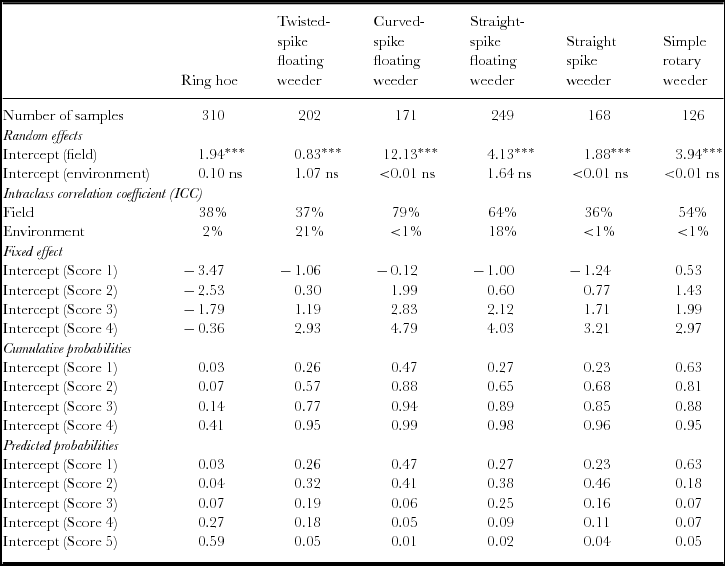
Results from the unconditional model using field as random effect showed that 38% of the variability in the score for the ring hoe was accounted for by the field in our study, leaving 62% of the variability to be accounted for by the environment (production system and site combination), the farmers or other unknown factors (Table 3). Similarly, 37, 79, 64, 36 and 54% of the variability in the scores for the twisted-spike floating weeder, the curved-spike floating weeder, the straight-spike floating weeder, the straight spike weeder and the simple rotary weeder, respectively, was accounted for by the field. However, when environment was used as random effect, less than 22% of variation was explained by environment, and for none of the weeders the environmental effect was significant. This suggests that scores might be largely affected by non-environmental conditions of the field, and hence, that scores of weeders are relatively consistent across environments.
p-Values of random effects and estimates of intraclass correlation coefficient and predicted probabilities from a three-level multinomial linear model for assessing distribution of the scores given by farmers to the tested weeders (unconditional models).

***p-value <0.001; ns = not significant at the 95% confidence interval.
With respect to the ring hoe (Table 3), the predicted probability (PP) of score 1–5 for the ring hoe was 3, 4, 7, 27 and 59%, respectively, making it the most preferred weeder type. The PPs of the other weeders were calculated in the same manner whereby the twisted-spike floating weeder was ranked second-best and the straight spike weeder third (Table 3). The ring hoe had the highest PPs in scores 4 (i.e., ‘good’) and 5 (i.e., ‘very good’) among the weeders, with 86% probability of scores 4 or 5. For other weeders, the probability was less than 24% for scores 4 or 5. The ring hoe also had the lowest PPs in scores 1 (i.e., ‘very bad’) and 2 (i.e., ‘bad’) compared to other weeders.
Comparing the preference of the ring hoe and other tested weeders with that of farmers’ own weed management practices, no significant effect of environment on preference was observed except for the comparison ring hoe vs. hand weeding (Supplementary Table S1, available online at https://doi.org/10.1017/S001447971700059X). When field was used as random effect, the probability of the ring hoe receiving the highest score among weeders was 71%, and the probability of farmers’ preference of the ring hoe over herbicide application and the use of the traditional short-handled hoe was 52 and 95%, respectively. Farmers’ preference for the ring hoe over hand weeding was consistent across fields. When the factor ‘environment’ was considered as random, the probability of farmers’ preference of the ring hoe over hand weeding was 91%.
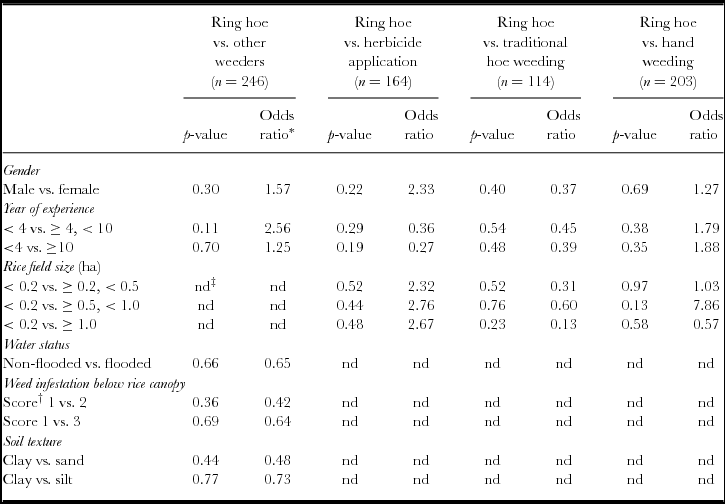
As farmers’ preference for the ring hoe against the other weeders was affected by field (Table S1), it was hypothesized that socio-demographic condition (Table 2) and field-level predictors (Table 1) could explain variation in their preference. However, the results from the two-level multinomial linear model revealed that the preference of this weeder was not related to field water status, weed infestation level or soil texture (p > 0.05, Table 4). Similarly, no farmer-level predictors like gender, year of experience in rice cultivation, were identified for explaining the variation in preference for the ring hoe compared to farmers’ weed management practices.
p-values of fixed effects and odds ratio estimates from a three-level multinomial linear model for the comparison between the ring hoe, and other tested weeders and farmers’ own weed management practices for farmers’ preference (full models).

* If the p-value is <0.05, the odds ratio estimate of < 1 indicates that the ring hoe tends to be more preferred by farmers over other weeder in a specific reference condition.
† 1 = weed cover less than or equal to 10% of ground cover; 2 = weed cover more than 10% and less than or equal to 30% of ground cover; 3 = weed cover more than 30%.
‡ ‘nd’ means ‘not determined’.
Follow-up study
Of the 186 farmers surveyed in the follow-up study, 39 farmers (21%) did not actually use the ring hoe, despite having received one (Table 4). The number of farmers who did not use the ring hoe was the highest in the dry season in 2016 in Lafia (Nigeria), when 15 of the farmers did not grow rice. A total of 10 farmers in Lafia indicated that a lack of uniformity in planting was the reason why they did not use the ring hoe. Six upland rice farmers in Glazoue (Benin) did not use the ring hoe because of the disturbing events (i.e., drought or bush fire), which destroyed their rice fields. Other minor reasons were shown in Table S2. The farmers, who actually used the ring hoe, shared the tool with on average four other persons (Table S3). A small majority (52%) of farmers indicated that the ring hoe was mainly used by women. In the dry season in Lafia, when there was an overall lower demand for labour due to a limited number of crops, fewer women used the ring hoe for weeding. In Lafia, average rice field size on which the ring hoe was used (1.14 ha) was much larger than in Glazoué (0.18 ha).
Around 80% of the farmers indicated that the ring hoe reduced weeding time by at least 31%. Apart from rice, 35% of the farmers used the ring hoe in other crops as well. Nearly all (99%) farmers who actually used the ring hoe during the follow-up study indicated that they want to use it for next season as well. Farmers’ expected to pay between US$1 and US$8 per ring hoe, with the average price ranging from US$3.2 in Glazoue (Benin) to US$2.6 in Lafia (Nigeria). In Benin, the expected, and presumed acceptable, price for the ring hoe was much higher among upland rice farmers than among lowland rice farmers.
A multiple regression analysis was conducted to identify factors affecting the farmers’ willingness to purchase the ring hoe. This analysis revealed that the best-fitted model (R 2 = 0.29; AIC = 469.1; p < 0.001) comprised of four predictors: (1) rice production system, (2) use of herbicides, (3) number of persons who used the weeder; and (4) gender of the main person using the weeder. In the model, rice production system, use of herbicides and number of persons who used the weeder are the predictors that showed significant effects on the willingness to pay. Upland rice farmers were willing to pay more than lowland rice farmers. Farmers who used to buy and apply herbicides were more eager to purchase the ring hoe than others. The higher the number of ring hoe users in a farm household, the more willing the head of the household was to purchase the ring hoe (Table S4).
DISCUSSION
This study presents the first report on test results of various types of mechanical weeders with a large sample of farmers in a wide range of rice growing conditions in SSA, revealing farmers’ preferences. The ring hoe was identified as the most preferred mechanical weeder, confirming a previous study conducted in Benin (Gongotchame et al., Reference Gongotchame, Dieng, Ahouanton, Johnson, Alognon, Tanaka, Atta and Saito2014), followed by the twisted-spike floating weeder. The ring hoe was adapted to a wide range of conditions as scoring was consistent across 12 environments (rice production system × geographical site). The ring hoe proved to be gender and age neutral, as women and elderly also preferred this weeder. This contrasts with results from Senthilkumar et al. (Reference Senthilkumar, Bindraban, Thiyagarajan, de Ridder and Giller2008) who observed in India that farmers’ perception of weeders was related to gender. Since the weeders tested by Senthilkumar et al. (Reference Senthilkumar, Bindraban, Thiyagarajan, de Ridder and Giller2008) were all rotary or cono-weeders, which are heavier and more expensive than the ring hoe, this result could imply that the ring hoe is specifically gender neutral because of its light weight and low price. However, the effect of cultural aspects cannot be ruled out in comparisons between India and Africa.
Weeding is mostly done by women and this task negatively affects the well-being of those farmers (Lodin-Bergman et al., Reference Lodin-Bergman, Paulson and Mugenyi2012). Gender neutral weeders, such as the ring hoe, could therefore alleviate the burden of women farmers and consequently improve their well-being. One of the reasons why most farmers preferred the ring hoe to the other weeders might be related to the fact that puddling is not a common practice even in irrigated lowland rice fields in SSA. Puddling in combination with transplanting is a common practice in irrigated rice in Asia and an effective method to reduce weed infestation (Chauhan et al., Reference Chauhan, Awan, Abugho, Evengelista and Sudhir2015). Puddling may also contribute to a better performance of the rotary weeders such as the twisted-spike floating weeder, the curved-spike floating weeder and the straight spike weeder. The ring hoe on the other hand does not require puddling. Furthermore, as the ring hoe was originally developed for upland crops in Japan (Gongotchame et al., Reference Gongotchame, Dieng, Ahouanton, Johnson, Alognon, Tanaka, Atta and Saito2014), it is not surprising that farmers used it for other crops than rice as well and this probably raises its attractiveness as a tool. African (rice-based) smallholder farming systems hardly ever comprise only one crop species (Kuivanen et al., Reference Kuivanen, Alvarez, Michalscheck, Adjei-Nsiah, Descheemaeker, Mellon-Bedi and Groot2016) and in such systems technologies that serve more than one crop are likely to be favoured over technologies that serve just one.
Around 50% of the farmers who used herbicides actually preferred herbicide application over the use of the ring hoe (Table S1). This contrasts with the high preference for the ring hoe over manual weeding practices by hand or using traditional equipment (short-handled hoe). This can be attributed to the ease and speed of application of herbicides compared with using mechanical weeders (Rodenburg et al., Reference Rodenburg, Saito, Irakiza, Makokha, Onyuka and Senthilkumar2015). This does not mean that farmers who use herbicides are not interested in mechanical weeders. On the contrary, the regression analyses showed that farmers using herbicides were more eager to purchase the ring hoe than farmers who were not using herbicides (Table S4). This is probably because farmers purchasing and applying herbicides inherently have more financial means. In addition, the follow-up study showed that almost 100% of farmers, including the ones using herbicides, indicated that they want to continue using this weeder (Table S3). The ring hoe may therefore be used complementary to other weed management practices. This actually provides an attractive outlook for farmers that are already using herbicides, as integrated weed management approaches can both reduce the cost and increase the efficacy of weed control (Swanton and Weise, Reference Swanton and Weise1991). Mechanical weeders, in general, are very compatible with other weed management practices – e.g., transplanting, continuous flooding, the use of weed competitive varieties, herbicide application – and can therefore be a valuable component in an integrated crop and weed management approach (Rodenburg et al., Reference Rodenburg, Saito, Irakiza, Makokha, Onyuka and Senthilkumar2015).
The ring hoe reduced weeding time by at least 31% compared with the farmer's conventional weeding method (Table S3). The evaluation of the weeding time by farmer is subjective and we acknowledge that farmers might not be able to precisely indicate their time saving in percentages. However, we believe that this indicator could be used to show how much farmers appreciate the weeder for its labour saving. Furthermore, labour-saving time of the ring hoe reported in this study was similar to what was obtained in a researcher-managed trial with other types of mechanical weeders in Tanzania, i.e., the twisted-spike and the straight-spike floating weeder (Rodenburg et al., Reference Rodenburg, Saito, Irakiza, Makokha, Onyuka and Senthilkumar2015). It confirms the high weeding efficiency of the ring hoe.
About 20% of the farmers (39 farmers) did not use the ring hoe in the follow-up study. However, looking at the underlying reasons for this, it becomes clear that this can hardly be explained by a lack of appreciation for the ring hoe as a weeding tool itself. Only 2% of the famers (four farmers) were not using the ring hoe due to its perceived poor performance under prevailing (soil and water) conditions. Our results indicate that mechanical weeders, in particular the ring hoe, work well in a wide range of conditions and can be promoted to smallholder rice farmers in Africa to save weeding labour. As Rickman et al. (Reference Rickman, Moreira, Gummert, Wopereis, Wopereis, Johnson, Ahmadi, Tollens and Jalloh2013) indicated, there are various bottlenecks for the effective introduction of mechanisation tools in SSA. Such tools are often abandoned for many different, partly concomitant and overlapping reasons: (1) the technology is not adapted to the specific field conditions of smallholder farms in SSA; (2) the technology does not have an appropriate design; (3) there is a lack of spare parts for the tool to be repaired after break-down; and (4) maintenance is costly. A lack of initial adoption of machineries in SSA can often be explained by the high costs of such technologies, in particular if they are fuel-powered (Guthiga et al., Reference Guthiga, Karugia and Nyikal2007). The initial investment cost for purchasing the machinery is often too high for smallholder farmers. However, none of the above reasons for lack of adoption, or for the high rate of dis-adoption, seems to be applicable for any of the mechanical weeders tested in the current study. These weeders are well-adapted and can be made locally. The design is simple (Figure S1) and could also be adapted according to local conditions. Spare parts can be locally made and maintenance should therefore be affordable. In addition, in contrast with fuel-powered tools, the use of the weeders is not associated with any additional costs.
In the follow-up study, three factors were identified as affecting the farmers’ willingness to purchase the ring hoe. The trends showed that upland rice farmers, herbicide users and farmers who have many relatives with interests in using the ring hoe were more eager to purchase it (Table S4). In Benin, the expected, and presumed acceptable price for the ring hoe was much higher among upland rice farmers than among lowland rice farmers. In these rice-growing environments, there are fewer possibilities to control weeds compared to irrigated lowlands (Rodenburg and Johnson, Reference Rodenburg and Johnson2009), which may explain the higher willingness to pay for such tools among upland rice farmers. Similarly, herbicide users tend to pay more for the ring hoe probably because they are more used to invest in weeding than others. Last, the higher the number of potential ring hoe users in a farm household, the more willing the head of the household is to purchase the ring hoe as it becomes evident that the ring hoe will be used. The price farmers are expected and willing to pay for the ring hoe is on average US$3 per unit. This is somehow lower than the price that local fabricators would like to sell it in Benin, which is around US$5 per unit (Azoma, B. Personal communication). It is, however, similar to what local fabricators in Nigeria like to fetch for it (Bakare, S.O., Personal communication). Interestingly, the weeder type that was most preferred by farmers in the current study, is also the cheapest solution, as price indications of the rotary weeders in Madagascar (US$23 per unit) are about five times higher (Rodenburg et al., Reference Rodenburg, Saito, Irakiza, Makokha, Onyuka and Senthilkumar2015). It is not clear how the presumed price differences by the test farmers influenced – conscientiously or unconscientiously – their choices. Given the small difference between the willingness to pay indicated by the farmers and the required price indicated by local vendors, it is highly likely that there will be a viable market for ring hoes in rural Africa. Currently, apart from Madagascar, none of these weeders are yet widely available on rural markets in SSA (Ndiiri et al., Reference Ndiiri, Mati, Home, Odongo and Uphoff2013). It would probably require both the creation of incentives for their use – i.e., through the promotion of the technologies among end-users by farm radio or farmer-to-farmer instruction videos – and the necessary technical know-how for their production – i.e., the broad dissemination of technical drawings among artisans in rural Africa, followed by training – to create vibrant and reliable markets for weeders in Africa.
CONCLUSIONS
In this study, the mechanical weeders were introduced to farmers. The main objective of these technologies is to reduce labour inputs for weeding in rice cultivation and a farmer participatory approach was used to identify the most preferred ones. The ring hoe was identified as the best weeder by farmers. Other weeders that were appreciated by rice farmers were the twisted-spike floating weeder and the straight spike weeder. The most preferred weeder, the ring hoe, showed to be gender-neutral and broadly adapted to diverse environments and crops due to its simplicity and presumed affordability. For enhancing farmers’ access to this weeder, agricultural research and development efforts should address improvements of local fabricators’ technical skills, and challenges and opportunities for their business dealing with it. Wide-scale dissemination of technical drawings of these weeders and promotional materials such as videos could help to reach the right stakeholders and assist them in production, retail and use of these labour-saving technologies.
Acknowledgements
This study was funded by Global Rice Science Partnership (GRiSP) and African Development Bank under the project support to Agricultural Research for Development of Strategic Crops in Africa [2100155022217]. We are grateful to Jules Toundé Gregoire for data management. Farmers in Benin, Burkina Faso, Côte d'Ivoire, Ghana, Nigeria, Rwanda and Togo are sincerely thanked for their collaboration.
SUPPLEMENTARY MATERIAL
To view supplementary material for this article, please visit https://doi.org/10.1017/S001447971700059X