Older adults, persons with disabilities, and those who are highly dependent on medical care are high-risk groups during disasters.Reference Enarson and Walsh1 In Japan, people requiring special consideration during disasters (hereinafter, “persons requiring special care”) are the recipients of special support.
In 2017, adults ages 65 years and older made up 27.7% of the total population in Japan, and it is estimated that by 2065, 1 in 4 people will be age 75 years or older.2 Moreover, older adults account for 72.6% of people with physical disabilities.3 Therefore, the proportion of older adults among persons requiring special care is large.
It is difficult for older adults to respond appropriately during disasters and to obtain the needed support. This can lead directly to death as a result of being slow to evacuate, and cause disaster-related fatalities due to health impairments or impediments to daily life after evacuating.Reference Aldrich and Benson4,Reference McGuire, Ford and Okoro5
In fact, many older adults died in the Great East Japan Earthquake of 2011 and Hurricane Katrina in 2005. The mortality rate of those ages 75 years and older, in particular, was higher than in all other age groups.Reference Tatsuki6,Reference Brunkard, Namulanda and Ratard7
According to a 2016 report by the United Nations International Strategy for Disaster Reduction, earthquake and tsunami disasters had the highest rate of deaths for all disasters worldwide over the past 20 years, at 56%.8 Similarly, the number of deaths and missing persons was higher in earthquakes and tsunamis than in other disasters in Japan.9 Thus, persons requiring special care who are age 75 years and older and living in areas of high earthquake disaster risk are a high-risk group for disaster fatality.
To mitigate disaster damage is 1 of the most important measures of disaster preparedness. Past research has found, however, that the individual disaster preparedness of elderly people is insufficient, especially in elderly people living alone and those who lack community support.Reference Loke, Lai and Fung10,Reference Kang11 In Japan, there are regions where mega-earthquakes and huge tsunamis are predicted to occur (eg, Nankai Trough).12 Such regions face challenges for disaster prevention activities and rescue operations due to their declining and aging populations, and the risk of damage from disasters is very high.Reference Iwahara, Shiraki and Inomo13
Therefore, to reduce disaster casualties and damage, it is important to identify the characteristics and problems of groups with disaster risk factors, and to take measures to counter them. Previous studies have reported that new functional disabilities occurred after a disaster in elderly people with reduced physical or cognitive functions, and in those who were depressed,Reference Kuroda, Iwasa and Orui14 and that sleep disturbances occurred in elderly people who experienced severe disaster damage.Reference Li, Buxton and Hikichi15 Among elderly people, however, decreases in mental and physical function and increases in frailty are even greater in those ages 75 years and older,Reference Shaw, Dennison and Cooper16,Reference Burke and Mackay17 and disaster risks are assumed to increase. However, no studies to date have clarified the characteristics associated with disaster preparedness with a focus solely on persons requiring special care who are age 75 years and older and living in areas with a high risk of earthquake damage.
Therefore, the purpose of this study was to clarify the disaster preparedness of persons requiring special care who are age 75 years and older in regions with a high risk of earthquake disasters, and to clarify the relationships between disaster preparedness and the characteristics of these populations.
METHODS
Subjects
The survey was conducted in the Pacific coast region of southern Mie Prefecture, located near the center of Japan. This region has a ria coast that generates large tsunamis. One such past earthquake and tsunami disaster was the Tonankai earthquake of 1944 that resulted in 389 casualties. A Nankai Trough mega-earthquake and accompanying tsunami are predicted to occur in this area in the near future.18 The rate of population decline in the survey region over the past year as of 2018 was 1.66%, so depopulation is occurring here at a faster rate than in Japan as a whole (0.21%). The proportion of the population that is ages 65 years and older is 48.8%, so it is also aging at a faster rate (average rate of aging in Japan, 28.1%).19,20
People who met any of the following 3 conditions were selected as survey subjects, with reference to the criteria of “people who require disaster support” published by the Japanese Cabinet Office.21 The first condition was people who were certified as care level 3–5 in the Japanese long-term care insurance system. In this system, care needs are separated into care levels 1–5, with higher numbers indicating a higher level of need for care in daily life. Care level 3 indicates that the person has difficulty walking independently and needs assistance in activities such as using the toilet and bathing. Care level 5 indicates a bedridden state in which the person cannot perform daily activities without nursing care. The second condition was people who were certified as grade 1 or 2 according to the grades of the disability certificates in Japan. This system divides disabilities into grades 1–6 by type of disability, such as vision, hearing, and limb impairment, with lower numbers indicating severer impairments that prevent daily living and social activities. For example, grade 1 physical disability is a state of total loss of function in both arms or both legs, and grade 2 is significant disability. The third condition was subjects who were elderly individuals or couples living alone. People ages 75 years and older were sampled from those who took the survey and were taken as the subjects in this study.
Data Collection
The survey was conducted from October 2014 to June 2017. Subjects were recruited from a region that spanned 3 towns on the coast of southern Mie Prefecture, recommended by authorities as an area of special concern for tsunami damage. In selecting the subjects who met the study conditions, we worked together with local government officials and volunteers who were very familiar with the community members. The purpose of the study was explained to the survey subjects, and the survey forms were distributed after obtaining their consent. At a later date, subjects were visited at home and interviewed, and the survey forms were collected. It was anticipated that some of the survey subjects would have difficulty in answering the questions due to deterioration of cognitive function. Thus, we asked their family members or volunteers who helped provide care whether each individual was cognitively impaired. If the subject had dementia, or when cognitive impairment was suspected, a specialist in gerontological nursing introduced ideas to assist the subject with communication and conducted the interview with great care.
This study was approved by the ethics review board of the Mie University Graduate School of Medicine.
Dependent Variables
The dependent variables were 15 items in 4 types of individual disaster preparedness for earthquakes and tsunamis: evacuation plan, community preparedness, family preparedness, and emergency goods. We extracted the items that are necessary for elderly and people with disabilities to prepare prior to a disaster from previous studies and from items described by the American Red Cross and National Institute of Health. Further, we categorized similar items into types and determined the 4 types of preparedness. Original questions were also prepared with reference to previous studies, so that the things required as individual preparation could be evaluated.Reference Loke, Lai and Fung10,Reference Kang11,Reference Smith and Notaro22-26
Questions on evacuation plans were (1) “Have you confirmed your evacuation site and evacuation route in preparation for emergencies?” and (2) “Have you determined how you will contact family members during an emergency?” (Hereinafter, we will use “emergency contact plan.”) Responses on confirming evacuation site and route were “I have confirmed my evacuation site and route,” “I have confirmed one of them,” and “I have not confirmed either of them.” Responses of “I have not confirmed either of them” were classified as “Not confirmed,” and the other 2 responses were classified as “Confirmed” and analyzed.
The questions on community preparedness were (1) “Have you talked with your family about how to evacuate?” and (2) “Have you talked with neighbors about how to evacuate?”
Questions about family preparedness to ensure safety were (1) “Have you taken measures to prevent large electrical appliances from moving or falling?”; (2) “Have you taken measures to prevent large furniture from moving or falling?”; (3) “Do you have a fire extinguisher ready for use?”; and (4) “Do you have footwear ready in your bedroom?”
Questions on emergency goods were whether they had prepared these 7 items: (1) water, (2) non-perishable foods, (3) portable radio, (4) flashlight, (5) medical prescription records, (6) medications, and (7) written memo with emergency contact information.
Independent Variables
Four types of subject characteristics, specifically, demographic indicators, physical function, health status, and community involvement were chosen as independent variables.
Demographic variables were age, sex, and household composition. Age was divided into 75–84 years old and 85 years old and older, and household composition was divided into “living with family (not including spouse),” “household with elderly couple only,” and “living alone.”
For physical function, evaluations were made of long-term care, mobility, and whether the need for support during disasters is recognized. Mobility was divided into “independent” and “dependent.” Long-term care was divided into “no certification,” “support needed (support levels 1–2),” and “care needed (care levels 1–5).”
For health status, perceived general health status and impairments in cognitive function were evaluated. Perceived health status was divided into “very good health,” “fair health,” “not very good health,” and “poor health.” Responses of “very good health” and “fair health” were classified as “healthy,” and responses of “not very good health” and “poor health” were classified as “unhealthy.” Impairments in cognitive function were measured using 3 cognitive function items from a basic checklist prepared by the Japanese Ministry of Health, Labour and Welfare.27 This tool has been verified to have predictive validity for the development of dementia and is widely used.Reference Meguro28,Reference Tomata, Sugiyama and Kaiho29 The 3 questions are (1) “Have you been told by those around you that you are forgetful, such as repeating the same question?”; (2) “Can you look up a phone number and make a phone call by yourself?”; and (3) “Do you sometimes not know what today’s date is?” This tool can measure memory, executive function, and disorientation. One point is allocated when any 1 of these items applies, and total scores range from 0 to 3. When the total score is 1 or more, it is judged to be cognitive impairment, whereas a score of 0 is taken to indicate no dysfunction.
For community involvement, level of interaction with neighbors and participation in community activities were evaluated. Level of interaction with neighbors was divided into “discussion and lending and borrowing things,” “making small talk,” “giving a greeting,” and “no interaction.” This was decided with reference to a survey that measured the closeness of neighborhood relations among elderly people and a study that measured the emotional support of neighbors.30,Reference Nobe31
Data Analysis
Descriptive statistics were used for subject characteristics and disaster preparedness. Next, to analyze the relationship between subject characteristics and disaster preparedness, a binomial logistic regression model was applied, and odds ratios and their 95% confidence intervals (CIs) were calculated. IBM SPSS Version 25.0 (IBM Corp, Armonk, NY) for Windows was used in the statistical analysis.
RESULTS
Seven hundred twelve people who corresponded to persons requiring special care participated in the survey. Among them, 673 were ages 75 years and older and were taken as study subjects. Cases with missing data for major variables were excluded, and the final analysis was performed with 662 people (valid response rate, 98.4%).
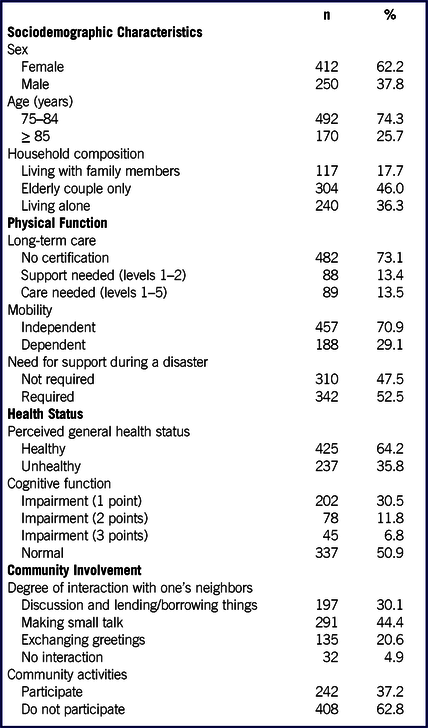
The characteristics of the subjects are shown in Table 1. The mean age of subjects was 82.0 years (SD, 4.8), and 62.2% were women. The percentage of households with older adults only and no family members of a younger generation was 82.3%. The percentage of people receiving medical treatment was 87.8%, and that with impaired cognitive function was 49.1%, but the percentage of those who required support or care was 26.9%. The percentage of people who regularly talked with neighbors was 74.5%.
Subject Characteristics (n = 662)

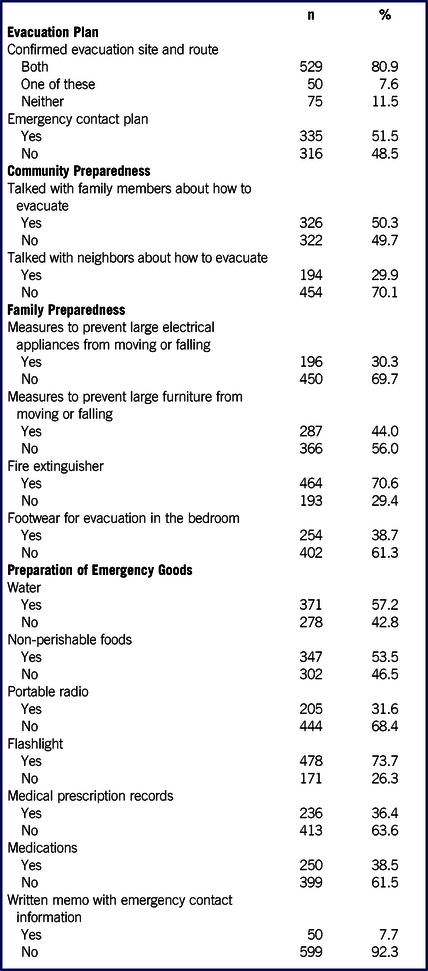
The disaster preparedness of the study subjects is shown in Table 2. The percentage of subjects who had confirmed their evacuation site and route was 80.9%, but the percentages of subjects who had taken measures to prevent large electrical appliances and furniture from falling were 30.3% and 44.0%, respectively. About half of the subjects had not prepared drinking water and non-perishable foods, whereas the percentages of those who had prepared medications and prescription records were 38.5% and 36.4%, respectively.
Disaster Preparedness of the Subjects (n = 662)

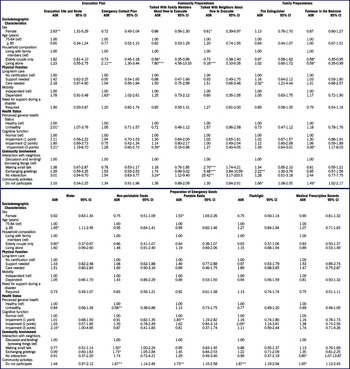
The results of logistic regression analysis to predict disaster preparedness are shown in Table 3. Only the results of preparedness variables that were significant in the regression model are shown. The characteristics related to disaster preparedness were sex, age, family composition, long-term care, mobility, perceived general health, cognitive function, level of interaction with neighbors, and participation in community activities. Some of these characteristics were related to more than 1 of the following preparations.
Associations Between Subject Characteristics and Emergency Preparedness Based on Multivariable Logistic Regression Analysis (n = 662)

AOR = adjusted odds ratio; CI = confidence interval.
*P < 0.05; **P < 0.01; ***P < 0.001.
As demographic variables, preparations significantly related to being female were confirmation of evacuation site and route (adjusted odds ratio [AOR] 2.63, 95% CI: 1.31-5.29), talking with neighbors about how to evacuate (AOR 0.61, 95% CI: 0.39-0.97), and having a portable radio ready for use (AOR 1.53, 95% CI: 1.03-2.26). Preparations that were significantly related to households consisting of an elderly couple only, in comparison with households in which older adults lived with other family members, were talking with family about how to evacuate (AOR 0.58, 95% CI: 0.35-0.96) and having footwear (AOR 0.58, 95% CI: 0.35-0.95) and drinking water (AOR 0.60, 95% CI: 0.37-0.97) ready for use. Preparations that were significantly related to living alone compared to living with family were emergency contact plans (AOR 2.11, 95% CI: 1.30-3.44), talking with family about how to evacuate (AOR 7.80, 95% CI: 4.56-13.33), talking with neighbors about how to evacuate (AOR 0.18, 95% CI: 0.10-0.35), and having footwear ready for use (AOR 0.59, 95% CI: 0.35-0.99).
Among health status factors, cognitive function was related to multiple preparations. Preparations significantly related to cognitive impairment (1–3 points) in comparison with normal cognitive function were confirmation of evacuation site and route, talking with family about how to evacuate, and having footwear, water, a portable radio, and a flashlight ready for use. The effects of cognitive impairment varied depending on the type of preparation.
Regarding interaction with neighbors, preparations significantly related to little interaction, in comparison to those who consulted with neighbors and lent/borrowed things, were talking with family and neighbors about how to evacuate, having a fire extinguisher and non-perishable foods ready for use, and prescription records. This effect was larger the less interaction people had with their neighbors. In community activities, preparations significantly related to no participation were fire extinguisher (AOR 1.66, 95% CI: 1.08-2.55), footwear (AOR 1.49, 95% CI: 1.02-2.17), non-perishable foods (AOR 1.67, 95% CI: 1.14-2.45), portable radio (AOR 1.73, 95% CI: 1.15-2.58), flashlight (AOR 1.87, 95% CI: 1.19-2.94), and prescription records (AOR 1.65, 95% CI: 1.12-2.43).
DISCUSSION
Characteristics That Affected the Disaster Preparedness of the Subjects
Even though they lived in a depopulating and aging region with a high risk of earthquake disaster, there was a high likelihood that the present study subjects had not talked with family or neighbors about how to evacuate and had made insufficient preparations to ensure a safe home. Thus, the possibility of suffering damage was thought to be very high. In addition, more than half had not planned emergency contacts with family and had not sufficiently prepared emergency goods. Thus, it was thought that life after evacuating would be difficult for these people.
In older adults, underlying diseases worsen when medications and medical technologies are discontinued, and the morbidity and fatality rate risks increase.Reference Oriol32,Reference Mokdad, Mensah and Posner33 The subjects would have insufficient medicines and drug information during a disaster, and it is expected that drugs could not be provided quickly; therefore, the possibility of health problems occurring is extremely high. From the above, persons requiring special care who are ages 75 years and older and living in regions at high risk for earthquake disaster are thought to have great vulnerability during disasters.
The possibility was shown that women, people living alone, and people with cognitive dysfunction cannot make multiple preparations. The reasons for this are thought to be as follows. In looking at the effects of gender, social roles and values are reflected in gender differences of preparatory behaviors toward risk.Reference Finucane, Slovic and Mertz34 Traditional attitudes toward gender role divisions remain in Japan, and, in traditional role awareness, the man is always the center in the family with the woman positioned in a supporting role.Reference Sweeting, Bhaskar and Benzeval35 The role awareness of Japanese women in disaster control is low, as is understood from the Japanese Cabinet Office’s efforts to educate people on the participation of women in disaster prevention measures.
Effects of household composition are thought to include that people living alone do not receive support from family members who are living far away, and do not talk with them about emergency plan contacts and how to evacuate. However, 75.5% of our study subjects living alone had built relationships with neighbors with whom they could make small talk, and they could depend on neighbors during difficulties. For that reason, it is thought that they were probably also able to talk with neighbors about how to evacuate.
Decreased cognitive function causes decreases in the ability to judge situations and in the cognitive ability toward risk, and invites inadequate behaviors during disasters.Reference Sakauye, Streim and Kennedy36,Reference Akanuma, Nakamura and Meguro37 Half of the study subjects had cognitive impairment, which is thought to be reflected in their insufficient preparation. With greater concurrent memory impairment, disorientation, and executive dysfunction, the risk increases compared to people with normal cognitive function, and it is thought that preparations could not be made by those people themselves. Among the subjects with cognitive impairment, 63.1% lived with their spouse or other family members, and it is thought that they were able to consult their family and talk about how to evacuate.
Preparedness Measures for Persons Requiring Special Care Ages 75 Years and Older
For effective disaster measures, supporters need to understand where people are and what kinds of risks and needs they have, with attention to demographic changes in the community and to identify the health information of those people.Reference Donner and Rodríguez38,Reference Gibson and Hayunga39 Community supporters can implement efficient and effective disaster measures by focusing on the possibility that, among persons requiring special care who are ages 75 years and older, preparations are more likely to be insufficient in people with the characteristics of being female, living alone, and having cognitive impairment, as well as understanding their characteristics and preparation needs.
The possibility was shown that greater interaction with people in the community facilitates preparation. Preparations were greater in people with close neighborhood relationships and who participated in community activities than in those who did not. With deeper communication in the community through social interaction, knowledge of preparedness measures and evacuation strategies is provided by community members. This is thought to heighten subjects’ awareness of disaster prevention so that they carry out preparations. A difference was seen between the sexes in talking with neighbors about how to evacuate, but 70% of the subjects talked with neighbors regularly, and Japanese women are more likely than men to build neighborhood relationships, which is thought to be why preparations could be made.40
Community engagement is crucial in reducing disaster damage and recovering effectively. Community members need to acquire knowledge about disasters, and make and practice contingency plans for emergencies to ready themselves for disasters.Reference Adhikari, Mishra and Raut41 The elements of community engagement that can promote this community readiness have been reported. They are involving community stakeholders and government offices and ensuring that local human resources can take action. Other elements are surveying the socioeconomic status of the region and adapting the approach to suit the needs of the community.Reference Adhikari, Pell and Phommasone42 Thus, for community involvement that facilitates preparedness measures for persons requiring special care ages 75 years and older, the first step is formation of community groups consisting of community supporters, family members, and neighbors. Community group members then need to understand the characteristics of persons requiring special care in relation to insufficient preparations and acquire knowledge about disasters, and prepare emergency contingency plans corresponding to community needs. Government offices also need to be involved so that the community can continue to play a central role in implementing disaster mitigation measures. This kind of community participation-type approach needs to be widely promulgated for disaster control.
Limitations
The strengths of this study are that the subjects were a group at high risk of disaster fatality, that the characteristics affecting multiple kinds of disaster preparedness were shown, and that specialists in gerontological nursing conducted the interviews and obtained highly reliable responses. However, there were also several limitations.
First, while the study results may be applicable to persons requiring special care who are ages 75 years and older in coastal regions where populations are declining and aging, based on the care status and mobility of the subjects, there is a possibility that the results show the characteristics of people who are relatively independent in activities in daily living. In the future, research attention will need to be directed to subject selection. Second, only 5.5% of the survey subjects in this study were under 75 years old. Hence, the difficulty of making comparisons with people under the age of 75 was a study limitation. Third, it is expected that, as older adults are affected by declining physical function over time, they may no longer be able to make disaster preparations. However, this was a cross-sectional study and causal relationships in how decreased physical function over time affect preparedness could not be elucidated. Finally, older adults are more susceptible to the effects of disasters because of low financial reserves,Reference Thompson, Norris and Hanacek43 and the effect of that on disaster preparedness was not analyzed. A deeper study is needed.
CONCLUSIONS
Persons requiring special care who are ages 75 years and older and live in regions with a high risk of earthquake disaster had insufficient disaster preparedness and great vulnerability during disasters. Being female, living alone, and having cognitive impairment were factors that led to decreased disaster preparedness. On the other hand, it seemed that close human interactions in the community facilitated preparedness. It is necessary to form communities with strong ties among members and facilitate preparedness in persons requiring special care who are 75 years and older. That may lead to heightened community disaster resilience.
Funding
This study was supported by funding from Chubu Electric Power Co., Inc.
Acknowledgments
The authors thank all of the elderly who participated in this study.
Conflict of Interest Statement
The authors have no conflicts of interest to declare.
Author Contributions
YH, TI, MH, and MT contributed to the conception and design of this study. MH, AK, and YH contributed to the acquisition of the data. YH analyzed the data and prepared the manuscript. MT and TI critically reviewed the manuscript and supervised the whole study process. All authors read and approved the final article.