Introduction
Birds are good indicators of environmental quality (Eeva et al. Reference Eeva, Raivikko, Espín, Sánchez-Virosta, Ruuskanen and Sorvari2020, Liang et al. Reference Liang, Rudik, Zou, Johnston, Rodewald and Klin2020). The degree to which their environment is disturbed by plastic waste can be measured by their presence, both in nesting and foraging areas (Blettler et al. Reference Blettler, Gauna, Andréault, Abrial, Lorenzón and Espinola2020, Ibañez et al. Reference Ibañez, Morales, Torres, Borghello, Haidr and Montalti2020). Plastics have been reported in nests, and their abundance may be influenced by their availability in the environment (Grant et al. Reference Grant, Lavers, Stuckenbrock, Sharp and Bond2018, Jagiello et al. Reference Jagiello, Dylewski, Winiarska, Zolnierowicz and Tobolka2018, Yorio et al. Reference Yorio, Suárez, Ibarra, Gonzales, Canti, Kasinsky and Marinao2022). These can entangle both adults and chicks, sometimes with fatal outcomes (Votier et al. Reference Votier, Archibald, Morgan and Morgan2011, Witteveen et al. Reference Witteveen, Brown and Ryan2017). In addition, birds can ingest plastics through their confusing them with regular prey (Henry et al. Reference Henry, Wey and Balança2011, Savoca et al. Reference Savoca, Wohlfeil, Ebeler and Nevitt2016). Although ingested plastic waste can be expelled through regurgitation and defecation (Bessa et al. Reference Bessa, Ratcliffe, Otero, Sobral, Marques and Waluda2019, Bond et al. Reference Bond, Hutton and Lavers2021), some hard items can cause the obstruction or perforation of the gastrointestinal tract (e.g., Senko et al. Reference Senko, Nelms, Reavis, Witherington, Godley and Wallace2020). Plastic waste spans a wide range of sizes and shapes, from millimetre-sized to large, and recently has come to include single-use discarded objects such as personal protective equipment (Rossi et al. Reference Rossi, Scherer and Petry2019, Neto et al. Reference Neto, Gomes Bantel, Browning, Della Fina, Albuquerque Ballabio and Teles de Santana2021).
A total of 282 bird species around the world (2.6% of all bird species) have been reported to interact with plastic waste (i.e., entanglement, ingestion and addition of plastic waste to nests; Ryan Reference Ryan2018, Battisti et al. Reference Battisti, Staffieri, Poeta, Sorace, Luiselli and Amori2019, Jagiello et al. Reference Jagiello, Dylewski, Tobolka and Aguirre2019, Kühn & van Franeker Reference Kühn and van Franeker2020, Billerman et al. Reference Billerman, Keeney, Rodewald and Schulenberg2022). Many other bird species probably interact with plastics, but the available records are limited. Recent studies have increased knowledge in this regard (e.g., Blettler & Mitchell Reference Blettler and Mitchell2021, Bond et al. Reference Bond, Hutton and Lavers2021, Nam et al. Reference Nam, Kim, Hong and Kwon2021), but gaps remain regarding potential benefits, adaptations for the use of these materials (repel ectoparasites, avoid conflict with other birds) and physiological and toxicological impact (e.g., reduction of blood calcium and genotoxicity), with there being limited existing research, especially in developing countries (Suárez-Rodríguez & Garcia Reference Suárez-Rodríguez and Garcia2014, Jagiello et al. Reference Jagiello, Dylewski, Tobolka and Aguirre2019, Lavers et al. Reference Lavers, Hutton and Bond2019, Malizia & Monmany-Garzia Reference Malizia and Monmany-Garzia2019, Blettler & Mitchell Reference Blettler and Mitchell2021).
Peru currently has 1889 recorded bird species, which places it second in the world in terms of bird species richness after Colombia (Remsen et al. Reference Remsen, Areta, Bonaccorso, Claramunt, Jaramillo and Lane2022). It also has 117 endemic species and life zones that are important resting and feeding sites during the journeys of migratory birds, as well as for resident species (Senner & Angulo Reference Senner and Angulo2014, SERFOR 2018, Remsen et al. Reference Remsen, Areta, Bonaccorso, Claramunt, Jaramillo and Lane2022). Birds in Peru face different threats such as deforestation, illegal trade bycatch and the introduction of exotic species such as rats and cats, amongst others (SERFOR 2018). Plastics are currently considered a new and increasing threat that can affect bird survivorship and reproduction (Ryan Reference Ryan2018, Battisti et al. Reference Battisti, Staffieri, Poeta, Sorace, Luiselli and Amori2019). However, in Peru, bird interactions with plastic waste have been scarcely reported, so attention being given to this issue is required.
Social networks and citizen science websites are ideal for data collection (Siriwat et al. Reference Siriwat, Nekaris and Nijman2019, Sánchez-Clavijo et al. Reference Sánchez-Clavijo, Martínez-Callejas, Acevedo-Charry, Diaz-Pulido, Gómez-Valencia and Ocampo-Peñuela2021). Furthermore, they can be valuable sources of inventories and information regarding the impacts of plastic waste on wild populations (Abreo et al. Reference Abreo, Thompson, Arabejo and Superio2019, Coram et al. Reference Coram, Abreo, Ellis and Thompson2021, Hiemstra et al. Reference Hiemstra, Rambonnet, Gravendeel and Schilthuizen2021, Ammendolia et al. Reference Ammendolia, Saturno, Bond, O’Hanlon, Masden, James and Jacobs2022). Researchers can access records of impacted species across a wide range of locations through digital means that previously would have been restricted by distances and limited resources (Abreo et al. Reference Abreo, Thompson, Arabejo and Superio2019, Coram et al. Reference Coram, Abreo, Ellis and Thompson2021). In this sense, our goal is to bridge the knowledge gap and to inventory Peruvian birds interacting with plastic waste through photographic records of researchers and civil society published on Facebook™, documented personal communications, citizen science databases such as iNaturalist and Macaulay Library and the authors’ own records. We specifically sought to provide a baseline study for future research.
Materials and methods
To assess the interaction of birds with plastic waste, we searched different sources of records that included: (1) a social network platform (Facebook); (2) citizen science databases (Macaulay Library, iNaturalist); (3) personal communications with researchers and/or bird enthusiasts; and (4) published studies in peer-reviewed journals and grey literature.
Record collection began on 6 January 2020 and extended through 10 September 2021.
On Facebook, we used keywords in Spanish through the general search engine. Photographs were searched using the word strings ‘nest and garbage’, ‘entanglements and birds’, ‘plastics and birds’, ‘plastics and nests’, ‘birds and solid waste’, ‘birds and waste ingestion’ and ‘necropsy and plastics in birds’. When a photograph of interest was found, the author of the image was contacted and we requested permission to include it in the study. We also reviewed and made announcements in social media groups dedicated to ornithology and wildlife in general (Supplementary Table S1). We posted announcements on social media networks, which led to other researchers, bird enthusiasts and general public helping us to contact others and ask them to submit their records.
In Macaulay Library, we used the English filters ‘nest building’, ‘foraging or eating’, ‘habitat’, ‘nest’, ‘eggs’ and ‘dead’. For iNaturalist, the Spanish keywords ‘garbage’, ‘plastic pollution’, ‘waste’, ‘entanglement’, ‘synthetic fibres’, ‘necropsies’, ‘nests’, ‘plastic’ and ‘debris’ to locate these reports.
A third way to obtain records was through email messages to researchers and/or bird enthusiasts asking for unpublished records.
Finally, an exhaustive review of reports on birds and their interactions with plastic waste in Peru was carried out using Scopus, Google Scholar and other websites. The keywords used were ‘plastic waste in Peruvian birds’ accompanied by ‘ingestion’, ‘entanglement’, ‘nest’ and ‘capture and handling’. Information was retrieved from scientific articles, conference proceedings and reports from governmental institutions.
For the taxonomic nomenclature and status of birds in Peru (resident or visitor), the version of the South American Classification Committee (SACC) of 6 June 2022 was used. Species were also classified according to their global conservation status (International Union for Conservation of Nature), their distribution and type of foraging habitat (BirdLife International and Handbook of the Birds of the World, 2019; Supplementary Table S2).
Plastic waste was classified into categories using an adapted methodology based on Tavares et al. (Reference Tavares, de Moura, Merico and Siciliano2017) with modifications: 1 = hard plastics (e.g., fragments), 2 = soft plastics (e.g., bags and tapes), 3 = monofilaments, 4 = ropes and nets, 5 = rubber/latex and 6 = textiles (e.g., fibres or clothing remnants).
Results
Four types of interactions were identified: (1) ingested plastics; (2) entanglement; (3) plastic waste as nesting material; and (4) capture and handling of plastics. We found a total of 119 interactions in 79 photographs. These involved 39 species in 20 families and 9 orders. Of all species, 95% (n = 37) were continental, both inland and coastal, and two species were oceanic (Thalassarche melanophris and Hydrobates hornbyi). The species with the most interactions was Phalacrocorax gaimardi at 25% (n = 30), followed by Phalacrocorax brasilianus at 24% (n = 29) and Larus dominicanus, Larus belcheri, Pyrocephalus rubinus, Campylorhynchus fasciatus and Spheniscus humboldti at 3% (n = 4) of records each (Fig. 1). Of these and other species with fewer records, S. humboldti is listed as Vulnerable, Sternula lorata as Endangered and H. hornbyi, Larosterna inca, Pelecanus thagus, Phalacrocorax bougainvillii and P. gaimardi as Near Threatened (Table S2). Most (87%) of the recorded species (n = 34) had a wide distribution range. Only 10% (n = 4) of the species are found in Peru and Chile (i.e., S. humboldti, P. thagus and L. belcheri) or Peru and Ecuador (i.e., Campylorhynchus fasciatus). In addition, one endemic species for Peru was reported (Cinclodes taczanowskii; Table S2).
Frequency of interactions (capture and handling: grey; entanglement: red; ingestion: light blue; nest: yellow) with plastic waste by bird species in Peru.

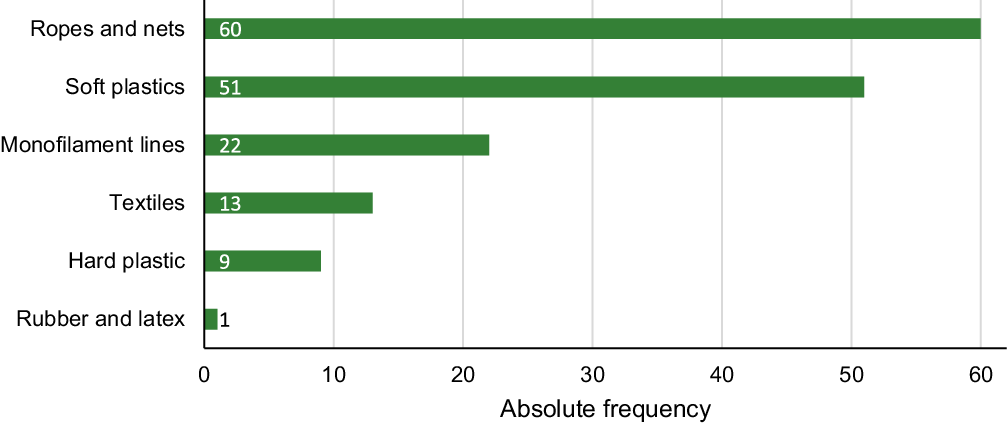
Plastic waste in nests accounted for 59% (n = 70) of the interactions, entanglement accounted for 24% (n = 29), capture and handling accounted for 14% (n = 17) and ingestion accounted for 3% (n = 3). Some evidence of these interactions is provided (Fig. 2 & Supplementary Fig. S1). Nets and ropes were the most frequent waste type (60 interactions, 38%) followed by soft plastics (51 interactions, 33%; Fig. 3 & Supplementary Fig. S2). Plastic waste detected in the nests consisted of mainly bags, ropes and nets. Ropes and nets were most common in entanglement interactions (62%), soft plastics in capture and handling interactions (72%) and hard plastics, soft plastics, monofilaments and textiles in ingestion interactions, with 25% for each item (Supplementary Fig. S2).
Photographs illustrating the four types of interactions between birds and plastics in Peru: (a) residues in nests (credit: Jhonson K. Vizcarra); (b) entanglement (credit: Jhonson K. Vizcarra); (c) capture and handling (credit: Juan Urquiaga); and (d) ingestion (credit: Karla Alfaro).

Frequency of plastic waste categories identified in interactions with birds: ropes and nets; soft plastics (e.g., bags and polypropylene tapes); monofilament lines (e.g., nylon); textiles (e.g., fibres); hard plastics (e.g., fragments, toys, lighters); and latex and rubber.

Records of birds and interactions with plastic waste by department in Peru are shown in Supplementary Fig. S3.
Discussion
In this study, we take advantage of the information available on social networks to evaluate the interactions of birds with plastic waste in Peru. We found that 48 bird species have interacted with plastic waste, and 23 of these had not been previously described as interacting with plastic waste.
Plastic waste in nests
Our records indicate that birds mostly use soft (e.g., plastic bags) and resistant materials (e.g., tapes, nets, ropes and monofilaments) with insulating and waterproof capacities in their nests. Birds have been reported to use plastic waste to indicate signaller dominance (Sergio et al. Reference Sergio, Blas, Blanco, Tanferna, López and Lemus2011), as parasite repellents (Suaréz-Rodríguez et al. Reference Suárez-Rodríguez, López-Rull and Garcia2013) or to strengthen the structures of their nests (Antczak et al. Reference Antczak, Hromada, Czechowski, Tabor, Zablocki and Grzybek2010). We found that this interaction was mostly intentional (i.e., birds carried plastics to their nests by themselves), while a low proportion was accidental (Supplementary Fig. S1).
P. brasilianus and P. gaimardi presented the highest numbers of records of plastic waste in nests. The genus Phalacrocorax in Chile uses plastic waste due to its availability in the environment (García-Cegarra et al. Reference Garcia-Cegarra, Ramirez and Orrego2020), and it has shown a preference for certain colours of plastic waste – notably white, green and black – for nest construction (García-Cegarra et al. Reference Garcia-Cegarra, Ramirez and Orrego2020). Future studies are needed to determine whether there is a colour preference in Peruvian birds, given that the colours of plastics may indicate individual preferences for satisfying demands linked to mating and/or defence (Sergio et al. Reference Sergio, Blas, Blanco, Tanferna, López and Lemus2011, Canal et al. Reference Canal, Mulero-Pázmány, Negro and Sergio2016). Such preferences may also be related to the supply and availability of these colours in the environment (Sergio et al. Reference Sergio, Blas, Blanco, Tanferna, López and Lemus2011, Canal et al. Reference Canal, Mulero-Pázmány, Negro and Sergio2016, Brentano et al. Reference Brentano, Brum, Montone and Petry2020). A limitation in our study is that there is a low number of records per species and nests were not available for evaluation.
On the other hand, the costs of using plastic nesting materials may increase their attraction to predators because of the highly visibility of these materials (Møller Reference Møller2017) and increase their risk of entanglement with these nesting materials (Witteveen et al. Reference Witteveen, Brown and Ryan2017). Plastic additives may also put bird welfare at risk (Suárez-Rodríguez et al. Reference Suárez-Rodríguez, López-Rull and Garcia2013).
The records included in this category may reflect the ease with which citizen scientists can detect plastics primarily because they are conspicuous and because they remain in the same place for a long time. Therefore, the increased frequency of sightings of this interaction should be interpreted with caution.
Entanglement
Effects of entanglement often include broken limbs, strangulation, decreased flight and, ultimately, death (Seacor et al. Reference Seacor, Ostovar and Restani2014, Townsend & Barker Reference Townsend and Barker2014). In our study, of the 14 species recorded having experienced entanglement, Numenius phaeopus and L. belcheri showed plastic residue on their legs causing limb amputations (Supplementary Fig. S1). In addition, 12 individuals of P. gaimardi were found dead in the middle of fishing gear on a beach in the coastal city of Tacna in southern Peru. Two individuals of T. melanophris on a beach in Tacna and Bartramia longicauda near Iquitos (Peruvian Amazon) were found dead in fishing gear and were also included.
Studies focused on seabirds agree that entanglements are caused mostly by lines and nets discarded by fisheries (Ryan Reference Ryan2018, Battisti et al. Reference Battisti, Staffieri, Poeta, Sorace, Luiselli and Amori2019, Kühn & van Franeker Reference Kühn and van Franeker2020). For inland birds, entanglements are caused by their interaction with a variety of artefacts such as threads, ropes, twines, monofilaments, bags and nets (Houston & Scott Reference Houston and Scott2006, Seacor et al. Reference Seacor, Ostovar and Restani2014, Townsend & Baker Reference Townsend and Barker2014, Blettler & Mitchell Reference Blettler and Mitchell2021). In our study, it was nets, ropes and bags that mainly entangled the birds (Supplementary Fig. S1). However, we are not certain as to whether these interactions were due to ghost fishing, bycatch or post-mortem entanglement.
Previous studies in different parts of the world have found that adults as well as nestlings are affected by entanglement (Houston & Scott Reference Houston and Scott2006, Votier et al. Reference Votier, Archibald, Morgan and Morgan2011). In our study, we found no records of entangled chicks; however, this could be due to our methodological limitations (e.g., not having inspected the nests themselves).
There are fewer studies documenting land and freshwater bird interactions with plastic debris in South America (Blettler & Mitchell Reference Blettler and Mitchell2021) compared to seabird studies (Ryan Reference Ryan2018). Collaborative efforts among researchers to study terrestrial ecosystems are thus necessary.
Capture and handling
The capture and handling of plastics, especially in terrestrial species, has been rarely reported (Blettler & Mitchell Reference Blettler and Mitchell2021). As reported here, this interaction could be related to the presence of organic waste (Torres-Mura et al. Reference Torres-Mura, Lemus and Hertel2015, Witteveen et al. Reference Witteveen, Brown and Ryan2017) or food (Savoca et al. Reference Savoca, Wohlfeil, Ebeler and Nevitt2016).
We found that birds moved or pecked at plastic waste for different purposes. For example, Nycticorax nycticorax and Plegadis ridgwayi manipulated the plastics to find and extract their food under the waste (Supplementary Fig. S1). Other species, such as L. dominicanus and L. belcheri, manipulated the plastics in search of human food remains inside them. Gallinula galeata and Arenaria interpres were also observed apparently removing microorganisms attached to the plastic. Some species handled plastics very briefly, apparently out of curiosity, as in Paroaria coronata (plastic balloon), Haematopus palliatus (ropes and bags), S. lorata (cigarettes) and Phalcoboenus megalopterus (degraded plastic bags). One individual of Sicalis olivascens was observed apparently carrying plastic bands to its nest (Supplementary Fig. S1).
Ingestion
Two Humboldt penguins (S. humboldti) were necropsied, and plastic fragments and a sock were found obstructing their gastrointestinal cavities. Another species also affected by plastic ingestion was Hornby’s storm petrel (H. hornbyi), represented by one individual who had regurgitated a piece of a plastic bag. In the present study, ingestion represented a low percentage of the interactions (3%); this could be due to our methodological limitation, even though plastic ingestion by birds has been frequently reported by scientists worldwide (Battisti et al. Reference Battisti, Staffieri, Poeta, Sorace, Luiselli and Amori2019, Rossi et al. Reference Rossi, Scherer and Petry2019, Flemming et al. Reference Flemming, Lanctot, Price, Mallory, Kühn and Drever2022).
To evaluate the ingestion of plastics, it is necessary to have access to stomach contents (Rossi et al. Reference Rossi, Scherer and Petry2019), faecal samples (Bessa et al. Reference Bessa, Ratcliffe, Otero, Sobral, Marques and Waluda2019) and regurgitates or pellets (Uhart et al. Reference Uhart, Gallo and Pereira Serafini2020). To collect these types of samples, it is necessary to go into the field to conduct scheduled sampling and then to perform laboratory analyses. It may be that the complexity process is what has led to the scarcity of such reports.
Conclusion
We recognize the preliminary nature of our work and its limitations in terms of the search for information, as well as the bias of the records by species. However, these records demonstrate clear evidence that birds interact with plastic waste. In countries such as Peru, which has one of the highest levels of bird biodiversity worldwide, plastic waste pollution has not been adequately reported. We recommend more detailed studies are conducted on birds in Peru, and we recommend the implementation of public environmental awareness techniques to reduce waste generation.
Supplementary material
To view supplementary material for this article, please visit https://doi.org/10.1017/S037689292300005X.
Acknowledgments
We thank Shirley Freyre, Doris Choquehuanca, Frank Suarez, Nataly Hidalgo, Luz Gavancho, Juan Chalco, Cesar Ortiz, Raul Perez, Ken Simonite, Marco Begazo, Willy Nizama, Mauricio Ugarte, Teresa Avalo, Francisco Cavero, Peter Colasanti, Enver Ortiz, Karla Alfaro, Saori Grillo, Christian Quispe, Walter Wust, Diego Nishiyama, Juan Urquiaga and the Circulo Estudiantil Veterinario de Fauna Silvestre – Universidad Nacional Pedro Ruiz Gallo for providing the photographs of the interactions. CC-M thanks Pacific Plastics: Science to Solutions Project. Special thanks are given to Liliana Ayala and Nataly Hidalgo for their suggestions and comments that helped to improve the manuscript. We also thank the peer reviewers and the editor for their valuable recommendations.
Financial support
None.
Competing interests
The authors declare none.
Ethical standards
None.