1. Introduction
The frequency of large-scale natural disasters, including earthquakes, typhoons, and floods, has increased globally, posing severe risks to public health and food security.1, 2
Among these disasters, earthquakes represent one of the most devastating threats, disrupting infrastructure and essential services such as food supply and health care systems. Japan, situated in a seismically active region, has developed various disaster preparedness strategies, including disaster meal provision manuals aimed at maintaining food security in emergency situations.Reference Nozue, Ishikawa-Takata and Sarukura3, 4
Ensuring adequate food provision during disasters is particularly crucial for vulnerable populations, such as infants, children, pregnant women, the elderly, and individuals with chronic health conditions. Research has indicated that food insecurity during disasters exacerbates malnutrition, leading to long-term health consequences.Reference Datar, Liu and Linnemayr5, Reference Weaver and Hadley6
For instance, infants and young children are particularly at risk, and several studies on their feeding during emergencies have been published.Reference Seal, McGrath and Seal7-Reference Gribble, Peterson and Brown10 Moreover, Japan’s aging population, which crossed the threshold of 14% aged 65 and older in 1994, is projected to reach close to 30% by 2020, a demographic shift occurring before that of other nations.Reference Okamoto and Komamura11 As a result, the Ministry of Health, Labour and Welfare (MHLW) requires meal service providers to prepare a disaster preparedness system, for instance, stockpiling foodstuffs and organizing response methods, to meet these vulnerable populations’ specific dietary needs according to nutritional management standards and to prepare for disasters and crises outside the norm.12
However, disaster preparedness varies considerably across meal service facilities, according to type of institution, facility size, and the local government’s extent of involvement in emergency planning.Reference Udagawa and Tanaka13 Hospitals and welfare institutions are especially critical because they serve populations with limited mobility and/or severe health conditions, making continuous meal service vital. Under adverse conditions, these institutions must ensure not only the availability of food but also the appropriateness and quality of emergency meals. Disruption of food supply chains after past disasters underscores the need for a systematic approach to securing and distributing emergency food supplies.Reference Jagtap, Trollman and Trollman14, 15
Despite the importance of disaster meal provision manuals, limited research has examined the key factors influencing their development within food service facilities. Understanding these factors can provide valuable insights for improving disaster preparedness not only in Japan but also in other earthquake-prone regions worldwide, such as Indonesia, Chile, and the United States’ West Coast.
This study assessed the disaster preparedness capabilities of meal service facilities in earthquake-prone regions of Japan. There are concerns about the occurrence of large-scale earthquakes in the Tokai region, including Mie Prefecture, and the government’s Seismological Research Commission has indicated that the probability of a large Nankai Trough earthquake of magnitude 8-9 occurring within 30 years is “around 80%.”16 Given these risks, understanding the current state of disaster preparedness in food service facilities is essential for enhancing emergency food security.
This study aims to identify the key predictors of disaster meal provision manual development in food service facilities by analyzing facility characteristics, preparedness measures, and policy awareness. The findings contribute to the broader discourse on disaster nutrition preparedness and inform strategies for enhancing emergency food security on a global scale.
2. Materials and methods
2.1. Study Population
This study targeted the entire population of 1,464 notified food service facilities in Mie Prefecture as a census-style survey. The inclusion criteria encompassed all facilities that had submitted a notification to the Mie Prefectural Government under the Health Promotion Act. The questionnaires were distributed via an online system, and the response period was from 1 to 31 October 2022. Because the study aimed to capture the current status of the total population within the prefecture, a specific sample size calculation for statistical power was not performed. Of the total population, facilities that did not respond to the survey (n = 598) were excluded from the final analysis, resulting in a final sample of 866 facilities (response rate: 59.2%).
2.2. Measurements
The study examined target facilities’ characteristics, including facility type, administrative district, and method of operation. Facility types were classified as schools (including elementary schools and kindergartens), hospitals (hospitals, geriatric health care facilities, and long-term care medical homes), welfare facilities (for elder care, child welfare, and social welfare facilities), and business establishments (including offices and dormitories), based on categories outlined in the MHLW’s Report on Public Health Administration and Services. 17 According to Mie Prefecture’s district designations, administrative districts were divided into the following regions: Hokusei (Kuwana, Yokkaichi, and Suzuka), Chūnansei (Tsu and Matsusaka), Ise-Shima (Ise), Iga (Iga), and East Kishu (Owase and Kumano).18 Food service management methods were classified as either managed directly or outsourced.
2.2.1. Disaster-meal-provision manual
For this study, facilities with a disaster-meal-provision manual prepared by either the facility or its outsourced contractor were categorized as the “Yes” or “No” group according to whether the facility had a manual or not.
2.2.2. Registered dietitians and dietitians
In compliance with Japan’s Dietitians Act,19 dietitians are classified as registered dietitians and dietitians. For this study, facilities were categorized into the “Yes” or “No” group according to whether the facility employed either a registered dietician or a dietician, or not.
2.2.3. Disaster preparedness training and drills
Facilities were further categorized into the “Yes” or “No” group according to whether the facility conducted training and drills for meal provision during disasters or not.
2.2.4. Disaster management council
Responding facilities were divided into the “Yes” or “No” group according to whether the facility had established a disaster management council or not.
2.3. Balanced, Stockpiled Food Prepared
The survey did not specify daily quantities of stockpiled food, making it difficult to accurately assess the amount available. Consequently, whether facilities’ stockpiled food met established nutritional standards remains unclear. Despite this, we evaluated stockpiled food’s status based on target nutritional standards,20 examples of food composition for planning and assessing food supplies in shelters,Reference Tsuboyama-Kasaoka, Hoshi and Onodera21 and previous studies on food and nutrition provision following the Great East Japan Earthquake. In this study,Reference Hirouchi, Tanaka and Shimada22 we defined “Balanced stockpiled food prepared” as emergency food accessible for facility residents, including at least three days’ drinking water, staple foods, main dishes, and side dishes.
2.4. Mie Prefecture Disaster Nutrition and Dietary Support Activities Guidelines
In April 2020, Mie Prefecture published on its website the Mie Prefecture Disaster Nutrition and Dietary Support Activities Guidelines (2nd edition).23 Prepared as a guide for food service and other facilities preparing manuals, these guidelines contain nutrition and dietary support activities for various situations. Facilities aware of these guidelines or familiar with their content were classified as “aware” or as “unaware” if they were not.
2.5. Statistical Analyses
Finally, responding facilities were divided into those with and without a disaster-meal-provision manual and compared according to whether they had the 4 attributes: (1) a registered dietitian/dietitian, (2) disaster meetings/drills/training, (3) a disaster management council, and (4) a balanced stockpile of meals. Chi-square tests were used for statistical analysis, and logistic regression analyses were conducted according to the presence or absence of the four attributes as dependent variables. A disaster-meal-provision manual’s presence or absence was the independent variable, and analysis was conducted in Model 1 without introducing any adjustment variables to obtain odds ratios (ORs) and 95% confidence intervals (CIs). Binomial logistic regression analyses were conducted with the dependent variables, respectively, all with “no” as the reference category. Furthermore, in Models 2 and 3, based on the attributes’ possible influence and the Mie Prefecture Nutrition and Dietary Guidelines for Disaster Preparedness on registered dietitians and dietitians, disaster meetings/drills/training, and balanced stockpiled food, analyses were conducted using forced entry methods, with each attribute as an adjustment variable in Model 2. In addition to the four attributes, Model 3 was analyzed using the forced entry method with the Mie Prefecture Disaster Nutrition and Dietary Balance Guide as an adjustment variable.
All statistical analyses used JMP 9.0.2 (SAS Institute Inc., Cary, NC, USA).
Regarding the management of incomplete data, facilities with missing values in any of the variables included in the logistic regression analysis were excluded from the final statistical models (listwise deletion).
2.6. Ethical Considerations
This study utilized publicly available secondary data from the “Questionnaire Survey on Disaster Meal Provision at Meal Service Facilities,” conducted by the Health Promotion Division of the Mie Prefectural Medical and Health Department in October 2022. Permission to use the data was obtained by submitting a data usage application to the Mie Prefectural Government. Since the data were anonymized and did not include personally identifiable information, ethical approval and individual participant consent were not required, in accordance with the Ethical Guidelines for Medical and Health Research Involving Human Subjects established by the Japanese Ministry of Health, Labour and Welfare.Reference Labour and Welfare24
3. Results
3.1 Facility Attributes
Of Mie Prefecture’s notified facilities (1464), the 866 (59.2%) that responded were included for analysis: 51.3% were welfare facilities; 39.4% were in the Hokusei region; and 50.4% were directly managed.
3.2 Disaster-Meal-Provision Manual
Of the responding facilities, 507 (58.5%) reported having a manual prepared by the facility itself or by a contractor; 359 (41.5%) reported not having one.
3.3. Comparison of Facility Characteristics According to the Presence of Disaster-Meal-Provision Manuals
Table 1 shows the results of the attributes’ χ-square test comparison, that is, the Mie Prefecture Guidelines, registered dietitian/dietician, disaster meetings/drills/trainings, and balanced stockpiled food of facilities with and without disaster-meal-provision manuals. For the attributes, significant differences were found in facility type (P < 0.001), administrative district (P < 0.001), and method of operation (P < 0.001). More than half of the disaster-meal-provision manual were welfare facilities and facilities outsourcing their operation. Significant differences were also found for registered dietitians/dietitians, disaster meetings/drills/trainings, and balanced stockpiles of food (each P < 0.001). No differences were found in the Mie Prefecture Nutrition and Dietary Support Guidelines.
Attributes, dietitian establishment of disaster management meetings and training and preparing stockpiles of food according to whether or not a disaster meals manual has been prepared

Table 1. Long description
Starting from the top, the table has six columns. The first column lists attributes such as facility classification, administrative districts, operational method, dietitian presence, disaster management council establishment, disaster drills, and balanced food stockpiles. The second column details categories within each attribute, for example, under facility classification: school, hospital, welfare facility, office. The next three columns show counts and percentages for all facilities (n equals 866), those with a disaster meal provision manual (n equals 507), and those without (n equals 359). The last column provides p-values for statistical significance where applicable. For facility classification, schools are 26.6 percent overall, 8.3 percent with a manual, and 52.4 percent without; hospitals are 15.8 percent overall, 24.7 percent with, and 3.3 percent without; welfare facilities are 51.3 percent overall, 61.7 percent with, and 36.5 percent without; offices are 6.4 percent overall, 5.3 percent with, and 7.8 percent without. For administrative districts, Hokusei area is 39.4 percent overall, 33.7 percent with, and 47.4 percent without; Chunansei area is 30.6 percent overall, 30.4 percent with, and 30.9 percent without; Iseshima area is 15.2 percent overall, 16.8 percent with, and 13.1 percent without; Iga area is 10.3 percent overall, 13.0 percent with, and 6.4 percent without; Higashikisyu area is 4.5 percent overall, 6.1 percent with, and 2.2 percent without. For operational method, direct management is 50.4 percent overall, 44.6 percent with, and 58.5 percent without; consignment is 49.7 percent overall, 55.4 percent with, and 41.5 percent without. For dietitian presence, yes is 67.6 percent overall, 81.4 percent with, and 48.2 percent without; no is 32.4 percent overall, 18.6 percent with, and 51.8 percent without. For disaster management council establishment, yes is 58.0 percent overall, 65.3 percent with, and 47.3 percent without; no is 42.0 percent overall, 34.7 percent with, and 52.4 percent without. For conducting disaster drills, yes is 43.8 percent overall, 51.9 percent with, and 32.3 percent without; no is 56.2 percent overall, 48.1 percent with, and 67.7 percent without. For preparing balanced stockpiles of food, yes is 31.0 percent overall, 44.6 percent with, and 11.7 percent without; no is 69.1 percent overall, 55.4 percent with, and 88.3 percent without. Statistically significant differences (p less than 0.001) are noted for several attributes. Footnotes clarify facility and district definitions.
n (%), chi-squared test
a Facility types: schools (including elementary schools and kindergartens), hospitals (comprising hospitals, geriatric health care facilities, and long-term care medical homes), welfare facilities (encompassing elder care, child welfare, and social welfare facilities), and business establishments (including offices and dormitories).
b Administrative districts: Hokusei region (Kuwana, Yokkaichi, and Suzuka), the Chūnansei region (Tsu and Matsusaka), the Ise-Shima region (Ise), the Iga region (Iga), and the East Kishu region (Owase and Kumano).
3.4. Factors Involved in Preparation of a Disaster-Meal-Provision Manual Using Logistic Regression Analysis
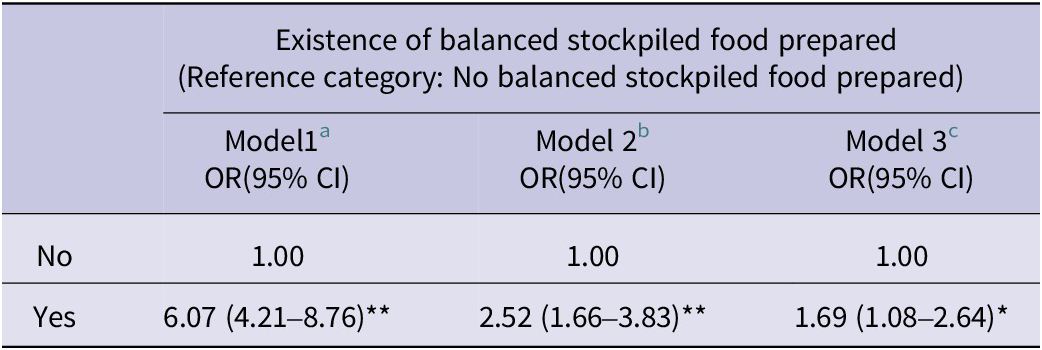
Tables 2 and 3 show results of a logistic regression analysis (forced entry method) with Registered Dietitians/Dietitians, disaster meetings/drills, and balanced stockpiles of food as dependent variables and, as the independent variable, whether a disaster-meal-provision manual has been prepared. The presence, respectively, of registered dietitians/dietitians [Model 1: 4.70 (3.46-6.38), Model 2: 2.82 (1.95-4.08), Model 3: 2.54 (1.72-3.74)], disaster meetings [Model 1: 2.07 (1.57-2.73), Model 2: 2.33 (2.63-3.33), Model 3: 1.69 (1.15-2.46)], disaster drills [Model 1: 2.26 (1.70-2.99), Model 2: 3.15 (2.18-4.57), Model 3: 2.65 (1.79-3.94)], and balanced food stockpiles [Model 1: 2.26 (1.70-2.99), Model 2: 3.15 (2.18-4.57), Model 3: 2.65 (1.79-3.94)] was associated with higher odds of having a disaster-meal-provision manual in Models 1, 2, and 3 (95% CI).
Logistic regression analysis of the development of a manual for providing meals during disasters and its relationship with registered dietitians and dietitians, and the establishment and training of disaster management meetings

Table 2. Long description
The table is structured in three main sections, each analyzing the relationship between the existence of a disaster meal provision manual and a different variable group. Each section contains a header row naming the variable group, followed by two rows labeled ‘No’ and ‘Yes’, with three columns for Model 1, Model 2, and Model 3. The first section is ‘Existence of registered dietitian/dietitian’ with ‘No’ as the reference group (odds ratio 1.00 for all models). For ‘Yes’, Model 1 shows odds ratio 4.70 (95 percent CI 3.46 to 6.38) double asterisk, Model 2 is 2.82 (1.95 to 4.08) double asterisk, Model 3 is 2.54 (1.72 to 3.74) double asterisk. The second section is ‘Existence of Disaster Management Council’ with ‘No’ as reference (1.00 for all models). For ‘Yes’, Model 1 is 2.07 (1.57 to 2.73) double asterisk, Model 2 is 2.33 (1.63 to 3.33) double asterisk, Model 3 is 1.69 (1.15 to 2.46) single asterisk. The third section is ‘Existence of Disaster Preparedness Training’ with ‘No’ as reference (1.00 for all models). For ‘Yes’, Model 1 is 2.26 (1.70 to 2.99) double asterisk, Model 2 is 3.15 (2.18 to 4.57) double asterisk, Model 3 is 2.65 (1.79 to 3.94) double asterisk. Model footnotes explain the adjustment variables for each model. Odds ratios are labeled as OR, double asterisk indicates P less than 0.001, single asterisk indicates P less than 0.05.
a Model with registered dietitian/dietitian and disaster management meeting establishment/training as dependent variables and the existence of a disaster meal provision manual as independent variables.
b A model in which registered dietitians/dietitians and the establishment and training of disaster management meetings are dependent variables, the existence of a disaster meal provision manual is an independent variable, and attributes (facility type, administrative district, and method of operation) are all simultaneously entered as adjustment variables.
c Model with registered dietitians/dietitians and disaster management meeting establishment/training as dependent variables and the existence of a disaster meal provision manual as an independent variable, in addition to attributes (facility type, administrative district, and method of operation), with registered dietitians/dietitians and disaster management meeting establishment/training as adjustment variables, all entered simultaneously.
OR: Odds rate, *P < 0.05, **P < 0.001.
Logistic regression analysis of the relationship between the preparation of a disaster meal provision manual and the preparation of a balanced stockpile of food

Table 3. Long description
The table consists of two rows labeled ‘No’ and ‘Yes’ for the preparation of a disaster meal provision manual. Three columns display odds ratios and 95 percent confidence intervals for balanced stockpiled food prepared: Model 1 shows 1.00 for ‘No’ and 6.07 (4.21–8.76) double asterisk for ‘Yes’; Model 2 shows 1.00 for ‘No’ and 2.52 (1.66–3.83) double asterisk for ‘Yes’; Model 3 shows 1.00 for ‘No’ and 1.69 (1.08–2.64) single asterisk for ‘Yes’. Footnotes clarify model adjustments: Model 1 uses only the existence of a manual as an independent variable; Model 2 adjusts for facility type, district, and operation method; Model 3 further adjusts for institution type, district, operation, dietitians, and disaster management meetings or training. Odds rate is abbreviated as O R. Double asterisk indicates P less than 0.001, single asterisk indicates P less than 0.05.
a Model with balanced stockpiled food prepared as dependent variable and the existence of a disaster meal provision manual as independent variable.
b A model in which balanced stockpiled food prepared is a dependent variable, the existence of a disaster meal provision manual is an independent variable, and attributes (type of facility, administrative district, and method of operation) are all simultaneously entered as adjustment variables.
c A model in which the dependent variable is the preparation of balanced stockpiled food and the independent variable is the existence of a disaster meal provision manual, with attributes (type of institution, administrative district, and type of operation), registered dietitians/dietitians, and disaster management meetings/training as adjustment variables, all entered simultaneously.
OR: Odds rate, *P < 0.05, **P < 0.001.
4. Discussion
This study examined factors influencing the development of disaster meal provision manuals in meal service facilities located in earthquake-prone regions of Japan. The results indicate that the presence of registered dietitians, the implementation of disaster preparedness drills and meetings, and the maintenance of well-balanced emergency food stockpiles are significant predictors of whether a facility has established a disaster meal provision manual.
The association between the presence of dietitians and the existence of disaster-meal manuals highlights these professionals’ critical role in ensuring food safety and nutritional adequacy during emergencies. Yamada et al. identified several issues in municipal disaster preparedness, including insufficient food stockpiles, absence of clear guidelines on required food stock quantities in disaster plans, and lack of a system that involves registered dietitians in food relief distribution.Reference Yamada, Sudo and Tsuboyama-Kasaoka25 Furthermore, similar nationwide studies on municipalities have reported that those with full-time dietitians show better disaster preparedness and stronger collaboration with relevant disaster-related departments.Reference Kubo, Ohara and Enshouiwa26 In addition, Harada et al. found that dietitians’ involvement in meal provision during disasters contributed to improved nutritional balance in provided meals.Reference Harada, Takizawa and Oka27 Thus, registered dietitians’ involvement not only enhances adequate food stockpiles and nutritional balance during disasters but also plays a crucial role in establishing a support system that considers vulnerable populations’ specific nutritional needs. With dietitians on site, facilities can better stockpile relief foods that address the specific needs of infants, children, pregnant women, older adults, and individuals with chronic illnesses—groups often at high risk during disasters,Reference Ito, Tsuboyama-Kasaoka and Nakatani28-30 thus contributing to development of effective disaster-meal-provision manuals that can address special dietary requirements, ultimately strengthening disaster preparedness systems’ quality and effectiveness.
The study also found that disaster preparedness training and meetings were strongly associated with the presence of a disaster-meal-provision manual. Facilities engaged in such preparatory activities are likely to have heightened awareness of logistical challenges, for instance, food shortages and supply chain disruptions that often arise during emergencies. Becky Dorner’s Emergency/Disaster Plan for Food and Dining Services provides crucial guidelines for managing meal services during crises,Reference Dorner31 highlighting that regular disaster response meetings and training sessions significantly strengthen staff readiness. This approach helps staff develop enhanced logistical skills and enables them to effectively address issues of food supply and distribution during emergencies. Engagement in structured preparedness activities, as outlined in Dorner’s manual,Reference Dorner31 ultimately strengthens a facility’s ability to maintain food service operations under emergency conditions. Similarly, findings from this study support the notion that a disaster-meal-provision manual closely relates to proactive disaster preparedness efforts—such as training and meetings—that, in turn, enhance a facility’s ability to respond effectively when crises arise. This relationship underscores proactive participation’s importance in disaster preparedness as a means of bolstering facilities’ operational resilience. The findings also align with global recommendations that advocate for structured disaster preparedness training and strategic food stockpiling to mitigate food insecurity during crises.
In addition, balanced stockpiling of emergency food supplies has emerged as a critical factor in predicting the development of disaster-meal-provision manuals, highlighting nutritional quality’s importance in emergency planning. Balanced food provision not only meets vulnerable populations’ caloric needs but also provides essential nutrients for maintaining health during prolonged emergencies. In Japan, the MHLW has established, especially for disaster situations, nutritional guidelines that include Target Nutritional Reference Values for Meal Planning and Assessment in Shelters, which aim to secure the necessary nutrient intake for up to three months after a disaster.32 To prevent nutritional deficiencies and lifestyle-related diseases during extended shelter stays, these guidelines (hereafter, Reference Values) have also been set for three months.33 However, only 43.0% of municipalities responsible for direct food support to disaster survivors reported awareness of the Reference Values,Reference Sudo, Matsumoto and Tsuboyama-Kasaoka34 suggesting that they might not often be used as a basis for selecting stockpiled foods.Reference Sato, Sudo and Takeda35, Reference Sudo, Shimada and Tsuboyama-Kasaoka36 While this study does not confirm whether the Reference Values are fully met, the establishment of disaster-meal-provision manuals was related to the preparedness of balanced stockpiled foods, possibly influencing these foods’ selection. Certainly, future research should examine how disaster-meal-provision manuals align with the Reference Values.
The findings also align with global recommendations that advocate for structured disaster preparedness training and strategic food stockpiling to mitigate food insecurity during crises.37-39 While this study focused on Japan, its implications extend beyond national borders. Other earthquake-prone regions, such as Indonesia and Chile, face similar challenges in ensuring emergency food provision. By integrating trained nutrition professionals into disaster preparedness frameworks and adopting structured food stockpiling policies, governments and institutions can enhance their disaster resilience and ensure that emergency food supplies meet the diverse nutritional needs of affected populations. Strengthening these measures on a global scale will contribute to more effective disaster response systems and improved food security in crisis situations.
Despite these positive findings, this study has some limitations. Its cross-sectional design limits drawing causal inferences about relationships between facility characteristics and disaster-meal-provision manual development. Furthermore, data are based on self-reported surveys that might introduce bias according to how facilities perceive their preparedness. Future studies should consider longitudinal designs to examine changes in disaster preparedness over time and use objective measures to assess disaster-meal manuals’ quality and implementation.
5. Conclusion
This study underscores the critical factors influencing disaster meal provision manual development in food service facilities within earthquake-prone areas. The presence of registered dietitians, implementation of disaster preparedness training, and maintenance of balanced emergency food stockpiles significantly contribute to the establishment of such manuals. Policymakers should consider these findings to strengthen disaster preparedness measures not only in Japan but also in other disaster-prone regions globally. Future research should explore longitudinal approaches to assess the long-term impact of these preparedness measures on food security and public health outcomes during disasters.
Acknowledgment
The authors thank all participants of this study. The authors used Notebook LM to assist in the manuscript revision process, specifically for interpreting reviewer comments, drafting the response and cover letters, and refining English expressions in the revised Methods and Reference sections. The authors reviewed and edited the AI-generated content as needed and take full responsibility for the final content of the published work.
Author contribution
MO, AA, and HO designed the study. MO and HO conducted the experimental work. MO, AA, and HO analyzed the data, prepared the figure, and drafted the manuscript. All authors participated in data interpretation and revised the manuscript. The final version of the manuscript was approved by all authors.
Funding statement
The authors have not disclosed any funding.
Competing interests
None.
Ethics declarations
This study was a secondary analysis of anonymized data obtained from the “Questionnaire Survey on Disaster Meal Provision at Meal Service Facilities” conducted by the Health Promotion Division of the Mie Prefectural Medical and Health Department in October 2022.