Introduction
Consumption of rice, Oryza sativa L. (Poaceae), is growing rapidly in sub-Saharan Africa (WARDA, 2005), with consumption outstripping production in many countries (Williams et al., Reference Williams, Ukwungwu, Singh and Okhidievbie2001; Kormawa et al., Reference Kormawa, Keya and Toure2004; Mohapatra, Reference Mohapatra2006; Omoloye and Vidal, Reference Omoloye and Vidal2007; WARDA, 2008). The rice production deficit in Nigeria is attributed mainly to low rice yields due to insect pest infestation (WARDA, 2007).
The African rice gall midge (AfRGM) Orseolia oryzivora Harris and Gagné (Diptera: Cecidomyiidae) is the most serious insect pest of lowland and irrigated rice (Williams et al., Reference Williams, Okhidievbie, Harris and Ukwungwu1999; Ogah et al., Reference Ogah, Echezona and Umeh2005, Reference Ogah, Nwilene, Ukwungwu, Omoloye and Agunbiade2009; Nwilene et al., Reference Nwilene, Nwanze and Okhidievbie2006). Indigenous to Africa, the insect's status has changed during the last two decades from a minor to a major pest, and in several countries in Africa, it causes perennial economic damage to rice (Nacro et al., Reference Nacro, Heinrichs and Dakouo1996; Singh et al., Reference Singh, Williams, Ukwungwu, Maji, Bennett, Bentur, Pasalu and Krishnaiah2004). Since its major outbreak in Nigeria in 1988, O. oryzivora's pest status has been on the increase in all ecologies of the country (Ukwungwu and Misari, Reference Ukwungwu and Misari1997). Losses caused by this pest have reached 100% in some areas (Imolehin and Ukwungwu, Reference Imolehin and Ukwungwu1992).
Orseolia oryzivora attacks the vegetative stage of rice. Attacked tillers are irreversibly damaged and do not produce any panicles. Control measures adopted so far have not given the desired results. This failure could be attributed to poor knowledge of the biology of O. oryzivora's complete life history and environmental factors that influence its population growth rate and distribution, knowledge that is requisite for selecting or developing suitable pest control techniques (Janssen and Sabelis, Reference Janssen and Sabelis1992; Baskauf, Reference Baskauf2003; Murua et al., Reference Murua, Molina-Ochoa and Coviella2006).
The study reported here was conducted with the objectives of generating additional information on the biology of O. oryzivora and the influence of environmental factors on its abundance during the rice-growing season in Nigeria.
Materials and methods
Experimental site/materials
Laboratory and screenhouse experiments were conducted at the Africa Rice Center (WARDA)/International Institute for Tropical Agriculture in Ibadan, Nigeria. Field experiments were done in Ogidiga in southeastern Nigeria and Edozhigi in central Nigeria, where regular outbreaks of O. oryzivora have been recorded since the late 1980s. The two areas are in different agroecological zones, with different climatic patterns. Ogidiga (06° 17′N, 08° 04′E) is within the forest-savannah transition agroecological zone 104.40 m above sea level (masl), while Edozhigi (09° 45′N, 06° 07′E) is within the Guinea savannah agroecological zone 50.57 masl. Rainfall is bimodal in both the areas, with an average annual rainfall of about 1800–2200 mm and 900–1050 mm in Ogidiga and Edozhigi, respectively, distributed between May and October. Average daily temperature ranges from 20 to 35 °C, with an annual mean of 26.5 and 27.4 °C, respectively, for the two localities. Mean relative humidity (RH) ranges from 64 to 83% and 52 to 73%, respectively. The soils are Utisols and Alfisols, and are of slightly acidic pHs of 4.5–4.9 and 5.5–6.3 for Ogidiga and Edozhigi, respectively.
Stock culture
An O. oryzivora stock culture was established in the screenhouse on ITA 306, a susceptible rice variety. Seedlings were raised in seed boxes and placed in an oviposition cage.
Galled rice tillers were obtained from experimental fields and transplanted into seed boxes. These were kept in an oviposition cage and were later transferred into the emergence cages in the screenhouse. Following emergence, 1-day-old mated O. oryzivora females were selected and introduced for oviposition on the ITA 306 seedlings, 20 females per seed box. Thereafter, the seedlings were sprayed with water at 2 h intervals between 06.00 and 18.00 h local time daily for 3 days to facilitate the entry of the O. oryzivora larvae into the rice culms. The seedlings were then transferred to the screenhouse until galls started to appear, after which they were transferred back into the emergence cages. Emerging adults were collected into glass vials between 08.00 and 09.00 h local time daily, and were used to infest fresh batches of the susceptible seedlings. This cycle maintained a continuous clean and healthy stock culture of O. oryzivora.
Developmental biology
The developmental processes of O. oryzivora were studied in seedlings of rice variety ITA 306 under ambient temperature and RH, with natural light providing a photoperiod of approximately 15 h light–9 h dark. Ten newly emerged, mated females collected from the stock culture were introduced individually onto caged rice seedlings. Each cage containing about 300 seedlings represented a replicate, giving ten replicates. After 24 h, the midges were transferred to similar cages with fresh seedlings. This transfer continued until the third day, the maximum longevity period of mated females of O. oryzivora. Thereafter, the seedlings were examined for midge eggs using a hand lens.
Leaves with eggs were transferred into moist Petri dishes and were taken to the laboratory for hatching. The eggs were observed in the morning and evening for hatching, following which larvae were transferred individually onto young (14-day-old) rice seedlings. Since O. oryzivora larvae develop inside rice galls, each day ten rice seedlings containing midge larvae were dissected using a binocular dissecting microscope. Developing O. oryzivora larvae were extracted from the galls, killed in 60% ethanol and immediately measured under a microscope. Their morphological characteristics were also observed and measured. The remaining infested seedlings in the cage were kept in the screenhouse until the emergence of adult O. oryzivora, and total developmental period was calculated. All eggs, larvae, pupae and emerged adults of O. oryzivora were measured using an Olympus SH-ZT stereo binocular microscope fitted with an ocular micrometer.
Male and female developmental periods were computed and compared, and adult longevity was estimated based on the observation of 100 individuals (56 females and 44 males).
Reproductive biology
Pre-oviposition time and parthenogenic reproduction in O. oryzivora were assessed using ten mated and ten unmated newly emerged females, replicated five times. Unmated midges were obtained by keeping infested galls individually in cages and separating male and female adults immediately following emergence. Mated or unmated female midges were introduced onto caged rice seedlings for 24 h. Thereafter, each female was transferred to similar rice seedlings for 24 h durations for a total of 72 h. The rice seedlings were maintained until the progeny of mated females had emerged and died. Longevity, pattern of oviposition and sex of progeny of the two groups were recorded. Potential fecundity was assessed by dissecting ten newly emerged females from the screenhouse experiments and by counting the eggs in their ovaries.
Mating
Fifty newly emerged females were enclosed in a 14 cm diameter Petri dish with a single 1-day-old male, and mating was observed under magnification for 1 h.
Seasonal field incidence
Most rice-growing areas in Nigeria are rainfed, which permits only one rice crop per year, cultivated during the rainy season. All field studies were done in farmers' rainfed rice fields at Ogidiga and Edozhigi, in six fields per location during the 2006 and 2007 wet seasons.
The area planted with lowland rice at the two locations averaged 0.5 ha, with planting staggered from May to August of each season. At Ogidiga, farmers planted mostly improved varieties such as Cisadane, a popular gall midge-tolerant variety released as FARO 51 in Nigeria. At Edozhigi, an O. oryzivora susceptible variety, ITA 306 (also known as FARO 37) was popular. Insecticides were not applied on any of the fields sampled.
Sampling for O. oryzivora infestation was done at 2-week intervals at both the locations from June to November of 2006 and 2007. By December, all the rice fields were dry and showed no sign of new infestation by O. oryzivora. Some fields were sampled twice and others once depending on the growth stage of the rice at the time of sampling. For each field and sampling period, 50 rice hills were selected randomly at 6 m intervals along parallel transects, which were adjusted to give good coverage of the field sampled. The incidence of O. oryzivora was calculated as % tiller infestation. Temperature, RH and rainfall data were collected weekly from a network weather station from each zone.
Statistical analysis
An arcsine transformation was done on incidence data (% tiller infestation) prior to analysis of variance (SAS Institute, 2002–2003). Mean separation was done using Tukey's studentized range test (P = 0.05). Pearson's regression coefficient (r) was used to determine the relationship between % tiller infestation and climatic factors.
Results
The life history of O. oryzivora consists of an egg stage, three larval stages and pre-pupal, pupal and adult stages. The entire life cycle of O. oryzivora was completed within 21–24 days under ambient temperature and RH in screenhouse conditions.
Egg stage
Eggs were laid mostly singly and rarely in batches of 3–5 eggs, by both mated and unmated females.
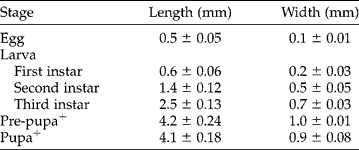
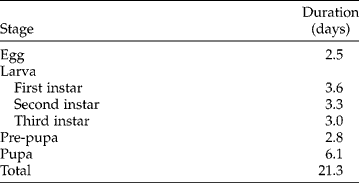
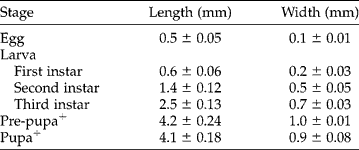
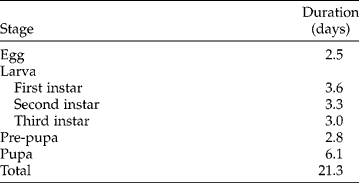
The eggs were laid mainly on the inner and outer surfaces of the leaf sheath, just above and below the ligules (53%) and on the upper and lower surfaces of the leaf blade (44%). A few eggs (3%) were laid on the auricles, in a posterior-to-anterior end chain. Approximately, 389 eggs were laid per mated female. Eggs measured 0.5 mm in length and 0.1 mm flat in width on average (Table 1). All freshly laid eggs were elongated and colourless, but those from mated females gradually changed colour to pale pink, pale orange and finally red before hatching. The egg developmental period took on average 2.5 days (Table 2). Eggs from the unmated females remained transparent and did not undergo further development or hatch. Three days after being deposited, viable eggs from mated females had hatched, with an egg hatch rate of about 70%. Eggs appeared to require high RH for optimum development.
Sizes of the immature stages of Orseolia oryzivora (means±SE)
+ Head capsule widths.
Developmental duration of immature stages of Orseolia oryzivora at 25±2 °C and at 65±3% RH
Larval stage
Orseolia oryzivora larvae were at first greyish-white and fairly stout with a pointed anterior, and then became more elongated and pinkish. Upon emergence, first instars worked their way into the rice plant's bud, where development took place. The first, second and third instars took 3.6, 3.3 and 3.0 days, respectively. The larval widths and lengths are given in Table 1. The characteristic features of the first instars were a segmented body, a black spot on the third segment, one pair of open spiracles in the eighth abdominal segment and a brownish spot on the head region. The second instar had a head spot split into two comma-shaped sections. The third instar had nine pairs of spiracles and a crown-shaped sternal spatula.
Larvae fed on the shoot bud, inducing characteristic hollow leaf galls. Galls were formed from 16 to 18 days after hatching. Gall length varied between screenhouse and field experiments. The immature stage found on dissection at the first appearance of galls varied with environmental conditions – larvae were found under favourable conditions, and pupae under unfavourable ones.
Pre-pupal stage
The pre-pupal stage averaged 2.8 days between cessation of feeding and the transformation to a pupa. The mature pre-pupae were initially white and then pale orange, with three body segments discernible. Pre-pupae were on average 4.2 mm long and 0.98 mm wide.
Pupal stage
Pupae were first pink, and then brownish, and were 4.1 mm long and 0.9 mm wide on average. The pupal stage took an average of 6.1 days to emergence. At the end of this period, the pupae moved up the gall, and upon adult emerge, the pupal case remained in the gall's emergence hole.
Adult stage
Orseolia oryzivora adults are nocturnal. Adult males generally emerge earlier in the evening (between 18.00 and 20.00 h) than females (between 20.00 and 24.00 h). The sexes can easily be distinguished at the adult stage: the male is slender and about 3 mm long, with a yellowish-brown body, whereas the female is thicker, with a 4 mm long body with a bright red abdomen. The male's antenna has 23 segments, whereas the female's antenna has only 13. Females lived for 48–78 h and the males for just 24–30 h.
Reproductive biology
During mating, which took place immediately after emergence and lasted on average 1.5 min, the male and female faced opposite directions. A male mated with 2–4 females, but females mated only once.
Pattern of oviposition by mated and unmated females
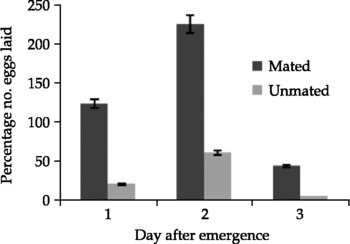
The oviposition cycles of both mated and unmated females of O. oryzivora were similar, peaking 24 h after emergence (Fig. 1). On average, mated females laid a total of 389 eggs, while unmated ones laid 87 eggs. Dissections made following the death of unmated females showed that their ovaries contained, on average, 297 eggs. This was in contrast with the mated females, most of which at death contained no eggs in their ovaries, or in a few cases, contained just 5–14 eggs.
Pattern of oviposition by mated and unmated females of Orseolia oryzivora

Potential fecundity and sex ratio
Dissection of the ovaries of newly emerged females showed that their two ovaries were filled with, on average, 389 mature eggs. Under screenhouse conditions, the insect produced unisexual progeny, i.e. a female produced either all-female or all-male progeny, with an overall sex ratio of one male to three females.
Seasonal incidence in the field
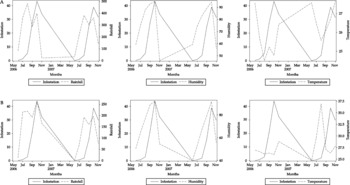
Abundance of O. oryzivora varied significantly by season among the sampled years and sites. Generally, incidence was low during the initial stage of the wet season in both sites. At Edozhigi, in the moist savannah zone, which has a longer dry season and less rain than Ogidiga, lower O. oryzivora incidence was recorded throughout the field studies (Fig. 2).
Effect of rainfall, RH and temperature on the incidence of Orseolia oryzivora at Ogidiga (A) and Edozhigi (B), Nigeria during 2006/2007 seasons

At the beginning of the wet season in June, only a few O. oryzivora galls were found at Edozhigi. The trend continued until the end of July, following which field infestation increased rapidly, reaching its peak in October in both 2006 and 2007 (Fig. 2). The period of high infestation was observed to coincide with heavy and prolonged rains, cloudy weather and high RH. Towards the end of the wet season in November, O. oryzivora incidence fell rapidly.
At Ogidiga in the savannah forest transition zone, the incidence of O. oryzivora showed the same trend as that observed at Edozhigi. It was low at the beginning of the wet season, but gradually built up to peak in October (Fig. 2).
At both the sites, field infestation was greater in the 2006 growing season, which had heavier and more prolonged rainfall, lower temperatures and higher RH than in the 2007 growing season.
Discussion
This article describes the complete life history of O. oryzivora and environmental factors affecting its field occurrence. Previous publications on the insect's biology have not provided a detailed account of its developmental morphometrics and behaviour of immature stages or its reproductive anatomy, especially for females (Omoloye et al., Reference Omoloye, Odebiyi, Williams and Singh2002). This limitation has probably been due to the nature of this pest as an internal stem feeder, a characteristic of Cecidomyiidae gall midges (Omoloye and Fadina, Reference Omoloye and Fadina2003).
Working with the Asian rice gall midge, Huang (Reference Huang1957) reported a 63–67% egg hatch, which is similar to our findings. A previous study of this pest indicated that a mated female parent, whether from a natural (wild) or screenhouse population, produced one single sex F1 progeny in her lifetime (Omoloye, Reference Omoloye2006), indicating monogeny in O. oryzivora. This is in agreement with the work carried out by Sain and Kalode (Reference Sain and Kolade1988) on Asian species, which found that the rice gall midge showed a karyological sexual dimorphism. In the metaphase ganglionic cells of larvae, there are six chromosomes that generate males and eight chromosomes that generate females. This would suggest that continuous rearing of this insect would lead to inbreeding, resulting in the predominance of females and subsequently a decline in population. Recent studies have shown that the sex of progeny is affected by the presence of a bacterium, Wolbachia sp. (Saliu, personal communication).
Orseolia oryzivora is generally very rare at the beginning of the wet season, but its population builds up during the rains. This could be attributed to the high water requirements of newly hatched larvae. Reviewing the influence of climatic conditions on O. oryzivora, Heinrichs and Barrion (Reference Heinrichs, Barrion and Hettel2004) mentioned abnormally wet weather as a factor contributing to heavy infestation. In addition, rice plants at the susceptible vegetative stage are abundant in the rainy season, providing ample food supply for the larvae. Bonzi (Reference Bonzi1980) stated that midge activity in Burkina Faso, in general, starts in August and is comparatively higher in years when rainfall exceeds 1500 mm during May.
Our study also showed that the peak of infestation occurred between August and October of each growing season, which coincides with the period of high RH. This suggests that alteration of the planting period according to climatic factors could affect the incidence of O. oryzivora. Ogah et al. (Reference Ogah, Echezona and Umeh2005) have suggested that delayed sowing may reduce the incidence of O. oryzivora in southeastern Nigeria, by reducing the period during which rice plants are available for infestation by the midge. Ogah et al. (Reference Ogah, Umeh and Oselebe2006) studied the effect of time of transplanting and spacing on the incidence of O. oryzivora, and found that earlier and regular rains accelerated the incidence. That study also found that the incidence of O. oryzivora decreased with an increase in temperature, corroborating the relationship observed between infestation and seasonal factors in the present study.
Conclusion
The complete life cycle of O. oryzivora takes 21–24 days. Its incidence in the field is dependent on environmental factors, including rainfall, humidity and temperature. Increased rainfall not only results in a more humid environment, but also accelerates the insect's development, with infestation peaking during the vegetative stage of the crop. Therefore climatic factors should be considered in developing control strategies for the gall midge.
Acknowledgements
We thank the farmers at Edozhigi and Ogidiga who allowed us to use their farms for data collection. We are also grateful to Mr Nte Nwafor and Mr Bayo Kehinde for providing technical assistance.