Borderline personality disorder (BPD) is characterized by an enduring “pattern of instability in interpersonal relationships, self-image, and affects, and marked impulsivity” (American Psychiatric Association, APA, 2013, p. 645). BPD is estimated to affect 1.6% to 5.9% of the general population and about 10% of individuals seen in outpatient settings and 20% of individuals seen in inpatient settings (APA, 2013). Prevalence estimates in childhood and adolescence are not clearly defined, because BPD is not well studied in this age group. Bernstein et al. (Reference Bernstein, Cohen, Velez, Schwab-Stone, Siever and Shinsato1993) reported on the prevalence of personality disorders in a community sample of children and adolescents aged 9 to 19 years and found that 7.1% of boys and 8.5% of girls met diagnostic criteria for BPD, with 3% being severely affected by the disorder. The highest prevalence rate was reported for girls between the ages of 11 and 14 (11.5%). Chabrol, Montovany, Chouicha, Callahan, and Mullet (Reference Chabrol, Montovany, Chouicha, Callahan and Mullet2001) examined the overall frequency of BPD in French students aged 13–20 and found that 10% of boys and 18% of girls met diagnostic criteria for BPD. The peak frequency for girls and boys was 14 years of age. In a recent study comparing prevalence rates between American adults (n = 34,653) and English 11-year-olds (n = 6,330), Zanarini et al. (Reference Zanarini, Horwood, Wolke, Waylen, Fitzmaurice and Grant2011) reported that more adults (5.9%) than children (3.2%) met diagnostic criteria for BPD. The symptom rates between adults and children were similar for feelings of emptiness, self-injurious behavior, and experiencing stormy relationships. However, more children than adults reported being angry and moody, whereas more adults than children reported being paranoid/dissociated, having identity disturbances that were serious in nature, being impulsive, and making frantic efforts to avoid abandonment (p. 607).
BPD is a debilitating, serious mental health disorder that is associated with pronounced health care usage and high mortality rates owing to suicide (see Lieb, Zanarini, Schmahl, Linehan, & Bohus, Reference Lieb, Zanarini, Schmahl, Linehan and Bohus2004). Accordingly, early identification of BPD risk is imperative. Given that the presentation of BPD manifests in troubled social relationships, the present study questioned whether symptoms of BPD in adolescence could be reliably predicted by knowing about other stable markers of early relationship dysfunction, namely, physical (e.g., hitting) and relational (e.g., spreading rumors or peer group exclusion) aggression in childhood. Most studies examining mental health predictors of BPD have tended to focus on one-to-one connections between internalizing or externalizing problems in predicting BPD features in youth or BPD in adults. The common use of unidirectional models in studies examining early developmental patterns of BPD has made it difficult to consider bidirectional influences and more multifarious transactions that exist among core features of BPD and how these features influence each other over time. Thus, in this study, we consider how the central features of negative affect (i.e., symptoms of depression), childhood impulsivity (i.e., symptoms of attention-deficit/hyperactivity disorder [ADHD]), and behavioral problems (i.e., physical and relational aggression) interacted over time in predicting BPD features in adolescence.
Development and Course of BPD
There is reluctance to diagnose children and adolescents with personality disorders even though it is generally accepted that the features of personality disorders are present during childhood and, more commonly, adolescence (e.g., APA, 2013; Bernstein et al., Reference Bernstein, Cohen, Velez, Schwab-Stone, Siever and Shinsato1993; Cohen, Crawford, Johnson, & Kasen, Reference Cohen, Crawford, Johnson and Kasen2005). The developmental course of personality disorders is one that is typically marked by peak symptomology in early adolescence followed by a progressive decline into adulthood (Bernstein et al., Reference Bernstein, Cohen, Velez, Schwab-Stone, Siever and Shinsato1993; Chabrol et al., Reference Chabrol, Montovany, Chouicha, Callahan and Mullet2001; Chanen et al., Reference Chanen, Jackson, McGorry, Allot, Clarkson and Yuen2004; Johnson et al., Reference Johnson, Cohen, Kasen, Skodol, Hamagami and Brook2000). With respect to BPD in particular, DSM-5 characterizes its development and course as a pattern of chronic instability notably in early adulthood, with the greatest impairment found in the young-adult years (APA, 2013). It is likely that the improvements seen in symptomology by ages 30 and 40 are attributable to declines in impulsivity, attention-seeking behavior, and dependency (Cohen et al., Reference Cohen, Crawford, Johnson and Kasen2005).
Developmental Pathways to BPD
Several longitudinal studies examining early markers of psychopathology have linked emotional and behavioral disorders in childhood and adolescence to the emergence of personality disorders in late adolescence and early adulthood (Belsky et al., Reference Belsky, Caspi, Arseneault, Bleidorn, Fonagy and Goodman2012; Bernstein, Cohen, Skodol, Bezirganian, & Brook, Reference Bernstein, Cohen, Skodol, Bezirganian and Brook1996; Crawford, Cohen, & Brook, Reference Crawford, Cohen and Brook2001a, Reference Crawford, Cohen and Brook2001b; Helgeland, Kjelsberg, & Torgersen, Reference Helgeland, Kjelsberg and Torgersen2005; Rey, Morris-Yates, Singh, Andrews, & Stewart, Reference Rey, Morris-Yates, Singh, Andrews and Stewart1995). Specific to BPD, most longitudinal studies have focused on examining the central features of negative affect, impulsivity, and/or behavioral problems as antecedents of BPD (e.g., Belsky et al., Reference Belsky, Caspi, Arseneault, Bleidorn, Fonagy and Goodman2012). With respect to negative affect, researchers have reported strong concurrent associations between depression and BPD (Kasen, Cohen, Skodol, Johnson, & Brook, Reference Kasen, Cohen, Skodol, Johnson and Brook1999; Lewinsohn, Rohde, Seeley, & Klein, Reference Lewinsohn, Rohde, Seeley and Klein1997; Lewinsohn, Rohde, Seeley, Klein, & Gotlib, Reference Lewinsohn, Rohde, Seeley, Klein and Gotlib2000; Pepper et al., Reference Pepper, Klein, Anderson, Riso, Ouimette and Lizardi1995; Siever & Davis, Reference Siever and Davis1991). However, studies examining mood disturbances in the prediction of BPD are scarce. Lewinsohn et al. (Reference Lewinsohn, Rohde, Seeley and Klein1997) examined the prediction of elevated personality disorders scores at age 24 from psychopathology scores assessed between the ages of 14 and 18. In their study, BPD was predicted by adolescent depression. In a community sample of fourth- to sixth-grade students followed over three time points (~6-month intervals), Crick, Murray-Close, and Woods (Reference Crick, Murray-Close and Woods2005) found that symptoms of depression and borderline personality features were highly correlated at each time point and that increases in depressive symptoms were tied to increases in borderline personality features, suggesting that BPD and depressive symptoms “track” together over time. Arens, Grabe, Spitzer, and Barnow (Reference Arens, Grabe, Spitzer and Barnow2011) reported that adolescent internalizing disorders predicted the risk of BPD 5 years later. Using data from the Environmental Risk Longitudinal Twin Study, Belsky et al. (Reference Belsky, Caspi, Arseneault, Bleidorn, Fonagy and Goodman2012) found that internalizing problems at age 5 predicted elevated BPD features at age 12.
Externalizing problems have also been shown to be robust predictors of BPD, and of depression (e.g., Burt & Roisman, Reference Burt and Roisman2010; Cleverley, Szatmari, Vaillancourt, Boyle, & Lipman, Reference Cleverley, Szatmari, Vaillancourt, Boyle and Lipman2012; Moilanen, Shaw, & Maxwell, Reference Moilanen, Shaw and Maxwell2010; Vaillancourt, Brittain, McDougall, & Duku, Reference Vaillancourt, Brittain, McDougall and Duku2013), highlighting the utility of assessing these relations using a cascade model. For example, earlier work by Bernstein et al. (Reference Bernstein, Cohen, Skodol, Bezirganian and Brook1996) highlighted the role of childhood conduct problems (assessed between the ages of 1 and 10) in the emergence of adolescent personality disorders (assessed 10 years later) across all three personality disorder clusters. In their study, immaturity emerged as an independent predictor of Cluster B personality disorders,Footnote 1 but only in girls. Belsky et al. (Reference Belsky, Caspi, Arseneault, Bleidorn, Fonagy and Goodman2012) recently predicted BPD features in early adolescence (age 12) on the basis of higher impulsivity, poorer emotion self-regulation, and externalizing problems measured 7 years earlier. Similarly, Stepp, Burke, Hipwell, and Loeber (Reference Stepp, Burke, Hipwell and Loeber2012) examined the trajectories of ADHD and oppositional defiant disorder (ODD) symptoms (age 8 to 13) as precursors to BPD symptoms (age 14) in a sample of girls. Results indicated that elevated symptoms of ADHD and ODD at age 8 uniquely predicted symptoms of BPD at age 14 and that the growth in these symptoms predicted higher BPD symptoms. In another recent study, Burke and Stepp (Reference Burke and Stepp2012) examined disruptive behavior (i.e., ADHD and ODD) pathways to BPD at age 24 in a clinical sample of boys who were assessed annually from the time they were first seen at ages 7 to 12 until they were 18 years of age. Consistent with Stepp et al.'s (Reference Burke and Stepp2012) findings for nonclinical girls, ADHD and ODD were both predictive of BPD in young adult men. Helgeland et al. (Reference Helgeland, Kjelsberg and Torgersen2005) also found that adolescents diagnosed with disruptive behavior disorders were more likely to be diagnosed with BPD in adulthood (age 28).
That externalizing disorders of all types (i.e., ADHD, ODD, and conduct disorder) have been shown to be significant predictors of BPD (see Beauchaine, Klein, Crowell, Derbidge, & Gatzke-Kopp, Reference Beauchaine, Klein, Crowell, Derbidge and Gatzke-Kopp2009 for review) alludes to the importance of a common link with physical aggression (Loeber, Burke, Lahaey, Winters, & Zera, Reference Loeber, Burke, Lahey, Winters and Zera2000; Tremblay, Reference Tremblay2000). The use of physical aggression (e.g., hitting, kicking, or punching) has been shown to be normative in the preschool years with a linear decline in use noted for about 85%–90% of children (e.g., Côté, Vaillancourt, LeBlanc, Nagin, & Tremblay, Reference Côté, Vaillancourt, LeBlanc, Nagin and Tremblay2006; Nagin & Tremblay, Reference Nagin and Tremblay1999). Physical aggression is strongly correlated with relational aggression (Card, Stucky, Sawalani, & Little, Reference Card, Stucky, Sawalani and Little2008), which is more circuitous in nature, increases with age across childhood and adolescence (Miller, Vaillancourt, & Boyle, Reference Miller, Vaillancourt and Boyle2009; Murray-Close et al., Reference Murray-Close, Ostrov, Crick, Achenbach, Edelbrock and Berndt2007; Vaillancourt, Miller, Fagbemi, Côté, & Tremblay, Reference Vaillancourt, Miller, Fagbemi, Côté and Tremblay2007), and takes the form of peer group exclusion, rumor spreading, giving someone the silent treatment, and so forth (Crick, Reference Crick1996; Crick & Grotpeter, Reference Crick and Grotpeter1995). Relational aggression, like physical aggression, is strongly linked concurrently and prospectively to psychosocial maladjustment across childhood, adolescence, and adulthood, including depression and ADHD (Card et al., Reference Card, Stucky, Sawalani and Little2008; Cleverley et al., Reference Cleverley, Szatmari, Vaillancourt, Boyle and Lipman2012; Crick, Reference Crick1996; Crick, Ostrov, & Werner, Reference Crick, Ostrov and Werner2006).
According to Geiger and Crick (Reference Geiger, Crick, Ingram and Price2001), persistent high use of relational aggression may be a precursor to the development of BPD. This hypothesis is based on the observation that relational aggression and BPD share common features such as socially manipulative behavior and enmeshed tumultuous relationships. Consistent with this hypothesis, several studies have shown concurrent links between relational aggression and BPD features in children (Crick et al., Reference Crick, Murray-Close and Woods2005) and adults (Ostrov & Houston, Reference Ostrov and Houston2008; Schmeelk, Sylvers, & Lilienfeld, Reference Schmeelk, Sylvers and Lilienfeld2008; Stepp, Pilkonis, Hipwell, Loeber, Stouthamer-Loeber, Reference Stepp, Pilkonis, Hipwell, Loeber and Stouthamer-Loeber2010; Werner & Crick, Reference Werner and Crick1999), even when controlling for physical aggression.
Longitudinal studies examining the predictive links between different forms of aggression and the development of BPD are rare. To the best of our knowledge, only two studies have examined BPD features in relation to different forms of aggression using a longitudinal design. In the first study, Crick et al. (Reference Crick, Murray-Close and Woods2005) found that when physical and relational aggression were assessed together in predicting BPD features, only relational aggression emerged as a significant predictor. Moreover, Crick et al. also reported that the longitudinal links between growth in relational aggression and increased BPD features were strong: results were found even when depression was statistically accounted for. In the second study, Underwood, Beron, and Rosen (Reference Underwood, Beron and Rosen2011) examined the joint trajectories of physical and relational aggression using yearly teachers' ratings when students were in Grade 3 to Grade 7. These teacher ratings were used to predict adjustment problems at age 14 (Grade 8), which included BPD features assessed using self-reports and parent reports. Results indicated that when examining physical and relational aggression in the same model, along with gender, only high relational aggression trajectory group membership emerged as a significant predictor of BPD features.
Present Study
Crick et al. (Reference Crick, Murray-Close and Woods2005) clearly emphasized the need for future research to “disentangle the associations among relational aggression, physical aggression, and borderline personality features” (p. 1065). Close to 10 years after their initial call for more research on this topic, only one other longitudinal study has been conducted (i.e., Underwood et al., Reference Underwood, Beron and Rosen2011). Examining early predisposing traits of BPD is important because the behavior associated with this disorder is “very difficult to treat once canalized” (Beauchaine et al., Reference Beauchaine, Klein, Crowell, Derbidge and Gatzke-Kopp2009, p. 736). Examining physical and relational aggression in childhood is a good starting point because aggression shares strong links with key predisposing vulnerabilities for BPD: negative affect, impulsivity, and behavioral problems (Card et al., Reference Card, Stucky, Sawalani and Little2008; Crick & Grotpeter, Reference Crick and Grotpeter1995; Kawabata, Tseng, Murray-Close, & Crick, Reference Kawabata, Tseng, Murray-Close and Crick2012). Moreover, by assessing the role of physical and relational aggression in the emergence of BPD features in relation to disturbances in other core domains of child functioning, we get a truer idea of how these variables interact over time to confer a risk for the development of BPD.
The development of psychopathology cannot be accounted for by simple one-to-one interactions, but rather unfolds within a complex developmental system. As such, the purpose of the present study was to examine the longitudinal predictive links between physical and relational aggression and BPD features along with two established risk factors: depression and ADHD. In order to assess the interplay of these multiple factors over time in the development of BPD features, we tested developmental cascade models. Cascade models provide a way to demonstrate “the cumulative consequences for development of the many interactions and transactions occurring in developing systems that result in spreading effects across levels, among domains at the same level, and across different systems or generations” (Masten & Cicchetti, Reference Masten and Cicchetti2010, p. 491).
Based on the few studies examining different forms of aggression and BPD features in children, we expected that earlier assessments of physical and relational aggression would predict higher levels of BPD features at age 14. However, consistent with other published studies (e.g., Crick et al., Reference Crick, Murray-Close and Woods2005; Underwood et al., Reference Underwood, Beron and Rosen2011), we expected stronger predictive associations with relational aggression than physical aggression. We also expected that childhood symptoms of depression and ADHD would predict BPD features. Given that the longitudinal associations between physical and relational aggression, depression, and ADHD have not been examined simultaneously, or sequentially, we made no predictions about which of these variables would be the strongest predictor of BPF features.
Finally, BPD is primarily (75%) diagnosed in females (APA, 2013), whereas physical aggression is more commonly used by males across the life span (Card et al., Reference Card, Stucky, Sawalani and Little2008; Vaillancourt, Reference Vaillancourt2013). There is also a small but significant sex difference noted in the use of relational aggression that favors females (Card et al., Reference Card, Stucky, Sawalani and Little2008; Vaillancourt, Reference Vaillancourt2013). ADHD is also more commonly diagnosed in males than in females (APA, 2013). Given these sex differences, we examined the possible moderating effect of sex, although no specific predictions were made.
Methods
Participants
Data were drawn from the McMaster Teen Study, an ongoing study examining the relations among bullying, mental health, and academic achievement. The study began in the spring of 2008 (Grade 5, age 10; Time 1 [T1]). Data collected annually from five time points (T1 to Time 5 [T5]) were available for the present study. Participants were initially recruited from a random sample of 51 schools within a large Southern Ontario Public School Board. For a comprehensive description of the recruitment procedures, see Vaillancourt et al. (Reference Vaillancourt, Brittain, McDougall and Duku2013).
At T1, a total of 875 participants were recruited (80% participation rate) to take part in the longitudinal arm of the study. Of the recruited participants, 697 participated in at least one time point between Time 2 (T2) and T5. From this sample, 99% (n = 688; 646 students, 638 parents) participated at T1, 93% (n = 650; 602 students, 608 parents) at T2, 86% (n = 600; 549 students, 569 parents) at Time 3 (T3), 80% (n = 555; 507 students, 515 parents) at Time 4 (T4), and 75% (n = 524; 489 students, 491 parents) at T5. At each time point, children completed self-report measures about their behavior, peer experiences, and mental health functioning (described below). Parents (87% mothers) were also interviewed about their child's behavior, peer experiences, and mental health functioning at each time point. At T1, most of the parent reporters were over 40 years of age (59%), with a median household income of $70,000–$80,000, and well over half (74%) had postsecondary education. The median income for the city from which participants were recruited at T1 was $76,222 and for the province it was $70,910 (http://www.statscan.gc.ca). At T1 child participants were on average 10.91 (SD = 0.36) years of age and approximately half were girls (53%). Most children (71%) were Caucasian; the rest identified as 2% Middle Eastern Canadian, 3% African/West Indian Canadian (Black), 3% South Asian Canadian, 2% Asian Canadian, 1% Native Canadian, 1% South/Latin American Canadian, 4% other, and 12% did not know.
A subsample of participants who had reports of BPD features at age 14 (T5) was selected for the current study (n = 484). A missing data analysis was conducted comparing participants who were included in the subsample for analysis to those who were not included (n = 213). Results indicated that participants included and participants not included did not differ in terms of their levels of physical aggression, relational aggression, or depression symptoms. The two groups did differ on ADHD, with parents of nonincluded participants reporting significantly higher levels of ADHD symptoms for their children than parents of included students at each time point (T1–T5). The sex ratio also differed between the two groups; the sample for analysis included more girls than boys (55.0% girls to 45.0% boys), whereas the nonincluded sample included more boys than girls (46.5% girls to 53.5% boys).
Procedures
Data were collected using paper/pencil surveys from children in their classrooms at T1; in ensuing years (T2–T5), data were collected in the privacy of children's homes with the option of completing either a paper/pencil or an online version. Parents were interviewed over the telephone by a trained research assistant. Parental consent and child assent were obtained at each time point. The study has maintained consistent yearly approval status from the pertinent university research ethics boards.
With regard to compensation for participation, at T1 all participating classrooms received a book and each student who returned a consent form received a package of sugar-free gum. In subsequent years (T2–T5), students were compensated with a gift card of their choice ($10 in T2 and T3, $20 in T4, and $25 in T5). In T4 and T5 students who returned their completed survey within 2 weeks were entered in a drawing for one of six iPod Touches. Parents who completed interviews were compensated with a gift card in each year of the study ($5 in T1, $10 in T2 and T3, $15 in T4, and $20 in T5). In T3–T5 parents who returned their consent form within 2 weeks were entered in a drawing for one of two $100 gift cards.
Reporters
Careful consideration was given to reducing reporter biases. Several studies have shown that parent reports of ADHD symptoms are more closely aligned with diagnostic status than teacher and self-reports (e.g., Barkley, Fischer, Smallish, & Fletcher, Reference Barkley, Fischer, Smallish and Fletcher2002; Wolraich et al., Reference Wolraich, Lambert, Bickman, Simmons, Doffing and Worley2004). Thus, parent reports of ADHD symptoms were obtained in this study. Self-reports were used to assess aggression, symptoms of depression, and BPD features. Aggression tends to occur in a social context, one that parents and teachers are less privy to and hence less likely to have knowledge of (Saudino, Ronald, & Plomin, Reference Saudino, Ronald and Plomin2005; Vaillancourt, Hymel, & McDougall, Reference Vaillancourt, Hymel and McDougall2003). Moreover, relational aggression is circuitous in nature and therefore more accurately reported by the person engaging in the behavior (Vaillancourt, Miller, & Sharma, Reference Vaillancourt, Miller, Sharma and Österman2010). Self-reports of depression have been shown to provide a better account of symptom presence than reports from other informants, including parents (Birmaher, Ryan, Williamson, Brent, & Kaufman, Reference Birmaher, Ryan, Williamson, Brent and Kaufman1996; Rubio-Stipec, Fitzmaurice, Murphy, & Walker, Reference Rubio-Stipec, Fitzmaurice, Murphy and Walker2003). As one example, when examining the connection from parent and self-reports to clinical judgment of depression, Rubio-Stipec et al. (Reference Rubio-Stipec, Canino, Shrout, Dulcan, Freeman and Bravo1994) found that self-reports and clinician reports showed highest agreement (κ = 0.54), whereas parent and clinician reports showed the lowest agreement (κ = 0.33). Finally, self-reports of BPD features were used because there is currently no consensus around who is the more accurate reporter of symptoms in adults (Klonsky, Otmanns, & Turkheimer, Reference Klonsky, Oltmanns and Turkheimer2002), let alone children. Given that, with few exceptions (e.g., Belsky et al., Reference Belsky, Caspi, Arseneault, Bleidorn, Fonagy and Goodman2012), most researchers examining BPD features in children have used self-reports (including child interviews) to assess BPD symptoms (e.g., Crick et al., Reference Crick, Murray-Close and Woods2005; Stepp et al., Reference Stepp, Burke, Hipwell and Loeber2012; Underwood et al., Reference Underwood, Beron and Rosen2011; Wolke, Schreier, Zanarini, & Winsper, Reference Wolke, Schreier, Zanarini and Winsper2012), we continued with this trend.
Measures
Physical and relational aggression
A shortened version of the Aggressive Behavior Scale (Little, Henrich, Jones, & Hawley, Reference Little, Henrich, Jones and Hawley2003) was used to assess T1–T5 self-reported physical (e.g., “I am the kind of person who hits, kicks, or punches others”) and relational aggression (e.g., “I am the kind of person who tells my friends to stop liking someone”). At each time point, children responded to 24 questions (12 overt aggression and 12 relational aggression) on a 4-point scale (0 = not at all true, 1 = sort of not true, 2 = sort of true, and 3 = completely true). In this study, three items were excluded from the physical aggression composite that asked about verbal aggression (e.g., “I'm the kind of person who says means things to others”).
The Aggressive Behavior Scale is a psychometrically sound measure with good internal consistency for the physical/overt aggression (α = 0.79–0.84) and relational aggression subscales (α = 0.62–078; Little et al., Reference Little, Henrich, Jones and Hawley2003). In the present study, physical and relational aggression composites were calculated as an average of their respective items and were highly correlated at each time point (rs = .45–.59). Internal consistencies (Cronbach αs) for both forms of aggression over time were high (T1 α = 0.87, T2 α = 0.85, T3 α = 0.84, T4 α = 0.85, and T5 α = 0.82 for physical aggression and T1 α = 0.81, T2 α = 0.80, T3 α = 0.80, T4 α = 0.82, and T5 α = 0.81 for relational aggression). Higher scores on both subscales indicated greater self-reported use of aggression.
Depression symptoms
The Behavior Assessment System for Children Second Edition (BASC-2; Reynolds & Kamphaus, Reference Reynolds and Kamphaus2004) Self-Report of Personality child (T1 and T2) and adolescent (T3–T5) versions were used to assess self-reported symptoms of depression. The BASC-2 is a multimethod, multidimensional measure of behavior and self-perceptions of people between the ages of 2 and 25. It is used to make differential diagnoses based on categories outlined in the DSM-IV-TR. Participants answered approximately equal numbers of true/false and Likert-type questions (0 = false, 2 = true; 0 = never, 1 = sometimes, 2 = often, and 3 = almost always). Sample items included “I just don't care anymore” and “No one understands me.”
The BASC-2 clinical scales have been shown to be psychometrically sound (Reynolds & Kamphaus, Reference Reynolds and Kamphaus2004). In the present study, the internal consistencies for depression over time were excellent (T1 α = 0.90, T2 α = 0.87, T3 α = 0.87, T4 α = 0.87, and T5 α = 0.89). The depression score was calculated, using the approach recommended by the developers, by taking the sum of scores, allowing up to two missing items with required corrections factors for each missing item (T1 and T2 factor = 0; T3–T5 factor = 1). Scores were not computed for participants with three or more missing items because they were considered invalid. Higher scores indicated more symptoms of depression.
ADHD symptoms
Parent-reported symptoms of ADHD at T1–T5 were assessed using the Brief Child and Family Phone Interview Version 3 (BCFPI-3; Cunningham, Pettingill, & Boyle, Reference Cunningham, Pettingill and Boyle2000). The BCFPI is a structured telephone interview that is used to screen for emotional and behavioral issues in children ages 3–18 years. Each of the subscales from the Mental Health Scale corresponds to diagnostic criteria for a specific DSM-IV childhood disorder. The subscales assessing ADHD included six items (e.g., “Do you notice that your child is impulsive, acts without stopping to think?”) answered on a 3-point scale (0 = never, 1 = sometimes, and 2 = often).
The BCFPI is a reliable and valid measure (Cunningham, Pettinghill, & Boyle, Reference Cunningham, Pettingill and Boyle2006) with internal consistencies for the subscales varying from 0.77 to 0.86 in field trials. The instrument has adequate test–retest reliability, with BCFPI scores on mental health subscales stable and reliable over 1–3 months and κs exceeding 0.50 for all conditions except major depressive disorder (0.45; Boyle et al., Reference Boyle, Cunningham, Georgiades, Cullen, Racine and Pettingill2009). In the present study, the ADHD composite was calculated as an average of the six items, with strong internal consistencies for ADHD over time (T1 α = 0.83, T2 α = 0.82, T3 α = 0.84, T4 α = 0.83, and T5 α = 0.82). Higher scores indicated greater parent reported symptoms of ADHD.
BPD features
The Borderline Personality Features Scale for Children (BPFS-C) was used to examine self-reported features of BPD at T5 (Crick et al., Reference Crick, Murray-Close and Woods2005). The BPFS-C is a psychometrically sound measure of BPD features (Crick et al., Reference Crick, Murray-Close and Woods2005; Sharp, Mosko, Chang, & Ha, Reference Sharp, Mosko, Chang and Ha2011), consisting of 24 items rated on a Likert scale, with responses varying from 0 (not at all true) to 4 (always true). Sample items included “My feelings are very strong. For instance, when I get mad, I get really, really mad. When I get happy, I get really, really happy” and “I worry that people I care about will leave and not come back.” The BPD features composite was calculated as an average of all items, with higher scores indicating greater self-reported symptoms of BPD. The internal consistency for the BPFS-C in the present sample was 0.91 at T5.
Analytic plan
Cascade models were examined using path analysis with maximum likelihood robust (MLR) estimation in Mplus version 6.12 (Muthén & Muthén, Reference Muthén and Muthén2011) using TYPE = COMPLEX and the cluster option. The cluster option was used to account for T1 nesting at the classroom level, and MLR was used to account for potential deviations from normality. The comparative fit index (CFI), the root mean square error of approximation (RMSEA), and the standardized root mean square residual (SRMR) were used to assess model fit. The chi-square test of significance was also considered as a fit indicator, although it was not used as a measure of absolute model fit, given that it has been shown to be highly sensitive to large samples (Kline, Reference Kline2005). Nested models were compared using the Satorra–Bentler scaled chi-square difference test owing to the use of MLR estimation. In the literature, agreement regarding alternate measures of fit for comparison of nested models is lacking, particularly when using MLR estimation. Finally, to maximize the use of all available data, estimation of models was handled with full information maximum likelihood.
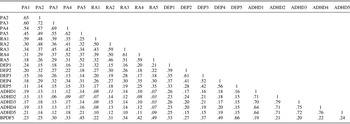
According to Masten and Cicchetti (Reference Masten and Cicchetti2010), rigorous tests of cascade models include the use of multiple assessments from several levels of functioning over time and account for continuity (i.e., stability over time) and covariance (i.e., within time associations) so that a “unique and cumulative cascade effect from one domain to another” can be examined (p. 493). Masten and Cicchetti further argue that directional cascades can often be obscured by high within-time and across-time correlations among variables, and recommend larger intervals between assessments. Taking into account this possibility, we first examined the within- and across-time correlations between variables at all available time points and noted many high correlations (r = .15–.79, p < .01; Table 1). Given these results, we followed recommendations by Masten and Cicchetti, and tested a series of models in which assessments at T2 and T4 were excluded (i.e., we tested T1 → T3 → T5). In Model 1, covariance terms between all cross sectional variables (i.e., age 10 physical with relational aggression) were estimated. In Model 2, the covariance terms and stability paths between repeated measures (i.e., age 10 to age 12 relational aggression) were included. In Model 3, covariance terms, stability paths, as well as cross-lagged paths between differing variables at consecutive time points (i.e., age 10 physical aggression to age 12 relational aggression; age 12 physical and relational aggression to age 14 BPD) were assessed. A series of follow-up analyses were performed using Model 3. We first examined potential sex differences in the links between age 12 physical aggression, relational aggression, symptoms of depression, and ADHD in the prediction of BPD features at age 14 (T5). We then examined indirect effects of age 10 (T1) predictors on age 14 (T5) BPD features. Finally, we tested for differences in magnitude of associations between predictors of age 14 BPD features.
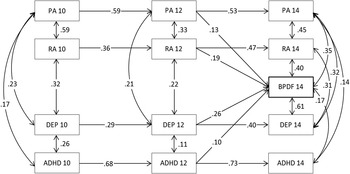
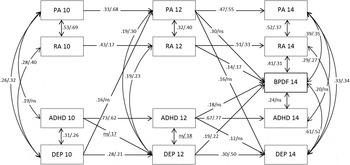
Cascade model for the full sample. Values represent standardized coefficients that are statistically significant at p < .05. Nonsignificant parameters remain in the model but are not displayed in the figure.

Correlations between study variables

Note: Correlations are all statistically significant at .05 (two tailed). Nonsignificant correlations are in italics. PA, Physical aggression; RA, Relational aggression; DEP, Depression; ADHD, attention-deficit/hyperactivity disorder; BPDF, borderline personality disorder features.
Results
Descriptive data
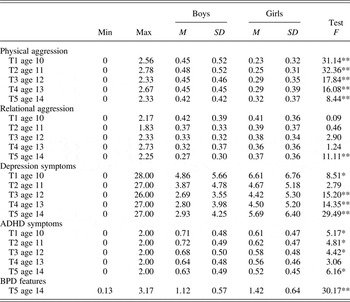
Descriptive statistics of all measures (minimum, maximum, means, and standard deviations) are presented in Table 2, along with results of tests of sex difference in physical and relational aggression and symptoms of depression and ADHD at each time point. Boys reported higher levels of physical aggression than did girls at each time point (T1–T5), and parents of boys consistently reported higher symptoms of ADHD than did parents of girls (exception at T4 age 13 where no sex difference was found). Girls reported more symptoms of depression than did boys at each time point (exception at T2 age 11 where no sex difference was found). As well, girls reported more symptoms of BPD than did boys at T5. Sex differences were not found for relational aggression at T1–T4, although at T5 girls reported greater use of relational aggression.
Descriptive statistics
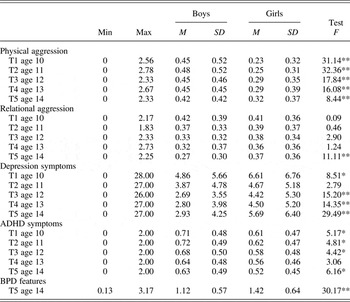
Note: T1–T5, Times 1–5; ADHD, attention-deficit/hyperactivity disorder; BPD, borderline personality disorder.
*p < .05. **p < .01.
Cascade models
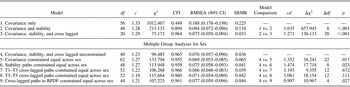
Absolute fit indices for each model and Satorra–Bentler scaled chi-square difference test results for nested models are summarized in Table 3. Models 1–3 include age 10, 12, and 14 physical and relational aggression, symptoms of depression and ADHD, and age 14 BPD features. Model 1, including covariance terms between cross-sectional variables, resulted in poor model fit (CFI = 0.449, RMSEA = 0.188, and SRMR = 0.225). Stability paths between repeated measures were added in Model 2, resulting in improved fit over Model 1 (CFI = 0.894, RMSEA = 0.084, and SRMR = 0.110), ΔχFootnote 2 (8) = 657.945, p < .001. The addition of cross-lagged paths between different variables at consecutive time points were added in Model 3, resulting in an additional improvement over Model 2, with adequate model fit (CFI = 0.964, RMSEA = 0.075, and SRMR = 0.033), Δχ2 (28) = 136.133, p < .001. Figure 1 includes all statistically significant paths and correlations within the final model. Nonsignificant estimates were retained in the model, but they were not displayed in the figure, or reported in results, for ease of interpretation.
Model fit statistics

Note: c, weighting constant for computing χ2 under multiple linear regression; CFI, comparative fit index; RMSEA, root mean square error of approximation; SRMR, standardized root mean square residual; cd, weighting constant for comparing difference in χ2 values using multiple linear regression; T1–T5, Times 1–5; BPDF, borderline personality disorder features.
Relationships between BPD features and predictors
At age 14 (T5) BPD features were significantly correlated with physical aggression (r = .35, p < .001),2 relational aggression (r = .40, p < .001), symptoms of depression (r = .61, p < .001), and symptoms of ADHD (r = .17, p = .001). Accounting for earlier within- and across-time associations, all of the age 12 variables predicted BPD features at age 14 (physical aggression β = 0.13, p = .016; relational aggression β = 0.19, p < .001; depression β = 0.26, p < .001; ADHD β = 0.10, p = .030).
Cross-sectional relationships between predictors
At each time point, physical aggression was positively related to relational aggression (r = .59, .33, and .45, ps < .001) and symptoms of depression (r = .23, .21, and .32, ps < .01), and was related to symptoms of ADHD at ages 10 and 14 (r = .17 and .14, ps < .05). Relational aggression was correlated with symptoms of depression at each time point (r = .32, .22, and .31, ps < .001). Symptoms of depression and ADHD were correlated at ages 10 and 12 (r = .26 and .11, ps < .05).
Stability of predictors
Although no statistically significant cross-lagged paths were found between physical aggression, relational aggression, symptoms of depression, and ADHD, each of the predictors was found to have moderate to high stability across time (physical aggression β = 0.59 and 0.53, ps < .001; relational aggression β = 0.36 and 0.47, ps < .001; depression β = 0.29 and 0.40, ps < .001; ADHD β = 0.68 and 0.73, ps < .001).
Multigroup models examining sex differences
Multigroup analyses were performed to examine sex differences in covariance estimates, stability paths, and cross-lagged paths. Using Model 3 as the baseline model, six additional models were estimated: Model 4, where all parameters were free to vary across sex; Model 5, where all covariance terms were held equal across sex; Model 6, where all stability paths were held equal across sex; Model 7, where all cross-lagged paths between age 10 and 12 physical and relational aggression, symptoms of depression, and ADHD were held equal across sex; Model 8, where all cross-lagged paths between age 12 and 14 physical and relational aggression, symptoms of depression, and ADHD were held equal across sex; and Model 9, where the cross-lagged paths from age 12 physical and relational aggression, symptoms of depression, and ADHD to age 14 BPD features were held equal across sex. A statistically significant decline in model fit between Model 4 and each of the constrained models was considered evidence of sex differences in the constrained paths.
Model 4, where all parameters freely varied across sex, resulted in adequate model fit (CFI = 0.965, RMSEA = 0.076, and SRMR = 0.036). Constraining covariance estimates equal across sex in Model 5 resulted in a decline in fit over Model 4, Δχ2 (22) = 38.241, p < .05, indicating that covariance estimates were not invariant across sex. Similarly, constraining stability paths equal across sex in Model 6 also resulted in a decline in fit over Model 4, Δχ2 (8) = 17.718, p < .05, indicating that stability paths were not invariant across sex. Models 7 and 8, in which cross-lagged paths between physical aggression, relational aggression, symptoms of depression, and ADHD from age 10 to 12 and age 12 to 14, respectively, were constrained equal across sex both resulted in nonsignificant differences in fit compared to Model 4, Model 7: Δχ2 (12) = 9.355, p > .05; Model 8: Δχ2 (12) = 18.154, p > .05. Model 9, where parameters between predictors and BPD features were held equal across sex, showed a decline in fit over Model 4, Δχ2 (4) = 10.967, p < .05. This difference in model fit was considered evidence that the relationships among physical aggression, relational aggression, symptoms of depression and ADHD, and BPD features did vary across sex.
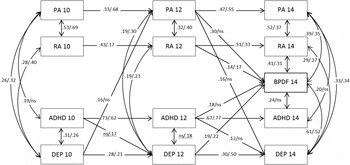
Results of multiple group analyses indicated that covariance estimates, stability paths, and cross-lagged estimates predicting BPD features were not sex invariant although cross-lagged paths between physical aggression, relational aggression, symptoms of depression, and ADHD were invariant across sex. Constraining cross-lagged paths across sex would eradicate any meaningful differences that may exist in those parameter estimates and could also impact parameter estimates further down the cascade. For the aforementioned reasons, we opted to continue testing using Model 4, the sex specific model (see Figure 2).
Cascade model by sex. Girls/boys. Values represent standardized coefficients that are statistically significant at p < .05. Nonsignificant parameters remain in the model but are not displayed in the figure.
Sex differences in relationships with BPD features
For both boys and girls, age 12 relational aggression positively predicted age 14 BPD features (boys β = 0.17, p = .048; girls β = 0.14, p = .005). Similarly, for both sexes, age 12 symptoms of depression was related to subsequent BPD features (boys β = 0.22, p = .005; girls β = 0.19, p = .006). For girls but not boys, age 12 physical aggression and symptoms of ADHD predicted age 14 BPD features (physical aggression β = 0.30, p < .001; ADHD β = 0.18, p = .002).
Sex specific cross-lagged paths
In the sex-specific model, four cross-lagged paths emerged. For girls, age 10 symptoms of depression predicted age 12 physical aggression (β = 0.16, p = .013). As well, age 14 symptoms of depression were predicted by age 12 physical aggression (β = 0.16, p = .010) and symptoms of ADHD (β = 0.12, p = .033). For boys, symptoms of ADHD at age 10 was related to depression at age 12 (β = 0.17, p = .013).
Indirect effects
Indirect effects from age 10 (T1) physical and relational aggression, symptoms of depression, and ADHD to age 14 (T5) BPD features were examined by using MODEL INDIRECT in Mplus. In light of observed sex differences in the relationships between predictors and BPD features, indirect effects were only examined in the sex-specific model (Figure 2), Model 4. For boys, a pathway from age 10 symptoms of ADHD, to age 12 symptoms of depression, to age 14 BPD features was identified (β = 0.04, p = .048). For girls, a pathway from age 10 symptoms of depression, to age 12 physical aggression, to age 14 BPD features was identified (β = 0.05, p = .022). Further, the pathways from age 10 physical aggression (β = 0.10, p < .001), relational aggression (β = 0.06, p = .002), symptoms of depression (β = 0.05, p = .021), and symptoms of ADHD (β = 0.13, p = 0.002), to their respective repeated measures at age 12, to age 14 BPD features were significant for girls but not for boys.
Differences in magnitude of predictors
In order to test which, if any, predictor had the strongest association with BPD features, we transformed all variables to have a mean of 0 and standard deviation of 1 in order to have all unstandardized coefficients on the same metric. We next ran a series of models in which we compared Model 4, where all parameters were free to vary across sex, to a model where two pathways (i.e., T3 physical aggression to T5 BPD features and T3 relational aggression to T5 BPD features) were constrained to be equal. Nested models were compared using the Satorra–Bentler scaled chi-square difference test for all six pairs of predictors. A statistically significant decline in model fit was considered evidence of difference in magnitude. The results indicated that for girls age 12 physical aggression was a stronger predictor of age 14 BPD features than age 12 relational aggression, Δχ2 (1) = 8.243, p = .004, symptoms of depression, Δχ2 (1) = 4.63, p = .031, and symptoms of ADHD, Δχ2 (1) = 4.505, p = .034. For boys, none of the comparisons across predictor strength were statistically significant (ps > .10).
Discussion
We examined cascade models involving children's use of physical and relational aggression over time alongside symptoms of childhood depression and ADHD in the prediction of elevated BPD features. Given our intent to consider multiple reciprocal processes across important developmental areas (Masten & Cicchetti, Reference Masten and Cicchetti2010), cascade modeling was considered the best suited analytic strategy.
In view of research suggesting that BPD is predicted by a multitude of mental health disturbances and behavioral problems that include physical and relational aggression (Crick et al., Reference Crick, Murray-Close and Woods2005; Ostrov & Houston, Reference Ostrov and Houston2008; Schmeelk et al., Reference Schmeelk, Sylvers and Lilienfeld2008; Stepp et al., Reference Stepp, Pilkonis, Hipwell, Loeber and Stouthamer-Loeber2010; Underwood et al., Reference Underwood, Beron and Rosen2011; Werner & Crick, Reference Werner and Crick1999), symptoms of depression (Belsky et al., Reference Belsky, Caspi, Arseneault, Bleidorn, Fonagy and Goodman2012; Crick et al., Reference Crick, Murray-Close and Woods2005; Kasen et al., Reference Kasen, Cohen, Skodol, Johnson and Brook1999; Lewinsohn et al., Reference Lewinsohn, Rohde, Seeley and Klein1997, Reference Lewinsohn, Rohde, Seeley, Klein and Gotlib2000; Pepper et al., Reference Pepper, Klein, Anderson, Riso, Ouimette and Lizardi1995; Siever & Davis, Reference Siever and Davis1991), and symptoms of ADHD (Belsky et al., Reference Belsky, Caspi, Arseneault, Bleidorn, Fonagy and Goodman2012; Burke & Stepp, Reference Burke and Stepp2012; Stepp et al., Reference Stepp, Burke, Hipwell and Loeber2012), we predicted that these symptoms and behaviors at earlier ages would predict BPD at age 14. We also expected that when examining different types of aggression, relational aggression would hold a stronger predictive link to BPD features than would physical aggression based on recent work demonstrating this effect (Crick et al., Reference Crick, Murray-Close and Woods2005; Underwood et al., Reference Underwood, Beron and Rosen2011).
Overall, results supported many of our initial hypotheses. Concurrent relations at T5 indicated that self-reported BPD features were highly correlated with self-reported physical aggression, relational aggression, symptoms of depression, and to a lesser extent, parent-reported symptoms of ADHD. When we examined the longitudinal links among these variables, controlling for within-time covariance and across-time stability in the examination of cross-lag effects, we found that BPD features at age 14 were independently predicted by higher use of physical and relational aggression and higher symptoms of depression and ADHD in childhood. However, when we examined patterns of sex differences alongside the possible moderating role of sex, several important differences were found.
Although there are some reports that BPD symptoms do not vary for boys and for girls (e.g., Belsky et al., Reference Belsky, Caspi, Arseneault, Bleidorn, Fonagy and Goodman2012), the DSM-5 (APA, 2013) indicates that BPD is diagnosed predominately in females (~75%). In this study, we found that, like many published studies on BPD (APA, 2013), girls reported more BPD symptoms than did boys. We also found that, consistent with meta-analytic research on sex differences in aggression (e.g., Card et al., Reference Card, Stucky, Sawalani and Little2008), boys reported greater use of physical aggression than did girls, and no sex differences were observed in the use of relational aggression, with the exception of T5 (age 14), when girls reported greater relational aggression than did boys. Research on sex differences in depression suggests that, prior to puberty, more boys are affected than girls, but by age 12 and beyond, twice as many girls are affected as boys (Angold, Costello, & Worthman, Reference Angold, Costello and Worthman1998). Results from the present study largely replicate this finding. At each assessment (with the exception of age 11), girls reported more symptoms of depression than did boys. Finally, with one exception at age 13, maternal reports of ADHD symptoms were higher for boys than for girls, in keeping with other published studies (APA, 2013). These observed sex differences are consistent with earlier published studies (e.g., Angold et al., Reference Angold, Costello and Worthman1998; APA, 2013).
When we examined the longitudinal associations between our predictor variables and our outcome of BPD features, we found several interesting pathways that differed for girls and for boys. We found that elevated symptoms of BPD features were only predicted by relational aggression and symptoms of depression for boys, while for girls they were predicted by the full constellation of symptoms and behaviors: physical and relational aggression, symptoms of depression, and ADHD. It is interesting that high relational aggression use predicted increased borderline symptoms for boys, whereas for girls both high relational aggression and physical aggression predicted higher symptoms. Crick (Reference Crick1997) found that children (aged 9 to 12) who engaged in nonnormative forms of aggression (i.e., physically aggressive girls and relationally aggression boys) were significantly more maladjusted than children who engaged in gender typical forms of aggression or nonaggressive children. It seems that, for the prediction of BPD features, engagement in nonnormative forms of aggression may be an important early marker of future personality impairment. However, a potential alternative explanation is that risk factors of physical and relational aggression, symptoms of depression, and ADHD most strongly predict BPD features in girls because this type of personality pathology is more common among girls and women. For boys (and men) it could be that physical and relational aggression, depression, and ADHD are more strongly associated with antisocial personality disorder (ASPD), which is far more common in men (APA, 2013). Examining predictors of BPD and ASPD is an important next step in understanding the role of gender in the emergence of personality pathology, particularly because BPD and ASPD “are disorders for which trait impulsivity is the principal predisposing vulnerability” (Beauchaine et al., Reference Beauchaine, Klein, Crowell, Derbidge and Gatzke-Kopp2009, p. 736). Moreover, it is also important to consider that there are a multitude of different pathways that can give rise to a given outcome (equifinality) or that similar developmental pathways can give rise to divergent outcomes (multifinality; Cicchetti & Rogosch, Reference Cicchetti and Rogosch1996), highlighting the need for more longitudinal studies in this area.
We also found that our indirect pathways varied by sex. We found that for boys a pathway from age 10 symptoms of ADHD, to age 12 symptoms of depression, to age 14 BPD features was present, while for girls the cascade started with age 10 symptoms of depression, moving through age 12 physical aggression, to age 14 BPD features. For boys, the pathway from symptoms of ADHD to BPD features through depression is consistent with Crowell, Beauchaine, and Linehan's (Reference Crowell, Beauchaine and Linehan2009) theory that “impulsivity and emotion dysregulation may emerge independently and sequentially during development” (p. 496), and that specifically, “impulsivity is among the earliest emerging traits” in individuals who eventually receive a diagnosis of BPD (p. 496). For girls, the pathway from symptoms of depression to BPD features was through physical aggression. It is possible that for girls, the physical aggression predictive of BPD features is driven by an impulsive attempt to regulate negative emotions associated with depression. However, it could also be an early manifestation of the BPD phenotype (related or not related to depression) where aggression is “inappropriate, intense anger or difficulty controlling anger (e.g., frequent displays of temper, constant anger, recurrent physical fights),” or criterion 8 of BPD in the DSM-5 (APA, 2013, p. 663). Consistent with both hypotheses, BPD is associated with anger in children (Zanarini et al., Reference Zanarini, Horwood, Wolke, Waylen, Fitzmaurice and Grant2011), while depression is often associated with irritability (APA, 2013) and aggressive behavior in children and youth (Knox, King, Hanna, Logan, & Ghaziuddin, Reference Knox, King, Hanna, Logan and Ghaziuddin2000).
We found that the pathways from age 10 physical aggression, relational aggression, symptoms of depression, and ADHD to their respective repeated measures at age 12, to age 14 BPD features were significant for girls but not for boys. That is, for girls and not for boys, unidimensional cascades began as early as age 10 with the stability in early risk indicators proving to be more important in the prediction of BPD features relative to boys. Ten-year-old girls who experience these nefarious symptoms, particularly depression and ADHD, are early expressers of symptomatology. Akin to the stronger prediction of physical aggression to BPD in girls, the less normative experience of prepubertal depression and ADHD in girls may pose a risk pathway of stable continuity to BPD symptoms at age 14, particularly without intervention.
Although we predicted that, consistent with previous work, relational aggression would emerge as a stronger predictor of BPD features, this was not the case in the present study. For boys, age 12 mental health and behavioral predictors of BPD features could not be reliably separated on the basis of magnitude, suggesting that predictors carried similar strength. In contrast, the use of physical aggression by girls at age 12 was the strongest predictor of BPD features 2 years later. Physical aggression use by girls is rare, especially among older children and adolescents (Card et al., Reference Card, Stucky, Sawalani and Little2008), which may be indicative of more severe impairment (Loeber & Keenan, Reference Loeber and Keenan1994). Thus, the nonnormative persistent use of physical aggression may be a particularly good clinical indicator of emerging personality pathology in girls, especially when coupled with preexisting disturbances in mood and elevated ADHD symptoms or impulsivity.
Limitations
Our focus was on childhood behavioral and mental health symptoms as predictors of BPD features in adolescence, the potential developmental peak (Chabrol et al. Reference Chabrol, Montovany, Chouicha, Callahan and Mullet2001). Nevertheless, measuring BPD features at age 14 may give the impression that this is when the challenge emerges, when it is possible that BPD features are present in childhood and can be reliably measured at a younger age. Our concern with current study designs, including our own, is that they do not permit the assessment of temporal patterns. That is, it is not possible to discern if we are actually measuring distinct, independent clinical predictors of BPD, or rather if our mental health and behavioral measures are actually measuring the collection of symptomology that comprises BPD. In other words, it is important to question whether we have measured separate disorders and behaviors that predict BPD features, or whether we are simply measuring one taxonomic construct. Longitudinal designs that include the assessment of BPD features across childhood into adulthood are needed to properly verify predictors of BPD, over what may be prodromal symptoms of the disorder. We suggest that researchers should consider measuring BPD features at an earlier age and examine whether its development is best described as heterotypic or homotypic in continuity. Beauchaine et al. (Reference Beauchaine, Klein, Crowell, Derbidge and Gatzke-Kopp2009) suggested that “BPD is likely characterized by a pattern of heterotypic continuity that is better described in terms of predisposing traits rather than specific BPD symptoms” (p. 745). However, current study designs do not permit the assessment of this hypothesis.
Although we paid special attention to reducing reporter bias, we still have an issue with common method variance in that aggression, symptoms of depression, and BPD features were derived from self-reports. The use of a longitudinal design helps to mitigate this issue to some extent, and while data from a single informant can be argued to provide a sufficient sample of behavior, obtaining more than one informant on child behavior may be desirable (Achenbach, McConaughy, & Howell, Reference Achenbach, McConaughy and Howell1987), because the reporting of personality disturbances could have been elevated owing to current mood state. As well, there is always the possibility of social desirability bias, especially when asking children and youth about their engagement in behavior that is disproved of by society. In the case of physical aggression, there is also the criminal element that could influence youths' willingness to admit their engagement, particularly after the age of 12, when the use of physical aggression in Canada can be considered assault under the criminal code.
Differences in parent reports of ADHD symptoms were found among participants included in the analyses from those not included. Specifically, children with high ADHD symptom scores were more likely to be omitted from our sample for analysis, as were boys. Given these differences, our multiwave sample is not strictly representative of the full sample at T1.
Conclusion
In their recent review of the literature on the developmental pathways to BPD, Chanen and Kaess (Reference Chanen and Kaess2012) suggested that “early temperamental and personality features, internalizing and externalizing psychopathology, and specific BPD criteria [were] all candidate precursor signs and symptoms” (p. 49). They further added that there is a need to better understand the “role these factors play in the developmental pathways to BPD” (p. 49). The present study fills an important gap in knowledge by considering how several different mental health and behavioral precursors interact over time in the prediction of elevated BPD features at age 14. The results suggest that clinicians ought to consider the role of aggression in assessing the presence of BPD pathology, alongside other known precursors such as depression and ADHD. Specifically, our study directs clinicians to pay careful attention to the use of aggression that crosses typical gender lines (e.g., girls being physically aggressive and boys being relationally aggressive). Our results also suggest that, for girls in particular, BPD features in adolescence were predicted by substantial stability in mental health and behavioral challenges through later childhood. Thus, clinicians should take note of girls who show a history of stable problems of physical and relational aggression, depression, and ADHD because it might be prudent to begin to think about the onset of BPD. Identifying the etiological precursors to BPD, which are likely sex moderated (see Beauchaine et al., Reference Beauchaine, Klein, Crowell, Derbidge and Gatzke-Kopp2009; Paris, Reference Paris1997), and how they interact over time, should help in the development of more effective prevention and intervention programs (Crowell et al., Reference Crowell, Beauchaine and Linehan2009).