Large-scale bioevent disasters, whether from natural or deliberate causes, result in mass illness or unchecked disease transmission (epidemic or pandemic). Bioevents differ in that they are characterized by vast numbers of individuals from geographically diverse areas seeking medical assistance over periods of days or months. Triage management and surge capacity decisions are required immediately as are sustained population-based actions built on unprecedented collaboration between state, national, and international resources to maintain operational continuity.Reference Burkle1–Reference Burkle5
Established management schemes under the National Incident Management System and its incident command system (ICS) are used by many public safety professions in North America, the United Kingdom, New Zealand, and Australia. The National Incident Management System has shown reliability in conventional disaster conditions and the ability to structure and restructure on a moment-to-moment basis in response to unforeseen complications provoked by large, complex, and dynamic emergencies.6–Reference Zane and Prestipino12 Although ICS has been used by various emergency responders for many years, its adoption for use by health care facilities (HCFs) is relatively recent and has occurred slowly during the past decade.Reference Christian, Kolleck and Schwartz13
The authors question whether the existing incident command system for conventional disasters is optimally structured and prepared to meet the myriad of decisions required during public health disasters in a timely and effective manner. This article examines a potential health-related command structure and the functions required for authoritative decision making in future bioevents.
CONCEPT OF A HEALTH-SPECIFIC COMMAND STRUCTURE AND EMERGENCY OPERATIONS CENTER
During a large-scale bioevent, many jurisdictions may designate their local department of health as the lead agency with the ability to expand by incorporating ethicists, legal consultants, infectious disease, critical care, and other specialists into decision-making processes. Epidemiological outbreak control and investigation, surveillance, emergency medical services, acute medical care, containment strategies, mental health, mass fatality care, hospital management, pharmacy, self-care and assisted self-care, veterinary medicine, and palliative care may be activated during high-consequence bioevents. Although the need for a heightened level of response by numerous health care partners during complex bioevents is widely assumed, this has rarely been comprehensively explored in the peer-reviewed literature in the context of a unified health care command structure and emergency operations center (EOC).Reference Zane and Prestipino12,Reference Arnold, Dembrey and Tsai14–Reference Hick, Hanfling and Burnstein17
Major bioevents can create a surge in demand for health care services while diminishing the availability of these services. This combination of effects generates the followingReference Burkle1, Reference Burkle5:
• Competition for limited resources requiring centralized prioritization
• A need for centralized information management to enhance situational awareness across the health care system
• A need for jurisdiction-wide altered standards of care to preserve critical health care system components and maximize availability of care
• A need to leverage the legal authorities of multiple health care system leaders
• A compelling need to maintain the confidence and support of the public while decisions are implemented that may curtail health care services
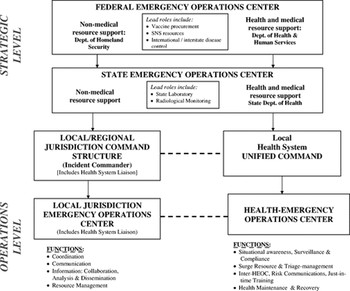
To address these consequences at the local level, a unified organizational structure for health care response must be developed, agreed upon, and followed during bioevents. The National Response Plan’s Emergency Support Function #8 (Public Health and Medical Services Annex) defines how federal agencies such as the Department of Health and Human Services will assist state, local, and tribal jurisdictions in responding to public health emergencies.18 Similarly, state departments of health are commonly identified as lead agencies for specific response activities such as laboratory analysis and radiological monitoring (Fig 1). State and federal agencies mainly focus their disaster response efforts on supporting, through resources and technical assistance, local health departments, hospitals, and health care providers. The primary responsibility for directing the health and medical response in the jurisdiction that is affected and coordinating the efforts of all health care partners having direct patient contact rests with local health care responders. The White House Pandemic Plan of May 3, 2006, stresses that the federal government plays an “advisory role,” with the states and communities relying primarily on themselves.19 Unfortunately, a prevailing mindset, supported by the lack of preparedness by individual state plans, suggests that this reality is not either fully understood or denied.Reference Holmberg, Layton, Ghneim and Wagener20
Strategic and operational ICSs depicting comparisons in the structure, relationship, and functions of potential jurisdictional and health-related EOCs

At the local level, the health and medical response should be structured under unified command (UC) to enhance strategic decision making and priority setting. Participants in the UC should include health care participants with significant legal authorities, responsibilities, and expertise across the continuum of care: The UC would focus systemwide resources, authorities, and expertise toward a common set of objectives while maintaining authority and direction over the jurisdiction’s health care response. In addition, a representative from the health and medical UC should be located in the jurisdictional EOC to ensure coordination with local responders and emergency management officials.
A critical component of a unified health and medical response is a health emergency operations center (HEOC). Serving as the operational and logistical arm of the UC, the HEOC includes representatives from key health sectors that maintain situational awareness across the system and can mobilize and deploy local health care resources. The jurisdictional EOC should function as the authoritative channel to provide nonmedical resources and logistical support, address nonmedical response priorities, and consult with public officials on emergency health policy issues.21
Many public health agencies are proactively involved in developing unified health care system preparedness and response capabilities.Reference Cook22–Reference Kendra and Wachtendorf26 It is critical that ICS structures and activities be clustered together in the planning phase in the same manner that they will be during an actual response.21 The Los Angeles County Department of Health Services was among the first to incorporate and describe unified incident management concepts in a standardized emergency management system and bioevent response plan.Reference Kim-Farley, Celentano and Gunther27 Following the 2001 anthrax attacks, the Centers for Disease Control and Prevention (CDC) established an international team in its EOC to provide for bioevent inquiries and information.Reference Polyak, Macy and Irizarry-De La Cruz28 Maldin et al describe a number of regional groups that were created to coordinate transfer and distribution of patients, staff, and supplies, and to allocate limited medical resources during large-scale events.Reference Maldin, Lam and Franco29 In Seattle, Washington, the King County Health Care Coalition links public health with acute care hospitals, ambulatory care providers, and emergency medical services providers and is vested with decision-making authority regarding health care resources during times of constraint.Reference Maldin, Lam and Franco29 The Unified Health Command in New York City serves to process situational updates from hospitals, receive material, allocate supplies and equipment, and address issues of concern.Reference Maldin, Lam and Franco29 Following Hurricane Katrina, the Regional Medical Operations Center in San Antonio, Texas, coordinated the placement and distribution of thousands of evacuees to regional hospitals, including those with special needs.Reference Epley, Stewart and Love30 Regional hospital coordinating groups are best suited to facilitate these roles when they have been integrated into a unified incident command structure and are linked to the jurisdictional EOC.
FUNCTIONAL RECOMMENDATIONS FOR HEOCs
The inherent complexities of managing a large-scale bioevent require unprecedented coordination among a broad array of key multidisciplinary stakeholders. The authors contend that the unique aspects of a pandemic, as well as large-scale chemical and radiation events, require a new, integrated EOC model with well-established lines of authority and responsibility. Although this is not widely recognized within the conventional ICS structure, this HEOC concept does not diminish the role of the established ICS and jurisdictional EOC structures in providing non-health-related resource and information support. Whereas HEOCs and unified health command systems may vary in structure, they must not limit the capacity to make effective and timely public health triage management decisions or limit the necessary functions of other ICS components, including jurisdictional EOCs. Hospitals, other HCFs, and practitioners’ offices must conform to decisions, and must never compete with each other during a resource constrained event, unilaterally decide when a triage protocol should be executed, or develop their own triage management system. Studies that provide specific triage management guidelines and protocols are scant; however, in the post–severe acute respiratory syndrome (SARS) environment a collaborative Ontario Health Plan task force, made up of professionals who managed the 2003 SARS epidemic in Toronto, called for “absolute command and control” over triage resources “ to ensure accountability.” They emphasize a “central committee” (eg, health UC) that is familiar with triage protocol development to oversee triage during a pandemic for every HCF.Reference Christian, Hawryluck and Wax31, Reference Melynychuk and Kenny32 Once the HEOC executes orders for the triage protocols, in this case for ICU admission and use of ventilators, HCFs and clinicians will uniformly implement those orders (M. Christian, personal communication, 2007).
The HEOC is the only entity that has the capacity and capability of executing timely triage management decisions. Conventional jurisdictional EOCs under existing ICS structure do not possess this capacity or knowledge base but continue to play an essential role in supporting the health response (eg, authorities not in health care in partnership to legally enforce quarantine and isolation). These functions would remain within the jurisdictional EOC structure and in close coordination with the HEOC. The incident commander will at all times be responsible for managing the incident, conducting high-level decision making regarding community-wide response and resources, and maintaining organizational continuity. The HEOC must have autonomous but collaborative authority with the incident commander to execute timely public health decisions and to determine surge capacity resource allocation that best ensures the prevention of transmission of disease.
New organizational systems that achieve flexibility and a degree of reliability under turbulent conditions have in common standardization, specialization, formalization, and hierarchical authority.6 Both BarbischReference Barbisch33 and BurkleReference Burkle1 used the concepts of the incidence management system to define unique responsibilities and authorities for an HEOC as the decision-making hub Reference Barbisch1,5,33 to support functions based on the following requirements:
• Surveillance supported situational awareness
• Triage decisions and protocols
• Strategic alliances (local to international) for resources related to the investigation, surveillance and control of the pandemic’s transmission of disease should be facilitated, integrated, and developed
• Communication and compliance enforcement
• Volunteer resources: mobilization and just-in-time training
• Health maintenance and recovery
The HEOC organizational structure for these functions is depicted in Figure 1.
The post-SARS Ontario, Canada Influenza Pandemic Plan has similar ICS-like functions and structure under the Ministry of Health and Long-Term Care using a Ministry Emergency Operations Center that is replicated at provincial and local levels. The Medical Officer for Health holds legal authority for provincial management of pandemics.34 In Victoria, Australia, similar post-SARS concerns led states to strengthen emergency management capability and capacity in the Department of Human Services. A health commander, normally a senior paramedic from the prehospital sector, oversees with authority and experience direction of the operational health response. The health commander establishes a health incident management team (equivalent to a health-related EOC) formed from senior personnel from responding health agencies to provide strategic direction for most tactical health responses. The Department of Human Services assumes responsibilities through a public health group for biological and radiation incidents, which provides specialist advice regarding the “handling, recovery, decontamination, clean up, infection control (including isolation and quarantine), surveillance, and clinical effects and treatments.”35
Maintain Situational Awareness
Maintaining situational awareness during disasters is critical for developing effective strategies, decisions, and response actions. Jurisdictional EOCs, health care system players, and public health must exchange information with the HEOC regarding the impact of surveillance, resource needs, resources deployed, and anticipated actions and timely analysis to revise triage protocols necessary to limit over- or undertriage, both of which decrease overall survival. Reference Frykberg1,5,36 Situational awareness supports daily, if not hourly, triage management decisions immediately passed on to hospitals, ambulatory health care facilities, and all public-private organizations with health care responsibilities.Reference Burkle1
Measures of effectiveness provide a means for measuring outcome, progress, and performance (success or failure). The major measures of effectiveness for bioevents are Reference Burkle1,37,38
• Timeliness and accuracy of mobilization of the health information system
• Decline in mortality and morbidity across the entire jurisdiction
• Equitable surge-capacity distribution across the entire population requiring care
• Control of the transmission or reproductive rate (R0) of the communicable disease (ratio of primary to secondary infections)
MOE information is the foundation of daily reports from the HEOC to all HCFs and both the jurisdictional EOC and ICS and incident commander.Reference Burkle1
Establish Triage Protocols and Make Decisions
Strategic triage decision making by the health UC within the HEOC is critical in establishing lines of authority and uniformity at every point of contact (POC) and to eliminate competition for resources among providers and health facilities. Reference Christian, Wax and Lazar5,33,39 Triage systems must be appropriate to the unique triage priorities that stem from population-based care in which everyone in the community requires some form of managed intervention. Reference Bombardt1,5,40 Professionals with expertise to advocate for and manage the unique issues and requirements of the population (e.g., education for susceptible populations; mass prophylaxis strategies; mass fatality and mortuary management) are best assigned to the HEOC. In turn, the HEOC authority will, in a timely manner,Reference Burkle1
• Determine surge capacity requirements for each population category: susceptible, exposed, infectious, removed by death or recovery, and vaccinated; referred to as SEIRV triage-management categoriesReference Burkle1
• Determine triage criteria, including resource-constrained and resource-driven minimal qualifications for survival and exclusion criteria
• Enforce health compliance measures executed through ICS authority and resources
• Ensure data collection, analysis, measures of effectiveness, and daily reports to ensure effectiveness of triage management
Triage methodologies, such as START and SAVE, which are based on severity of presentation have limited application in bioevents. POC decisions are based on exposure, duration, and infectiousness and the current case definition influenced by known lethality, illness severity profiles, time to death or recovery, surge capacity requirements, and resources.Reference Burkle1
The initial POC for potential victims often is established hotlines and 9-1-1 calls. A simple series of questions can determine whether the caller is probably exposed or infectious versus probably not exposed or not infectious, followed by questions concerning transport and self-assisted care capacity that direct the caller to 1 of 3 options41: ambulatory clinic or practitioner, designated pandemic hospital, or home (self- or assisted) care.
A hotline approach successfully used by Toronto during SARS has become their first level of triage in future outbreaks.Reference Burkle1 CDC guidelines recommend telephone triage with preestablished criteria governing deployment of emergency transport and plans for alternate forms of transportation.42
HCFs are expected to increase their capacity (staffing, equipment, and prioritization of care) when faced with large numbers of severely critical victims; all being simultaneously triaged against limited resources.Reference Macintyre, Christopher and Eitzen43 The HEOC must have situational awareness of what is occurring at each and every hospital and nonhospital facility to resolve these management problems. Triage decisions in the prehospital setting results in direct effects on clinical decisions at an advanced care level.Reference Burkle1,Reference Hick and O’Laughlin44–Reference Talmor, Jones and Howell46 To prevent system collapse, POCs must be fully aware of triage decisions and their impact. Decisions directed by the health UC and coordinated by an HEOC must ensure that HCFs are using the same triage approach criteria and are aware of their ethical and legal pitfalls. Reference Christian, Hawryluck and Wax31,Reference Melynychuk and Kenny32,Reference Christian, Wax and Lazar39 The complex understanding, implications, and execution of triage protocols are best determined by a HEOC staffed by professional resources (eg, ethicists, legal experts) readily available to consult with practitioners executing these protocols under difficult conditions.Reference Burkle1, Reference Christian, Hawryluck and Wax31
When appropriate, the health UC must implement triage protocols simultaneously in all hospitals and then monitor its effectiveness by maintaining and analyzing outcome indicators. These decisions must be communicated to the local jurisdictional EOC. It is essential that there be a clear plan for two-way communication between the HEOC and the jurisdictional EOC with predeveloped plans for coordination of authority and ultimate decision making between the 2 EOCs. Each and every triage decision will have legal and ethical implications, many affecting the perception of public safety. Operational EOCs must be kept abreast of the decisions made to ensure community compliance, especially in regard to both public safety and public information support directives. The jurisdictional EOC provides crucial resources such as law enforcement, transportation, and establishment of alternate and temporary HCFs.
Facilitate and Integrate Resources
The coordinated response by local communities to large-scale disasters is no longer an ad hoc process derived from local disaster plans. Health planning requirements first occur at a local level and within health care facilities responsible for those services.Reference Arnold, Dembrey and Tsai14, Reference Macintyre, Christopher and Eitzen43 As the disaster escalates, it is necessary to integrate both planning and operational activities at county, state, regional, national, and even international levels. HEOCs must ensure that local linkages for regional health resources exist and must develop and maintain strategic alliances with governmental and nongovernmental organizations. During a bioevent of national or international significance, the HEOC could be functioning under organizations such as the World Health Organization (WHO) or WHO-sponsored entities such as the CDC. WHO has the authority under new International Health Regulations to quarantine and monitor transmission rates necessary for global protection, the implementation of which have a direct impact on local HEOC decisions.47
The authority of a health UC would ensure health provider capacity for HCFs (both hospital- and community-centric) throughout the jurisdiction and that these duties are carried out under emergency public health laws. The HEOC would ensure that distribution of providers, pharmaceuticals, support staff, equipment, supplies, and facilities fit the requirements and would place, shift, and redirect resources, including personnel, where they are needed most.
Enforce Health Information Communication and Compliance
An essential component of effective disaster response is the timely and accurate dissemination of risk communication messages over television, radio, the Internet, and other media.Reference Burkle1 The health UC, through the HEOC and in combination with the jurisdictional EOC and the ICS public information officer can ensure that risk communications messages are consistent across all of the partner agencies, that changes to those messages are implemented in a rapid and uniform way when needed, and that messages account for the needs of vulnerable and non-English-speaking populations.
Mobilization and Just-in-Time Training of Volunteers
Health information systems, vaccination centers, medication distribution centers, and services tied to evacuation, isolation, and quarantine programs are high-maintenance programs requiring large numbers of skilled volunteers. The HEOC can effectively coordinate requests for staff support from health care partners, prioritize those requests, and ensure that only volunteers with appropriate skill sets and credentials are deployed. The HEOC can also leverage the expertise of health care partners and other agencies within jurisdictional EOCs to develop and conduct just-in-time training. In addition, the HEOC must have the authority to determine what training has priority and ensure that necessary training is expedited.Reference Burkle1, Reference Alexander and Wynia48 Unique strategies can be implemented through the HEOC that meet the needs of victims while effectively protecting the safety of volunteers.
Maintain Health and Recovery Systems
A pandemic produces a number of variables that are not predictable: the nature of the virus or bacteria itself, how it affects the population, the number of subsequent waves of infection, the capacity to provide measures to restore emotional and psychological well-being, and the recovery time of the devastated health and public health systems. From the outset, the HEOC must consider means to maintain the existing health system and the long-term impact of the pandemic on recovery. The HEOC will need to evolve into a recovery mode that goes beyond the life span of the conventional ICS and EOC. This expanded HEOC must have access to resources that implement prevention, preparedness, and response strategies supported by integrated recovery planning (eg, import nursing professionals for many months, resources in place to manage long-term complications, both physical and behavioral).
CONCLUSIONS
Unaddressed here is whether prevailing public health systems have the capacity and capability to handle an HEOC.Reference Salinsky and Gursky49–Reference Estrada, Fraser and Cioffi52 A successful health UC and HEOC engenders an atmosphere of leadership, trust, and cooperation in which the public health and health care partnership aspects of emergency response can be efficiently organized and conducted.Reference Estrada, Fraser and Cioffi52 Two decisions must be made: (1) who are the appropriate leaders within the public health and health care system and (2) if there is need for a health UC/HEOC, what agencies will participate in this effort? Although each participating agency contributes within the unified incident management structure, a primary agency vested with final decision-making authority must be designated for each type of event through a transparent preevent planning process. For large-scale bioevents public health, prehospital professionals, or the medical community, depending on the circumstances, serve as logical choices to assume leadership, given the specialized expertise required to manage such an event. The lead agency, as in this case, may also operate the HEOC. Every decision, no matter how small, must be scrutinized so as not to lead to unnecessary transmission of disease. For a community to maximize its resources and to coordinate the health care system, it will need to have a preestablished and operational HEOC that works in concert with the jurisdictional EOC. The authors suggest that a health-specific UC and EOC structure, with authority, population-based public health skills, and expertise to lead the bioevent response, is necessary at the community level. Finally, the authors support the concept of further oversight by a public health authority (eg, Regional Public Health Service Office) at the regional level that provides surge resources and advocates for the community-level functions and responsibilities of UC and HEOCs under their regional jurisdiction.