In confronting the inefficient performance of China's irrigation systems, leaders have begun experimenting with new institutional forms to manage water in rural communities. In rural China only 40 per cent of the water that is allocated to irrigation is effectively used, a figure much lower than many developed countries (Wang, Reference Wang2000). Although the dependence on traditional irrigation technology, such as flood irrigation, accounts for part of the inefficient use of water, poorly designed water management institutions also contribute to the subpar performance (Wang et al., Reference Wang, Xu, Huang and Rozelle2005b). Since the late 1990s, policymakers have promoted surface water management reform, especially in the Yellow River basin. The essence of the reforms is to gradually decentralize management of local irrigation systems by transferring the management of the system from the village leader (the local government, referred to as the leader in the rest of the paper) to private managers (typically villagers, referred to as the manager).
The record on reforms, however, is mixed, although most evaluations are only based on anecdotes or small case studies (China Irrigation District Association, 2002; Huang, Reference Huang and Nian2001; Nian, Reference Nian2001). Some observers have reported that the process of water management reform has been successful. At the same time, visits to the field can easily uncover cases in which local water management changes were implemented and subsequently failed. Even in those areas in which management reform has been well-designed, effective implementation of the reform has been difficult (Ma, Reference Ma and Nian2001; Management Authority of Shaoshan Irrigation District, 2002).
Unlike most anecdote-based research, Wang et al. (Reference Wang, Xu, Huang and Rozelle2005b) study a set of randomly selected villages in the Yellow River Basin and find that the success of water management reform in China is positively correlated with the incentives that are provided to managers. In the study area, leaders provide incentives to managers by offering them shares of the profit from the operation of the village's irrigation system. In some villages, the canal networks are leased to individuals for a fixed contract fee and the individuals keep all of the earnings net of expenses; in other villages the managers of the water management committee are rewarded with part of the water fees that are collected after the irrigation network's expenses have been paid. In villages that provide managers with strong incentives to save water, water use falls sharply, while having almost no effect on agricultural production or rural incomes. In contrast, when villages do not provide incentives, managers do not save water.
One question Wang et al. (Reference Wang, Xu, Huang and Rozelle2005b) do not answer, however, is that if incentives work so well, why is it that all villages do not provide incentives to their managers. To try to explain this puzzling fact, the overall goal of our paper is to provide a framework for explaining the choice of managerial form. To meet the overall goal, we have two specific objectives. First, we set up a theoretical framework that predicts how the contractual form varies with the nature of village's cultivated land, the design of the canal system and the characteristics of its leaders and the pool of managerial candidates. By candidates, we mean individuals within the village that are eligible to take on the role of a canal manager. Since any villager is eligible, the pool of managerial candidates refers to all the villagers in our sample villages. Second, we seek to empirically identify the factors that may induce leaders to choose one type of contractual form over another by using descriptive statistics and multivariate analysis.
The novelty of this paper is that we treat the managerial form of China's most basic management unit of the village's irrigation system as endogenous and econometrically measure the factors that determine how water is managed. Unlike most previous studies that are anecdote-based, we use the data that we collected from 32 villages and 40 canal village-level systems in northern China to describe and econometrically identify the determinants of the managerial form. This is the first empirical village-level study on this subject in China. More importantly, we have incorporated important factors that were not analyzed in previous studies: the characteristics of the key players. In most past studies, discussions of the appropriate institutional forms are usually limited to overcoming the transaction costs of enactment (Easter et al., Reference Easter, Dinar, Rosegrant, Easter, Rosegrant and Dinar1998) or the legal and physical restrictions to their establishment (Radosevich, Reference Radosevich and O'Mara1988). Baland and Platteau (Reference Baland and Platteau1999) are among the few other authors (Dayton-Johnson, Reference Dayton-Johnson2000a, Reference Dayton-Johnson2000b; Fujiie et al., Reference Fujiie, Hayami and Kikuchi2005) that discuss the impact of local characteristics on the success of proposed institutional arrangements for managing the commons, although none has examined the characteristics of the key players. In our study, we examine the roles the leader and the pool of managerial candidates play in the endogenous choice of managerial forms.
The rest of this paper is organized as follows. We first summarize the existing contractual forms. In the next section, we model contractual choices formally and, based upon the results of the simulation analysis, make four predictions about the factors that determine how contractual relationships are formed in different types of environments. Using the predictions as a basis for generating testable hypotheses, our empirical work analyzes the relationship between contractual choice and a number of different characteristics of a village: the nature of its cultivated land, the design of its canal system and the characteristics of the leader and the pool of managerial candidates. In the final section, we conclude.
Three forms of contracts in managing the canal system
The managerial contract between the leader and a manager governs not only each party's responsibilities in the operation of canals, but also their rights to claim the residual profits from irrigation services. There are two main types of activities in managing the canal system: collective activities and supervisory activities. Collective activities include tasks such as maintaining canals, coordinating water deliveries, and resolving water conflicts that involve several households. Collective tasks typically require the leader or manager to coordinate or facilitate negotiations among villagers. It should be noted, that collective activities in our paper are distinctly different from the term collective action in Ostrom (Reference Ostrom1990). In our case the leader or manager organizes the actions of villagers in water management activities; in Ostrom (Reference Ostrom1990) villagers must find ways to cooperate among themselves, often in a self-organizing way. In contrast, supervisory activities are tasks that are relatively effort intensive for the leader or manager. In the operation of a canal system, many supervisory tasks, such as water delivery (e.g., the opening and closing of sluice gates), monitoring water allocations, and collecting water fees, are the key elements in the system's efficient and profitable operation. One of the fundamental ways that canal systems vary is that in some communities, the leader assumes responsibility for all of the tasks; in other villages, the manager assumes responsibility for most of the tasks; and in others, leaders and managers share responsibilities. Not surprisingly, in return for taking on greater (or fewer) responsibilities for implementing the different tasks, leaders and managers are compensated with more (or less) of the earnings of the system.
When sorted according to the ways managerial responsibilities and earnings are divided, irrigation systems in China's villages are managed in three distinct ways. Some villages have chosen to stay with the traditional form of leader-run irrigation management. In these villages, the leader is in charge of organizing both collective activities and supervisory activities. The leader either manages the whole system by himself or hires a foreman for a fixed wage to perform some of the water management tasks under his direct instruction. Importantly, under such a fixed-wage contract, the foreman does not have a strong incentive to put out effort since he does not get any share of the profit from the operation of the irrigation system. In fact, because the leader knows this, the foreman is not expected to take much initiative and at most carries out fairly routine activities under the direction of the leader.
In contrast, some leaders have transferred complete control and income rights of the village's canal network to managers on the basis of a fixed-rent contract. Under such an arrangement, the individual has effectively become the manager of a private water management company and is provided with full incentives. As long as the manager follows the rules and regulations set by the leader, provides quality irrigation services and pays the fixed rent (or in terms of China's villages, the contract fee), the leader does not intervene directly in the manager's execution of day-to-day canal management tasks, neither collective activities nor supervisory ones. Finally, in other villages the leader and manager share both responsibilities and earnings from the irrigation tasks, a form of management that is called a profit-sharing arrangement. To maximize the profit from operating the village's irrigation system (or at least to operate it efficiently), one of the key decisions the leader needs to make is to put the individual that can run the irrigation system most efficiently in charge and to provide that individual with the incentives to do so. In other words, the leader decides how his village's irrigation system is managed by choosing the contract that will return the highest level of profits. Thus, the profit-maximization behavior of the leader is consistent with efficiency from a social perspective.
Modeling managerial choice in rural China
Since ultimate property rights reside with the leader as the curator of local assets in rural China, the leader will choose the contractual form that will further his interests. After the onset of the rural financial reforms, leaders have been encouraged to use village assets efficiently and are allowed to run them on a fee for service basis (Oi, Reference Oi1999; Rozelle, Reference Rozelle1994; Whiting, Reference Whiting2001). Description of policies and regulations that promote the efficient use of irrigation system – both groundwater and surface water – are found in Lohmar et al. (Reference Lohmar, Wang, Rozelle, Huang and Dawe2003) and Wang et al. (Reference Wang, Huang and Rozelle2005a). Importantly, these policies implicitly allow the leader to claim profits from such service-oriented activities (e.g., the water fee collected in the case of running irrigation systems) as the reward for building the village's treasury (Rozelle, Reference Rozelle1994).Footnote 1 As a consequence, we believe that it is reasonable to assume that the leader's interests frequently are consistent with profit-maximization (Oi, Reference Oi1999).Footnote 2 In this section, we develop a way to understand how different communities in China choose to manage their irrigation systems – as fixed-wage, fixed-rent or profit-sharing contracts.
Two basic assumptions
Following Eswaran and Kotwal (Reference Eswaran and Kotwal1985), we outline a theory to explain the different ways in which villages manage their irrigation systems.Footnote 3 In developing a model in which the leader endogenously chooses the optimal contractual form, we make two basic assumptions. First, the leader and the manager have an absolute advantage in being able to perform one or the other of the two activities that are required to run an irrigation system. As the local authority, the leader is efficient at organizing collective activities such as mobilizing the labor of his villagers to clean canals, coordinating irrigation schedules among households, and resolving water conflicts. For example, using his executive authority, the leader can easily (at least in relative terms compared to any individual villager) mobilize households within the village to clean and perform maintenance work on the village's canal system on a seasonal or annual basis. If an individual manager were in charge of maintaining the canals on his own, he would almost invariably have to hire labors from inside and/or outside of the village to help him do so.
In contrast, we assume that the manager is endowed with a superior ability (and more available time) to execute supervisory operations. For example, while there is no reason to believe that leaders could not effectively manage water allocation operations if they had the time, one of our key points is that they often do not. Since the leader is also invariably burdened with many other duties, such as running village enterprises, implementing family planning, maintaining local schools and health facilities, as well as a myriad of other administrative responsibilities assigned by township officials, he almost assuredly is less able to provide the concentrated effort and attention to detail that is needed in certain villages to allocate water and provide other irrigation services. A full time manager, however, can focus his energy and often can draw on his family members to provide the hours needed to meet the irrigation needs of the farmers in the command area. In addition, managers sometimes have an advantage over leaders in the time-intensive job of collecting water fees. Besides being a time-consuming task (almost always requiring going door-to-door, sometimes many times), households often will use various excuses to avoid or delay payment to the leader or his foreman, frequently taking advantage of the fact that the village is at least partly considered responsible for providing welfare functions to needy villagers. The leader may also be worried that if he forces the villager to pay the water fee, the villager will vote against him during the next election. These tactics are less effective when managers, who themselves are fellow-villagers, come to collect payment for services rendered.
Our second key assumption is that the abilities of the parties to organize collective activities and supervisory activities are unmarketable, partly because those services are unobservable and therefore difficult to measure. For example, the leader could hire an individual foreman to supervise water delivery. In theory, the leader would like to pay a wage to the foreman on the basis of the amount of effective work that he does. However, it is difficult for the leader to monitor the foreman, and it is impossible to measure the amount of effective work even after the tasks are performed. As a consequence, it is difficult for the leader to provide an incentive for the foremen. For these reasons, it is difficult or impossible to purchase the effort that is needed to execute supervisory tasks on the market. To obtain effective supervisory activities, the leader either has to do them himself or provide self-monitoring incentives to an individual that is able to carry out this task. Likewise, a manager cannot procure the authority that is needed to execute collective activities on the market.
Model
In most surface water irrigation areas in rural China, the distribution of water is organized at two levels: at the first level, the irrigation district (ID) is responsible for supplying water to irrigation units, which in China is almost always an administrative village; at the second level, the village committee (which is the governing body at the lowest level of quasi-government in rural China). In our problem, the village committee decides to manage the village's water resources itself (traditional collective management) or contracts the canal system out to a manager (a profit-sharing contract or a fixed-rent contract), and it is this management unit that is responsible for delivering water directly into the fields of farmers. When water passes from the ID to the village (that is at the first level), irrigation water is typically priced volumetrically because the volume of water can be measured fairly accurately as water passes out of the main, ID-controlled canal network into the village-controlled branch canal system. When purchasing water from the ID, the village committee (or the manager) usually pays a deposit to the ID before the irrigation season (as a down payment for the water to be used during the year); after the water is delivered to the village, the village committee (or the manager) needs to pay the balance.
Within the village, however, the situation is often fundamentally different. Households are obligated to pay a fixed water fee for irrigation services during an irrigation season or a year. Although the village leader or the manager would like to charge on a volumetric basis, due to the difficulty of measuring water at the plot level, water fees are often converted to a per unit of land basis. Although there is heterogeneity across IDs and even villages within the same ID, in most villages the water fee (which is fixed in terms of yuan per unit of irrigated land) was determined by the ID or the bureau that manages the ID (about 65 per cent of the villages). In other villages (20 per cent or so), the village committee set the household's water fee. In the rest of the villages – especially in those villages that contract out their canal network to a manager for a fixed-rent or profit-sharing contract – the water fee was determined together by the village leader and the canal manager (15 per cent of all the villages). Importantly, in all of our sample villages, there was no difference in level of water charges among households within the same village; in fact, there was only a small degree of variation in the water fee between different irrigation seasons within the same year (summer/early cropping season; and fall/late cropping season).
Hence, managing a canal in the village is similar to running a water company. The leader or the manager purchases water as an input from the ID and provides irrigation services to households. Output, in this case irrigation services (Q), generally includes the entire package of services, including the timing, frequency as well as the quantity of water delivered. Hence, in our study, we measure Q as revenues from managing the village's canal system.Footnote 4 Since, as discussed above, in villages that use surface water, households pay a fixed fee for each unit of irrigated land they have, the output, Q, is calculated as the total amount of fees collected from all the households within the village. The more irrigation services the leader/manager provides, and the less water they use, ceteris paribus, the higher is the profit.
Since the irrigation services are not just the volume of water delivered, other inputs besides water are also required in providing irrigation services. One such input is the quality of the system's infrastructure (H, measured as the length of the canal that is lined). Most importantly, the right-hand side of the production function also includes the two key inputs, time spent in providing collective activities (t, measured as the number of days spent by the manager in organizing the maintenance of the canal system, mitigating conflicts over water, etc.), and effort spent on operating the system.Footnote 5 Effort, however, consists of two parts: the manual labor (L) required in running the irrigation system; and time spent on supervision (s) to monitor the labor and supervise the operation of the system (e.g., operating sluice gates and collecting water fees). Both L and s are measured in days. The production function's parameters (δ1 to δ5) embody information about the irrigation system's technology, which will reflect the relative importance of the key inputs.Footnote 6 Given these variables, we can relate the inputs to irrigation services using a Cobb–Douglas production function:

where θ is a positive random variable with an expected value of unity, intended to embody the effects of such stochastic factors as weather. For example, when there is abundant rainfall, irrigation services would be easily provided. On the other hand, in a dry season, water delivery is a difficult task. For the sake of brevity, in the theoretical model, we assume the leader and the canal manager are risk-neutral and thus the effect of the random variable, θ, is not discussed. In the results sections, we discuss the possible impacts of the risk attitude of either the leader or the manager on the contractual choice in a village.
The leader of each village considers the production function of irrigation services (equation (1)), the characteristics of his village, his own characteristics, and the characteristics of the pool of potential managers, and solves three different problems for himself: how much profit would I make if I ran the irrigation system myself (as a fixed-wage contract), how much rent would I make if I leased it out (as a fixed-rent contract), and how much profits would be left for me if I split the duties and profits with a manager (under a profit-sharing agreement). He will then choose the contractual form that returns to him the highest level of profit.
In choosing the optimal contract, the leader must be able to provide the right level of incentives to the manager to operate the irrigation system – given its characteristics – most efficiently. To allow our model to reflect these decision-making criteria, we need to quantify the assumption that the leader has an absolute advantage in organizing collective activities and that the manager has an absolute advantage in carrying out supervisory activities. Hence, we define the time a leader spends on collective activities (supervisory activities) as t 1 (s 1 – where 1 refers to the leader for the rest of the paper) and define the time a manager spends on collective activities (supervisory activities) as t 2 (s 2 – where 2 denotes the manager). The idea of differential ability is quantified by the introduction of two parameters, γ1 and γ2. It is assumed that one hour of the leader's (manager's) time devoted to supervisory activities (collective activities) is equivalent to only a γ1 (γ2) fraction of one hour devoted to supervisory activities (collective activities) by the manager (leader). Both parameters, γ1 and γ2, are between 0 and 1.
Defined in this way, the benefit of choosing a fixed-rent contract when an irrigation system requires relatively more tasks that are supervision-intensive is clear. The leader gives full incentives (that is, the manager becomes the residual claimant of profits after paying the contract fee) to the manager since the leader wants the manager to fully utilize the manager's own efficient supervisory skills. Unfortunately, the provision of incentives to the manager can only come at a cost; the manager also will be providing the collective activities, which he can do, but only inefficiently. Following this logic, it is easy to see why in other irrigation systems, for example those that require relatively more input of collective activities, the leader will decide to run the irrigation system himself and keep the profits, fully utilizing his skills in providing collective activities, albeit at the cost of less effective delivery of supervisory activity. Details of the model are available from the authors upon request.
Operationalizing the model
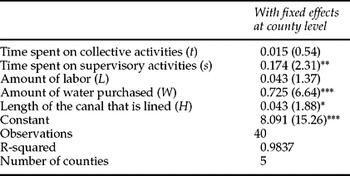
In creating a simulation model of the village's irrigation system that will allow us to study contractual choice, we use data (discussed below) to estimate the function coefficients (δ1 to δ5) of the irrigation services production function in equation (1).Footnote 7 In our empirical specification, we used a fixed effects model at the county level.Footnote 8 The estimation of irrigation production function performs well (table 1). Our data failed to reject the assumption that the production technology is characterized by constant returns to scale (CRS). The R2 is relatively high. Each of the input variables also has the expected positive signs.Footnote 9 Using our estimates, we are able to parameterize our model in (1) with parameters that are consistent with our data. For example, our baseline parameters for the production coefficients are: A = 3264.95, δ1 = 0.015, δ2 = 0.174, δ3 = 0.043, δ4 = 0.725, and δ5 = 0.043.Footnote 10 We also set the opportunity cost parameters of the leaders and managers, v = 1 and u = 0.8, so that they are consistent with what we observe in the field; in our data the average daily wage of leaders exceeds that of managers by about 20 per cent. We also set the level of the input prices, w = 0.8, r = 0.004, on the basis of our data; in our sample, water price per cubic meter (r) is around 0.5 percent of the observed daily wage (w).Footnote 11 Sensitivity analysis is performed throughout the analysis to ensure our choices of parameters are not driving the results.
Estimates of production function parameters for use in simulations  , CRS: δ1+δ2+δ3+δ4 + δ5 = 1

Notes: All variables are in log form.
t, s, and L are all measured using the unit of a labor day.
Absolute value of t-statistics in parentheses; * significant at 10%; ** significant at 5%; *** significant at 1%.
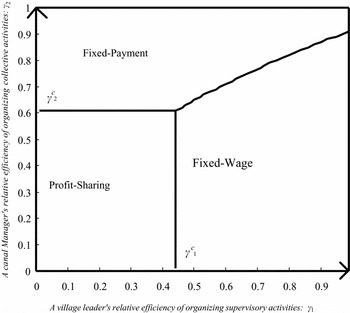
Figure 1 illustrates the partitioning of the contract space based upon the relative efficiency parameters, γ1 and γ2. In figure 1, γc1 and γc2 are the critical values of γ1 and γ2: the point at which the leader will choose to switch from a profit-sharing to a fixed-wage contract, or the point at which he will switch from a profit-sharing to fixed-rent contract. Values of γc1 and γc2 can be used to partition the contract space into those areas where each of the contracts is optimal. In the figure, we keep the values of the other parameters (A and δ1 to δ5) constant. The only thing that varies is γ1 and γ2. The determination of the critical values can be found by simulating the model (solving the three problems of leader – fixed-wage; fixed-rent; and profit-sharing – and comparing the profit levels of each to find which generates the highest expected income) across a grid of γ1 and γ2 values (varying each from 0 to 1 by increments of 0.01). The result of such an exercise is denoted by the solid lines in figure 1. If a characteristic of the village's irrigation system or the actors were changed, it is possible that γc1 and γc2 would change.Footnote 12
Optimal contractual forms under varying degrees of comparative advantage for village leader- and canal manager- supplied inputs

Predictions
The basic results from figure 1 can be used to gain some intuition about why the form of the contract between the leader and a manager varies across space. The relative efficiency of the leader (manager) to perform supervisory (collective) activities, γ1(γ2), differs from village to village. If besides having a superior ability to organize collective activities, such as canal maintenance, a leader also is willing and able to devote himself to supervisory activities, such as water allocation and fee collection (that is the leader has a relatively high value of γ1), the leader may choose to manage the village's canals by himself and at most only hire a foreman at a fixed wage to carry out certain routine irrigation tasks under his instruction. If on the other hand, a manager's ability to organize collective activities, γ2, is high, the leader may prefer to lease out the canal to an individual manager for a fixed-rent contract. When the leader (manager) has little hope of increasing his ability to carry out supervisory (organize collective) activities and the values of γ1 and γ1 are both low, the leader may choose a profit-sharing arrangement whereby both the leader and manager share in the duties and also share the system's earnings.
From figure 1, then, we can make the first prediction of the model:
Prediction 1: The dominant contractual form in a given village depends on the relative ability of the villager leader (manager) to perform supervisory (collective) activities. The more experienced the leader (manager) is at supervisory (organizing collective) activities, the more prevalent will be fixed-wage (fixed-rent) contracts.
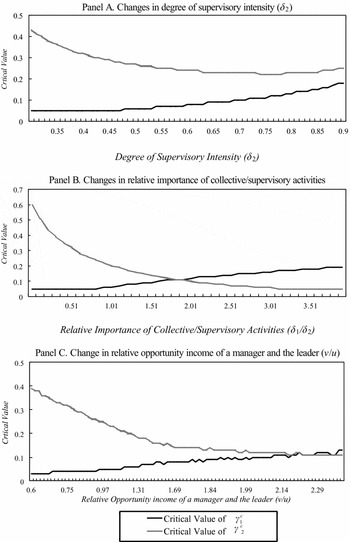
Even if the ability of the leader (manager) to perform supervisory (collective) sactivities is constant (that is, γ1 and γ1 are constant), changes in other factors might lead to changes in γc1 and γc2. Examining the associations between contractual choices and the other factors also will help explain differences among villages in their choices of irrigation system management. Panels A to C in figure 2 illustrate the results of three comparative static exercises.
Simulations of impacts of different factors on critical values of relative efficiency

According to the first exercise, the optimal managerial form depends on the nature of the village's cultivated land that can determine the relative importance of supervisory activities and collective activities (figure 2, panel A). For example, in villages with canal systems that wind intricately through fields of highly fragmented plots that are spread out spatially, the water delivery task is more demanding in that each household may grow different crops on different plots that have different water delivery quantity and timing requirements. Additional efforts are also needed towards the collection of water fees.
In such a setting, there is a greater need for the manager to take on supervisory activities. Therefore, a leader will be more likely to offer a fixed-rent contract to a managerial candidate who can more efficiently deliver water and meet the specific water delivery requirements of each household (figure 2, panel A). In the notation of our model, when supervisory activities are highly valued, the value of the parameter δ2 increases, and we can summarize with a second prediction:
Prediction 2: The optimal contractual form in a village depends on the nature of its cultivated land, such as the degree of land fragmentation. As land becomes more fragmented, supervisory activities become more valuable and the leader will be more likely to grant a fixed-rent contract to an individual manager.
Given the nature of village's cultivated land (and relative strengths of leaders and managers), the characteristics of the canal system also can determine the relative importance of the two activities. For example, lined canals typically require less maintenance (or are less maintenance intensive). In such a case, collective activities are less important. As a result, we might observe that δ1 (the importance of collective activities in producing irrigation services) decreases relative to δ2 (the importance of supervisory activities). Since the leader will not play a role in managing the day-to-day operation of canals, there is a relatively greater need for a motivated manager to operate the rest of the irrigation system. Under these circumstances, there should be a greater propensity for the profit-maximizing leader to move away from a fixed-wage contract into a fixed-rent contract (figure 2, panel B). Thus, we can make a third prediction:
Prediction 3: The optimal contractual form in a village depends on the design of the canal system that determines the degree to which the canal system is maintenance intensive. The less maintenance intensive is the canal system, the less important are collective activities, and the more likely it is that the leader will select a fixed-rent contract.
Finally, our model can show that, holding other factors constant, if the opportunity to find an off-farm job is high for the pool of individuals that potentially could take on the role of manager, the opportunity cost (u) of forgoing other jobs to take on the tasks of managing the village's canals will increase (figure 2, panel C).Footnote 13 In this case γ1c will decrease (or γ2c will increase) relative to that of a village in which it is more difficult for managerial candidates to find other jobs. The change in the relative values of the opportunity cost parameter of the managerial candidate versus the leader will change the bargaining power of the managerial candidate; as u rises, the leader will have to lower the fixed rent or increase the share (required by the managerial candidate) to attract the managerial candidate to take a fixed-rent or profit-sharing contract. As a result, under such circumstances, it would be less profitable for a leader to offer a fixed-rent or profit-sharing contract, and we can summarize this as follows:
Prediction 4: The optimal contractual form in a village depends on the opportunity cost of the leader and the pool of managerial candidates, which is associated with the socio-economic environment of the village. The wealthier a village is (or the more opportunities there are to find an off-farm job), the more likely it will be that a fixed-wage contract is chosen.
To summarize the results of our model, a number of factors affect the optimal choice of contract in rural China: the relative abilities of the leader and the manager, the nature of the cultivated land, the design of the canal system and the opportunity costs of the leader, and the pool of managerial candidates. The unifying mechanism driving this evolution, in all cases, is the relative change in the ability of the leader and manager to perform the unmarketable activities that are needed to provide irrigation services.Footnote 14
Data
The data for our study come from a survey that we conducted in 32 randomly chosen villages within two IDs in Ningxia, a province that is located in the upper reaches of the Yellow River Basin. The survey was conducted in January 2002. Within Ningxia province, we chose one ID in the upper reaches of the river basin and one in the lower reaches. Within the larger ID (Qingtongxia), which is comprised of nine counties, we chose one county from the upper, middle, and lower sections of the ID. In the smaller ID (Weining), we included both counties that make up the majority of the district's command area. From within each county we randomly selected two townships, from which we randomly chose two villages to include in our sample. In the survey, we administered a village-level questionnaire to the leader and a separate questionnaire to each village's canal manager, if there was one.Footnote 15
In our interviews and formal surveys with leaders and individual managers within each sample village, enumerators asked detailed information on the canal's contractual form and management activities in the year 2001. In particular, we asked the leaders and managers to list the activities that they were responsible for and the hours spent performing such activities (for example, activities such as cleaning canals, opening and closing sluice gates, and collecting water fees). Leaders and managers also reported the way in which they were compensated. For example, we asked for each actor's share of the profits from the operation of the irrigation system. In order to classify a contract as fixed-wage, we include villages in which there was no one except the village leaders involved in canal management (6 per cent of fixed-wage contracts) and villages in which the foreman (or person – who is not a cadre – responsible for the operation of the canal system) is paid either a truly fixed-wage – 88 per cent – or is paid a salary that is less than 10 per cent of the profits of the irrigation system – 6 per cent. A contract is categorized as a fixed-rent contract if the manager is the full residual claimant of the earnings of the irrigation system (i.e., his share is 100 per cent and the village only receives a lump-sum fee that is paid before beginning of the agricultural season). The remainder of the canal systems is categorized as profit-sharing contracts.
The manager survey collected information on a wide number of other variables that we use to explain the determinants of contractual choice.Footnote 16 To measure the nature of the cultivated area within which the canal system is operated (which in theory should also affect the relative importance of collective and supervisory activities), we included questions that led to the creation of two variables. The degree of fragmentation is measured as the average number of plots of each household in the village.Footnote 17Water abundance is measured as an indicator variable that takes the values of 1, 2, 3, or 4. Water abundance is equal to 1 when a village's water resources are considered (by the village leader's subjective evaluation) to be highly scarce and equal to 4 when its water resources are considered to be abundant.
We also created three variables to measure the design of the village's canal infrastructure: canal lining (measured as lined if at least 10 per cent of the length of the canal system within the village is lined); the propensity to silt up (which is a dummy variable that is equal to 1 if the respondent answered yes to both of the following questions: Does your canal system ever silt up? Is the siltation considered to be serious?); and the density of sluice gates (measured on a per kilometer basis as the number of openings in the irrigation system that were designed to move water from the irrigation canal network into the fields of farmers). These three variables are included to measure the relative importance of collective and supervisory activities in each village's irrigation system.
To capture the opportunity cost of the pool of managerial candidates, we construct two variables from the leader questionnaire that asked about the socio-economic status of the village in detail for years 1990, 1995, and 2001. The opportunity cost of the pool of managerial candidates is captured in part by the share of off-farm income. This is measured as the average share of off-farm income in total household income. Alternatively, we measure the opportunity cost as the proportion of migrants, which is measured as the percentage of the village's labor force that lives and works outside of the village for at least one month per year. Both variables were measured during 1995 in order to make them exogenous.
Finally, we use standard measures of human capital, education, and age, as proxies for the ability of leaders and managers to organize collective activities or take on supervisory activities. The level of education of the leader is measured as the number of years of education actually attained by the leader. Better-educated leaders may be better suited to run supervisory activities versus those with poorer education. The age of the leader captures the level of physical fitness of the leader (which will fall with age) and may be associated with the leader's ability to undertake the strenuous demands of executing supervisory activities during the peak irrigation seasons. The level of education of the managerial candidates is measured at the village level as the percentage of the village labor force that has attained at least a high school education. The use of this variable depends on the assumption that managers that come out of such a pool would have a stronger inherent ability to organize collective activities. Descriptive statistics of the main variables in our study are in Appendix B.
Contractual choices and the nature of the irrigation system
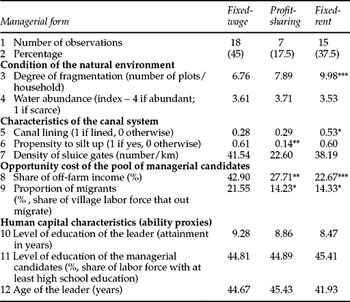
Similar to what Wang et al. (Reference Wang, Xu, Huang and Rozelle2005b) found, our data show that water management reform was implemented in some villages but not others (table 2, rows 1 and 2). If villages that use fixed-wage contracts are categorized as unreformed villages, most of the reformed villages in our sample started to use either a profit-sharing or fixed-wage contract to manage the canals. In our sample, most of the reformed villages (82 per cent) started to use either a profit-sharing or fixed-rent contract to manage their canals in either year 2000 or 2001. Other villages started earlier. For example, one village started to use a fixed-rent contract as early as 1995. Although a substantial share of leaders chooses either profit-sharing or fixed-rent contracts (17.5 per cent and 37.5 per cent respectively), fixed-wage contracts are still the dominant form of canal management (45 per cent). Hence, there are still many villages in our sample that have yet to reform.
Characteristics of canals, water resources, village leaders, and villages under different water managerial forms (Ningxia Province, China 2001)

Notes: *denotes the difference between the mean under profit-sharing or fixed-rent contract and under a fixed-wage contract is significant at 10%; **significant at 5%; ***significant at 1%.
The descriptive statistics are largely consistent with predictions derived from theory. The contractual choices of the leaders seem to vary systematically with the nature of the village's cultivated land, the characteristics of the canal system, the human capital, and the opportunity cost of the leader and managerial candidates. When the degree of fragmentation of a village's cultivated land is high, the leader appears to be more likely to use a fixed-rent contract (table 2, row 3). When the canals in a village's irrigation system are lined, villages apparently are less likely to be run as a fixed-wage contract (only 28 per cent of the 18 irrigation systems with lining are run as fixed-wage contracts – row 5). In contrast, irrigation systems that have a higher propensity to silt up appear to be more likely to be run under fixed-wage contracts (row 6). In villages with fixed-wage contracts, the share of off-farm income in a villager's total household income is almost twice that of villages with fixed-rent contracts (42.9 per cent versus 22.7 per cent, row 8). Villages also appear to favor fixed-wage contracts when a greater share of the labor force out-migrates (row 9).
The descriptive statistics, however, also uncover some patterns that are not entirely consistent with the predictions. In examining more closely the relationship between the propensity to silt up and contractual choice, we observe an up–down–up pattern when moving from fixed-wage contracts (highest) to profit-sharing (lowest) to fixed-rent contracts (higher than profit-sharing and lower than fixed-wage). We find another type of non-linearity in the relationship between the contractual choice and some of the covariates (e.g., with water abundance – table 2, row 4; and age of leader – row 12). In these cases, we observe a down-up-down pattern when moving from fixed-wage contracts (lower than profit-sharing but higher than fixed-rent contracts) to profit-sharing contracts (highest) to fixed-rent contracts (lowest). It is possible that in table 2 we are only observing two-way correlations and so we are not able to observe the true underlying relationships. In the next section, we then move to use multivariate analysis to examine more rigorously these relationships.
Explaining contractual choice in canal management: multivariate analysis
In order to measure the net contributions of possible factors identified in the last section and to statistically test the theoretical predictions from the contractual choice model, we run a series of multinomial, limited dependent variable regressions using the data that are available for our sample canals. Our empirical framework helps us answer the question: what factors in a particular locality induce the leader to choose to offer managerial candidates a fixed-wage, profit-sharing, or fixed-rent contract?
Our dependent variable is a discrete outcome variable with three alternatives

Since the explanatory variables that we use are alternative invariant, a multinomial logit (MNL) model is used in our analysis. In equation form, the basic model can be written as

where j is the index for the alternatives and i is the index for our observations.
From equation (2), we know that

The term,  , is the log of the relative probability that choice j will be chosen over choice m. In Greene (Reference Greene2004), this term is called the log-odds ratios. We will use this terminology in the rest of the paper. Conveniently, the log-odds ratios are linear in the parameter vector βj. Suppose the choice m is the base category in the multinomial logit regression, the parameter vector βm is normalized to be zeros. Now βj represents the marginal effect of the independent variables on the log-odds ratio. For example, if in the regression results,
 is positive and statistically significant, we can say that a marginal increase in the kth independent variable will make the village leader more likely to choose choice j as opposed to choice m.
We include in the x vector those factors that we included in the descriptive analysis to test our predictions about the determinants of contractual form. We explain contractual choice as a function of the nature of the village's cultivated land, the design of the canal, the opportunity costs of the pool of managerial candidates and leaders, and the human capital characteristics of the leaders and managerial candidates. Specifically, we use the degree of fragmentation and water abundance to test prediction 2. We use the canal lining, propensity to silt up, and density of sluice gates to measure the characteristics of the canals in the village to test prediction 3. We use two measures of the relative opportunity cost of canal managerial candidates and leaders, the share of off-farm income, and the proportion of migrants in the village to test prediction 4. Finally, we use the human capital characteristics of leaders – the level of education and age of the village leader, and the average level of education of those in the pool of managerial candidates in order to test prediction 1.
Estimation issues
Since we only have a small sample of data that we can use in our analysis (n = 40), there may be multicollinearity in the data.Footnote 18 To check this, we conducted collinearity diagnostic to detect potential collinearity in the data (Belsley, Reference Belsley1991). Fortunately, we only detected a minor collinearity in the data (the condition index was less than 100).
We also tested various specifications of the model (that is, different combinations of explanatory variables) to examine the robustness of the estimation results. The results show that although the absolute magnitudes of the coefficients of the same variable vary with different combinations of explanatory variables, the relative magnitudes, the signs, and the significances of the coefficients are largely consistent.Footnote 19 Since the focus of our analysis is the directions of the impacts of the explanatory variables on the relative probabilities of different types of contracts being chosen by the village leaders, the variations in the magnitudes of the coefficients do not impair our analysis.
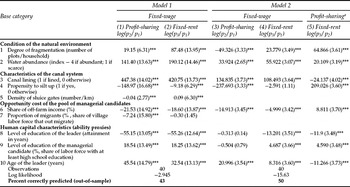
Given the differences in the estimation results generated by different model specifications, the natural question to ask is which specification is the best. We compare the out-of-sample predictions of our models to choose the ‘best’ model for our analysis. In particular, we used a leave-one-out, cross-validation procedure (Allen, Reference Allen1974). Using the results from the out-of-sample prediction, we then calculate the value of the percent correctly predicted (PCP) measure, which is defined as the percentage of the sampled village leaders for whom the contractual form with the highest probability (as in the out-of-sample prediction) and the chosen contractual form (as observed in the data) are the same.Footnote 20 The model with the highest PCP should have the property of minimizing the impact of the small sample problems on the results of the analysis. Comparison of the values of PCP shows that models with fixed effects at the county level have higher values of PCP than models without fixed effects. Among the models with fixed effects at the county level, model 2 in table 3 has the highest PCP. That is the basis of our choice of right-hand side variables.Footnote 21
Multinomial logit regressions with fixed effects at county level explaining contractual choice by the village leader in Ningxia Province

Notes: Robust z statistics in parentheses, *significant at 10%; **significant at 5%; ***significant at 1%
Since the coefficients for the Fixed-wage equation when the profit-sharing contract is treated as the base category would have the opposite sign and same magnitude as the coefficient for the profit-sharing equation when the fixed-wage contract is treated as the base category (column 3), it is not reported in the table for brevity.
The dependent variable in our regression is the contractual form existing in the village in year 2001. Using the values of some of the key independent variables (water abundance, the share of off-farm income, proportion of migrants) from the same year may cause problems of endogeneity bias. To avoid the possible endogeneity problem, we chose to use 1995 values for these independent variables.
A potentially important drawback of the MNL model is the implicit assumption of independence of irrelevant alternatives property (IIA, Hausman and McFadden, Reference Hausman and McFadden1984; Small and Hsiao, Reference Small and Hsiao1985). When we test whether the IIA property holds for our multinomial logit regression, both the Small–Hsiao test and the Hausman test fail to reject the null hypothesis of IIA. Therefore, we believe that it is safe to assume that the IIA property holds for our data and that a multinomial logit approach is appropriate.
Results
Since we are interested in the leader's choice of one type of contract over another, in table 3 we report coefficients that represent the relative probability of choosing one alternative over another. In general, our empirical estimations perform satisfactorily, especially given the fact that our sample is relatively small (table 3).Footnote 22 The goodness of fit measure, pseudo R2, is around 0.9 for the multinomial logit equations with county dummies, which is quite high for analyses that use cross-sectional data. The coefficients are also jointly significant.
Most importantly, many of our results support the predictions of our model and help us identify factors that induce some villages to run their irrigation systems under fixed-rent contracts, while others run them under profit-sharing or fixed-wage contracts. For example, the multivariate analysis is consistent with prediction 2. The contractual choices vary systematically with the nature of the village's cultivated land. The coefficient in the fixed-rent equation on the variable Degree of fragmentation is positive and statistically significant when the fixed-wage contract is treated as the base category (table 3, row 1, column 4). Hence, the village leader is more likely to choose a fixed-rent contract relative to a fixed-wage contract. The positive and statistically significant coefficient in the fixed-rent equation when the profit-sharing contract is treated as the base category indicates that the village leader is also more likely to choose a fixed-rent contract relative to a profit-sharing contract (row 1, column 5). In short, when the degree of land fragmentation is higher and the coordination of water delivery is likely to be more complex and require closer supervision, the leader finds fixed-rent contracts more profitable.Footnote 23 The relationship between water abundance and the contractual choices is also in line with prediction 2. The positive and statistically significant coefficients show that the village leader is more likely to choose a fixed-rent contract as opposed to a fixed-wage contract (row 2, column 4) or a profit-sharing contract (row 2, column 5) when water resources become more abundant. Such a relationship may mean that when there is more water, there is likely to be less conflict over water and thus less need for the leader's skill at resolving the water-related conflicts. Moreover, with abundant water resources, there is more scope for the manager to utilize his skill at supervising water usage (e.g. managing the sluice gates in a way that avoids excess water loss). Savings on the volume of water as an input in providing irrigation services increase the level of profit and, under such circumstances, the manager is more likely to be willing to take a fixed-rent contract.
The signs on the other sets of variables are somewhat supportive of the other predictions. When looking at the effect of characteristics of the canal system on the decision to choose a fixed-rent contract versus a fixed-wage contract, our data support prediction 3. The positive sign on the canal lining variable demonstrates that as increasing investment improves the conditions of canals, the leader has a propensity to switch from a fixed-wage contract to a profit-sharing or fixed-rent contract (table 3, row 3, columns 3 and 4). On the other hand, the negative sign on the propensity to silt up variable indicates that a canal that often silts up and requires more cleaning makes the leader more reluctant to provide the managers with a fixed-rent contract or a profit-sharing contract (table 3, row 4, columns 3 and 4). Likewise, the multivariate analysis shows that in canal systems in which the density of sluice gates is higher, the leader is more likely to use a fixed-rent contract as opposed to a fixed-wage contract or a profit-sharing contract (table 3, row 5, columns 1 and 2).
Our estimated effects of variables representing the opportunity costs of the managerial candidates and the leader also are consistent with our theory (prediction 4). The negative and statistically significant coefficients on the share of off-farm income variable in both the profit-sharing equation and the fixed-rent equation when the fixed-wage contract is treated as the base category show that when villagers have more access to off-farm activities, the leader is more inclined to run the canal system under a fixed-wage contract as opposed to a profit-sharing contract or a fixed-rent contract (table 3, row 6, columns 3 and 4). Similarly, the coefficient on the proportion of migrants variable indicates that when there are more migration opportunities (i.e., it is easier to find an off-farm job outside the village), it is less likely that a managerial candidate will take a profit-sharing or fixed-rent contract as opposed to the case when the village leader runs the canal system under a fixed-wage contract (table 3, row 7, columns 1 and 2).
While generally consistent with the basic model, the relative magnitudes (and in one case the sign) of the coefficients on the variables measuring the three characteristics of the canal system and on the coefficient of both the opportunity cost variables show that there are nonlinearities in the relationship. For example, similar to the analysis in the descriptive statistics, as the propensity of the canal to silt up increases, the village leader is less likely to select a profit-sharing contract as opposed to a fixed-rent contract (table 3, row 4, column 5). We also observe the same nonlinearities as the share of off-farm income or the proportion of migrants increases (table 3, rows 6 and 7). Under a profit-sharing contract, since the manager and the leader can only claim a fraction of the residual profits, they have weaker incentives. Given costly monitoring in our theoretical framework, it is possible that the manager will shirk and a moral hazard problem could arise (Marshall, Reference Marshall1956; Otsuka et al., Reference Otsuka, Chuma and Hayami1992). For example, when the managerial candidates have more access to off-farm employment, they are likely to be able to generate higher earnings by working off-farm. In such a circumstance, they would have more of an incentive after taking a profit-sharing contract to shirk by spending as little time working on water management and as much time as possible off the farm. Knowing this, even though the characteristics of the canal and environment are such that profit sharing may be the optimal contractual arrangements (in the absence of imperfect information), the leader would be less inclined to offer the manager a profit-sharing contract.
Our results also contain nonlinearities that are consistent with the idea that the contractual arrangements between leaders and managers are affected by the role that profit-sharing contracts can play in sharing risk. In our theoretical model, both the leader and the manager are assumed to be risk-neutral. In an environment with uncertainty (reflected by the parameter, θ, in equation (1)), whether the leader and/or the manager are risk-neutral will affect the contractual choices. As is well known in the share contracting literature, with production uncertainty, the choice of contractual form affects not only the share of the responsibilities and the residual profit, but also the sharing of risk between the leader and the manager (Otsuka et al., Reference Otsuka, Chuma and Hayami1992). Under a fixed-wage contract, the leader is burdened with all the risk. In contrast, the manager shoulders all the risk under a fixed-rent contract. The leader and the manager share the risk under a profit-sharing contract. According to our basic theory, when canals are lined, collective activities play less of a role and so leaders, ceteris paribus, are more inclined to rent the canal system to an individual manager. The positive and statistically significant coefficients on the canal lining variable in the profit-sharing and fixed-rent equations (table 3, row 3, columns 3 and 4) confirm the idea that the village leader is more likely to use a fixed-rent contract or a profit-sharing contract as opposed to a fixed-wage contract. However, the results also show that the village leader is more likely to use a profit-sharing contract as opposed to a fixed-rent contract (table 3, row 3, column 5). If leaders in such systems are willing to rent out the canal system, but managers, who are risk averse, are less willing to accept such an offer (because of the risk they assume as the contractor), it could be that the leader finds it optimal to engage the services of the manager as a profit-sharing contract. In this case, although the incentives for the manager are less than under a fixed-rent contract, the additional risk sharing offered by the profit-sharing contract is enough to get more managers to accept a managerial role.
Multivariate analysis also provides some support for prediction 1: the optimal contractual choice depends on the relative abilities of the leader and potential managers. The negative signs on the coefficients of the level of education of the leader indicate that more capable leaders (that is, those with higher education) are less likely to run the canal system under a fixed-rent contract as opposed to running it by themselves under a fixed-wage contract or sharing the responsibilities under a profit-sharing contract (table 3, row 8, columns 4 and 5). In contrast, when the pool of managerial candidates is better educated and thus is more capable of running the irrigation system by themselves, leaders are more likely to use a fixed-rent contract as opposed to a fixed-wage contract or a profit-sharing contract (table 3, row 9, columns 4 and 5). Older leaders may be less able to manage the canal system (due to need to exert high levels of effort). Hence, older leaders are less likely to use a fixed-wage contract as opposed to a profit-sharing contract or a fixed-rent contract (table 3, row 10, columns 3 and 4). As above, however, the basic theory is not complete, since there is some evidence that our results are consistent with the idea that profit-sharing contracts are in fact demanded since they reduce risk.
Conclusion
The main purpose of our paper is to explain the puzzling fact that in pursuing water management reform, leaders have provided incentives to managers in some areas, but not in all. Our findings indicate that one of the reasons that not all leaders provide strong incentives stems from the specific characteristics of the irrigation system. If the conditions of canals do not allow for profitable operation of the canal under a profit-sharing or fixed-rent contract, the leader would not lease out the canal to the manager. In addition, the nature of the village's resources and its economic environment as well as the characteristics of its leaders and the pool of possible managers will affect contract choice. The absolute advantage-based explanation for the determinants of contractual choice explains much of what we observe in rural China. The findings also suggest contractual choice may also depend on risk sharing and imperfect information.
Regardless of the exact determinants of contractual choice, our findings do help explain why even though strong incentives promote water savings, they are not used in all villages. The simple answer is that they are not appropriate to all villages. Hence, in China's future design of water management reforms, policy implementation should depend on the local conditions of the villages and it should be recognized that not one reform path fits all villages. Concretely, when designing policies on water management reform, instead of simply requesting leaders to provide incentives, China's policymakers need to take into account the features of the area where the reform is going to take place.
Our results also have implications for the design of China's broad water reform strategy. According to our results, water management reform has potential to work in some areas. Hence, it should be encouraged. However, in other areas reforms will not be appropriate. In such areas, pushing water management reform will not only be difficult, but may produce negative results if forced. Losing the leader's active participation could be counterproductive in villages that need collective action to be mobilized. In these other villages, if water is to be saved, upper-level policy officials may have to look beyond water management reform. In general, this means that a more integrated water reform strategy, using water management reform (with the support of complementary policies in some areas) and focusing mostly on complementary policies in others may be more successful in the long run.
Appendix A. Time spent on collective and supervisory activities per unit length of the canal in year 2001 (Unit: labor day/meter)

Note: Standard deviations in parentheses.
Appendix B. Descriptive statistics of variables

Note: aIf = 1, fixed-wage; if = 2, profit-sharing; if = 3, fixed-rent.
Appendix C. Multinomial logit regressions explaining contractual choice by the village leader in Ningxia Province (with fixed effects at county level) – marginal effects in model 2a

Notes: Robust z statistics in parentheses, * significant at 10%; ** significant at 5%; *** significant at 1%.
aThe marginal effects are calculated using two steps. In the first step, the changes in the quantities of interest are evaluated at each observation first. In the second step, the sample averages of these changes are reported as the average marginal effects in Appendix C. The standard errors (and thus the z statistics) are calculated using the delta method.