Introduction
Approximately 90 million Americans currently live with chronic, life-threatening illnesses, and this number is expected to double in the next 25 years (Center to Advance Palliative Care, nd). People with chronic and debilitating illnesses and those nearing the end of their lives have different and often more complex needs than younger and healthier people. This creates a need for longer-term comprehensive care in addition to shorter-term curative treatments. Palliative care (PC) is intended to complement curative treatment and can be offered early in the course of a serious illness (Center to Advance Palliative Care, nd). This contrasts with hospice care, a subtype of PC that is reserved for the last 6 months of an individual's life when only comfort care is indicated in the USA. The goal of PC is to improve the quality of life for both the patient and the caregiver. When a patient experiences chronic and life-threatening illness, PC helps by preventing and relieving suffering through early identification and treatment of pain (physical, psychosocial, and spiritual) (World Health Organization, nd). It also offers a support system to help the family/caregivers cope during the patient's illness (World Health Organization, nd). Integrating PC into the continuum of care increases patient and family satisfaction, improves the quality of care, can extend survival, and may lower costs (Morrison et al., Reference Morrison, Penrod and Cassel2008; Temel et al., Reference Temel, Greer and Admane2011; Zimmermann et al., Reference Zimmermann, Swami and Krzyzanowska2014; Bakitas et al., Reference Bakitas, Tosteson and Li2015; El-Jawahri et al., Reference El-Jawahri, Traeger and Greer2017). Despite these benefits, the proportion of patients with PC-eligible conditions who receive such care is unknown.
However, reports indicate that approximately six million Americans could benefit from PC (Center to Advance Palliative Care, nd). Even though the number of US hospitals offering PC services has increased over the past decade (Bruera and Hui, Reference Bruera and Hui2012), studies show that many patients who would benefit from PC either receive it too late in their illness for significant benefit or not at all (Kozlov et al., Reference Kozlov, Carpenter and Thorsten2015; Gidwani et al., Reference Gidwani, Joyce and Kinosian2016). One means to increase PC utilization is to have eligible patients and/or caregivers advocate for such service on their own behalf (complementary to clinician-based interventions designed to increase compliance with care and prescribing guidelines). Other means to increase PC utilization include increasing a referral to PC services by providers, enhancing the PC workforce, investing in the field's science base, and increasing the availability of PC services in US hospitals and nursing homes (Meier, Reference Meier2011; Ferrell et al., Reference Ferrell, Temel and Temin2017).
To develop interventions that promote PC utilization among the general public, we must have a better understanding of access barriers. One likely barrier is low public knowledge and awareness of PC. Research in other contexts has shown that patient knowledge of health services drives service utilization, and that patients accept or seek services which they know are relevant to their conditions (Grossman and Kaestner, Reference Grossman, Kaestner, Behrman and Stacey1997). While studies regarding patients' knowledge of PC are sparse, one community study in the USA found knowledge to be generally low (mean score of 5.25 of a possible 13 using the Palliative Care Knowledge Scale) (Kozlov et al., Reference Kozlov, McDarby and Reid2018). In addition, most people incorrectly equate PC to hospice, itself associated with end of life; so, they may be unwilling to accept a referral for PC (Schreibeis-Baum et al., Reference Schreibeis-Baum, Xenakis and Chen2016; Slomka et al., Reference Slomka, Prince-Paul and Webel2016). If patients and family members understand the true aim and benefits of PC, they may be more likely to ask providers for a referral and may subsequently be more willing to participate in a program. Increased knowledge of PC among patients and family members may remove misconceptions and improve patient willingness to utilize this valuable and evidence-based service.
Prior research regarding the knowledge of PC has been primarily conducted among healthcare providers, individuals in a community context, or populations outside the USA (Morita et al., Reference Morita, Miyashita and Shibagaki2006; Kassa et al., Reference Kassa, Murugan and Zewdu2014; Wilson et al., Reference Wilson, Avalos and Dowling2016; Dimoula et al., Reference Dimoula, Kotronoulas and Katsaragakis2018; Kozlov et al., Reference Kozlov, McDarby and Reid2018). Clearly, more research is needed to clarify the depth of individual knowledge about PC, especially among those actively seeking care. Therefore, the aims of this study were to use a nationally representative survey to (1) quantify PC knowledge and examine factors that are associated with PC knowledge, (2) identify sources of PC information among those knowledgeable about PC, and (3) assess beliefs about PC among those who have knowledge about PC.
Methods
Data source and sample
The Health Information National Trends Study (HINTS) is a nationally representative survey mailed to civilian non-institutionalized adults aged 18 years and older. It has been conducted yearly by the National Cancer Institute (NCI) since 2003. A two-stage sampling strategy was used: households using addresses were selected using a random sample, and within each household, one adult was selected. HINTS 5 (Cycle 2) was conducted from January 26 to May 2, 2018, and the overall weighted response rate was approximately 33%. Extensive details on the study design, methods, and sampling plan of the HINTS can be found at https://hints.cancer.gov/ and elsewhere (Finney Rutten et al., Reference Finney Rutten, Davis and Beckjord2012).
Measures
PC knowledge was assessed with the HINTS question “How would you describe your level of knowledge about palliative care?” Responses included: (i) I know a little bit about PC, (ii) I know what PC is and could explain it to someone else, and (iii) I've never heard of it. For the logistic regression analysis, both responses (i) and (ii) were combined as having any knowledge about PC.
To assess sources of health information about PC, the following item was used “Imagine you had a strong need to get information about PC. Where would you go first to get information?” Responses to this item were grouped into four categories: (i) printed materials (newspapers and magazines), (ii) healthcare provider (doctor, nurse, and social worker), (iii) interpersonal sources [conversations with people you trust] (friends, relatives, or coworkers), and (iv) internet/social media (Google or another search engine, WebMD or another medical website, Facebook, or Instagram).
To assess trust in sources of PC health information, respondents were asked this question in HINTS: “Imagine you had a strong need to get information about palliative care. Which of the following would you most trust as a source of information about palliative care?” Responses were grouped into the same four categories as above: (i) printed materials, (ii) healthcare provider, (iii) interpersonal sources, and (iv) internet/social media.
Beliefs about PCs were assessed with two set of questions that were asked in the HINTS. The first question was assessed with these statements: (a) PC goal is to help friends and family to cope with a patient's illness, (b) PC goal is to offer social and emotional support, (c) PC goal is to manage pain and other physical symptoms, and (d) PC goal is to give patients more time at the end of life. Responses to each question were coded as (a) strongly agree or somewhat agree, (b) strongly disagree or somewhat disagree, and (c) don't know.
The second question was assessed with these statements: (i) accepting PC means giving up, (ii) it is a doctor's obligation to inform all patients with cancer about the option of PC, (iii) if you accept PC, you must stop other treatments, (iv) PC is the same as hospice care, and (v) when I think of PC, I automatically think of death. Responses to each question were coded as (a) strongly agree or somewhat agree, (b) strongly disagree or somewhat disagree, and (c) don't know.
Sociodemographic characteristics and other covariates with their categorizations included in the study were: age, gender, race/ethnicity, marital status, education, household income, employment status, health insurance, regular provider, general health, number of healthcare visits within past year, internet use, history of cancer, family history of cancer, and census region (Table 1). A HINTS original coding scheme was retained or recoded when necessary for analytical purposes.
Characteristics of survey respondents, HINTS 5 Cycle 2 (N = 3,504)

HINTS, Health Information National Trends Study.
Totals may not add to sample size because of missing data.
Statistical analysis
Analyses were performed using SAS (Version 9.4) procedures which incorporate survey sampling weights to account for the complex sampling design used in the HINTS and to provide representative estimates of the US population (SAS Institute Inc., Cary, NC). Jackknife weights, provided by HINTS, were used for calculating standard errors. Weighted, unadjusted prevalence estimates (%) and 95% confidence intervals were used to assess PC knowledge, sources of PC information, trusted sources of PC information, and beliefs about PC. A weighted, multivariable logistic regression model examined the factors (age, gender, race/ethnicity, marital status, education, household income, health insurance, regular provider, general health, internet use, and history of cancer) that were associated with PC knowledge. Statistical significance was set at p < 0.05, and all tests were two-tailed. The analysis was performed in December 2018.
Results
A total of 3,504 respondents were included in this study. The majority were non-Hispanic whites (59.7%), married or living with a partner (52.4%), had health insurance (91.5%), had a regular provider (65.5%), and used the internet (82.8%). Approximately 29% reported having knowledge about PC (18.0% knew a little about it and 10.8% knew enough to be able to explain it to others; Table 1).
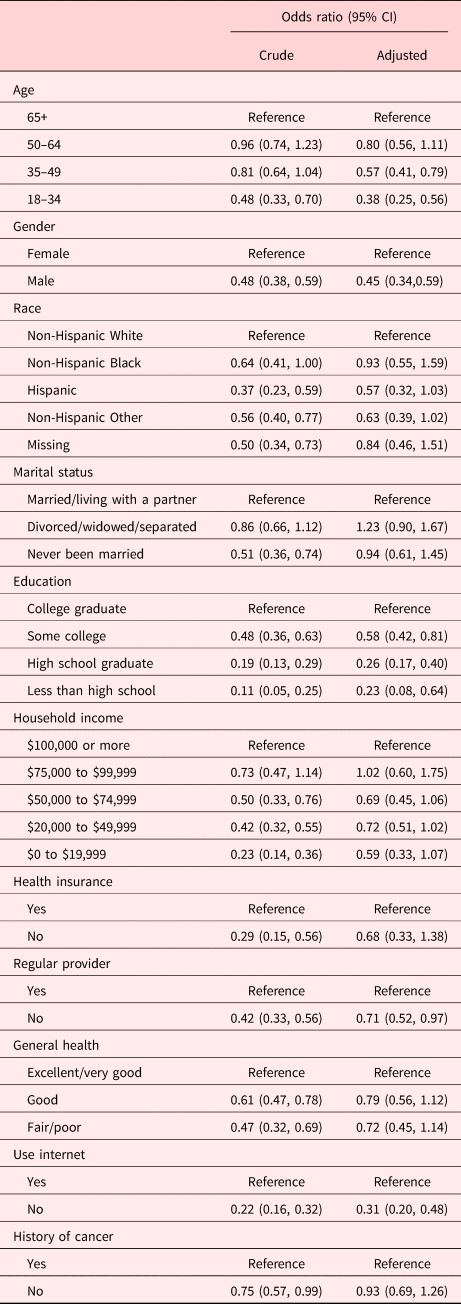
There were differences in the characteristics of respondents based on whether or not they had heard about PC (Table 2). Results from the adjusted logistic regression showed that respondents who were less likely to have any knowledge about PC were mostly those 18–34 years old (aOR = 0.38; 95% CI = 0.25, 0.56) or 35–49 years old (aOR = 0.57; 0.41, 0.79) compared with those over 65 years old. Similarly, compared to females, males (aOR = 0.45; 0.34, 0.59) were less likely to have any knowledge about PC, as well as non-internet users (aOR = 0.31; 0.20, 0.48) compared with internet users. Additionally, respondents who held college degrees were more likely to have knowledge of PC than those with less than a high school diploma (aOR = 0.23; 0.08, 0.64), those who had only graduated from high school (aOR = 0.26; 0.17, 0.40), and those who had some college education (aOR = 0.58; 0.42, 0.81).
Unadjusted and adjusted odds ratios of having any knowledge about PC, HINTS 5 Cycle 2

HINTS, Health Information National Trends Study.
Among respondents who had any knowledge about PC (1,162), the majority reported going first to a healthcare provider (55.1%), followed by going to the internet/social media (30.4%), with printed materials being the least popular information source (Figure 1A). Respondents' rating of trust in healthcare providers as a source of PC information exceeded that of any other information channel. We found healthcare providers (80.0%) to be the most trusted source of PC information among those who had any knowledge about PC, followed by the internet (8.8%), and printed materials (1.2%) were again the least trusted (Figure 1B).
(A) Sources of PC information, (B) Information sources trusted by PC knowledgeable respondents, HINTS 5 Cycle 2 (January 2018 to May 2018). # includes doctor, nurse, or social worker. $ includes newspapers or magazines. % includes friends, relatives, or coworkers. * includes Google or another search engine, WebMD or another medical website, Facebook, or Instagram. HINTS, Health Information National Trends Study.

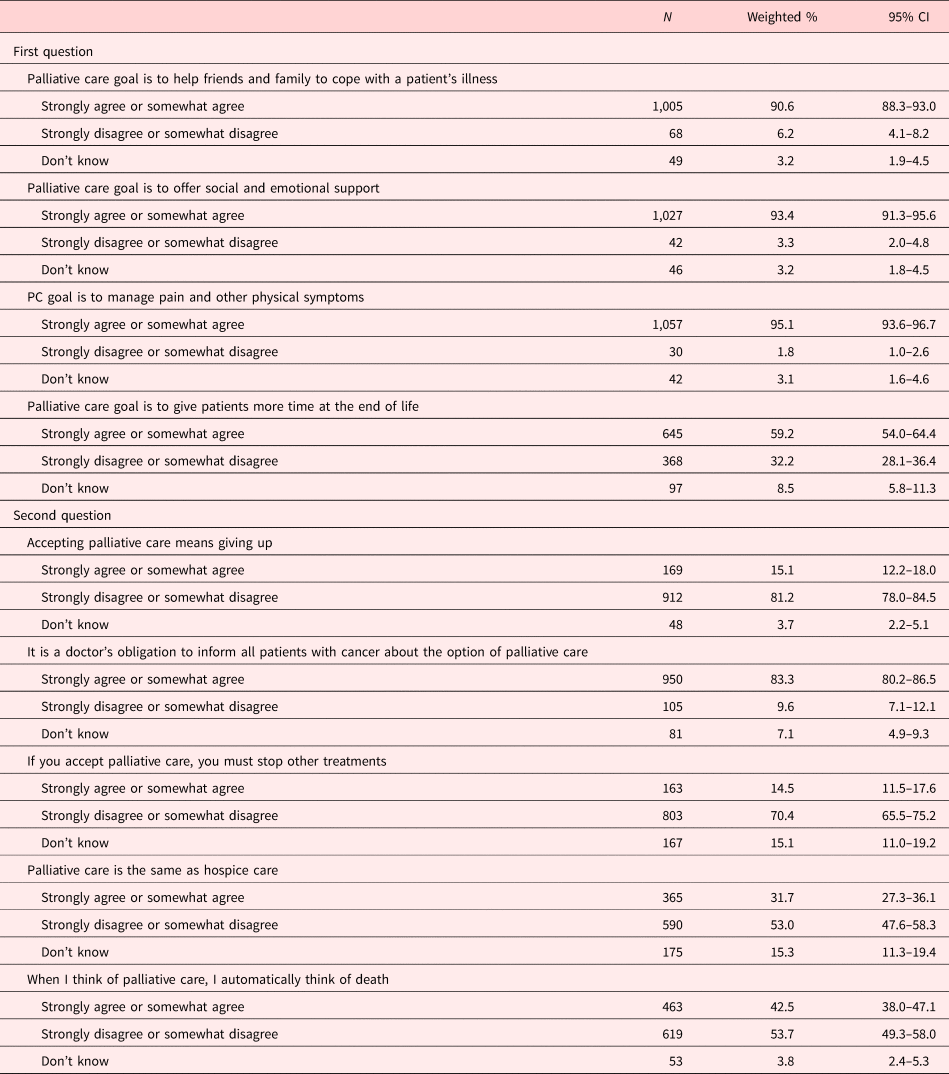
Table 3 presents beliefs about PC among respondents who had knowledge about PC. Most of these participants strongly/somewhat agreed that the goal of PC is to help friends and family to cope with a patient's illness (90.6%), offer social and emotional support (93.4%), manage pain and other physical symptoms (95.1%), and give patients more time at the end of life (59.2%). The majority strongly/somewhat agreed that it is a doctor's obligation to inform all patients with cancer about the option of PC (83.3%). But most strongly/somewhat disagreed that accepting PC meant giving up (81.2%) and that accepting PC meant one must stop other treatments (70.4%).
Beliefs about PC among respondents who had knowledge about PC, HINTS 5 Cycle 5 (N = 1,162)

HINTS, Health Information National Trends Study.
Totals may not add to sample size because of missing data.
Discussion
The findings of this study were fourfold. First, we found that PC knowledge in the USA was low, with only one in three individuals having any knowledge about PC. Second, there were sociodemographic differences between those who had heard about PC. We found that younger respondents, males, and those with lower levels of education had less knowledge about PC. Third, among respondents who had any knowledge about PC, most went to healthcare providers first for more information and they also endorsed healthcare providers as the most trusted source of information. Finally, most respondents agreed that it is a doctor's obligation to inform all patients with cancer about the option of PC. In order to expand the use of PC services, we need to better understand PC knowledge among the general population. It should be noted that PC reflects the USA model since PC definitions differ widely globally. In addition, it is possible that the US population may be different than the global population due to the differences in access to care and the availability of resources.
The low level of knowledge found in this study may be due to multiple reasons. First, it may be associated with hospitals not being equipped to provide PC to patients (and therefore less likely to discuss or promote PC). Although the number of US hospitals offering PC services has increased over the past decade, a previous study reported that nearly one-third of US hospitals with more than 50 beds do not provide any PC services (Dumanovsky et al., Reference Dumanovsky, Augustin and Rogers2016). Another reason may be due to healthcare providers' low awareness/knowledge about PC. Studies have shown that providers' PC knowledge is low, possibly due to a lack of training (Osta et al., Reference Osta, Palmer and Paraskevopoulos2008; Kavalieratos et al., Reference Kavalieratos, Mitchell and Carey2014; Haines et al., Reference Haines, Frost and Kane2018). The low PC knowledge highlights the need to develop strategies to enhance awareness of the potential role that PC can play in caring for patients and their families among the general population and also healthcare providers. Increasing PC knowledge among healthcare providers would be expected to increase the frequency with which the topic is discussed. Improving patient's awareness of PC may help improve PC services utilization by increasing their request for that service. In addition, when physicians refer their patients for PC, they may be more likely to accept if they have a better/correct understanding of what PC actually entails. For instance, because hospice is mistakenly and frequently equated with PC (we found that 32% of respondents agree that PC was the same as hospice care), patients and their families may be unwilling to accept a referral for PC early in the disease trajectory if curative treatments are still pursued (Maciasz et al., Reference Maciasz, Arnold and Chu2013). Prior research on PC knowledge and education has primarily focused on healthcare providers especially nurses, but this education should be expanded to include patients and their families.
This study found that males and those with lower education levels have the least knowledge about PC. Women, in general, seek more health information and usually have higher knowledge about health-related information than men (Mansfield et al., Reference Mansfield, Addis and Mahalik2003; Rice, Reference Rice2006). Furthermore, respondents who lack a high school diploma and those with only a high school degree are less likely to have knowledge about PC than those with at least some college education. These findings are consistent with previous literature on health-related information seeking (Nagler et al., Reference Nagler, Gray and Romantan2010; Adjei Boakye et al., Reference Adjei Boakye, Mohammed and Geneus2018). This may be due to low health literacy among this subgroup.
Among respondents who had any knowledge about PC, a little over half reported using healthcare providers first to seek information about PC, even though almost a third also used the internet. This finding is consistent with previous studies, which found that people usually seek health information from healthcare providers first before consulting other sources (Rains, Reference Rains2007; Nguyen et al., Reference Nguyen, Robinson and O'Brien2017; Adjei Boakye et al., Reference Adjei Boakye, Mohammed and Geneus2018). In addition, a little over three quarters of respondents expressed a high level of trust in PC information provided by healthcare providers, in contrast to all the other sources. Even though the internet has become a frequent resource for health-related information for patients, it seems people still prefer to hear about PC from their healthcare providers and place the greatest trust in information from providers. This is despite the fact that most of the respondents in our study indicated using the internet (83%) but chose to solicit PC information first from a healthcare provider. Other studies have found that patients traditionally trust their doctor or healthcare provider as a source of information compared to other communication channels (Hesse et al., Reference Hesse, Nelson and Kreps2005; Nguyen et al., Reference Nguyen, Robinson and O'Brien2017). As healthcare providers still represent a very viable source of information for patients on this topic, they should take every opportunity to discuss PC with patients and their families as appropriate. This complements the finding that 83% of respondents agree it is a doctor's obligation to inform all patients with cancer about the option of PC.
Implications
The National Comprehensive Cancer Network (NCCN) asserts that PC should begin at the diagnosis of a serious illness and should be provided throughout life-prolonging treatment, including end-of-life care (National Comprehensive Cancer Network, 2017). Early integration of PC services has been shown to improve a wide range of patient-reported outcomes, including symptom burden, quality of life, depression, coping, and illness understanding (Temel et al., Reference Temel, Greer and Admane2011; Zimmermann et al., Reference Zimmermann, Swami and Krzyzanowska2014; Bakitas et al., Reference Bakitas, Tosteson and Li2015; El-Jawahri et al., Reference El-Jawahri, Traeger and Greer2017). In addition, PC programs help health systems to achieve lower costs of care (Morrison et al., Reference Morrison, Penrod and Cassel2008). Consumers need to understand a service both exists and may influence their care and personal health outcome before they will seek it out or accept it. Our study provides current estimates of PC awareness in a nationally representative sample (overall quite low) and the source of PC information most frequently sought with the greatest trust (healthcare providers). With the aging population (Vespa et al., Reference Vespa, Armstrong and Medina2018), it is imperative to increase knowledge about PC to improve utilization. There should be policies to educate healthcare providers about the principles and benefits of PC, who should, in turn, initiate conversations with patients and families to educate them about PC. Due to the overwhelming responsibilities of healthcare providers, healthcare systems should incorporate PC in workforce planning and staffing models. Because PC involves a multidisciplinary team, healthcare systems should create a dedicated PC team and, if not possible, should make sure providers are giving time to provide PC care when needed. Communication among the team will be critical, especially if PC team is not a dedicated team.
Limitations and strengths
This study has limitations. First, PC knowledge and sources of information were self-reported, which could lead to self-report and recall bias. Second, variables such as receipt of PC and actual information sought were not assessed because they were unavailable in the HINTS. If measured, such variables could have influenced the magnitude and direction of the associations we found. Data were collected at one point in time, and different results may have been found if data were collected over different time periods. Third, the majority of the respondents did not have any knowledge about PC and, therefore, were not asked about the sources of information. Those respondents may have different sources of information. Despite these limitations, the main strength of the study is that it is one of the first of its kind to use a nationally representative population to access PC knowledge, sources of PC information, and beliefs about PC.
Conclusion
Our study demonstrates that the majority of people in the USA are not knowledgeable about PC. Men and individuals with lower levels of education have less knowledge of PC than women and individuals with higher levels of education. We found that people use healthcare providers for sources of PC information, and they also trust information from healthcare providers the most. Future efforts to provide PC education and increase the number of conversations with patients and caregivers about PC are warranted.
Funding
None.
Conflict of interest
No competing financial interests exist.