Introduction
Since the end of the Cold War, Chinese economic and military capabilities have gradually increased, resulting in rising strategic concerns on the part of East Asian states.Footnote 1 To construct a favorable regional security environment, since the middle of the 1990s China has consistently worked to try to reduce the concerns of its neighboring states, and, in October of 2003, it formally promised to pursue a policy of bringing harmony, security and prosperity to neighbors,Footnote 2 which it immediately began to implement.Footnote 3 For example, in November 2002, China signed the Declaration on Conduct of Parties in the South China Sea with ASEAN, alleviating the conflict between China and several ASEAN states over the South China Sea, and representing a comprehensive improvement in ties between China and ASEAN.Footnote 4 More recently, in June of 2008, China and Japan reached a consensus in principle on the East Sea, the two states agreeing to cooperate to the extent that they do not damage one another's legal positions during the transitional period before the boundary is demarcated.Footnote 5
However, it is often difficult for China to maintain its reassurance policy, and the positive effects of the policy are often short-lived.Footnote 6 For example, after 2004, the dispute over the South China Sea between China and the states of Southeast Asia gradually flared up once again, and from 2009 to 2012 bilateral disputes continued to emerge between China and Vietnam and China and the Philippines.Footnote 7 The tensions between China and Japan also flared up over Japan's arrest of the captain of a Chinese fishing boat in waters near the Diaoyu Islands in September 2010, and the Japanese central government buying the Diaoyu Islands from private Japanese owners in September 2012.Footnote 8
It has been argued that to achieve an ideal effect, China's reassurance policy must simultaneously satisfy the core security interests of East Asian states and the United States.Footnote 9 The flaw with such arguments is that they cannot explain why China's reassurance policy has only short-term effects. A more common argument holds that the limited effectiveness of China's reassurance policy is rooted in the security dilemma.Footnote 10 However, the theory of security dilemma cannot be applied to the security contradictions between China and East Asian states.
First, following the conclusion of the Cold War, the rapid rise of Chinese power caused the gradual expansion of China's security interests which continues to present. Against the background of an obviously changing range of security interests, in practice it is very difficult to determine whether China's behavior is intentionally damaging the security interests of its neighbors. One necessary condition for the security dilemma theory is that the strategic intentions of all relevant states are benign, that is that they do not purposely damage the security of other states.Footnote 11 For this reason, there is a need to carefully discuss whether the theory of security dilemma can be applied to explain the security contradictions between China and East Asian states.
Second, as Chinese capabilities continue to increase, China's territorial disputes in East Asia continue to become the most salient security contradictions in its bilateral relations throughout the region. Central to a territorial dispute is that both parties to the dispute do not recognize the territorial claims advanced by the other party. Such behavior inherently implies that both parties to the dispute purposely damage one another's security, and as such the necessary condition of the security dilemma is not met. In other words, the security dilemma does not apply to security disputes over sovereign territory between China and its neighbors.
Even if we were to acknowledge that China's security contradictions with East Asian states are primarily rooted in the security dilemma, the puzzle as to why East Asian states are so concerned that China will damage their security interests remains. If we argue that it is because China's capabilities are increasing, why would the East Asian states not fear the much more powerful United States? Perhaps some might emphasize that it is impossible to check US power,Footnote 12 and over the past 60 years the United States has provided a reliable security umbrella for its allies and partners in East Asia. Thus, the more interesting question is why these states are so dependent on the United States? Does this imply that these states have now shifted to rely primarily on an external force to maintain their security? What does this shift imply for China to be effective in its effort to maintain a reassurance policy towards East Asia?
This article takes the characteristics of East Asian regional order as its starting point to consider external constraints on the long-term effectiveness of China's regional reassurance policy. The author finds that the East Asia is neither a classical anarchical system, nor a pure hierarchy, but that it is characterized by a quasi-anarchical order. A quasi-anarchical order refers to an anarchical system with a hierarchical sub-system, which demonstrates the characteristics of both anarchical and hierarchical systems in terms of security relations. The reasons why China's reassurance policy is not effective over the long term is rooted in the quasi-anarchical nature of the East Asia system.
Following this introduction, this article is divided into four additional sections. The next section defines the quasi-anarchic order and then demonstrates that the East Asian system in fact represents quasi-anarchy. The third section explains how the quasi-anarchical order in East Asia limits the efficiency of China's reassurance policy; the fourth section offers a case study which analyzes the shifting efficiency of China's reassurance policy with respect to the issue of the South China Sea. The last section offers a conclusion and its policy implications.
The quasi-anarchical order in East Asia
The quasi-anarchical systemFootnote 13 is an anarchical system which encompasses a hierarchical sub-system in security issues. In this section, the author applies the concept of quasi-anarchy to describe and define the regional order in East Asia, which has exerted substantial structural constrains on China's rise since the end of the Cold War.
Defining quasi-anarchical system
The most important assumption in international relations theory is that the international system is anarchic. This implies that among the sovereign states that make up the international system, there is no central authority with a monopoly on the use of violent force. As such, under a system of anarchy, sovereign states have the equivalent basic function: relying on their own capabilities to ensure national survival. In other words, sovereign states in the international system are all self-help actors. As a result, security relations among states are extremely competitive.Footnote 14 States may choose to form alliances with other states to collectively respond to major external security threats, but external allies generally can only be a supplementary force in response to these security threats, and the duration of an alliance often does not surpass one generation (20–30 years). Alliances shift and change regularly in their focus, and after a common threat is exterminated, they tend to dissolve.Footnote 15 One classic example is the dissolution after the end of World War II of the alliance against fascism.
However, under a quasi-anarchical system, a group of sovereign states largely give up their autonomy in the provision of security, either because they are so weak or to save on the costs of maintaining security, and this illustrates the characteristics of a client state. A client state refers to a state which depends on support and protection from a great power when it comes to responding to core strategic threats.Footnote 16 In other words, in a quasi-anarchical system, there is a security guarantor to ensure the national survival of the client states. The security guarantor extends its security protection through military alliances, the establishment of military bases, and an integrated military command system. The client states provide all necessary support within their capabilities to the security guarantor so that it can achieve its security mission.
It is not difficult to see that a hierarchical relationship exists between states the security guarantor and the client states. While the security guarantor is in a position of leadership, the client states are in a position of subordination.Footnote 17 For this reason, alliances between the security guarantor and client states tend to be long term, and even should the security threat which first prompted the creation of an alliance disappear, the parties to the alliance will work to identify a new threat to maintain it because neither state desires to leave the alliance. For the client states, many years of receiving security increases the level of dependency on the security guarantor; for the security guarantor, it can take advantage of the dependency of the client states in order to maintain its privileged place in the hierarchy, and can utilize the resources of the client states to decrease its security burden. Since World War II, the relationship between the United States and other members of the North Atlantic Treaty Alliance (NATO) represent a classical case of the security hierarchy, with the United States as the security guarantor and the European countries as the client states.
In addition to the security guarantor and the client states, in the quasi-anarchical system there is another group of states (including both great powers and small and medium sized states) which rely on their own capabilities to maintain their security. Together with the sub-hierarchy system led by the security guarantor, these self-help states collectively form a classical anarchic system with rather intense security competition among them. If the power of one self-help state within the system grows quickly, security competition within the system will be particularly intense.
For self-help states, they are mainly concerned that a rising self-help state will damage their capacity to self-preservation and pose a serious threat to their security. In order to respond to a threat from a rising state, in addition to increasing their own capacity, these states also seek strategic cooperation with the security guarantor. It is important to recognize that such cooperation between self-help states and the security guarantor does not imply that they join the hierarchical sub-system led by the security guarantor. As for the security guarantor, its key concern is that its power advantage will be diluted or reversed, and that the security hierarchy will gradually loosen and ultimately dissolve, causing the loss of its dominant position over the long term. For this reason, it uses its hierarchical system and the worries of other self-help states to check the expanding power of rising powers. As for the states within the hierarchy, they can take advantage of the security guarantor's protection to compete with rising powers, especially with respect to territorial disputes with great powers, where they can gain an advantage and realize core security interests while at the same time creating more space for the security guarantor to offer support.
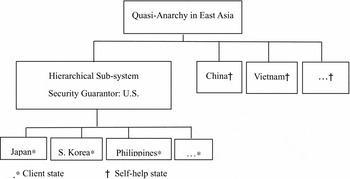
In sum, the quasi-anarchical system is an anarchical system within which there exists a hierarchical sub-system in terms of security relations among related states. As such, the quasi-anarchic system illustrates the characteristics of both anarchy and hierarchy. States within such a quasi-anarchical system can be divided into three different types according to the means by which they seek security: (1) the security guarantor which not only are capable of self-defense, but which can also provide security guarantees to the client states; (2) client states which have difficulty responding to major security threats, and must depend on protection from the security guarantor; (3) self-help states which rely on their own capacity to deter threats, but are not able to provide security to other states. In terms of the security relations between states, there are two types of relations which predominate in quasi-anarchy: the first is competitive security relations, which are between two self-help states and between self-help states and the security guarantor or the client states; the second is relations of security dependence, which are found between the client states and the security guarantor within the hierachical subsystem.
The quasi-anarchical order in East Asia
During the Cold War, Asian allies and most ASEAN states relied primarily on US military assistance and security protection,Footnote 18 and their security dependency was quite apparent. In the immediate aftermath of the Cold War, the situation changed slightly, but soon returned to the Cold War status quo, with United States’ East Asian allies or strategic partners (including Japan, Korea, Philippines, Thailand, Singapore and Indonesia) trending towards increased security dependence on the United States, increasingly constituting a hierarchical sub-system, with the East Asian states subordinate to the United States. The security alliance between these states and the United States is still evident, and has tended towards deepening; the United States maintains a visible, large-scale military presence in these countries, or has military bases on their soil. Further, the significance of the US security guarantee has become more evident, as these countries are increasingly dependent on US strategic protection from threats by great powers, from small and medium sized states, or even from internal threats.
For example, in October 2009, when then Japanese Prime Minister Hatoyama Yukio proposed the concept of the East Asian Community, he especially emphasized that as Japan deepened its relations with Asian states (especially China) that it must depend on the Japanese–US alliance.Footnote 19 In August of 2011, the Japanese government issued the Self-Defense White Paper, which emphasized even more that the Japanese–US alliance is critical for maintaining peace and stability for Japan and the Asia Pacific Region, and that it would deepen its alliance with the United States in the future.Footnote 20
To offer another example, facing concerns related to North Korean nuclear missiles, South Korea continues to depend on the ROC-US military alliance. In June of 2009, during his visit to the United States, Lee Myung-bak noted that the ROK-US alliance is critical for resolving the Democratic People's Republic of Korea (DPRK) nuclear and missile threats. He is expected to seek a written promise of continued US nuclear protection.Footnote 21 In November of 2011, the ROK government announced that the ROK Army planned to construct a new military facility at Paekyong Island, west of DPRK territorial waters in order to accommodate an US military deployment in the event of an emergency situation or a military exercise.Footnote 22
To offer a further example, at the Nuclear Security Summit held in April 2010, President Arroyo of the Philippines expressed her desire for a US guarantee to prevent a recurrence of the 2009 post-electoral violence that left 46 people dead.Footnote 23 On 2 July 2012, the Philippine President Aquino told Reuters in an interview that the Philippines may ask the United States to deploy spy planes over the South China Sea to help monitor the disputed waters because the Philippines does not have aircraft with those capabilities. Aquino also said he would not object to an increased ‘rotational tempo’ for US military forces in his country to help train their Filipino counterparts.Footnote 24
The quasi-anarchical system in East Asia

In addition to the security guarantor and client states, there are a number of self-help states in the East Asia that depend on their own capabilities for security, including China, North Korea, and Vietnam. There is obvious security competition both between these states and the US dominated hierarchy, with the most traditional form of competition being between the US and China, the self-help state rising most rapidly and the primary security guarantor to the region. In the face of increasing Chinese power, the United States is worried that its leadership position in the region will be weakened.Footnote 25 These strategic concerns have caused the United States to become more actively involved in security disputes between China and US allies, and to work to contain expanding Chinese influence by directly providing security or advocating for cooperation between its allies. This has increased security competition in the East Asia.
The self-help states in East Asia have regular security competition with the client states that are dependent on an external security umbrella. For example, China and the Philippines face security conflicts over the South China Sea; China and Japan over the East Sea; and China, the ROK, and Japan over security conflicts related to DPRK efforts to develop nuclear weapons. In the face of these major security threats, the client states look primarily to the United States for support and protection.
There are also obvious security conflicts between the self-help states in East Asia. A classical example of this is China and Vietnam, whose security relations have deteriorated as a result of the dispute over the South China Sea. At the same time, China and the DPRK are also at odds with one another over the DPRK's efforts to obtain nuclear weapons. These security disputes will result in self-help small states (such as Vietnam) taking steps to cooperate with the regional security guarantor (the United States) or with the states under the security guarantor's protection in order to respond to their external security threats. Such cooperation does not imply though that these states (i.e. Vietnam) necessarily lose their self-help and become integrated into US-led hierarchal sub-system.
In sum, the regional security framework in East Asia clearly exhibits the characteristics of quasi-anarchy. Based on the ways in which they seek security, the states of East Asia can be divided into three categories: the United States is the regional security guarantor; the East Asian allies of the United States are client states; the other states, such as China, are self-help. In terms of security relations between states in the region, East Asia continues to face security competition, while dependencies also continue to exist in the region (between the United States and its allies). In other words, the East Asian framework exhibits both characteristics of anarchy and hierarchy, and is a classical example of a quasi-anarchical system.
Quasi-anarchical order and the efficiency of a rising China's reassurance policy
This section analyzes how the quasi-anarchical system presents difficulties for the continued efficiency of a rising China's reassurance policy.Footnote 26 The author identifies three mechanisms (dependence, reliance on support, and imitation) through which the quasi-anarchical order in East Asia constrain the efficiency of China's regional reassurance policy.
Dependency
As China's reassurance policy ease its security contradictions with the client states, these client states within the US security hierarchy seek to rely on support and guarantees from the United States to demonstrate their power to China and gain a position of advantage in the security competetion with China. They do so, as improvement in disputes with China does not imply the resolution of deeper security contradictions, while the US fundamentally can provide an effective security guarantee. For example, just three months after China joined the ASEAN Treaty of Amity and Cooperation (January 2004), the United States and the Philippines staged their first joint exercise in the South China Sea, identifying the objective of the exercises as preventing a foreign invasion. President Arroyo of the Philippines publically acknowledged that the US army was training Filipino troops to defend against China and protect the Spratly Islands.Footnote 27
In addition, as China takes advantage of regional economic cooperation to reassure its neighbors, commercial and trade ties between China and other Asian states deepen, and economic dependence on China gradually increases. As long as security contradictions have not been completely resolved, economic dependence will deepen the concerns of these states. They worry their continued complicity with China's reassurance policy will have negative impacts on their ability to maintain their core interests in the future. This encourages these states to take advantage of the US security guarantee to shape a more favorable environment for their security competition with China, ultimately preventing China from using its comparative power advantage to damage their core security interests.
The provocative behaviors of the client states also weakens China's determination to adhere to its reassurance policy. On the one hand, with the serious security competition that prevails under the quasi-anarchical East Asian system, it is hard for China, which seeks security independently, not to respond to challenges to its core security interests (especially with respect to territorial disputes). On the other hand, the declining efficiency of the reassurance policy also increase domestic pressures to take more efficient policies. From China's perspective, the reassurance policy is fundamentally incapable of changing the provocative policies of the client states in Taking this as a given, China assumes that if it does not respond in a timely fashion, not only will its sovereign interests be excessively encroached upon, but its national dignity will be damaged, provoking massive societal pressures domestically. As a result, China will adopt necessary measures to respond in turn to competitive actions taken by the client states in the region.
However, a targeted response by China is not able to compel those client states to halt challenging China's core interests, and will only result in deepening tensions in China's security relations with these states. The reason for this is that in the end the United States will ultimately provide robust security guarantees to these states which allow them to continue to resist China. As for the United States, its incentive to support its allies in the region is to maintain its leadership within the security hierarchy of the region.Footnote 28 Just as the US naval commander Admiral Carney noted on the South China Sea, the US has already dispatched forces to the Western Pacific and the South China Sea for 50 to 60 years. The United States still wants to maintain its military power in the region as before, and has no desire to step back from such military actions.Footnote 29 It is important to recognize that the hard response of the US towards China will embolden the client states under the US security umbrella to implement policies of resistance vis-à-vis China in support of the US policy shift, deepening their reliance on US security, and thereby creating more favorable conditions to obtain the US protection in future times of need.Footnote 30 It should be clear that the existence of the US-led hierarchy seriously weakens the otherwise positive effects of China's reassurance policy.
Reliance on support
With improvement in their security contradictions with China, the self-help states in East Asia which have a direct contradiction with China will be concerned that the long-term improvement in the contradiction will ultimately place China in a favorable position (this is especially the case with territorial disputes). As Chinese power gradually expands and its position of advantage deepens, these self-help will be incapable of finding an effective security guarantee, and to the greatest extent possible will look for ways to enhance their capabilities. For instance, in December of 2009, the Vietnamese General Secretary Nguyen Minh Triet demanded that the Vietnamese army rapidly modernize, and protect the state as the situation in the South China Sea becomes more and more tense.Footnote 31
However, the relative gap that these states face vis-à-vis China in terms of national power determines that they must find external assistance. For example, in October of 2011, Vietnam and India signed an agreement for cooperation in the joint development of offshore oil resources in disputed waters in the South China Sea.Footnote 32 More importantly, these self-help states will also leverage the security contradictions between China and the client states in the hierarchical subsystem to check the expansion of Chinese influence. For example, in January of 2004, three months after the US–Philippines Joint Military Exercises, Vietnam organized a group of 60 tourists and 40 ‘invited’ government officials to tour the Spratly Islands to illustrate its ‘effective application of sovereignty’ over the islands.Footnote 33 It also invited oil companies from the United States and other countries to participate in the joint development of disputed parts of the South China Sea. It is not difficult to see that such actions which exploit deep contradictions can lessen the extent of China's attention to security competition with these self-help states, while weakening the legitimacy of a hard-line response on the part of China. If China adopts a hard-line towards these states, it will give the international community the negative impression that China does not dare stand up against the US-led hierarchy.
Even though it may be difficult to adopt measures which can transcend the US alliance, in the face of security challenges from these self-help states, China will inevitably move to check any actions which will damage its core security interests, and, as a result, bilateral security contradictions will flare up once again and China's reassurance policy will fail. However, it is important to observe that as other self-help states can only lean on the United States, but cannot obtain an effective US security guarantee, they will not enjoy long-term improvement in the security situation. So they must adopt measures to prevent the complete deterioration of security relations with China, which could inflict unbearable harm on their security.
Imitation
For self-help states in East Asia which have security contradictions with China, but face the greatest challenge from the US-led hierarchical system, they will look to China for assistance in alleviating their core security threats. They especially hope that China will imitate the United States by offering an effective security guarantee to them. China's reassurance policy generally can only ensure that there is not a sharp rise in the security threats faced by these states, and is incapable of effectively reducing the major external threats they face. The reason for this is that not only do China and these states face a serious common external threat, but there are also security contradictions between China and these states. As such, it is difficult for China to intimate the United States to extend security guarantee to these states. As a result, it is only natural that these countries become increasingly certain that China's reassurance policy will ultimately damage their core security interests, and as a result are not willing to support China's reassurance policy over the long term.
It should be observed that the primary adversary that these countries face, namely the United States and the self-help states within the US-led hierarchy, are all dissatisfied with China's reassurance policy, which they see as a barrier to their adversaries abandoning provocative policies. As a result, the United States and its allies demand that China abandon its reassurance policy, and adopt even more hard-line policies to force their adversaries to change their provocative policies. Under these two kinds of pressures, not only does it become difficult for China's reassurance policy to provide long-term results, the policy itself is further rendered untenable. China's failed attempts to respond to the North Korea nuclear issue through the Six Party Talks from 2006 to 2008 is a perfect example of this.Footnote 34
China's reassurance policy in the South China Sea
In this section, I select the efficiency of China's reassurance policy with respect to the South China Sea in the wake of the Cold War as a case to test the key hypotheses and mechanisms identified in this article.Footnote 35 There are three key reasons why we select the case of China's reassurance policy towards the South China Sea.
First, the South China Sea involves all types of states and security cooperation found in the quasi-anarchical system. It involves the client state (the Philippines), self-help states (Vietnam and China), and the security guarantor (the United States). In terms of types of security relations, it includes relations between the client state and the security guarantor within the hierarchy (United States–Philippines); relations categorized by security competition between states (competitive relations between self-help states, China–Vietnam, China–the United States); and security competition between the self-help states and the client states (China–the Philippines).
Second, following the Cold War, the dispute over the South China Sea went through cycles of tension, improvement, tension, which is useful in terms of helping us to identify the critical points in the changing dispute, and to conduct more concentrated comparative analysis. Third, the case has great empirical importance. As the issue of Taiwan is gradually resolved, the issue of the South China Sea is increasingly becoming the issue of greatest strategic significance to East Asian regional security and China's regional diplomacy. An in depth understanding of the limitations of China's reassurance policy in the South China Sea will help us to better understand the factors constraining regional stability and China's regional policy adjustments.
Initial success
The dispute over the sovereignty of the islands in the South China Sea represents the first multi-lateral territorial dispute faced by China. In February of 1995, the Mischief Reef incident brought tensions to a climax.Footnote 36 Following the incident, the government of the Philippines demanded that the issue be referred to the United Nations Security Council and the International Court of Justice. Vietnam also issued a statement which claimed that China's actions were extremely serious, and had made the situation in the Spratly Islands even more problematic. On 18 March 1995, ASEAN issued a Statement on Recent Developments in the South China Sea, which expressed the concern of ASEAN regarding the matter, and urged the parties involved not to take any actions which would undermine regional stability.Footnote 37
The emergence of the dispute between China and several ASEAN states over the South China Sea caused the ‘China threat theory’ to become quite popular among ASEAN countries. In order to reduce the security pressures from the ASEAN states, China started to experiment with adjusting its East Asian regional policy to reassure its neighboring states and stabilize the dispute over the South China Sea.
In July of 1997, following the outbreak of the Asian Financial Crisis, China provided over 4 billion US dollars of assistance to Thailand and other impacted countries through the International Monetary Fund and bilateral channels. It also provided Indonesia with export credit and emergency medical assistance. At the same time, with a view towards maintaining regional stability and peace, China resolved not to depreciate its currency, a major contribution to fiscal and economic stability in Asia.Footnote 38 Some years later, the Ambassador of Malaysia to the PRC, Datuk Syed Zaman expressed thanks on behalf of Malaysia to the Chinese government for not depreciating its currency after the 1997 Financial Crisis, noting that this played a critical role in helping the Malaysian economy recover.Footnote 39
However, it was not long before some ASEAN states began to worry that China's entry into the World Trade Organization would result in a shock for the economies of Southeast Asia.Footnote 40 In response, China proposed the establishment of the China–ASEAN Free Trade Agreement, and at the end of 2002 it signed the Framework Agreement for Economic Cooperation between China and ASEAN. The official signing of the Framework Agreement greatly stimulated the growth of the total amount of trade between China and ASEAN. By 2005, trade between China and ASEAN increased from 54.77 billion US dollars in 2002 to 113.4 billion US dollars.Footnote 41 This also helped promote industrial development in ASEAN (for example, the electronics industry in the Philippines.)Footnote 42
As it promoted economic cooperation with ASEAN, China also adopted positive measures to advance resolution of the dispute over the South China Sea. This helped to improve China's image among ASEAN states, which responded quite positively.Footnote 43 In March of 1999, China and the Philippines established a ‘Working Meeting to Build Trust between China and the Philippines in the South China Sea’, opening a significant channel for the two sides to discuss the South China Sea dispute.Footnote 44 In December of 2000, China and Vietnam signed the China-Vietnam Beibu Gulf Demarcation Agreement and the China-Vietnam Beibu Gulf Fishery Cooperation Agreement. In addition, Chinese and Vietnamese maritime experts also engaged in several rounds of small group discussions on the South China Sea.Footnote 45
Related to this, China also took a number of concrete steps to increase the level of political trust with ASEAN states. First, in November 2002, China and ASEAN signed the Declaration on the Conduct of Parties in the South China Sea. Footnote 46 The Declaration emphasized that the Parties concerned undertake to resolve their territorial and jurisdictional disputes by peaceful means, without resorting to the threat or use of force.Footnote 47 The General Secretary of ASEAN Rodolfo Severino noted that the Declaration marked the emergence of the new code of conduct for the parties, which would help prevent the dispute over the South China Sea from spiraling into open conflict.Footnote 48 In addition, in October 2003, China became the first major non-ASEAN state to enter the ASEAN Treaty of Amity and Cooperation (TAC). China and ASEAN went on to sign the China-ASEAN Joint Statement on Strategic Partnership, declaring the establishment of a strategic partnership relationship towards building peace and prosperity.Footnote 49
From success to failure
It is important to note that this period represented a comprehensive improvement in relations, but not a more fundamental resolution of the issue of concern to the parties to the dispute. As Chinese power continued to rise, the concerns of some claimant states to the South China Sea began to change, and they started to depend on or look to the United States for support to secure their sovereignty over the South China Sea. For example, in January of 2004, President Arroyo of the Philippines publicly acknowledged that the US army was training Filipino troops how to resist China.Footnote 50 At the same time, Vietnam took advantage of the moment to strengthen its sovereign presence in the South China Sea.Footnote 51 These actions created conditions for an escalation of the South China Sea dispute.Footnote 52
In July of 2008, Chinese Minister of Foreign Affairs Yang Jiechi said at the China–ASEAN Minister's meeting that in order to implement the Declaration on the Conduct of Parties in the South China Sea that all parties to the South China Sea dispute would need to engage in dialogue, and advance concrete cooperation and joint development of the South China Sea.Footnote 53 However, according to the 1982 UN Convention on the Law of the Sea and the principles determined by states bound by the Convention, 13 May 2009 was the deadline for maritime states to submit information on the 200 nautical mile boundary of their continental shelf to the United Nations Commission for the Delimitation of the Continental Shelf. As they were concerned that they would be at a disadvantage vis-à-vis China in the future with respect to the dispute over delimitation of the South China Sea, beginning from 2009, the Philippines, Vietnam, and Malaysia declared their sovereign by issuing the domestic laws on their territorial sea baseline.
On 10 March the President of the Philippines officially signed the Territorial Baseline Law, which identified some of China's Spratly Islands and Huangyan Islands as territory of the Philippines.Footnote 54 At the same time, the government of the Philippines also noted that six states (or territories) maintained sovereignty over the Spratly Islands, and that it must inform these other countries of its intent to maintain its sovereignty, as doing so is only proper.Footnote 55 On 25 April Vietnam appointed a Chairperson to the governmental organization with authority over the Spratly Islands.Footnote 56
China responded with resolute diplomatic action. On 11 March 2009, the Chinese Ambassador to the Philippines issued a statement expressing strong opposition and serious protest against ‘Territorial Baseline Law’ signed by Arroyo, and reaffirmed China's historical sovereignty over the Huangyan and Spratly Islands.Footnote 57 On 12 May, in responding to the call to submit to the United Nations information about the exclusive economic zone and the boundary of the continental shelf, Speaker of the Foreign Ministry Mr Ma Chaoxu noted that China had submitted documents regarding the 200 nautical mile outer limit of its continental shelf in the East Sea. However, as China has indisputable sovereignty, sovereign rights and administrative rights over the islands of the South China Sea and their nearby waters, it did not submit such documentation for these islands. China did reserve the right to submit information and data regarding the 200 nautical mile outer limit of its continental shelf in other areas in the future.Footnote 58 Ten days later, China dispatched a fleet of four fisheries patrol boats to the Beibu Gulf to monitor the moratorium on fishing in the South China Sea, and to demonstrate China's sovereign claim over the South China Sea.Footnote 59
During this same period, friction developed between China and the United States around the issue of whether US intelligence-gathering vessels were entering Chinese territorial waters illegally in the South China Sea and the Yellow Sea. However, because the dispute between China and ASEAN remained at the diplomatic level, frictions between China and the United States were insignificant compared to the incident involving a collision in the South China Sea. This was due in part to the fact that China and the United States were cooperating in response to the financial crisis.Footnote 60 As a result, the US was cautious with respect to the South China Sea, and avoided taking steps to become involved in the dispute. On 18 March 2009, US President Barak Obama told Foreign Minister Yang Jiechi that it was extremely important for China and the United States to engage in enhanced military dialogue in order to avoid accidental catastrophes in the future. US Secretary of State Hillary Clinton expressed her hope that China and the United States might enhance military ties, to guarantee that an unexpected incident would not result in an unpredictable outcome.Footnote 61 On 4 June, during a visit to the Philippines, US Secretary of Defense Robert Gates publically declared that the United States would not become involved in the dispute over sovereignty of the South China Sea.Footnote 62
The soft stance of the US helped to gradually alleviate the dispute over the South China Sea, but one year later, the US suddenly became involved in the South China Sea in a very high profile manner, causing conflict to break out once again. On 24 July 2010, Hillary Clinton attended the ASEAN Regional Forum in Vietnam, where she announced that the US was willing to support multi-lateral talks to resolve the dispute over the South China Sea. This statement was seen as the ‘internationalization’ of the dispute over the South China Sea, which was a major victory for Vietnam's foreign policy.Footnote 63 On 24 September, at the second US–ASEAN Leadership Summit, a joint statement was released which claimed that ‘to guarantee regional peace and stability, maritime security and freedom of navigation must be guaranteed’.Footnote 64 On 4 October 2010, the US Ambassador to the Philippines Harry Thomas publically stated that in order to resolve territorial disputes between ASEAN member states and China with respect to the South China Sea, the United States was willing to assist with the determination of a legally binding set of codes of conduct for the region.Footnote 65 Before releasing this statement, the US aircraft carrier the George Washington completed a joint US–ROK military exercise, after which it visited Danang, Vietnam, where the US and Vietnam engaged in a week-long joint military exercise in the South China Sea.Footnote 66
The change in US attitude was primarily a result of fears that the financial crisis might weaken the US dominant position in East Asia. First, the pace of development of China's navy and air force had picked up.Footnote 67 As the Chairman of the US Joint Chiefs of Staff Mike Mullen pointed out, China's military focus had gradually shifted from its army to its navy and air force, and as the Asia Pacific is the most important trade and economic zone, his view of the direction of China's development had already changed from curiosity into concern.Footnote 68
Second was the statement of China's core interests in the South China Sea. In March of 2010, the Japanese media report that during a visit to China, Jeffrey Bader, the Senior Director for Asia of the National Security Council, and James Steinburg, Assistant Secretary of State, were told by Chinese officials that the South China Sea represents China's core interests, similar to Taiwan, Tibet and Xinjiang. The Chinese government has never issued a policy to clarify this.Footnote 69 Regardless of whether the ‘South China Sea is a core interest’, this incident heightened US suspicions of China's East Asian security policy, and worries that US freedom of navigation in the South China Sea might be threatened. On 24 July 2010, Hillary Clinton publically stated at the ASEAN Regional Forum in Vietnam that the US would remain neutral with respect to the dispute over the islands of the South China Sea, but that maintaining freedom of navigation in the South China Sea related to US interests.Footnote 70 Analysts argue that Hillary Clinton's statement illustrated US concerns that if China is not contained, it might change the strategic status quo in the region.Footnote 71
The deep involvement by the United States made China realize the severity of the situation it faced in the South China Sea, and in late May 2011 the dispute between China and Vietnam and China and the Philippines became tense once again.Footnote 72 From 28 to 30 July, China's largest and most advanced patrol boat carried out a three-day patrol mission, which had deep implications with respect to illustrating sovereignty.Footnote 73 Just a little bit more than one month before this, Vietnam engaged in a live-fire military exercise with various types of weaponry off of its central coast.Footnote 74 At an ASEAN Foreign Minister's Meeting, the Philippines Foreign Minister Albert del Rosario publically called on all states to maintain a common position on disputes over sovereignty in order that they might hedge against China.Footnote 75
This action by the Philippines obtained strong support from the United States and other client states in East Asia. On 23 June, Hillary Clinton publically expressed that the US was committed to supporting the Philippines national defense, and that it would implement the defense agreement signed with the Philippines. According to the Mutual Defense Agreement between the two states, if the Philippines is attacked in the Pacific region, the US will come to the defense of the Philippines. In this agreement, ‘Pacific’ includes the South China Sea.Footnote 76 On 9 July the US, Japan, and Australia held a joint military exercise in the territorial waters of Brunei in the South China Sea, and from 2007 to 2010, joint naval exercises among these three states were held to the west of Kyushu and in waters off of Okinawa, locations with obvious implications for China.Footnote 77
At the same time, the United States responded positively to Vietnam's effort to lean on its military power to advance its interests in the dispute over the South China Sea. On 17 June, the US and Vietnam held a diplomatic, security and military dialogue in Washington, DC. In the joint statement released after the meeting, the US emphasized that in recent months accidents in the Sea (the South China Sea) were not helpful for regional peace and stability. With respect to maritime security, and especially the right of freedom of navigation, the United States expressed concerns.Footnote 78 On 15 July, despite strong opposition from China, three US warships arrived at Danang to participate in the US–Vietnamese maritime military exercises.Footnote 79
In order to support East Asian countries, the US has gradually shifted from its policy of maintaining a neutral position with respect to the dispute over sovereignty of the South China Sea. In July 2011, at the ASEAN Regional Forum, Hillary Clinton publically called on all parties to use expressions which are consistent with international law in order to support resolution of conflicts in the South China Sea, and emphasized the need to raise legal claims related to the South China Sea.Footnote 80 Clinton's claims clearly run counter to those made by China, while other voices remain close to this position, implying that the US is already beginning to run counter to its principle of neutrality with respect to sovereignty over the South China Sea.
US involvement promoted the deepening of cooperation among the client states protected by the US. around the South China Sea. On 28 September 2011, Japan and the Philippines released a joint statement to strengthen military and security cooperation, contain China's maritime activities. At the same time, both parties expressed that as US allies the two would cooperate closely in November at the East Asian Summit in Indonesia to purposely exaggerate the China threat.Footnote 81 Vietnam, on the other hand, which is outside of the hierarchal sub system led by the US, took steps to adjust its confrontational attitude towards China, as it feared that uncertainty over the US support would led to serious damages to its core security interests. In October of 2011, China and Vietnam signed the China–Vietnam Agreement on Basic Principles to Guide Resolution of Maritime Issues, illustrating that the two parties would increase efforts to negotiate maritime issues and search for a universally acceptable, long-term solution, while positively discussing temporary measures which would not harm the respective positions and claims of either party. This includes research and discussions around the issue of joint development.Footnote 82
Conclusion
Since the middle of the 1990s, while the Chinese government has consistently attempted to maintain a reassurance strategy in its regional diplomacy efforts, the strategy has not been effective over the long term. This article argues that the long-term efficiency of China's reassurance policy has been weakened by the quasi-anarchical security order in East Asia. The quasi-anarchical system includes a hierarchical sub-system and a set of states outside of the hierarchical sub-system, which causes it to demonstrate aspects of both anarchy and hierarchy. Within the quasi-anarchical system, states can be classified into three types based on how they seek security: self-help states, security guarantor, and client states. There are then two types of security relations between states: competition and dependence. The quasi-anarchic order in East Asia constrains the effectiveness and continuity of China's regional reassurance policy through three mechanisms: dependence, reliance on support, and imitation.
If the findings of this article are correct, it implies the following for China's East Asian security strategy: first, China must coordinate its East Asian security policy and its policy towards the US. In the past ten-plus years, China's regional assurance policy has had great difficulty in obtaining its desired results, the main reason for this being the existence of the US-led hierarchical sub-system within the East Asian quasi-anarchical system. As long as this hierarchical sub-system continues to exist, for China's reassurance policy to be effective it must be coordinated with its US policy, and the two can no longer be considered separately. Failure to do so will result in Chinese diplomacy regularly being undermined by issues in Sino-US relations, while also creating intense competition between East Asian countries. China's East Asian security policy and its policy towards the US could be linked mainly by elevating the level of the current Sino-US Asia Pacific security dialogue, and by focusing the dialogue on maintaining overall stability in East Asia. At the same time, a track two bilateral dialogue might be established between China and the US on strategic security in East Asia. This would help to ensure that the official security dialogue could make comprehensive progress.
Second, policies which better respond to the security threats faced by the self-help states in East Asia need to be designed. As the states within the US-led security hierarchy lack an independent security policy, as long as there is a consensus between China and the United States these states will not adopt a seriously confrontational policy towards China. For this reason, China's East Asian security policy should focus primarily on the states within the region that rely on their own capabilities to maintain national security, and should design policies which respond to the characteristics of their security threats. If the primary threat a state faces stems from the US-led security hierarchy in the region, China should provide a level of security protection in order to weaken any confrontational positions the state might adopt towards China. If the main security threat faced by such a state stems from China, China must adopt a package of policies that include reassurance and containment, and take advantage of the fact that these states ultimately cannot obtain US security protection and force them to change their confrontational policies towards China.
In addition, in the course of conducting research for this article, the author found that paying close attention to international relations in East Asia is of great importance for Chinese scholars working to create new theories. The central concept proposed in this article of a quasi-anarchical system is rooted empirically in the contemporary practice of international relations in East Asia. In reality, most theoretical findings in contemporary international relations are rooted in regional experiences. Taking the characteristics of the order of the international system as an example, the mainstream understanding in modern international relations theory that the international system is made up of sovereign states which exist in a state of anarchy actually is rooted empirically in the modern European international relations. Over the past ten-plus years, US and European scholars such as David Lake have systematically described the characteristics of hierarchy in international relations based on cooperation between the United States and its allies (especially European allies) following World War II. In reality, the source of theoretical creativity has been rooted empirically in European practices, and at most the experiences of the trans-Atlantic community. Meanwhile in the field of international political economy, research on dependency has mainly focused on experiences from Africa and Latin America. For this reason, Chinese scholars might consider attempting to create new international relations theories based on the East Asian experience.Footnote 83
About the author
Dr Sun Xuefeng is Associate Professor of International Relations and Executive Deputy Dean of the Department of International Relations, Tsinghua University. He also serves the executive editor of Chinese Journal of International Politics (Oxford University Press). His current research focuses on the rise of great powers, China's foreign policy and international relations in East Asia. He is the author of dozen of academic papers in International Relations of the Asia-Pacific, Pacific Focus, Chinese Journal of International Politics etc., the author, co-author, or co-editor of six books, International Legitimacy and the Rise of Great Powers: Chinese Perspectives (2012); Dilemma of China's Rise (2011); China and East Asian Regional Order: A CJIP Reader; Rethinking China's Rise: A CJIP Reader; Selected Readings in Practical Methods of International Studies (2010); Practical Methods of International Studies (first edition in 2001, 2nd edition in 2007) and The Grand Strategy of China's Rise (2005).