Shortage of medical oxygen has been reported in the current COVID-19 pandemic in low, middle, and even high-income countries.
Reference Tyrrell, Mytton and Gentry1,Reference Kliff, Satariano, Silver-Greenberg and Kulish2
In fact, shortness of oxygen supply in the face of a raging COVID-19 pandemic has been reported in California, jeopardizing medical care, hospitalizations, and patient discharges,
Reference Patil3,Reference Devereaux, Backer and Salami4
in one of the strongest economies in the world. While high-income countries have the infrastructure to rapidly respond to changing oxygen demands, oxygen supply is a chronic challenge in low-and middle-income countries in Africa,
Reference Mangipudi, Leather, Seedat and Davies5
Asia,
Reference Gettleman6
and South America. The COVID-19 pandemic has made matters worse.
Reference McNeil7,Reference Stroffolini, Cortellaro, Raviolo, Tommasoni, Gupta Kumar and Marotta8
The state-of-affairs is explained by purchasing costs, technical complexity, and the logistics required for transporting and storing medical oxygen.
Reference Stroffolini, Cortellaro, Raviolo, Tommasoni, Gupta Kumar and Marotta8,Reference Stein, Perry, Banda, Woolhouse and Mutapi9
We reasoned that in truly catastrophic medical situations where increased oxygen needs cannot be reasonably met through conventional sources, oxygen could be generated through self-made generators using materials that are available in most countries. Therefore, we set out to determine the feasibility of building electrical hydrolysis and membrane-based oxygen generators with technology solely based on everyday commodities.
Existing technical solutions and their limitations in public health emergencies
The World Health Organization (WHO) and the United Nations Children’s Fund published technical specifications and guidance for oxygen concentrator devices, stating that the produced medical gas should contain at least 82% oxygen and should be free of contaminants.
10
Oxygen concentrators and oxygen cylinders are the 2 oxygen resources which are favored by the WHO to close oxygen gaps in less developed areas. Successful application of these guidelines requires reliable energy supply, gas distribution tubing, continuous technical maintenance, and patient respiratory monitoring. However, in disaster situations, multicomponent-based oxygen infrastructure may not be feasible.
Theoretical considerations and testing of self-made devices
Membrane-based techniques for oxygen generation
Focusing on ambient temperature applications, polymeric membranes can be used for air separation. The functional principle is based on differences in diffusion velocities among gas molecules. Although oxygen molecules are only slightly smaller than nitrogen molecules, most membranes are more permeable to the former. The membrane separates high-pressure oxygen depleted and lower pressure oxygen enriched gas streams. The oxygen permeation is controlled by the oxygen diffusion rate through the membrane and the surface oxygen exchange kinetics, which requires a thin membrane with a large surface area. Selectivity of the membrane is defined by the ratio of the permeability of the gases. Due to a high membrane-area-to-volume ratio, the spiral wound membrane module and the hollow fiber membrane module are the most common membrane systems. Polymer membrane systems can reach purity levels of 60-80% of oxygen.
Reference Murali, Sankarshana and Sridhar11
Continuous operation, compactness, and low operation costs are advantages of the systems.
Reference Robeson12
Practical testing of membrane-based oxygen generation
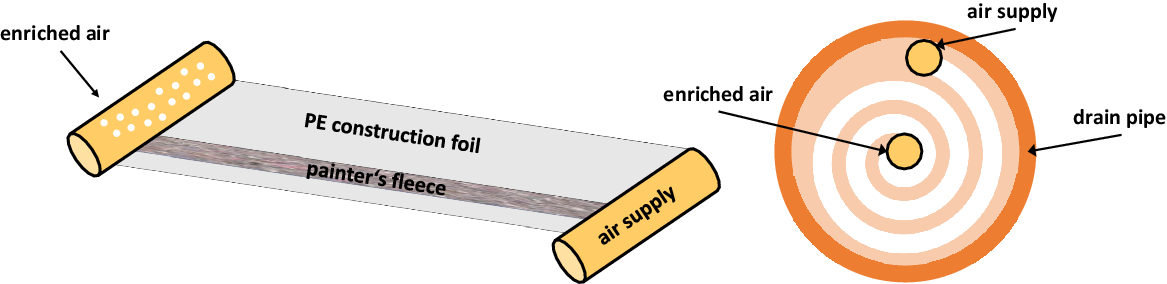
We thought that operation under ambient conditions would make this approach a good choice for self-made oxygen generation. Therefore, we constructed a membrane of polyethylene construction foil with a thickness of 80 μm and painter’s fleece as a separator (Figure 1). We used pressure and heat applied via an iron as a heat sealer, to join 2 polyethylene foil layers air tightly together. The necessary air supply tubing consisted of a 6mm compressed air control line and the oxygen enriched outlet line of a cable protection pipe. We wound up the membrane, and pushed it into a drainpipe with an outer protective layer of painter’s fleece. We used an operating pressure of 1.5 bar, which is achieved by commercially available compressors. However, our device only achieved approximately 1% oxygen enrichment of air. The small surface area of 7.2 m
Reference Kliff, Satariano, Silver-Greenberg and Kulish2
likely limited oxygen enrichment. Furthermore, the membrane was sensitive to mechanical damage through sand grains or other small objects such that a clean room would be required when assembling the device.
Figure 1.
Schematic diagram of the assembled spiral-wound membrane oxygen generator. A: setup unreeled showing sandwiched polyethylene foil (PE) and painter’s fleece; B: cross section of the self-made membrane reeled and encased in a plastic drainpipe.
We therefore concluded that building a spiral wound out of workshop materials is unrealistic and cannot replace a fabricated spiral wound module, which guarantees a constant oxygen concentration.
Oxygen generation by electrical water hydrolysis
Water electrolysis is the process of decomposing water through electricity into its components, hydrogen, and oxygen. An electrolysis cell consists of 2 electrodes within an electrolyte which are connected by a power supply. The individual reactions at the electrodes are dependent on the characteristic of the electrolyte. The technically simplest approach is pure water electrolysis. The electrolysis cell consists of electrodes, electrolyte, and power supply. The electrode material influences the performance.
Reference Chakik, Kaddami and Mikou13
Due to its stability and low corrosivity, nickel, and nickel-plated electrodes are preferable, although not available everywhere. Stainless steel, brass, or iron are inappropriate electrical conductors because of their fast decomposition and the formation of aggressive chemical compounds. Water electrolysis requires high voltages and produces an explosive gas, hydrogen.
Practical testing of electrical water hydrolysis
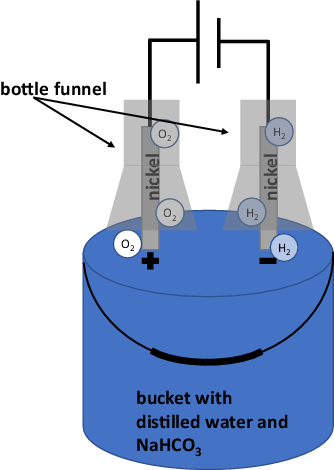
Water electrolysis was difficult to control with our self-made apparatus comprising of elementary materials such as buckets, plastic bottles, and nylon tights (Figure 2). We faced operational problems through the distance between anode and cathode. The wider separated the anode and cathode were, the more electrical power we needed. On the other side, short circuits happened when electrodes got in direct contact. To enable close electrode-contact without short circuits, we tested paper and nylon tights as insulators. However, paper was not suitable because of its flammability. Nylon tights prevented contact of the electrodes, yet they are permeable to the molecules. Eventually, the efficiency of our experimental setups ranged between 10 - 15% only.
Figure 2.
Schematic diagram of the assembled dialysis cell.
Clean separation of the resulting gases (oxygen and hydrogen) could not be reached. Maintaining adequate safety without re-mixing the gases requires higher technical standards. For an electrolyte with a good ion conductivity, we used distilled water mixed with sodium bicarbonate.
We conclude that self-made electrolysis with the simplest means seems unsuitable in situations of disaster.
Oxygen generation through pressure-swing absorption
During pressure-swing-adsorption, differences in molecular absorption to surfaces are used to separate gases. The process works at ambient temperature and consists of 2 steps. First, a gas is trapped from a gas mixture by a bed of adsorbent materials at high pressures of about 3 - 6 bar. With increasing pressure, more molecules are adsorbed by the adsorbent material. For oxygen adsorption from air, the adsorbent material can be either zeolite or zeolite with additional metals.
Reference Santos, Cruz, Regala, Magalhães and Mendes14
The material has a porous structure to increase the active surface area. When the adsorbent material is saturated, the pressure is reduced to ambient pressure for regeneration (pressure swings to low pressure). Molecules with the lowest affinity are being desorbed first. Since the affinity of the zeolite for nitrogen is higher than for oxygen, oxygen enriched air is produced. Gas purity of 90-95% can be achieved, however, reaching higher purity is challenging because zeolite has a similar affinity for O2 and argon.
Reference Santos, Cruz, Regala, Magalhães and Mendes14
To enable a quasi-continuous operation, 2 adsorbent columns are operated anti-cyclic.
Reference Santos, Cruz, Regala, Magalhães and Mendes14
Practical testing of nitrogen tire gas generators for oxygen production
The absorption materials cannot be found among everyday commodities; however, they are part of commercial nitrogen tire gas generators, which are commonly available at car repair shops. Due to the complementary working method, an industrial nitrogen generator can easily be adjusted to serve as an oxygen generator. Therefore, the waste gas outlet is used. By adjusting the pressures, the oxygen content can be controlled and an oxygen concentration of 40% could be reached during our testing.
Discussion
Potentially beneficial effects of self-made oxygen must be balanced against potential harms. Oxygen of low quality (due to contamination with toxic gases or oil inhaled over a long period by patients with diseased lungs) could worsen outcomes. Furthermore, constructing and maintaining self-made oxygen devices would bind human resources of already strained health care systems. Construction and application of self-made oxygen supplies would only be justified if relevant amounts of oxygen-rich gases were harnessed. Furthermore, whether gas mixtures with only moderately enriched oxygen concentrations (30–80%) can improve medical outcome is unclear. Finally, oxygen purification is associated with increased risk of fire accidents.
Supplemental oxygen is 1 of the most important basic supplies for medical care. The current pandemic has once more revealed relevant oxygen supply gaps, particularly in low- and middle-income countries. The external support of critical oxygen infrastructure, by installation of industrial oxygen generators by foreign government organizations, has been shown to be fast and highly efficient under certain circumstances.
Reference Stroffolini, Cortellaro, Raviolo, Tommasoni, Gupta Kumar and Marotta8
However, for regions cut off from the outside world, autarkic solutions of improving oxygen generation would be essential.
In theory, oxygen generation is technically simple to achieve. In fact, we showed the feasibility to construct oxygen generators from everyday commodities. However, our observations suggest that none of the tested approaches provides enough oxygen that would justify the efforts and potential risks. Clearly, the massive amounts of oxygen required in the COVID-19 pandemic cannot be met with such measures. Instead, efforts should be made to provide reliable, effective, and easy-to-maintain medical grade technology to countries in need.
Data availability statement
The data supporting the findings of this study are available within the article. No additional data available.
Acknowledgements
We are grateful to the team of the DLR Department of Sleep and Human Factors Research and the team of the European Transonic Wind tunnel (ETW) for their technical advice.
Author contributions
Ulrich Limper supervised the work from the standpoint of a medical doctor, contributed in the methodology, and wrote the original draft. Lena Klaas performed technical investigations and wrote the original draft. Markus Köhler worked on the methodology, performed investigations, reviewed, and edited the original draft. Daniel Lichte contributed to the methodology, performed investigations, reviewed, and edited the original draft. Nelson J Maldonado Samaniego supervised the work from a standpoint of a medical doctor from a low-income country, added to the methodology, reviewed, and edited the original draft. Jose I Suarez supervised the work, reviewed, and edited the original draft. Jens Jordan (guarantor) contributed to the conceptualization of the study, supervised the work, reviewed, edited the original draft, and acquired funding. Bernhard Hoffschmidt (guarantor) contributed to the conceptualization and methodology, supervised the formal analysis, acquired funding, reviewed, and edited the original draft.
Funding statement
This study was supported by the programmatic funding of the German Aerospace Center (DLR). Ulrich Limper received funding from the internal grant program (project IFF 2020-26) of the Faculty of Health at Witten/Herdecke University, Germany, during preparation of this work.
Competing interests
Ulrich Limper, Lena Klaus, Markus Köhler, Daniel Lichte, Jens Jordan, Bernard Hoffschmidt, and Nelson J Maldonado have nothing to disclose related to this project. Jose I Suarez is the Chair for the DSMB for the INTREPID Study supported by BARD. Dr Suarez has received no monetary compensation for this activity. He is also a member of the Clinical Events Committee for the REACT Study funded by IDORSIA. Dr Suarez has received less than US$10000 for this activity.
Ethical standards
No patients were involved.





 You have
Access
Shortage of medical oxygen has been reported in the current COVID-19 pandemic in low, middle, and even high-income countries. Reference Tyrrell, Mytton and Gentry1,Reference Kliff, Satariano, Silver-Greenberg and Kulish2 In fact, shortness of oxygen supply in the face of a raging COVID-19 pandemic has been reported in California, jeopardizing medical care, hospitalizations, and patient discharges, Reference Patil3,Reference Devereaux, Backer and Salami4 in one of the strongest economies in the world. While high-income countries have the infrastructure to rapidly respond to changing oxygen demands, oxygen supply is a chronic challenge in low-and middle-income countries in Africa, Reference Mangipudi, Leather, Seedat and Davies5 Asia, Reference Gettleman6 and South America. The COVID-19 pandemic has made matters worse. Reference McNeil7,Reference Stroffolini, Cortellaro, Raviolo, Tommasoni, Gupta Kumar and Marotta8 The state-of-affairs is explained by purchasing costs, technical complexity, and the logistics required for transporting and storing medical oxygen. Reference Stroffolini, Cortellaro, Raviolo, Tommasoni, Gupta Kumar and Marotta8,Reference Stein, Perry, Banda, Woolhouse and Mutapi9 We reasoned that in truly catastrophic medical situations where increased oxygen needs cannot be reasonably met through conventional sources, oxygen could be generated through self-made generators using materials that are available in most countries. Therefore, we set out to determine the feasibility of building electrical hydrolysis and membrane-based oxygen generators with technology solely based on everyday commodities.
Existing technical solutions and their limitations in public health emergencies
The World Health Organization (WHO) and the United Nations Children’s Fund published technical specifications and guidance for oxygen concentrator devices, stating that the produced medical gas should contain at least 82% oxygen and should be free of contaminants. 10 Oxygen concentrators and oxygen cylinders are the 2 oxygen resources which are favored by the WHO to close oxygen gaps in less developed areas. Successful application of these guidelines requires reliable energy supply, gas distribution tubing, continuous technical maintenance, and patient respiratory monitoring. However, in disaster situations, multicomponent-based oxygen infrastructure may not be feasible.
Theoretical considerations and testing of self-made devices
Membrane-based techniques for oxygen generation
Focusing on ambient temperature applications, polymeric membranes can be used for air separation. The functional principle is based on differences in diffusion velocities among gas molecules. Although oxygen molecules are only slightly smaller than nitrogen molecules, most membranes are more permeable to the former. The membrane separates high-pressure oxygen depleted and lower pressure oxygen enriched gas streams. The oxygen permeation is controlled by the oxygen diffusion rate through the membrane and the surface oxygen exchange kinetics, which requires a thin membrane with a large surface area. Selectivity of the membrane is defined by the ratio of the permeability of the gases. Due to a high membrane-area-to-volume ratio, the spiral wound membrane module and the hollow fiber membrane module are the most common membrane systems. Polymer membrane systems can reach purity levels of 60-80% of oxygen. Reference Murali, Sankarshana and Sridhar11 Continuous operation, compactness, and low operation costs are advantages of the systems. Reference Robeson12
Practical testing of membrane-based oxygen generation
We thought that operation under ambient conditions would make this approach a good choice for self-made oxygen generation. Therefore, we constructed a membrane of polyethylene construction foil with a thickness of 80 μm and painter’s fleece as a separator (Figure 1). We used pressure and heat applied via an iron as a heat sealer, to join 2 polyethylene foil layers air tightly together. The necessary air supply tubing consisted of a 6mm compressed air control line and the oxygen enriched outlet line of a cable protection pipe. We wound up the membrane, and pushed it into a drainpipe with an outer protective layer of painter’s fleece. We used an operating pressure of 1.5 bar, which is achieved by commercially available compressors. However, our device only achieved approximately 1% oxygen enrichment of air. The small surface area of 7.2 m Reference Kliff, Satariano, Silver-Greenberg and Kulish2 likely limited oxygen enrichment. Furthermore, the membrane was sensitive to mechanical damage through sand grains or other small objects such that a clean room would be required when assembling the device.
Schematic diagram of the assembled spiral-wound membrane oxygen generator. A: setup unreeled showing sandwiched polyethylene foil (PE) and painter’s fleece; B: cross section of the self-made membrane reeled and encased in a plastic drainpipe.
We therefore concluded that building a spiral wound out of workshop materials is unrealistic and cannot replace a fabricated spiral wound module, which guarantees a constant oxygen concentration.
Oxygen generation by electrical water hydrolysis
Water electrolysis is the process of decomposing water through electricity into its components, hydrogen, and oxygen. An electrolysis cell consists of 2 electrodes within an electrolyte which are connected by a power supply. The individual reactions at the electrodes are dependent on the characteristic of the electrolyte. The technically simplest approach is pure water electrolysis. The electrolysis cell consists of electrodes, electrolyte, and power supply. The electrode material influences the performance. Reference Chakik, Kaddami and Mikou13 Due to its stability and low corrosivity, nickel, and nickel-plated electrodes are preferable, although not available everywhere. Stainless steel, brass, or iron are inappropriate electrical conductors because of their fast decomposition and the formation of aggressive chemical compounds. Water electrolysis requires high voltages and produces an explosive gas, hydrogen.
Practical testing of electrical water hydrolysis
Water electrolysis was difficult to control with our self-made apparatus comprising of elementary materials such as buckets, plastic bottles, and nylon tights (Figure 2). We faced operational problems through the distance between anode and cathode. The wider separated the anode and cathode were, the more electrical power we needed. On the other side, short circuits happened when electrodes got in direct contact. To enable close electrode-contact without short circuits, we tested paper and nylon tights as insulators. However, paper was not suitable because of its flammability. Nylon tights prevented contact of the electrodes, yet they are permeable to the molecules. Eventually, the efficiency of our experimental setups ranged between 10 - 15% only.
Schematic diagram of the assembled dialysis cell.
Clean separation of the resulting gases (oxygen and hydrogen) could not be reached. Maintaining adequate safety without re-mixing the gases requires higher technical standards. For an electrolyte with a good ion conductivity, we used distilled water mixed with sodium bicarbonate.
We conclude that self-made electrolysis with the simplest means seems unsuitable in situations of disaster.
Oxygen generation through pressure-swing absorption
During pressure-swing-adsorption, differences in molecular absorption to surfaces are used to separate gases. The process works at ambient temperature and consists of 2 steps. First, a gas is trapped from a gas mixture by a bed of adsorbent materials at high pressures of about 3 - 6 bar. With increasing pressure, more molecules are adsorbed by the adsorbent material. For oxygen adsorption from air, the adsorbent material can be either zeolite or zeolite with additional metals. Reference Santos, Cruz, Regala, Magalhães and Mendes14 The material has a porous structure to increase the active surface area. When the adsorbent material is saturated, the pressure is reduced to ambient pressure for regeneration (pressure swings to low pressure). Molecules with the lowest affinity are being desorbed first. Since the affinity of the zeolite for nitrogen is higher than for oxygen, oxygen enriched air is produced. Gas purity of 90-95% can be achieved, however, reaching higher purity is challenging because zeolite has a similar affinity for O2 and argon. Reference Santos, Cruz, Regala, Magalhães and Mendes14 To enable a quasi-continuous operation, 2 adsorbent columns are operated anti-cyclic. Reference Santos, Cruz, Regala, Magalhães and Mendes14
Practical testing of nitrogen tire gas generators for oxygen production
The absorption materials cannot be found among everyday commodities; however, they are part of commercial nitrogen tire gas generators, which are commonly available at car repair shops. Due to the complementary working method, an industrial nitrogen generator can easily be adjusted to serve as an oxygen generator. Therefore, the waste gas outlet is used. By adjusting the pressures, the oxygen content can be controlled and an oxygen concentration of 40% could be reached during our testing.
Discussion
Potentially beneficial effects of self-made oxygen must be balanced against potential harms. Oxygen of low quality (due to contamination with toxic gases or oil inhaled over a long period by patients with diseased lungs) could worsen outcomes. Furthermore, constructing and maintaining self-made oxygen devices would bind human resources of already strained health care systems. Construction and application of self-made oxygen supplies would only be justified if relevant amounts of oxygen-rich gases were harnessed. Furthermore, whether gas mixtures with only moderately enriched oxygen concentrations (30–80%) can improve medical outcome is unclear. Finally, oxygen purification is associated with increased risk of fire accidents.
Supplemental oxygen is 1 of the most important basic supplies for medical care. The current pandemic has once more revealed relevant oxygen supply gaps, particularly in low- and middle-income countries. The external support of critical oxygen infrastructure, by installation of industrial oxygen generators by foreign government organizations, has been shown to be fast and highly efficient under certain circumstances. Reference Stroffolini, Cortellaro, Raviolo, Tommasoni, Gupta Kumar and Marotta8 However, for regions cut off from the outside world, autarkic solutions of improving oxygen generation would be essential.
In theory, oxygen generation is technically simple to achieve. In fact, we showed the feasibility to construct oxygen generators from everyday commodities. However, our observations suggest that none of the tested approaches provides enough oxygen that would justify the efforts and potential risks. Clearly, the massive amounts of oxygen required in the COVID-19 pandemic cannot be met with such measures. Instead, efforts should be made to provide reliable, effective, and easy-to-maintain medical grade technology to countries in need.
Data availability statement
The data supporting the findings of this study are available within the article. No additional data available.
Acknowledgements
We are grateful to the team of the DLR Department of Sleep and Human Factors Research and the team of the European Transonic Wind tunnel (ETW) for their technical advice.
Author contributions
Ulrich Limper supervised the work from the standpoint of a medical doctor, contributed in the methodology, and wrote the original draft. Lena Klaas performed technical investigations and wrote the original draft. Markus Köhler worked on the methodology, performed investigations, reviewed, and edited the original draft. Daniel Lichte contributed to the methodology, performed investigations, reviewed, and edited the original draft. Nelson J Maldonado Samaniego supervised the work from a standpoint of a medical doctor from a low-income country, added to the methodology, reviewed, and edited the original draft. Jose I Suarez supervised the work, reviewed, and edited the original draft. Jens Jordan (guarantor) contributed to the conceptualization of the study, supervised the work, reviewed, edited the original draft, and acquired funding. Bernhard Hoffschmidt (guarantor) contributed to the conceptualization and methodology, supervised the formal analysis, acquired funding, reviewed, and edited the original draft.
Funding statement
This study was supported by the programmatic funding of the German Aerospace Center (DLR). Ulrich Limper received funding from the internal grant program (project IFF 2020-26) of the Faculty of Health at Witten/Herdecke University, Germany, during preparation of this work.
Competing interests
Ulrich Limper, Lena Klaus, Markus Köhler, Daniel Lichte, Jens Jordan, Bernard Hoffschmidt, and Nelson J Maldonado have nothing to disclose related to this project. Jose I Suarez is the Chair for the DSMB for the INTREPID Study supported by BARD. Dr Suarez has received no monetary compensation for this activity. He is also a member of the Clinical Events Committee for the REACT Study funded by IDORSIA. Dr Suarez has received less than US$10000 for this activity.
Ethical standards
No patients were involved.