1. Introduction
As an economic development policy, many governments have tried to induce migration to rural areas by offering individual property rights to land converted to agricultural land in frontier areas (Alston et al., Reference Alston, Libecap and Schneider1996; Deininger and Jin, Reference Deininger and Jin2003). Yet, although theory predicts that property rights improve resource management and income opportunities encourage migration, in the empirical land use and migration literature, property rights or increased income opportunities do not always lead to high levels of uptake of such opportunities, especially in the case of rural-rural migration (e.g., Ruzzante et al., Reference Ruzzante, Labart and Bilton2021).
Following Ostrom's finding that collective resource management arises in many settings and avoids open-access resource depletion, many governments have offered community or collective resource user rights to encourage efficient resource use and improve incomes. Such initiatives include community forest management programs (Chhatre and Agrawal, Reference Chhatre and Agrawal2008; Robinson et al., Reference Robinson, Albers, Ngeleza and Lokina2014), collective agricultural land rights (e.g., Vélez, Reference Vélez2011; Peña et al., Reference Peña, Vélez, Cárdenas, Perdomo and Matajira2017), collective quota rights in fisheries (Cancino et al., Reference Cancino, Uchida and Wilen2007; Dresdner et al., Reference Dresdner, Campos and Chávez2010; Arnason, Reference Arnason2012), and space-based or territorial user rights in marine activities (Wilen et al., Reference Wilen, Cancino and Uchida2012; Quynh et al., Reference Quynh, Schilizzi, Hailu and Iftekhar2017; Chávez et al., Reference Chávez, Murphy and Stranlund2018). Yet, resource user rights may provide different incentives when they are held by individuals or by groups. Rights held by groups face potential problems of coordination among users (Platteau and Abraham, Reference Platteau and Abraham2002), with collective resource management critically affected by membership size, type of resource/species, and control of entrance of new members (Cancino et al., Reference Cancino, Uchida and Wilen2007). Similarly, the specific definition and attributes of resource user rights affect users' behavior (Deininger and Jin, Reference Deininger and Jin2003; Qin et al., Reference Qin, Carlsson and Xu2011; Vélez, Reference Vélez2011; Peña et al., Reference Peña, Vélez, Cárdenas, Perdomo and Matajira2017). Therefore, people's response to collective versus individual marine user rights may differ, yet little analysis exists to predict or evaluate that difference. Similarly, little analysis describes the impact of the type of resource rights a household holds on their decisions to participate in resource activities that have collective versus individual rights.
In coastal areas, governments aim to induce in-migration or local uptake of marine-based activities through marine resource user rights. The Chilean government uses various types of marine resource user rights to encourage the efficient use of marine resources and to solve open access problems that dissipate rents from marine-based activities, with a recent focus on small-scale aquaculture. In response to resource depletion that limits coastal community incomes and economic development, the Chilean government has implemented many novel marine resource user rights to individuals and cooperatives, including a program aimed at small-scale aquaculture to generate alternative income opportunities for coastal communities (CORFO, 2016; Subpesca, 2019; Salazar et al., Reference Salazar, Jaime and Quiroga2021).
Previous analysis found that government stakeholders intend to increase resource use efficiency and promote economic growth through various marine-resource-based activities paired with user rights (Albers et al., Reference Albers, Baquedano, Chávez, Dresdner and Yubini2021a). Despite the government's push to implement these programs, little analysis exists to predict the response of households to marine resource opportunities – including the resource-based activity and the user right's collective or individual characteristic – nor how that response is influenced by the household's existing user rights. Similarly, while previous work found that households choose income-generating activities near their homes, little analysis exists to predict the response of households to commute/relocation disruption costs in a marine setting (Albers et al., Reference Albers, Baquedano, Chávez, Dresdner and Yubini2021a).
We explore a purpose-developed data set based on household surveys in the Los Lagos Region in southern Chile to improve the targeting, design, and implementation of marine resource-based development policies that encourage efficient use of natural resources and increase household incomes. The data set contains responses to hypothetical opportunities to participate in three different marine resource-based activities paired with resource user rights–activity-rights pairs, both across many payoff levels and across three different commutes or relocation ‘disruption’ cost scenarios. Estimating binary probit models of participation models that investigate the factors that explain their propensity to accept the project, we ask two main research questions. First, to inform marine user rights policy, how does the participation decision vary with the project's marine resource activity–user right pair and with the current marine user rights of the household? We find that both the household's existing user rights affect project participation levels, with particular differences across collective and individually held rights. Second, to inform rural-rural migration policy for economic development, are people willing to participate in projects with activity–rights pairs in locations that require commute or relocation costs? Our results indicate a low propensity to participate in marine activity–user right pair projects overall, which declines with the level of disruption costs. These results inform economic development policy aimed at increasing incomes and resource use efficiency through marine resource projects paired with user rights.
The remainder of this paper proceeds as follows. Section 2 presents the setting and conceptual model. Section 3 presents the survey instrument and data. Section 4 presents the empirical strategy, including the econometric specifications used in our analysis. Section 5 presents the results of our econometric estimations. Section 6 summarizes the results and discusses the implications of these results.
2. Chilean user rights, marine resource activities, and conceptual model
In this section, we first describe the marine resource rights and activities, the activity–rights pairs, used in our study. Then, we develop a conceptual model for the household head's decisions about participating in projects that builds from related economic literature on user and property rights to explore the impact of collective and individual rights on project participation, and from economic literature about technology adoption, rural-rural migration, and location choices with commuting costs to explore the impact of disruption costs on project participation.
2.1 Marine resource activity–user rights pairs
In the conceptual model and in the survey instrument, we examine the decision to participate in a marine resource project. Each hypothetical ‘project’ proposed contains three components: a level of disruption to the household head's current commute/location with increasing disruption from project type A to project type B to project type C; a level of income generated from the project; and a pairing of the resource activity with its user right type. We consider three pairs of user rights and resource activities: loco extraction with collective user rights; mussels aquaculture with individual user rights; and algae collection or aquaculture using individual user rights. Throughout this analysis of participation in projects, as is common in the Chilean context, the marine resource activity and the particular user right cannot be teased apart.
Although other countries define ‘TURFs’ – Territorial Use Rights for Fisheries – in various ways, Chile defines TURFs only for benthic resources and only as group or collective rights. Chile's TURFs, or benthic resource management and exploitation areas (BRMEAs), give local cooperatives, unions, or guild associations the rights to manage benthic resources – particularly Chilean abalone or loco – within a specific geographic area (Chávez et al., Reference Chávez, Dresdner, Quiroga, Baquedano, González and Castro2010; Wilen et al., Reference Wilen, Cancino and Uchida2012). Still, Chilean TURFs are conducive to small-scale aquaculture because up to 40 per cent of the area can be used for such activities. Here, one activity–rights pair project offers ‘loco’ production through collectively-held TURF rights; the loco–collective rights pair project.
In contrast, Chile's marine concessions are user rights allocated to individuals for aquaculture activities within designated areas for a renewable period of 25 years. The principal species groups in marine aquaculture concessions in the Los Lagos Region include salmonids, mussels, and algae. Here, one marine resource activity–rights pair project offers mussel production through individual marine concessions; the mussels–individual rights project. Our third marine resource activity–rights pair project offers algae production. Although algae can be produced either through marine concessions or through TURF rights in Chile, our survey instrument describes the rights as ‘concessions,’ which are individual rights, making this project the algae–individual rights pair project.
Although our analysis focuses on these three project pairings of activities and collective or individual user rights, households hold other types of resource rights that might inform their project participation. Fishing operates through a cooperative catch shares system (Bonzon et al., Reference Bonzon, McIlwain, Strauss and Van Leuvan2010), ‘Regimen Artesanal de Extracción’, that grants extraction rights to artisanal fisher organizations – group rights. The quotas are collectively managed by formal fisher organizations, which are responsible for making decisions regarding fishing operations and income distribution. Other individual rights include ‘special permits,’ ‘minor permits’ or ‘permisos de escasa importancia,’ which are short-term permits granting territorial user rights for mussel seed collection (Ministerio de Defensa Nacional, 2018).
2.2 Conceptual model based on related literatures
We develop a conceptual model of the household head's decisions to participate in projects that considers the roles of user rights – both those associated with projects and those that the household holds – and the commuting and relocation disruption costs described as deterrents to participation in stakeholder interviews.Footnote 1 The model builds from economic literatures on property and user rights, both collective and individual; technology adoption; rural-rural migration; and location choice models. The household head's decision about whether to accept a particular project depends, in theory, on the difference between the household's current utility and its utility after accepting the project, and, in practice, on the characteristics of the project, the characteristics of the household head and household, and on the current household activities and resource rights.
Resource economics has long described the benefits of established property or user rights in moving away from open access resource over-exploitation toward higher income and efficiency in resource use, with many government policies to establish individual property or user rights for resources. Similarly, Ostrom's work emphasizes that common property resource management institutions often arise that enable groups to manage resources as well as individual rights for resource use (e.g., Ostrom, Reference Ostrom1990; Meinzen-Dick and Di Gregorio, Reference Meinzen-Dick and Di Gregorio2004), which led to policies that provide resource rights to groups. Both individual and group rights can encourage more efficient resource use and higher incomes. Individual rights provide autonomy to holders while group rights require defining methods to share inputs and benefits among group members. While some households may prefer autonomy, other households may have preferences for group rights for a range of reasons including cultural reasons (Carlo et al., Reference Carlo, Roesch, Knight and Koller2001), pro-social behavior (Tilman et al., Reference Tilman, Dixit and Levin2018), risk-aversion (Meinzen-Dick and Di Gregorio, Reference Meinzen-Dick and Di Gregorio2004), and labor constraints. The user rights held by households and user rights associated with a project can enter a household's utility in a variety of ways. The empirical agricultural technology adoption literature finds that ‘farmer education, household size, land size, access to credit, land tenure, access to extension services, and organization membership positively correlate with the adoption of many agricultural technologies’ (Ruzzante et al., Reference Ruzzante, Labart and Bilton2021, quote from abstract). Yet, less research identifies how user rights, as opposed to land tenure, influence technology adoption. In addition, little research goes beyond income improvements as drivers of a household's decision to incorporate a new activity into their set of activities or to switch to a new activity altogether.
The rural-rural migration, housing location choice, and von Thunen framework literatures suggest that households consider transportation and commute costs, relative incomes, and adjustment costs in making location decisions. The von Thunen perspective states that each land unit goes to its highest valued land use considering transportation costs to markets but does not address human decisions to move to a location and employ that land use (e.g., Andam et al., Reference Andam, Ferraro, Pfaff, Sanchez-Azofeifa and Robalino2008; Albers, Reference Albers and Shogren2013). Models and empirical analyses identify tradeoffs in housing location choices between proximity to employment that determine commute costs and housing prices (e.g., Anas et al., Reference Anas, Arnott and Small1998; Wu and Plantinga, Reference Wu and Plantinga2003). Although small and almost entirely based on opportunities in agriculture, the rural-rural migration literature finds that income differentials between rural settings can drive migration, but attachment to locations for cultural reasons limit responsiveness to such income differentials (e.g., Cuthbert and Thomas, Reference Cuthbert and Thomas2021). Beyond income differentials, high levels of household income reduce the likelihood of a household deciding to migrate permanently to another rural setting (e.g., Agbonlahor and Phillip, Reference Agbonlahor and Phillip2015).
Putting the guidance from these related literatures together, we define a utility assessment as our conceptual framework through which to interpret the responses of household heads to the three activity–rights pair types and to different levels of project values per commute or relocation disruption. Using the subscript p to denote the project levels and subscript h to denote the household's current levels, a household head decides to accept the project when the utility expected from participating in that project outweighs their utility from maintaining their current set of activities. That comparison includes the income generated from the proposed project, Yp, but households may not view that funding as perfectly additional to their current income, Yh, due to labor reallocations and constraints.
In addition to preferences over different activities themselves, user rights that the household holds and that the project's activity–rights pair contains could influence utility in two ways. First, households with distinct preferences for collective versus individual user rights capture utility directly from their current rights holdings (Rh) and from project participation in projects that have a preferred user right in the activity–rights pair (Rp). Second, the user rights inform the income of a household (Yh as a function of Rh) or a project (Yp as a function of Rp), with an indirect impact on utility. In this analysis, however, the project income is identical across all projects regardless of the activity–rights pair, which means that we can interpret differences in preferences across projects as a function of both the activity itself and the user right in the activity–rights pair for the same project income.
In addition, households consider disutility from the commute or relocation's disruption (Dp). The costs of the disruption may include out-of-pocket costs from commuting or relocating, opportunity costs of time spent commuting, and psychological costs of commuting and relocation disruption. The disutility of the disruption increases with the level of disruption, Dp. This disruption is expected to be lower for project type A than for project type B and for project type C: projects Dp A < Dp B < Dp C.
The household head accepts the project if:
 \begin{equation}U({{Y_h};{R_h}} )< U({{Y_p},{D_p},{R_p};({{Y_h};{R_h}} )} )\end{equation}
Following the related literatures, we make several hypotheses about the drivers of participation in the proposed marine-based projects. First, although adapting the agricultural technology adoption literature to this setting in which marine locations paired with user rights replaces aspects of land holdings, based on that literature we hypothesize that level of schooling and income of the household decrease participation in projects, and that age follows a U-shape with high enough ages deterring project participation.
While the agricultural technology adoption literature emphasizes land tenure security and organizational membership, the small-scale aquaculture and marine context requires resource user rights rather than land rights. In addition, in this setting, collective rights are linked to particular activities while individual rights are linked to other activities, which means that user rights are not expected to enter household decisions in exactly the same way as land tenure in agricultural household decisions. Here, in both theory and practice, the preference for a particular activity cannot be disentangled from preferences for the specific (collective or individual) user rights associated with the project's activity–rights pair.
The specific definition and attributes of resource user rights affect users' behavior. Individual and collective user rights differ in several aspects. Collective user rights have several potential problems of coordination among users (Platteau and Abraham, Reference Platteau and Abraham2002), requiring shared rules for administration, effort exertion, entrance of new members, profit distribution, and sustainability of the venture. These coordination problems are dependent on a series of circumstances that affect resource management, such as the number of members in the organization, the mobility of the targeted species, membership rules, self-monitoring and enforcement practices, among others (Cancino et al., Reference Cancino, Uchida and Wilen2007). These coordination difficulties do not exist for the individual user right, which enables autonomous decisions. At the same time, the collective nature of the user rights dilutes individual responsibilities and opens the opportunity to take advantage of the efforts of others (Heintzelman et al., Reference Heintzelman, Salant and Schott2009). Moreover, the uneven seasonal pattern of effort requirements over the year might allow members to accept new job offers and maintain their membership in the organization, without having to abandon the community work.Footnote 2 This flexibility is clearly restricted for the individual user right owner, because in this case, the progress of the marine activity is dependent only on the engagement and effort of this owner. Thus, we hypothesize that a household's willingness to participate in a project will differ depending on the household's initial ownership of user rights. In particular, these labor considerations decrease the willingness to participate in any activity–rights pair project for those households that have individual user rights, relative to households that hold collective user rights.
Therefore, second, the direction of impact of a household's current marine resource rights on participation in the projects offered here is ambiguous from a theoretical perspective. The household's current marine rights holdings may provide a signal as to their preferences for particular marine rights–resource activity pairs. Or, the household's current resource rights holdings may indicate an ability or inability to be absent from their homes to participate in the proposed projects, with holders of collective resource rights able to rely on their organization to maintain productivity while they are absent – making those rights holders more likely to participate in projects – and with holders of individual rights unable to leave their marine small businesses unattended to participate in projects. Given the possibility for household user rights to influence project participation negatively or positively in theory, whether, and in what direction, current resource rights influence participation in projects is an empirical question.
Here, a household with marine concessions may prefer individual rights when considering project participation – being inclined toward the project pair of mussels and marine concessions or the project pair of algae and marine concessions – but may also have constraints that do not enable them to accept any type of project that keeps them far from their marine concession activities. Similarly, households with TURFs may prefer collective rights and may be able to be distant from their TURF, which may lead to high project participation by TURF-rights holding households. Because we cannot tease apart the activity from the rights, we also consider that characteristics of a household's loco extraction activity itself generates annual periods of labor availability that also facilitate participation in all projects. Similarly, households that hold collective fishing quota rights may prefer group rights, prefer fishing over all other activities, or have time availability in off-seasons for other project activities.
Third, the type of right associated with the project itself may also influence a household's project participation. For a given project-generated income, households that prefer individual rights may be more likely to participate in the mussels–marine concession project or algae–marine concession project than the loco–collective rights project. Similarly, households that prefer collective rights may be more likely to participate in the loco–collective rights project than other projects. Yet, the project's user rights are paired with particular marine activities and different labor commitments that interact with the household's current activity set and labor constraints. Because activity types and user rights are linked, and because activities and rights enter utility in various ways, we cannot predict how existing household user rights and project user rights influence the decision to participate in projects. Instead, we conduct empirical work to identify the magnitude and direction of the net impact of user rights held by the household on project participation across activity–rights pairs.
Fourth, as in the rural-rural migration literature, we expect that many households will not accept any project, whether with a commute or relocation, perhaps due to cultural and lifestyle attachments that create disutility. Fifth, following the von Thunen literature and rural-rural migration literature, we hypothesize that household heads will be more likely to accept projects that provide higher levels of income relative to their current income, making wealthier households less likely to accept any project. Sixth, following the rural-rural migration literature and the regional location literature, we hypothesize that higher commute costs or project aspects that are more disruptive to current household lifestyle – such as relocation in project type C and long periods of commuting in project type B – decrease utility and discourage acceptance of the project.
3. Survey instrument and data
3.1 Sample and household characteristics
We performed the field survey on a sample of households from coastal communities located across the ecologically and socioeconomically diverse Los Lagos Region in southern Chile using a two-step procedure to select the sample. In the first step, we selected villages/coastal communities, and in the second step, we chose households in these locations. The selection of villages/coastal communities followed an intentional selection procedure that chose the locations proportionally based on the total number of artisanal fishers, which generates a representative village sample of the total fishers in the selected area. The household selection procedure in each village consisted of contacting a local leader (i.e., president of a local union) to obtain basic information that allowed the enumerators to identify households within a resource rights holder group to be surveyed. Using a snowball approach, additional village households were chosen using information from previously interviewed households about households both inside and outside that resource rights holder organization. Finally, we surveyed household heads of 316 households in 73 fishing villages and eight municipalities in the region. The household survey instrument contained questions about the household, including socio-demographic characteristics, economic activities, income sources, and current marine user rights.
3.2 Survey: hypothetical projects, participation questions, and respondents who reject projects
To collect data about household responses to marine resource economic opportunities, the survey instrument contained hypothetical questions about the respondent's participation in each of three marine resource-based activity–user right pair projects, each at three levels of location disruption costs and across several project income levels. (See a survey example for the hypothetical project based on scenario A in online appendix A1.)
The proposed activities correspond to the most common main activities, other than fishing, that households in the stakeholder interviews pursue: mussel growing, algae cultivation, and loco extraction. The three activities have different productive characteristics. Mussel growing is a year-round activity. Algae cultivation can only be implemented in intertidal and subtidal zones. Loco is a mollusk extracted from open sea zones during small windows of time in the year, which implies discontinuous income opportunities. We notice that women's participation in algae aquaculture in Chile is important (Salazar et al., Reference Salazar, Jaime, Cárdenas and Baquedano2023). A recent study on motivations to transition from fishers and land farmers to seaweed production in Chile reported that about 30 per cent of seaweed collectors are women; also, 20 per cent of the sample studied was composed of women seaweed cultivators (Salazar et al., Reference Salazar, Jaime and Quiroga2021). Because a producer must have user rights for each marine resource, the survey indicated that each offered project included the required access to the user rights to prevent respondents from considering the challenges of acquiring such right; the survey projects considered a mussel–individual rights pair project, an algae–individual rights pair, and a loco–collective rights pair.
To each respondent, the survey presented three increasingly costly (monetary and non-monetary) disruption or mobility cost scenarios – commuting for eight weeks/year for project type A, a long commute for 26 weeks/year in project type B, and a permanent location shift for project type C – for each of the three resource project types. Scenario A implied some forgone income at home, travel costs, and psychological disruption costs associated with commuting and initiating a new activity. Scenario B implied traveling and staying at the work location for half of the year but allowed the respondent to maintain the residence and the family in its current location, thereby imposing lodging and food costs, forgone income opportunities at home, and psychological costs from being away from home. Scenario C implied that the respondent had to change the whole household's location, with out-of-pocket and psychological relocation costs.
For each project – activity–rights pair and disruption level – we presented a set of payoffs beginning at one-fifth the monthly minimum income level (50,000 Chilean pesos; about US$73 given the exchange rate at the time)Footnote 3 and increasing over six steps to four times this minimum income level (1,000,000 Chilean pesos; about US$1,450), with the additional option ‘I am not interested.’ If the respondent did not want to participate in a project for any of the income amounts presented, we complemented these hypothetical questions with a question about the reasons for this decision.
For the subsample of all respondents that selected the option ‘I am not interested’ for each scenario and resource, we asked an additional question about motives for rejecting all offers. We regrouped the answers into four alternatives that embraced all responses, considering the number of responses obtained in each case to generate these alternatives: (i) I don't want to change my current lifestyle, (ii) I can't leave my village for family reasons, (iii) Don't know how to cultivate mussels/algae/extraction of loco, and (iv) Other reasons: (alternatives 1, 2, 4, 7, and 8) (see online appendix A2).
3.3 Data description and summary statistics
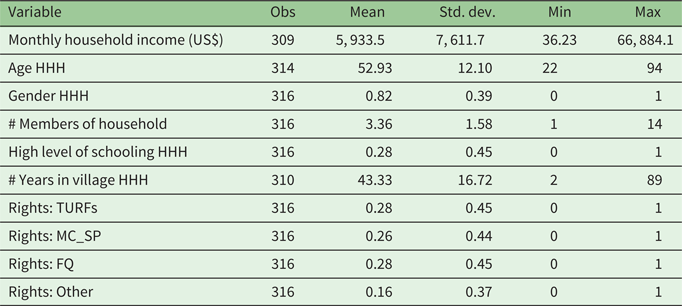
In our data set of 316 household observations, the mean number of household members is 3.4, the mean age of the household head is 52.9 years, and most heads of households are male (82 per cent) with less than 12 years of formal schooling (72 per cent) (table 1). The number of years that a household head has lived in their current location is 43.3 years. The mean monthly household income is 4,094,148 Chilean pesos (about US$5,933.5), with a range between US$36 to 66,884.1, exhibiting high heterogeneity; for this reason, in our empirical strategy, we consider the household income in logarithm.Footnote 4 Regarding marine user rights, 28 per cent of households hold collective TURFs, 26 per cent hold individual marine concessions and/or special permits, 28 per cent hold individual fishing quotas, and 16 per cent hold other fishing rights (see online appendix table A6 for more variable descriptions). The types of user rights are TURF, MC_SP (marine concession or special permit), FQ (fishing quota), and ‘others.’
Descriptive statistics

Table 1 Long description
The table has six columns: Variable, Obs, Mean, Std. dev., Min, Max. Row 1: Monthly household income (US$) 309; 5,933.5; 7,611.7; 36.23; 66,884.1. Row 2: Age HHH 314; 52.93; 12.10; 22; 94. Row 3: Gender HHH 316; 0.82; 0.39; 0; 1. Row 4: Number of Members of household 316; 3.36; 1.58; 1; 14. Row 5: High level of schooling HHH 316; 0.28; 0.45; 0; 1. Row 6: Years in village HHH 310; 43.33; 16.72; 2; 89. Row 7: Rights: TURFs 316; 0.28; 0.45; 0; 1. Row 8: Rights: MC_SP 316; 0.26; 0.44; 0; 1. Row 9: Rights: FQ 316; 0.28; 0.45; 0; 1. Row 10: Rights: Other 316; 0.16; 0.37; 0; 1.
HHH, household head.
Source: Own elaboration.
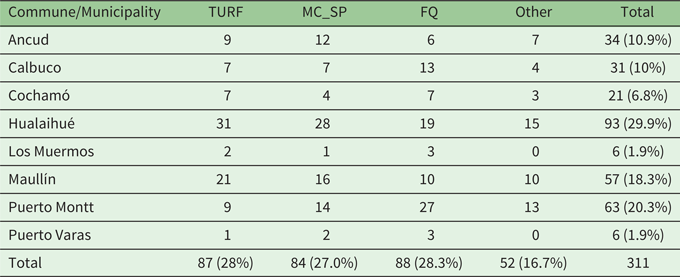
The types of marine user rights among households vary across municipalities (table 2), Here, we ‘merged’ marine concession and special permit into one category (MC_SP) to facilitate analysis of these rights held by individuals as compared to collective rights. Hualaihué has the highest number of households with marine user rights in the sample, particularly TURF and MC_SP rights. In contrast, Los Muermos and Puerto Varas have the fewest households with any marine user rights. The distribution of user rights is relatively uniform among households (ranging from 27 to 28.3 per cent), except for other types of rights,Footnote 5 which are less common (16.7 per cent), and the different types of user rights are found all along the territory.
Distribution of household's user rights per commune

Table 2 Long description
The table has six columns: Commune/Municipality, TURF, MC_SP, FQ, Other, Total. Row 1: Ancud 9, 12, 6, 7, 34 (10.9 percent). Row 2: Calbuco 7, 7, 13, 4, 31 (10 percent). Row 3: Cochamó 7, 4, 7, 3, 21 (6.8 percent). Row 4: Hualaihué 31, 28, 19, 15, 93 (29.9 percent). Row 5: Los Muermos 2, 1, 3, 0, 6 (1.9 percent). Row 6: Maullín 21, 16, 10, 10, 57 (18.3 percent). Row 7: Puerto Montt 9, 14, 27, 13, 63 (20.3 percent). Row 8: Puerto Varas 1, 2, 3, 0, 6 (1.9 percent). Row 9: Total 87 (28 percent), 84 (27 percent), 88 (28.3 percent), 52 (16.7 percent), 311.
TURF, TURF/BRMEAs rights; FQ, fishing quota; MC_SP, marine concession and/or special permit.
Past Location and Activity Choices. The survey reports a range of primary reasons why household heads perform marine productive activities in their specific location: 40 per cent stated that the location was close to home, 19 per cent acknowledged low transportation costs, and 11 per cent chose the location due to the high productivity of the site. The majority of the households (160) reported that the head of the family was born in the same village where the survey took place (50.6 per cent). In 46 cases, the household head was born outside the village but in the same county (14.6 per cent), while in 84 cases, the household head was born outside the county but in the Los Lagos Region (26.6 per cent). Less than 10 per cent of the household heads were born in other regions of the country.
4. Empirical strategy
Our empirical strategy aims to measure and test the drivers of the propensity of household heads to participate in marine resource-based projects of different types and with different levels of commute or relocation disruption costs, as outlined in our conceptual model. First, we included in the survey a set of hypothetical scenarios about income opportunities and three levels of location disruption – A, B, and C – which provide information about the household heads' propensity to incur commute and relocation costs for each of three types of marine activity–rights pair projects. Second, we estimated a binary probit model of the participation in each project, on potential drivers of this decision, across a range of project incomes.
To analyze the drivers of participation in each marine resource activity–rights pair project, we estimated binary probit models considering each activity–rights pair across many commute or relocation disruption costs. We included determinant variables from our conceptual model, including income from the proposed project, household and household heads' characteristics, and current holdings of marine user rights. To empirically analyze the probability that a household participates in a project (prob[Yl = 1]), we estimate:
 \begin{align}\begin{aligned} & \textrm{Prob}[{{Y_l} = 1} ]= f(ln\;project\;\; income,\; \;ln\;household\;incom{e_h},\\ & \quad ag{e_l},\; \;ages{q_l},\;\; gende{r_l},\;\; members\;househol{d_h},\\ & \quad high\;schoolin{g_l},\;\# \;years\;in\;villag{e_l},\; \;user\;\; right{s_h}), \end{aligned}\end{align}
where Prob[.] stands for the probability, Yl is a binary indicator variable for the decision of household head l to accept  $({Y_l} = 1)$ or reject
 $({Y_l} = 0)$ the proposed project,Footnote 6 ln project income is the logarithm of the amount offered to accept the hypothetical scenario (in Chilean pesos), ln household incomeh is the logarithm of the household h's income, agel is the age, measured in number of years, of the household's head l, agesql is the square of age that allows nonlinear effects of age on the decision, genderl is the gender of the household's head l (male = 1, female = 0), membersh is the number of members in the household h, a measure of the dimension of the household, high schoolingl is a dummy variable that adopts the value of unity if the number of years of formal schooling of the head of the household l is 12 or higher and zero otherwise, # years in villagel is a countable variable that measures the number of years that the head of household l has lived in the village, user rightsh is a vector of dummy variables indicating if the household h has access (1) or not (0) to marine user rights, including TURF, fishing quota (FQ), marine concession/special permits (MC_SP), and other rights. The base category is households without access to marine user rights.
5. Results
5.1 Participate in projects: general findings
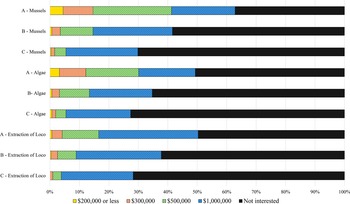
Household head respondents demonstrate variation in their participation in projects across the level of disruption costs and across the marine resource project type (figure 1). The participation for a specific amount of project income was highest for all marine activities in lowest disruption cost scenario A, with declining participation for sequentially higher disruption costs of scenarios B and C. Respondents have a higher propensity to participate in the mussels–individual rights project, in all disruption cost scenarios, than in the algae–individual rights and loco–collective rights projects. Because project incomes are equal across activity–rights pair projects, this ranking provides some information about households' preferences across projects, albeit with raw data here. Yet, because these projects combine an activity and a type of user right, our analysis cannot discern whether households prefer mussels–individual rights pairs due to the activity itself, the individual rights, or the combination.
Rate of project acceptance and project income (in Chilean pesos) that induces participation by project type and level of disruption.
Source: Own elaboration.

Figure 1 Long description
A stacked horizontal bar graph with nine horizontal stacked bars labeled, from top to bottom: A dash Mussels, B dash Mussels, C dash Mussels, A dash Algae, B dash Algae, C dash Algae, A dash Extraction of Loco, B dash Extraction of Loco, C dash Extraction of Loco. The horizontal axis shows percentages labeled 0 percent, 10 percent, 20 percent, 30 percent, 40 percent, 50 percent, 60 percent, 70 percent, 80 percent, 90 percent, 100 percent. A legend lists five categories: 200,000 dollar or less; 300,000 dollar; 500,000 dollar; 1,000,000 dollar; Not interested. A dash Mussels: 200,000 dollar or less 5 percent; 300,000 dollar 10 percent; 500,000 dollar 27 percent; 1,000,000 dollar 22 percent; Not interested 36 percent. B dash Mussels: 200,000 dollar or less 1 percent; 300,000 dollar 3 percent; 500,000 dollar 11 percent; 1,000,000 dollar 27 percent; Not interested 58 percent. C dash Mussels: 200,000 dollar or less 0 percent; 300,000 dollar 2 percent; 500,000 dollar 5 percent; 1,000,000 dollar 25 percent; Not interested 68 percent. A dash Algae: 200,000 dollar or less 4 percent; 300,000 dollar 9 percent; 500,000 dollar 18 percent; 1,000,000 dollar 20 percent; Not interested 49 percent. B dash Algae: 200,000 dollar or less 1 percent; 300,000 dollar 3 percent; 500,000 dollar 10 percent; 1,000,000 dollar 22 percent; Not interested 64 percent. C dash Algae: 200,000 dollar or less 0 percent; 300,000 dollar 2 percent; 500,000 dollar 4 percent; 1,000,000 dollar 22 percent; Not interested 72 percent. A dash Extraction of Loco: 200,000 dollar or less 1 percent; 300,000 dollar 3 percent; 500,000 dollar 12 percent; 1,000,000 dollar 34 percent; Not interested 50 percent. B dash Extraction of Loco: 200,000 dollar or less 0 percent; 300,000 dollar 2 percent; 500,000 dollar 6 percent; 1,000,000 dollar 30 percent; Not interested 62 percent. C dash Extraction of Loco: 200,000 dollar or less 0 percent; 300,000 dollar 0 percent; 500,000 dollar 3 percent; 1,000,000 dollar 26 percent; Not interested 71 percent.
In addition, across all project type and disruption cost scenarios, high percentages of respondents were not willing to participate in the project, even with high compensation or with low disruption costs. The percentage of ‘no interest’ responses for the project at any project income level at the low-disruption cost A scenario for mussels, algae, and loco options were 37.1, 50.6, and 49.7 per cent, respectively. For the most disruptive C scenario, these percentages climbed to 70.2, 78.9, and 71.7 per cent, respectively. These results indicate a low participation in marine resource projects that require even small location disruption costs among this coastal population. In this setting and as found in previous analyses, the households appear to select an activity choice set that is constrained by the opportunities found in their surroundings (Albers et al., Reference Albers, Baquedano, Chávez, Dresdner and Yubini2021a, Reference Albers, Chávez, Dresdner and Leiva2021b).
5.2 Drivers of participation in projects: econometric results
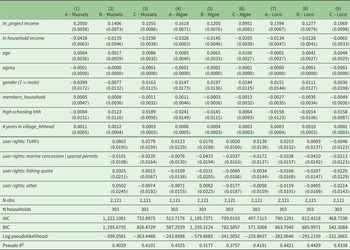
We performed an econometric analysis on the determinants of the propensity to accept the projects across associated project income, with a binary model by disruption cost scenario and by marine resource activity–rights pair project type, where the dependent variable takes the value one if the household is willing to participate in the hypothetical project and zero otherwise (equation (2)). Estimating a probit model as the probability of participating according to scenarios and resources generates the marginal effect of each explanatory variable on participation in the project (table 3). Several variables – household head gender, household size, level of schooling, and number of years living in the village – show no, or sporadic, significant effects, as expected with such a heterogeneous sample.
Marginal effects: probability of participating according to scenario and species

Table 3 Long description
The table has nine columns labeled: (1) A - Mussels, (2) B - Mussels, (3) C - Mussels, (4) A - Algae, (5) B - Algae, (6) C - Algae, (7) A - Loco, (8) B - Loco, (9) C - Loco. It includes regression coefficients and standard errors for various predictors. Key predictors include ln project income, ln household income, age, gender, household members, education, village years and user rights. Coefficients are in log units, with standard errors in parentheses. Notable patterns: ln project income is consistently positive across all models, indicating a strong relationship with the dependent variable. Household income shows negative coefficients, suggesting an inverse relationship. User rights variables vary, with TURFs generally positive and fishing quotas showing mixed effects. The table includes fit statistics like AIC, BIC, log pseudolikelihood and Pseudo R2, highlighting model performance. There are 2,121 observations and 303 households across all models. The table provides a comprehensive view of how different factors impact outcomes in Mussels, Algae and Loco models.
Note: Robust standard errors in parentheses.
The results obtained indicate consistently that, across scenarios and resources, the amount of the project's income has a positive effect on the propensity to participate in a project, but with lower impact in higher disruption cases (table 3, row ‘ln project income’). As in the conceptual model, higher project income increases the profitability of the offered project and increases the incentives for the household heads to participate in the project. Comparing across disruption cost scenarios within the same resource project type, the marginal effect of the project income tends to be lower with higher disruption costs, likely because the project income level offsets a smaller portion of the disruption costs – both out-of-pocket and psychological. In addition, these results demonstrate a similar ranking of activity–rights pairs as the raw data, with mussels–individual rights pair projects having higher propensity to participate across project income levels in disruption cost scenarios A and B, although we find no statistical difference between the propensity to participate in scenarios B and C for mussels–individual rights pair projects versus loco–collective rights pair projects (see online appendix, table A7).
The results also demonstrate that household income has a negative effect on the propensity to participate in a project (table 3, row ‘ln household income’). As in the conceptual model, higher household income decreases the potential percentage income gain obtained from the project and suggests a high opportunity cost of time spent in other activities, which combine to produce a low propensity to participate in the project at a given project income level. In addition, the estimated marginal effects of income on the probability of participation shows a tendency to be lower in scenarios B and C, suggesting that income differences become less important in the decision to participate in the project for higher disruption cost projects. The variable age has a positive but decreasing marginal effect on the probability of agreeing to participate in projects until an age at which the marginal effect becomes negative, and the probability of project participation declines with higher age (table 3, rows ‘age’ and ‘agesq’). The age at which the marginal effect of age turns negative varies across the resource types and disruption cost levels. In the low disruption cost A project for mussels, the marginal effect is positive until 32.5 years old before becoming negative with increasing age. In the case of the high disruption cost C project for algae, the turning point age is 52.5 years old. Focusing on the qualitative result, as in the agricultural technology adoption and migration literature, older people tend to be reluctant to embrace new projects, particularly with location disruption costs.
Household head probabilities of project participation also vary with the types of marine resource rights, user rights, the household already has. Fishing rights, fishing quota, show no effect on participating in any project, indicating that fishers have no particular predisposition toward or against other marine activity–rights pairs, as compared to households without marine user rights. Household heads with TURF rights show a positive marginal effect on mussel–individual rights pair projects that have lower disruption costs (A and B) (table 3). In one interpretation of these results through the lens of the conceptual model, the household heads with TURF rights have a higher probability of participating in low-disruption cost mussel–individual rights pair projects because TURFs enable some flexibility in labor commitments due to their collective aspect and because most TURFs in this region collect loco mollusk, which requires only a few weeks of labor per year. In contrast, households with marine concessions and special permits – individual rights – show a negative marginal effect on the probability of participating in algae–individual rights pair and loco–collective rights pair projects. One interpretation of this result is that the individual characteristic of these user rights imposes constraints on the individual in terms of available time for other activities, while another interpretation of the results would be that holders of such individual rights do not want to participate in projects that require cooperative group membership such as loco–collective rights pair projects.
For robustness check, we also run a version of the model with commune (‘district’) dummies to capture fixed effects. The primary results remained very stable (online appendix, table A8).
5.3 Typical household, disruption costs, and marine user rights
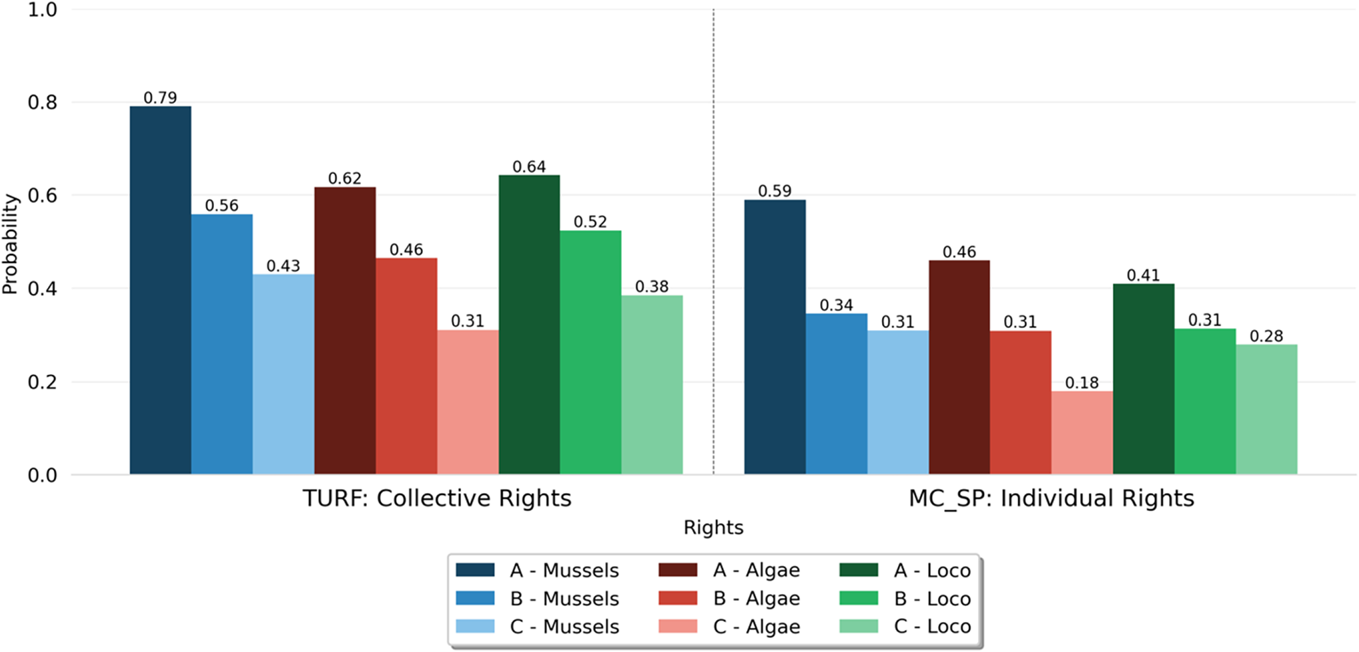
To more clearly depict the impact of marine user rights and disruption costs on the probability of accepting a project offer, we simulated a ‘typical’ household by calculating the probability of participating in the hypothetical project for a household possessing individual rights and for a household possessing collective rights. We performed a similar simulation for different income groups. As expected, the low-income group has higher probabilities of participation while the high-income group has lower participation probabilities (see online appendix, figure A2 for this income-based analysis). We use TURFs to measure collective user rights and marine concessions combined with special permits for individual user rights (figure 2). We set the project income at 1,000,000 Chilean pesos (about US$1,450) and all other variables at their mean, except that we set individual and collective user rights at their respective average values.
Probability of participating in the hypothetical project for a typical individual and different user rights.
Source: Own elaboration.

Figure 2 Long description
A grouped bar graph with y-axis label Probability and range 0.0 to 1.0. The x-axis label is Rights, with two groups: TURF colon Collective Rights and MC underscore SP colon Individual Rights. A legend lists nine series: A dash Mussels, B dash Mussels, C dash Mussels, A dash Algae, B dash Algae, C dash Algae, A dash Loco, B dash Loco, C dash Loco. TURF colon Collective Rights bars, left to right: A dash Mussels 0.79; B dash Mussels 0.56; C dash Mussels 0.43; A dash Algae 0.62; B dash Algae 0.46; C dash Algae 0.31; A dash Loco 0.64; B dash Loco 0.52; C dash Loco 0.38. MC underscore SP colon Individual Rights bars, left to right: A dash Mussels 0.59; B dash Mussels 0.34; C dash Mussels 0.31; A dash Algae 0.46; B dash Algae 0.31; C dash Algae 0.18; A dash Loco 0.41; B dash Loco 0.31; C dash Loco 0.28.
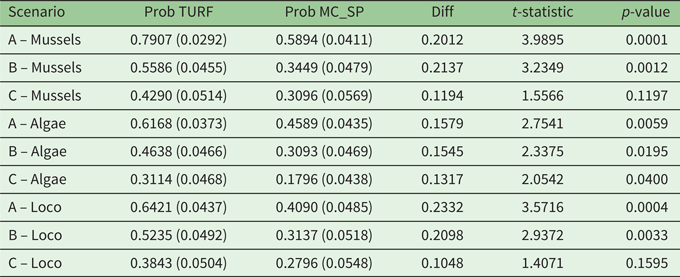
We compare the probability of participation between typical individual-rights-holding households and typical collective-rights-holding households (table 4). In each activity–rights pair project, the collective user rights household shows higher probabilities of participation than the individual user rights household across scenario A and B disruption costs and across activity–rights projects. In the most disruptive case, scenario C, this difference in participation probability of individual and collective rights holders is not statistically different from zero for mussel–individual rights and loco–collective rights projects. Still, these results add depth to the arguments developed based on the regression results and marginal effects (table 3) above that found that probabilities of participation are lower for households with individual rights – marine concessions and special permits – across all projects and higher for households with collective rights – TURFs – for low-disruption mussel–individual rights projects.
Probability of participating in the hypothetical project for a typical average individual and different types of rights

Table 4 Long description
The table has six columns: Scenario, Prob TURF, Prob MC_SP, Diff, t-statistic, p-value. Row 1: A – Mussels, 0.7907 (0.0292), 0.5894 (0.0411), 0.2012, 3.9895, 0.0001. Row 2: B – Mussels, 0.5586 (0.0455), 0.3449 (0.0479), 0.2137, 3.2349, 0.0012. Row 3: C – Mussels, 0.4290 (0.0514), 0.3096 (0.0569), 0.1194, 1.5566, 0.1197. Row 4: A – Algae, 0.6168 (0.0373), 0.4589 (0.0435), 0.1579, 2.7541, 0.0059. Row 5: B – Algae, 0.4638 (0.0466), 0.3093 (0.0469), 0.1545, 2.3375, 0.0195. Row 6: C – Algae, 0.3114 (0.0468), 0.1796 (0.0438), 0.1317, 2.0542, 0.0406. Row 7: A – Loco, 0.6421 (0.0437), 0.4090 (0.0485), 0.2332, 3.5716, 0.0004. Row 8: B – Loco, 0.5235 (0.0492), 0.3137 (0.0518), 0.2098, 2.9372, 0.0033. Row 9: C – Loco, 0.3843 (0.0504), 0.2796 (0.0548), 0.1048, 1.4071, 0.1595.
Source: Own elaboration.
For both user right ‘typical’ households, the probability of the typical household participating in a project declines with the increasing disruption costs, reflected in scenarios A, B, and C, for all activity–rights pair project types. The finding of much lower participation probabilities for high disruption cost scenarios, C, reveals the importance of the location disruption costs in this rural coastal population's willingness to relocate for new opportunities.
6. Discussion and conclusion
With the resource economics literature emphasizing resource use efficiency and income gains from defining appropriate resource rights, and with a long history of economic development policy encouraging migration through agricultural property rights, many countries are initiating marine user rights as a coastal economic development program. Such initiatives face at least two questions that we address here. First, what households are likely to participate in programs that provide resource user rights but require commuting or migration relocation costs? Second, how does households' participation vary across the user rights that households hold and across the marine activity paired with its user right type – collective or individual? Both of these aspects of marine user right policies influence the success of such programs for improving resource management and increasing economic development. In addition, the results here call for more research that discerns differences between marine user rights and better-studied land property rights on resource use and that analyzes preferences and labor allocation decisions in response to collective versus individual rights.
In accordance with the agricultural technology adoption and the rural-rural migration literature, our analysis finds that younger and lower-income household heads have the highest probability of participating in marine resource-based projects. Yet, a high percentage – over 68 per cent – of household heads in our sample decline to participate in any offered marine resource project that requires relocation (project type C) at any of the project income levels offered. Most household head respondents who chose no project at any offered income level described lifestyle and family reasons for being unwilling to participate (see figure 1). Lower levels of location disruption encourage more participation in these projects, but only 44 per cent of respondents are willing to incur six months per year of relocation (project type B), and 51 per cent participate at a lower level of disruption involving commuting for eight weeks (project type A) (figure 1). These marine resource and user results coincide with agricultural property rights results in finding that policies to promote marine resource-based activities paired with user rights should expect more participation from targeting younger and lower-income households and from targeting locations that do not require high disruption costs of relocation and commuting.
The development economics literature models and empirically estimates drivers of migration, but relatively little of that research considers rural-rural migration and less investigates potential migrators including those who choose not to migrate. By focusing on households in rural areas of Los Lagos Region and providing projects with varying degrees of disruption ranging up to migration to another rural area, this analysis extends the rural-rural migration literature with its finding that nearly 70 per cent percent of people in the sample choose not to migrate (scenario C in our survey) in response to high income opportunities. Marine activity–user rights projects and policies to induce economic development and efficient resource use of resources should consider the non-income related disutility of adopting such projects that stems from altering the family lifestyle, even with only weeks of lifestyle disruption. Informing economic development policy in coastal areas requires additional research to explore the low participation rates in such projects and how the marine setting differs from low rural-rural migration rates for agricultural opportunities. Further, many land use models and land conversion analyses in rural areas of low-income countries rely on von Thunen's framework that posits that all land units go to their highest use, as a function of market access/transportation costs. Because that framework does not consider human decisions explicitly, analyses based on that framework cannot reflect the characteristics of households and settings that lead people to migrate and undertake land – or, here, marine – use changes. Our results suggest that those analyses likely overstate the response to a particular location's productive value in driving marine resource use change by ignoring the disutility associated with disruptive commutes and relocations and households' preferences for project activities paired with collective and individual user rights.
In contrast to findings that strong land tenure motivates adoption of agricultural technologies, the marine resource user rights common in the Los Lagos Region form a more nuanced and complex response to marine project adoption. The empirical analysis here finds that household heads who have individual user rights, such as marine concessions and special permits, are less likely to participate in any project than all other rights holders, including those holding collective TURF rights. Based on the conceptual model and stakeholder discussions, two explanations arise for this low level of project acceptance by individual user rights holders. First, individual user rights holders may perceive higher utility from their current marine resource activities relative to proposed activity–rights pair projects, perhaps due to satisfaction with their solo entrepreneurial efforts. Similarly, individual user rights holders may prefer to avoid potential coordination problems associated with participating in a collective rights-based activity, including coordinated actions to protect the natural resource-based activity from encroachment in a collective right setting (Chávez et al., Reference Chávez, Murphy and Stranlund2018). Second, individual user rights holders may face higher costs, and therefore lower total returns, from the proposed projects due to foregone income or additional costs to maintaining their current projects while commuting, or from losing their individual user rights when relocating. Similarly, group rights holders may be less constrained away from participating in projects that require commuting or relocating because they can rely on the cooperative organization to protect and manage their collective rights marine activities in their absence. Because we see a clear difference in willingness to participate in any resource activity–user rights pair between households with individual versus collective user rights, this analysis identifies the need for further research to more fully understand how a household's existing marine resource rights enter household labor allocation and activity choices to improve the efficiency of implementing marine activity – user rights pair policies.
In addition, this analysis finds that households rank one type of activity–rights pair project – the mussels–individual rights – more highly than either the algae–individual rights pair or the loco–collective rights pair. Because the activity type is inextricably linked to its user right in the Chilean context and in our data, this ranking cannot distinguish between preferences for a user right type or for an activity type, despite removing heterogeneity in project incomes. For example, we cannot state that individual rights are preferred by households based on this ranking of mussel–individual rights projects because the algae-based activity contains individual rights and both the activity and rights differ for the loco–collective rights project. Some research indicates that algae is perceived as an activity where women's presence is relevant (Salazar et al., Reference Salazar, Jaime and Quiroga2021, Reference Salazar, Jaime, Cárdenas and Baquedano2023), but our sample has too few female heads of household to discern a gender effect on willingness to participate in algae–individual rights projects. Because of the link between activity and rights, our analysis provides only weak evidence that the user right associated with the project contributes to participation rates. Still, although legal recognition and policy promotion of collective or cooperative resource rights has grown in recent decades, this analysis points to a need for further analysis about how individual and collective user rights are perceived by households and how the project's user right contributes to project participation.
Instead of blanket or uniform marine resource projects and policies applied over the whole region, targeting such projects to particular locations and people could induce more households to adopt marine resource activities, thereby improving incomes and resource use efficiency across the region. First, targeting marine resource projects to younger people and those with lower incomes focuses policy on households who are more inclined to adopt such projects. Second, targeting policies to the production opportunities in specific bio-geographic locations would enable households to avoid disruptive commutes and relocation, in addition to leveraging household's local knowledge and experience. Third, policy implementation that targets people without individual marine resource user rights like marine concessions and special temporary permits could improve the efficiency and uptake of such marine resource projects. Fourth, increased implementation of mussels–individual rights pair projects would lead to higher project uptake, based on our sample's preference for such projects. Still, further analysis to determine which types of user rights and which activity–user rights pairs households prefer would help agencies develop projects with characteristics that lead to more project participation. Similarly, additional analyses to explore the reasons why so few households choose to participate in any project, even at high incomes, and how the marine setting differs from agricultural settings in that propensity to participate, would inform coastal economic development policy. Overall, these results suggest that opportunities to target marine user rights and marine resource projects to types of households and to locations that leverage user rights of the household and of the projects and that limit location disruption costs to increase the adoption of such activities, create more efficient use of marine resources, and improve rural incomes and economic development of the coastal communities.
Supplementary material
The supplementary material for this article can be found at https://doi.org/10.1017/S1355770X25000166.
Acknowledgements
We gratefully acknowledge the financial support for this research from the Swedish International Development Cooperation Agency (Sida) through the Environment for Development (EfD) initiative under project MS-368, ‘Small-Scale Aquaculture as a Livelihood Alternative with Marine Conservation Benefits in Coastal Communities in Chile,’ and the program Blue Resources for Development (BlueRforD). Chávez, Dresdner, and Leiva also acknowledge partial funding by ANID/FONDAP/1523A0007.