Introduction
Major depressive disorder (MDD) is a highly prevalent psychiatric condition characterized by a range of abnormal behaviors, including dysregulated responses to both positive and negative outcomes. Functional magnetic resonance imaging (fMRI) studies have described reduced responsivity in localized brain regions including the ventral [nucleus accumbens (Nacc)] and dorsal (caudate) striatum in response to a variety of positive stimuli in individuals with MDD (Lawrence et al. Reference Lawrence, Williams, Surguladze, Giampietro, Brammer, Andrew, Frangou, Ecker and Phillips2004; Forbes et al. Reference Forbes, Christopher May, Siegle, Ladouceur, Ryan, Carter, Birmaher, Axelson and Dahl2006, Reference Forbes, Hariri, Martin, Silk, Moyles, Fisher, Brown, Ryan, Birmaher, Axelson and Dahl2009; Schaefer et al. Reference Schaefer, Putnam, Benca and Davidson2006; Kumar et al. Reference Kumar, Waiter, Ahearn, Milders, Reid and Steele2008; Smoski et al. Reference Smoski, Felder, Bizzell, Green, Ernst, Lynch and Dichter2009). Blunted reward-related striatal responsiveness in MDD has been associated with decreased positive affect (Forbes et al. Reference Forbes, Hariri, Martin, Silk, Moyles, Fisher, Brown, Ryan, Birmaher, Axelson and Dahl2009), in line with the well-established role of the striatum in reward processing (Haber & Knutson, Reference Haber and Knutson2010). Depression, however, is a highly complex construct and thus is likely to involve circuit-level alterations rather than isolated dysfunction in discrete brain regions (Mayberg, Reference Mayberg1997). Indeed, using functional connectivity analyses, Heller et al. (Reference Heller, Johnstone, Shackman, Light, Peterson, Kolden, Kalin and Davidson2009) found that the inability to sustain positive affect in MDD was associated with reduced frontostriatal connectivity in addition to blunted striatal activation. Despite these promising results, the neural circuitry underlying abnormal responses to positive outcomes in MDD remains largely unexplored. The first aim of the current study was to fill this gap by investigating whether MDD is characterized by abnormal striatal connectivity in response to monetary gains.
Of note, neuroimaging studies in healthy populations have also demonstrated striatal involvement in response to aversive stimuli. For example, the ventral striatum (i.e. the Nacc) was shown to respond to thermal pain (Becerra et al. Reference Becerra, Breiter, Wise, Gonzalez and Borsook2001; Baliki et al. Reference Baliki, Mansour, Baria, Huang, Berger, Fields and Apkarian2013) whereas the dorsal striatum (i.e. the caudate) responded to electric shock and monetary losses (Tricomi et al. Reference Tricomi, Delgado and Fiez2004; Seymour et al. Reference Seymour, Daw, Dayan, Singer and Dolan2007; Delgado et al. Reference Delgado, Li, Schiller and Phelps2008; Mattfeld et al. Reference Mattfeld, Gluck and Stark2011; Niznikiewicz & Delgado, Reference Niznikiewicz and Delgado2011). Indeed, among healthy controls (HCs), both monetary gains and penalties were found to elicit increased bilateral caudate activations (Pizzagalli et al. Reference Pizzagalli, Holmes, Dillon, Goetz, Birk, Bogdan, Dougherty, Iosifescu, Rauch and Fava2009). Moreover, relative to HCs, MDD patients showed significantly lower caudate activation to both gains and penalties (Pizzagalli et al. Reference Pizzagalli, Holmes, Dillon, Goetz, Birk, Bogdan, Dougherty, Iosifescu, Rauch and Fava2009), suggesting that blunted caudate responsivity in MDD might extend to a broad range of affective stimuli. Thus, our second aim was to test whether putative striatal connectivity disruptions in MDD are valence dependent. This was achieved by implementing psychophysiological interaction (PPI) analysis, enabling the identification of brain regions whose direct connectivity changes in a given psychological context (Friston et al. Reference Friston, Buechel, Fink, Morris, Rolls and Dolan1997; O'Reilly et al. Reference O'Reilly, Woolrich, Behrens, Smith and Johansen-Berg2012). To this end, whole-brain PPI analyses were conducted separately for gain and penalty outcomes using the caudate as a seed. Following the fMRI scan, depressed individuals were enrolled in a 12-week, randomized, double-blind, placebo-controlled clinical trial comparing escitalopram and S-adenosyl-l-methionine (SAMe), a dietary supplement with antidepressant properties (Papakostas et al. Reference Papakostas, Mischoulon, Shyu, Alpert and Fava2010; Mischoulon et al. Reference Mischoulon, Price, Carpenter, Tyrka, Papakostas, Baer, Dording, Clain, Durham, Walker, Ludington and Fava2013). As an exploratory third aim we investigated whether pre-treatment PPI connectivity values predicted symptom change 12 weeks later.
Method
Participants
Recruitment procedures and sample characteristics have been described previously in detail (Pizzagalli et al. Reference Pizzagalli, Holmes, Dillon, Goetz, Birk, Bogdan, Dougherty, Iosifescu, Rauch and Fava2009). In brief, depressed participants (n = 30; 15 males) had a diagnosis of MDD according to the SCID (First et al. Reference First, Spitzer, Gibbon and Williams2002), and a score ⩾16 on the 21-item Hamilton Depression Rating Scale (HAMD-21; Hamilton, Reference Hamilton1967). Exclusion criteria included: any psychotropic medication in the past 2 weeks (6 weeks for fluoxetine; 6 months for dopaminergic drugs or neuroleptics); a current or past history of MDD with psychotic features; and presence of other Axis I diagnoses (including lifetime substance dependence and any substance use disorder in the past year), with the exception of anxiety disorders. Specifically, 11 depressed participants had a current anxiety disorder (37% of the sample) and three had subthreshold anxiety symptoms (10% of the sample). Comparison subjects (n = 31; 18 males) were recruited from the community. They reported no medical or neurological illness, no current or past psychopathology (according to the SCID), and no use of psychotropic medications. As summarized in the online Supplementary Table S1, MDD and comparison groups were demographically matched in age, years of education, gender and ethnicity. All participants were right-handed and provided written informed consent to a protocol approved by the Committee on the Use of Human Subjects in Research at Harvard University and the Partners Human Research Committee.
Monetary incentive delay task
A graphical description of the task is presented in Supplementary Fig. S1. In brief, trials began with a visual cue (1.5 s) indicating the potential outcome (reward: +$; loss: −$; no incentive: 0$). After a variable interstimulus interval (3–7.5 s), a red target square was presented briefly, to which subjects responded by pressing a button. After a second variable delay (4.4–8.9 s), visual feedback (1.5 s) indicated the trial outcome (gain, penalty, no change). A variable interval (3–12 s) separated the trials. The task involved five blocks of 24 trials each. Gains and penalties were delivered in a predetermined pattern to allow a balanced design. For each block, half of the reward trials yielded a monetary gain (range = US$1.96–US$2.34, mean = US$2.15) and half ended with no-change feedback. Similarly, half of the loss trials yielded a monetary penalty (range = US$1.81–US$2.19, mean = US$2.00), and half resulted in no change. No-incentive trials always ended with no-change feedback. Despite these predetermined outcomes, participants were told that responding rapidly would maximize their chances of obtaining gains and avoiding penalties. To maximize the perception of contingency between outcomes and participants' responses, target presentation duration was individually titrated to be longer for trials scheduled to be successful than for those scheduled to be unsuccessful.
Data acquisition
Data were collected on a 1.5-T Symphony/Sonata scanner (Siemens Medical Systems, USA) and consisted of a T1-weighted magnetization prepared rapid gradient echo (MPRAGE) acquisition [repetition time (TR) = 2730 ms, echo time (TE) = 3.39 ms, field of view (FOV) = 256 mm, resolution = 1 × 1 × 1.33 mm3, 128 slices) and gradient echo T2*-weighted echoplanar images (TR = 2500 ms, TE = 35 ms, FOV = 200 mm, resolution = 3.125 × 3.125 × 3 mm3, 35 interleaved slices).
fMRI data analysis
fMRI data were analyzed using the Oxford Centre for Functional MRI of the Brain (FMRIB) Software Library (FSL) version 4.1.5 (Smith et al. Reference Smith, Jenkinson, Woolrich, Beckmann, Behrens, Johansen-Berg, Bannister, De Luca, Drobnjak, Flitney, Niazy, Saunders, Vickers, Zhang, De Stefano, Brady and Matthews2004; http://fsl.fmrib.ox.ac.uk/fsl/fslwiki/). Data preprocessing included: motion correction using MCFLIRT (Jenkinson et al. Reference Jenkinson, Bannister, Brady and Smith2002), slice timing correction, removal of non-brain structures using BET (Smith, Reference Smith2002), spatial smoothing (6 mm), grand mean intensity normalization, and high-pass temporal filtering (σ = 60 s). Registration of functional data to the high-resolution structural images was achieved using the linear registration tool in FSL, FLIRT (Jenkinson et al. Reference Jenkinson, Bannister, Brady and Smith2002), and registration of structural images to the 2-mm Montreal Neurological Institute (MNI) standard space template was performed using the non-linear registration tool FNIRT (Smith et al. Reference Smith, Jenkinson, Woolrich, Beckmann, Behrens, Johansen-Berg, Bannister, De Luca, Drobnjak, Flitney, Niazy, Saunders, Vickers, Zhang, De Stefano, Brady and Matthews2004). Data for four MDD and two control subjects were lost because of excessive motion (>2 mm), leaving 26 individuals in the MDD group and 29 in the controls. Notably, the present study included two fewer participants than our previous report (Pizzagalli et al. Reference Pizzagalli, Holmes, Dillon, Goetz, Birk, Bogdan, Dougherty, Iosifescu, Rauch and Fava2009) because of a stricter motion correction exclusion criterion, as motion can have a particularly strong impact on connectivity analyses (Power et al. Reference Power, Barnes, Snyder, Schlaggar and Petersen2012). Hemodynamic responses were modeled using a gamma function and convolved with onset times of cues and outcomes to form the general linear model (GLM) at the single subject level. The six rigid-body movement parameters, target and error trials were included in the GLM as covariates of no interest. Our previous analysis of this sample revealed that the differences in brain function between HCs and MDD subjects were much more robust in response to outcomes than cues (Pizzagalli et al. Reference Pizzagalli, Holmes, Dillon, Goetz, Birk, Bogdan, Dougherty, Iosifescu, Rauch and Fava2009). Thus, current analyses focused on connectivity abnormalities in response to outcome stimuli only. To probe caudate responsivity and connectivity to both monetary outcomes in a balanced way, contrast maps were created by comparing responses to gains and penalties outcomes versus responses to neutral outcome (gain = +1, penalty = +1, no-change = −2). These subject-level contrast maps were transformed to MNI standard space (2 mm) using the transformation matrices from the registration step during pre-processing. Group differences were evaluated using a random effects higher-level GLM (two-group unpaired t test). Left and right caudate regions of interest (ROIs) were defined by conducting a conjunction between functional and anatomical masks of the caudate. The functional caudate cluster was derived from the map of significant group differences (controls > MDD) in responses to gains and penalties outcomes versus responses to neutral outcome (p < 0.005 or Z > 2.58, uncorrected for multiple comparisons across voxels), whereas the anatomical caudate template was taken from the Harvard–Oxford subcortical structural atlas (likelihood > 20%) (Desikan et al. Reference Desikan, Segonne, Fischl, Quinn, Dickerson, Blacker, Buckner, Dale, Maguire, Hyman, Albert and Killiany2006). These group-level ROIs were then warped into each individual's native space to identify subject-specific caudate ROIs from which average blood oxygen level-dependent (BOLD) signal parameter estimates were extracted separately for gain, penalty and no-change outcomes. Next, left and right caudate ROIs were merged to create a single ROI mask of the bilateral caudate from which time-courses were extracted for PPI analyses. For each subject, subject-level GLMs were constructed as described above, with the addition of the bilateral caudate seed time-course as a regressor and three additional PPI regressors, that is the product of the seed time-course and the regressors for gain, penalty and no-change outcomes. These regressors are orthogonal to the task and seed regressors, and thus describe the contribution of the interaction above and beyond the main effects of the task and seed time-course. In addition, the orthogonality of the task and PPI regressors ensures that the approach used to identify the caudate seed ROI for the PPI is not circular (McLaren et al. Reference McLaren, Ries, Xu and Johnson2012). Contrasts for each PPI were assessed for group differences using a higher-level GLM (two-group unpaired t test). Inference at the whole-brain level was made using clusters determined by Z > 2.3 and a corrected cluster significance threshold of p = 0.05 (using Gaussian random field theory; Worsley, Reference Worsley, Jezzard, Matthews and Smith2001).
Treatment and symptom evaluation
Patients in the current study were chosen randomly to undergo an fMRI scan from a larger pool of depressed individuals (n = 189) enrolled in a multi-site randomized, double-bind, placebo-controlled clinical trial comparing the dietary supplement SAMe (1600–3200 mg/day) and escitalopram (10–20 mg/day) over a 12-week treatment period (Mischoulon et al. Reference Mischoulon, Price, Carpenter, Tyrka, Papakostas, Baer, Dording, Clain, Durham, Walker, Ludington and Fava2013). SAMe treatment was investigated because of previous reports supporting its antidepressant efficacy as monotherapy against placebo and tricyclic antidepressants (Papakostas et al. Reference Papakostas, Alpert and Fava2003; Papakostas, Reference Papakostas2009). Notably, the larger clinical trial revealed that depressive symptoms significantly improved over the 12 treatment weeks; however, both the primary outcome measure [percentage symptom change from pre- to post-treatment, defined as (HAMD-17pre – HAMD-17post)/(HAMD-17pre) × 100] and secondary outcome measures (treatment response and remission rate, defined as ⩾50% pre- to post-treatment reduction in HAMD-17 scores and a post-treatment HAMD-17 score ⩽7, respectively) revealed no significant difference among the three treatment arms: escitalopram, SAMe and placebo (Mischoulon et al. Reference Mischoulon, Price, Carpenter, Tyrka, Papakostas, Baer, Dording, Clain, Durham, Walker, Ludington and Fava2013). As depicted in Table 1, the sample that underwent fMRI prior to their enrollment in the clinical trial was equally randomized to the three treatment arms, displayed no differences in treatment completion rate, and showed comparable efficacy among treatment arms. Thus, the fMRI sample is representative of the larger clinical trial sample. In light of these outcome data, the pretreatment PPI connectivity values for the 14 MDD patients who completed the 12-week treatment were aggregated across treatments and tested as predictors of clinical outcome using regression analyses.
Treatment outcome data

SAMe, S-adenosyl-l-methionine.
a Because of the limited sample size, the three treatment arms were compared using a Kruskal–Wallis non-parametric ANOVA.
The three treatment arms were comparable across all measures, mirroring patterns observed in the larger clinical trial (Mischoulon et al. Reference Mischoulon, Price, Carpenter, Tyrka, Papakostas, Baer, Dording, Clain, Durham, Walker, Ludington and Fava2013).
Results
Caudate activation in response to gains and penalties
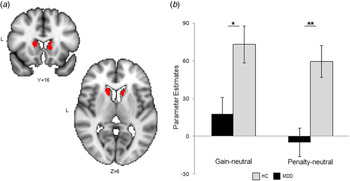
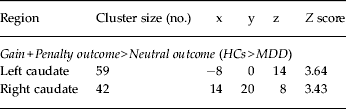
Whole-brain analysis revealed weaker bilateral caudate activation to incentives in MDD compared to controls (Fig. 1 a). As depicted in Table 2, the location of those clusters matches those described in our prior analyses (Pizzagalli et al. Reference Pizzagalli, Holmes, Dillon, Goetz, Birk, Bogdan, Dougherty, Iosifescu, Rauch and Fava2009). To further investigate caudate activations, average parameter estimates from the left and right caudate were extracted for each outcome contrast and entered as the dependent variables into a hemisphere × condition repeated-measures analysis of variance (ANOVA) with group (controls versus MDD) as a between-subject factor. This analysis revealed only a significant main effect of group (F 53 = 18.51, p < 0.001), with no interaction, suggesting that both left and right caudate clusters were hypo-active in MDD in response to both gains and penalties. Thus, left and right caudate ROIs were merged to create a single ROI mask of bilateral caudate. Figure 1 b depicts the group average activation values as extracted from this bilateral caudate mask, indicating that, relative to HCs, depressed individuals exhibited decreased bilateral caudate activation to both gains (p = 0.023) and penalties (p = 0.002).
(a) Clusters in the left and right caudate exhibiting hypo-activation in individuals with major depressive disorder (MDD) compared to healthy controls (HCs) in response to monetary gains and penalties versus responses to neutral outcome (p < 0.005 or Z > 2.58, uncorrected for multiple comparisons across voxels). (b) Average activation values as extracted from the bilateral caudate mask indicating that, relative to HC, depressed individuals exhibited decreased bilateral caudate activation to both gains and penalties. Bars ±1 s.e.m. * p < 0.05, ** p < 0.005.

Caudate hypo-activations in response to gains and penalties in major depressive disorder (MDD)

HCs, Healthy controls.
Left and right caudate emerged from the map of significant group differences (HCs > MDD) in responses to gains and penalties outcomes versus responses to neutral outcome (p < 0.005 or Z > 2.58, uncorrected for multiple comparisons across voxels).
Caudate connectivity in response to gains and penalties
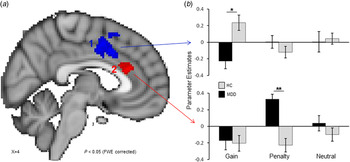
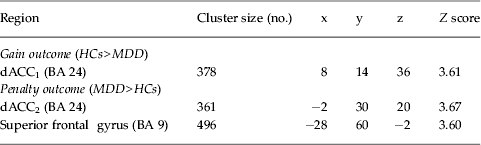
Whole-brain PPI analyses revealed a single cluster, located in the dorsal section of anterior cingulate cortex (dACC), that was more functionally connected to the caudate in controls compared to depressed participants during gain outcomes. By contrast, a different dACC cluster was found to be more functionally connected to the caudate in MDD compared to controls during penalties (Fig. 2 a, blue and red respectively, and Table 3). No clusters showed stronger connection with the caudate in controls compared to MDD during penalty outcomes or in MDD compared to controls during gain outcomes. Furthermore, no group PPI differences emerged during neutral outcomes. Figure 2 b depict the mean connectivity values as extracted from each dACC ROI for each condition. Importantly, the opposite pattern of abnormal connectivity in MDD suggests that their diminished caudate activation did not bias the PPI analyses. Indeed, regression analyses of the extracted connectivity values revealed that group differences in connectivity remained significant even after accounting for caudate activation as a covariate (p = 0.018 and p = 0.005 for gain and penalty respectively).
(a) Two distinct dorsal anterior cingulate cortex (dACC) clusters with opposite caudate connectivity abnormalities in major depressive disorder (MDD). dACC1 (blue) was more functionally connected to the caudate in healthy controls (HCs) compared to MDD subjects during gains, whereas dACC2 (red) was more functionally connected to the caudate in MDD compared to HCs during penalties. (b) Mean parameter estimates (connectivity values) from each dACC section for each condition. Bars ±1 s.e.m. * p < 0.05, ** p < 0.005.

Caudate connectivity abnormalities in response to gains and penalties in major depressive disorder (MDD)

HCs, Healthy controls; dACC, dorsal anterior cingulate cortex; BA, Brodmann area.
The results emerged from a whole-brain family-wise error (FWE)-corrected (p < 0.05) psychophysiological interaction (PPI) analyses using the bilateral caudate as a seed.
Notably, although both dACC clusters were within Brodmann area (BA) 24, they were distinct and spatially segregated. For the sake of simplicity, the dACC cluster that was more connected to the caudate in controls during positive outcomes (monetary gains) is referred to hereafter as dACC1, and the one that was more connected to the caudate in MDD during negative outcomes (monetary penalties) is referred to as dACC2 (Fig. 2 a, blue and red respectively).
Prediction of symptom change
Regression analyses revealed that neither pre-treatment dACC1–caudate connectivity during gains nor pre-treatment dACC2–caudate connectivity during penalties was associated with the percentage symptom change 12 weeks later (r = 0.23, p = 0.42 and r = 0.08, p = 0.79 respectively). Notably, both connectivity measures were also not associated with baseline depressive severity (pre-treatment HAMD-17 score) (r = 0.2, p = 0.33 and r = 0.03, p = 0.9 for dACC1–caudate and dACC2–caudate connectivity, respectively).
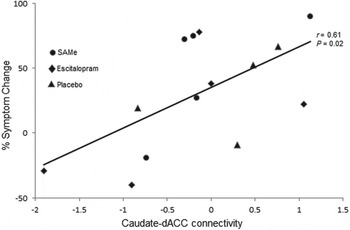
Next, we evaluated whether simultaneously accounting for connectivity abnormalities to both outcomes would increase prediction accuracy. This was done because of the demonstrated abnormalities in response to both positive and negative outcomes in our MDD sample, in addition to previous findings indicating that responses to positive and negative contexts contribute mutually to depression course (Rottenberg et al. Reference Rottenberg, Kasch, Gross and Gotlib2002). Furthermore, various event-related potential (ERP) studies have shown that a difference (composite) score in the feedback-related negativity (FRN) in response to monetary reward and loss correlated with depression severity (Foti & Hajcak, Reference Foti and Hajcak2009), and predicted future first onset of MDD (Bress et al. Reference Bress, Foti, Kotov, Klein and Hajcak2013). Directly relevant to the current study, the FRN is thought to originate from the ACC (Gehring & Willoughby, Reference Gehring and Willoughby2002), further corroborating our approach. Thus, the individuals' dACC2–caudate connectivity during penalty was subtracted from dACC1–caudate connectivity during gain, yielding a composite measure for which decreasing scores highlight greater deviation from the HCs' pattern. Regression analyses revealed that the composite connectivity score was not associated with baseline depression severity (r = 0.35, p = 0.09), but was significantly positively correlated with the percentage symptom change (F 12 = 6.92, r = 0.61, p = 0.022). Accordingly, the higher the score (i.e. the more normative the pre-treatment pattern of cortico-striatal connectivity), the more the symptoms improved 12 weeks later (Fig. 3). To test the specificity and robustness of these findings, we conducted a hierarchical regression analysis in which treatment arm (dummy coded), gender, baseline depressive severity and caudate (seed) activation to gain and penalty outcomes were entered in the first step, followed by the composite connectivity score in the second step; the percentage symptom change was the dependent variable. The model in the first step was not significant (F = 1.14, p = 0.4, r = 0.4). When entering the composite score in the second step, the model became significant (F change = 6.61, p change = 0.033, r change = 0.56, R 2 change = 0.36), indicating that the association between percentage symptom change and pre-treatment cortico-striatal connectivity remained significant even when accounting for baseline depression severity, gender and treatment arm.
Connectivity between the caudate and dorsal anterior cingulate cortex (dACC) in major depressive disorder (MDD) aggregated across both incentives is positively correlated with the percentage of symptom change following 12 weeks of treatment. The closer the pattern of pre-treatment caudate–dACC connectivity was to the controls' pattern, the larger was the improvement in symptoms. Percentage symptom change = [(HAMD-17pre – HAMD-17post)/HAMD-17pre] × 100. Caudate–dACC connectivity = (dACC1–caudate connectivity during gains) – (dACC2–caudate connectivity during penalties).

Discussion
Following the demonstration of blunted caudate responsiveness to positive and negative outcomes in MDD (Pizzagalli et al. Reference Pizzagalli, Holmes, Dillon, Goetz, Birk, Bogdan, Dougherty, Iosifescu, Rauch and Fava2009), the overarching aim of the present study was to evaluate whether unmedicated MDD individuals are also characterized by disrupted, valence-dependent, caudate connectivity. Using PPI whole-brain analyses in a relatively large sample involving 26 unmedicated individuals with MDD and 29 HCs, we identified spatially distinct dACC regions characterized by opposite patterns of abnormal caudate connectivity in MDD in response to positive and negative outcomes. Specifically, one dACC subregion showed decreased connectivity with the caudate during gain outcomes, whereas a distinct dACC subregion showed increased connectivity with the caudate during penalty outcomes relative to HCs. In addition, an exploratory analysis revealed that a more normative pattern of pre-treatment cortico-striatal connectivity predicted greater improvement in symptoms following a 12-week treatment period.
Previous findings in healthy subjects have implicated the caudate–dACC circuitry in the establishment of contingency between a given action and its outcome, regardless of its valence (Tricomi et al. Reference Tricomi, Delgado and Fiez2004; Niznikiewicz & Delgado, Reference Niznikiewicz and Delgado2011). Specifically, in prior studies, striatal function was interpreted as indicating a mismatch between expected and experienced outcomes (prediction error) (Delgado, Reference Delgado2007; Rangel et al. Reference Rangel, Camerer and Montague2008), whereas dACC function was associated with individuals' evaluation of their control over a given process (Shenhav et al. Reference Shenhav, Botvinick and Cohen2013). In light of these findings, altered cortico-striatal connectivity in MDD may hamper learning action–outcome contingencies, which in turn might disrupt goal-directed behavior. In particular, reduced synchronization between the caudate and dACC1 in response to monetary gains in MDD may reflect impaired functional integration in this circuitry during positive feedback, which might reduce the saliency of such feedback in reinforcing a repetition of this (successful) action. In support of this interpretation, compared to HCs, individuals with MDD show a lower probability of repeating an action that leads to a positive feedback or reward (Pizzagalli et al. Reference Pizzagalli, Iosifescu, Hallett, Ratner and Fava2008; Liu et al. Reference Liu, Chan, Wang, Huang, Cheung, Gong and Gollan2011; Vrieze et al. Reference Vrieze, Pizzagalli, Demyttenaere, Hompes, Sienaert, de Boer, Schmidt and Claes2013), and weaker behavioral modulation of incentives (Pizzagalli et al. Reference Pizzagalli, Holmes, Dillon, Goetz, Birk, Bogdan, Dougherty, Iosifescu, Rauch and Fava2009). In addition, a blunted caudate responsiveness in MDD emerged while patients learned to associate their actions with the receipt of unpredictable reward (Kumar et al. Reference Kumar, Waiter, Ahearn, Milders, Reid and Steele2008; Pizzagalli et al. Reference Pizzagalli, Holmes, Dillon, Goetz, Birk, Bogdan, Dougherty, Iosifescu, Rauch and Fava2009; Smoski et al. Reference Smoski, Felder, Bizzell, Green, Ernst, Lynch and Dichter2009), yet no caudate abnormalities in MDD emerged when rewards were more predictable (Knutson et al. Reference Knutson, Bhanji, Cooney, Atlas and Gotlib2008). By contrast, increased caudate–dACC2 connectivity during penalties may represent a neural mechanism for the abnormally increased representation of negative feedback upon the completion of an (unsuccessful) action in MDD. Indeed, depressed individuals amplify the significance of failures relative to controls (Wenzlaff & Grozier, Reference Wenzlaff and Grozier1988), potentially leading to the commitment of more errors after an initial mistake (Beats et al. Reference Beats, Sahakian and Levy1996; Elliott et al. Reference Elliott, Sahakian, McKay, Herrod, Robbins and Paykel1996; Steffens et al. Reference Steffens, Wagner, Levy, Horn and Krishnan2001; Pizzagalli et al. Reference Pizzagalli, Peccoralo, Davidson and Cohen2006; Holmes & Pizzagalli, Reference Holmes and Pizzagalli2008). Intriguingly, inaccurate estimation of contingencies between behaviors and emotional outcomes has long been considered a characterizing feature of MDD (Alloy & Abramson, Reference Alloy and Abramson1979). Furthermore, contingency deficiencies in response to affective outcomes fit with two classical models of MDD: Seligman's learned helplessness model (Seligman, Reference Seligman1972) and Beck's cognitive theory (Beck, Reference Beck2005). The first posits that MDD patients grow to accept that negative circumstances cannot be altered through their own actions (Seligman, Reference Seligman1972), whereas the second proposes that depression is associated with biased processing of feedback information in such a way that depressed individuals fail to interpret positive events as resulting from their owns' actions yet overattribute negative events to their actions (Beck, Reference Beck2005). Whether disrupted cortico-striatal connectivity is indeed linked to these cognitive diatheses is currently unknown and warrants further inquiry.
Of note, caudate–dACC connectivity before treatment was associated with symptom changes 12 weeks later, even when accounting for pre-treatment depression severity. This novel finding should be regarded as preliminary given that the current sample size prevented us from comparing individuals who reached remission versus those who did not, and also from differentiating between treatment arms. Indeed, symptom change was predicted regardless of whether it was achieved through pharmacology, a dietary supplement with antidepressant properties, or placebo. Therefore, we can only speculate that a more normative pattern of pre-treatment caudate–dACC connectivity may be associated with larger and global clinical improvement. Further highlighting the role of these neural pathways in clinical course, treatment-induced normalization of frontostriatal functional connectivity was found to correlate positively with increases in positive affect (Heller et al. Reference Heller, Johnstone, Light, Peterson, Kolden, Kalin and Davidson2013). Importantly, clinical improvement was achieved through either venlafaxine or fluoxetine, suggesting that the mechanism of action fostering improvements in positive affect and frontostriatal connectivity did not differ between the two antidepressants (Heller et al. Reference Heller, Johnstone, Light, Peterson, Kolden, Kalin and Davidson2013). Similarly, a recent meta-analysis indicated that increased pre-treatment ACC and striatum activation is a robust predictor of positive response to both pharmacological and behavioral treatment in MDD (Fu et al. Reference Fu, Steiner and Costafreda2013). Moreover, the ACC cluster identified by Fu et al. (Reference Fu, Steiner and Costafreda2013) overlaps with the dACC cluster emerging from the current connectivity analyses and predicting symptom improvement following treatment. Lastly, it should be noted that MDD subjects were also shown to exhibit abnormalities in the integrity of the internal capsule fibers, which connect striatal and cingulate regions (Zou et al. Reference Zou, Huang, Li, Gong, Li, Ou-yang, Deng, Chen, Li, Ding and Sun2008; Zhu et al. Reference Zhu, Wang, Xiao, Zhong, Liao and Yao2011; Zhang et al. Reference Zhang, Ajilore, Zhan, Gadelkarim, Korthauer, Yang, Leow and Kumar2013), and that decreased white-matter volume in the internal capsule predicted treatment non-response to pharmacology (Phillips et al. Reference Phillips, Batten, Aldosary, Tremblay and Blier2012). Conversely, deep brain stimulation (DBS) to the internal capsule has been found to reduce depressive symptoms in severely depressed, treatment-resistant MDD patients (Blomstedt et al. Reference Blomstedt, Sjoberg, Hansson, Bodlund and Hariz2011), and stimulate cingulate regions in non-human primates (Knight et al. Reference Knight, Min, Hwang, Marsh, Paek, Kim, Felmlee, Abulseoud, Bennet, Frye and Lee2013). Accordingly, the current cortico-striatal connectivity findings and prior findings highlight a key role of this circuitry in the pathophysiology of MDD and mechanisms of treatment response.
In summary, we have demonstrated that, compared to HCs, depressed individuals exhibit abnormal caudate connectivity with the dACC and, furthermore, that such dysregulated cortico-striatal connectivity is both incentive dependent and predictive of treatment response. These findings may account for the commonly observed reduced action–outcome contingency learning in MDD, which may disrupt goal-directed behavior and represent a central feature of anhedonic behavior in MDD.
Supplementary material
For supplementary material accompanying this paper visit http://dx.doi.org/10.1017/S0033291714001123.
Acknowledgments
We are grateful to E. L. Goetz, J. Birk, S. J. Dutra and N. B. Hall for their skilled assistance with this study. This study was supported by National Institute of Mental Health (NIMH) grant R01 MH068376 and National Center for Complementary and Alternative Medicine (NCCAM) grant R21 AT002974 (both awarded to D.A.P.) and NCCAM grant R01 AT001638 (awarded to M.F). A.J.H. and D.G.D. were supported by grants K01 MH099232 and K99 MH094438 respectively.
ClinicalTrials.gov Identifier: NCT00101452.
Declaration of Interest
Dr Dougherty has received, over the past three years, research support and consulting/honoraria from Medtronic, travel and research support from Roche and research support from Eli Lilly and Cyberonics. Dr Iosifescu has received, over the past three years, funding through Icahn School of Medicine at Mount Sinai from AstraZeneca, Brainsway, Euthymics, Neosync and Roche; and consulting fees from Avanir, CNS Response, Otsuka, Servier and Sunovion. Dr Mischoulon has received, over the past three years, research support from the Bowman Family Foundation, Bristol-Myers Squibb Co., Cederroth, FisherWallace, Ganeden, Lichtwer Pharma, Nordic Naturals, Laxdale (Amarin), Methylation Sciences, Inc. (MSI) and SwissMedica; honoraria for consulting, speaking and writing from Pamlab, Bristol-Myers Squibb Co., Nordic Naturals, Virbac, Pfizer, Reed Medical Education and the Massachusetts General Hospital Psychiatry Academy; royalties from Back Bay Scientific for PMS Escape, and from Lippincott Williams & Wilkins for the published book Natural Medications for Psychiatric Disorders: Considering the Alternatives. No payment has exceeded US$10 000. Dr Fava has received research support from Abbot Laboratories, Alkermes Inc., American Cyanamid, Aspect Medical Systems, AstraZeneca, BioResearch, BrainCells Inc., Bristol-Myers Squib, CeNeRx BioPharma, Cephalon, Clintara LLC, Covance, Covidien, Eli Lilly and Company, EnVivo Pharmaceuticals Inc., Euthymics Bioscience Inc., Forest Pharmaceuticals Inc., Ganeden Biotec, Inc., GlaxoSmithKline, Harvard Clinical Research Institute, Hoffman-LaRoche, Icon Clinical Research, i3 Innovus/Ingenix, Janssen R&D LLC, Jed Foundation, Johnson & Johnson Pharmaceutical Research & Development, Lichtwer Pharma GmbH, Lorex Pharmaceuticals, MedAvante, National Alliance for Research on Schizophrenia & Depression (NARSAD), National Center for Complementary and Alternative Medicine (NCCAM), National Institute of Drug Abuse (NIDA), National Institute of Mental Health (NIMH), Neuralstem Inc., Novartis AG, Organon Pharmaceuticals, PamLab LLC, Pfizer Inc., Pharmacia-Upjohn, Pharmaceutical Research Associates Inc., Pharmavite® LLC, PharmoRx Therapeutics, Photothera, Roche Pharmaceuticals, RCT Logic, LLC (formerly Clinical Trials Solutions, LLC), Sanofi-Aventis US LLC, Shire, Solvay Pharmaceuticals Inc., Synthelabo and Wyeth-Ayerst Laboratories; advisory/consulting from Abbott Laboratories, Affectis Pharmaceuticals AG, Alkermes Inc., Amarin Pharma Inc., Aspect Medical Systems, AstraZeneca, Auspex Pharmaceuticals, Bayer AG, Best Practice Project Management Inc., BioMarin Pharmaceuticals Inc., Biovail Corporation, BrainCells Inc., Bristol-Myers Squibb, CeNeRx BioPharma, Cephalon Inc., Cerecor, Clinical Trials Solutions, CNS Response Inc., Compellis Pharmaceuticals, Cypress Pharmaceutical Inc., DiagnoSearch Life Sciences (P) Ltd., Dinippon Sumitomo Pharma Co. Inc., Dov Pharmaceuticals Inc., Edgemont Pharmaceuticals Inc., Eisai Inc., Eli Lilly and Company, EnVivo Pharmaceuticals Inc., ePharmaSolutions, EPIX Pharmaceuticals Inc., Euthymics Bioscience Inc., Fabre-Kramer Pharmaceuticals Inc., Forest Pharmaceuticals Inc., GenOmind LLC, GlaxoSmithKline, Grunenthal GmbH, i3 Innovus/Ingenis, Janssen Pharmaceutica, Jazz Pharmaceuticals Inc., Johnson & Johnson Pharmaceutical Research & Development LLC, Knoll Pharmaceuticals Corp., Labopharm Inc., Lorex Pharmaceuticals, Lundbeck Inc., MedAvante Inc., Merck & Co., Inc., MSI Methylation Sciences Inc., Naurex Inc., Neuralstem Inc., Neuronetics Inc., NextWave Pharmaceuticals, Novartis AG, Nutrition 21, Orexigen Therapeutics Inc., Organon Pharmaceuticals, Otsuka Pharmaceuticals, Pamlab LLC., Pfizer Inc., PharmaStar, Pharmavite® LLC., PharmoRx Therapeutics, Precision Human Biolaboratory, Prexa Pharmaceuticals Inc., Puretech Ventures, PsychoGenics, Psylin Neurosciences Inc., Rexahn Pharmaceuticals Inc., Ridge Diagnostics Inc., Roche, Sanofi-Aventis US LLC., Sepracor Inc., Servier Laboratories, Schering-Plough Corporation, Solvay Pharmaceuticals Inc., Somaxon Pharmaceuticals Inc., Somerset Pharmaceuticals Inc., Sunovion Pharmaceuticals, Supernus Pharmaceuticals Inc., Synthelabo, Takeda Pharmaceutical Company Limited, Tal Medical Inc., Tetragenex Pharmaceuticals Inc., TransForm Pharmaceuticals Inc., Transcept Pharmaceuticals Inc. and Vanda Pharmaceuticals Inc.; speaking/publishing from Adamed Co, Advanced Meeting Partners, American Psychiatric Association, American Society of Clinical Psychopharmacology, AstraZeneca, Belvoir Media Group, Boehringer Ingelheim GmbH, Bristol-Myers Squibb, Cephalon Inc., CME Institute/Physicians Postgraduate Press Inc., Eli Lilly and Company, Forest Pharmaceuticals Inc., GlaxoSmithKline, Imedex LLC, MGH Psychiatry Academy/Primedia, MGH Psychiatry Academy/Reed Elsevier, Novartis AG, Organon Pharmaceuticals, Pfizer Inc., PharmaStar, United BioSource Corp. and Wyeth-Ayerst Laboratories; equity holdings in Compellis and PsyBrain Inc.; royalty/patent or other income from Patent for Sequential Parallel Comparison Design (SPCD), which are licensed by MGH to RCT Logic, LLC, and patent application for a combination of Scopolamine and Ketamine in Major Depressive Disorder (MDD); copyright for the MGH Cognitive and Physical Functioning Questionnaire (CPFQ), Sexual Functioning Inventory (SFI), Antidepressant Treatment Response Questionnaire (ATRQ), Discontinuation-Emergent Signs and Symptoms (DESS), and SAFER, Lippincott, Williams & Wilkins, Wolkers Kluwer and World Scientific Publishing Co. Pte. Ltd. Dr Pizzagalli has received, over the past three years, honoraria/consulting fees from Advanced Neuro Technology North America, AstraZeneca, Ono Pharma USA, Pfizer, Servier and Shire for studies unrelated to this project.