Introduction
Ethiopian wolves, Canis simensis, are medium-sized territorial canids endemic to the Ethiopian highlands (Sillero-Zubiri & Gottelli, Reference Sillero-Zubiri and Gottelli1994). They live in family packs consisting of 2–13 adult wolves, and 0–6 yearlings and pups (Sillero-Zubiri et al., Reference Sillero-Zubiri, Gottelli and Macdonald1996a). Packs occupy and defend territories (Sillero-Zubiri & Gottelli, Reference Sillero-Zubiri and Gottelli1995b), and all adult pack members participate in daily territory boundary patrols, and defend their pack territory from wolves in neighbouring packs (Sillero-Zubiri & Macdonald, Reference Sillero-Zubiri and Macdonald1998). Although Ethiopian wolves live in packs, they mainly forage solitarily and specialize in hunting Afroalpine rodents, especially the endemic giant molerat, Tachyoryctes macrocephalus, which is the Ethiopian wolf's main prey in the Bale Mountains (Sillero-Zubiri & Gottelli, Reference Sillero-Zubiri and Gottelli1995a). Ethiopian wolves are co-operative breeders, and generally only the dominant female in a pack breeds (Sillero-Zubiri et al., Reference Sillero-Zubiri, Gottelli and Macdonald1996a). Breeding is seasonal, with pups (1–6) usually born at the end of the rainy season (October–January, Sillero-Zubiri & Gottelli, Reference Sillero-Zubiri and Gottelli1994). Ethiopian wolves are considered to be the world's rarest canid (Marino et al., Reference Marino, Sillero-Zubiri and Macdonald2006), and are listed as ‘endangered’ by the International Union for Conservation of Nature (IUCN), with fewer than 500 adults surviving (Marino & Sillero-Zubiri, Reference Marino and Sillero-Zubiri2011). Threats to Ethiopian wolf survival include habitat destruction and fragmentation (Sillero-Zubiri & Macdonald, Reference Sillero-Zubiri and Macdonald1997), but the most immediate threat is infectious disease spread by domestic dogs, notably rabies (Haydon et al., Reference Haydon, Laurenson and Sillero-Zubiri2002; Randall et al., Reference Randall, Williams, Kuzmin, Rupprecht, Tallents, Tefera, Argaw, Shiferaw, Knobel, Sillero-Zubiri and Laurenson2004; Johnson et al., Reference Johnson, Mansfield, Marston, Wilson, Goddard, Selden, Hemson, Edea, Van Kesteren, Shiferaw, Stewart, Sillero-Zubiri and Fooks2010).
As the world's rarest canid, and a flagship species for its unique habitat (Sillero-Zubiri & Macdonald, Reference Sillero-Zubiri and Macdonald1997), the Ethiopian wolf has long been the focus of scientific studies, including those on diet (Sillero-Zubiri & Gottelli, Reference Sillero-Zubiri and Gottelli1995a), territoriality (Sillero-Zubiri & Macdonald, Reference Sillero-Zubiri and Macdonald1998), breeding system (Sillero-Zubiri et al., Reference Sillero-Zubiri, Gottelli and Macdonald1996a) and reproductive physiology (van Kesteren et al., Reference van Kesteren, Sillero-Zubiri, Millar, Argaw, Macdonald and Paris2012, Reference van Kesteren, Paris, Macdonald, Millar, Argaw, Johnson, Farstad and Sillero-Zubiri2013). However, to date, no detailed studies on Ethiopian wolf parasites have been published. A publication by Jebessa (Reference Jebessa2009) describes eight Ethiopian wolf faecal samples and records eggs of Trichuris vulpis, taeniid species, Ascaris lumbricoides and an adult Echinococcus granulosus. M. Anwar (pers. comm. in Sillero-Zubiri & Gottelli, Reference Sillero-Zubiri and Gottelli1994) reported finding nematodes, trematodes and Taenia sp. in the intestines of several carcasses. In the current study we aimed to study the helminth fauna of Ethiopian wolves in more detail by analysing faecal samples collected from 94 individual wolves. We further aimed to assess the effects of wolves' location, sex and age on their helminth fauna, and to assess relationships between the different parasites found.
Materials and methods
Study site
This study was conducted in the Bale Mountains National Park (BMNP) in southern Ethiopia (7°N, 39°40′E). Samples were collected in the Web Valley (WV, 7°01′N, 39°69′E), Morebawa (MB, 6°92′N, 39°63′E) and the Sanetti Plateau (SP, 6°85′N, 39°88′E). The Web Valley and Morebawa are both located at 3450–3550 m above sea level (asl), and the Sanetti Plateau is located at 3800-4300 m asl, with all three locations supporting wolf densities of approximately 1.2 wolves/km2 (Sillero-Zubiri et al., Reference Sillero-Zubiri, Gottelli and Macdonald1996a), although disease outbreaks have periodically reduced this density (e.g. Haydon et al., Reference Haydon, Laurenson and Sillero-Zubiri2002; Randall et al., Reference Randall, Williams, Kuzmin, Rupprecht, Tallents, Tefera, Argaw, Shiferaw, Knobel, Sillero-Zubiri and Laurenson2004; Johnson et al., Reference Johnson, Mansfield, Marston, Wilson, Goddard, Selden, Hemson, Edea, Van Kesteren, Shiferaw, Stewart, Sillero-Zubiri and Fooks2010). The climate in the higher altitudes of the Bale Mountains is characterized by an 8-month wet season (approximately March–October), with rainfall maxima of 1150 mm/year, and a 4-month dry season (approximately November–February, see Hillman, Reference Hillman1988; Atickem et al., Reference Atickem, Bekele and Williams2009). Temperatures in the dry season range from − 15°C at night to +26°C during the day, with more modest temperature fluctuations during the wet season (Hillman, Reference Hillman1988). The vegetation is typical of Afroalpine meadowland and is dominated by short alpine grasses and herbs, including African sage, Artemesia afra, Alchemilla sp. and bushy everlasting, Helichrysum species. Areas with poor drainage are swampy and dominated by grasses such as Cyperus sp. and Scirpus sp. (Malcolm, Reference Malcolm1997). The mammalian fauna in BMNP includes endemic species such as the giant molerat, Starck's hare, Lepus starcki, mountain nyala, Tragelaphus buxtoni (Yalden & Largen, Reference Yalden and Largen1992), and Menelik's bushbuck, Tragelaphus scriptus meneliki (Blower, Reference Blower1968), as well as non-endemic species including klipspringer, Oreotragus oreotragus, common duiker, Sylvicapra grimmia, rock hyrax, Procavia capensis (Blower, Reference Blower1968), serval cats, Felis serval, spotted hyenas, Crocuta crocuta, and honey badgers, Mellivora capensis (Sillero-Zubiri et al., Reference Sillero-Zubiri, King and Macdonald1996b). In addition, humans, domestic dogs and livestock, including cattle, sheep and goats, are present inside BMNP (Vial et al., Reference Vial, Sillero-Zubiri, Marino, Haydon and Macdonald2010).
Collection and processing of faecal samples
Faecal samples were collected between 7 August 2008 and 20 February 2010 (see van Kesteren et al., Reference van Kesteren, Sillero-Zubiri, Millar, Argaw, Macdonald and Paris2012, Reference van Kesteren, Paris, Macdonald, Millar, Argaw, Johnson, Farstad and Sillero-Zubiri2013). The sampling time included two field seasons, one from August 2008 to February 2009 and one from July 2009 to February 2010, with two samples collected opportunistically in April and May 2008. A total of 94 wolves were sampled. This included 51 wolves from the Web Valley, including 47 from eight known packs and 4 wolves not belonging to any known pack (including one adult male dog–wolf hybrid, Gottelli et al., Reference Gottelli, Sillero-Zubiri, Applebaum, Roy, Girman, Garcia-Moreno, Ostrander and Wayne1994). A total of 28 wolves from four packs in the Sanetti Plateau were included, as well as 15 wolves from six packs in Morebawa. Of the 94 sampled wolves, 37 were female, 56 were male and one was of unknown sex. Of wolves sampled, 75 were adult (classed as ≥ 2 years old), 11 were sub-adult ( ≥ 1 ≤ 2 years), 7 were juvenile ( ≥ 0.5 ≤ 1 year) and one was a puppy ( < 6 months).
Ethiopian wolves were followed on foot with the assistance of local field assistants. Whenever a wolf was seen defecating, the faecal sample was collected within minutes of defecation. The age, sex and identity of the wolf were recorded. In addition, 10 samples were collected from wolves that defecated while foot-trapped as part of the 2008 emergency rabies vaccination (Johnson et al., Reference Johnson, Mansfield, Marston, Wilson, Goddard, Selden, Hemson, Edea, Van Kesteren, Shiferaw, Stewart, Sillero-Zubiri and Fooks2010). Individual wolves were identified by ear tags (n= 41), individual markings (n= 43) or from foot traps and subsequent ear tagging (n= 10). Upon collection, faecal samples were put in 50 ml tubes and stored in a cooler box on ice until return to the research camp, where a subsection of each sample was preserved in 95% ethanol in 35-ml or 15-ml tubes. Samples were stored at room temperature until transport to the UK, where they were stored at − 20°C until analysis.
Samples were analysed for parasite eggs using the volumetric dilution method, as described by Ashford et al. (Reference Ashford, Hall and Babona1981). In brief, a small portion of faeces (~1 ± 0.1 g) previously fixed in 95% ethanol was sieved through a small mesh with 4 ml of distilled water. The slurry was collected in a 15-ml centrifuge tube and distilled water was added to make up to 15 ml in total volume. Tubes were centrifuged at 2000 rpm for 2 min, the supernatant was discarded and the pellet was re-suspended in 4 ml of distilled water. A drop of re-suspended sample was placed on a microscope slide and examined under a compound microscope for the presence of parasite eggs. Five slides were examined per faecal sample, and the total number of eggs per slide were counted, and recorded as mean eggs per gram (epg). Helminth eggs were identified to genus level using Ash & Orihel (Reference Ash and Orihel1997) and Soulsby (Reference Soulsby1974).
When taeniid eggs were identified, we attempted to determine the species present using two polymerase chain reaction (PCR) approaches. First, we attempted to isolate and extract DNA directly from the taeniid eggs using a Qiagen® DNEasy blood&tissue kit (Qiagen, Hilden, Germany), which was then subjected to a generic cestode PCR protocol (von Nickisch-Rosenegk et al., Reference von Nickisch-Rosenegk, Silva-Gonzalez and Lucius1999). Second, DNA was extracted from faecal samples positive for taeniid eggs using a Qiagen® Qiamp Stoolkit, following the manufacturer's instructions but using 1 g of faeces. This DNA was subjected to amplification with generic cestode primers (von Nickisch-Rosenegk et al., Reference von Nickisch-Rosenegk, Silva-Gonzalez and Lucius1999) and a copro-PCR protocol was performed for E. granulosus sensu lato (Abbasi et al., Reference Abbasi, Branzburg, Campos-Ponce, Hafez, Raoul, Craig and Hamburger2003; with modifications by Boufana et al., Reference Boufana, Campos-Ponce, Naidich, Buishi, Lahmar, Zeyhle, Jenkins, Combes, Wen, Xiao, Nakao, Ito, Qiu and Craig2008). Positive controls (DNA from adult E. multilocularis and E. granulosus) and negative controls (PCR-grade water) were included in all PCRs. A Stratagene (La Jolla, California, USA) Robocycler was used for cycling profiles and PCR products were separated by electrophoresis on a 1.5% agarose gel (Bioline, London, UK) in 1 × Tris–borate–EDTA buffer (Severn Biotech, Kidderminster, UK), stained with gel red (Cambridge Biosciences, Cambridge, UK). Gels were visualized using Syngene G:Box gel documentation system (Cambridge Biosciences). Samples that were successfully amplified were sequenced by Beckman Coulter (Essex, UK) and the resulting sequences analysed using BLAST (http://blast.ncbi.nlm.nih.gov/Blast.cgi).
Data analysis
Data were analysed using R statistical software version 3.0.1 (R Development Core Team, 2013). For initial analysis and for logistic regression modelling all faecal samples were dichotomously classified as positive (at least one egg recorded) or negative for each type of helminth egg. Data were available for five potential risk factors: location of wolf (MB, SP, WV); age of wolf; sex of wolf and sampling season (wet season 2008, dry season 2008–2009, wet season 2009, dry season 2009–2010). Additionally, the dichotomized status (positive/negative) of the sample in relation to each of the other three types of nematode eggs identified were considered as possible risk factors of interest. Cestodes were excluded from the analysis due to the very low number of outcomes (n< 5). The one puppy sampled was removed from further analysis.
Initial univariable analysis of associations between different nematode species and risk factor variables (including presence of other nematodes) was conducted using Fisher's exact test. In order to quantify levels of association between nematodes, phi coefficients were also calculated.
Generalized linear models were created for nematode data, using either the presence/absence of each of the four nematode eggs (logistic regression), or egg counts (negative binomial regression) as dependent variables. Logistic regression was conducted using the ‘glm’ command from the core ‘stats’ package in R, and negative binomial regression was conducted using the ‘glm.nb’ command from the ‘MASS’ package (Venables & Ripley, Reference Venables and Ripley2002). The same model selection protocol was used for all nematodes and model types. After parameterizing the model with all seven independent variables, a stepwise backward elimination process was used to create a suitably parsimonious model. Variables were removed sequentially according to their estimated impact on the residual deviance of the model (as assessed using a chi-square test), and likelihood ratio tests were used to assess whether the variables were contributing to the model. The ‘season’ variable was found post hoc to improve the final model fit. Therefore the effect of the two constituent variables (wet/dry season and sampling year) was investigated using a stepwise elimination process, which included first replacing the original variable with the two constituent variables, and including the interaction between them. Except for this case, interactions between other variables were not assessed in the current investigation due to the low number of outcomes and the potential risk of model instability. Comparison of the parameter estimates for different levels of those variables with more than two levels was achieved using the ‘glht’ command in the ‘multcomp’ package (Hothorn et al., Reference Hothorn, Bretz and Westfall2008), and factor levels were collapsed if warranted.
The final model was then compared to a null model containing only an intercept, and if the likelihood ratio P value was greater than 0.05 it was concluded that there were no significant predictors of the nematode in question. Additionally, all final negative binomial regression models were compared with equivalent Poisson regression models using a likelihood ratio test with a P value cut-off of 0.05.
Results
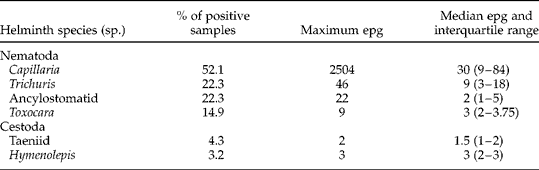
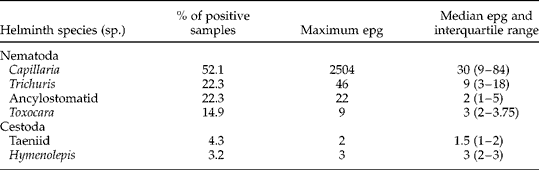
Eggs of at least one of six different helminths were found in 66 faecal samples (70.2%), namely species of Capillaria, Trichuris, Toxocara, Hymenolepis, ancylostomatids and taeniids. Capillaria eggs were the most commonly found helminth eggs (n= 49 faecal samples), with between 1 and 2504 epg. Trichuris eggs were found in 21 faecal samples, Toxocara eggs were found in 14 samples and ancylostomatid eggs were found in 21 samples. Only 3 samples contained Hymenolepis sp. and 4 contained taeniid eggs (table 1). Most samples (n= 34) contained eggs of only one type of helminth, with some containing two (n= 22) or three (n= 7) types. Two samples contained eggs of four helminth types, and one sample contained eggs of five types.
The prevalence (%) of helminth eggs per gram (epg) in 94 faecal samples of the Ethiopian wolf from 2008 to 2010. Median and interquartile range estimates are based upon positive samples only.
Attempts to extract and amplify DNA directly from taeniid eggs using a generic cestode PCR (von Nickisch-Rosenegk et al., Reference von Nickisch-Rosenegk, Silva-Gonzalez and Lucius1999) were not successful. Similarly, the faecal DNA samples did not yield a diagnostic band when tested with the generic cestode primers (von Nickisch-Rosenegk et al., Reference von Nickisch-Rosenegk, Silva-Gonzalez and Lucius1999), possibly because this protocol is not optimized for copro-PCR. However, faecal DNA extracted from one of the four samples positive for taeniid eggs was copro-PCR positive and, after sequencing, gave a 98% match to E. granulosus (NCBI database number DQ157697.1).
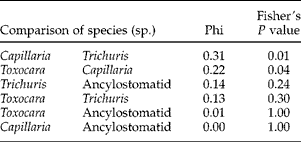
Due to the very low numbers of positive samples, analysis was not conducted for Hymenolepis or taeniid species. There was some evidence of positive associations between the presence of species of Capillaria, Toxocara and Trichuris (table 2).
Measures of association (phi coefficients) and Fisher's exact test (P values) between different nematode species.
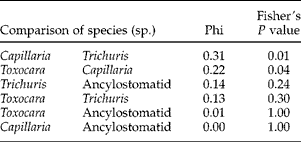
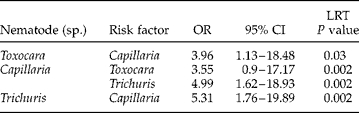
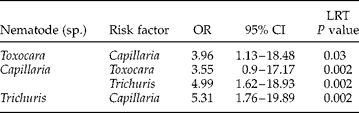
Of the five non-parasite model variables (wolf age, sex, location, season and year), none was found to be significantly associated with the presence of species of Capillaria, Toxocara, ancylostomatids or Trichuris. However, there was evidence of a positive association between the presence of Capillaria and each of Toxocara and Trichuris, as had been identified from simple pairwise comparison with odds ratio estimates from the final logistic regression models (table 3).
Significant risk factors for presence/absence of the four nematodes (no significant risk factors found for ancylostomatids) using the final logistic regression model. OR denotes the odds ratio, and the LRT P value is the likelihood ratio test P value of the final model compared to a null (intercept-only) model.
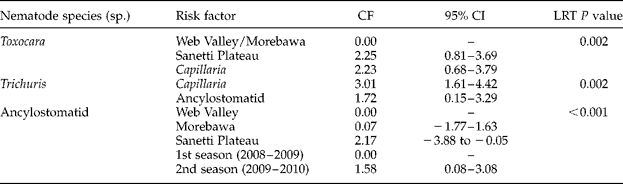
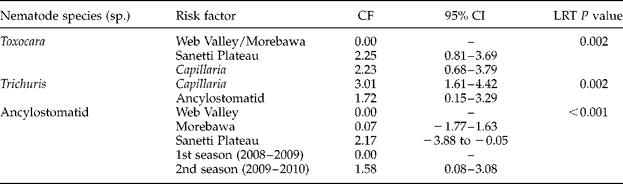
All negative binomial regression models were a superior fit to the data than the equivalent Poisson regression models (LRT P values < 0.001 in all cases), suggesting that the distribution of egg counts between different wolves was overdispersed. Wolf age, sex, location, sampling season and sampling year were not significant predictors for Capillaria or Trichuris egg counts. Location was a significant predictor for Toxocara sp. egg counts, with higher egg counts amongst wolves in the Sanetti Plateau compared to Web Valley and Morebawa. As there was no evidence of a difference between the coefficients for Web Valley and Morebawa, these factor levels were combined for the final model. Location was also a significant predictor for ancylostomatid egg count, with samples collected in the Web Valley associated with higher egg counts than those collected from the Sanetti Plateau. A similar pattern was observed for Morebawa as compared to Sanetti, but did not reach significance. Sampling year was also a significant predictor for ancylostomatid egg count, with samples collected during the second field season (2009–2010), being associated with higher egg counts. In terms of associations between different nematode species, the presence of Capillaria was associated with higher egg counts of both Toxocara and Trichuris. A positive association between ancylostomatid presence and Trichuris egg counts was also identified. No associations with Capillaria egg count were identified. The possibility that this was due to the effect of a single high recorded egg count (2504 epg) was investigated by repeating the model selection process with this observation removed. However, there remained no evidence to select any model other than that with an intercept only (data not shown). Table 4 shows the results of the negative binomial regression model, with coefficients presented on the log scale and the intercept set to zero.
Significant risk factors for differences in nematode species using the final negative binomial regression model; coefficients of log of egg counts (CF), 95% confidence intervals (CI) and likelihood ratio test (LRT) P values.
Discussion
Helminth eggs of species of Trichuris, Capillaria, Toxocara, ancylostomatids, Hymenolepis and taeniids, including E. granulosus, were identified from Ethiopian wolf faecal samples. These helminth genera have all been recorded in closely related grey wolves, Canis lupus (Craig & Craig, Reference Craig and Craig2005). Faecal samples from Arctic foxes, Vulpes lagopus, (Meijer et al., Reference Meijer, Mattsson, Angerbjörn, Osterman-Lind, Fernández-Aguilar and Gavier-Widén2011; Elmore et al., Reference Elmore, Lalonde, Samelius, Alisauskas, Gajadhar and Jenkins2013), and coyotes, Canis latrans (Gompper et al., Reference Gompper, Goodman, Kays, Ray and Fiorello2003), have been found to contain Capillaria species. Trichuris spp., including T. vulpis, have been found in Arctic foxes (Meijer et al., Reference Meijer, Mattsson, Angerbjörn, Osterman-Lind, Fernández-Aguilar and Gavier-Widén2011) and maned wolves, Chrysocyon brachyurus (Curi et al., Reference Curi, Coelho, de Campos Cordeiro Malta, Magni, Sabato, Araujo, Lobato, Santos, Santos, Ragozo and de Souza2012). Ancylostomatid helminths have also been recorded in maned wolves (Curi et al., Reference Curi, Coelho, de Campos Cordeiro Malta, Magni, Sabato, Araujo, Lobato, Santos, Santos, Ragozo and de Souza2012) and red foxes (Dalimi et al., Reference Dalimi, Sattari and Motamedi2006). Taeniid species, including Taenia sp. and Echinococcus sp., have been found in several canid species, including Arctic foxes (Meijer et al., Reference Meijer, Mattsson, Angerbjörn, Osterman-Lind, Fernández-Aguilar and Gavier-Widén2011; Elmore et al., Reference Elmore, Lalonde, Samelius, Alisauskas, Gajadhar and Jenkins2013), red foxes (Vervaeke et al., Reference Vervaeke, Dorny, De Bruyn, Vercammen, Jordaens, Van Den Berghe and Verhagen2005; Dalimi et al., Reference Dalimi, Sattari and Motamedi2006), coyotes (Gompper et al., Reference Gompper, Goodman, Kays, Ray and Fiorello2003) and golden jackals (Dalimi et al., Reference Dalimi, Sattari and Motamedi2006). Hymenolepis sp. do not usually use canids as definitive hosts (Woodland, Reference Woodland1924), and the three samples containing Hymenolepis eggs found here are probably artefacts from ingested rodent prey. Hymenolepis eggs were also recorded in Arctic fox faecal samples (Elmore et al., Reference Elmore, Lalonde, Samelius, Alisauskas, Gajadhar and Jenkins2013).
Many helminths found in Ethiopian wolves have been recorded in domestic dogs from Debre Zeit (Yacob et al., Reference Yacob, Ayele, Fikru and Basu2007), Ambo (Zewdu et al., Reference Zewdu, Semahegn and Mekibib2010) and Jimma (Degefu et al., Reference Degefu, Tefera and Yohannes2011), all located within approximately 325 km north-west of BMNP. Domestic dogs are closely related to Ethiopian wolves (Gottelli et al., Reference Gottelli, Sillero-Zubiri, Applebaum, Roy, Girman, Garcia-Moreno, Ostrander and Wayne1994) and are sympatric in the Bale Mountains (Laurenson et al., Reference Laurenson, Sillero-Zubiri, Thompson, Shiferaw, Thirgood and Malcolm1998; Vial et al., Reference Vial, Sillero-Zubiri, Marino, Haydon and Macdonald2010). As such, they may have some parasites in common, and transmission of parasites between domestic dogs and Ethiopian wolves may occur. Ancylostoma caninum was the most common dog helminth recorded in Debre Zeit and Jimma, and the second most common in Ambo (Yacob et al., Reference Yacob, Ayele, Fikru and Basu2007; Zewdu et al., Reference Zewdu, Semahegn and Mekibib2010; Degefu et al., Reference Degefu, Tefera and Yohannes2011). Other commonly found helminths in dogs in all three studies were Toxocara canis and Trichuris vulpis (Yacob et al., Reference Yacob, Ayele, Fikru and Basu2007; Zewdu et al., Reference Zewdu, Semahegn and Mekibib2010; Degefu et al., Reference Degefu, Tefera and Yohannes2011), with taeniids, including E. granulosus, reported in Jimma (Degefu et al., Reference Degefu, Tefera and Yohannes2011) and Ambo (Zewdu et al., Reference Zewdu, Semahegn and Mekibib2010). Capillaria sp. have been reported in domestic dogs in several world locations (e.g. Fok et al., Reference Fok, Szatmári, Busák and Rozgonyi2001; Di Cesare et al., Reference Di Cesare, Castagna, Otranto, Meloni, Milillo, Latrofa, Paoletti, Bartolini and Traversa2012b), although none were reported from the three Ethiopian study sites (Yacob et al., Reference Yacob, Ayele, Fikru and Basu2007; Zewdu et al., Reference Zewdu, Semahegn and Mekibib2010; Degefu et al., Reference Degefu, Tefera and Yohannes2011).
Infection of Ethiopian wolves with the four nematode species reported here could result from direct transmission from other wolves or domestic dogs (Urquhart et al., Reference Urquhart, Armour, Duncan, Dunn and Jennings1996); or, in the case of Toxocara and Capillaria, through consumption of infected small mammals (e.g. Warren, Reference Warren1969; Ceruti et al., Reference Ceruti, Sonzogni, Origgi, Vezzoli, Cammarata, Giusti and Scanziani2001). In domestic dogs, infections with T. vulpis (Urquhart et al., Reference Urquhart, Armour, Duncan, Dunn and Jennings1996), T. canis (Glickman & Schantz, Reference Glickman and Schantz1981) and ancylostomatids, such as A. caninum (see Traub et al., Reference Traub, Robertson, Irwin, Mencke and Thompson2004) and Uncinaria stenocephela (Urquhart et al., Reference Urquhart, Armour, Duncan, Dunn and Jennings1996), are usually localized in the intestines. Most infections are light and asymptomatic, although clinical signs may become apparent in severe cases. In domestic dogs, clinical symptoms may include intestinal inflammation and haemorrhage (Kirkova & Dinev, Reference Kirkova and Dinev2005) and pneumonia (Urquhart et al., Reference Urquhart, Armour, Duncan, Dunn and Jennings1996), and heavy ancylostomatid infections may cause anaemia, diarrhoea and anorexia, and lead to mortality, particularly in pups (see Traub et al., Reference Traub, Robertson, Irwin, Mencke and Thompson2004). Although symptoms are likely to be similar in Ethiopian wolves, exact clinical manifestations of nematode infections in Ethiopian wolves are not known. Canids may be infected with at least four species of Capillaria, including C. aerophila, C. boehmi (Di Cesare et al., Reference Di Cesare, Castagna, Meloni, Otranto and Traversa2012a), C. plica (Senior et al., Reference Senior, Solomon, Goldschmidt, Joyce and Bovee1980) and C. hepatica (syn. Calodium hepaticum, Crowell et al., Reference Crowell, Klei, Hall, Smith and Newsom1978; Lloyd et al., Reference Lloyd, Elwood and Smit2002). However, none of these infections would be expected to result in the production of eggs in the faeces: C. plica usually occurs in the bladder (Senior et al., Reference Senior, Solomon, Goldschmidt, Joyce and Bovee1980); C. aerophila usually occurs in the respiratory tract (Traversa et al., Reference Traversa, Di Cesare, Lia, Castagna, Meloni, Heine, Strube, Millillo, Otranto, Meckes and Schaper2011); C. boehmi usually occurs in the nasal cavities and sinuses (Di Cesare et al., Reference Di Cesare, Castagna, Meloni, Otranto and Traversa2012a); and C. hepatica usually occurs in the liver (Soulsby, Reference Soulsby1974) (Urquhart et al., Reference Urquhart, Armour, Duncan, Dunn and Jennings1996). Based on this, it is likely that the Capillaria eggs represent those ‘passing through’ the intestine following consumption of prey species infected with this nematode. Although we could not identify the species of Capillaria found, C. hepatica occurs commonly in rodents (Soulsby, Reference Soulsby1974), with at least 34 rodent species reported to be infected with C. hepatica (Spratt & Singleton, Reference Spratt, Singleton, Samuel, Pybus and Kocan2001). Although no Capillaria sp. were found by Jebessa (Reference Jebessa2009), this finding may be due to the low sample size (n= 7 rodents), and detailed studies on parasites of the rodent community of BMNP are lacking.
Statistical analysis of our data found no effect of wolf age, sex, location, sampling year or season on the dichotomized presence/absence status of each of the four nematode species investigated. Care should be taken when interpreting the results of the negative binomial regression due to the relatively low number of positive outcomes, but these models suggested that location was a significant predictor for Toxocara egg counts, with higher egg counts in the Sanetti Plateau than in the Web Valley and Morebawa. In contrast, ancylostomatid egg burdens were higher in the Web Valley than in the Sanetti Plateau (with a similar pattern observed for Morebawa and Sanetti, which may have not reached significance due to the relatively low number of samples collected from Morebawa). This could be related to differences in habitats between the three locations. The Web Valley and Morebawa are geographically closer to each other than to the Sanetti Plateau and are at a similar altitude (~3500 m asl). The Sanetti Plateau, however, is further away and located at approximately 4200 m asl. The micro-climate differs somewhat between these two altitudes, and this could potentially affect wolf exposure to nematode eggs, as temperature and humidity are known to affect development of nematode eggs (e.g. Matthews, Reference Matthews1985; Gamboa, Reference Gamboa2005). Similarly, the two locations have different domestic dog densities, with higher densities in the Web Valley (Vial et al., Reference Vial, Sillero-Zubiri, Marino, Haydon and Macdonald2010). However, as the Web Valley and Morebawa are located at a lower altitude than the Sanetti Plateau (and are therefore warmer), and generally have more domestic dogs, the finding of higher Toxocara egg burdens in the Sanetti Plateau is of interest, and could be due to localized exposures. Ancylostomatid egg burdens were higher during the second field season, which may also be associated with climatic effects, or increasing dog populations (Vial et al., Reference Vial, Sillero-Zubiri, Marino, Haydon and Macdonald2010).
Associations between different nematodes were commonly identified in the regression models. A positive association was found between the presence of Capillaria eggs and both the presence and numbers of Toxocara and Trichuris eggs. The presence of ancylostomatid eggs was also associated with higher Trichuris egg counts. Possible reasons for these associations are the presence of a biological association between infections with these helminths, residual confounding in the model or random variation. As Capillaria eggs were suspected to represent artefacts rather than patent infections, a biological association between presence of eggs and presence of Toxocara or Trichuris (e.g. due to competition within the intestine) would be unlikely. It is therefore more likely that either this pattern is due to random variation (a relatively low number of samples were positive for Toxocara or Trichuris), or represents residual confounding by an unrecorded common exposure, such as micro-climatic effects or differences in local dog densities. The association between Trichuris egg count and the presence of ancylostomatids may also be due to residual confounding by a common exposure – although differences in pre-patent periods (Urquhart et al., Reference Urquhart, Armour, Duncan, Dunn and Jennings1996) may need to be accounted for if this were to be investigated further.
In addition to the four nematode species, two cestode species were found in our study. Three samples were found to have Hymenolepis sp. eggs, which probably represent artefacts from ingested rodent prey (Woodland, Reference Woodland1924; Elmore et al., Reference Elmore, Lalonde, Samelius, Alisauskas, Gajadhar and Jenkins2013). Four Ethiopian wolf faecal samples contained taeniid eggs, and one of these samples was copro-PCR and sequence positive using primers designed to detect E. granulosus sensu lato, although unfortunately this protocol does not allow for identification of the strain (Boufana et al., Reference Boufana, Campos-Ponce, Naidich, Buishi, Lahmar, Zeyhle, Jenkins, Combes, Wen, Xiao, Nakao, Ito, Qiu and Craig2008). Future studies could aim to further elucidate taeniid species present in the Bale Mountains and in Ethiopian wolves, especially since the complex of E. granulosus sensu lato is now generally considered to consist of different species, including E. granulosus sensu strictu, E. equinus, E. ortleppi and E. canadensis (Thompson, Reference Thompson2008), and there is some disagreement between authors on the specificity of the protocol used (Abbasi et al., Reference Abbasi, Branzburg, Campos-Ponce, Hafez, Raoul, Craig and Hamburger2003; Naidich et al., Reference Naidich, McManus, Canova, Gutierrez, Zhang, Guarnera and Rosenzvit2006; Zhang et al., Reference Zhang, Bart, Hao, Ma, Miao and Chen2006; Boufana et al., Reference Boufana, Campos-Ponce, Naidich, Buishi, Lahmar, Zeyhle, Jenkins, Combes, Wen, Xiao, Nakao, Ito, Qiu and Craig2008). Jebessa (Reference Jebessa2009) reported finding adult E. granulosus tapeworms in one of eight faecal samples collected from Web Valley wolves, and unidentified taeniid eggs in all samples. Canids are definitive hosts of E. granulosus (Eckert & Deplazes, Reference Eckert and Deplazes2004), and are susceptible to more than ten Taenia species. These may be derived from ungulates (T. hydatigena, T. ovis (Gemmell, Reference Gemmell1987) or T. multiceps (Varcasia et al., Reference Varcasia, Lightowlers, Cattoli, Cancedda, Canu, Garippa and Scala2006)); from rodents (T. crassiceps (Hoberg, Reference Hoberg2002) and T. polycantha (Haukisalmi & Henttononen, Reference Haukisalmi and Henttononen1993)); or from lagomorphs (T. pisiformis (Jenkins & Rickard, Reference Jenkins and Rickard1985)).
Rodents are the main prey for Ethiopian wolves (Sillero-Zubiri & Gottelli, Reference Sillero-Zubiri and Gottelli1995a) and occur at high density in BMNP, with many species being endemic (Yalden & Largen, Reference Yalden and Largen1992). Although very little is known about the parasites of rodents present in BMNP, it is reasonable to suspect that Taenia sp. infections in Ethiopian wolves could result from ingestion of infected rodents. Echinococcus granulosus is highly prevalent in Ethiopia, and both sheep and goats commonly act as intermediate hosts (for a review see Kassa, Reference Kassa2012). Data from slaughterhouses in Robe, located approximately 30 km east of BMNP, suggest that the prevalence of E. granulosus in sheep is greater than 60% (Fromsa & Jobre, Reference Fromsa and Jobre2011). Local livestock herders commonly graze sheep and goats inside the BMNP (e.g. Vial et al., Reference Vial, Sillero-Zubiri, Marino, Haydon and Macdonald2010), and E. granulosus life cycles could be maintained inside the Park. Sheep from the Ethiopian highlands have also been found to be commonly infected with T. hydatigena (Bekele et al., Reference Bekele, Mukasa-Mugerwa and Kasali1988), a species which also has a high biotic potential (Gemmell, Reference Gemmell1987). Although nominally protected within the BMNP, the Web Valley, Morebawa and the Sanetti Plateau are inhabited by people, livestock and domestic dogs (Laurenson et al., Reference Laurenson, Sillero-Zubiri, Thompson, Shiferaw, Thirgood and Malcolm1998; Vial et al., Reference Vial, Sillero-Zubiri, Marino, Haydon and Macdonald2010). Ethiopian wolves occasionally hunt or scavenge sheep and goats (Sillero-Zubiri & Gottelli, Reference Sillero-Zubiri and Gottelli1995a; F. van Kesteren, pers. obs.), and could become infected with E. granulosus or Taenia sp. by consuming livestock offal. Little is known of the parasitic burdens of wild ungulates in the BMNP, although helminth transmission between domestic livestock and mountain nyala has been reported (Shiferaw & Laurenson, Reference Shiferaw and Laurenson2011), and it is possible that domestic taeniid cycles are spilling over into native ungulates, which, although uncommon, could also be consumed by Ethiopian wolves (Sillero-Zubiri & Gottelli, Reference Sillero-Zubiri and Gottelli1995a).
The Bale Mountains are a unique ecosystem, containing many endemic mammals (Hillman, Reference Hillman1988; Yalden & Largen, Reference Yalden and Largen1992), birds (Blower, Reference Blower1968) and amphibians (Hillman, Reference Hillman1988). However, currently this unique environment is also home to an estimated 35,000 people and their livestock and domestic dogs (Jebessa, Reference Jebessa2009; Vial et al., Reference Vial, Sillero-Zubiri, Marino, Haydon and Macdonald2010). Livestock densities in the Web Valley are estimated at 250 head/km2 for cattle and 120 head/km2 for sheep and goats (Vial et al., Reference Vial, Sillero-Zubiri, Marino, Haydon and Macdonald2010) and domestic dog densities may be as high as 10/km2 during the rainy season (Atickem et al., Reference Atickem, Bekele and Williams2009). This environment, where wild endemic species, humans, livestock and domestic dogs all co-exist, could be home to domestic and sylvatic parasite cycles and transmissions, which are currently poorly understood. The results presented here expand our knowledge on helminths present in the Bale Mountains, and shows that Ethiopian wolves share some helminth species with other wild carnivores, as well as with domestic dogs in Ethiopia.
Acknowledgements
We gratefully acknowledge the Ethiopian Wildlife Conservation Authority for permission to work in Bale Mountains National Park, and the Ethiopian Wolf Conservation Programme for their assistance in the field. We thank Gedlu Tessera, Muzeyin Turkee, Tamam Mohammed, Yussuf Emeno, Antennah Girma and Hussein Savi for their assistance in collecting data in the field.
Financial support
The field work was funded by the Institute for Breeding Rare and Endangered African Mammals (IBREAM), the Born Free Foundation and the Wildlife Conservation Network. The laboratory analysis of samples was funded by the University of Salford, through funding for M.Sc. (K.J.P.) and B.Sc. (T.B. and S.B.K.) dissertation research.
Conflict of interest
None.
Ethical standards
Ten samples were collected opportunistically from wolves foot-trapped during an emergency parenteral rabies vaccination campaign. This vaccination was approved by the Technical Committee of the Ethiopian Wildlife Conservation Authority.