A great number of studies have been devoted to the influence of the Armed Forces in the scientific milieu. Under the heading of “militarization,” historians and sociologists of sciences portray the process by which different societies or communities across the world have organized themselves for war; a process which in practice involves various aspects that affect different levels of science.Footnote 1 In light of these studies and my own research on the development and institutionalization of meteorology in Spain I wish to show how the instrumentalization of meteorology by the rebel band during the Spanish Civil War (1936–1939) transformed the role and nature of that science, and how this transformation was performed on the basis of the mythification of a meteorological Service model that was supported by victory and that would be projected as a paradigm for the postwar period. This transformation also had an effect on the social status of postwar meteorologists, who benefitted from it – thanks to an atypical legal framework – by assimilating categories and rights which, until the outbreak of the war, had been exclusively confined to the military.
Although frequently better attended and cared for by meteorologists than by historians of science themselves, meteorology is a science with various dimensions – institutional, collective, political, military, cultural, aeronautical – suitable for social studies. But not only that. By its idiosyncrasy it allows for interesting transitions between the scientific and social arenas. Despite being based on observing individual phenomena and isolated data, meteorology is an activity that is intrinsic to collective enterprise and to public service. Furthermore, it is an activity that became vital to the success or failure of military warfare. In the introduction to the book Science, Technology and the Military, the editors Everett Mendelsohn, Merritt Roe Smith, and Peter Weingart suggest that the historical analyses of the interaction of these areas should focus on the process by which the armed forces took control of – or penetrated – the scientific system, whether as a result of contingent developments or intentional “managing” (Mendelsohn, Smith, and Weingart 1996, xix). Although their call was answered in a good number of case studies, the interaction between meteorology and the armed forces rarely was an issue of historical inquiry in its own right. No research has placed meteorology at the center of analysis or examined its role in shaping the thinking and action of military authorities.Footnote 2
It is undeniable that the historical development of meteorology includes attractive bonuses. During the Civil War, Spanish science, and even more so meteorology, was constrained to a bellicose framework of a military spirit and action. Meteorologists were mobilized and incorporated into the strategies of war. The personnel of the National Meteorological Service were assimilated into military categories. Control by the Air Ministry over the Service was very tight. These are circumstances common to all meteorological services in a country at war. But the fact that the subsequent political regime, dictatorial and of a military bent, would maintain this momentum postwar when they were abandoned in other countries in times of peace, indicates the different nature of the Spanish experience when compared to that of Europe. Clearly, the historiographic problem we just pointed out and with which we will deal here, extends to other sciences. But meteorology, by its character, is ideal for analyzing in historical perspective the question of the militarization of science.
The development of science in the Franco regime is a historical issue that is beginning to be well studied and analyzed. We have studies on the attitude of authorities towards science, towards the processes of purging or the scientific policies of the academe, to name a few areas.Footnote 3 Nevertheless, a few clichés remain to be unmasked, and a number of gaps to be filled, gaps which are so thorny that they must be treated as pernicious from the standpoint of historiography. Some relate, for example, to the uncritical use of the concept of militarization, others to the way that the military nature of many organizations of the regime shaped scientific policy, or to the privileged status of some scientific communities over others that this entailed. The “amphibianism” – or quality of being both civil and military simultaneously – is one of those gaps. And this was given full expression in the postwar period as the history of meteorology suggests.
This civil and military “amphibianism” appears to be intrinsic to the construction of a new sphere of practices and knowledge. Marked by the gap created by the Spanish Civil War (1936–1939), which separated the democratic wishes of the Second Republic (1931–1936) from the Franco dictatorship (1939–1975), there is general consensus among most historians in reference to a common sentiment for critical change. In particular, within the crucial fields of nuclear energy and biology, both Spain and other Western countries (although the latter, after the Second World War), shifted their trajectories of practices and knowledge, embedding them in cultures which combined public government policies, such as academic and industrial, policies, with the military. The emergence of this military-industrial-academic sphere was congenital to the militarization of science.Footnote 4
I will proceed to analyze “militarization” in both senses of the word, that of mobilization for war and that of social control exercised by the military. First I will attempt to show how meteorologists from the Republican and the rebel sides were mobilized during the war to reinforce the strategies outlined by their military commanders. Then I will analyze the social control exercised by the military authorities of the new regime, through the Servicio Meteorológico Nacional (SMN), the institutional framework of meteorology under Franco's Spain, beginning with the principles that inspired its creation. I will describe the organizational and institutional structure, the military rationale, the aeronautical context, and routes of entry and promotion of meteorologists. I will conclude by analyzing the effects of the symbiosis between the civil and the military on Spanish meteorology. As a postscript, I will discuss the emergence of a new sphere of practices and knowledge that invaded areas related to SMN, such as the Consejo Superior de Investigaciones Científicas (CSIC).Footnote 5
The analysis of the control by military authorities attempts to offer a critique and an alternative to the current use of the concept of “militarization,” which fails to grasp the distinction between the two aforementioned meanings and fails to consider this process as a means of construction of new cognitive spheres.
Militarization during the Civil War (1936–39)
Meteorology, as well as many aspects of the economy, took on first priority during the Civil War. In preparing for military operations, the precise evaluation of weather conditions constituted an essential element. The military mobilization of meteorologists was, thus, almost compulsory. However, unlike the enemy camp, the military on the Republican side had more to do with the deployment of staff – especially at the outset of the war – than with the technical and administrative aspects of the Service.Footnote 6
The official weather forecasting service tried to continue functioning, even when subject to transfers and dispersions caused by the contingencies of war. Part of the work force was moved to “safe” zones like Valencia. Others, pertaining to the central office (or headquarters), remained in Madrid. They conducted surveys and collaborated with foreign services, such as Air France. It was important for the service to convey an image of normalcy and support to the Republic. The military had them fill out some questionnaires as a kind of a purge, demanding proof of loyalty to the Republic.
At a critical moment when rebel troops were attacking and seemed better organized, the technical cooperation provided by the service to the Republican army was important for the progress of both sides. The service would pass along information to the Soviet army using secret codes. In fact, the orders of the Office of Retiro included submitting a map daily with the weather predictions to a certain Colonel Boris, who worked for the Soviet embassy, located in the Hotel Metropol in Madrid. In a clear expression of excellent collaboration between weather forecasters and the armies of both sides – which clearly shows the relevant role of meteorology in the war that, at this point, we can only sketch out – the Russian military requested the famous physicist Arturo Duperier for weather forecasting services. A few days later, on December 15, the delegation of the Service in Madrid moved to Valencia to comply with the Russian request.Footnote 7
The collaboration of the Service with the army involved mobilization as well. The Head of Service, Hilario Alonso, proposed a plan to help the meteorological service of the Republican air force. Consequently, some meteorologists were assigned to military aerodromes, whereas others supplied weather forecasts from Valencia.Footnote 8
In contrast, the involvement and role of meteorological services on the rebel side, which originally appeared in Salamanca and then in Zaragoza, ran much deeper. While some eyewitnesses of the time suggest that the disruption of service on the Republican side “had no name,”Footnote 9 others emphasize the efficiency and the disposition of the rival service (Lorente Reference Lorente1943, 177–8). In this regard, it should first be recalled that the rebels were able to create a new service of a purely military and flexible nature that did not have the inertia or the routines of the SMN. Secondly, we must remember that some schools run by the religious were materially important in allowing the insurgent air force to win key battles.Footnote 10 Lastly, as mentioned, we must bear in mind that the role of meteorological services in the war has not yet been analyzed. Official orders and commands, however, do provide some important data for this analysis.
The first step in doing this was the claim by the Chief of the Air Force in Salamanca about the services and observatories that remained in the rebel zone. In June 1936, we found eleven SMN observatories in that zone and military aviation posts at airports. The rebel army gathered these forces together and brought them to the Head Office in Salamanca – an organization where all services were centralized for weather information and forecasting for the needs of the war. The Service being thus established was assigned to Flight Protection Service and later to the General Staff. Rafael Marin was appointed its head.Footnote 11
The organization of the “rebel” service was of a tactical structure, a military unit, equipped for mobility and flexibility at the service of the armed forces. They depended on its nerve center located at the Salamanca headquarters as sub-units of the regional centers of Seville and Zaragoza. The organizational layout displayed a military hierarchy to the extent that all these sites were directly related to the army commanders and heads of the Air Force. The outposts of this unit, which accompanied the troops in their advances and occupied places in the front line, were the three mobile stations. Equipped with radio, surveying and technical machines for weather maps, they were assigned to the aerial brigades and supplied headquarters with atmospheric data. Above the mobile stations, there was a fixed station reporting to the office of the general of the air force, which provided forecasts and reports to the Generalissimo's headquarters. The same subordinate relationship was in effect throughout all these stations with respect to the Head Office. It is not easy to find another organization of a scientific nature more homogeneous and hierarchical with such integrated functions placed at the service of the war (on this organization, see Azcárraga Reference Azcárraga1941, 25).
The make-up of this military unit was more far reaching than the operational aspect since the tactical command hierarchy was accompanied by a military hierarchy of a technical and administrative nature. At the outset of the war, only four meteorologists and thirteen assistants remained in the rebel area, who were later joined under duress by ten professionals and 70 assistants (some of them recruited from topographers of the Instituto Geográfico y Catastral). In both the technical and the administrative side, rebel military commanders would never have allowed a non-military structure to man the front line observatories of the war.
Although it represents a military concept of the Service, the assimilation of military categories explicitly shows the real concerns of the rebel commanders. As the introduction of the Order of August 17, 1937, said, wherein were specified categories of “an honorary nature and only for the duration of the campaign” (Boletín Oficial del Estado-BOE, 305 [21 August 1937], 2973–4):
Being as the weather service is an indispensable element to the development and implementation of the missions assigned to the Air Force, constantly intervening in the development of military operations, often acting in close proximity to combat zones and being part of the staff belonging to the same military by various authorities and in order to unify the situation [. . . the entire staff of the SMN] is henceforth militarized as subject to the Air Force Command.
The New Servicio Meteorológico Nacional
The SMN was reorganized (by the Order of April 5, 1940, which replaced the Republican one of 1932), partly for financial reasons and above all as a political response to the success of the militarization of the Service during the war. Franco's Air Ministry had all the infrastructure of the meteorological service established by the rebel side as well as that of the Republican side, which included the Head Office and the branches in the regional centers. Fanned by the victory of war, and prompted by a desire to emulate the militarization experienced by the German Weather Service at that time, the Ministry drew on these experiences and retained the militarized format for the SMN. Thus, the new SMN became responsible for everything related to aviation security of civil and military aviation. The SMN also gathered the centers established before the war, such as the Head Office, the meteorological centers and stations, and observatories installed in airports and educational institutions. It also took control of sections of the Head Office, both the old ones (Prediction, Aerology, Aeronautics, Climatology, Research and Education) and the new ones (Laboratory, Library and Archives, Personnel and Materiel, and the Secretariat). The SMN's Head Office was no longer the main component of the Corps of Meteorologists, but rather corresponded to one of the Heads of the Air Force, which was precisely what the regime wanted.Footnote 12
The brains behind the orientation and structure of the new SMN was Luis Azcárraga Pérez Caballero (1907–1988).Footnote 13 An Air Observer (1927), military pilot (1930), Captain and Aeronautical Engineer (1934), professor at the School of Aerotechnics (1939) and the newly created Military Academy of Aeronautical Engineers (1940), Azcárraga was the Director General for the Protection of Flights and Head of the SMN for 28 years in the period that covered most of the dictatorship, from 1942 to 1970.
Azcárraga undertook the key missions of aviation and aeronautics at all levels on a career path with a brilliant professional record that culminated in the Chairmanship of the National Institute for Space Technology and Vice Chair of the European Space Agency. He became nothing less than first vice-president of the World Meteorological Organization (1959–1967), in whose creation he was very involved (Miró-Granada Reference Miró-Granada2000, 13). He was also president of the European Confederation of Civil Aviation (1958–1969). He furthermore combined his responsibilities in the Ministry of Air with those of the Director of the Iberia Company (where he would become its chief executive), which is a clear manifestation of his holding amphibious responsibilities between the military and the civil.
Azcárraga, a fervent monarchist (a Juanista), was always an atypical militarist.Footnote 14 For example, he always advocated that civil aviation should not depend on the Air Force, except in times of war and in transitional situations. As he wrote with foreboding in his paper on the future of aviation in the Revista de Aeronáutica (for which he was a writer and later deputy editor):
The search for a new traffic organization will begin with the end of the [World] War, but we cannot presume to find it immediately in a definitive form. The future of international traffic is a political problem of the highest degree. We must first count on a period of armistice and military occupation, during which air space will be dominated by military organizations. Only when the definite borders are consolidated can we think of International Regulation for Air Laws. (Azcárraga Reference Azcárraga1941, 44)
Azcárraga's policy directive was characterized by his willingness to negotiate. As the president at the time of the International Civil Aviation Organization (ICAO) recalled, a UN agency created in 1947 to regulate air traffic worldwide, Azcárraga was “certainly the most decisive Spaniard in the field of commercial aviation until the end of the war” (Azcárraga Reference Azcárraga2008, 7). In view of that, Azcárraga seemed to have a special facility for establishing relationships with countries at war, which led him to seek all kinds of formulas for which he could obtain a counterpart for Spain. He participated in the Chicago Conference of 1944 (from which came the ICAO), and his performance was so remarkable he was proposed as vice-president of the conference.Footnote 15 His personal intervention was also crucial in avoiding the UN veto of Spain. Azcárraga swapped the “fifth freedom rights” for aircraft and fuel.Footnote 16 As such, he authorized flights to the Dutch company KLM from Madrid to Buenos Aires, in exchange for DC-4 aircraft with which Iberia covered destinations in the southern hemisphere. This bilateral agreement was followed by others, between 1947 and 1950, with countries such as Italy, the UK, Brazil, Argentina, and the United States.Footnote 17
The subordination of meteorology to aviation security was the basis on which the Franco regime settled the new SMN, both in the technical aspect as well as the administrative. When the minister Juan Yagüe remodeled the Air Ministry, he assigned the SMN to the Department of Infrastructure, giving preference to military men with aeronautical experience as well as sharp strategic and commercial insight. The experienced figure of Azcárraga, who had been one of the planners of an expedition to Guinea in 1935 (and another expedition over the Amazon that was blighted by the war), towered over the others.Footnote 18 It is no coincidence that, in 1939, Azcárraga, along with fellow aeronautical engineer Felipe Lafita, won a major national competition for his study on the strategic situation that considered Cadiz as a European airport terminal for routes to South America. In it, the meteorological requirements were subject to geo-economic factors:
The enormous importance for the air navigation service of having the best organized weather forecasting possible as a necessary adjunct to the safety, regularity and economic operation of any airline, and even if at this time, a detailed study of prevailing weather conditions on European routes were quite complete, as it influenced short flights without disrupting them, is not the same vis-a-vis aerial navigation over the Atlantic, exposed not only to sudden changes in wind, visibility, temperature, etc., but to a lack of stopover stations en route, where one can attend to replenishment, damages, or await better weather in case of an emergency.Footnote 19
Azcárraga's commercial insight was combined with the conviction that the development of aviation was inseparable from meteorology: “In order to be able to do business, to transport, by air, the first thing needed is to fly.” “Flying requires safe routes, international standards,” but also “an exchange of meteorological information.”Footnote 20 Azcárraga believed aviation security was inseparable from weather forecasting, much as it was subject to considerations and elements of personal judgment that could “easily fail or be subject to error.”
Official services require increasingly greater support, as more pressing and more accurate reports are needed, particularly by aerial navigation. The Achilles heel of aviation still lies on pilot visibility; on the other hand, the most important factor in the economics of flying is the wind. . . . Weather reports in airports can not conform to the prognostication of rain or snow . . ., but rather, they need to accurately deal with a large amount of data.Footnote 21
The danger of this combination of commercial intuition and aeronautical concepts in meteorology is glaring. According to the meteorologist Manuel Palomares Jr., the SMN focused their efforts on short-term prediction to the great detriment of the long term. The weather men assigned to airports and regional centers often gave priority to analysis of flying routes and prediction of weather interferences, to surface observations such as winds, fogs and ice-forming conditions, in other words, to pilots’ short-term concerns rather than to general and long term concerns.Footnote 22
On the other hand, the first serial issues of the new SMN sometimes included references, at times very explicitly, to the discredit of the “Republican service.” These references were always accompanied with enhancements of the work of the “national service,” that was more militarily able and more capable. It is true that, as regards the Spanish meteorological tradition (and in particular, previous to the Republic), we cannot talk of a de-legitimization or denigration of previous meteorology by the Franco authorities; on the contrary, we can appreciate, as we shall see, an overlap in many technical aspects. But when it affected the administrative level, the military superiority of the “National Service” was used as an argument to legitimize the new SMN. Let us see how the aforementioned military superiority is described, in what came to be the program text of the new SMN, regarding their background and organization (1946):
During the war, in the national sphere, a perfect use in military aviation of technical civil elements integral to the Servicio Meteorológico Nacional, allowed the organization of weather protection quite effectively, while in the opposite camp, not adopting properly similar elements led to the failure of coordination that such protection required.Footnote 23
The Structure of the SMN
The structure of the SMN changed profoundly during the period between the Republic and its aftermath. There can be no doubt of the tactical efficiency demonstrated by the rebel service in the war; however, it is also true that, once the same was finalized, the SMN opted for a duplicate organization – technically and administratively – which determined much its future activities. This illustrates an already acknowledged pattern, that the success of a given organizational model during a war can generate inertias with important consequences for the post-war era.
The structure of the SMN changed after the Civil War. The biggest changes came with the Franco regime and had to do not as much with the sections, which underwent little reform, as with the administrative organization. In the Republic, since adopting the name in 1932, the SMN had a single structure, formed by meteorological centers – established in watersheds due to agricultural reasons and public works – that included observatories and stations, all coordinated by the central office. From 1940 onwards, however, the SMN was a bicephalous structure, an entity in which two organizations overlapped: one administrative, consisting of Aerial Regions and Aerial Zones, affecting the Ministry of Air, and the other technical, composed of the meteorological centers established in 1932 (García de Pedraza and Giménez de la Cuadra Reference García de Pedraza and Giménez de la Cuadra1985, 102–3).
The Regulatory Decree of 1940 justified this measure for financial reasons (to save on “duplication of elements”) and policies (to address “aviation security”).Footnote 24 In 1941, however, Azcárraga easily recognized that “based from war experience” and the “possibilities of modern meteorology” it was possible to deduce the bases for a good organization that, in his view, were, among others, a high density of observations, the standard unit of general information, and the savings in simplifying installations (Azcárraga Reference Azcárraga1941, 26). Apart from other considerations, the experience of war was, thus, a guarantee for the structure adopted.
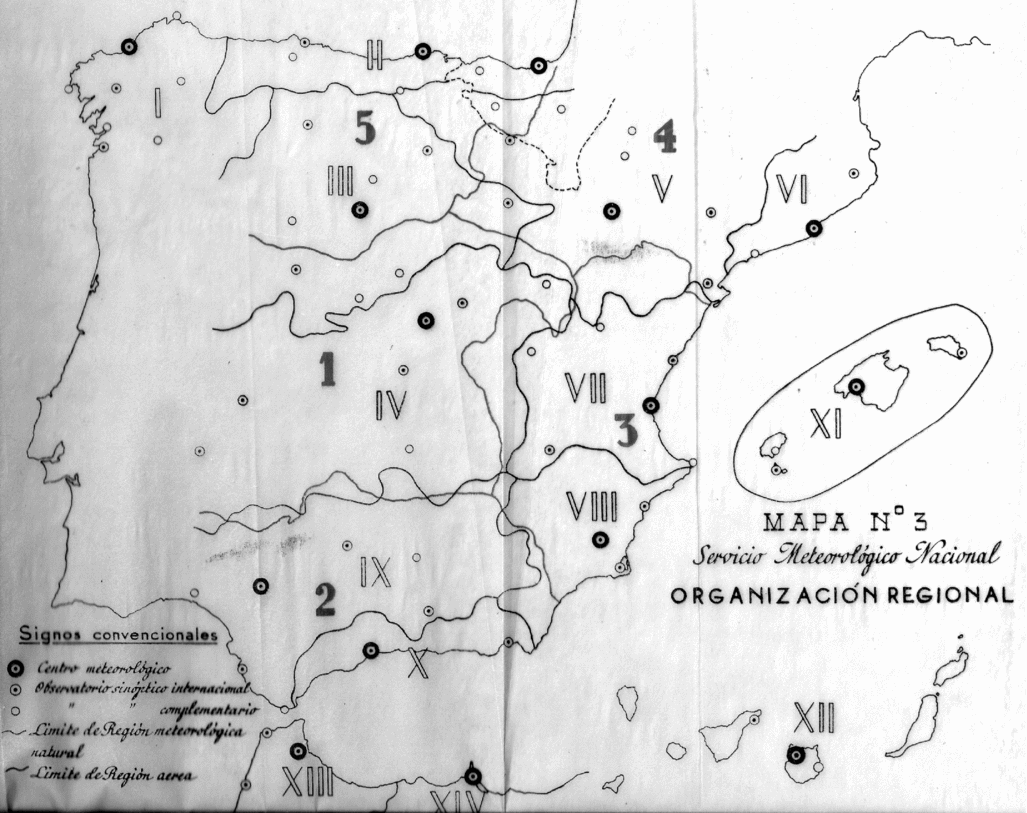
During the dictatorship, the Regional Headquarters of Meteorology were responsible not only for the administrative coordination of the centers locked into their air space, but also all the technical information relative to the meteorological protection of flights. As agencies with technical expertise, however, this caused an overlap between the functions of these headquarters and those of meteorological centers (fig. 1). This was foreseen even by the SMN itself when it described its organization in 1946:
The Map of the SMN Organization in 1946. Source: El Servicio Meteorológico Nacional de España (Antecedentes y Organización). Madrid: SMN, 1946, C, 19.
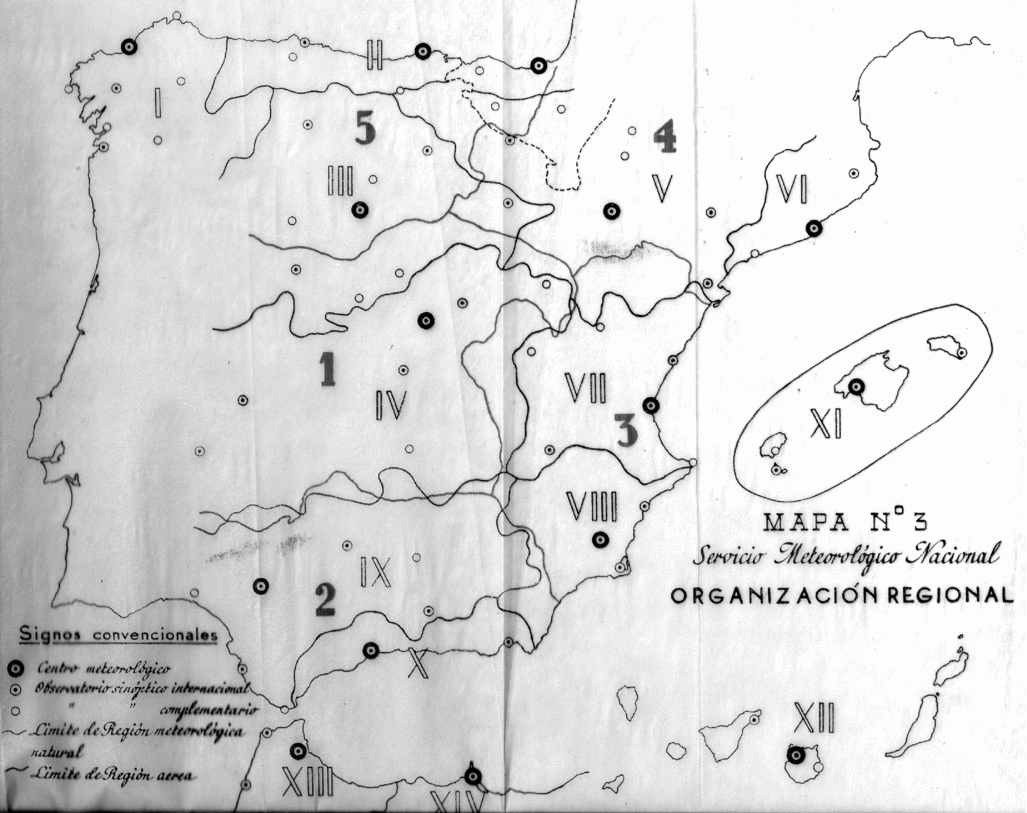
The Centers . . . are the technical agencies of major importance whose main mission is to adapt forecasts to the natural area that generally emanate from the Central Office. And it is understood that . . . their limits may coincide with those of a region or an aerial zone, in which case, the Regional Meteorological Headquarters assumes that of the Center; it may comprise only a portion of the administrative demarcation; or it may be spread out among various aerial zones. In the two latter cases, the purely technical roles of organizing [the] forecasts is reserved to the Centers.Footnote 25
In an interview conducted in 2003 by the Spanish Meteorological Association, the meteorologist Inocencio Font reviewed the idiosyncrasies of the post-war SMN. “Following the Civil War,” Font admitted, “the SMN was militarized, and this situation was retained at the outbreak of the Second World War.” The cordial relations between the Spanish and German meteorological services resulted, in his view, in “our service, in emulation of the German,” to designate “a military from the Air Force” to direct the SMN and a meteorologist (at the first echelon) as Head of the Central Office. Moreover, he insinuated this duplication was counterproductive since, he said, it was retained “more out of administrative inertia and financial difficulties, than for technical reasons.”Footnote 26 As it was conceivable in a government that mimicked a model prepared for war, the new scheme framed the SMN within a military structure – as was Aviation Security, with clearly political functions. This allowed him to control all meteorological activities and regulate the technical staff of the Service, some aspects of which were more or less subject to civilian control before the war.
We must not forget that the Meteorological Service of the German Luftwaffe was a civilian agency that was militarized (not a military agency).Footnote 27 While the services of allied countries, such as the Americans, were full military organizations that were developed to meet the demands of war, the German service was organized militarizing and expanding prewar civilian weather service.Footnote 28 A similar consideration applies to the Spanish case, on both sides, but here we should add that the continuation of the SMN as a semi-military organization after the war was, precisely at the beginning of autarchy and driven by the force of the war, a non-negotiable mandate.
During World War II, the national meteorological services of countries at war adapted their routines and activities to the headquarters of the armed forces. Administrative functions such as outplacement and staff development were carried out as usual military procedures. These links were undone after the end of the war when civil meteorological services were integrated into the Air Ministry, within departments of transportation or infrastructure.Footnote 29 In Spain, however, the assignment of SMN to the Directorate of Aviation Security, a position more political than technical, meant that these bonds would continue intact for nearly forty years.Footnote 30
In meteorology, as in other sciences, the break with the past constituted one of the leitmotifs of the reformist policies in the early Franco years. The principle on which the restructuring of the SMN was based was the de-legitimization not so much of the previous meteorological tradition as that of the organization that existed in 1936. It is no small irony that lies behind the principle that guided the reform movement. On the one hand, the Air Ministry applied its own administrative frame to the SMN (on which it depended) – that took into account the aerial Regions (and Zones) as the best and most effective divisions. But it recognized the need for a complementary technical framework that would represent the more natural geographic regions and those more adaptable to the needs of atmospheric prediction – namely, those of the meteorological Centers. It is interesting to note that the configuration of these centers adjusted to hydrographic confederations, which, on one side, had a military guarantee, i.e., they were legalized during the dictatorship of Primo de Rivera in the 1920s (Frutos Reference Frutos, Olcina and Morales1995, 181–182); and on the other side, they were attempts at spatial planning and regional rather than meteorological planification. In reality, they responded to agricultural and industrial interests, linked to the use of water and irrigation areas (Pérez Picazo Reference Pérez Picazo, Villaverde and Ortiz2001, 86). Notwithstanding all this, they opted as a Solomonic solution for the administrative and technical duality of the Service – for an equivocal organizational model that was scientifically inappropriate, even if politically expedient.
Military Rationale
Beneath the conception and structure of the SMN lies a basic military rationale. The form whereby military logic affected the content of meteorology can be traced in the reports and official papers of the SMN. An example of this infiltration, very intense by the end of the war, is embodied in the decree modifying the prewar SMN Regulations. In its introduction, it urges the replacement of the Republican Regulations of 1932 for a more effective one, which gives “the importance it requires to aviation security,” due to “the responsibility, volume and urgency that this Service represents” and given “the technical and military character that corresponds to an organization as important as that which deals in national defense.”Footnote 31 In reality, it was not merely an administrative order: it was a call for military discipline and identification.
In war, for example, this call was concretized by the close rapport between the meteorologist and the Command, albeit oriented more towards tactical offensives than to defense. This logic was precisely what Azcárraga described in a lecture delivered in February 1940, before the Royal Geographical Society of Madrid (the same society that years prior participated in organizing his expedition to the Amazon). In it, Azcárraga stressed the importance of deploying in the front line, both pluviometric stations and information posts as well as mobile stations. Let's see what place the meteorologist had in this deployment:
The extreme rapport [with] the Command is everything in the military application of meteorology. An anonymous forecast, central or regional, can only inspire limited confidence; the meteorologist will hesitate in giving instructions to decide the time of an operation, attempt a landing or carry out an air strike; he would surround his forecasts with conservative formulas that would detract from utility and accuracy. It is important for him to have the courage to undertake his responsibility and internalize the underlying reasons for its use. The command of Meteorological Service in war must be a military command attached to the corresponding headquarters. (Azcárraga Reference Azcárraga1941, 26–7)
Notwithstanding this, the rapport between meteorology and the army was not limited to wartime. The triumph of the unity of tactical action in war advocated the unity of hierarchical action postwar.Footnote 32 In its new phase, the SMN would bring together a series of networks – headquarters, regional centers, observatories, secondary stations, information posts, etc.., – which shared a hierarchy and military discipline. Inasmuch as, as Azcárraga affirmed, meteorological applications in peacetime also required knowing how to use information, hierarchical unity was still valid.
Let us see how Azcárraga defines the functions of each level in the hierarchical pyramid that is the SMN:
[1] A central office that unifies criteria, investigates, verifies the correctness of instruments and methods, focuses observations, [which] liaises with headquarters, [that] centralizes relevant reports in each case [and] gives daily general predictions; [2] A series of regional centers [that] focuses observations in its zone and disseminates central messages; [3] A network of observatories [that] provides data on the international synoptic network; [4] Secondary thermo-pluviometric stations [that provide] data for Hydrographic Confederations, studies in culture, mining, etc.; [5] Information posts [that collaborate] in aviation security and make up a permanent network for anti-aircraft espionage. (Azcárraga 1942, 27)
The Framework of Aeronautics
It is not risky to sneak a glimpse of the socioeconomic circumstances that prompted the authorities of the regime to confine the SMN to the framework of the aeronautical industry.Footnote 33 Needs of navigation and aviation security – motivated, first, in the military field, and later in commercial uses – made it imperative to orient institutional meteorology to the service of aviation. This happened with the SMN, which we must remember, was assigned – or was conscripted, to be precise – to the Section of Meteorology and Aviation Security within the Department of Infrastructure, in 1940, where it remained until 1942, when it became dependent on the Directorate General of Aviation Security. The founding decree of that section was very explicit in this regard, to entrust “the development of Meteorology, in all respects, as the organization of auxiliary aerial navigational networks and facilities for aviation security” (see article five of the Decree of February 10, 1940. BOE, 46 [15 February 1940], 1160–1).
Later, in introducing the book Nociones de navegación aérea meteorológica, dated January 1946, we find again what can be considered the military rationale that guides the inclusion of the SMN within the area of aeronautics (we see arguments put forward in this preamble that appear in other publications of the SMN). This work, with a foreword by the erstwhile director general of Aviation Security, was published by the SMN for a “domestic” public in the C series of instructions. The place was very appropriate, as it included applications for Spain. In it, Azcárraga highlighted in the first place something that did not cease to be relevant simply because it was widespread: the close rapport between meteorology and military aviation:
The war served as the agent that accelerated the process. The real cause, however, is partly due to a tremendous increase in the range of aircraft, and partly on the other hand to the close union of meteorology and aviation, which . . . stimulates new concepts in the meteorologist that were already nascent and growing before the war began.Footnote 34
It is striking that, in defense of aeronautical meteorology, Azcárraga would use the argument associating it with practical meteorology, which for all practical purposes was reflected in a book – aimed at meteorologists, pilots, service employees, and simple clerks – that shrank from definitions of the general principles in atmospheric physics, and valued weather forecasting for its practical application – i.e., for its utility, reliability, flight security.
When modern long range aircraft was used in the recent war, whether in mass bombings or on transatlantic transport, always operating for long distances, it has become manifestly clear that modern weather protection has lost many important local details of the present time on the road, but they have built the foundation of meteorological navigation which tries to take advantage of the general evolution of atmospheric situations. In some cases they would be tactical advantages, while financial in others, and security above all. (Ibid., 6).
In his view, it was a combination of the intuitive and the pragmatic, not so much the scientific, which should have been the axis and guide for all flight plans. “The initial basis of a flight plan is meteorological information. Its final summary should be the backbone of the route to be followed.” To do this, the pilot must know “practical meteorology to a degree sufficient enough to obtain insights of the expected evolution.” This approach was what prevailed in the SMN, both in the so-called Group of Flight Explorations, that directed the meteorologist and aviation pilot José Antonio Barasoaín in collaboration with Wilhelm Zimmerschied, and in later more systematic treatises on flight security.Footnote 35 We can find an extreme example in the book entitled El problema de la visibilidad by José María Jansà, who, in the section on applications, dispenses with all the utilities that visibility has – for the diagnosis of air mass, the calculation of the coefficient of turbulence, the savings of radiation, etc., – and limits himself to reviewing aeronautical applications. In this regard, he states:
Visibility was of concern to all pilots because the methods of navigation, to a large extent, are dependent on it; but it is also of concern in a special way to the military observer and to the Command for its close interaction with the success or failure of possible operations. (Jansá 1946, 40)
In the forties, the rapport between meteorology and aeronautics (whether civil or military) was not specifically Spanish. Rules and instructions on how to guarantee meteorological security of flights were of concern to organizations such as the International Meteorological Organization. Successive regulations on this subject were broadcast and published by national meteorological services, both civilian and military.Footnote 36 In Spain, however, the existence of a meteorological service controlled by the military gave the Service a strong aeronautical bent, and conditioned the relationships between civil and military responsibilities.
Personnel Recruitment and Evolution in the SMN
The requirements for entry laid down in Franco's time (by the SMN Regulations of 1940) were very different from those of the Republic time (Regulations of 1932). In reference to the Level of meteorologists, qualified assistant meteorologists could initially apply, however aeronautical engineers could also apply if they qualified by dint of examinations wherein they competed among themselves and the assistant meteorologists.Footnote 37 In the Regulations of 1932, this promotion was restricted to assistants who fulfilled certain requirements (such as having an approved “original Report on a research topic”).Footnote 38
In the event that there were insufficient applicants, the competition was expanded to a second round, admitting licensed graduates in science and engineering, even if they were not assistant meteorologists. The beneficiaries, both the older ones as well as those culled from competitions, would have to pass a theoretical and practical course. This course focused on dynamic meteorology, solar radiation, aeronautical information, climatological statistics, instrumentation, etc. (BOE, 111 [20 April 1940], 2698). An important innovation introduced in 1940 pertained to the requirements for promotion by seniority. The assistant meteorologist was no longer required to have an approved Research Report nor a Doctorate in Meteorology.
The examinations for assistant meteorologist were aimed at recruiting personnel familiar with the duties of aviation security. The Regulations of 1940 stated that this level was accessed through examinations among individuals who met the qualifications set forth in the previous Regulations of 1932 or – and this is new – those set forth for Meteorological Reporters. The latter included the completion of courses organized by Military Aviation since 1936 and having served in the Army or Navy during the last campaign. After passing the examinations, assistants had to take a course of one year, which included, among other requirements, studies and military training and aeronautical information, offered at the SMN Headquarters and at the Academy of Aeronautical Engineers. The ordinance clearly demonstrates that the entry requirements introduced a strong military bias, designed mainly to rapidly and massively recruit military personnel and/or militarized civilians, who, for various reasons and to varying degrees, had developed a résumé during the Civil War at the service of “national aviation” (BOE, 111 [20 April 1940], 2696–8).
It is interesting to note that the Franco regulations seemed to have been designed to reverse the SMN from its university condition status to that of an engineering one (not geographical, but aeronautical). The tribunals that were to judge the competitions comprised the Head of SMN (who, we must remember was an aeronautical engineer), three meteorologists (appointed by him), and a member of the Academy of Sciences (BOE, 111 [20 April 1940], 2697–8). An important development regarding the Republican laws was the abolition, in those tribunals, of a university figure. [In the Regulations of 1932, this figure had been represented by a Professor of Science at the Central University (with a vote)]. This composition and the above stated requirements led to a highly inbred recruitment system that tended either to promote personnel who had joined the SMN for services rendered during the Civil War, or to attract individuals with little scientific baggage and no experience in meteorological research, like a military officer or an engineer.
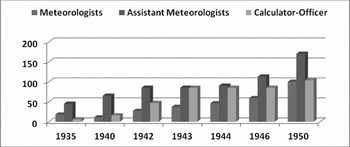
Evolution of SMN Staff from 1935 to 1949. Source: Personal compilation based on the data provided by García de Pedraza and Giménez de la Cuadra (1985), page 95.

In the last postwar years the prevailing discourse among military commanders and the Franco authorities was that the SMN had increased the number of staff compared to the Republican era (especially after the 1950 Act, which consisted of 100 meteorologists, 170 assistants and 104 administrative-calculators; in comparison to the 1935 organization which were 18, 45, and 6, respectively). Notwithstanding, it is also true that a good part of the personnel in 1950 was allocated to the meteorological offices of civil airports and military airfields. We do not know the demand for atmospheric data that existed in these offices, but an interesting reference point is the number of Informants of Meteorology and Anti-aeronautics.Footnote 39 Created in 1940 as Air Force specialists, they numbered 265 in 1946.Footnote 40 The differences are striking: while in the Republic the bulk of SMN staff was absorbed by regional meteorological centers, in the postwar era it was covered by the (new) demand of jobs for aviation and aeronautical security.
“Amphibianism” between the Civil and the Military
Meteorologists showed a remarkable ability in carrying out miscellaneous jobs and responsibilities. This general practice among employees was well known during the regime, but it is clear that the SMN personnel enjoyed certain privileges and an ambivalent legal framework that gave them access to these routes. This leads us to a very interesting feature (because it is unusual), that the amphibious condition between the “civil” and the “military” in the SMN environment seems to have favored the multiplicity of jobs and a conception of a meteorology that was technical-functionary type rather than investigative.
In order to analyze in detail some of the aspects of the amphibious condition of the SMN staff, we drew on a series of reports and interviews with meteorologists (or their family members) of that time. The reports are narratives of personal occurrences written to illustrate the past, such as those of Manuel Palomares, José María Vidal, and Jaume Miró-Granada (who at the time worked in the SMN).Footnote 41 But they are not merely private episodes. The stories also refer to contextual realities. The verbal interviews, for their part, are valuable in providing information on topics that witnesses rarely wrote about.Footnote 42
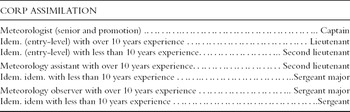
The assimilation of military categories we outlined in Table 1 (stipulated by virtue of the Order of August 17, 1937) was not the only right that was given to SMN personnel. The qualifying examinations that were subsequently published in the Boletín Oficial del Estado (BOE) and the Boletín Oficial del Aire (BOA) gave the rights and obligations that such assimilation entailed. Among others, what stand out are the rights to the military card, patronage (or sponsorships), family housing, uniform allowances, and the use of arms and flags. Assimilation also brought with it other more visible effects. Functionaries, for example, had to wear uniforms at their places of assignment when required. These included air bases, offices, and military airfields, as well as all dependencies under direct military command (García de Pedraza Reference García de Pedraza1980, 1350).
Military categories assimilated into the SMN personnel on the rebel side. Source: Order of 17 August 1937.

The relationship between the SMN and the army also had an important gender component. Women functionaries who joined prior to 1940, which amended the Regulations of the SMN, did not enjoy these rights (nor could they occupy positions of leadership or assistant positions in the SMN).Footnote 43 In addition, until 1965, females were not allowed to take the examinations for meteorology.
Even more significant for our purposes here, the assimilated military categories granted a plus in power, the exploitation of which could be attractive to anyone interested in additional remuneration for those in the SMN. For example, in 1946 the young meteorologist and Captain Manuel Palomares was a professor in the School for Assistants of the Military Academy of Aeronautical Engineering, a position he was offered by the meteorologist David Gangutia, whom he replaced (Gangutia would eventually become the head of relations with the World Meteorological Organization and the Spanish representative at various conferences worldwide). These employment opportunities were not accidental, but the result of the use of known contacts (preferably influential military men) to obtain paying jobs that would complement those of the Service. And since teaching job prospects were mentioned, it is worth quoting what Palomares, an associate professor at the chair held by Francisco Morán at the University of Madrid, said in his professional memoirs:
During those years I paved the way to receive various emoluments. As I was quite free to come and go from the office of the Regional Air Command, I could during certain hours go to college when Morán would call to teach his classes [as Chair of Physics of the Air]. I also convinced them to place me in charge of courses in physics for physicians and then other courses in general physics. I would double these classes with other physics classes in the introductory course of the School of Architecture. In the afternoons I taught other courses in general physics at the official academy of SEU San Alberto Magno . . . and at different local universities, such as the School of Law, the old University of San Bernardo, and even for a year at the old Faculty of Medicine of San Carlos.Footnote 44
Despite its exuberance, this practice was more widespread than would appear at first glance. The biographies of some meteorologists illustrate the extent of this professorial sideline. Morán and Miguel Azpíroz took the Chair of Physics of the Air at the Universities of Madrid (1948–1971) and Barcelona (1953–1965), respectively (Castañs Reference Castañs2003, 66–7; Anduaga Reference Anduaga, Batlló, de la Fuente and Puig2000, 273–8). Azpíroz was succeeded by Manuel Puigcerver (1967–1987), who was a meteorologist since 1949. Azcárraga and Gangutia were professors at the Military Academy of Aeronautical Engineering in the 1940s; Azcárraga became the first head of studies (Álvaro Azcárraga Reference Azcárraga2008, 3). José Baltà í Elías was Professor of Theoretical and Experimental Physics at the Universities of Salamanca (1933–1941) and Madrid (1941–1963) (García Santesmases Reference García Santesmases1973, 583–92). Joaquín Catalá held the chair of General Physics at the University of Valencia (1945–1972).Footnote 45 Antonio Espurz Sánchez was Professor of Theoretical and Experimental Physics at Oviedo (1944–1979) (Arribas Jimeno Reference Arribas Jimeno1984, 44–5). Vicente García Gomar was Vidal's assistant professor (1950–60) and later Professor of Thermology in Seville (1960–1969), a position that he held simultaneously as head of the Meteorological Service of Guadalquivir.Footnote 46 Jansà did the same in the Meteorological Center of the Balearic Islands, teaching at the Institute of Mallorca (since 1955) (Miró-Granada Reference Miró-Granada1998, 39). Castañs worked as a professor assigned to the University of Madrid (1951–1961) and a Professor of Physics at the School of Civil Engineering of Madrid (1961–1972). Carlos Santamaría helped create the Center for Advanced Studies (1939) in San Sebastián.Footnote 47 Pío Pita was also a teacher (Matacán Flight School, School of Aeronautical Engineering, etc.). All this brought Palomares to say, one day, that of all the professional corps involved in the state, that of meteorologists had the highest percentage of members who worked simultaneously as university professors.
Nevertheless, we must state that this educational compatibility came endorsed by the self-same SMN Regulation of 1940 (in Article 1),Footnote 48 and which was perfectly legal within the framework of CSIC and the University. However, while it is true that the conditions for access to teaching centers were the same as those of the 1932 Regulations (Article 1 was not altered), it is also true that the meteorologists of the Republic tended to focus solely on the specific tasks of the SMN, whether in the Central Office or as heads of regional centers. Of the 18 meteorologists active in 1936, we know that only 3 were assiduously devoted to teaching.Footnote 49
Teaching was not the only avenue for additional remuneration to which Spanish meteorologists resorted. Press collaboration, announcing the next day's weather, was another. Apart from the military (which included advice, flight support, etc.), there were other jobs, such as broadcaster, translator or chemical and aeronautical consultant.Footnote 50 However, meteorologists tended to be secretive about these other avenues. For example, Jansà worked with the newspaper Menorca, from 1943 to 1952, and with the daily Baleares from 1958 to 1962, annotating occurring synoptic situations. He would almost always sign with the pseudonym Alcor (Miró-Granada Reference Miró-Granada1998, 38). The same could be said of Castañs and Julián Sánchez Rodríguez, announcing predictions in the evening paper Informaciones, under the pseudonym Predictor. For obvious reasons, they had no interest in publicizing their names. The use of official information for personal gain is an interesting topic that we cannot examine in depth here.
This evidence powerfully reflects the image that the balancing of SMN tasks with outside employment was frequent – it was the same before the war, as we are reminded by the lives of Duperier, Vidal or Quílez – but now it was widespread. Beneath this lay the existence of threads of liberty resulting from an ambiguous legal framework, wherein questions such as employment or jurisdictional issues of assimilated functionary job were not clearly regulated. The Service emerged as a functional job that was clearly compatible with other fully committed ones.
The testimonies also forcefully transmit the image of privilegeness for the SMN staff, especially before the promulgation of the Decree of July 21, 1950, when the status of “assimilation” was replaced by that of “consideration.” This included the lowering of military categories and the subjection to the laws of military discipline only in the case of serving in military centers.Footnote 51 It is certainly no coincidence that Palomares confessed that “with the dual salaries of a meteorologist and the academe,” one's life in Valencia was “almost luxurious,”Footnote 52 nor that García de Pedraza would summarize his meteorological era in Zaragoza, in the following terms:
The author of these lines . . . wore various uniforms and lived the military life with enthusiasm and interest in sixteen years of service in Zaragoza [1949–1965]; cooperated actively with American meteorologists in the joint Spanish-American Base, studied climatology at the Polígono de Tiro of Las Bardenas; advised the EM of the 4th Aeronautical Region in his position as mobile post commander, taking active part in the campaigns and maneuvers with the General Military Academy. . . . In short, he lived a good part of his life because of and for Military Meteorology. (García de Pedraza Reference García de Pedraza1980, 1352)
The privileged acquisition of multi-employment was certainly easier if a group could take advantage of influential contacts that appealed to the dual civil-military condition of its members and if the legal framework of the coveted assimilation would allow for freedom of movement outside the performance of the Service.
This peculiar way of understanding meteorology powerfully contrasts with those of the official meteorological services (whether civilian or military) that were established in Western countries.Footnote 53 In military services, the Ministries of Defense (not the SMN, as in Spain) recruited engineers and science graduates, who later went through military academies. There, they were indoctrinated in the disciplinary system, functions, etc. The meteorologists in these services were professional soldiers – not civilians in military service.Footnote 54 In the civil services, meanwhile, meteorological research was often projected on the basis of the collaborative “University-Service”; despite its technical orientation, the services benefited from university cooperation. The synergy of efforts was highly successful for everyone.Footnote 55
In contrast, within the functionary culture of the Spanish meteorological service, there was rarely room for innovation or for original research; instead, there was partial or complete dedication (never exclusive) to the SMN that concurred with other jobs. When it affected universities or engineering schools, this multi-employment stemmed not from the collaboration of research projects, but from the use of educational opportunities that served as fringe benefits (of course there were exceptions, such as Morán and Azpíroz, who contributed to high quality research).Footnote 56 Such a culture fostered the development of meteorology as a technical job in the SMN, not as a science. An ambivalent legal framework and some civil servants with military assimilations (or considerations) favored the spread of that culture. In the militarized civil SMN, the dispersion of efforts was widespread.
Towards a New Military-Industrial-Academic Sphere
During the Republic, the SMN was a civil entity integrated into a military organization whose meteorologists conducted special investigations, of a civil character, on atmospheric physics. After the war, when their services and civilian staff were militarized, they issued more from a combination of civil and military interests and the cooperation of the SMN with the CSIC and universities.
In 1933, the SMN was integrated into the Department of Aeronautics, but this military subordination affected only senior management. The military took control of all aviation weather networks, both civilian and military. But the research lines were not affected. For example, when in 1932, the SMN created the Special Research Section, under the direction of Duperier, five of the ten studies published by the SMN between 1933 and 1938 carried his signature and dealt with cosmic radiation (a subject for which he won international prestige), conductivity, and atmospheric temperature. But the administrative change did not affect the nature nor the outcome of research, beyond any particular case.Footnote 57
With Franco, everything changed. In 1942, the SMN was absorbed into the Flight Protection of Ministry of Aviation, affecting the military assimilation for all personnel, not only management. The military took control of all meteorology, not just aviation. And the lines of research were indeed affected.
The ideological alignment and the break (more dogmatic than effective) with all the scientific policy of liberal and republican past, were the two principles on which the SMN based its research policy and relationships. Thus, the SMN attenuated the weight of special research (reorganizing it into the “Research and Educational Section”), but served to strengthen relations with the CSIC. In effect, the SMN was one of the centers that comprised the National Institute of Geophysics (ING), created in 1941 within the framework of the CSIC.Footnote 58 It should be remembered that the CSIC was the body established by the regime to organize and direct research in all fields of knowledge, which replaced the Junta para Ampliación de Estudios, director of scientific policy in the liberal pre-war era (Malet Reference Malet, Pablos and Santesmases2008, 211–3). In addition to Geophysics and Oceanography, the ING consisted of the Meteorology Section, which in 1948 was divided into Pure and Applied (being its directors Moran and Lorente, respectively). While in the first section, the individual contributions of Morán and Azpiroz on theoretical and aerological applications of the thermodynamic theory stood out,Footnote 59 in the second section smaller “research teams” were formed in the Meteorological Centers of Baleares and Barcelona, led by Jansà and Vidal on issues of climatology, aerology, and electrical conductivity.Footnote 60
There were also military interests. After the war the regime promoted initiatives aimed at boosting studies in aerology and weather forecasting – this is within the context of international political isolation, wherein Spain stopped relying on weather data coming from Allied countries. The Government designated Moran to attend the meeting of the International Commission of Aerology in Berlin in 1939, which would discuss issues that competed with the Air Force. In 1942 he was commissioned anew. During both times, the mission was nothing more nor less than to create a “true Aerological Institute and generally for Atmospheric Physics.”Footnote 61 Probing techniques were studied at the Lindenberg Observatory as well as weather prediction methods and meteorological mapping at the Reichsamt für Wetterdienst. Although the project did not work out, there was, in effect, a transfer of knowledge.Footnote 62
The creation of new spheres had another dimension. A good number of forecasters had a merely circumstantial and indirect link to meteorology. For example, in addition to being a professor, Català was a researcher at the Institute of Optics “Daza de Valdés” of the CSIC (Navarro Brotons Reference Navarro Brotons and Albiñana2004, 112–3); his interest focused on particle physics, not the weather: of the 17 references of Catalá that we posted in the Bibliografía meteorológica of Fernando Huerta, only two date from the forties, and both are popular articles.Footnote 63 The same may be said of Baltà, who researched at the Institute Leonardo Torres Quevedo and at the Institute of Electronics of the CSIC, on radioactivity, semiconductors, and other issues.Footnote 64 There were many others. In the majority of cases, joining the Corps meant remuneration and added curricular merits, as well as an access path to the dual civil-military condition that helped broaden horizons and opportunities. For these, meteorology had no special interest; rather, it was a means rather than an end in itself.
The belief in the backwardness of Franco's Spain has been one of the dominant perceptions of past historiography of the Spanish science and technology. This belief in research and technological backwardness during the Franco era posits a logical analysis. After the war, adopting a policy of autarkic economy severely diverted tremendous funds and effort to the needs of fuel and the reconstruction of infrastructure. In fact, the importation and transfer of technology and expertise from countries that were more related to their ideology than to that of the Allies, was a common practice.Footnote 65 The scientific purge and political isolation (partial but highly influential) also played its part. However, these perceptions run the risk of being too “ahistorical” and of being biased by prejudice and preconceived ideas. In 1948 military authorities ordered the military engineer José María Otero Navascués to train a group to conduct research in nuclear physics, the basis of what would later become the Nuclear Energy Board (JEN) (Romero de Pablos and Sánchez Ron Reference Romero de Pablos and Ron2001; Presas Reference Presas2000, 527–602). Almost at the same time, the naval engineer José Antonio Suanzes promoted the scientific-technical production of the first national car company in mass production (the SEAT, the model company of the Franco regime) (San Román Reference San Román1995). In both cases, we can see the construction of a new military-industrial-academic sphere. Relegating the SMN from this movement of ‘plates’ is to distort reality. Certainly, behind closed doors, the SMN carried out technical and supervisory work in various civil service organizations in which it served, both in relation to the field of flight security and academic instruction. But outside, the SMN, integrated into the CSIC (through the ING), was able to promote theoretical and applied research that were of interest. Were it not for its civil and military “amphibianism,” it would be difficult to think that a Service as rigid and functionary could have formed part of this shift and expansion of plates (or “sphere of practices and knowledge”) which was one of the essential features of science in the Franco regime.
Acknowledgments
I owe a special debt of gratitude to an editor of Science in Context, Alexandre Métraux, as well as to the two anonymous referees, for their valuable remarks and suggestions. I am particularly grateful to Manuel Palomares Calderón, for generously providing abundant information and for his inestimable help.