Disasters occur suddenly and seriously disrupt communities; furthermore, they trigger widespread human, material, economic, and environmental losses and impacts. Calamities create situations that normally exceed the affected community’s ability to cope using its own resources. Disasters can be identified as natural (such as earthquakes and tsunamis) and human-caused (including epidemics, mass transportation accidents, and power interruptions).Reference Quarantelli 1 Natural disasters can occur on a wide scale and have grave effects on a large number of people.Reference Bankoff, Frerks and Hilhorst 2 It is important to consider people’s basic demands in disaster zones to improve sanitation management.
Because excreting is one of the most natural and frequent demands of human life, special attention to sanitation-related problems during catastrophes is critical. Nowadays, it is common for human sanitary waste to be mixed with domestic water runoff (such as from showers and washing) and transferred to a wastewater treatment plant through a sewer pipeline. When there is no sewer network, an on-site system (such as a septic tank) is used along with a flush toilet or sometimes toilets that do not require water.
During the restoration stage of a calamity, the water supply and wastewater system (which includes treatment and transport) are upset. In addition, limited amounts of water, energy, personnel, transportation, and resources are allocated owing to more urgent needs elsewhere. More human sanitary waste is generated as a result of larger populations at refugee camps as well as rescue teams, which increase demand for further sanitation precautions, demand for facilities, and burdens on current hygienic networks. Even after restoration occurs, the water supply and wastewater system need time to recover; furthermore sanitation is seldom considered important.
This situation could exacerbate disasters, albeit indirectly. For example, under such conditions, if sanitary waste is improperly disposed of during heavy seasonal rainfall, infected waste could spread and cause disease. Furthermore, social problems (such as sexual harassment) and obstacles to security can occur owing to the lack of a proper toilet with an acceptable degree of privacy.
This article (1) investigates common sanitation challenges in disaster zones, (2) identifies the common characteristics of proper sanitation practices in disaster areas, and (3) presents the waterless, portable, private toilet (WPPT) for individuals and households as a sustainable solution, in addition to a suitable procedure to collect and treat human waste.
Common Problems with Sanitation Practices in Disaster Zones
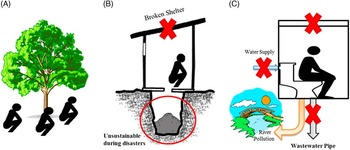
In general, there are 3 types of sanitation practices, as shown in Figure 1: (1) open defecation, (2) a pit latrine, and (3) a squatting or sitting flush toilet. These practices are not sustainable in disaster zones because specific problems arise as a result of the breakdown of infrastructures (such as those of water, wastewater, electricity, and housing), the collapse of social safety systems, and the overloaded handling capacity.
Three Types of Sanitation Practices. (A) Open defecation. (B) Pit latrine. (C) Squatting or sitting flush toilet.

In terms of open defecation, waste deposited directly into soil without any composting or treatment process pollutes the soil and water sources, especially when the load is greater than the environment’s self-purifying capacity. The buildup of human waste occurs rapidly, leading to a high risk for a disease or virus epidemic, especially during heavy seasonal rainfall (such as the monsoon period). Furthermore, open defecation can generate many social problems (such as sexual harassment) owing to limited privacy, such as in a refugee camp.Reference Morella, Foster and Banerjee 3
In the case of the pit latrine, in high-density populations (such as a refugee camp), pits quickly fill to capacity, which prevents adequate time for self-biodegrading functions. Under these circumstances, disease is more likely to spread to the general population.Reference Rechaigl and MacKinnon 4 Security and privacy may be limited by shelters being damaged by the disaster.
In the case of the flush toilet, the entire system requires water. If water delivery systems get damaged or stop functioning, flush toilets stop working. If people can no longer operate treatment plants and infrastructures for collecting wastewater, they can no longer use toilet facilities. When this occurs, it is sometimes not possible to maintain basic human dignity. Wastewater runoff can flow directly into soil, rivers, or the ocean, which increases the risk of contracting diseases or causing irreparable environmental destruction. Last, during an emergency, risk rises due to contact with urine or fecal matter when multiple people share the same sanitation facility.Reference Tayler, Parkinson and Colin 5 Sharing the same toilet seats may be dangerous, especially for such diseases as the Ebola virus.
Characteristics of Sustainable Sanitation in Disaster Areas
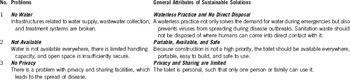
Table 1 summarizes the problems and general attributes of sustainable sanitation via an understanding of hygienic needs during emergencies and the functional shortcomings of current practices. The first aspect deals with a lack of water. Water may not be available in a disaster zone, and other health problems can arise when wastewater is improperly disposed.Reference Uscher-Pines 6 The second feature is portability. The toilet should be easily transportable, safe to use, and easy to install in a short amount of time. The third element regards individuals’ and families’ privacy and not having to share sanitation facilities with others.
Identifying Sanitation Problems During Emergencies and Essential Characteristics of Sustainable Solutions

An Innovative and Sustainable Solution for Disaster Zones
The Waterless Portable Private Toilet Kit
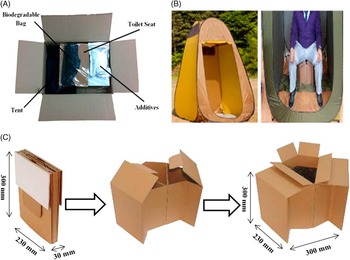
The WPPT kit is designed to be light, compact, and nonbreakable and to contain all the necessary parts for one person or family over a certain period of time. Figure 2A shows the contents of the WPPT: a hardboard toilet seat, several biodegradable plastic bags, additives, and a single tent (1.5 m×1.5 m×2 m) that can be easily opened and closed with a simple zipper to provide privacy and safety, making it useful for a family, as shown in Figure 2B.
The Waterless Portable Private Toilet (WPPT). (A) Contents of the WPPT. (B) A private tent with a zipper for housing the WPPT. (C) The WPPT’s hardboard toilet seat before and after setup.

Figure 2C shows the WPPT’s hardboard toilet seat before and after it is set up. The weight is 1 kg, the packed size is 230 mm×300 mm×30 mm, and the set-up size is 230 mm×300 mm×300 mm. The WPPT can bear up to 300 kg. The toilet’s diamond-formed design makes it ergonomic and applicable for people with different hip sizes. The kit is packaged in a heavy-duty cardboard box, which makes it survivable when dropped into an inaccessible, damaged area by air. The kit is predominantly made of innovative biodegradable paper, which makes it easy to dispose of after use.
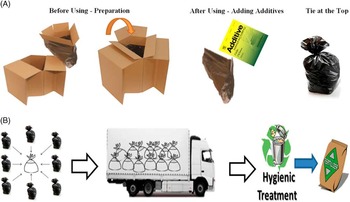
Figure 3A shows the steps for operating the WPPT. A biodegradable plastic bag is set over the middle each time a person produces urine or feces. After the toilet is filled, additives containing polymers or bio-seeds can be added to reduce the smell and volume of sanitary waste,Reference McCrory and Hobbs 7 and then the bag is tied at the top for easy handling and transport.
(A) Steps for Operating the Waterless Portable Private Toilet (WPPT) and (B) Collection and Treatment of WPPT Waste.

Collecting and Treating WPPT Waste
In disaster areas, collecting and treating human waste is usually considered less of a priority because more urgent needs take precedence. Human waste should be continually collected, stored, and transported for later treatment after restoration is complete. Figure 3B shows the process of collecting and treating WPPT waste: a large plastic bag is provided for a community or neighbor to store waste for a certain period of time, and a truck collects the bags periodically. The waste can be treated on site via composting or transported to a safe, hygienic treatment system and finally disposed of as fertilizer or in a sterile landfill.
Trial Run Following the Gorkha Earthquake, April 2015, Nepal
A trial run was executed to examine the system’s performance and efficiency in the wake of the Gorkha Earthquake in Nepal, which occurred on April 25, 2015, at a magnitude of 7.8 Mw. 8 This project was carried out as a part of the humanitarian services provided by Institute for Global Social Responsibility (IGSR) and Sustainable Water Management Center at Seoul National University SNU from September 7 to 21, 2015, 5 months after the earthquake.
The camp for victims, set up by Kathmandu University and Dhulikhel Hospital to house 500 people from the Kathmandu district, was deemed a disaster zone. Although recovery operations were going on, which improved the overall living situation, the camp had limited reserves of water that were mainly used for drinking. In terms of sanitation, the most common strategy consisted of pit latrines; however, they were nearly unusable because they were filled as the result of overuse, and the shelter was so weak that it could have easily been damaged by aftershocks. Victims had to walk about 1 km outside the camp to find a place or facilities to defecate.
One hundred WPPT kits were distributed to the earthquake victims, a community of 50 people (32 men and 18 women); they were asked about their experiences and the product’s comfort and efficiency over a 2-week period. All users, especially women, were very pleased with the tent because it provided safety and privacy. The product’s portability received the highest satisfaction score. Fast and easy installation was the next benefit that pleased users.
On the basis of our experiences in this trial run, we concluded that producing the kit with local materials could make it more accessible. Furthermore, establishing an on-site treatment plant for small communities or camps could help to sustain this innovative practice.
Conclusions
This article investigated sanitation problems in disaster zones and showed that current sanitation practices are not effective or safe owing to interruptions in water and energy among other reasons. The general attributes of sustainable toilets in disaster zones are being waterless, having portability, and allowing privacy. On the basis of these traits, an innovative WPPT kit, which can be used during disaster restoration, is suggested. It can be used during disaster restoration. Afterward, a system is required to collect the filled plastic bags and treat the waste.
For a private company, manufacturing one kit in Korea before mass production cost less than US $30 without the receipt of any funds or subsidies; this is almost the same price as for a first aid kit. Producing the kit using local materials can reduce costs, and if related organizations such as the United Nations and governments provide funding and support for manufacturing, the kit can be easily accessed by anyone for free. Considering the costs of providing medication during an epidemic both during and after a catastrophe, the kit may be very effective in reducing recovery expenses.
Similar to a first aid kit, the WPPT kit can be purchased before a disaster happens. Local governments and municipalities can store kits to use in emergency situations. Organizations such as the United Nations and the International Committee of the Red Cross and Red Crescent can provide the kit as a part of their humanitarian services.
After a disaster and during recovery, waste can be collected from each community and kept in safe, protected containers. When communities recover and conditions improve, trucks or vehicles can be used to move the containers for final waste treatment. In some areas with poor vehicle access, which usually have smaller populations, on-site treatment containers can be brought in to facilitate hygienic treatment, without the occurrence of any epidemics.
Our successful trial run following the Gorkha Earthquake showed that the kit can be efficiently used in real disasters. These positive results may convince related organizations to support this plan. An especially important advantage of the kit is that it provides privacy and reduces the risk of sexual harassment.
Funding
This research was supported by Korea Ministry of Environment as Eco- 253 Innovation Project (413-111-008) and SNU Institute for Global Social Responsibility (IGSR).