1. Introduction
Mewahang is a Kiranti language of the Upper Arun subgroup (Trans-Himalayan and Sino-Tibetan language family) spoken in the Sankhuwa and Arun river valleys of eastern Nepal, the distribution into the two valleys corresponding roughly to a primary dialect division between Western Mewahang (Sankhuwa valley) and Eastern Mewahang (Arun valley).Footnote 1 Kiranti constitutes a conventional, but empirically unproven phylogenetic hypothesis, since no convincing, exclusively shared innovations have so far been detected (cf. Gerber and Grollmann Reference Gerber and Grollmann2018). However, a monophyletic “Eastern Kiranti” branch of Trans-Himalayan, composed of Upper Arun, Khambu, Southern Kiranti, and Greater Yakkha-Limbu, can tentatively be assumed on the basis of the empirical evidence (cf. Shafer Reference Shafer1953; van Driem Reference van Driem1990; Michailovsky Reference Michailovsky, Kitamura, Nishida and Nagano1994; Gerber and Grollmann Reference Gerber and Grollmann2018). Some shared innovations of the individual branches of Eastern Kiranti are presented in Gerber (Reference Gerber2022b, under review) and Grollmann (Reference Grollmann2018/2019, under review). As a consequence, in this paper, the term “Kiranti” is to be understood in an agnostic, areal sense, and the frame of linguistic comparison is generally limited to Eastern Kiranti as defined above and excludes languages from the other major, “western” branch of the conventional Kiranti model.Footnote 2
This paper discusses the sound change of oralization (denasalization) which constitutes a diagnostic innovation of Mewahang with regard to its closest relatives Lohorung and Yamphu. By this sound change, syllable-final nasals of Pre-Mewahang were oralized to homorganic stops when immediately followed by voiceless obstruents. This is reflected in stem allomorphy of nasal-final nominal or verbal stems when followed by morphemes with a voiceless obstruent initial, but also (less obviously) in the lack of clusters of nasals plus voiceless obstruents at the syllable boundary of polysyllabic, morphologically unsegmentable lexemes. This sound change has already been noted by Gaenszle (Reference Gaenszle2007: xiv), but no phonologically informed account with comprehensive illustration has been provided so far.
First, a short, preliminary overview of Western Mewahang phonology will be given in section 2. Section 3 begins by positioning the sound change of oralization in the context of Kiranti verb stem alternation (section 3.1) and then discusses and illustrates the traces of the sound change in compounding and derivational and inflectional morphology (sections 3.2 and 3.3). Section 4 shows how the recognition of this sound change allows for an explanation of certain peculiarities of Mewahang verbal morphology. Finally, exceptions to the sound change are presented in section 5. If not indicated otherwise, the Mewahang data in this paper have been collected by the author, whereas data on other Kiranti languages are taken from the following sources: Rutgers (Reference Rutgers1998) for Yamphu, van Driem (Reference van Driemn.d.) for Lohorung, Doornenbal (Reference Doornenbal2009) for Bantawa (Southern Kiranti), Ebert (Reference Ebert1997) for Athpahariya (“Athpare”, Greater Yakkha-Limbu), Rāī et al. (VS 2067) for Chintang (Greater Yakkha-Limbu), Schackow (Reference Schackow2015) for Yakkha (Greater Yakkha-Limbu), van Driem (Reference van Driem1987) for Limbu (Greater-Yakkha-Limbu), Tolsma (Reference Tolsma2006) for Kulung (Khambu) and Selin Grollmann (personal communication) for Nachiring (Khambu). The transcription of the data follows the conventions used in the respective source, except for vowel length, which is consistently transcribed as <ː>, whereas van Driem (Reference van Driem1987) and Rutgers (Reference Rutgers1998) use <•>.
2. A synopsis of Western Mewahang phonology
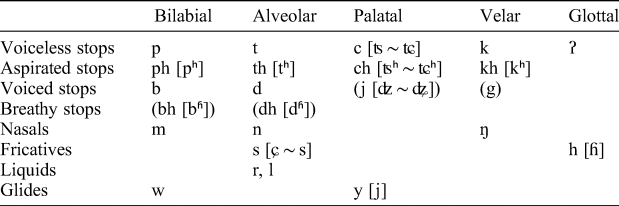
The consonant phoneme inventory of Western Mewahang is given in Table 1, with the phonetic value in the International Phonetic Alphabet given in square brackets wherever the phonetic value deviates graphically from the graphemes used to transcribe Mewahang. Brackets around a phoneme indicate that the phonemic status of the phone in question is not yet verified with minimal pairs.Footnote 3
Consonant phonemes

The breathy bilabial and alveolar stops appear consistently in a small number of lexemes, but may be the result of influence from the Indo-Aryan lingua franca Nepali, of which all Mewahang are fluent speakers and which shows a phonemic contrast between breathy and modal voice for voiced stops.
The two voiced stops [ʥ] and [g] are only attested stably in one lexeme each, viz. jambu “jackal” and goŋ- “to topple”. Furthermore, these two stops are diachronically secondary. The sound change from Trans-Himalayan *b, *d, *j, *g > Eastern Kiranti *p, *t, *c, *k (cf. Shafer Reference Shafer1953; Michailovsky Reference Michailovsky, Kitamura, Nishida and Nagano1994; van Driem Reference van Driem2001) led to a lack of voiced palatal and velar stops in Eastern Kiranti and, consequently, Upper Arun and Mewahang.Footnote 4 In the light of these historical developments, the instances of [ʥ] and [g] mentioned above must be secondary and rather recent.
Two other phones of Mewahang are likewise diachronically secondary, but synchronically constitute phonemes, namely the glottal stop /ʔ/ and the rhotic /r/. The glottal stop in Mewahang in most cases constitutes an allophone of /t/ in syllable-final position and does not contrast phonemically with /t/, but only with /k/ and /p/. All three voiceless buccal stops are regularly glottalized in syllable-final position and often reduced to bare glottal stops, especially word-finally, where the phonemic contrast seems to have collapsed. However, the glottalization of a word-internal, syllable-final stop is only completed with /t/, which is consistently realized as [ʔ] and never as [tˀ ~ t], whereas /k/ and /p/ are often realized as merely glottalized or, in conscious speech, even as non-glottalized buccal stops [p] and [k]. In the morphophonology of verb stems, the underlying place of articulation of all three buccal stops resurfaces when they do not stand in syllable-final position, i.e. with vocalic suffixes, cf. phakˀma “to separate” and phag-in “we separated”, dapˀma “to come (on same level)” and dab-a-ŋ “I came”, kheːʔma “to buy” and kheːd-a-ye “buy!”. However, there are a few additional instances of [ʔ] in syllable-initial position that contrast phonemically with /t/, for example -ʔa “erg” vs. -ta “loc”, and therefore justify the assumption of phonemic status.Footnote 5
The rhotic /r/, although occurring only in a handful of lexemes, contrasts phonemically with the lateral approximant /l/ and the two glides /y/ and /w/. Historically, Trans-Himalayan *r became y in the Upper Arun as well as Greater Yakkha-Limbu languages of Eastern Kiranti (cf. van Driem Reference van Driem1990). This explains the rareness of the phoneme /r/ in Mewahang and suggests that the attested instances must be secondary.
The alveolar nasal /n/ in Mewahang is prone to assimilation to following segments. The alveolar nasal is assimilated in terms of place of articulation to a following voiced bilabial and velar sound and completely assimilated to a following fricative /s/ and lateral approximant /l/. Before the labio-velar glide /w/, the alveolar nasal is dropped. Before a voiceless stop, the alveolar nasal is completely assimilated. While the partial regressive assimilation to voiced bilabial and velar segments, the total regressive assimilation to the fricative and lateral approximant, and the loss before the glide /w/ are also attested in Yamphu (Rutgers Reference Rutgers1998: 43–45)Footnote 6 and therefore chronologically predate the splitting up of Upper Arun, the realization as homorganic stop before voiceless stops is due to the Mewahang-specific sound change of oralization which will be described in detail in section 3.
The Mewahang vowel inventory, as shown in Table 2, consists of the three high vowels /i/, /ɯ/ and /u/, the two mid vowels /e/ and /o/ and the low vowel /a/.
Vowel phonemes

Another salient vowel phone of Mewahang, the mid-low front vowel [ɛ], does not have phonemic status. The mid-low front vowel [ɛ] contrasts with both the mid-high vowel /e/, viz. set- “to kill” vs. sɛt- “to pull”, as well as with the low vowel /a/, viz. hak- “to feed” vs. hɛk- “to cut”, but there are no instances of [ɛ] contrasting both with /e/ and /a/. Therefore, the vowel [ɛ] cannot be assigned phonemic status. Historically, the mid-low vowel derives on the one hand from *a before alveolar *t and *n, cf. Mewahang sɛt- : Bantawa sat- : Athpahariya sat- “to pull”, or Mewahang khɛn : Bantawa khan (my own data) : Kulung khai Footnote 7 “wet side dish (Nepali tihun)”, and on the other hand from *e before velar *k and *ŋ, viz. Mewahang hɛk- : Bantawa hek- : Athpahariya hek- “to cut”, or Mewahang dɛŋ : Bantawa deŋ : Athpahariya eŋsuwa : Chintang theŋsi “back, behind”. In the synchronic phonology of Mewahang, the phone [ɛ] therefore constitutes a complementary allophone of both /e/ and /a/, but no distinct phoneme, since the phone is still confined as an allophone of /e/ and /a/ to its respective conditioning environment. The conditioned sound changes *a > ɛ /_t, n and *e > ɛ /_k, ŋ are also attested in Lohorung and Yamphu, cf. Lohorung sɛt- and Yamphu sæt- “to pull”, Lohorung khɛn and Yamphu khæŋ “wet side dish”, Lohorung hɛk- and Yamphu hæk- “to cut”, and Lohorung dɛŋkɔʔwa “back”, dɛŋpi “behind, after” and Yamphu æŋ “back”.Footnote 8 These changes therefore constitute shared, diagnostic innovations of Upper Arun (cf. Gerber Reference Gerberforthcoming).
The high back unrounded vowel /ɯ/ is a diagnostic innovation of Mewahang which sets the language phylogenetically apart from its relatives Lohorung and Yamphu. The vowel mostly constitutes a complementary allophone of /i/ before velars and bilabials, e.g. Mewahang mɯk : Lohorung mik “eye”, Mewahang sɯŋ : Lohorung siŋ “wood”, or Mewahang ɯmma : Yamphu imma “to sleep”. Certain other instances of the high back unrounded vowel, however, contrast with /i/, viz. iːma “to say” and ɯːma “to defecate”, -mi “gen” and mɯː “fire”, so that /ɯ/ is synchronically phonemic.Footnote 9
While phonotactics and syllable structure are not discussed in detail here, for the discussion of the sound change of oralization it is relevant to state that polysyllabic, morphologically unsegmentable lexemes in Mewahang do not show sequences of nasals and voiceless obstruents at the syllable boundary, the only exceptions attested so far concerning a few proper names, cf. the sequence /m.t/ in Sisamtiŋ, “second wife of the mythological first man Tumna”, and /ŋ.th/ in Yuŋthu “founder and mythological progenitor of the village of Bala” and Yaŋthapa “founder and mythological progenitor of the village of Tamku (or Mangtewa), brother of Yungthu” (cf. Gaenszle Reference Gaenszle1991: 331, passim). Since such sequences are attested more regularly in Lohorung and Yamphu, e.g. Yamphu aŋghu : Mewahang dakhu “kind of nut used as a hair-care product (Nepali pāṅgrā)”, Yamphu laŋgam : Lohorung laŋkam : Mewahang lakam “friend”,Footnote 10 or Yamphu hoŋsiʔ : Lohorung hɔŋsi : Mewahang hoksi “inside”, the gap in Mewahang can be analysed as systematic and explained by the sound change of oralization. Oralization in morphologically segmentable polysyllabic forms is discussed in section 3.
On the basis of the field notes of the author, the phoneme inventory of Eastern Mewahang as spoken in the villages of Mangtewa, Yaphu and Choyang can be said to be basically the same as that of Western Mewahang, with the sole exception that the high back unrounded vowel is allophonic in Yaphu Mewahang. For concise accounts on Eastern Mewahang phonology, see Mewāhāṅg Rāī Yā-khommā (VS 2062: xiv–xv), Banjade (Reference Banjade2009: 12–13) or Mewāhāṅ Rāī (VS 2073: 1–2).
3. The sound change of oralization
The sound change of oralization is a diagnostic innovation of Mewahang within Upper Arun, since it is reflected in both Western and Eastern Mewahang,Footnote 11 but is not shared by the other Upper Arun languages Lohorung and Yamphu.
The sound change consists in the regressive assimilation in terms of manner of articulation of a syllable-final nasal to a following voiceless obstruent, namely p, ph, t, th, c, ch, k, kh or s. Velar and bilabial nasals became homorganic stops, i.e. *ŋ > k and *m > p. In the case of the alveolar nasal *n, the assimilation processes described in section 2 predated oralization, since historical *n became a stop with the same place of articulation as the conditioning obstruent rather than t and since assimiliation with regard to place is shared by Yamphu (cf. section 2), whereas oralization is a Mewahang-specific and therefore logically more recent development. Furthermore, for *n, the conditioning environment was more restricted than for *ŋ and *m and excluded the alveolar fricative *s, as the sequence *-ns- is realized synchronically as [ss], not as [ts] (cf. section 2). Note also that the outcome of *-nc(h)- is [tʨ(h)] and not [ʨʨ(h)].
The sound change must have taken place before the 1850s, since it is attested in the “Báláli”Footnote 12 data recorded by Hodgson (Reference Hodgson1857: 350–71), for example lu'ko’wa “stone”, from earlier *luŋ-koʔwa (cf. section 3.2.1), lák'phékma “foot [actually ‘sole of foot’]” vs. láng “leg” (cf. section 3.2.1), or mátúpti “raw (green) [actually ‘it is not yet ripe’]”, from the negative verb stem ma-tum- “not to be ripe” plus the negative perfect suffix -tiːtt (cf. section 3.3).
The sound change affected both the coda of the first element of compounds as well as the coda of nominal and verbal stems when followed by a morpheme with initial voiceless obstruent. Section 3.2 will show the sound change of oralization in the domain of word formation, that is compounding and derivational morphology, whereas section 3.3 will illustrate its effects in inflectional morphology.
First, however, section 3.1 will briefly present similar processes of nasal oralization attested in a number of Kiranti languages in the restricted domain of verb stem morphophonology.
3.1. Oralization in Kiranti verb stem alternations
While oralization is a clear innovation of Mewahang within Upper Arun and not attested as a regular and productive process in any other Eastern Kiranti language, there are traces of oralization or denasalization preserved in verb stem alternations in a number of Eastern Kiranti languages, including the Upper Arun language Yamphu. These instances of oralization are caused by the stem augments -s and -t, whereby the element -s reflects either a causative or reflexive suffix and the element -t an applicative (or “directive” in the terminology employed by Michailovsky (Reference Michailovsky, Thurgood, Matisoff and Bradley1985) or van Driem (Reference van Driem, Bradley, Henderson and Mazaudon1988)), deponent or denominal suffix (cf. Michailovsky Reference Michailovsky, Thurgood, Matisoff and Bradley1985; Jacques Reference Jacques2017: 180–85, 207).
Jacques (Reference Jacques2017: 181) shows that with a number of verbs in Limbu and Bantawa, the applicative -t caused denasalization of a final nasal, cf. Limbu yuŋ- “to sit down” vs. yukt- “to sit on, to mount” or Bantawa thom- “to dance” vs. thopt- “to dance for someone”, although this is no longer a productive process, as there are also verbs with the coda -Nt (cf. Jacques Reference Jacques2017: 181, 207–10). In other Eastern Kiranti languages such as Kulung or Yakkha, both the causative -s and the applicative -t caused oralization of stem-final nasals, viz. Kulung thəps- ~ thəm- “to cause the shaman to dance” vs. thəm- “to dance (shaman)” and thət- ~ thətt- ~ thəi- ~ thən- ~ thəː- “to bring up” vs. thoŋ- ~ thoː- “to come up” (Tolsma Reference Tolsma2006: 114–15), Yakkha yuks- ~ yuŋ- “to put” and yukt- “to put for somebody”.
The Upper Arun languages show evidence for the oralization of stem-final nasals with the augment -s. In Yamphu, all verbs ending in a nasal show an extended stem with a homorganic oral stop plus -s before vocalic suffixes, viz. khaŋ- ~ khaks- “to look”, sim- ~ sips- “to ask”, in- ~ iss- “to buy”. The same alternation is attested in Mewahang, but only for a small number of verbs ending in a velar nasal /ŋ/, viz. kuŋ- ~ kuks- “to come down” or yuŋ- ~ yuks- “to put”. Verbs with final /m/ or /n/ never show a stem augmented with -s. In Lohorung, the stem codas -ŋs and -ms in the available data corpus are rare and do not show oralization in prevocalic position, viz. lamdhum- ~ lamdhums- “to walk” (van Driem Reference van Driem1992: 65) or yuŋ- ~ yuŋs- “to bring down”.Footnote 13 The coda -ns is not attested in the available data on Lohorung. Obviously, none of the Upper Arun languages has preserved a functional distribution of the inherited augment -s, with Yamphu extending the augmented stem to all verbs ending in a nasal and with Mewahang and Lohorung levelling the alternation in favour of the unaugmented stem in most cases, and Lohorung furthermore showing analogical levelling of the oralized stem.
The augment -t is preserved in all Upper Arun languages and caused oralization of nasal-final verbs in Yamphu, cf. -ʔukt- “to bring down (only used as an auxiliary)”, from uŋ- ~ uks- “to come down” or mitt- “to direct one's thoughts towards a certain object”, from min- ~ miss- “to be occupied by feelings or thoughts”. In Lohorung, the augment -t is only scarcely attested in general and never with etymologically nasal-final verbs. In Mewahang, the augment has caused oralization as in Yamphu and other Kiranti languages (cf. section 4.4), but it remains unclear whether this is due to the old process of nasal oralization in verb stem morphophonology or to the more recent, Mewahang-specific and more general oralization sound change.
One may speculate, thus, that the oralization in the domain of verb stem morphophonology was the point of origin for the further spread of the sound change of oralization in Mewahang. However, it is probably more accurate to view the two processes as independent and unrelated sound changes, as Mewahang, in its development from Proto-Upper Arun, shows a reduction in the number of augmented, oralized verb stems and therefore also a reduction of the productivity of this old process, while at the same time innovating a more productive oralization sound change not restricted to verb stem morphophonology. Further research will have to address the relationship between the Kiranti-wide oralization of stem-final nasals and the Mewahang-specific, productive oralization sound change.
3.2. Word formation
Word formation in Mewahang comprises both compounding as well as derivation by means of suffixes. In the following, compounding will be presented first (cf. section 3.2.1), followed by an account on derivational morphology (cf. section 3.2.2).
3.2.1. Compounding
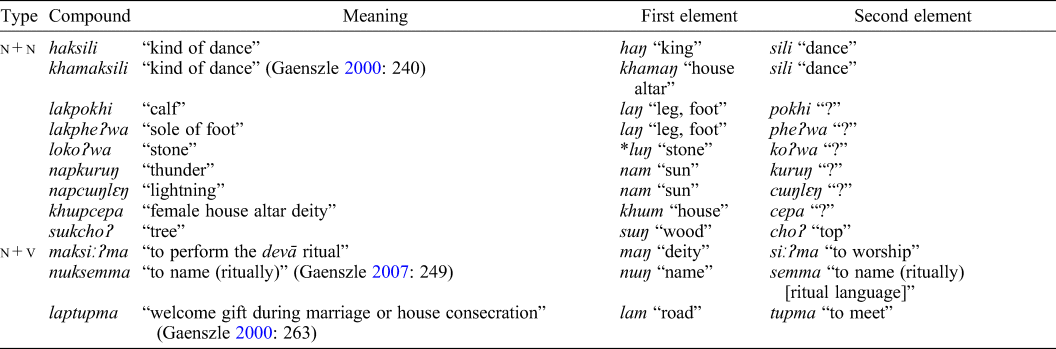
Compounds with a nasal-final first element and a second element with initial voiceless obstruent regularly show oralization. This affects noun-noun compounds as well as noun-verb compounds.Footnote 14
Examples are given in Table 3. Question marks indicate that the respective compound element is not attested in isolation and its meaning unknown. Lexical roots which are attested in other Eastern Kiranti languages, but not as such in Mewahang, are marked with an asterisk <*>.
Oralization in compounds

The lexeme lokoʔwa “stone” deserves a short comment. Although synchronically quite divergent, the first syllable lo- continues the widespread Trans-Himalayan root for stone, *luŋ. This, and consequently the oralization of the final velar nasal in Mewahang, can be proven by adding the Lohorung and Yamphu cognates, luŋkoʔwa Footnote 15 and ruŋguʔwa, respectively. The lexeme can be reconstructed for Proto-Upper Arun as *luŋkoʔwa, faithfully preserved in Lohorung. Mewahang, in addition to the oralization of the velar nasal in *-ŋk- to *-kk-, shows assimilation of the vowel *u to the vowel of the second syllable and degemination of the sequence *-kk- (cf. sections 2, 4.3 and 4.4 for further instances of the degemination of stops), whereas Yamphu shows an initial [r] due to the reanalysis of the phonological relationship between the two liquids following the sound change *r > y (see section 2), the regular allophone [g] of /k/ after a nasal and assimilation of the vowel *o of the second syllable to the vowel of the first syllable. The element *-koʔwa in the words for “stone” is of unknown origin, but van Driem (Reference van Driemn.d.) assumes for Lohorung that it is derived from the verb kokma “to throw”, which matches well with the semantics in Lohorung, where luŋkoʔwa designates a stone of “throwable size”, whereas the basic form luŋ refers to any kind and size of stone.
3.2.2. Derivational morphology
This section discusses derivational morphemes that cause oralization, namely the male gender affiliation suffix -pa, the nominalizers -pɯ, -pala and -kapa and the purposive suffix -si.
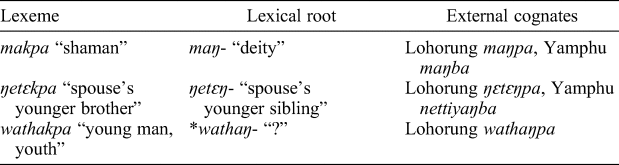
The male gender affiliation suffix -pa causes oralization of the final nasal of the nominal stem, cf. Table 4. The voiced stop [b] in the Yamphu forms is the regular allophone of /p/ after nasals (cf. Rutgers Reference Rutgers1998: 22). Corresponding female forms with the female gender suffix -ma exist for “shaman”, namely Yamphu maŋma, and “spouse's younger brother”, namely Mewahang ŋetɛŋma or Yamphu nettiyaŋma, which secure the isolation of the lexical roots maŋ- and ŋetɛŋ-.
Oralization with the male gender suffix -pa

Additional potential instances of oralization caused by a homophonous suffix -pa, which may or may not be cognate with the male gender suffix, exist, but no Lohorung or Yamphu cognate could be found, and these words are therefore not included in Table 4. Those include calpokpa “butterfly”, khakcɯkpa “timur pepper”, khɛkrokpa “bird species (black jureli)”, pacɛkpa “lizard” and yaklɛkpa “ant”.
Another instance of oralization caused by a suffix -pa which is probably not cognate with the male gender suffix, is thakpa “up” (Mangtewa Mewahang thakpe), with cognates in Lohorung thaŋpe “up there”, Limbu thaŋ-, and Kulung thoŋ- ~ thoː-, both “to come up from below”.
Fully productive derivational suffixes which cause oralization are the nominalizers -pɯ, -pala and -kapa and the purposive suffix -si.
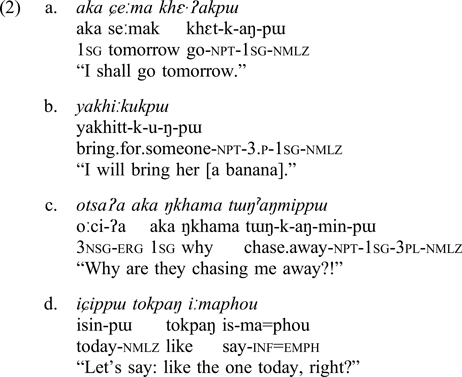
Oralization caused by the versatile nominalizer -pɯ is shown in examples (2a)–(2d). The nominalizer -pɯ is used to nominalize verbs and other parts of speech for grammatical purposes, cf. example (2d), but is also commonly used with inflected verbal forms with pragmatic, discourse-oriented functions, cf. examples (2a)–(2c).

In examples (2a)–(2b), the addition of the nominalizer -pɯ to the first person verb agreement endings for pragmatic reasons causes the oralization of the velar nasal of the first person singular index. Formal and semantic similarities suggest that the resulting endings -akpɯ and -kpɯ served as the source construction for the oral endings -ak and -k, to be discussed in section 4.1.
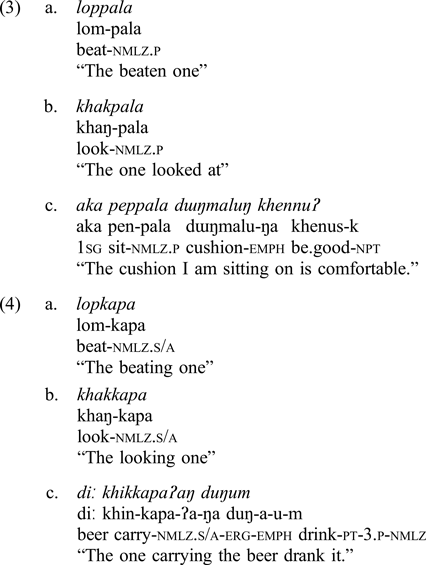
The two nominalizers -pala and -kapa, which derive deverbal nominals co-referential with the P and S/A arguments, respectively, are shown to cause oralization in examples (3a)–(3c) and (4a)–(4c).

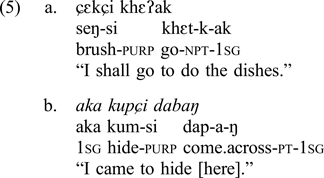
Oralization caused by the non-finite verbal suffix -si, which is used to form a purposive clause, is exemplified in example (5a)–(5b).

3.3. Inflectional morphology
Both nominal and verbal inflectional suffixes cause the oralization of final nasals of inflected stems. We will first discuss morphemes of the verbal morphology in section 3.3.1 before turning to nominal morphology in section 3.3.2.
3.3.1. Verbal markers
The verbal markers that cause oralization comprise inflectional morphemes denoting tense, number and person as well as grammaticalized auxiliaries which function as modifiers with regard to aspect, direction, valence or other semantic nuances.
The verbal markers that trigger oralization are the dual suffix -ci, the homophonous third person non-singular marker -ci, the exclusive suffix -ka, the perfect suffix -ʔda, the negative perfect suffix -tiːtt, the question marker -pha and the emphasis marker =phou.Footnote 16 Since the third person non-singular marker -ci and the exclusive morpheme -ka only attach to one and two morphemes with a final nasal, respectively, their occurrence is not productive and the oralization triggered by them can comprehensively be described by listing the respective agreement endings, i.e. -ukci “1sg→3nsg” (cf. -uŋ “1sg→3sg”), -ikka “1pl.excl” (cf. -in “1pl”) and -upka “1pl.excl→3” (cf. -um “1pl→3”).
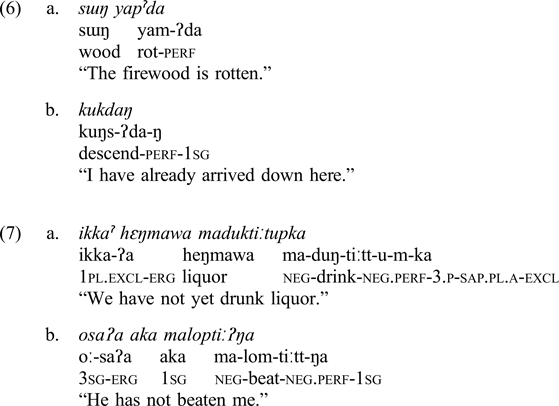
The perfect suffix -ʔda and the negative perfect suffix -tiːtt illustrated in examples (6) and (7) attach directly to the verb stem and therefore trigger oralization on nasal final verbs. Oralization caused by -ʔda is shown in examples (6a)–(6b), whereas oralization triggered by -tiːtt is illustrated with examples (7a)–(7b).

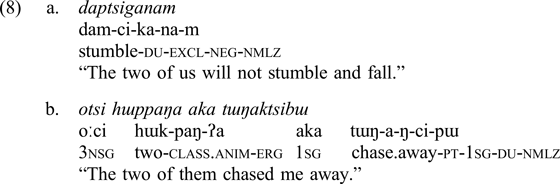
Like all person-number markers, the dual morpheme -ci, which marks a dual referent irrespective of grammatical person, occurs after the tense-aspect markers. In negated non-past forms, however, there is no non-past marking between the verb stem and the person-number endings, so that the dual suffix is directly added to the verb stem and causes oralization of a nasal verb stem coda, as shown in example (8a). The dual morpheme is also used to mark a dual agent acting on a first person singular patient. In this configuration, -ci is added to the first person singular ending, which in the non-past affirmative and in the past tense has the form -aŋ and -ŋ, respectively, and is therefore subject to oralization, viz example (8b).

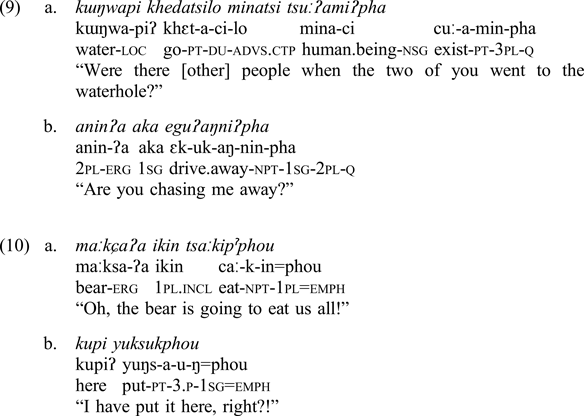
The question marker -pha and the emphasis marker =phou are added to a conjugated verb form to express a question or to emphasize the proposition. When the two morphemes are added to a verb form ending in a nasal, this nasal is oralized, e.g. the final alveolar nasal of the endings -min, cf. example (9a), -nin, cf. example (9b), and -in, cf. example (10a), or the first person singular suffix -ŋ in example (10b).Footnote 17

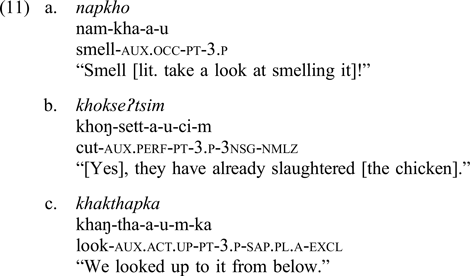
Mewahang makes extensive use of partially grammaticalized auxiliary verbs which derive from verbs still in use as lexical verbs in most cases and which are added directly to the unmarked lexical verb root to express aspectual, valence-related or more general, semantic differentiations. Historically, the perfect, negative perfect and non-past markers of Mewahang may also have been derived ultimately from this source construction, representing an earlier and more thoroughly grammaticalized layer of auxiliaries. Any auxiliary with a voiceless obstruent initial causes oralization if the lexical verb ends in a nasal, as shown in examples (11a)–(11c).

3.3.2. Nominal markers
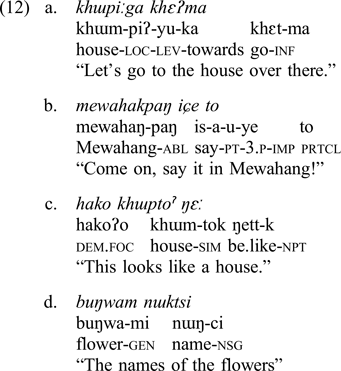
The nominal markers that trigger oralization are the three case marker locative -piʔ, ablative -paŋ and similaritive -tok, and the non-singular marker -ci. Examples (12a)–(12d) illustrate oralization with these markers.Footnote 18

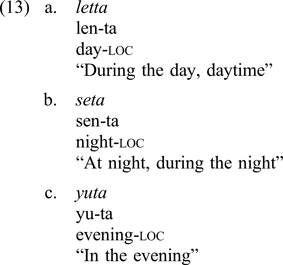
Oralization is also caused by a suffix which is no longer productive in Mewahang, namely -ta. This suffix is only attested in a number of frozen, lexicalized instances relating to different times of a day, as shown in examples (13a)–(13c). With the two lexical roots len- “day” and sen- “night”, the addition of -ta has caused the oralization of the final nasal. This analysis is justified by the occurrence of the presumed lexical root len- of letta as an independent lexeme meaning “day” in Mewahang and by external Upper Arun cognates for the presumed lexical root sen- of setta, namely Lohorung sɛnsɛn “all night” and Yamphu senda “night”.Footnote 19

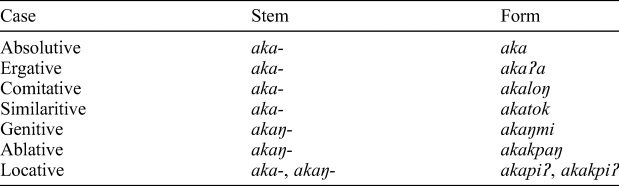
In addition to these suffixes which are the trigger of oralization on the verb coda, the oblique stem of the first person pronoun, akaŋ-, is the locus of oralization in inflected forms with a suffix with voiceless obstruent onset, namely -piʔ “loc” and -paŋ “abl”. Table 5 shows the case paradigm of the first person singular pronoun, including the oralized forms akakpaŋ and akakpiʔ. Note that for the locative, both the basic and the extended, oblique pronominal stem may be used.
Case paradigm of aka “I”

The nominal possessive prefixes aŋ- “1sg”, am- “2sg” and om- “3sg” are another locus of oralization when added to nominal stems with initial voiceless obstruent, but since they seem to have been oralized only irregularly, they are discussed below in section 5.2.
4. Explanatory potential
This section illustrates the explanatory potential of the recognition of the sound change of oralization for certain morphophonological and morphological peculiarities in Western Mewahang verbal morphology.
The recognition of the sound change of oralization allows for a diachronic evaluation of the first person oral agreement suffixes -ak and -k, for the internal reconstruction of the allomorphy of non-past tense suffixes and causative prefixes and for an explanation of the stem alternation between nasal and homorganic stop observed for certain verbs. These topics are discussed in sections 4.1–4.4.
4.1. Oral agreement suffixes
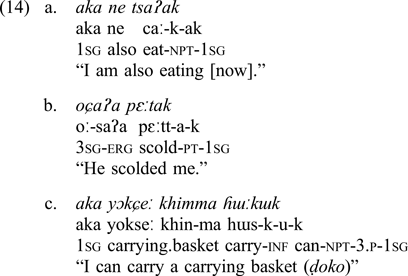
Mewahang indexes a first person singular actant with a velar nasal, which is a widespread and old etymon in Trans-Himalayan (cf. Bauman Reference Bauman1975; DeLancey Reference DeLancey1989; van Driem Reference van Driem1993). However, Mewahang also shows another set of first person indices which are characterized by a final velar oral stop, namely -ak and -k, with identical distribution as -aŋ and -ŋ, i.e. -aŋ ~ -ak for intransitive forms and transitive forms with a first person singular patient in the affirmative non-past tense, and -ŋ ~ -k for intransitive forms and transitive forms with a first person singular patient in the past tense and transitive forms with a first person singular agent and a third person singular patient, see examples (14a)–(14c).

The functional difference to the corresponding forms with a velar nasal seem to be mainly discourse-oriented and pragmatic, although a definitive analysis is still outstanding. Since this is a similar difference to that between the plain nasal endings and the nominalized forms (cf. section 3.2.2) and since the addition of the nominalizer -pɯ to the first person nasal endings caused the oralization of the final nasal, there are semantic as well as formal indications that the oral endings result from back formation of earlier -(a)kpɯ (cf. Gerber Reference Gerber2020). While this is still a mere hypothesis that needs to be tested in future research, alternative explanations are not easy to find. A retention from an earlier language stage is implausible, given that no other Upper Arun or Eastern Kiranti language with cognate morphology shows such doublets, and other sources for a recent innovation in Mewahang have not been detected either.
4.2 Non-past marking
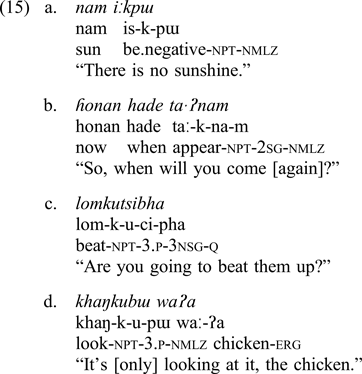
Tense marking in Mewahang is based on a primary, equipollent opposition between past and non-past, whereby past is marked by the suffix -a and non-past by an array of different suffixes, namely -k, -uk and -yuk, which can be analysed as allomorphs of the same morpheme, internally reconstructible as *-yuk (cf. Gerber Reference Gerber2022b). That these different allomorphs are historically related can be shown with the following data, which directly relate the allomorphy to the process of oralization. Examples (15a)–(15d) show the use of the allomorph -k, which is employed with vowel-, sibilant-, and nasal-final verb stems.

The observation relevant here is that the non-past marker in examples (15c)–(15d) does not trigger oralization, although synchronically there are direct sequences of nasal and voiceless obstruent. This irregularity can be explained by assuming that the non-past allomorph in this environment historically did not start in k, but in an element which did not trigger oralization, i.e. a sonorant. Given the other non-past allomorphs -uk and -yuk with initial sonorants, a very plausible hypothesis would be that the allomorph -k historically also had the form *-uk or *-yuk.Footnote 20 The complementary distribution of the three non-past allomorphs further supports this assumption,Footnote 21 although the conditions for the reduction of *-yuk to -uk after non-alveolar stops and to -k after vowels, nasals, and the sibilant s are not yet fully understood.
Importantly, it is the recognition of the sound change of oralization which compels us to identify the lack of oralization before non-past -k as unexpected and indirectly provides evidence for its etymological identity with -uk and -yuk.
4.3. Causative prefix *yaŋ-
Certain transitive verbs of direction exhibit a prefix ya- ~ yam- ~ yak-, namely yamdapma “to bring across”, yakhɛʔma “to take away”, yakɛʔma “to bring up”, yakuŋma “to bring down”, and yaktɛʔma “to bring”. The isolation of a causative prefix is justified by morphological minimal pairs for these verbs, cf. dapma “to come across”, khɛʔma “to go away”, kɛʔma “to come up, ascend”, kuŋma “to come down, descend” and taːma “to come from far, to appear”. The prefix is an innovation of Mewahang, since Lohorung and Yamphu differentiate these morphological minimal pairs exclusively by a valence-increasing suffix -t (cf. section 3.1), whereas Mewahang reinforced this suffix with a prefix, the source of which is unknown.Footnote 22
The prefix shows an idiosyncratic allomorphy, occurring as ya- before a velar stop, as yak- before a voiceless alveolar stop and as yam- before a voiced alveolar stop. The consideration of the sound change of oralization allows for the internal reconstruction of the causative prefix and accounts for a part of the allomorphy observed. Conceivably, the sound change of oralization also affected this prefix, the allomorph yak- in yaktɛʔma therefore reflecting the oralization of the nasal before t. The different place of articulation of the nasal in yamdapma and the stop in yaktɛʔma looks like an obstacle to this analysis, but the modern Western Mewahang form yamdapma can be identified as innovative, since Eastern Mewahang shows yaŋdapma, and Hodgson (Reference Hodgson1857: 366) recorded the form yangdáppu also for “Báláli”, i.e. Western Mewahang. Thus, we can assume that the prefix was originally *yaŋ- and was oralized before t to yak- and changed to yam- before d. A plausible phonetic explanation for the latter change is outstanding and the assumption therefore remains speculative. For verbs with initial velar stop, the sequence *-kk- was degeminated after the oralization, hence *yaŋ-k- > *yak-k- > ya-k-.Footnote 23 The consideration of the sound change of oralization thus allows us to trace all the allomorphs of the causative prefix back to a single form *yaŋ-.
4.4. Nasal–oral stem alternation
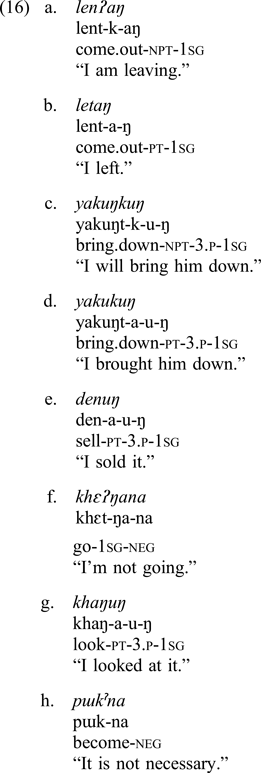
A group of verbs in Mewahang exhibit a stem alternation between nasal and homorganic oral stop, e.g. len- ~ let- “to come out, leave”, lin- ~ lit- “to be heavy”, sin- ~ sit- “be sour” or yakuŋ- ~ yakuk- “to bring down”. These verbs show the nasal coda before consonantal suffixes and the stop coda before vocalic suffixes, as shown in examples (16a)–(16d). Since there are verbs which invariantly show a nasal or stop coda, cf. examples (16e)–(16h), the verbs with the alternation between nasal and stop can internally be reconstructed with a complex coda of nasal plus stop, i.e. *-NC, which became *-CC by means of oralization and was later degeminated to -C before vowel-initial suffixes. Before consonant-initial suffixes, however, the final stop was dropped in a cluster reduction process and oralization did not take place, so that in this environment, the modern outcome is a simple nasal.

Although the final oral stop is not directly retained in the Mewahang forms in examples (16a)–(16d), there is indirect evidence that the final stop was *-t for all verbs with *NC-coda, namely that most Kiranti languages, including all Upper Arun languages, exhibit a stem augment -t (cf. section 3.1). This augment has different functions (cf. Michailovsky Reference Michailovsky, Thurgood, Matisoff and Bradley1985; Jacques Reference Jacques2017: 180–85, 207), i.e. causative, applicative, denominal derivation and deponent, and is likely to stem from more than one etymological source (cf. Jacques Reference Jacques2017: 180–85, 207). Although the exact individual etymologies still need to be worked out for Mewahang, it is clear from the comparative evidence that all the verbs with a complex *NC-coda involve the augment -t and therefore had the form *-Nt. A question not yet conclusively clarified and to be addressed in future research is whether the oralization of this complex coda in Mewahang reflects the Mewahang-specific oralization sound change or the older process of denasalization of nasal verb codas caused by the augment -t also attested in other Kiranti languages (cf. section 3.1).
5. Exceptions
The sound change of oralization shows some exceptions, that is morphemes that seem not to or only sporadically to have triggered or undergone the process of oralization, although the conditions seem to be met on first sight.
One important reason for exceptions to the regularity of oralization is the fact that Mewahang is an endangered language no longer actively transmitted to children, and the resulting fading of language competence among the younger generation. This has led to a regularization of stem forms, i.e. the oralized allomorphs are replaced by the more regular and transparent free-standing allomorphs, e.g. haksili “dance performed during house consecrations” (cf. Gaenszle Reference Gaenszle2000: 263–4) is replaced by haŋsili due to the identification of the lexical element haŋ “king” in this compound. Such morphophonological regulation and reduction of complexity is a typical pattern of change in endangered languages (cf. Campbell and Muntzel Reference Campbell, Muntzel and Dorian1989).
Besides these “re-nasalizations” caused by exaggeratedly cautious etymological analysis and language attrition, there are analytically more substantial exceptions to the oralization sound change. This concerns cases where oralization did not take place at all, or only in a few cases of the same environment, although the necessary phonological conditions were met. Since these irregularities cannot be explained conclusively at the moment, and since exceptions to sound laws are to be treated as “problems” to be solved in further research rather than “methodological insights worthy of incorporation into the practice of historical linguistics” (Fellner and Hill Reference Fellner and Hill2019: 110), this section is basically restricted to listing these irregularities to lay a foundation for future research on the topic.Footnote 24
5.1. Cotemporal adverbializer -saʔa
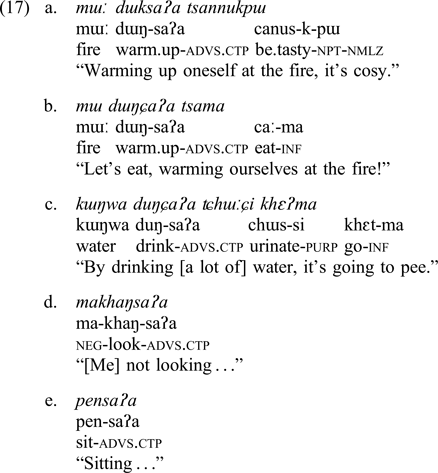
The cotemporal adverbializer -saʔa is sometimes observed to have triggered oralization, as shown in example (17a). More often, however, the suffix did not affect stem-final nasals, as in examples (17b)–(17e), in example (17b) even with the same verb as in example (17a).

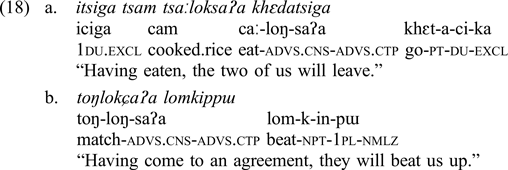
A lexicalized instance of oralization caused by -saʔa is the morphologically complex adverbializer -loksaʔa, which is composed of the consecutive marker -loŋ followed by the cotemporal adverbializer -saʔa, cf. examples (18a)–(18b).

There are two potential explanations for the inconsistency of oralization with the adverbializer -saʔa. The first is that -saʔa is phonologically less bound than suffixes that consistently cause oralization. The sporadic oralization in some instances may be caused by the high salience of the phonological process of oralization in the synchronic morphophonology of Mewahang, i.e. as a process of analogical extension of oralization to instances where the conditions are actually not met. The second explanation is to assume analogical levelling of erstwhile oralized forms in favour of a consistent nasal stem. This, however, is less likely given the fact that for other suffixes, there is no inconsistency in oralizing nasal-final stems.
5.2. Possessive prefixes
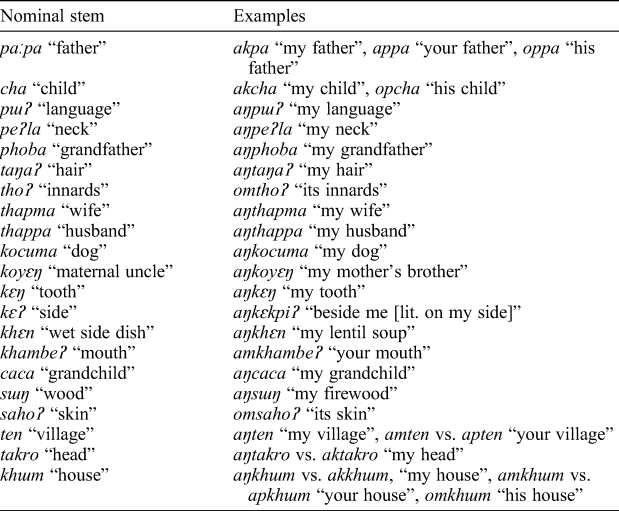
Mewahang exhibits a set of possessive prefixes for singular referents, namely first person aŋ-, second person am- and third person om-. When added to the kinship terms paːpa “father” and cha “child”, the nasal coda of these prefixes are oralized, as shown in the first part of Table 6. The non-oralized form for “my father”, i.e. *aŋpa, was consciously rejected by speakers of Mewahang. However, with most other nominal stems, oralization does not seem to have taken place, as the second part of Table 6 illustrates. When the abundant Nepali (ad hoc) loan words are combined with posssessive prefixes, these likewise show the nasal, i.e. non-oralized form, e.g. am-parivār “your family”, om-citra “its picture”, om-chāyā ̃ “its shadow”. Three nominal stems in the data corpus, namely ten “village”, khɯm “house” and takro “head”, however, are attested in both variants, conditioned by inter-speaker variation.Footnote 25
Oralization with possessive prefixes

The inconsistency of possessive prefixes to show the expected oralization is not understood so far and awaits further investigation. As with the adverbializer -saʔa, there are basically two explanations. The small number of nominal stems that actually trigger oralization implies that the prefixes were originally not affected by oralization, possibly because of having been only loosely bound phonologically to the nominal stem. The variation that is observable may indicate that the possessive prefixes are sporadically being oralized before voiceless obstruents due to analogical extension, primarily affecting those nominal stems that are most frequently used with possessive prefixes, namely basic kinship terms. Another possibility is that the possessive prefixes originally underwent oralization consistently and that the alternation between nasal and oral coda was subsequently levelled analogically in favour of the nasal coda, except for a few frequent lexemes, including basic kinship terms.
5.3. anci “the two of you”
The second person dual pronoun of Western Mewahang, anci, does not show the expected oralized form, i.e. *atci. A possible explanation for this is that the form anci in Mewahang is the result of analogical restoration of the nasal under the influence of the singular and plural forms ana and anin after the oralization, i.e. *anci > *atci → anci. However, it is also conceivable that the nowadays disyllabic form anci is recent and derives from earlier *anaci, transparently built on the second person singular pronoun ana, and was therefore not affected by oralization. In fact, Hodgson (Reference Hodgson1857: 358) recorded the form anáchí for Mewahang in the 1850s, and modern Eastern Mewahang shows anaci, too. However, Lohorung as well as the Khambu languages Kulung and Nachiring show the form anci, suggesting either that this form is older than the Mewahang-specific oralization sound change and that the forms in Hodgson (Reference Hodgson1857) and Eastern Mewahang reflect an analogical extension of the root ana- to the dual form, or that Khambu, Lohorung, and Western Mewahang all indepedently changed inherited *anaci to anci.Footnote 26
6. Summary
This paper presented and discussed the sound change of oralization that took place in the common ancestor of all Mewahang dialects, and constitutes an innovation that defines Mewahang within Upper Arun. The sound change is visible in compounding, derivational and inflectional morphology as well as in general phonotactic restrictions.
The historical process of oralization has left prevailing traces in the synchronic morphophonology in that it caused predictable and transparent stem alternations. As a consequence, oralization is readily transmitted to new forms by analogy in present-day Mewahang and speakers may construct new forms like khotakpi “in Khotang (district)” or nachirikpaŋ “from Nachiring [i.e. in the Nachiring language]”. Once, a cheerful speaker spontaneously came up with the neologism Yagakpa to designate the imaginary male counterpart of the female harmful spirit or witch Yagaŋma, using the male gender suffix -pa (see section 3.2.2). Another speaker even used an oralized allomorph of the question formative ŋ- in combination with an ad hoc borrowing from Nepali, i.e. sāhro “hard”, in the sentence ɯk-saːro hɯkwaba lus-a-bha [q-hard wind to.be.felt-pt-q] “What kind of wind is that?/How violently the wind blows!”
Despite its prevailing status, the sound change shows certain so far inexplicable exceptions which need to be scrutinized in future research. Some of these morphemes were originally probably not affected by the sound change, probably due to prosodic distance from the conditioning environment, and are only nowadays partially realized in oralized variants because of the salience of oralization for the speakers of Mewahang. Other instances of unexpected nasal forms may be attributed to analogical levelling of formerly oralized forms.
Abbreviations