




No CrossRef data available.
Article contents
The effect of education and occupational complexity on rate of cognitive decline in Alzheimer's patients
Published online by Cambridge University Press: 23 January 2006
Abstract
We explored the effect of education and occupational complexity on the rate of cognitive decline (as measured by the Mini-Mental State Examination) in 171 patients with a confirmed Alzheimer's disease (AD) diagnosis. Complexity was measured as substantive complexity of work and complexity of work with data, people, and things. Average lifetime occupational complexity was calculated based on years at each occupation. Participants were followed for an average of 2.5 years and 3.7 visits. In multivariate mixed-effects models, high education, high substantive complexity, and high complexity of work with data and people predicted faster rates of cognitive decline, controlling for age, gender, native language, dementia severity, and entry into the analyses at initial versus follow-up testing. These results provide support for the concept of cognitive reserve according to which greater reserve may postpone clinical onset of AD but also accelerate cognitive decline after the onset. (JINS, 2006, 12, 147–152.)
Keywords
Information
- Type
- BRIEF COMMUNICATION
- Information
- Journal of the International Neuropsychological Society , Volume 12 , Issue 1 , January 2006 , pp. 147 - 152
- Copyright
- © 2006 The International Neuropsychological Society
INTRODUCTION
The concept of “cognitive reserve” has been proposed as an explanation for why Alzheimer's disease (AD) diagnosis may be postponed in older adults with more education or higher-status occupations (Stern et al., 1994). Cognitive reserve has been defined as the amount of brain damage an individual can tolerate before reaching a clinical threshold for impairment (Katzman, 1993; Stern, 2002). Thus, individuals with greater reserve are hypothesized to sustain more AD-related neuronal damage before onset of symptoms and clinical diagnosis. Lending support to this hypothesis, two brain imaging studies found that AD patients with more demanding lifetime occupations (Stern et al., 1995) and higher education (Stern et al., 1992) had greater extent of brain pathology when dementia severity was controlled. Bennett and colleagues (2003) found a similar effect for education using brain autopsies.
Although onset may initially be postponed in older adults with greater reserve, compensation for deficits may be more difficult after AD diagnosis due to greater brain pathology, leading to a faster rate of cognitive decline. Higher education (Teri et al., 1995; Wilson et al., 2004) and high occupational status (Stern et al., 1999) have been associated with more rapid cognitive decline in AD. However, others did not find the same effect for education (Le Carret et al., 2005) and occupational status (Fritsch et al., 2002). We explored the effect of education and lifetime levels of occupational complexity—measured by substantive complexity of work and complexity of work with data, people, and things—on rate of decline on the Mini-Mental State Examination (Folstein et al., 1975) in patients with AD. Measures of occupational complexity have not previously been evaluated in relation to cognitive decline in AD patients.
METHOD
Participants
Participants were enrolled in a longitudinal study of aging and dementia at the University of Southern California Alzheimer Disease Research Center. Enrolling entailed commitment to semiannual retesting. On enrollment, each participant received a neurological assessment, medical evaluation, and neuropsychological testing. Informed consent was obtained from all participants or their caregivers using procedures approved by the Institutional Review Board at the University of Southern California. AD was diagnosed according to the Diagnostic and Statistical Manual for Mental Disorders, 3rd edition–revised (DSM-IIIR) criteria for dementia, and National Institute of Neurologic and Communicative Disorders and Stroke/AD and Related Disorders Association (NINCDS/ADRDA) criteria for AD (McKhann et al., 1984). Dementia severity was graded using the Clinical Dementia Rating Scale (CDR; Burke et al., 1988), a 5-point scale used to discriminate individuals without dementia (0), and with questionable (0.5), mild (1), moderate (2), and severe (3) dementia. Criteria for inclusion in the analyses were CDR of 1 or greater at baseline or at retesting, clinical diagnosis of AD, at least one follow-up testing after AD diagnosis, baseline MMSE scores greater than 5 to avoid floor effects on retesting, and information about education and occupation obtained either from a knowledgeable informant or from the participant before AD diagnosis.
In all, 171 AD patients met these criteria; 144 were diagnosed with AD at their baseline assessment, while 27 were diagnosed with AD at retesting. For these 27, this retest occasion served as the baseline for the present analyses. These 171 patients were identified from a total of 974 individuals who were tested as part of the longitudinal study. Of these 974, 509 were diagnosed with AD at initial or follow-up testing. Among those with AD, 10 had only self-reported information collected when or after AD diagnosis was established, 160 had baseline scores of 5 or lower on the MMSE, and 14 died before the first follow-up testing could be scheduled. Another 88 had missing education and/or occupational data. Of the remaining 237 AD patients, 171 (72%) had at least one follow-up testing.
During the first testing with an AD diagnosis, average MMSE score was 17.7 (SD = 5.5), 123 patients received a CDR score of 1, 43 received a score of 2, and 5 received a score of 3. The design called for retesting subjects every 6 months if demented. In this study, the average number of follow-ups after AD diagnosis was 3.7 (SD = 3.5) over an average of 2.5 years (SD = 1.9 years). Therefore, the actual average follow-up interval was 8.1 months. Delays in follow-ups were mostly due to scheduling issues and illness. Follow-up for cognitive testing was ended due to death in 15 participants. In 146 participants, cognitive test follow-up was ended due to another medical reason or inability to complete a cognitive test battery. Ten participants were still active in the longitudinal cognitive testing.
The sample was 61% Caucasian, 27% Hispanic, 11% African American, and 1% Asian/Pacific Islander. Information about ethnicity was missing for one participant. Women composed 57% of the sample; 78% were English-speaking and 22% were Spanish-speaking. Previously, the Spanish versions of the neuropsychological battery (Taussig et al., 1992) and the MMSE (Taussig et al., 1996) showed no measurable cultural bias and reliably discriminated AD cases from normal controls.
Measures
Rate of cognitive decline was measured with the Mini-Mental State Examination (MMSE; Folstein et al., 1975), a 30-point test of global cognition that includes orientation to time and place, language, memory, and visuomotor performance.
The main independent variables were education and complexity of occupation. Information about education, lifetime occupational history, and demographics was obtained from participants when they were cognitively intact (9%), or otherwise from a spouse (38%), son/daughter (22%), brother/sister (4%), or another, unspecified person (27%). For participants who gave self-reports, average interval between time of report and AD diagnosis was 6.0 years.
Occupations were coded by using categories from the 1970 U. S. Census. To measure complexity, we used scores for substantive complexity of work, and for complexity of work with data, people, and things calculated for the 1970 U. S. Census occupational categories by Roos and Treiman (1980) based on ratings in the Dictionary of Occupational Titles (see Miller et al., 1980). Once occupation was coded with its 1970 U. S. Census category, occupational complexity ratings are available in a directory. For the substantive complexity factor, scores range from 0 to 10. Interpretation of scales for complexity of work with data, people, and things is presented in the Appendix. These measures are “intended to reflect the levels of complexity at which a worker in a particular occupation functions in relation to data, people, and things” (Miller et al., 1980, p. 19).
The scores used in our analyses reflect the average complexity of occupations held by each participant throughout adulthood. We multiplied the complexity score for each reported occupation by years spent in that occupation, summed the values across all occupations, and divided the total sum by the total number of years spent in all occupations. Years spent as a homemaker were not included in these calculations because complexity ratings for this category were not available.
Substantive complexity was correlated with complexity of work with data (r = .94, p < .01) and people (r = .71, p < .01), and complexity of work with data was correlated with complexity of work with people (r = .66, p < .01). Complexity of work with people was negatively correlated with complexity of work with things (r = −.30, p < .01). Substantive complexity, complexity of work with data, and complexity of work with people were correlated with education (r = .61, .57, .57, respectively, p < .01).
Analysis
Education and measures of occupational complexity were dichotomized into high (1) and low (0) categories. Education was classified as 12 years or less versus more than 12 years. Substantive complexity was dichotomized at the median, as scores greater than or equal to 4.9 versus less than 4.9. Complexity of work with data, people, and things were dichotomized along complexity levels (see the Appendix) as follows: Complexity of work with data was classified as Analyzing or more complex work versus Compiling or less complex work, complexity of work with people as Speaking/Signaling or more complex work versus Serving or Taking Instructions, and complexity of work with things as Manipulating or more complex work versus Tending or less complex work.
We used mixed-effects models in the SAS procedure MIXED (SAS Institute, 2003) to test whether average rate of decline on MMSE was predicted by levels of education or occupational complexity. Education and each complexity measure were entered into separate models. A mixed-effects model yields estimates of overall fixed effects, or average effects for the group, as well as random effects that reflect individual deviation from the fixed effect. Random effects were calculated using an unstructured covariance matrix and included baseline MMSE (intercept) and rate of decline (slope). The procedure accounts for intraindividual correlation among MMSE scores over time. All models controlled for age (centered at the mean), gender, native language (English/Spanish), AD diagnosis at initial testing vs. at retesting, and dementia severity at baseline (CDR score). Models with occupational complexity also controlled for years of education.
RESULTS
Out of 237 AD patients eligible to participate in this study, 66 did not have follow-up testing. Logistic regression analyses indicated that the two groups were comparable in age, gender, baseline CDR scores, substantive complexity, and complexity of work with data and people (p > .05). However, AD patients without follow-up were more likely to be Spanish-speaking, were less educated, had lower baseline MMSE scores, and had held occupations with higher complexity of work with things (p < .05).
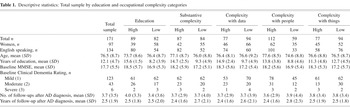
Descriptive information for the sample is presented in Table 1. There were more men than women with high education and with high complexity of work with data (p < .05). Chi-square tests also indicated that patients who were diagnosed with AD at retesting were more likely than those diagnosed with AD at initial testing to be in the high groups for education, substantive complexity, and complexity of work with people (p < .05). Those who were English-speaking were more likely than those who were Spanish-speaking to be in the high groups for education, substantive complexity, and complexity of work with data and people (p < .05). There were no differences in clinical dementia severity between participants with low and high education or complexity scores (p > .05), however, dementia severity was greater for those with lower initial MMSE score (r = −.55, p < .01). Independent sample t-tests yielded no significant differences in baseline MMSE between participants with low and high education or complexity scores, or between men and women (p > .05).
Descriptive statistics: Total sample by education and occupational complexity categories

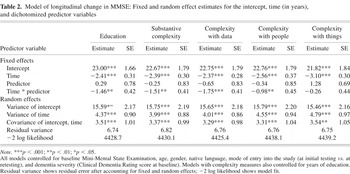
Table 2 displays the results of mixed-effects analyses. The fixed effect for the intercept represents the average baseline MMSE score for those in the lower category on the predictor variable, adjusted for all variables in the model. In each model there was an average annual rate of decline in MMSE of approximately 2.5 points for every year elapsed since the initial MMSE test for participants in the lower education or occupational complexity category. The lack of statistical significance for the fixed effect for the predictor in all models indicated that baseline MMSE scores were not different between participants with high versus low scores on each predictor.
Model of longitudinal change in MMSE: Fixed and random effect estimates for the intercept, time (in years), and dichotomized predictor variables

The interaction of time by predictor constituted the test of the main hypothesis. The interaction yielded significant negative parameter estimates in all models except the model testing complexity of work with things. The negative parameter estimates indicated that participants with high scores on the predictor (i.e., education or occupation) declined significantly faster than their counterparts with low scores; the average difference in the rate of MMSE decline in participants in the high versus low complexity categories was between 0.98 MMSE points per year for complexity of work with people and 1.75 points per year for complexity of work with data.
The significant random effects for the variance in the intercept across all models indicated that individual baseline MMSE scores varied. The significant variance for time showed significant individual differences in the rate of cognitive decline. Since individual differences in rate of decline existed in models with fixed effects for time and predictor included (controlled), it is likely that other factors besides the predictor might explain a portion of variation in individual rates of decline. Finally, the significant covariance between intercept and years of follow-up indicated that rate of decline was less steep among individuals with higher baseline MMSE.
We also conducted post hoc analyses with continuous education and complexity variables. Since complexity of work with people was skewed, we log-transformed this variable. The pattern of results was similar to that obtained with dichotomous variables.
Finally, complexity of work with data, people and things were entered into the same, covariate-adjusted model. Substantive complexity was not included in these models because of the high colinearity between this variable and complexity of work with data. AD patients with high complexity of work with data declined about 1.9 points per year faster on the MMSE than AD patients with low complexity of work with data (p < 0.05), while complexity of work with people and things were not significantly related to rate of decline.
DISCUSSION
We examined the effects of education and complexity of occupation on rate of decline in the MMSE score among patients diagnosed with AD. We found that high education and high levels of occupational complexity were associated with faster rate of decline on MMSE. The results were adjusted for age, gender, native language, dementia severity, and entry into the study at initial (versus follow-up) testing, and for education in analyses with complexity measures. These findings provide additional support for the hypothesis that the individuals who may have greater reserve, measured by levels of education or complexity of occupation independent of education, are likely to show faster rate of cognitive decline after their reserve is depleted to the point of clinical expression of AD.
Previously, faster rate of cognitive decline was found in AD patients with high education (Stern et al., 1999; Teri et al., 1995; Wilson et al., 2004) and with high occupational attainment defined as primary occupation being managerial, professional, or technical as opposed to trade, craft, or clerical (Stern et al., 1999). This was the first study to link occupational complexity associated with job titles to rate of cognitive decline in AD patients.
This study has some limitations. Participants were volunteers from a university-based research center, limiting the ability to generalize the findings to the entire population. In addition, we used mostly prevalent AD cases and only one measure of cognitive ability to test rate of decline. We could not assure that the clinicians performing each neuropsychological evaluation were blinded to previous evaluations. Finally, we were unable to include complexity scores for time spent as a homemaker because such scores were not available. In conclusion, while neither education nor occupational complexity fully accounted for individual variance in the rate of decline, our findings provide further evidence that some type of reserve created through or associated with lifestyle factors, namely education and occupation, is related to an accelerated cognitive decline once clinical symptoms of AD are evident.
ACKNOWLEDGMENTS
This study was supported by NIA grant nos. P03 AG17265 and P50 AG05142.
APPENDIX

References
REFERENCES
Bennett, D.A.,
Wilson, R.S.,
Schneider, J.A.,
Evans, D.A.,
Mendes de Leon, C.F.,
Arnold, S.E.,
Barnes, L.L., &
Bienias, J.L.
(2003).
Education modifies the relation of AD pathology to level of
cognitive function in older persons.
Neurology,
60,
1909–1915.Google Scholar
Burke, W.J.,
Miller, P.,
Rubin, E.H.,
Morris, J.C.,
Coben, L.A.,
Ducheck, J.,
Wittels, I.G., &
Berg L.
(1988).
Reliability of the Washington University Clinical Dementia
Rating.
Archives of Neurology,
45,
31–32.Google Scholar
Folstein, M.F.,
Folstein, S.E., &
McHugh, P.R.
(1975).
“Mini-Mental state”: A practical method for grading the
cognitive state of patients for the clinician.
Journal of Psychiatric Research,
12,
189–198.Google Scholar
Fritsch, T.,
McClendon, M.J.,
Smyth, K.A., &
Ogrocki, P.K.,
(2002).
Effects of educational attainment and occupational status on
cognitive and functional decline in persons with Alzheimer-type
dementia.
International Journal of Geriatric Psychiatry,
14,
347–363.Google Scholar
Katzman, R.
(1993).
Education and the prevalence of dementia and Alzheimer's
disease.
Neurology,
43,
13–20.Google Scholar
Le Carret, N.,
Auriacombe, S.,
Letenneur, L.,
Bergua, V.,
Datrigues, J.-F., &
Fabrigoule, C.
(2005).
Influence of education on the pattern of cognitive deterioration in
AD patients: The cognitive reserve hypothesis.
Brain and Cognition,
57,
120–126.Google Scholar
McKhann, G.,
Drachman, D.,
Folstein, M.,
Katzman, R.,
Price, D., &
Stadlan, E.M.
(1984).
Clinical diagnosis of Alzheimer's disease: report of the
NINCDS-ADRDA work group under the auspices of Department of Health and
Human Services Task Force on Alzheimer's disease.
Neurology,
34,
939–944.Google Scholar
Miller, A.R.,
Treiman, D.J.,
Cain, P.S., &
Roos, P.A.
(1980).
Work, jobs, and occupations: A critical review of occupational
titles.
Washington, DC:
National Academy Press.
Roos, P.A. &
Treiman, D.J.
(1980).
DOT scales for the 1970 Census classification. In
A.R. Miller,
D.J. Treiman,
P.S Cain, &
P.A. Roos (Eds.),
Work, jobs, and occupations: A critical review of occupational
titles.
Washington, DC:
National Academy Press.
SAS Institute
(2003).
SAS System for Microsoft Windows (Version 9) [Computer
software].
Cary, NC:
SAS Institute Inc.
Stern, Y.
(2002).
What is cognitive reserve? Theory and research application of the
reserve concept.
Journal of the International Neuropsychological Society,
8,
448–460.CrossRefGoogle Scholar
Stern, Y.,
Albert, S.,
Tang, M.-X., &
Tsai, W.-Y.
(1999).
Rate of memory decline in AD is related to education and occupation:
Cognitive reserve?
Neurology,
53,
1942–1947.Google Scholar
Stern, Y.,
Alexander, G.E.,
Prohovnik, I., &
Mayeux, R.
(1992).
Inverse relationship between education and parietotemporal perfusion
deficit in Alzheimer's disease.
Annals of Neurology,
32,
371–375.Google Scholar
Stern, Y.,
Alexander, G.E.,
Prohovnik, I.,
Stricks, L.,
Link, B.,
Lennon, M.C., &
Mayeux, R.
(1995).
Relationship between lifetime occupation and parietal flow:
Implications for a reserve against Alzheimer's disease
pathology.
Neurology,
45,
55–60.Google Scholar
Stern, Y.,
Gurland, B.,
Tatemichi, T.K.,
Tang, M.X.,
Wilder, D., &
Mayeux, R.
(1994).
Influence of education and occupation on the incidence of
Alzheimer's disease.
Journal of the American Medical Association,
271,
1004–1010.CrossRefGoogle Scholar
Taussig, I.M.,
Henderson, V.W., &
Mack W.
(1992).
Spanish translation and validation of a neuropsychological battery:
Performance of Spanish- and English-speaking Alzheimer's disease
patients and normal comparison subjects.
Clinical Gerontologist,
11,
95–108.Google Scholar
Taussig, I.M.,
Mack, W.J., &
Henderson, V.W.
(1996).
Concurrent validity of Spanish-language versions of the Mini-Mental
State Examination, Mental Status Questionnaire,
Information-Memory-Concentration Test, and
Orientation-Memory-Concentration Test: Alzheimer's disease patients
and nondemented elderly comparison subjects.
Journal of the International Neuropsychological Society,
2,
286–298.Google Scholar
Teri, L.,
McCurry, S.M.,
Edland, S.D.,
Kukull, W.A., &
Larson, E.B.
(1995).
Cognitive decline in Alzheimer's disease: A longitudinal
investigation of risk factors for accelerated decline.
Journal of Gerontology: Medical Sciences,
50A,
M49–M55.Google Scholar
Wilson, R.S.,
Li, Y.,
Aggarwal, N.T.,
Barnes, L.L.,
McCann, J.J.,
Gilley, D.W., &
Evans, D.A.
(2004).
Education and the course of cognitive decline in Alzheimer
disease.
Neurology,
63,
1198–1202.Google Scholar
Descriptive statistics: Total sample by education and occupational complexity categories
Model of longitudinal change in MMSE: Fixed and random effect estimates for the intercept, time (in years), and dichotomized predictor variables
 You have
Access
- 134
- Cited by