Introduction
In the next few decades in many developed countries, as a consequence of the ageing of the baby-boom generation, the number of community-dwelling elders needing non-institutional personal assistance will more than double (e.g. US Department of Health and Human Services 2003), while the number of family carers available for every disabled oldest adult will significantly decrease (Robine, Michel and Herrmann Reference Robine, Michel and Herrmann2007). Thus, in developed countries the demand for personal-care workers, which has considerably increased in the last years, is expected to soar in the near future (Kaye et al. Reference Kaye, Chapman, Newcomer and Harrington2006; Litwin and Attias-Donfut Reference Litwin and Attias-Donfut2009). Although no precise data are available on the number of personal-care workers working in Italy, they have been estimated to be over 700,000 (Italian Ministry of Labour and Social Policy (MLSP) 2010) with 93 per cent being foreigners (Alemani Reference Alemani2008). In northern Italy, they provide paid personal assistance to nearly 10 per cent of community-dwelling older people and almost 50 per cent of elders with disabilities living at home (MLSP 2010). Privately-employed personal care is widespread in Italy not only for its economic convenience but also because it is consistent with the cultural, social and moral traditions of the country in that it supports a model of care ‘that considers families … as the key providers of personal care, that discourages institutionalisation, and that favours keeping frail older people in their own homes’ (Degiuli Reference Degiuli2010: 773–4). Personal-care workers live 24 hours a day with the elderly care-recipient in about 65 per cent of cases (Farina Reference Farina2005; Simoni and Zucca Reference Simoni and Zucca2007). It is estimated that at least one-third of the foreign personal-care staff are without a residence permit (Zanfrei Reference Zanfrei2008) and that two personal-care workers out of three do not have a regular employment contract (MLSP 2010).
Hard work, high risk of job burnout, low wages and benefits, and irregular work schedules might explain the high turnover rates reported among these workers (Yamada Reference Yamada2002; Montgomery et al. Reference Montgomery, Holley, Deichert and Kosloski2005; US Department of Labor 2008). High turnover can be costly to consumers, workers and providers (Dawson and Surpin Reference Dawson and Surpin2000). It may also lead to disruptions in the continuity of care for the clients (Dawson and Surpin Reference Dawson and Surpin2000; Stone Reference Stone2004) and to poor quality care (Castle and Engberg Reference Castle and Engberg2005; Seavey Reference Seavey2004). If the job conditions of personal-care staff do not improve, it may become increasingly difficult to attract and retain skilled workers (Kaye et al. Reference Kaye, Chapman, Newcomer and Harrington2006).
To identify the factors associated with the retention of personal-care staff, various studies have been carried out on nursing-home staff and, to a lesser extent, on personal-care staff employed in assisted-living facilities and as agency-recruited home workers. As far as the former two categories are concerned, it has been shown that in predicting turnover rates economic factors are less important than environmental factors such as communication, supervision and being appreciated, listened to and treated with respect (Chou and Robert Reference Chou and Robert2008; Kemper et al. Reference Kemper, Heier, Barry, Brannon, Angelelli, Vasey and Anderson-Knott2008; Konetzka et al. Reference Konetzka, Stearns, Konrad, Magaziner and Zimmerman2005). Instead, for agency-recruited home workers, higher remuneration or wages was the single most important reason for staying in the job (Kemper et al. Reference Kemper, Heier, Barry, Brannon, Angelelli, Vasey and Anderson-Knott2008). Similarly, in a recent study involving consumer-directed care workers, being granted health insurance ranked first among the factors promoting job retention (Howes Reference Howes2008). Many of these studies have not considered the actual turnover of personal-care workers, however, but only their self-declared intention to keep or leave the job (Howes Reference Howes2008; Kemper et al. Reference Kemper, Heier, Barry, Brannon, Angelelli, Vasey and Anderson-Knott2008); which means that although we have a detailed picture of the factors that make personal-care staff satisfied or dissatisfied with their work, we cannot take for granted that such factors are the effective determinants of turnover. Moreover, most of these studies have been carried out in the United States of America (USA) with their specific health-care system and the results may not apply to other developed countries such as Italy, where every citizen is entitled to free health care.
No studies have yet investigated the predictors of the turnover of personal-care staff in Italy. In a recent study concerning the outcomes of the perceived quality of paid personal care provided to community-dwelling older adults with disabilities, we found that poor quality of personal care at baseline was associated with a higher turnover rate of personal-care staff and with a higher likelihood of nursing home placement one year later (Bilotta, Nicolini and Vergani Reference Bilotta, Nicolini and Vergani2009). However, apart from the quality of paid personal assistance, that study did not investigate other possible predictors of the turnover of personal-care workers. The aim of this study was therefore to find predictors of the turnover of personal-care staff providing community-dwelling older adults with assistance in the basic activities of daily living (BADLs) and/or the instrumental activities of daily living (IADLs) in an urban area in Italy.
Methods
Design, setting and participants
This prospective cohort study involved older adults (aged at least 65 years) who attended the outpatient Geriatric Medicine Unit of the Fondazione Cà Granda Ospedale Maggiore Policlinico, Istituto di Ricovero e Cura a Carattere Scientifico (IRCCS) in Milan, Italy, from May 2005 to June 2007. Part of this sample had already been considered in previous studies on the quality of paid personal care (Bilotta and Vergani Reference Bilotta and Vergani2008; Bilotta, Nicolini and Vergani Reference Bilotta, Nicolini and Vergani2009). The inclusion criteria for the older participants were living at home and receiving personal assistance from a care worker in at least one BADL or IADL for at least one month. All the older outpatients that met the criteria were asked to take part in the study along with their personal-care workers. Their informal care-givers were included only if they visited the care-recipient at least once a week. Elders suffering from an overt cognitive impairment and lacking an informal care-giver were excluded. All participants gave written informed consent to participate and were separately evaluated by means of a semi-structured interview that had been used in a previous study of personal-care workers (Bilotta and Vergani Reference Bilotta and Vergani2008).
Baseline evaluation
A number of characteristics of the personal-care workers were considered: age, sex, nationality, education, length of stay in Italy, self-evaluated Italian language skills, civil status, having children, living far away from their family, specific course attendance, agency-recruitment, professional experience, and daily working hours. They were also asked about possible difficulties encountered in their work. Finally, the personal-care workers were invited to evaluate their general conditions of life by choosing one of three possible options: ‘non-distressing’, ‘mildly distressing’ or ‘severely distressing’. As previously reported (Bilotta and Vergani Reference Bilotta and Vergani2008), we could not specifically investigate the legal status and the pay of the personal-care staff since most of the participants refused to disclose such information. However, low wages was one of the issues we asked them to consider when reporting causes of job dissatisfaction and legal status was one of the features they were invited to take into account when describing their general living conditions.
The older participants underwent a comprehensive geriatric evaluation. Functional status was assessed by means of the scales for the BADLs (Katz et al. Reference Katz, Downs, Cash and Grotz1970) and the IADLs (Lawton and Brody Reference Lawton and Brody1969), cognitive status by means of the Mini Mental State Examination (MMSE) (Folstein, Folstein and McHugh Reference Folstein, Folstein and McHugh1975), neuropsychological status by means of the Neuro Psychiatric Inventory (NPI) (Cummings et al. Reference Cummings, Mega, Gray, Rosenberg-Thompson, Carusi and Gornbein1994), and co-morbidity by means of the Cumulative Illness Rating Scales (CIRS-m and CIRS-s) (Parmelee et al. Reference Parmelee, Thuras, Katz and Lawton1995). We also collected information on pharmacological treatment (medication) and socio-demographic attributes such as education, civil status and living alone. As far as the informal carers were concerned, we considered sex, age, relationship with the care-recipient and care-giver burden assessed by means of the Care-giver Burden Inventory scale (CBI) (Novak and Guest Reference Novak and Guest1989).
To evaluate the perceived quality of paid personal care, we asked the older participants and their informal care-givers to describe the quality of care by choosing one of four possible options: ‘poor’, ‘fair’, ‘good’ and ‘optimal’ care. To help them make their choice, they were invited to consider possible qualities of the personal-care workers, such as being skilful, being able to establish a good relationship with the care-recipient, possessing positive personal characteristics (being reliable, good-natured). We excluded from this specific item of the interview the older adults with an overt cognitive impairment (MMSE score below 21 out of 30) as well as the elders deemed to be ‘unreliable’, i.e. those with a MMSE score of 21–23 out of 30 who expressed two different opinions on personal-care workers, at baseline and during a telephone interview one week later. The quality of care was considered to be ‘poor or fair’ if either the older participant or their informal care-givers described the quality of paid personal care as ‘poor’ or ‘fair’. If a single opinion was available or reliable this was the only one to be taken into account.
Follow-up evaluation
The one-year follow-up started in May 2006 and ended in June 2008. We investigated if there had been a change in the personal-care staff by means of telephone interviews with the older participants or with their informal care-givers (the latter were considered only if the older care-receivers were unreliable because of cognitive impairment or unavailable). The participants were stratified into two groups: the ‘turnover’ group, including cases in which the personal-care workers enrolled at baseline had either been changed or had decided to leave the job, and the ‘non-turnover’ group in which there had been no change in the personal-care staff over time.
Sample size and statistical analyses
In order to verify the null hypothesis that the main characteristics of the personal-care staff, older care-receivers and informal carers were similar across the two groups, analyses were performed by using Student's t-test for metric variables with a normal distribution, the Mann–Whitney test for metric variables without a normal distribution, and the chi-squared test for nominal variables. A two-sided p value less than 0.05 was taken to indicate statistical significance. In order to find independent predictors of the one-year turnover of personal-care staff, we performed a multivariate logistic regression analysis, taking the one-year turnover of personal-care workers as the dependent variable. The sample size calculation was carried out with reference to the nearly 25 per cent prevalence of turnover of personal-care workers we had found in previous work (Bilotta, Nicolini and Vergani Reference Bilotta, Nicolini and Vergani2009). Therefore a sample of 83 personal-care workers had an 80 per cent statistical power at a 5 per cent significance level to detect a 30 per cent absolute difference between the two groups in the prevalence of any complaint about the job as well as in the prevalence of non-distressing life conditions, assuming a 30 per cent prevalence of complaints about the job and a 65 per cent prevalence of non-distressing life conditions in the ‘non-turnover’ group according to our previous work. Statistical analyses were performed using SPSS 14.0 for Windows.
Results
From May 2005 to June 2007, 130 older adults living in the community and receiving paid, privately-employed personal help for BADLs and/or IADLs visited the outpatient Geriatric Medicine Unit. Six subjects were not willing to take part in the study and three did not fulfil the inclusion criteria (overt cognitive impairment, no informal care-giver, or an informal care-giver paying them a visit less than once a week). Thus the study enrolled at baseline 121 older outpatients living at home along with their personal-care workers, and 107 informal care-givers (i.e. for 14 of the 121 older participants no informal care-giver was available). One year after enrolment another 38 elders were excluded: 12 older participants (10%) had been placed in a nursing home and 26 (21%) had died. Therefore the reported analysis included the 83 older participants who were still living at home at a one-year follow-up, along with their personal-care workers and 74 available informal care-givers.
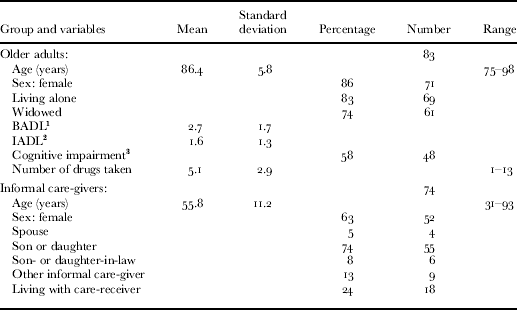
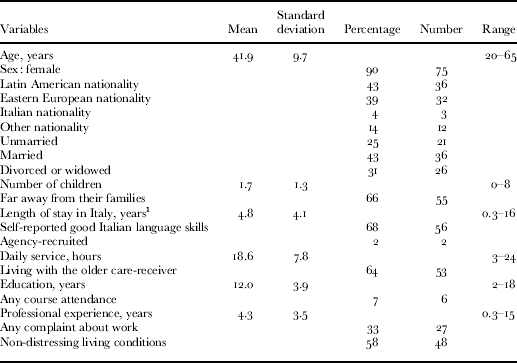
The main baseline characteristics of the sample are shown in Tables 1 and 2. The older care-receivers were mainly widowed women in advanced old age with significant co-morbidity and several disabilities, and many lived alone (Table 1). The informal care-givers were frequently daughters or sons who did not live with their parents (Table 1). The personal-care workers were mostly middle-aged foreign women, many of them married with children and living far away from their relatives (Table 2). About two-thirds were living with the care-receivers. It is interesting to note that the care workers reported at least one complaint about their work in only one-in-three cases: the most common complaints were not being respected by the care-recipients (23%) and excessive demands (8%), while just 4 per cent complained about the wages. At the one-year follow-up, 61 of the older participants were assisted by the personal-care worker interviewed at baseline, while 22 had changed their paid carer. The one-year turnover rate of personal-care workers was therefore 26.5 per cent: in nine cases the personal-care workers had been dismissed, while in 13 cases they had left voluntarily without giving any explanation.
Main baseline characteristics of the older adults and informal caregivers
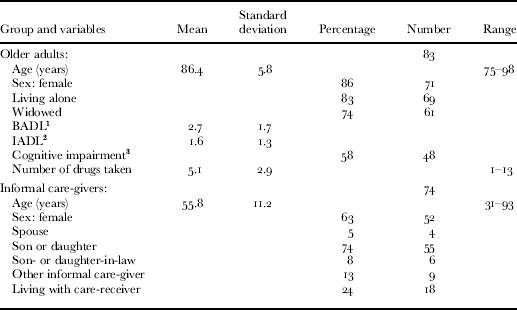
Notes: 1. BADL: basic activities of daily living; normal score 6/6; lower scores indicate worse functional status. 2. IADL: instrumental activities of daily living; normal score 8/8; lower scores indicate worse functional status. 3. Cognitive impairment of any kind as described by a Mini Mental State Examination score less than 24 out of 30 after correction for age and education.
Main baseline characteristics of the 83 personal-care workers
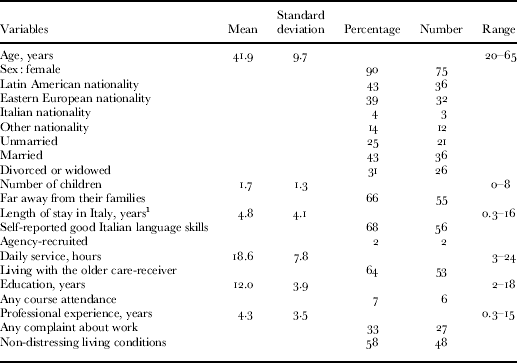
Note: 1. The three Italian personal-care workers were excluded from this analysis.
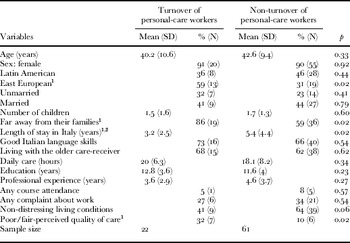
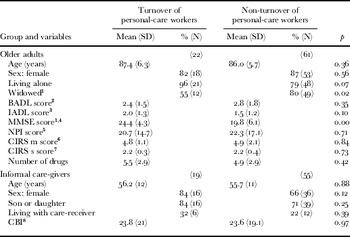
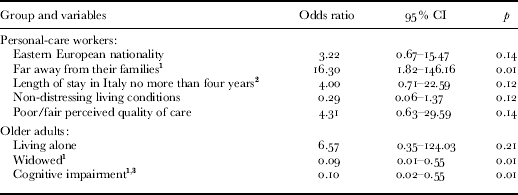
A comparison between the ‘turnover’ and the ‘non-turnover’ groups identified several characteristics of the personal-care workers that significantly associated with the former (Table 3): being of an East European nationality, living far away from their families, shorter stays in Italy, and providing a quality of care perceived as ‘poor or fair’. It is worth noting that the percentage of workers complaining about their job was similar in the two groups. As far as the characteristics of the older care-recipients were concerned, being widowed and having worse cognitive status were significantly associated with the ‘non-turnover’ group (Table 4). Multivariate logistic regression analysis of the one-year turnover of personal-care workers found just one attribute to be a significant predictor, namely living far away from their families, and identified two characteristics of the older participants as predictors, namely being widowed and being affected by cognitive impairment, as described by a MMSE score below 24 out of 30 after correction for age and education (test statistics in Table 5).
Characteristics of personal-care staff in the turnover and non-turnover groups

Notes: SD: standard deviation. 1. Null hypothesis rejected (p<0.05). 2. Analysis using Mann–Whitney test. The three Italian personal-care workers, who belonged to the non-turnover group, were excluded from this analysis.
Characteristics of older adults and their informal caregivers in the turnover and non-turnover groups

Notes: 1. Null-hypothesis rejected (p<0.05). 2. BADL: basic activities of daily living; normal score 6/6. 3. IADL: instrumental activities of daily living; normal score 8/8. 4. MMSE: Mini Mental State Examination; normal score range 24–30 ; lower scores indicate worse cognitive function. 5. NPI: Neuro Psychiatric Inventory; score range 0–144 ; higher scores indicate worse neuropsychiatric disorders. 6. CIRS m: Cumulative Illness Rating Scale morbidity; score range 0–13 ; lower scores indicate lower morbidity. 7. CIRS s: Cumulative Illness Rating Scale severity; score range 1–5 ; lower scores indicate less severe multiple pathology 8. CBI: Care-giver Burden Inventory; score range 0–96 ; higher scores indicate greater caregiver distress.
One-year predictors of turnover of personal-care workers from multivariate logistic regression analysis
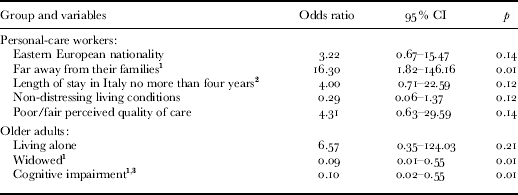
Notes: CI: confidence interval of odds ratio. 1. Null-hypothesis rejected (p<0.05). 2. The median length of stay in Italy of the 80 non-Italian personal-care workers was four years. The three Italian personal-care workers were excluded from the analysis. 3. A Mini Mental State Examination score less than 24 out of 30 after correction for age and education indicates cognitive impairment.
Discussion
This prospective study of paid personal assistance to community-dwelling older subjects in Milan in the northern Italian Region of Lombardy has found that the only characteristic of personal-care workers significantly associated with turnover at a one-year follow-up was living far away from their families. This finding must be interpreted on the basis of the socio-demographic profile of the personal-care staff working in Italy – it emerged from our study that they are generally immigrant middle-aged married women, that many have left their families behind in their countries of origin (66%), and that they were employed in a job for which they had received little or no training. This profile is consistent with not only those found by other studies in Lombardy (Alemani Reference Alemani2008; Farina Reference Farina2005), but also with those reported from the USA and other developed countries (Fleming and Taylor Reference Fleming and Taylor2007; Jorgensen et al. Reference Jorgensen, Parsons, Gundersen, Weidenbohm, Parsons and Jacobs2009; Montgomery et al. Reference Montgomery, Holley, Deichert and Kosloski2005; Yamada Reference Yamada2002). A study carried out in New Zealand has in fact noted that they are a ‘vulnerable workforce providing erratic care to vulnerable people’ (Jorgensen et al. Reference Jorgensen, Parsons, Gundersen, Weidenbohm, Parsons and Jacobs2009).
With regard to the relationship between the turnover of personal-care workers and their living far away from their families, it must be emphasised that the design of this study did not allow us to determine what underlies this association: it could be that having their relatives at a distance makes the personal-care workers more vulnerable to the stressful aspects of their job, or that migrant workers plan from the very start a shorter length of stay in our country. It is interesting to note that in the turnover group we found a higher prevalence of personal-care workers from Eastern Europe, possibly because these personal-care workers, unlike those from Asia or Latin America, generally leave their families behind and plan a shorter stay in Italy (Mesini Reference Mesini2006). Also a recent survey in Ireland pointed out that the experiences of European, South Asian and African paid carers were significantly different in terms of employment mobility and long-term plans for remaining in the sector (Doyle and Timonen Reference Doyle and Timonen2009). It must be stressed, however, that the multivariate analysis identified only one predictor of turnover, the personal-care worker lived far away from their families, and not nationality. Further studies are needed to assess whether immigration politics which enable the immigrant personal-care workers' spouses and children to join them (family reconjunction) would reduce the turnover of personal-care staff in Italy, thereby providing disabled older adults living at home with more continuity in their care.
The estimated one-year turnover rate (26.5%) is similar to that described by other studies (Seavey Reference Seavey2004). The fact that among the ‘turnover’ group, in nine of the 22 cases the personal-care worker had actually been dismissed may be viewed as a positive aspect of choice and control that enables the quality of personal assistance to be enhanced. Yet it must also be considered that it can be rather difficult for the older care-receivers and their families to find another care worker and to ensure quality and continuity of care in the specific Italian setting: in Italy personal-care workers are often recruited on the strength of personal recommendations and not by agencies (Degiuli Reference Degiuli2010; MLSP 2010), as confirmed by the results of our study. Therefore, hiring a new care worker can take many weeks during which the informal care-givers, who are in the meantime left to themselves in providing assistance to their older relatives, can suffer important physical, psychological and professional consequences. It is indeed well-known that care workers provide not only older people but also their families with substantial care and emotional support, as described in a recent study carried out in Israel (Ayalon Reference Ayalon2009).
Another finding of this study that deserves further discussion is that, among the older participants, being widowed or having an overt cognitive impairment turned out to be predictors of a low-turnover of personal-care staff: these older adults were more likely to keep their personal-care workers at the one-year follow-up, independently of the perceived quality of care. There are two possible (and conflicting) explanations. On the one hand, we can suppose there is a better relationship between the personal-care staff and the care-recipients, as these older people are in greater need of company and assistance and the personal-care workers can find their work more gratifying. This would be in line with the findings of a number of studies that have demonstrated that factors such as commitment to their role and feeling important are related to personal-care workers keeping their jobs, independent of economic issues (Hokenstad et al. Reference Hokenstad, Hart, Gould, Halper and Levine2006; Piercy and Woolley Reference Piercy and Woolley1999; Ryan et al. Reference Ryan, Nolan, Enderby and Reid2004). Moreover, in another recent study we found that the informal care-givers of older outpatients suffering from Alzheimer's disease reported general satisfaction with the work provided by the care workers (Bilotta et al. Reference Bilotta, Bergamaschini, Arienti, Spreafico and Vergani2010). On the other hand, widowed elders and older people with cognitive impairment are vulnerable care-recipients who may not be able to change their personal-care staff even in the face of a poor care quality or overt mistreatment. Abusive behaviours towards older persons are unfortunately a well-documented reality which involves both nursing home staff and family carers of people with dementia (Cooper et al. Reference Cooper, Selwood, Blanchard, Walker, Blizard and Livingstone2009; Hussein et al. Reference Hussein, Stevens, Manthorpe, Rapaport, Martineau and Harris2009). Further studies will be necessary to raise our understanding of the relatively low turnover among care workers that provide personal assistance to widowed elders or older adults with cognitive impairment.
Two limitations of the study should be mentioned: the limited size of the sample and having no information on potentially important factors such as the monthly wages and the legal status of the personal-care staff. However, as far as payment is concerned, we can consider the variable which is more likely to provide indirect information on monthly wages, i.e. complaints about the job: it certainly had no significant association with turnover, however small the size of the sample. Unfortunately, the statistical analysis of our data does not allow us to draw a similar conclusion when general living conditions, as reported by the personal-care staff, are taken as a surrogate for legal status.
It is therefore reasonable to suppose that in our sample of personal-care workers, monthly wages had no impact on the main outcome of the study. This is in line with the results of a study in Northern Ireland where there is much more public-sector provision of personal home care than in Italy and a minimum wage: according to this study, the main reasons given by home-care workers for dissatisfaction and considering leaving their job were irregular and anti-social hours, lack of management support and workload pressures, and not the pay (Fleming and Taylor Reference Fleming and Taylor2007). Other studies, mainly in the USA, have instead shown that low wages and the lack of a health insurance are the main causes of a high turnover (Brannon Reference Brannon2007; Howes Reference Howes2008; Kemper et al. Reference Kemper, Heier, Barry, Brannon, Angelelli, Vasey and Anderson-Knott2008). Such differences might be accounted for by the different setting: in the USA – but not in Italy and in other European countries – there is generally no government-funded health coverage for the middle-aged population. To conclude, in a sample of community-dwelling older people belonging to an Italian urban area, the only characteristic of the personal-care workers which was found to be significantly associated with their one-year turnover was living far away from their families, whereas among the older care-recipients both being widowed and having an overt cognitive impairment were predictors of a low turnover independently of the perceived quality of care.