Introduction
Herbicides that provide residual control of weedy species, especially herbicide-resistant species, are vital in crop production. Norsworthy et al. (Reference Norsworthy, Sm, Shaw, Llewellyn, Nichols, Webster, Bradley, Frisvold, Powles, Burgos, Witt and Barrett2012) stated that many chemical weed management programs aimed at reducing the risk of herbicide resistance begin with a residual herbicide. To achieve season-long control and prevent seed production of glyphosate-resistant Palmer amaranth (Amaranthus palmeri S. Wats.), a model simulating resistance indicated that residual herbicides were required (Jha and Norsworthy Reference Jha and Norsworthy2009; Neve et al. Reference Neve, Norsworthy, Smith and Zelaya2011). Furthermore, producers recognize that tillage and residual herbicides are effective tools for management of herbicide-resistant weeds (Prince et al. Reference Prince, Shaw, Givens, Owen, Weller, Young, Wilson and Jordan2012).
Flumioxazin inhibits the enzyme protoporphyrinogen oxidase and is typically used PRE for broadleaf weed control in peanut (Arachis hypogaea L.) and soybean and as a preplant application in cotton (Gossypium hirsutum L.) (Anonymous 2018a; Shaner et al 2014). When applied PRE, flumioxazin is absorbed primarily by the roots of treated plants, with limited symplastic movement in phloem. Sensitive plants become necrotic and die shortly after exposure to sunlight. Following POST application, flumioxazin can be absorbed by the foliage, causing rapid desiccation and necrosis of leaf tissue (Shaner et al. 2014). Flumioxazin PRE at 54 g ai ha−1 controlled Palmer amaranth 82% to 100% 20 d after treatment (DAT) (Whitaker et al. Reference Whitaker, York, Jordan, Culpepper and Sosnoskie2011).
Metribuzin inhibits photosynthesis at photosystem II and can be applied early preplant, PPI, PRE, or POST-directed in corn (Zea mays L.), potato (Solanum tuberosum L.), soybean, and other crops at 300 to 1,940 g ai ha−1 (Anonymous 2018b; Shaner Reference Shaner2014). Susceptible plants emerge through treated soil and become chlorotic and completely necrotic after 2 to 5 d in sunlight. Metribuzin is readily absorbed into roots by diffusion when applied to soil and is translocated via the xylem to the shoots. Uptake and translocation rates increased with higher transpiration rates. When foliar-applied, metribuzin absorption is moderate, with acropetal translocation (Shaner et al. 2014).
Soybean planting dates can depend upon geographic location and environmental conditions. The USDA (2010) reported that soybean was planted in the United States over an 8-wk time frame with a starting date of April 24 in the midsouthern states and ending July 12 in states along the Atlantic Ocean coast. However, the Louisiana State University Agricultural Center suggests March 25 through May 10 as optimal planting dates (LSUAC-CES Reference Spivey2018). April 15 through June 30 are suggested by the University of Arkansas (Ross Reference Ross2011). Recommended planting dates for soybean by universities in Iowa, Minnesota, and Ohio are April 15 through late May (Lindsey Reference Lindsey2018; Nicolai Reference Naeve and Nicolai2018; Pederson Reference Pederson2018). Regardless of geographic location, soybean is typically planted over a 6- to 10-wk period (USDA 2010). This wide range in planting dates could result in fields in close proximity being planted over a range of dates, and this would result in soybean at multiple growth stages on any given date.
Off-target movement to sensitive crops can result from spray drift, volatility, and spray equipment contamination and is a concern when utilizing herbicide-resistant crops (Culpepper et al. Reference Culpepper, Sosnoskie, Shugart, Leifheit, Curry and Gray2018; Ellis et al. Reference Ellis, Griffin and Jones2002). Off-target droplet drift at the time of spraying varies between 1% and 8% for ground application and can be 20% to 35% with aerial application (Maybank et al. Reference Maybank, Yoshida and Grover1978). Wolf et al. (Reference Wolf, Grover, Wallace, Shewchuk and Maybank1992) reported 2% to 16% droplet drift from nonshielded sprayers, which can be influenced by nozzle size and wind velocity. Others have evaluated the effect of low doses of herbicides on corn, cotton, grain sorghum [Sorghum bicolor (L.) Moench ssp. bicolor], rice (Oryza sativa L.), soybean, and watermelon [Citrullus lanatus (Thunb.) Matsum. & Nakai] (Al-Khatib et al. Reference Al-Khatib, Claassen, Stahlman, Geier, Regehr, Duncan and Heer2003; Bailey and Kapusta Reference Bailey and Kapusta1993; Culpepper et al. Reference Culpepper, Sosnoskie, Shugart, Leifheit, Curry and Gray2018; Ellis et al. Reference Ellis, Griffin and Jones2002, Reference Ellis, Griffin, Linscombe and Webster2003; Ellis and Griffin Reference Ellis and Griffin2002; Matocha and Jones Reference Matocha and Jones2015; Steppig et al. Reference Steppig, Norsworthy, Scott and Lorenz2017). Collectively, they evaluated 2,4-D, dicamba, glufosinate, glyphosate, halosulfuron, imazethapyr, mesotrione, nicosulfuron, primisulfuron, quizalfop, propanil, sethoxydim, and tembotrione. Although some of the herbicides evaluated in past research would provide residual weed control, the majority of research has evaluated POST herbicides offering little residual control of weeds. Consequently, minimal information is available focusing on the effects of low doses of soil-applied residual herbicides that are analogous to herbicide concentrations present in an off-target herbicide movement event.
Considering that most soybean producers are implementing practices to manage herbicide-resistant weeds, particularly the use of residual herbicides at or near planting, the chance of a residual herbicide to move off-target onto a neighboring soybean field is real and could potentially cause yield and economic loss. Unfortunately, no information is available pertaining to soybean growth and yield or potential economic impact following low-dose applications of flumioxazin or metribuzin. Therefore, the objective of these studies was to determine the effects of low doses of flumioxazin or metribuzin on visible injury, soybean height, width, yield, and yield revenue as a response to early-season soybean growth stage at time of treatment.
Materials and Methods
Studies were conducted at the Louisiana State University Agricultural Center Dean Lee Research and Extension Center near Alexandria, LA (31.178 N, 92.411 W) in 2016 and 2017. Soil was a Coushatta silt loam (Fine-silty, mixed, superactive, thermic Fluventic Entrudepts), with a pH of 8.0 and 1.5% organic matter. ‘P47T36R’ and ‘AG47X6’ were seeded at 306,000 seed ha−1 on May 4, 2016 and May 9, 2017, respectively. The experimental design was a randomized complete block with nine treatments in a factorial arrangement replicated four times in both years. Factor one was application timings at the unifoliate, V2, or V4 soybean growth stages (Fehr et al. Reference Fehr, Caviness, Burmond and Pennington1971). Factor two was flumioxazin (Valor SX; Valent U.S.A., Walnut Creek, CA 94596) or metribuzin (Metribuzin 75; Loveland Products, Greeley, CO 94596). Flumioxazin rates were 9, 18, and 36 g ha−1, and metribuzin rates were 39.5, 79, and 158 g ai ha−1, which represented 12.5%, 25%, and 50% of the field use rates of 72 g ha−1 of flumioxazin and 316 g ha−1 of metribuzin (Anonymous 2018a, 2018b). Low dose rates were chosen to represent herbicide rates similar to those observed with off-target movement (Maybank et al. Reference Maybank, Yoshida and Grover1978; Wolf et al. Reference Wolf, Grover, Wallace, Shewchuk and Maybank1992) or tank contamination. A nontreated control was included for comparison. Flumioxazin and metribuzin were evaluated in separate studies in each year.
Plots were four 9-m rows spaced 0.97 m apart with only the center two rows receiving prescribed treatments. Both study areas were maintained weed-free throughout the season by as-needed applications of glyphosate (Roundup PowerMax; Monsanto Company, St. Louis, MO 63167) at 1,260 g ae ha−1 and hand-weeding. Treatments were applied with a CO2-pressurized backpack sprayer calibrated 190 kPa on May 15, May 26, and June 6, 2016 and May 18, May 30, and June 7, 2017. All treatments were applied in a constant carrier volume of 140 L ha−1. The spray boom consisted of four flat-fan 11002 nozzles (AIXR TeeJet®; TeeJet Memphis, Collierville, TN).
Visible estimates of soybean injury were recorded 3, 7, 14, 28, and 42 d after each application timing (DAT) using a 0 to 100 scale (0 meaning no injury and 100 meaning complete soybean death). To evaluate soybean growth, soybean height and width were recorded 14, 28, and 42 DAT by measuring 10 randomly selected plants in each plot. Soybean height was measured from the soil to the apical terminal of each plant. Soybean width was recorded by measuring the distance between the outermost edges of the widest portion of the plant. Yield was determined by harvesting treated rows of plots using conventional harvesting equipment. Soybean height, width, and yield, adjusted to 13% moisture, were converted to a percentage of the nontreated control values within each application timing prior to analysis.
To determine the economic impact following application of low doses of flumioxazin and metribuzin, a loss calculation was conducted on a US dollar kg−1 basis. Economic losses were calculated by multiplying the soybean yield by the average soybean prices received in Louisiana in 2016 and 2017, which was $0.36 kg−1 (USDA 2018). A 2-yr average price was utilized, because it corresponds to the years the studies were conducted.
Data were subjected to ANOVA with PROC MIXED in SAS® release 9.4 (SAS Institute, Cary, NC). Fixed effects were flumioxazin or metribuzin application timing, rate, and all interactions. Random effects were years and replications within years. Least square means were calculated, and effects were separated using Tukey’s honest significant difference test at P ≤ 0.05. The initial effect of flumioxazin or metribuzin rate on soybean injury and the ability of soybean to recover from injury over time were of interest. Therefore, to evaluate the early effect of rate on soybean, injury was subjected to regression procedures using PROC REG in SAS testing for linear and quadratic functions against herbicide rate at 3, 7, or 14 DAT according to the interactions of application timing and herbicide rate. In addition, regression procedures testing injury against evaluation date were conducted to evaluate the ability of soybean to recover from initial injury according to the interactions of application timing and herbicide rate. Model fit was evaluated using the goodness-of-fit parameters root mean square error (RMSE) (Wilmott Reference Willmott1981) and the coefficient of determination (R2) (Legates and McCabe Reference Legates and McCabe1999). RMSE was utilized to measure goodness of fit in addition to R2, as Wilmott (Reference Willmott1981) and Wilmott and Matsura (Reference Willmott and Matsuura2006) suggested that RMSE provides a better parameter to estimate the accuracy of a model to be utilized for predictive purposes. A smaller RMSE value represents a better fit.
Results and Discussion
RMSE values for percent soybean injury ranged from 1.43 to 12.38 for all significant regressions, indicating a good fit for all models.
Low-Dose Flumioxazin
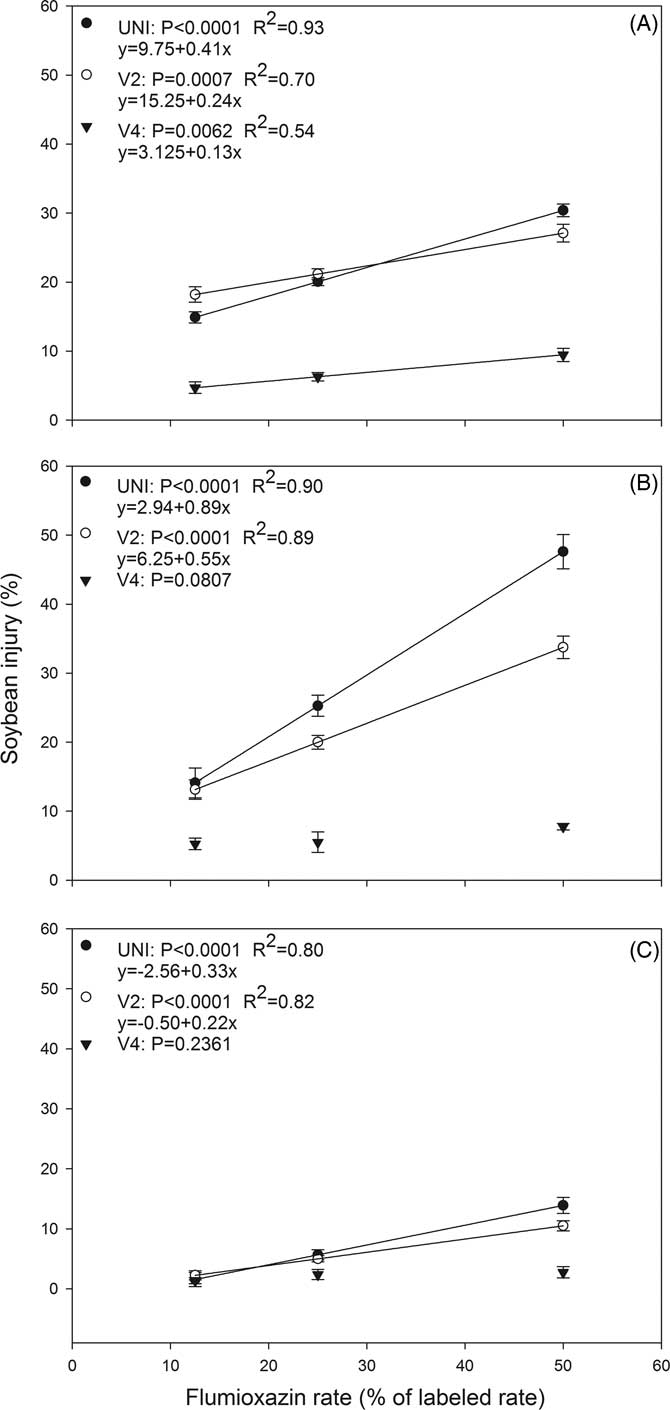
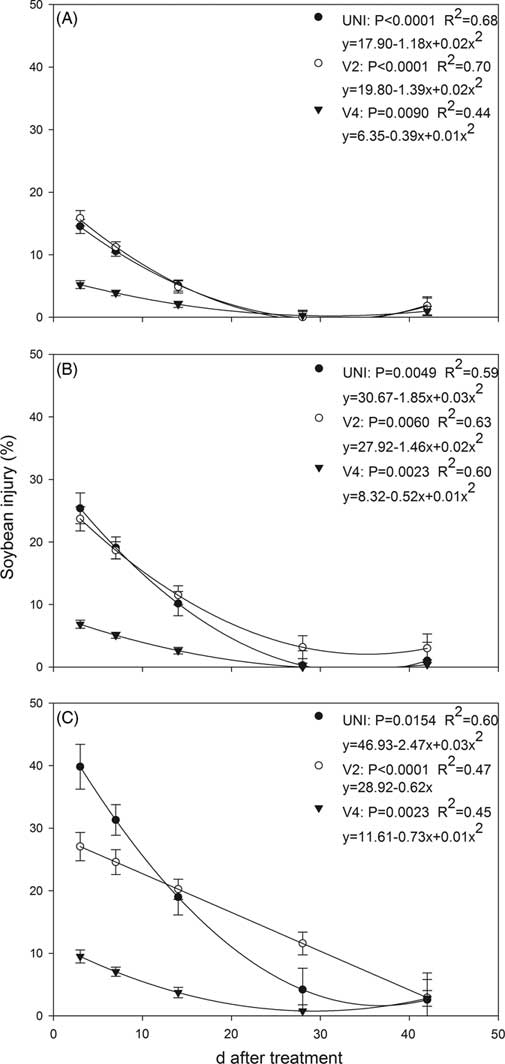
Flumioxazin injury was characterized by necrosis and visible soybean height and width reduction. Jursik et al. (Reference Jursik, Andr, Holec and Soukup2011) reported that the primary symptom of flumioxazin POST on sunflower was leaf necrosis. Injury increased with flumioxazin rate 3 DAT with unifoliate, V2, and V4 soybean injured 15% to 30%, 18% to 27%, and 5% to 8%, respectively, with little to no difference between unifoliate and V2 soybean (Figures 1A, 2A–C). Following the 12.5% rate, injury of unifoliate and V2 soybean decreased an average of 3% from 3 to 7 DAT (Figures 1A, B, 2B). However, unifoliate soybean injury increased 5% and 18% following the 25% and 50% rates, respectively, 3 to 7 DAT (Figure 1A, B). Injury of V2 soybean did not increase 3 to 7 DAT following the 25% rate but did increase 9% following the 50% rate. However, by 14 DAT, few if any differences were observed between the application timings following the 12.5% and 25% rates, with 10% or less injury (Figure 1C). Flumioxazin at 30 g ha−1 injured two-leaf or four- to six-leaf sunflower (Helianthus annuus L.) 21% to 29% or 17% to 24%, respectively, 7 DAT, but injury was ≤10% following both applications 21 to 28 DAT (Jursik et al. Reference Jursik, Andr, Holec and Soukup2011). However, Jordan et al. (Reference Jordan, Spears and Wilcut2003) found that flumioxazin POST at 50 g ha−1 injured peanut 47% 14 DAT and reduced yield 15% when applied 6 to 8 wk after emergence. The decrease in injury from 7 to 14 DAT indicates that unifoliate and V2 soybean are beginning to recover from early-season flumioxazin injury. When viewed over time (Figure 2A–C), unifoliate and V2 soybean were injured more than V4 soybean 3 to 14 DAT, but injury decreased to less than 5% at 42 DAT, which confirms that soybean can recover from low-dose flumioxazin injury. Furthermore, regardless of rate applied, V4 soybean injury was not greater than 10% at any evaluation date (Figures 1A–C, 2A–C). These data indicate that V4 soybean may be more tolerant to low-dose flumioxazin POST.
Soybean injury following low-dose flumioxazin applications applied to unifoliate (UNI), V2, and V4 soybean as a function of herbicide rate at (A) 3, (B) 7, and (C) 14 d after treatment. Sample means represent 12.5%, 25%, and 50% of the labeled use rate 72 g ai ha−1. Error bars represent ± 1 standard error.

Soybean injury following low-dose flumioxazin applied to unifoliate (UNI), V2, or V4 soybean as a function of d after treatment at (A) 12.5%, (B) 25%, and (C) 50% of the labeled use rate 72 g ai ha−1. Sample means represent 3, 7, 14, 28, and 42 d after treatment. Error bars represent ± 1 standard error.

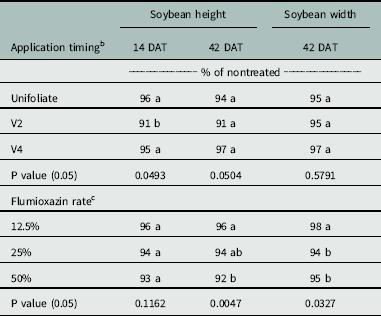
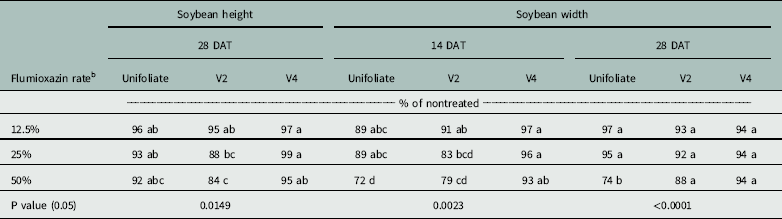
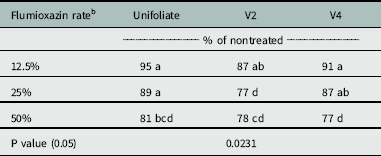
Soybean height was 96%, 91%, and 95% of the nontreated control following the unifoliate, V2, and V4 applications, with height following the V2 application less than that with the other application timings 14 DAT (Table 1). At 28 DAT, only the 25% and 50% rates reduced V2 soybean height less than 90% (Table 2), but no differences in height were observed among application timings 42 DAT (Table 1). Similarly, flumioxazin rate reduced soybean height to 96%, 94%, and 93% of the nontreated following 12.5%, 25%, and 50% flumioxazin rates 14 DAT (Table 1). However, differences in soybean height were observed between the 12.5% and 50% rates 42 DAT, with heights of 96% and 92% of the nontreated, respectively. At 42 DAT, all soybean heights were reduced ≤8%, which further indicates soybean’s ability to recover from early-season flumioxazin injury. The 50% flumioxazin rate applied to unifoliate soybean reduced width to 72% and 74% of the nontreated 14 and 28 DAT (Table 2). Furthermore, following the V2 application timing, soybean width differed between the 12.5% and 50% rates 14 DAT. Widths following the application of the 12.5% and 25% rates to unifoliate and V2 soybean 14 DAT, and all rates applied to the V2 and V4 soybean 28 DAT were 83% to 97% of the nontreated control (Table 2). At 42 DAT, no differences in soybean width were observed among application timings (95% to 97% of the nontreated), and only the 50% flumioxazin rate reduced width more than the 12.5% rate; however, width following all rates was 94% to 98% of the nontreated (Table 1). These data support injury observations and indicate that low doses of flumioxazin POST predominantly cause visible necrotic injury and width reduction, but soybean can recover.
Soybean height and width as a percent of the nontreated following low doses of flumioxazin applied to unifoliate, V2, or V4 soybean.a

a Means following soybean height 14 DAT or 42 DAT or soybean width 42 DAT for both independent variables are not different according to Tukey’s honest significant difference test at P ≤ 0.05.
b Data pooled across flumioxazin rates of 12.5%, 25%, and 50% of the labeled rate of 72 g ai ha−1.
c Data pooled across application timings of unifoliate, V2, and V4 soybean growth stages.
d Abbreviations: DAT, d after treatment.
Soybean height and width as a percent of the nontreated following low doses of flumioxazin applied to unifoliate, V2, or V4 soybean.a

a Means followed by the same letter for soybean height at 28 DAT or soybean width at 14 DAT or 28 DAT are not different according to Tukey’s honest significant difference test at P ≤ 0.05.
b Rates correspond to 12.5%, 25%, and 50% of the labeled rate of 72 g ai ha−1 of flumioxazin.
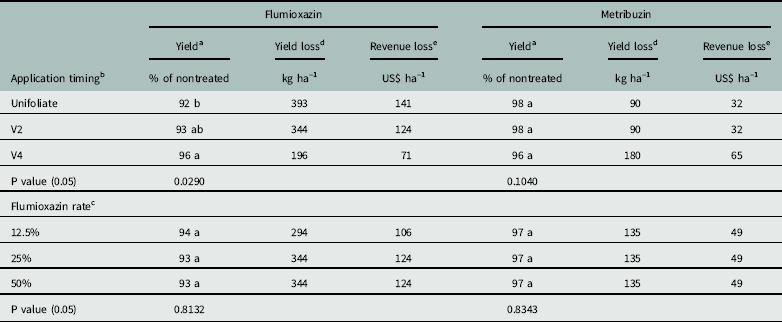
In the flumioxazin study, nontreated soybean yields were 4,908 kg ha−1. Yields were 92%, 93%, and 96% of the nontreated control following the unifoliate, V2, and V4 application timings, respectively. This resulted in a yield loss of 196 to 393 kg ha−1 and a potential revenue loss of 71 to 141 US$ ha−1 (Table 3). However, only following the unifoliate and V4 application timings was a difference observed. No differences in yield as a percent of the nontreated control were observed among flumioxazin rates, with 93% to 94% (Table 3). Although flumioxazin rates did not differ, application reduced soybean yield 294 and 344 kg ha−1, which equates to 106 and 124 US$ ha−1 loss in revenue. Soybean yield was reduced more than what was expected considering that injury, height, and width data indicated soybean can recover from early-season low-dose flumioxazin injury. Jursik et al. (Reference Jursik, Andr, Holec and Soukup2011) observed no yield reduction in sunflower following application of flumioxazin at 30 g ha−1 to two- or four- to six-leaf sunflower.
Soybean yield as a percent of the nontreated and yield and revenue loss following low doses of flumioxazin or metribuzin applied to unifoliate, V2, or V4 soybean.

a Means following soybean yield following flumioxazin or metribuzin are not different according to Tukey’s honest significant difference test at P ≤ 0.05.
b Data pooled across flumioxazin rates of 12.5%, 25%, and 50% of the labeled rate of 72 g ai ha−1.
c Data pooled across application timings of unifoliate, V2, and V4 soybean growth stages.
d Nontreated yields were 4,908 and 4,505 kg ha−1 in flumioxazin and metribuzin studies, respectively. Yield loss calculated by yield loss = nontreated yield × (100% − yield as a percent of the nontreated).
e Estimated soybean price was $0.36 kg−1 based upon USDA reported 2-yr average price received by Louisiana soybean producers. Revenue loss calculated by revenue loss = yield loss × $0.36 kg−1.
Low-Dose Metribuzin
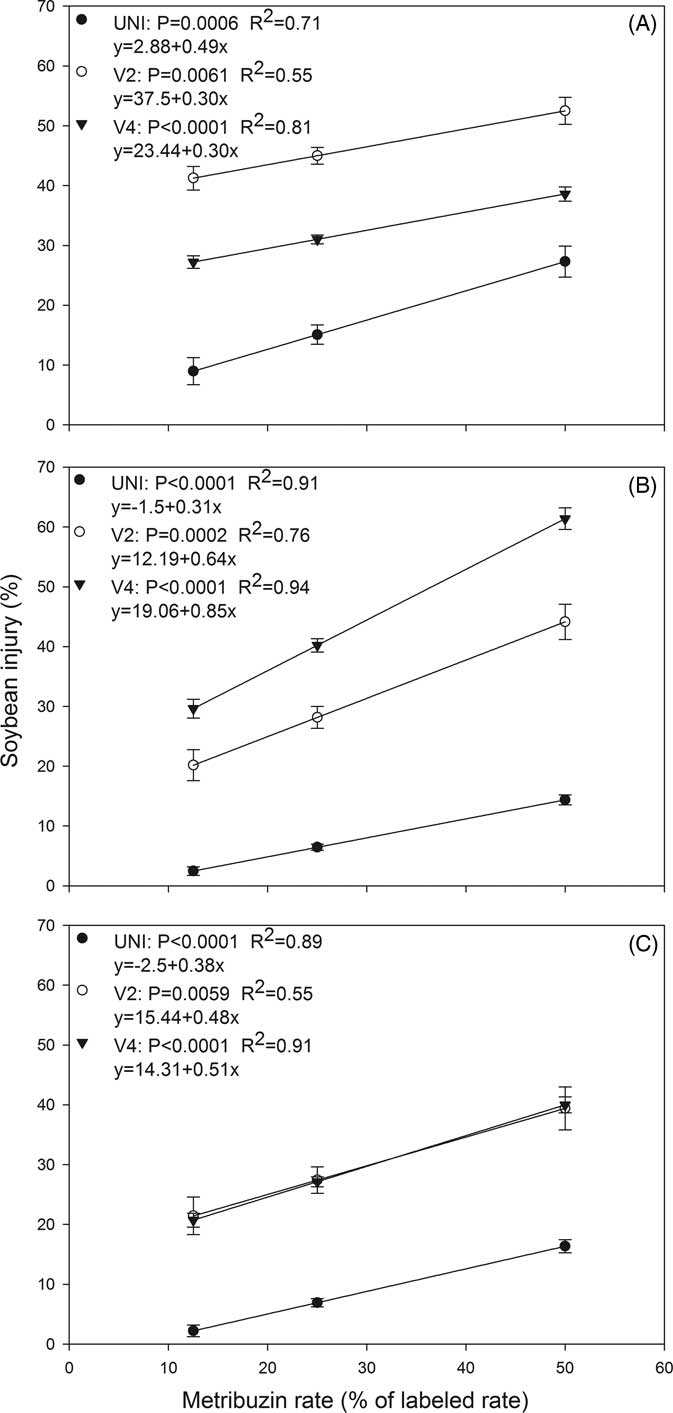
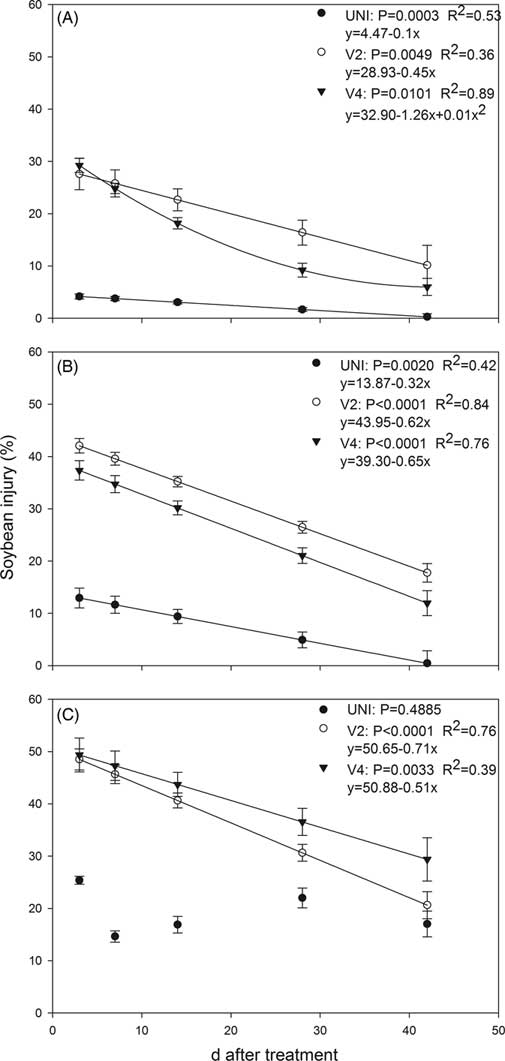
Injury was primarily chlorosis with necrosis on edges of the soybean trifoliates and a visual reduction in soybean height and width. Symptomology of metribuzin POST applied to chick pea (Cicer arietinum L.) was chlorosis or necrosis (Taran et al. Reference Taran, Holm and Banniza2013). Regardless of application timing, injury increased with rate 3, 7, and 14 DAT (Figure 3A–C). At 3 DAT, V2 soybean was injured 14% more than V4 soybean regardless of metribuzin rate (Figure 3A). However, the opposite was true 7 DAT, with V4 soybean injured 10%, 12%, and 17% more than V2 soybean following the 12.5%, 25%, and 50% rates, respectively (Figure 3B). Injury of V2 and V4 soybean differed only slightly, with injury of 21% to 40% across rates 14 DAT. Metribuzin at 140 g ha−1 injured six chick pea cultivars 0 to 45% when applied at the three- to five-node growth stage (Taran et al. Reference Taran, Holm and Banniza2013). Following the 50% metribuzin rate, V2 soybean recovered at a faster rate than V4 soybean (Figure 4C). Regardless of recovery rates, V2 and V4 soybean injury was 6% to 29% 42 DAT as compared to the unifoliate soybean at 0 to 17%, indicating that phytotoxicity or visible height reduction was still observed at the final evaluation (Figure 4A–C). These data indicate that unifoliate soybean seedlings are more tolerant to low doses of metribuzin POST than are V2 or V4 soybean plants, and more time was needed for recovery from visible injury, a result that contrasts to observations with flumioxazin.
Soybean injury following low-dose metribuzin applications applied to unifoliate (UNI), V2, and V4 soybean as a function of herbicide rate at (A) 3, (B) 7, and (C) 14 d after treatment. Sample means represent 12.5%, 25%, and 50% of the labeled use rate 316 g ai ha−1. Error bars represent ± 1 standard error.

Soybean injury following low doses of metribuzin applied to unifoliate (UNI), V2, or V4 soybean as a function of d after treatment at (A) 12.5%, (B) 25%, and (c) 50% of the labeled use rate 316 g ai ha−1. Sample means represent 3, 7, 14, 28, and 42 d after treatment. Error bars represent ± 1 standard error.

Differences in injury between unifoliate and V2 or V4 soybean may be due to the photosynthetic rate of the plant at and following the metribuzin application. Metribuzin is a photosynthesis inhibitor; thus, greater injury following the V2 and V4 applications may be due to greater total photosynthesis of soybean with multiple trifoliates compared to a unifoliate soybean. Sinclair (Reference Sinclair2004) found that both leaf and whole-plant photosynthetic rates will increase as the amount of photosynthetic apparatus increases. Therefore, whole-plant photosynthesis would increase with increasing vegetative development.
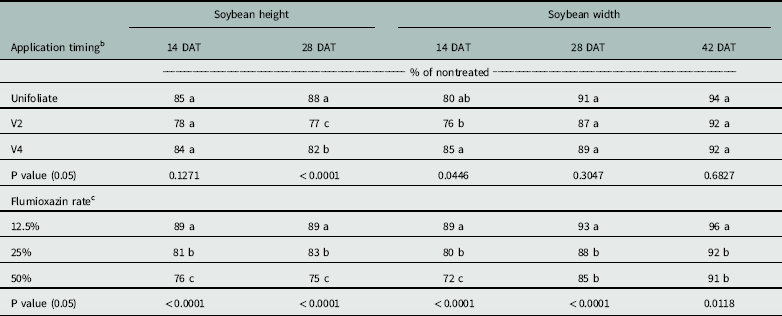
Soybean heights among application timings were 78% to 85% of the nontreated control 14 DAT and did not differ (Table 4). However, following the unifoliate, V2, and V4 application timings 28 DAT, heights were 88%, 77%, and 82% of the nontreated, respectively, with differences among all timings. In addition, height was inversely related to metribuzin rate 14 and 28 DAT. Soybean height of 9% to 23% of the nontreated 42 DAT supports slow recovery from low-dose metribuzin POST injury (Table 5). Soybean width was 80%, 76%, and 85% of the nontreated following the unifoliate, V2, and V4 applications, respectively, with differences between the V2 and V4 applications (Table 4). Like height, width reduction in soybean was greater as metribuzin rate increased 14 DAT, but width was similar among the 25% and 50% rates 28 and 42 DAT (Table 4). Both height and width data support injury observations and indicate that low doses of metribuzin are more detrimental to V2 and V4 soybean.
Soybean height 14 and 42 d after treatment (DAT) and width 14, 28, and 42 DAT as a percent of the nontreated following low doses of metribuzin applied to unifoliate, V2, or V4 soybean.a

a Means following soybean height 14 DAT or 28 DAT or soybean width 14, 28, or 42 DAT for both independent variables are not different according to Tukey’s honest significant difference test at P ≤ 0.05.
b Data pooled across flumioxazin rates of 12.5%, 25%, and 50% of the labeled rate of 316 g ai ha−1.
c Data pooled across application timings of unifoliate, V2, and V4 soybean growth stages.
Soybean height as a percent of the nontreated 42 d after treatment following low doses of metribuzin applied to unifoliate, V2, and V4 soybean.a

a Means followed by the same letter are not different according to Tukey’s honest significant difference test at P ≤ 0.05.
b Rates correspond to 12.5%, 25%, and 50% of the labeled rate of 72 g ai ha−1 of flumioxazin.
Neither application timing nor metribuzin rate influenced soybean yield, with yields of 96% to 98% of the nontreated (Table 3). This finding is in contrast to injury data, where V2 and V4 soybean injury ranged from approximately 27% to 50% 3 DAT and 9% to 30% 42 DAT (Figure 3A–C). In addition, soybean height and width was influenced by application timing and metribuzin rate (Tables 4 and 5). Although injury, height, and width data do not explain the lack of yield differences, yields ≥96% indicate that soybean can recover from early-season low-dose metribuzin POST injury. However, soybean yields were reduced 2% to 4% compared to the nontreated control. Nontreated soybean yield was 4,505 kg ha−1 in the metribuzin study. Therefore, yield losses of 90 to 180 kg ha−1 were observed, which would lead to a revenue loss of 32 to 65 US$ ha−1 for a producer (Table 3).
Low doses of flumioxazin and metribuzin POST can injure soybean and reduce soybean height, width, and yield. More injury was observed when flumioxazin was applied to unifoliate and V2 soybean and as flumioxazin rate increased, but injury diminished over time—indicating that soybean is able to recover from early-season injury. This is supported by soybean height and width data. However, soybean yield loss was in contrast with injury, height, and width observations, indicating that low doses of flumioxazin can limit yield and reduce revenue. Injury following low doses of metribuzin was greatest when applied to V2 and V4 soybean, with injury increasing with rate and injury symptoms persisting over time. Soybean height and width data support the slower recovery time following metribuzin application. Low doses of flumioxazin and metribuzin POST can have negative effects on soybean growth and yield, and could potentially cause economic loss for a soybean producer.
Acknowledgments
The authors would like to thank the Louisiana Soybean and Feed Grain Research and Promotion Board for partial funding of this research. In addition, we thank the support staff at the Louisiana State University Agricultural Center Dean Lee Research and Extension Center for their help with this research. No conflicts of interest have been declared. Approved for publication as journal no. 2018-263-33361 of the Louisiana State University Agricultural Center.