In their recent article, Hamamatsu et al. (Reference Hamamatsu, Inoue, Watanabe and Umezaki2014) considered three indicators of demographic change following the East Japan Earthquake disaster in 2011: birth rate, marriage rate and the secondary sex ratio (SSR). They found decreases in all three indicators. Their useful and timely analysis offers several socially based explanations for these changes. However, these changes may also be understood in terms of the underlying biological factors that promote reproduction in stochastic environments.
Sex ratio
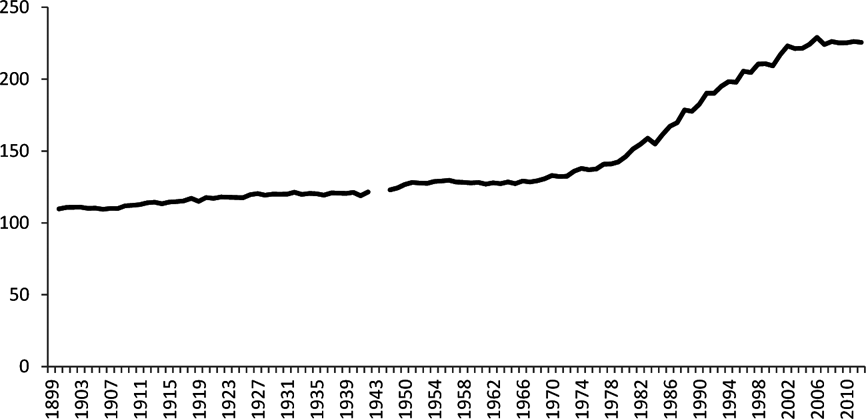
The decline in the Japanese SSR suggests increased male fetal loss or decreased male conceptions (Ellison, Reference Ellison2001; Catalano & Bruckner, Reference Catalano and Bruckner2006). From an evolutionary perspective, males offer a lesser chance of survival and are therefore subject to greater loss because they do not maximize the mother's investment in a stochastic environment (Helle et al., Reference Helle, Helama and Lertola2009). Changes to the Japanese SSR are particularly notable due to unusual underlying patterns in the fetal death sex ratio. Japan's fetal death sex ratio has increased substantially since the early 1970s (Statistics Bureau of Japan, 2012), as shown in Fig. 1.
Sex ratio of fetal deaths in Japan between 1899 and 2011.

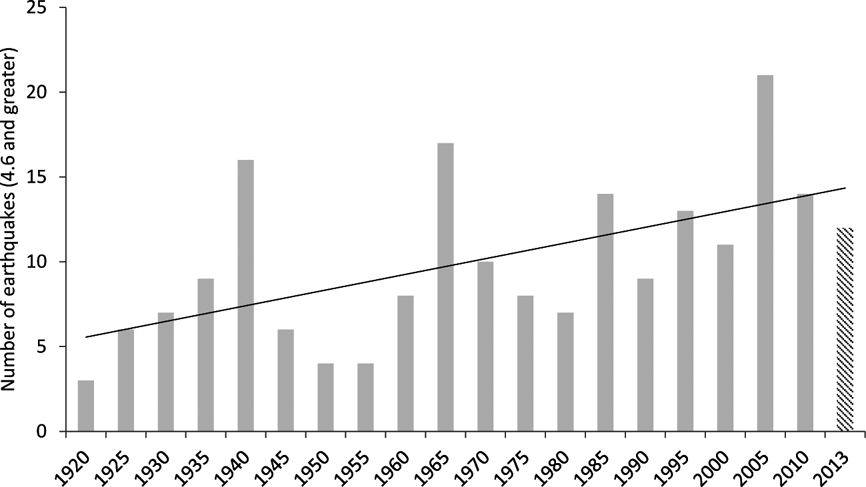
Factors such as reproductive technology and maternal age appear unrelated to this effect (Mizuno, Reference Mizuno2000). One possible influence is prenatal stress arising from the increasing frequency of Japanese earthquakes. Figure 2 shows earthquake frequency between 1920 and 2013 with a linear trend-line shown in black (noting that 2013 represents an incomplete 5-year data range) (National Geophysical Data Center, 2014).
Earthquake events above Richter scale 4.6 in Japan between 1920 and 2013 in 5-year groups.
Potentially the increase in male fetal loss reflects the cumulative impacts of successive earthquake exposure. We will study the possible relationship between earthquake frequency and fetal loss in future research.
Marriage
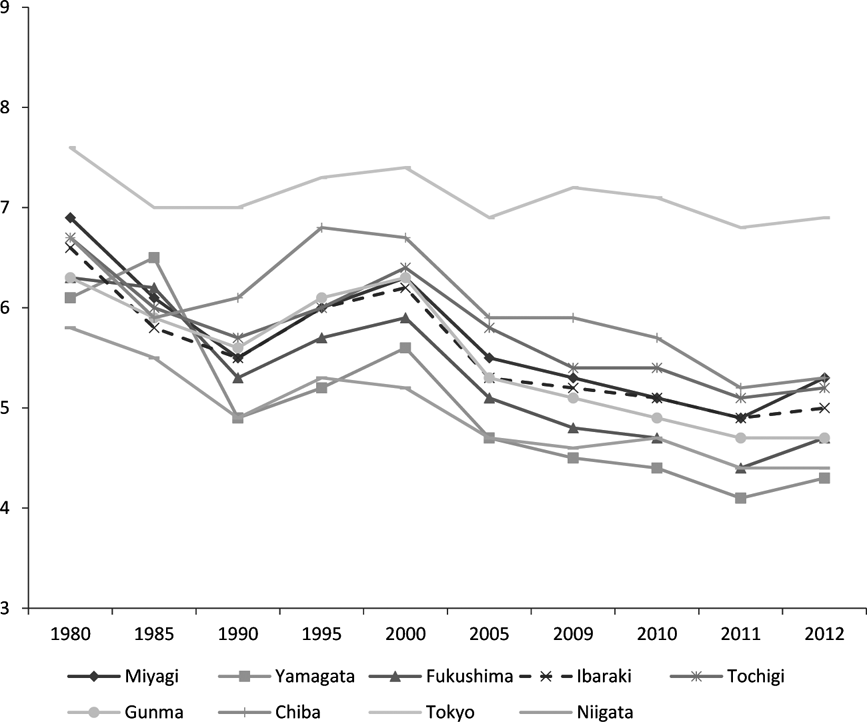
Evolutionary theory predicts that when people encounter life-threatening situations this should increase their instinctive desire to reproduce, thus maximizing the chances of their genetic continuation (Chisholm, Reference Chisholm1999). Hamamatsu et al. (Reference Hamamatsu, Inoue, Watanabe and Umezaki2014) did not find such an effect. However, more recent data show a small increase in marriage rates over the remainder of 2012 (Fig. 3). It is too early to determine whether this pattern is significant but it may indicate a delayed demographic response rather than an absent one.
Yearly marriage rates per 1000 head of population for Fukushima prefecture, its immediate neighbouring prefectures, as well as Tokyo and Chiba prefectures, between 1980 and 2012.
Conclusion
The change in Japan's SSR accords with predictions and probably shows an adaptive response to the actuality or perception of a dangerous environment. It is possible that the frequency of disasters in Japan is now sufficient that the fetal death ratio shows disruption over the longer term. In terms of marriage rates, if these continue to rise, they may reflect underlying biological impulses related to increasing reproduction in response to threat.