Introduction
A total of 98 countries on five continents are endemic for leishmaniasis with 350 million people at risk and annual estimates of 0.3 million cases of visceral leishmaniasis (VL) and 1 million cases of cutaneous leishmaniasis (CL). VL is the most severe form, fatal if not treated, with about 20 000–50 000 deaths each year (WHO, 2015). Treatment of VL is based on chemotherapy, but available drugs present severe side-effects. Frontline treatment relies on pentavalent antimonials and also on amphotericin B. Miltefosine was the first oral drug to treat VL but its use is limited due to its known teratogenic effects and to selection of resistance (Croft and Olliaro, Reference Croft and Olliaro2011).
The causative agents of leishmaniasis are protozoan parasites of the genus Leishmania, transmitted by different sand fly species. VL is caused, with few exceptions, by two species belonging to the Leishmania donovani complex, Leishmania donovani and Leishmania infantum. The transmission of the first species is mainly anthroponotic, whereas the transmission of the latter is zoonotic with a variety of canids known to serve as animal reservoirs and the domestic dog as the main reservoir host (Millan et al., Reference Millan, Ferroglio and Solano-Gallego2014; Ready, Reference Ready2014; Akhoundi et al., Reference Akhoundi, Kuhls, Cannet, Votypka, Marty, Delaunay and Sereno2016).
Conventional VL diagnosis is performed by parasitological methods as visualization of Leishmania parasites by microscopy in Giemsa-stained smears of bone marrow, lymph node or spleen aspirates or setting up parasite cultures from bone marrow aspirates or buffy coat. Other approaches are based on serology and the mostly used methods are the immunofluorescence antibody test (IFAT), the enzyme-linked immunosorbent assay (ELISA), the direct agglutination test (DAT) and the immunochromatographic strip test (rK39) (WHO, 2010). The serological tests have the limitation that they cannot distinguish between current, subclinical and past infections. The most powerful diagnostic tools in terms of sensitivity and specificity are polymerase chain reaction (PCR)-based methods however, they are restricted to research centres and specialized laboratories (Akhoundi et al., Reference Akhoundi, Downing, Votypka, Kuhls, Lukes, Cannet, Ravel, Marty, Delaunay, Kasbari, Granouillac, Gradoni and Sereno2017). They are superior to serological methods, as well as microscopy or culture, especially for samples with low parasitic loads and they can be performed on peripheral blood, sampling of which is less invasive than biopsies.
Historical overview of Leishmaniasis in Armenia
VL was well-known to the physicians in the Imperial Russia who worked in the Caucasus region and in Central Asia since the mid of the 19th century. In the time of the Soviet Union the aetiology, pathogenesis and epidemiology of this disease was intensively studied by famous local researchers who made many important conclusions on the biology of the causative agents and vectors as well as the transmission cycles. After the dissolution of the Soviet Union in 1991, VL received less attention and the new independent republics had to readjust their medical and public health services (Strelkova et al., Reference Strelkova, Ponirovsky, Morozov, Zhirenkina, Razakov, Kovalenko, Schnur and Schonian2015). Zoonotic VL currently occurs in many former Soviet Union countries such as in Georgia, Azerbaijan, Tajikistan and Uzbekistan being a serious public health concern (Kovalenko et al., Reference Kovalenko, Razakov, Ponirovsky, Warburg, Nasyrova, Ponomareva, Fatullaeva, Nasereddin, Klement, Alam, Schnur, Jaffe, Schonian and Baneth2011; Alvar et al., Reference Alvar, Velez, Bern, Herrero, Desjeux, Cano, Jannin and den Boer2012; Babuadze et al., Reference Babuadze, Alvar, Argaw, de Koning, Iosava, Kekelidze, Tsertsvadze, Tsereteli, Chakhunashvili, Mamatsashvili, Beria, Kalandadze, Ejov and Imnadze2014; Strelkova et al., Reference Strelkova, Ponirovsky, Morozov, Zhirenkina, Razakov, Kovalenko, Schnur and Schonian2015).
Leishmaniasis historically holds a special place in infectious pathologies of Armenia, however, most historical and present publications are in Russian or Armenian and therefore not accessible for the majority of international scientists and clinicians. Only a single information in English on VL in Armenia can be found in a recent review (Strelkova et al., Reference Strelkova, Ponirovsky, Morozov, Zhirenkina, Razakov, Kovalenko, Schnur and Schonian2015). In the past both VL and CL were recorded in Armenia. Interestingly, the first detailed description of the organism causing oriental sores (later named Leishmania tropica) by the American pathologist J. H. Wright in 1903 was based on clinical material isolated from sores of an Armenian girl that came to America (Wright, Reference Wright1903; Steverding, Reference Steverding2017). Anthroponotic CL (ACL) was registered for the first time in 1920 in the Shirak district at the north-western border of the country (Isahakyan, Reference Isahakyan1924). According to historical data a total of 135 CL cases were recorded between 1938 and 1970, mainly in the cities Kapan and Goris (Mirzoyan, Reference Mirzoyan1941; Pirumov, Reference Pirumov1957; Karagezian, Reference Karagezian1966). By the mid-1960s by combining treatment of patients and insecticidal treatment in the cities with ACL, almost complete elimination of this form of leishmaniasis was achieved. Zoonotic CL was never recorded in Transcaucasia. Since 1999 neither local nor imported cases of CL were detected.
VL was registered for the first time in the Southern Caucasus region (Georgia, Armenia and Azerbaijan) in 1912/13 in four children including a girl from Yerevan (Gurko, Reference Gurko1913). The second report about VL in Armenia in a 6-years-old girl was published in 1925 (Gishgorn, Reference Gishgorn1925). Since that time many cases were found predominantly in children under the age of 13 years, with almost half of the cases occurring in 1–2 years old children. The first adult case was detected in 1947 in a 23-years-old woman (Karapetyan, Reference Karapetyan1949), and only two more cases occurred in adults until 1959. Between 1926 and 1969 a total of 919 VL cases were registered in 62 villages from 16 districts of the country. The most active focus was Yerevan with 81.1% of the cases (Karapetyan, Reference Karapetyan1972). Especially in the early 1950s the number of VL cases increased not only in Armenia, but also in other Southern Caucasus countries, most probably because of new human settlements in former rural regions. Phlebotomus kandelaki and Phlebotomus balcanicus, widely distributed in regions between 400 and 700 m, were identified as potential vectors for L. infantum in the Caucasus region including Armenia (Saladze, Reference Saladze1964; Karapetyan and Baghdasaryan, Reference Karapetyan and Baghdasaryan1972; Dergacheva and Oganesian, Reference Dergacheva and Oganesian1987; Darchenkova and Dergacheva, Reference Darchenkova and Dergacheva1989; Baranets et al., Reference Baranets, Darchenkova, Ponirovskii and Zhirenkina2011). Evidence of Ph. kandelaki and Ph. balcanicus infected by L. infantum was provided for the first time only recently in 2012 by the use of PCR-based methods for sand flies from Georgia (Giorgobiani et al., Reference Giorgobiani, Lawyer, Babuadze, Dolidze, Jochim, Tskhvaradze, Kikaleishvili and Kamhawi2012).
In the first reservoir study in Armenia that was carried out in 1920 three dogs from Yerevan were found to be infected (Mamikonyan, Reference Mamikonyan1935). Later a high number of sick dogs was registered in Yerevan, as well as in five other districts (Mamikonyan, Reference Mamikonyan1935). Further surveys were carried out between 1954 and 1970 with a total of 4109 examined animals (e.g. dogs, cats, foxes, wolves and rodents) and 3.8% of the dogs were found to be infected with Leishmania sp. All the infected dogs originated from localities with human VL cases. According to these and other studies, the main wild reservoirs of VL in Armenia were foxes, jackals and wolves (Karapetyan and Baghdasaryan, Reference Karapetyan and Baghdasaryan1970, Reference Karapetyan and Baghdasaryan1972). Although the parasites were not definitely identified to the species level, clinical and epidemiological data suggested that it was L. infantum (Karapetyan et al., Reference Karapetyan, Petrosyan, Mnatsakanyan and Avetisyan1960; Karapetyan and Baghdasaryan, Reference Karapetyan and Baghdasaryan1972).
Since the mid-1950s and in the 1960s the number of VL cases was significantly reduced in the USSR as a result of wide-scale implementation of activities on trapping and culling sick dogs as well as conducting massive spraying campaigns for malaria control with significant reduction of sand fly populations (Isaev and Ryabtsev, Reference Isaev and Ryabtsev1958; Isaev, Reference Isaev1959). Specifically in Armenia there was a control program conducted in 1954/55 in the city of Yerevan that reduced significantly the morbidity from VL (Karapetyan et al., Reference Karapetyan, Petrosyan, Mnatsakanyan and Avetisyan1960). As a result of further control measures between 1954 and 1969 the number of VL cases continuously decreased (1953 till 1955 −73, 50, 39 cases, respectively; 1964 – two cases; 1967 and 1968 one case per year) with the last registered case in 1969 (Karapetyan et al., Reference Karapetyan, Vopyan and Mnatsakanyan1970).
Re-emergence of the disease
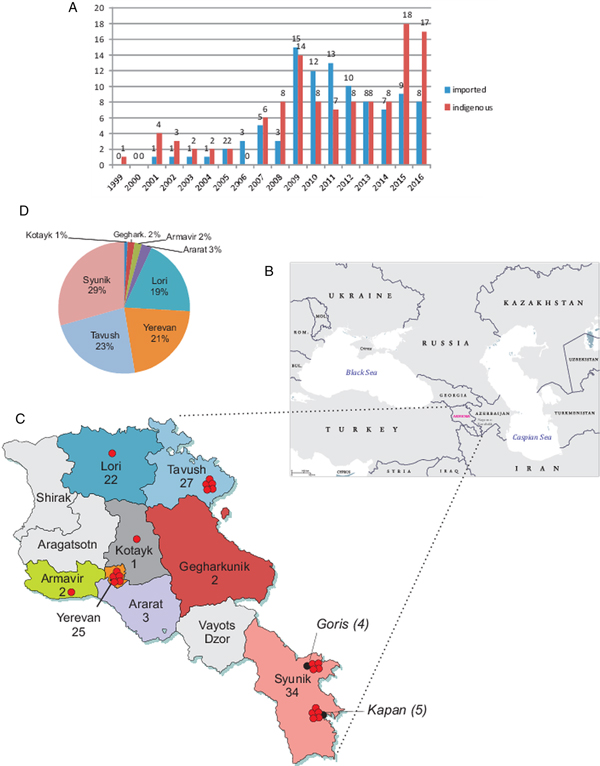
In 1999, after a long period without any notification, a VL case was diagnosed in a 4-years-old child from the village Shnogh in the Lori district. Between 1999 and 2016, 116 indigenous and 99 imported cases of VL were recorded in the country mainly in the districts Syunik, Tavush, Lori and Yerevan (Paronyan et al., Reference Paronyan, Apresyan, Galstyan, Keshishyan and Vanyan2015; Sukiasyan et al., Reference Sukiasyan, Keshishyan, Manukyan, Malik-Andreasyan, Atshemyan, Frohme, Cortes and Kuhls2017) (Fig. 1), some of them were included in the present study. According to entomological monitoring during this time period an increase in vector populations of Ph. balcanicus, Ph. kandelaki and Ph. papatasi was observed, particularly in the capital Yerevan, but also in the Ararat valley, Lori and Syunik districts (Keshishyan and Manukyan, Reference Keshishyan and Manukyan2003). In the Republic of Nagorno-Karabakh 82 cases of VL were registered between 2004 and 2013, mainly in Kashatagh, Hadrut and Stepanakert, of which 90.2% were children under 14-years-old (Keshishyan et al., Reference Keshishyan, Grigoryan, Manukyan and Hovsepyan2013a). Until now there was no case of Leishmania/HIV co-infection in Armenia (unpublished data). Treatment for VL patients is free with meglumine antimoniate (Glucantime®).
(A) Number of indigenous and imported cases of visceral leishmaniasis in Armenia per year in the period 1999–2016. In total 116 indigenous and 99 imported VL cases were recorded. (B) Map of the Southern Caucasus region with Armenia and the bordering countries. (C) Map showing the distribution of the 116 indigenous cases in the affected districts of the country (black numbers). Red dots indicate the studied 22 cases of visceral leishmaniasis from the time period 2012–16 in Armenia. (D) Percentage per district relative to the total number of 116 indigenous VL cases in the country.
The current trend of increasing numbers of VL is being observed in different countries of the Southern Caucasus, especially in Georgia and Azerbaijan. In the last two decades, the annual number of clinical VL cases in Georgia has remained persistently high, and varies between 122 and 189 (Babuadze et al., Reference Babuadze, Alvar, Argaw, de Koning, Iosava, Kekelidze, Tsertsvadze, Tsereteli, Chakhunashvili, Mamatsashvili, Beria, Kalandadze, Ejov and Imnadze2014). Also in Azerbaijan the estimated annual incidence of VL is high, ranging from 60 to 110 cases (Alvar et al., Reference Alvar, Velez, Bern, Herrero, Desjeux, Cano, Jannin and den Boer2012; Strelkova et al., Reference Strelkova, Ponirovsky, Morozov, Zhirenkina, Razakov, Kovalenko, Schnur and Schonian2015). Nevertheless, underreporting is suspected especially in Armenia and Azerbaijan, because of low awareness among the local population and physicians, lack of leishmaniasis diagnosis training programs for medical personnel and frequent misdiagnosis.
Diagnostic methods in use
Presently, all suspected VL cases are reported to and all diagnostic examinations are carried out in the Research Institute of Epidemiology, Virology and Medical Parasitology named after A.B. Alexanyan, Ministry of Health, Yerevan and the Reference Laboratory Center of the National Center for Disease Control and Prevention in Yerevan. Diagnosis of VL in Armenia was based, until the start of this study in 2015, exclusively on the clinical picture and the demonstration of parasites in Giemsa-stained smears from bone marrow aspirates by microscopic examination. Only from 2015 on serological tests as ELISA and rK39 were continuously implemented. Also setting up cultures from clinical material was not possible. The reasons of that was the lack of qualified personnel trained in modern diagnostic methods as well as of reference laboratories with the necessary equipment. Microscopy and serology however present limitations in terms of sensitivity and specificity. Since endemic foci of VL are re-emerging in Armenia after a long hiatus, there is a need of early, fast and reliable detection of infections. PCR-based methods are commonly used for diagnostic purposes (Akhoundi et al., Reference Akhoundi, Downing, Votypka, Kuhls, Lukes, Cannet, Ravel, Marty, Delaunay, Kasbari, Granouillac, Gradoni and Sereno2017), as they are highly sensitive and specific and molecular typing allows species identification and discrimination of Leishmania at strain level, depending on the markers used and many key epidemiological questions can be addressed (Schonian et al., Reference Schonian, Kuhls and Mauricio2011; Akhoundi et al., Reference Akhoundi, Downing, Votypka, Kuhls, Lukes, Cannet, Ravel, Marty, Delaunay, Kasbari, Granouillac, Gradoni and Sereno2017). The aim of the present work was the implementation of molecular methods for diagnosis of VL in Armenia and to enable the identification of the causative Leishmania species.
Material and methods
Study area, human cases, samples and conventional diagnosis
Retrospective data on case numbers and geographical distribution of cases presented in Fig. 1 are based on the notifications to the Research Institute of Epidemiology, Virology and Medical Parasitology named after A.B. Alexanyan, Ministry of Health, Yerevan. Diagnosis was performed initially on the basis of clinical observations. Bone marrow aspirates were collected from all patients and Giemsa-stained smear slides were prepared for further diagnosis. All slides were analyzed for the presence of amastigotes at 400x and 1000x magnification. Epidemiological data, information about travel histories as well as clinical characteristics were collected from all patients. Cases were considered as indigenous if the patient did not leave Armenia for 1–2 years. If the patients did not live in Armenia for several years and in the nearest epidemic season, the cases were classified as imported ones. Occurrence of putative vectors and of reservoirs in the localities of residence of the patients was examined. VL positive patients were treated with Glucantime or Amphotericin B.
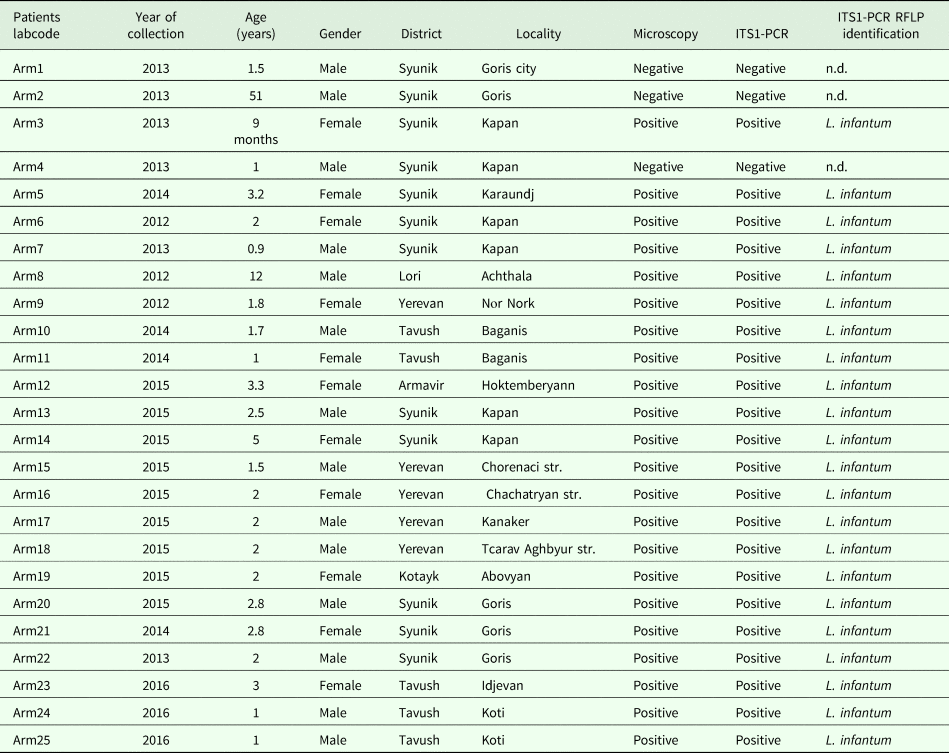
Between 2012 and 2016, all clinically suspected VL patients were hospitalized in the Infectious Clinical Hospital ‘Nork’ in Yerevan, 25 of which were included in this study in which molecular methods for diagnosis were applied. Out of these 25 patients, 14 were male and 11 female with an age range between 1 and 12 years (with the exception of a 51-years-old adult). They came from the districts Syunik, Lori, Tavush, Yerevan, Armavir and Kotayk and did not travel to other countries (Fig. 1C, Table 1). The same slides examined by microscopy were used for DNA extraction.
Designation, characteristics, origin and diagnostic results of the Armenian samples studied

DNA extraction and PCR amplification
DNA was extracted from stained slides as described elsewhere (Meredith et al., Reference Meredith, Zijlstra, Schoone, Kroon, van Eys, Schaeffer, el-Hassan and Lawyer1993; Schonian et al., Reference Schonian, Schweynoch, Zlateva, Oskam, Kroon, Graser and Presber1996). An additional purification step to avoid inhibition was carried out for all clinical samples by using a DNA purification kit (Qiagen). DNA was stored at −20 °C.
The internal transcribed spacer 1 (ITS1) of the ribosomal DNA was amplified by PCR with primers LITSR and L5.8S (el Tai et al., Reference el Tai, Osman, el Fari, Presber and Schonian2000) including negative, positive and inhibition controls. Negative controls were carried out by using ddH2O instead of DNA. In addition negative preparation controls were performed. For inhibition controls DNA (the same amount as for positive control) of L. turanica (IPAP/TM/1991/M87) extracted from culture was added together with the DNA of the analyzed clinical sample. For positive controls DNA of the following WHO reference strains was used: L. infantum MHOM/ES/1993/PM1, L. major MHOM/SU/1973/5ASKH and L. tropica MHOM/SU/1974/SAF-K27. PCR amplification was carried out as described previously, using 10 ng of DNA of the reference strains or 2 µL of extracted DNA from clinical samples (el Tai et al., Reference el Tai, Osman, el Fari, Presber and Schonian2000; Schonian et al., Reference Schonian, Nasereddin, Dinse, Schweynoch, Schallig, Presber and Jaffe2003). PCR products were subjected to electrophoresis in 2% agarose gels with DNA Stain G (Serva, Germany) in 1x TAE buffer and visualized under ultraviolet light.
Restriction fragment length polymorphism (RFLP) and sequence analysis
In order to identify Leishmania species, RFLP was performed according to Schönian et al. (Schonian et al., Reference Schonian, Nasereddin, Dinse, Schweynoch, Schallig, Presber and Jaffe2003). Depending on band intensity of the respective PCR product in control electrophoresis 10–20 µL of amplified ITS1 PCR products were digested with 10 U of HaeIII at 37 °C for 2 h as recommended by the supplier (New England BioLabs Inc., UK). The digested fragments were subjected to electrophoresis in 3.5% Metaphor agarose gels (Sigma-Aldrich, Germany) with DNA Stain G in 1x TBE buffer and visualized as previously. The above mentioned strains of L. infantum, L. major and L. tropica were used as references and pUC19 (Thermo Fisher Scientific, UK) was used as molecular size standard. The amplified fragments obtained by ITS1-PCR of two of the clinical samples were sequenced (SMB Services in Molecular Biology GmbH, Germany) by using an ABI3130XL sequencer (Applied Biosystems, USA). Sequences were submitted to GenBank (accession numbers LT576161, LT576162).
Results
Since re-emergence in 1999 the number of VL cases is increasing in Armenia. Figure 1A shows the number of indigenous and imported cases per year for the period 1999–2016, notified to the Research Institute of Epidemiology, Virology and Medical Parasitology named after A.B. Alexanyan, Ministry of Health, Yerevan. In total 215 VL cases were registered in this time period (Fig. 1A) – 116 indigenous cases without any travel history outside Armenia and 99 imported VL cases, all originating from Nagorno-Karabakh. The local cases of VL were registered in 8 of the 11 districts of Armenia, mainly in the northern districts Lori (19%), and Tavush (23%), in the southern district Syunik (29%) and in Yerevan (22%) (Fig. 1C). The infective season starts in April with the occurrence of the sand flies and ends in September/October. The seasonal quantitative dynamics of sand flies varies in the different regions of the country. The occurrence of putative vectors and of reservoirs in the localities of residence of the patients has been proven. The epidemic season (highest numbers of cases) can be observed between December till March.
Among the 116 local patients 43 (37.1%) were female, and 73 (62.9%) male. The age distribution among these patients was as follows: 86 (74.1%) were children up to 3-years-old, 26 (22.4%) children between 3 and 10 years-old and 4 (3.4%) were adults in the age of 21, 24, 51 and 54 years. Main clinical symptoms of the 116 indigenous patients were general weakness (100%), pallor (100%), splenomegaly (100%), hepatomegaly (98%), fever (94%), lymphadenopathy (86%), hemorrhagic rash (22%), bleeding (22%), sleep disorder (20%) and consciousness disorder (14%). The following laboratory data were collected at the time of admission: anemia 100%, Hb mean value 71.68 (g L−1), leukopenia 70%, mean value 2.82 (109 L−1), thrombocytopenia 82%, mean value 74 (109 L−1). Pentavalent antimonials (Glucantime) received 95% of the patients, amphotericin B 5%. The majority of patients recovered and three died. Relapses were observed in three cases, which were treated successfully. All imported cases were also successfully treated, and 76% of the patients were children up to 3-years-old and 34% were in the age of 3–10 years. The gender ratio was 61% males and 39% females.
Bone marrow samples of 25 VL suspected patients were collected between 2012 and 2016 (Table 1). Twenty-two out of the 25 samples were positive by microscopy, presenting different parasitic loads from highly infected samples till samples with very few parasites. In addition, Leishmania DNA was detected by ITS1-PCR in the same 22 bone marrow samples, showing a ~320 bp fragment. Inhibition of amplification for the three PCR-negative samples was excluded by inhibition controls. Contamination during DNA preparation or PCR was excluded since no products were observed in the negative controls. Concerning age distribution and gender, most cases were observed in children up to 3-years-old (n = 18) in an equal gender ratio.
Figure 1C shows the origin and number of studied positive VL cases in Armenia. Most cases were found in the districts Yerevan (5), Syunik (12) and Tavush (5) showing a trend of rather urban occurrence of VL, as the cases were found in large cities from these districts as Yerevan and Kapan.
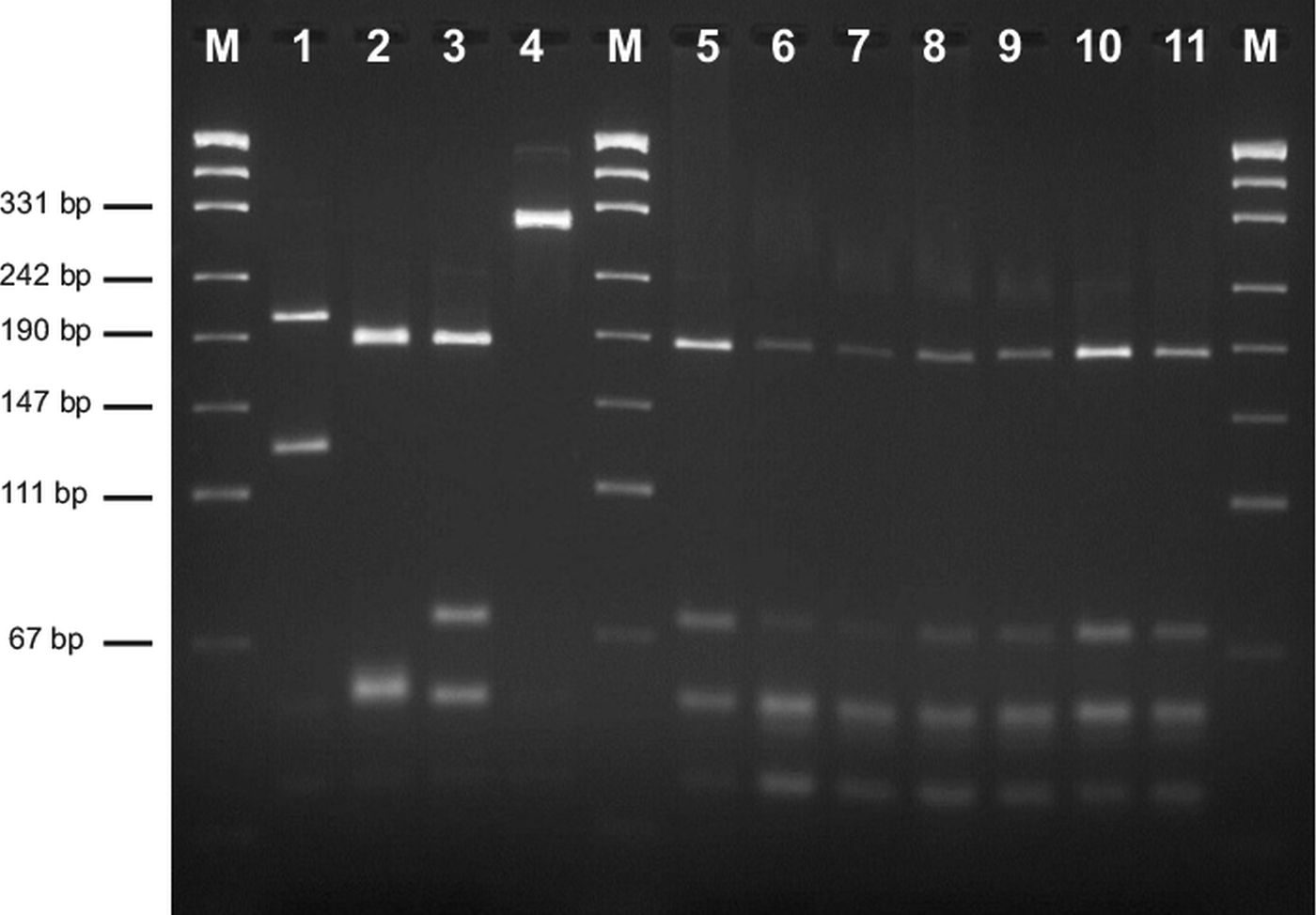
The causative agent, identified by RFLP of the ITS1-PCR product of the positive samples was L. infantum (Fig. 2). The sizes of the restriction products were identical for all clinical samples (184, 72, 55 bp). They correspond to those observed for the L. infantum reference strain and are different from those of the L. donovani reference strain (164, 75, 54 bp) described previously (Schonian et al., Reference Schonian, Nasereddin, Dinse, Schweynoch, Schallig, Presber and Jaffe2003). Since a metaphor agarose gel was applied the size difference of 20 bp in the largest fragment between L. infantum and L. donovani would be detectable and L. donovani therefore can be excluded. The ITS1 fragments of samples Arm11 (LT576161) and Arm17 (LT576162) were sequenced and showed 100% homology to previously sequenced L. infantum reference strains (Kuhls et al., Reference Kuhls, Mauricio, Pratlong, Presber and Schonian2005). Additional sequencing of the ITS1 region of all L. infantum samples was not useful, since according to published data and own comprehensive experiments there is no variability in this target for L. infantum.
ITS1-PCR-RFLP with HaeIII of reference strains and representative clinical samples of the Armenian studied cases. M, pUC19 DNA size marker; 1–3, WHO-reference strains: 1, L. major MHOM/SU/1973/5ASKH; 2, L. tropica MHOM/SU/1974/SAF-K27; 3, L. infantum MHOM/ES/1993/PM1; 4, ITS1 undigested clinical sample; 5, Arm8; 6, Arm3; 7, Arm5; 8, Arm6; 9, Arm7; 10, Arm9; 11, Arm10

Discussion
In the past both VL and CL cases were recorded in Armenia, but since 1969 no case was registered until 1999. Presently, due to re-emergence of VL in Armenia, this disease became a major and on-going problem. Diagnosis of VL was based in Armenia until this study only on the clinical picture and conventional microscopy of bone marrow aspirates and the causative agent has not been identified before to the species level. In the present study 25 clinically suspected VL cases were studied applying for the first time molecular diagnosis. In 22 of the 25 samples Leishmania DNA could be detected, showing that molecular approaches can be a reliable and sensitive method for Leishmania detection in Armenian settings. Moreover, the application of molecular methods allowed for the first time the identification of the causative agent of VL in Armenia at species level as L. infantum.
Similar trends and patterns of re-emergence and increase of incidence are currently observed in the whole Southern Caucasus region. Especially in Georgia there is a dramatic increase of VL cases in the last decade with 1919 registered cases from 1995 till 2010 and very high observed seroprevalences in pet and stray dogs as well as in humans (Babuadze et al., Reference Babuadze, Alvar, Argaw, de Koning, Iosava, Kekelidze, Tsertsvadze, Tsereteli, Chakhunashvili, Mamatsashvili, Beria, Kalandadze, Ejov and Imnadze2014). The first cases after a long break of approximately 30–40 years were registered in 1990 in Georgia and 1999 in Armenia. Tbilisi (in the East of Georgia) was identified as an old focus with many cases especially among adults, and Kutaisi (in the West of Georgia) as a new emerging focus with cases mainly among very young children. In Armenia most VL cases occurred in children in the age 1–3 years. First seroepidemiological studies conducted 2015 and 2016 in active Armenian VL foci (Yerevan, Armavir, Ararat, Lori, Tavush, Syunik) indicated that the seroprevalence in the ~1200 tested children under 10 years was rather low (0.3%). In addition, seroprevalence in dogs was between 3 and 16%, with the highest percentages in Tavush (16.1%), Syunik (9.3%) and Lori (6.5%), stressing the potential of dogs as reservoir in these VL foci (Paronyan et al., Reference Paronyan, Apresyan, Avetisyan, Tunyan, Gevorgyan, Babyan and Vanyan2017). Concerning bordering countries, such as Georgia, natural Leishmania foci are restricted mainly to the Eastern part of the country, some of them bordering to the north of Armenia (Lori and Tavush districts). In Azerbaijan, the most recent cases occurred in the Northeast of the country bordering the Tavush district in Armenia but also in the central part and the south of the country (Alvar et al., Reference Alvar, Velez, Bern, Herrero, Desjeux, Cano, Jannin and den Boer2012; Strelkova et al., Reference Strelkova, Ponirovsky, Morozov, Zhirenkina, Razakov, Kovalenko, Schnur and Schonian2015). Also the northwestern parts of Iran (East Azerbaijan and Ardabil provinces) bordering to the Syunik district are known as major endemic regions for VL showing also high seroprevalence in dogs (Soleimanzadeh et al., Reference Soleimanzadeh, Edrissian, Movahhed-Danesh and Nadim1993; Barati et al., Reference Barati, Mohebali, Alimohammadian, Khamesipour, Akhoundi and Zarei2015; Abdinia et al., Reference Abdinia, Oliaei-Motlagh and Teimouri-Dereshki2016). In Turkey, VL is endemic, and most cases occur at the Armenian border, in the Aegean, Mediterranean and Central Anatolia Regions and dogs seem to be the main animal reservoir (Alvar et al., Reference Alvar, Velez, Bern, Herrero, Desjeux, Cano, Jannin and den Boer2012).
The reasons for the re-emergence of VL in these countries are not yet understood, however persisting rural foci (e.g. in the border regions between the Southern Caucasus countries) with growing populations of wild animal reservoirs as foxes and jackals, changing climate and increasing numbers of vectors, travelling and migration and a lack of surveillance and control measures might play a relevant role. It should be mentioned, that after the collapse of the USSR for certain period surveillance and control of vectors and infected dogs was interrupted and has to be continuously re-organized.
ITS1-PCR is a highly sensitive molecular method for leishmaniasis diagnosis when compared with parasitological or serological techniques (Schonian et al., Reference Schonian, Schweynoch, Zlateva, Oskam, Kroon, Graser and Presber1996; el Tai et al., Reference el Tai, Osman, el Fari, Presber and Schonian2000; Al-Jawabreh et al., Reference Al-Jawabreh, Schoenian, Hamarsheh and Presber2006). Although results of the present study were obtained in a small sample set of previously microscopically confirmed VL cases, the diagnostic power and sensitivity of ITS1-PCR was demonstrated. The present study is a first and important step towards the implementation of modern molecular techniques in the current diagnosis of VL in Armenia. Because of the re-emergence of VL in different parts of Armenia and increasing prevalence in neighbouring countries as Georgia, Azerbaijan, Turkey and Iran, molecular diagnostic laboratories with trained medical personal have to be established in Armenian health care centres to enable fast and reliable diagnosis and further control and surveillance measures. Currently there is a lack of such laboratories and trained medical or scientific personal. A first successful step in training local young scientists has been made in the frame of the current study and the project, mentioned in the financial support information. Molecular methods can be applied in Armenia in future also for monitoring purposes by performing epidemiological surveys of humans and animal reservoirs, for prevalence studies and also for identification of infected sand flies as well as for sand fly typing.
Moreover, ITS1-PCR-RFLP and sequencing are useful tools for differentiation and identification of Leishmania species (Schonian et al., Reference Schonian, Nasereddin, Dinse, Schweynoch, Schallig, Presber and Jaffe2003; Kuhls et al., Reference Kuhls, Mauricio, Pratlong, Presber and Schonian2005; Van der Auwera et al., Reference Van der Auwera, Bart, Chicharro, Cortes, Davidsson, Di Muccio, Dujardin, Felger, Paglia, Grimm, Harms, Jaffe, Manser, Ravel, Robert-Gangneux, Roelfsema, Toz, Verweij and Chiodini2016; Akhoundi et al., Reference Akhoundi, Downing, Votypka, Kuhls, Lukes, Cannet, Ravel, Marty, Delaunay, Kasbari, Granouillac, Gradoni and Sereno2017). The advantage of ITS1-PCR is that digestion of the amplicon by just one restriction enzyme (HaeIII) is sufficient to distinguish most medically relevant Leishmania species (Schonian et al., Reference Schonian, Nasereddin, Dinse, Schweynoch, Schallig, Presber and Jaffe2003). In the present work it could be proven that L. infantum is the causative agent of VL in Armenia showing identical ITS1 sequences as all other L. infantum strains from the Mediterranean region, the Middle East and Central Asia as well as the New World. Recently, L. infantum was also identified as the causative agent of VL in Georgia by sequencing of the ITS region (Babuadze et al., Reference Babuadze, Farlow, de Koning, Carrillo, Chakhunashvili, Murskvaladze, Kekelidze, Karseladze, Kokaia, Kalandadze, Tsereteli, Markhvashvili, Sidamonidze, Chanturia, Adeishvili and Imnadze2016).
The ability to distinguish among Leishmania species is crucial when prescribing treatment, as well as in epidemiological studies to determine possible control measures (Schonian et al., Reference Schonian, Nasereddin, Dinse, Schweynoch, Schallig, Presber and Jaffe2003). Further typing at intra-species level applying more discriminative molecular markers, such as microsatellites, may address epidemiological questions of VL in this region such as transmission cycles (identification of animal reservoirs and transmitting vectors), infection's origin and mode of spread in the Southern Caucasus, and the differentiation of indigenous from imported cases.
The present study constitutes the very first report on VL in Armenia in English including a historical overview of the disease, a report about re-emergence of the disease with case numbers and related epidemiological information as geographical distribution, as well as on the application of molecular diagnosis for VL and identification of the causative agent as L. infantum. The implementation of fast and sensitive diagnostic methods as well as further studies on the prevalence of VL in animal reservoirs (dogs and wild animals) and humans and further entomological monitoring including vector control is urgently needed in Armenia taking into account that there is expected a considerable increasing risk for infections due to climate change. Recent simulation studies predicted a significant warming especially in the Southern Caucasus region with Armenia among the five countries of Eastern Europe and Central Asia that are mostly affected by hydro-meteorological phenomena that can result in a significant increase in vulnerability in relation to different infectious diseases such as malaria and leishmaniasis (Vermishev, Reference Vermishev2010; Keshishyan et al., Reference Keshishyan, Manukyan and Melik-Andreasyan2013b; Rajabi et al., Reference Rajabi, Pilesjo, Bazmani and Mansourian2017). In 2014 a joint initiative of the European Food Safety Authority and the European Centre for Disease Prevention and Control – VectorNet – started the establishment of a common database on the presence and distribution of vectors and pathogens in vectors in Europe and the Mediterranean basin, through a network of experts and organizations from the medical and veterinary field (https://vectornet.ecdc.europa.eu/). This initiative has allowed the support, among others, of East European and South Caucasus countries.
Conclusion
The present work represents the first report available in English about the re-emergence of VL in Armenia in 1999 after a long break of 30 years. It includes an epidemiological update as well as a detailed historical overview of VL in this country. In this study molecular diagnostic methods were implemented for the first time in Armenia for diagnosis of VL and as a result the causative agent was identified as Leishmania infantum. This work is an important step towards the inclusion of molecular techniques in the current diagnosis of VL in Armenia.
Author ORCIDs
Sofia Cortes, 0000-0001-5850-6950; Katrin Kuhls, 0000-0003-4168-8684
Acknowledgement
The authors would like to thank Susanne Lobstein (Technical University of Applied Sciences Wildau) for experimental support.
Financial support
The present study was supported by grants of the German Ministry of Education and Research (BMBF) (FKZ01DK14021, Central Asia – Southern Caucasus Leishmaniasis Project) and the German Academic Exchange Service (Deutscher Akademischer Austauschdienst – DAAD – Research grant 1618841).
Conflict of interest
The authors declare that there is no conflict of interest.
Ethical standards
Study design and protocols were approved by the Ethical Committee of the Yerevan State Medical University after Mkhitar Heratsi (Approval Nr. 9, 01.07.2016). The aims of the study were explained to the responsible person of each minor and informed consent was obtained in written form. All samples were anonymized and laboratory codes were used for all experiments and data analysis. Demographic data (e.g. age, gender, place of residence) were collected from each patient for epidemiological purposes.