1. Introduction
In Einstein’s original conception of general relativity (GR), the behavior of gravitating bodies was determined by two laws: The first (more fundamental) law consisted of his celebrated field equations describing how the geometry of spacetime is influenced by the flow of matter-energy. Second, Einstein’s geodesic principle then provides a “law of motion” for how gravitating bodies “surf the geometric field” as they travel through spacetime. According to this principle, gravitating bodies trace out the “straightest possible” or geodesic paths of the spacetime geometry. Soon after the theory’s introduction, the independent postulation of the geodesic principle became (apparently) redundant. In contrast to classical electrodynamics and Newtonian gravitation, GR appeared special in that its dynamics-providing principle seemed derivable from its field equations.
Although the motion of gravitating bodies is not logically independent of Einstein’s field equations, the geodesic principle canonically interpreted as a precise prescription for the dynamical evolution of massive bodies in GR does not follow from Einstein’s field equations. To the contrary, in Tamir (Reference Tamir2012) it was argued that under the canonical interpretation, not only does the geodesic principle fail to follow from the field equations, but such exactly geodetic evolution generically violates the field equations for nonvanishing massive bodies. In short, under the canonical interpretation the two laws are not even consistent.
Despite this failure, the widespread “approximately geodetic” motion of free-fall bodies is evident. Within certain margins of error, nearly geodetic motion is well confirmed. Moreover, some of the most important confirmations of Einstein’s theory, including the classic recovery of the otherwise anomalous perihelion of Mercury, also exhibit approximately geodetic motion. This abundance of apparent confirmation suggests that although massive bodies cannot exactly follow geodesics in Einstein’s theory, geodesics may constitute some kind of idealization for how generic massive bodies behave.
We must hence reconcile an apparent dilemma: geodesic following appears illustrative in idealizing the true motion of massive bodies, but nonvanishing bodies actually following geodesics would be highly pathological with respect to the theory, suggesting that they are not suitable as ideal theoretical models. Further, if we adopt such idealizations to gain knowledge about the paths of actual bodies, why can we draw conclusions about the nonpathological cases by considering pathological models generically incompatible with the theory?
In this article, I establish this reconciliation, arguing that the principle should instead be adopted as a universality thesis about the clustering of certain classes of gravitating bodies exhibiting nearly geodetic motion. In section 2, I propose an analysis of the general universality phenomena concept as a kind of similarity of behavior exhibited across a wide class of (ostensibly diverse) systems within a theory. In section 3, I explain how the nearly geodetic behavior observed in numerous gravitational systems counts as such a clustering within appropriately close (topological) neighborhoods of anchor models that exhibit perfect geodesic motion. Finally, in section 4, I explain how such pathological anchor models can characterize this clustering of the realistic models without having to reify the problem models or take them as representative of actual physical systems.
2. Universality in Physics
The arguments of Tamir (Reference Tamir2012) reveal that the geodesic principle cannot prescribe the precise dynamics of massive bodies in GR. However, if demoted from fundamental law to a thesis about the generic motion of classes of gravitating bodies, it may still benefit our understanding of dynamical behavior in GR. The challenge lies in characterizing such “nearly geodetic” motion in terms of closeness to perfect geodesic following despite the fact that attempts to model gravitating bodies that stably follow geodesics end up violating Einstein’s field equations. For such a well-founded reinterpretation, we must justify its endorsement without overlooking the pathologies associated with actual geodesic motion. This can be done by interpreting the robust geodesic clustering patterns actually observed in nature as a universality phenomenon. In this section, I investigate this concept’s use in physics.
2.1. The Paradigm Case: Universality in Phase Transitions
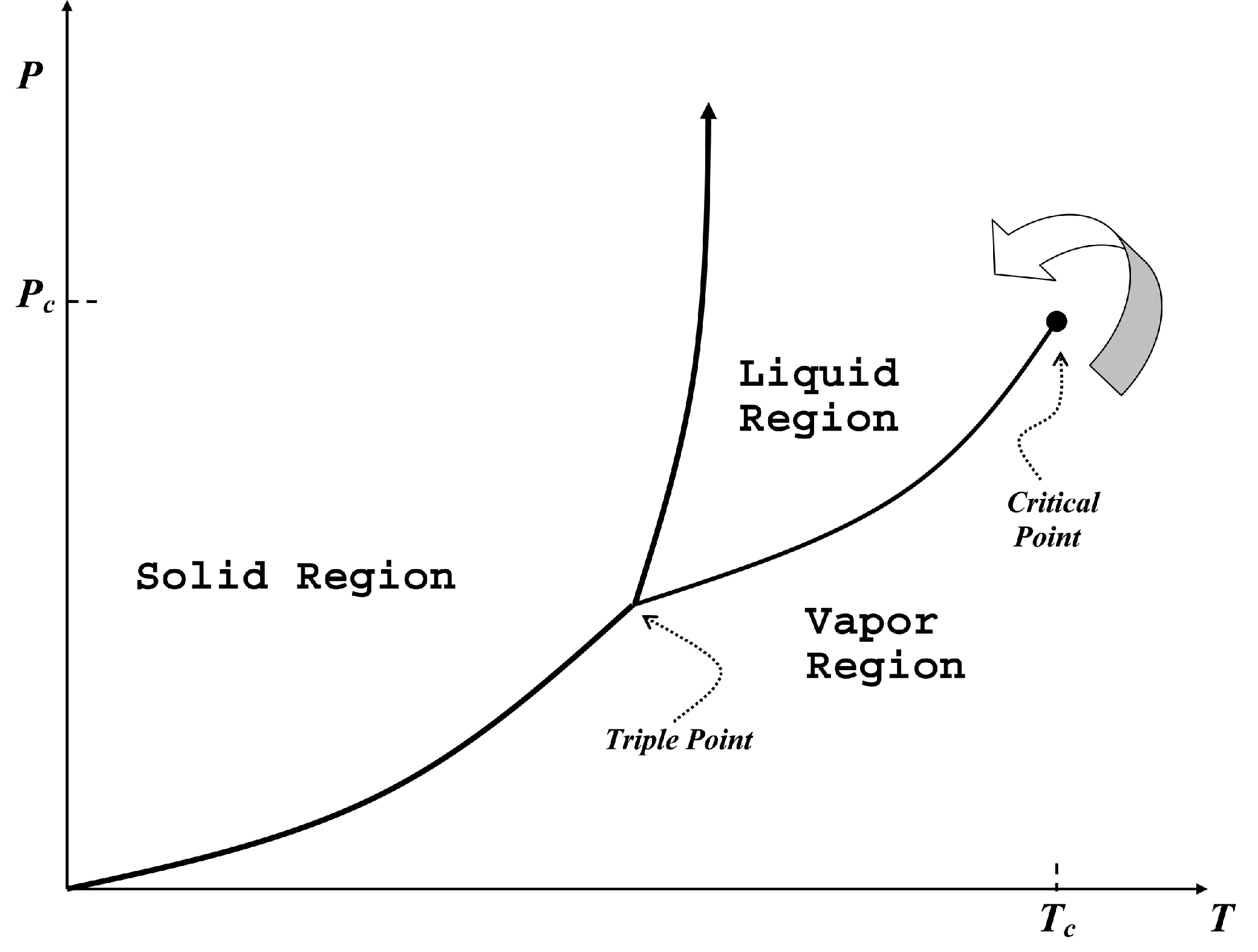
“Universality phenomenon” was initially coined to characterize a remarkable clustering in the behavior of thermal systems undergoing phase transitions, especially in the vicinity of a thermodynamic state called the “critical point.” In thermodynamics a system’s state can be characterized by the three state variables pressure, temperature, and density. According to thermodynamics, when the system state is kept below the “critical point” values  associated with a substance, phase transition boundaries correspond to discrete changes (signified in fig. 1 by thick black lines). If, however, the system exceeds its critical values, there exist paths available allowing it to change from vapor to liquid (or back) without undergoing such discrete changes. These paths involve avoiding the vapor-liquid boundary line by navigating around the critical point as depicted by the broad arrow in figure 1.
Phase diagram of a generic material at fixed density.

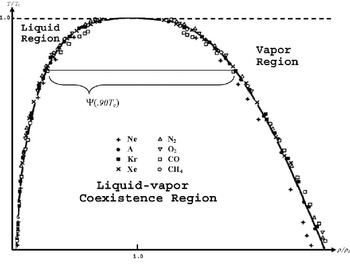
There exists a remarkable uniformity in the behavior of different systems near the critical point. One such uniformity is depicted in figure 2. In this figure we see a plot of temperature-density data recovered by Guggenheim (Reference Guggenheim1945) depicting thermodynamic states at which various fluids transition from a liquid or vapor state to a “two phase” liquid-vapor coexistence region. Systems located in this latter region can be in liquid or vapor phases and (according to thermodynamics) maintain constant temperature as the density changes. An important feature exhibited (after rescaling for the  and
 of the respective molecules) in figure 2 is that near criticality the transition points for each distinct substance appear well fit by a single curve called the coexistence curve. This coexistence-curve similarity across diverse molecular substances can be characterized by a particular value
 referred to as the critical exponent found in the following relation:

where  , called the order parameter, represents the width of the coexistence curve at a particular temperature value
 . As
 gets closer and closer to the critical temperature
 from below, this width drops down, eventually vanishing at criticality. We can think of the critical exponent
 as telling us about how rapidly this vanishing occurs. This number turns out to be similar (in the neighborhood of
 ) for vastly different fluid substances.Footnote 1
Adapted plot of Guggenheim (Reference Guggenheim1945) data rescaled for criticality.

What’s fascinating about these examples is not the universal (or “nearly” universal) regularity in physical systems. That uniform reliable regularities (namely, “universal laws”) can be found to apply to numerous physical systems (although remarkable) is nothing new. The interesting part is that such uniform reliable behavior occurs despite the fact that at least at one level of description the systems are so incredibly dissimilar. From a level of description thought to be perhaps more “fundamental” than the gross state variables ( ,
 , and
 ) used to characterize thermodynamic systems, the various substances exhibiting similar critical exponent values have quite diverse descriptions: at the quantum mechanical level, the state vectors or density matrices representing the respective quantum mixtures will be notably distinct (e.g., close to orthogonal). From a chemical perspective monotonic neon is different from diatomic oxygen, or asymmetrical carbon monoxide. We might hence expect surprise from a physicist or chemist since despite such vast differences in the ostensibly pertinent details at these levels of theorizing, the substances still share such similarity. This similarity, despite such (speciously relevant) differences, is what distinguishes the behavior across thermal systems as a universality phenomenon.
Although the term originated from the study of thermal systems, universality has now been identified in a multitude of domains. Robert Batterman has argued in the philosophical literature that “while most discussions of universality and its explanation take place in the context of thermodynamics and statistical mechanics, … universal behavior is really ubiquitous in science” (Batterman Reference Batterman2002, 4). A (noncomprehensive) list of vindicating examples includes clustering behavior found in nonthermal criticality patterns exhibited in avalanche and earthquake modeling (Kadanoff et al. Reference Kadanoff, Nagel, Wu and Zhou1989; Lise and Paczuski Reference Lise and Paczuski2001), extinction modeling in population genetics (Sole and Manrubia Reference Sole and Manrubia1996), and belief propagation modeling in multi-agent networking (Glinton et al. Reference Glinton, Paruchuri, Scerri and Sycara2010). Batterman has discussed many examples of universality phenomena distinct from criticality phenomena, including rainbow formation, semiclassical approximation, and drop breaking (Batterman Reference Batterman2002, Reference Batterman2005).Footnote 2 In the next section, I offer an explicit analysis of the concept’s general application in physics.
2.2. The Same but Different: Analyzing Universality
The term universality in physics describes cases in which broad similarities are exhibited by classes of physical systems despite ostensibly significant variations according to apparently “more fundamental” representations of the systems. Kadanoff (Reference Kadanoff2000, 225) describes the term most generally as applying to those patterns in which “many physically different systems show the same behavior.” Berry (Reference Berry1987, 185) has characterized it as the “way in which physicists denote identical behavior in different systems.” Batterman (Reference Batterman2002, 4) describes the “essence of universality” as when “many systems exhibit similar or identical behavior despite the fact that they are, at base, physically quite distinct.” These characterizations reveal that the concept hinges on the satisfaction of the two seemingly competing conditions of displaying a particular similarity despite other (evidently irrelevant) differences in the systems at some level of description. To make this conceptual dependency explicit, we propose the following analysis of universality phenomena.
(UP): A class  of models of physical systems in a theoretical context
 will be said to exhibit a universality phenomenon whenever the class can simultaneously meet the following two conditions:
(Sim) There exists a robust similarity in some observable behavior across the physical systems modeled by members of
 .
(Var) This similarity in the behavior of members modeled in
is stable under robust variations of their state descriptions according to context .
 .
 is stable under robust variations of their state descriptions according to context
 .
The first thing to specify is what counts as a “class of models of physical systems in a theoretical context.” To avoid complications associated with multiple (possibly not entirely equivalent) formulations of a full physical theory, UP leverages a restrictive notion of a theoretical context  that identifies a particular formulation and variety of studied phenomena within a given theory. Examples of different theoretical contexts in classical mechanics include the Hamiltonian versus the Lagrangian formulations; or, in quantum mechanics, it distinguishes between wave mechanics and operator mechanics.Footnote 3 A theoretical context may also restrict the phenomena considered by the total theory. For example, source free classical electrodynamics is a distinct theoretical context within full classical electrodynamics, which includes source effects. In some cases,
 may specify an entire theory uniquely, while in other cases specifications of (potentially nonequivalent) formulations and phenomena restrictions may be appropriate.
Given the particular  of a universality phenomenon, the expert can typically identify pertinent state descriptions “according to context
 .” For example, in classical electromagnetism the relevant state description could be fields specifying the flow of source charges and the electromagnetic field values throughout a spacetime; in GR the metric and energy-momentum tensors might play this role; in thermodynamics, state descriptions may be parametrized by
 ,
 , and
 (or perhaps
 and
 ), whereas in quantum statistical mechanics one may use density operators.
Satisfaction of Sim is primarily an empirical question. To claim that something universality-like is occurring, there must be evident similarities in the class of systems exhibiting the phenomenon. This evident similarity need not be (directly) in terms of the state descriptions used to characterize elements of  . So for the paradigm example of the universality of phase transitions, Sim is satisfied once physicists recover sufficient empirical data of the kind depicted in figure 2. The robust similarity of Sim can be quantified in terms of the remarkable closeness of the critical exponents of these various systems even though the critical exponent parameter
 may not be in terms of state quantities in
 (e.g., chemistry or statistical mechanics).
Satisfaction of Var depends primarily on the size and, most importantly, the diversity of the models in class  . The larger and more varied the members of class
 with respect to the relevant state descriptions of
 , the more “stable under variations.” If
 is suitably rich with diverse members, then a member
 may be “mapped” to a rich variety of other members of
 while still maintaining the very similarity shared by all members of
 that allowed the class to satisfy Sim. In the paradigm example of thermal universality, Var is satisfied by the fact that at the chemical or the statistical mechanics levels of description, the members in our class sharing this similar critical behavior are so diverse.
The central concepts of robust variation and robust similarity on which Var and Sim, respectively, depend are not binary. Some universality phenomena may be “more robust” than others, both in “degree” of similarity displayed and in “degree” of variations that the systems can withstand while still exhibiting such similar behavior. The greater the robustness of the pertinent similarity across the class of systems and the more ( -state) variation in the class, the more robust the universality is.Footnote 4 This nonbinary dependence means that universality may be subject to vagueness issues. While certain examples, such as thermal criticality behavior and, I argue, the clustering behavior of free-fall massive bodies around geodesic paths, are determinant cases of universality, penumbral cases where it is unclear whether a candidate universality class is sufficiently similar and robust under variations may exist.
3. The Geodesic Universality Thesis
In this section, I reconsider the near-geodesic clustering observed in nature in terms of the UP analysis. In section 3.1, I examine why such clustering qualifies as a universality phenomenon. In section 3.2, I then identify how the limit operation result of Ehlers and Geroch offers what we identify as a universality explanation of this clustering.
3.1. The Similarity and Diversity of Geodesic Universality
Consider a sequence of classes  indexed by some sufficiently small error parameter
 . For fixed
 , the class
 consists of (local) solutions to Einstein’s field equations:

where the energy-momentum field  describes the flow of matter-energy and
 describes the “Einstein curvature” determined by the metric field
 . Each member of
 models some massive body whose spacetime path comes close to following a (timelike) curve
 that is close to actually being a geodesic (where these two senses of closeness are parametrized by respective functions monotonically dependent on the smallness of
 ). With the UP analysis in hand, for a given degree of “
 -closeness” we can now ask if such a class
 satisfies the Sim and Var conditions in a GR context purged of the canonical commitment to geodesic dynamics.
The satisfaction of Sim is an empirical matter well confirmed by centuries of astronomical data recovered from cases where a relatively small body (a planet, moon, satellite, comet, star, etc.) travels under the influence of a much stronger gravitational source. Examples involving nonnegligible relativistic effects (like Mercury) are of particular importance, but even terrestrial cases, including Galileo and leaning towers or other (nearly) free-fall examples in determinately Newtonian regimes, can count as confirming instances for certain  -closeness values. Since observational precision is inevitably bounded, it is often claimed that the satellite, moon, planet, and so forth indeed “follows a geodesic.” In such instances, the body is actually observed only as coming “close enough” to geodesic following to warrant such equivocation. These instances hence confirm membership in a class
 for some
 threshold below the level of experimental precision or attention.
To appreciate the satisfaction of Var, we must consider the relevant GR context. State descriptions of physical systems according to the theory come in the form of the tensor fields  and
 , related by (2). Assuming we only consider (local) solutions, there exist six independent field components describing
 and so the matter-energy flow
 . In other words, from a fundamentals of relativity theory perspective, there are six physical degrees of freedom to how these bodies are described at each spacetime point.
Given the wealth of evident confirming instances falling under a class  with suitable
 , there is significant variation in terms of these degrees (even after rescaling) once we consider the differences in the density, shape, and flow of the matter-energy of a planet versus a satellite, asteroid, anvil, and so on. In these “fundamental state description” terms, the diversity of the bodies in a given class
 is stark. Despite this diversity, such bodies still satisfy the defining requirement of
 -closeness to following a geodesic. It is with respect to this diversity in these degrees of freedom (of the energy-momenta/gravitational influences of the “near-geodesic following bodies” of members in
 ) that a “robust stability under variations” can be established as satisfying Var.
So, according to UP, the near-geodesic following observed in nature constitutes a geodesic universality phenomenon. Meeting the conditions of the analysis depends crucially on the above empirical claims about the existence of bodies well modeled by members of the respective  classes for a suitable range of
 values, and that the bodies in each class are so fantastically diverse from the perspective of their
 (
 ) fields. In the next section, I address the more theoretical question of understanding how such geodesic universality is possible in GR, by considering the properties of the classes
 in terms of an important geodesic result of Ehlers and Geroch (Reference Ehlers and Geroch2004).
3.2. Explaining Geodesic Universality
I have now formulated the geodesic universality thesis in the context of GR as an empirically contingent claim about classes of the form  whose members model a physical system such that the path of some body counts as
 -close to being geodetic without violating Einstein’s field equations. I have also given a plausibility argument suggesting why observational data already obtained by experimentalists confirms this empirical hypothesis. Given such confirmation and the diversity of their respective energy-momenta, membership in some
 is sufficiently stable under significant variations of the fundamental state descriptions of GR to satisfy Var. A remaining theoretical question must now be answered: How can the systems exhibiting this universality phenomenon behave so similarly while being so different at the level of theoretical description fundamental to GR?
Geodesic universality can be explained through an important “limit proof” of the geodesic principle by Ehlers and Geroch (Reference Ehlers and Geroch2004), which deduces the “approximate geodesic motion” of gravitating bodies with relatively small volume and gravitational influence, by considering sequences of energy-momentum tensor fields with positive mass of the form  , referred to as “EG-particles” (see Tamir Reference Tamir2012). The spatial extent and gravitational influence of EG-particles can be made arbitrarily small by picking sufficiently large
 and
 values, respectively. The theorem of Ehlers and Geroch (Reference Ehlers and Geroch2004) entails that if for a given curve
 there exists such an EG-particle sequence, then by picking a large enough
 ,
 comes arbitrarily close to becoming a geodesic in a spacetime containing the
 instantiated matter-energy.
Specifically, let  be the sequence of metrics that couple to these
 according to (2) in arbitrarily small neighborhoods
 of
 , containing the support of the respective
 . Then if for each
 , as
 the
 approach a “limit metric”
 in the
 topology, which keeps track of differences in the metrics and their unique connections, then the curve
 approaches geodicity as
 .
To understand the impact of the theorem for our universality classes  , we need to appreciate the “limiting behavior” established by Ehlers and Geroch. The limit result establishes a kind of “
 -
 relationship” between, (a) how “nearly geodetic” we want the curve
 to be and (b) how much we need to bound the gravitational effects of the body on the background spacetime.Footnote 5 That is to say, the Ehlers-Geroch limit result tells us that “for every degree of
 -closeness to geodicity we want for the bodies’ path, there exists a
 -bound on the gravitational effect of the body that keeps the path at least that close to geodicity.” The important thing to observe about this
 -
 interplay is that although the limiting relationship requires imposing a
 -bound on the perturbative effects of the body, it does not impose any specific constraints on the details of how the matter-energy of the body flows within the
 -close spatial neighborhood of the curve, nor how the metric it couples to specifically behaves. So, although the metric is “bounded” within a certain
 -neighborhood of the limit metric, the particular details of the tensor values, the corresponding connection, and especially the curvature have considerable room for variation so long as they stay “bounded in that neighborhood.”
This relationship hence establishes a details-free way of understanding the diverse populations of the respective universality classes  : in effect the Ehlers-Geroch limiting relationship highlights that for each
 class, there exists a particular
 -bound around a limit metric with some geodesic anchor
 such that any body coupling to a metric that stays within that bound (and remaining spatially close to
 ) satisfies the relevant
 -closeness requirements for membership in
 . But falling under this
 -bound does not impose specific constraints on the detailed values of the energy-momenta or metric fields. In other words, membership in class
 is possible as long as the body is a massive solution to Einstein’s equations and its gravitational effect and extent are sufficiently bounded in the right way, but beyond these requirements the specific details concerning “what the gravitational effect does below those bounds” are irrelevant. Hence, the limit behavior established by Ehlers-Geroch explains how the
 -clustering near geodesic anchors is possible despite significant differences in the energy-momenta of our near-geodesic following bodies: so long as the bodies’ gravitational influences are bounded in the right way their (positive) matter-energy can vary as much as we like under those bounds.
4. Explanation without Reification
Before concluding, there remains a potential challenge concerning how we can endorse any kind of geodesic “idealization” thesis if the actual geodesic motion of massive bodies is incompatible with Einstein’s theory. Recall, while explaining the diversity in the  classes, we took a “geodesic limit” of the metrics
 coupling to the EG-particles
 in accordance with (2).Footnote 6 Haven’t we “essentially” appealed to pathological models precluded by Einstein’s field equations in taking such geodesic limits?
The answer is that although appreciating the  -
 interplay in the appropriate neighborhoods of the geodesic limit was essential to our universality explanation, the role played by the limiting geodesic anchor model does not require us to reify the idealization or make it representative of physical systems in GR. Although there are significant complications associated with what happens at the geodesic limit (1) the
 -
 behavior has a well-defined mathematical structure (the
 topologies) describing the approach to the limiting anchor model, and (2) the behavior of models in
 , which are “close but not identical to” a geodesic anchor model, still obey Einstein’s theory. A geodesic anchor model establishes (as the name suggests) an anchor for the (topological) neighborhoods in which elements of the respective
 classes cluster. However, using these models as anchors to identify the points around which the actual solutions to Einstein’s equations cluster does not require that the anchors themselves be admitted in
 .
In contrast to more traditional “idealizations,” universality phenomena are about the group behavior of classes of  , not the individual system. For nonuniversality idealizations severe pathologies can be detrimental because they render the sole idealized model theoretically inapposite. With universality, however, a pathologically idealized model “close to but excluded from” the universality class need not entail that members of the class are likewise poorly behaved. If a topological clustering “near to” an idealized model has physical significance (as with the
 topologies), such proximity may allow inferences about the well-behaved classes without molesting their admissibility according to
 .
This is precisely what occurs with geodesic universality. Members of a  can take advantage of their closeness to the geodesic anchor models without “contracting” the pathologies occurring at the actual geodesic limits. They also help to explain such
 -closeness by enabling our appeal to the “specific details irrelevant”
 -closeness in the
 topologies. Since we are talking about geodesic universality, we could infer directly from such
 -closeness that the relevant bodies modeled by the members of
 are close to following a geodesic in the relevant physical senses defined when we constructed the classes.
5. Conclusion
While the incompatibility result of Tamir (Reference Tamir2012) entails that a strict interpretation of the geodesic principle must be rejected, reinterpreting geodesic dynamics as a universality thesis is both viable and coherent within contemporary GR. By developing an analysis of universality phenomena in physics, we saw that the widespread geodesic clustering of a rich variety of gravitating, free-fall, massive bodies actually observed in nature qualifies as a geodesic universality phenomenon.
In addition to recovering approximate geodesic dynamics as a geodesic universality thesis, by reconsidering limit operation proofs of the principle, we generated a universality explanation of such a remarkable clustering despite the fact that from a “more fundamental” level of description in GR there is incredible diversity. Unlike traditional forms of idealization, when it comes to universality phenomena, the claim is about the group behavior of entire classes, not individual idealizations. Hence, in the case of universality, we can appeal to mathematical proximity to pathological anchors without the risk of realistic class members contracting these pathologies. Further, when the right (topological) closeness is employed we can gain knowledge about the physical properties of modeled systems thanks to the proximity of their models to pathological anchors.
 . For example, we might use some integration norm to quantify the difference between two (scalar) fields found in
 . The choice of appropriate norm, topology, etc. identifying differences in the members of
 is directly dependent on the context
 .
 -
 relationship,” suggesting that the closeness relations are quantified; however, the actual Ehlers-Geroch result is formulated (primarily) in topological terms. See Gralla and Wald (
 converge to a well-defined “geodesic limit” (in the
 topologies) the coupled energy-momentum tensors
 may not. Moreover, even if they do converge in a physically salient and independently well-defined way, at the limit they must either fail to obey