Porous nanoarchitectures based on clay minerals have been a focus of growing interest in the field of materials science due to their ability to produce nanostructures with beneficial functional and structural properties (Polverejan et al., Reference Polverejan, Pauly and Pinnavaia2000; Ruiz-Hitzky & Aranda, Reference Ruiz-Hitzky and Aranda2014; Kooli et al., Reference Kooli, Liu, Hbaieb and Al-Faze2017). This multifunctionality supports their use in various fields, notably in environmental remediation via the removal of pollutants due to their catalytic and adsorption properties and in the medical field in terms of the development of viable and functional biodevices for biomedical applications, as supports for the controlled release of drugs and in bioimaging (Tobajas et al., Reference Tobajas, Belver and Rodriguez2017; Akkari et al., Reference Akkari, Aranda, Ben Haj Amara and Ruiz-Hitzky2018; Yuan et al., Reference Yuan, Deng, Dong, Li, Zhao and Su2018; Yang et al., Reference Yang, Song, Kim, Jung and Hwang2019; Dai et al., Reference Dai, Guo, He, Song and Wang2021; Persano et al., Reference Persano, Gigli and Leporatti2021).
Among the clay minerals that have been studied, fibrous clay minerals have taken a prominent place in recent years due to their beneficial properties, such as the presence of silanol groups on the external surfaces of these fibres, which facilitates their assembly with various types of nanoparticle, thus giving great stability to the nanoarchitectures obtained (Belver et al., Reference Belver, Aranda, Martín-Luengo and Ruiz-Hitzky2012; Aranda et al., Reference Aranda and Ruiz-Hitzky2018). Moreover, the possibility of controlling the size of the pores of these nanostructured materials (Polverejan et al., Reference Polverejan, Pauly and Pinnavaia2000; Gómez-Avilés et al., Reference Gómez-Avilés, Aranda, Fernandes, Belver and Ruiz-Hitzky2013; Cecilia et al., Reference Cecilia, Garcıa-Sancho, Vilarrasa-Garcıa, Jimenez-Jimenez and Rodriguez-Castellon2018) allows various possible applications, particularly in catalysis, environmental remediation and energy production, among others (Guggenheim & Krekeler, Reference Guggenheim, Krekeler, Galan and Singer2011; Ruiz-Hitzky & Aranda, Reference Ruiz-Hitzky and Aranda2014). Depending on the synthesis method used, the resulting functional nanostructures can be used as antibacterials, adsorbents of pollutants, ion exchangers and magnetic sensors, etc. (González-Alfaro et al., Reference González-Alfaro, Aranda, Fernandes, Wicklein, Darder and Ruiz-Hitzky2011; Ruiz-Hitzky et al., Reference Ruiz-Hitzky, Aranda, Alvarez, Santaren and Cubillo2011).
The present study focuses on the possibility of obtaining a heterostructured silica–clay mineral using palygorskite as the starting fibrous clay mineral. Palygorskite belongs to the class of TOT fibrous non-swelling phyllosilicates in which the silica tetrahedra are inverted periodically in the tetrahedral sheets, giving rise to channels (Bradley, Reference Bradley1940; Chahi et al., Reference Chahi, Petit and Decarreau2002; Suarez & Garcia-Romero, Reference Suarez and Garcia-Romero2006; Boudriche et al., Reference Boudriche, Hamdi, Kessaissia, Calvet, Chamayou and Dodds2010, Reference Boudriche, Calvet, Hamdi and Balard2011). Previous research has shown that the combination of the thermal resistance and adsorptive properties of palygorskite with the mechanical reinforcement of silica can offer great potential for various applications, especially from an environmental perspective (Yang et al., Reference Yang, Tang, Ouyang, Li and Mann2010; Ruiz-Hitzky et al., Reference Ruiz-Hitzky, Aranda, Alvarez, Santaren and Cubillo2011; Gómez-Avilés et al., Reference Gómez-Avilés, Aranda, Fernandes, Belver and Ruiz-Hitzky2013). Moreover, Aranda & Ruiz-Hitzky (Reference Aranda and Ruiz-Hitzky2018) reported previously that the characteristics of the heterostructures thus obtained can be affected significantly by various aspects related to the preparation methodology.
The aim of this study is to highlight, through textural, structural, morphological and mineralogical characterizations of the nano-heterostructures obtained, the effects of two experimental parameters: (1) prior activation of the clay mineral with hydrochloric acid (HCl); and (2) variation of the amine chain length on the development of silica nanoparticles around palygorskite fibres.
Experimental
Materials
The raw palygorskite used in this study was extracted from a natural deposit (Ghoufi) located in Algeria (Boudriche et al., Reference Boudriche, Hamdi, Kessaissia, Calvet, Chamayou and Dodds2010; Ouali et al., Reference Ouali, Belaroui, Bengueddach, Galindo and Peña2015; Habibi et al., Reference Habibi, Belaroui, Bengueddach, López Galindo, Sainz Díaz and Peña2018) and has the following average mineralogical formula: (Si7.88Al0.12)O20(Mg1.69Al1.71Fe0.43)(OH)2(K0.06Ca0.05Na0.15)(OH2)4⋅4H2O (Belaroui et al., Reference Belaroui, Ouali, Bengueddach, Lopez Galindo and Peña2018). All other chemicals used, such as hexadecyltrimethylammonium bromide (C19H42BrN or HDTABr), butylamine (C4H11N or BTA), dodecylamine (C12H27N or DDA), sodium chloride (NaCl), HCl and tetraethylorthosilicate (SiC8H20O4 or TEOS), were of analytical grade, were manufactured by Sigma-Aldrich (France) and were used without further purification.
Synthesis method
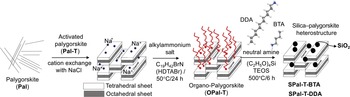
The raw palygorskite was milled and sieved to <1 mm, and this sample is referred as Pal. The Pal sample was first treated with HCl (0.5 M) at a 1/10 (solid/liquid) ratio at 100°C for 6 h to remove impurities such as carbonates. Then it was mixed with an excess of NaCl solution (1 M) to induce cation exchange with Na+. This cation-exchange step was repeated six times to ensure complete exchange. The sample obtained was then washed several times with hot distilled water to remove the chloride anions and finally dried at 100°C for 24 h. The treated sample obtained is referred as Pal-T.
The first step of synthesis is the formation of an organo-palygorskite by adding 3 g of Pal-T to 300 cm3 of 0.1 M HDTABr surfactant solution (long-chained quaternary ammonium cations). This dispersion was stirred for 24 h at 50°C to allow the sodium cations to be replaced by the organic surfactant cations. Then, the excess alkylammonium salt was removed via repeated washing with hot distilled water and centrifugation of the supernatant until an AgNO3 test indicated the absence of halide anions. The resulting solid was air-dried. The organo-palygorskite thus obtained is referred to as OPal-T.
In the next step, a neutral amine co-surfactant, DDA or BTA, with a silica precursor TEOS were added to 1 g of OPal-T in the amounts corresponding to an OPal-T/neutral amine/silica precursor ratio of 1/20/150. After 4 h of stirring at room temperature, the solid component was recovered by filtration and air dried. The samples obtained are referred to as OPal-T/DDA/TEOS and OPal-T/BTA/TEOS.
After calcination at 500°C for 6 h under airflow (heating rate 1°C min–1), silica–palygorskite heterostructures with co-surfactant BTA and DDA were obtained, which are referred to as SPal-T-BTA or SPal-T-DDA, respectively (Fig. 1).
Schematic illustration of the general procedure followed to prepare the silica–palygorskite heterostructure SPal-T-BTA and SPal-T-DDA.

Characterization techniques
X-ray diffraction (XRD) traces were recorded using a PANalytical XPERT-PRO diffractometer (New Jersey, USA) with Cu-Kα radiation (λ = 1.5405 Å). The powdered samples were placed without any pre-treatment in a horizontal sample holder. The instrument was operated at 45 kV and 40 mA with a step size of 0.02°2θ over a range of 2–45°2θ.
The specific surface area (SSA) and mesoporous and microporous volumes were calculated using gas adsorption (N2, CO2). The samples were outgassed overnight at 120°C under vacuum and their porosity was characterized by N2 and CO2 adsorption, respectively, at –196°C and 0°C (Autosorb-1, Quantachrome, FL, USA). The total pore volume was estimated from the amount adsorbed at P/P 0 = 0.95. The microporous and the mesoporous volumes were determined by applying the density functional theory (DFT) method to the N2 isotherms. The Dubinin–Radushkevich (DR) theory was applied to the CO2 adsorption isotherm to estimate the ultramicropore volume (diameter <0.7 nm).
Morphology and microtexture were investigated using conventional high-resolution transmission electron microscopy (TEM-FEI CM20, Philips, Germany) operating at 200 kV and at 0.14 nm resolution.
The infrared spectra of SPal were obtained using an Alpha-Bruker (Germany) spectrometer, with Fourier-transform infrared spectroscopy (FTIR) conducted in the range 400–4000 cm–1 with a resolution of 2 cm–1 and a scan number equal to 32. The attenuated total reflection module was used by placing the sample to be analysed in contact a crystal (diamond) without dilution in KBr.
Results and discussion
Mineralogical analysis
The XRD trace (Fig. 2) of Pal allowed the identification of the following mineralogical phases: palygorskite as the main phase and carbonates in two crystalline forms: calcite (CaCO3) and dolomite (CaMg(CO3)2). The characteristic reflections of the carbonates disappear in the XRD trace of Pal-T, with preservation of the crystalline structure of palygorskite after acid treatment, which is in agreement with previous studies (Ouali et al., Reference Ouali, Belaroui, Bengueddach, Galindo and Peña2015; Habibi et al., Reference Habibi, Belaroui, Bengueddach, López Galindo, Sainz Díaz and Peña2018).
X-ray diffraction (XRD) traces of raw palygorskite (Pal) and activated palygorskite (Pal-T) with: (a) the silica–palygorskite organo-heterostructure OPal-T/BTA/TEOS and the silica–palygorskite heterostructure SPal-T-BTA; and (b) the silica–palygorskite organo-heterostructure OPal-T/DDA/TEOS and the silica–palygorskite heterostructure SPal-T-DDA. The arrows represent the Pal in the SPal-T-DDA and SPal-T-BTA samples. C = calcite; D = dolomite.

The XRD traces of samples OPal-T/BTA/TEOS (Fig. 2a) and OPal-T/DDA/TEOS (Fig. 2b) indicate that the structure of palygorskite was not affected by the silica–palygorskite organo-heterostructure formation step. However, after calcination of these samples at 500°C, corresponding to organic matter removal, the XRD traces of SPal-T-DDA and SPal-T-BTA show the formation of a broad band at 16–37°2θ, attributed to the presence of amorphous silica, which obscures the Pal-T reflections. In addition, a small shift of the characteristic palygorskite reflections from 8.4 to 9.3°2θ was observed, which is attributable either to the insertion of silica gel into the structural channels, which replaced the zeolitic water removed after calcination, or to the existence of a distortion of the structure due to the interaction of SiOH with the nanoparticles formed. A similar observation was noted in previous studies performed on sepiolites (Belver et al., Reference Belver, Aranda and Ruiz-Hitzky2013; Aranda & Ruiz-Hitzky, Reference Aranda and Ruiz-Hitzky2018).
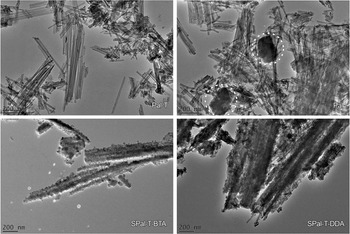
In the present case, according to the TEM results (Fig. 3), the disappearance of the characteristic reflections of Pal after calcination during the XRD analysis does not mean that the Pal structure was destroyed, but rather that the Pal surface was covered entirely by a silicic structure.
TEM images showing raw palygorskite (Pal), activated palygorskite (Pal-T), a silica–palygorskite heterostructure obtained with co-surfactant BTA (SPal-T-BTA) and a silica–palygorskite heterostructure obtained with co-surfactant DDA (SPal-T-DDA). The dashed circle highlights the cubic crystals.

The XRD trace of SPal-T-DDA revealed the formation of SiO2 on the surface of the Pal-T fibres (Fig. 2b) with the appearance, in addition to the broad band in the range 16–37°2θ, of a shoulder at ~3.6°2θ, probably due to a more pronounced entanglement and consolidation of the nanostructure between the Pal-T fibres and the long-chain co-surfactant DDA compared to BTA.
Morphological analysis
The TEM microstructural analysis of the Pal sample (Fig. 3) indicated a fibrous morphology with the presence of cubic shapes inserted within the fibres. Energy-dispersive X-ray (EDX) analysis of the fibres and the cubic crystals identified their majority chemical composition (atomic %): Mg (17.67%), Al (8.89%), Si (70.97%) for the fibres and Ca (51.35%) for the cubic crystals (dashed circle in Fig. 3) related to carbonate impurities (calcite and dolomite, as also confirmed by XRD).
The purification of the Pal sample with HCl allowed the removal of the cubic crystals related to carbonate impurities from the Pal sample (Boudriche et al., Reference Boudriche, Calvet, Hamdi and Balard2011). After calcination, spherical particles appeared, associated with the formation of a polysiloxane network surrounding the Pal fibres for the SPal-T-BTA and SPal-T-DDA samples. The presence of small particles on the surface of the Pal-T fibres is detectable in the SPal-T-BTA and SPal-T-DDA heterostructures via TEM analysis. However, these particles are denser according to EDX analysis (Fig. 4) in SPal-T-DDA sample, forming agglomerates of palygorskite particles, which corroborates the results obtained using XRD. The two Cu-Kα and Cu-Kβ reflections present in Fig. 4 are artefacts due to the Cu support (which is commonly used in TEM studies) producing intense X-ray fluorescence even if Cu is not present in the sample.
EDX analysis of fibres in SPal-T-BTA and SPal-T-DDA.

This predominance of particles around the fibres is due to the long-chain amine precursor (DDA) generating more silica around the Pal-T fibres compared to the BTA co-surfactant.
Textural analysis
The textural properties of this type of heterostructured material provide important information regarding the nanoarchitecture produced. The SSA and microporous and mesoporous volume data before and after modification of Pal-T determined from the nitrogen adsorption isotherm at –196°C are collected in Table 1.
Textural parameters of raw palygorskite (Pal), activated palygorskite (Pal-T) and the silica–palygorskite heterostructures SPal-T-BTA, SPal-T-DDA, SPal-BTA and SPal-DDA.

BET = Brunauer–Emmett–Teller.
Pal exhibited a type-IV isotherm (not shown). This adsorption isotherm is generally obtained with mesoporous adsorbents in which capillary condensation occurs at the greatest relative pressures. The raw Pal sample had a SSA value of ~87 m2 g–1. According to the data shown in Table 1, the raw sample was essentially mesoporous and not very microporous.
During acid purification, the mesoporous volume created in the clay mineral matrix (V meso = 0.6 cm3 g–1) as well as the microporosity and ultramicroporosity increased significantly (V micro = 0.027 cm3 g–1, V ultra = 0.12 cm3 g–1), increasing the SSA from 87 m2 g–1 before treatment to 302 m2 g–1 after treatment. Thus, acid activation enabled fibre dissociation (as shown in the TEM images) in the raw Pal through carbonate removal (as confirmed by XRD analysis) as well as the removal of exchangeable cations, leading to the creation of new types of porosity, as has been reported previously (Suarez Barrios et al., Reference Suarez Barrios, Flores Gonzalez, Vicente Rodriguez and Martin Pozas1995; Boudriche et al., Reference Boudriche, Calvet, Hamdi and Balard2011).
After calcination, the greatest SSA was found for the SPal-T sample prepared from OPal-T/DDA/TEOS, at a value of 628 m2 g–1 compared to a value of 263 m2 g–1 for OPal-T/BTA/TEOS. This significant increase in SSA in SPal-T-DDA was attributed mainly to the new microporosity generated by the removal of the DDA surfactant from the micellar structure after calcination. However, the mesoporosity decreased significantly after calcination, causing volume losses of 48% and 30% with BTA and DDA co-surfactants, respectively. The hollow silicate spheres derived from the micellar structure after calcination were located specifically in the mesoporous volumes of the clay mineral with the short-chain co-surfactant BTA. These varying textural behaviours of the polymerized silica SiO2 in the two SPal-T samples allow us to conclude that, after calcination, the co-surfactants used demonstrate varying levels of growth of the polysiloxane network around the fibres. Similar observations on the significant effects of various experimental variables, such as nature of both the alkoxysilane precursor and organo-sepiolite on the organization of the silica nanoparticles generated around the sepiolite fibres, have been reported previously by Gómez-Avilés et al. (Reference Gómez-Avilés, Aranda, Fernandes, Belver and Ruiz-Hitzky2013).
To verify the contribution of decarbonation in the synthesis step, textural analysis of two other SPal samples was performed using raw non-activated Pal as starting material and BTA/DDA, respectively, as surfactants. From the SSA and porosity values (Table 1), and in contrast to the activated clay mineral, the values obtained with the two silica–palygorskite heterostructures – SPal-DDA and SPal-BTA – were of the same order of magnitude and remained significantly lower than the values obtained with Pal-T.
Thus, the acid activation in the presence of the short-chain co-surfactant (BTA) or the use of the long-chain co-surfactant (DDA) without acid activation were not sufficient to develop the porous network optimally; only the combination of long-chain co-surfactant and acid treatment allowed the optimization of the synthesis conditions of SPal. This combination played an important role in the organization of the silica precursor, leading to the creation of this new porous network consisting, in particular, of micropores and ultramicropores, which contribute significantly to the increase in specific surface area, as shown by the values obtained for the SPal-T-DDA sample (Table 1).
However, no differences were found between the XRD traces and FTIR spectra of the SPal-T-BTA and SPal-T-DDA samples and those of the SPal-BTA and SPal-DDA samples, respectively. The XRD and FTIR analyses of the samples obtained from raw Pal are not shown in Figs 2 & 5.
FTIR spectra in the ranges (a) 4000–2600 cm–1 and (b) 2000–400 cm–1 of raw palygorskite (Pal), activated palygorskite (Pal-T) and the silica–palygorskite heterostructures SPal-T-BTA and SPal-T-DDA.

Chemical structure
The structural evolutions of Pal before and after acid activation and then after silica–palygorskite heterostructure formation are given in Fig. 5a,b in the spectral ranges of 4000–2600 and 2000–400 cm–1, respectively.
The identification of Pal bands before modification was carried out by analogy with other studies conducted previously on similar types of fibrous clay minerals (Blanco et al., Reference Blanco, Gonzalez, Pesquera and Benito1989; Chahi et al., Reference Chahi, Petit and Decarreau2002; Garcia-Romero et al., Reference García-Romero, Suárez-Barrios and Bustillo-Revuelta2004; Suarez et al., Reference Suarez and Garcia-Romero2006).
In the region of the vibrational bands of hydroxyl groups (Fig. 5a), a broad absorption band was detected between 3800 and 3000 cm–1, with three distinguishable bands at 3620, 3560 and 3400 cm–1 and with a small shoulder at 3260 cm–1.
The band at 3620 cm–1 was attributed to the OH-stretching vibration associated with Al3+ cations in dioctahedral coordination (Al2OH) and the Mg-coordinated OH-stretching vibration of water along the fibres.
The band at 3560 cm–1 was attributed to the contribution of OH-stretching vibrations in (Fe,Mg)-OH and (Al,Mg)-OH.
The absorption band, with a maximum located at 3400 cm–1, corresponded to the vibration of physisorbed water that interacted with the hydrogen atoms located at the edge of the fibres (these hydrogens have the role of compensating for the charge deficits due to edge effects).
After calcination, in the SPal spectra a single broad complex band centred at 3440 cm–1 appeared along with a band towards 3650 cm–1 due to dehydroxylation (1) with the release of the less stable OH groups that are bound mainly to aluminium and magnesium and (2) with the removal of coordinated, zeolitic and crystallization water molecules during the calcination step (Boudriche et al., Reference Boudriche, Calvet, Hamdi and Balard2012).
In the region from 2000 to 400 cm–1 in Fig. 5b, the bands at 1423 and 877 cm–1 in the raw Pal related to carbonate impurities (vibrations of the CO32– moiety) disappeared after acid activation, confirming the dissolution of these impurities (Suarez Barrios et al., Reference Suarez Barrios, Flores Gonzalez, Vicente Rodriguez and Martin Pozas1995; Boudriche et al., Reference Boudriche, Calvet, Hamdi and Balard2011; Habibi et al., Reference Habibi, Belaroui, Bengueddach, López Galindo, Sainz Díaz and Peña2018), as evidenced by the XRD analysis.
An intense H2O deformation band appeared at ~1651 cm–1. This band decreased sharply in intensity in the SPal spectra, corroborating the removal of bound and zeolitic water molecules after calcination.
The bands at 1190, 1026 and 982 cm–1 are attributable to the elongation vibrations of the Si–O–Si bond (Mendelovici, Reference Mendelovici1973; Gonzalez et al., Reference Gonzalez, Pesquera, Blanco, Benito, Mendioroz and Pajares1989) in the tetrahedral sheets in raw Pal, and these bands appeared in the SPal spectra as a new band centred at 1080 cm–1, characteristic of asymmetric stretching vibrations of Si–O–Si bridges. In addition, two other distinct bands appeared at 1210 and 1080 cm–1, characteristic of the presence of SiO2 nanoparticles in hybrid structures such as SPal (Olejniczak et al., Reference Olejniczak, Leczka, Cholewa-Kowalska, Wojtach, Rokita and Mozgawa2005; Gómez-Avilés et al., Reference Gómez-Avilés, Aranda, Fernandes, Belver and Ruiz-Hitzky2013).
A new band appeared at 800 cm–1 in SPal, attributable to symmetric stretching vibrations of Si–O bridges in the silica formed (Gonzalez et al., Reference Gonzalez, Pesquera, Blanco, Benito, Mendioroz and Pajares1989; Suarez Barrios et al., Reference Suarez Barrios, Flores Gonzalez, Vicente Rodriguez and Martin Pozas1995; Olejniczak et al., Reference Olejniczak, Leczka, Cholewa-Kowalska, Wojtach, Rokita and Mozgawa2005). This band appeared in the spectrum of Pal-T (Gonzalez et al., Reference Gonzalez, Pesquera, Blanco, Benito, Mendioroz and Pajares1989; Boudriche et al., Reference Boudriche, Calvet, Hamdi and Balard2011) and then increased in intensity in the final calcined samples (SPal-T-BTA, SPal-T-DDA), indicating the additional contribution of the silica formed by polymerization of TEOS and thus confirming the formation of the mesoporous structure. Upon addition of the co-surfactant (DDA/BTA) and a Si source (TEOS) to the OPal-T sample, a broad Si–O complex band at 1080 cm–1 appeared, indicating the hydrolysis of TEOS and the development of a silica network in the SPal precursor. Another band also appeared at 950 cm–1, attributable to the deformation vibration of silanol groups bound to the formed silica (Mendelovici, Reference Mendelovici1973; Gonzalez et al., Reference Gonzalez, Pesquera, Blanco, Benito, Mendioroz and Pajares1989; Olejniczak et al., Reference Olejniczak, Leczka, Cholewa-Kowalska, Wojtach, Rokita and Mozgawa2005). This band was more appreciable in SPal-T-DDA.
The 909 cm–1 band before treatment disappeared in the SPal spectra due to the release of the less stable OH groups that are bound mainly to aluminium and magnesium during calcination (Palkova et al., Reference Palkova, Madejova, Zimowska and Serwicka2010).
In the short-wavelength region of the SPal spectra, the intense band at ~455 cm–1 was attributed to the bending vibration of Si–O bridges in the silica formed (Olejniczak et al., Reference Olejniczak, Leczka, Cholewa-Kowalska, Wojtach, Rokita and Mozgawa2005).
The SPal-T-DDA sample, which presents the most advantageous textural properties (great SSA and developed porous network), will be tested for its use in air-pollution control and for the elimination of volatile organic compounds at low concentrations, in particular toluene and decane, in order to evaluate its adsorption capacity.
Conclusion
The preparation of heterostructured materials based on the immobilization of silica on a clay mineral, palygorskite, was carried out by varying two experimental conditions: (1) the acid activation of the clay mineral and (2) the neutral amine chain length. The mineralogical and structural analyses of the samples obtained demonstrated the formation of amorphous silica on the surface of the palygorskite fibres with preservation of the fibrous structure. This result is confirmed by the morphological analysis, which indicates total coverage of the surface of the palygorskite fibres by silica nanoparticles. Moreover, gas adsorption proved to be the most relevant analysis technique, as it revealed that the use of acid-activated clay minerals combined with a long-chain neutral amine co-surfactant optimized the textural properties of the formed silica–palygorskite heterostructure. The SSA and porosity measurements demonstrated that the SPal-T-DDA sample compared to the other heterostructures had a highly developed pore network (V N2 = 0.24 cm3 g–1; V ultra (CO2) = 0.18 cm3 g–1) with a high SSA (628 m2 g–1). These results confirm that the textural characteristics of the heterostructure obtained after removal of the organic matter and consolidation of the silica network on the external surface depend significantly on the experimental conditions used. Controlling such preparation conditions enables diversification of the physicochemical properties of the nanoarchitectures obtained, leading to a multitude of application possibilities.