Introduction
In Bangladesh, the poultry sector has turned into a promising and dynamic industry with enormous potential for poverty reduction through income and employment generation (Rahman, Reference RAHMAN2007). It has been recognised as a profitable enterprise and is the most popular income generating activity for the rural poor, particularly women and unemployed youths. Poultry raising has emerged as an integral part of agribusiness in the farming community in Bangladesh (Latif, Reference LATIF2007). In the recent years, poultry farming has become one of the most popular business in agriculture sector of Bangladesh and, more specifically, the broiler industry is now a developing enterprise alongside other sectors of poultry production. The countries commercial broiler and broiler parent stock population are 61 and 0.5 million, respectively (Tareque, Reference TAREQUE2001) and the total chicken population is about 142.2 million (DLS, 2006). The total growth rate of poultry in Bangladesh is about 6.25% per year (Saleque, Reference SALEQUE2007).
Bangladesh is a densely populated country and the population has a per capita land area of 0.089 ha (BBS, Reference BBS2005). Due to the lack of grazing land, the scope for development of livestock industries based on large animals is limited. Broiler production has become a specialised and rapidly established business for the people of the country. Broiler rearing is popular with farmers due to short life cycle and low capital investment (Raha, Reference RAHA2007). Chicken meat is acceptable by all sectors of consumers, irrespective of caste and religion. Broiler can be produced within the least possible time compared to other meat-producing animals.
The broiler industry has encountered some problems during its development, as broiler farmers face a great many input problems. Successful broiler rearing depends on many inputs - such as availability of quality chicks, supply of quality feed, medicine & vaccine and other support services. Each of these factors is vital for profitable broiler farming.
However, no research work had tried to determine the problems and factors influencing the performance of broiler farming in Bangladesh. Under these considerations, this survey was conducted with the following objectives:
• To determine the performance of the broiler farming in broiler production
• To determine selected factors influencing broiler farming (e.g. farmers’ age, family size, farm size, annual income, profit due to broiler rearing etc.)
• To explore the relationship between selected factors of broiler production and performance
• To determine the severity of problems faced by the farmers involved in broiler production
Study area, population and sample
Modhukhali upazilla (a sub-district of Faridpur district) was selected as the study area because it is a typical area high density broiler production in Bangladesh. Two hundred and fifty broiler farms constituted the population of the study. A list of broiler-producing farmers of the selected upazilla was collected from the local livestock office. One hundred twenty broiler farmers were randomly selected from the population as the sample for the survey. Data were collected under the supervision of researchers from December 2007 to June 2008.
Broiler productive performance
Broiler performance was determined on the basis of cost benefit ratio. Cost benefit ratio (BCR) of the broiler-producing farmers in broiler production was measured with the following formula:
![BCR = \begin{eqnarray} \frac{{{\rm{Benefit}}}}{{{\rm{Cost}}}}} \end{eqnarray}]](https://static.cambridge.org/binary/version/id/urn:cambridge.org:id:binary:20151024024335253-0736:S0043933910000127_eqn1.gif?pub-status=live)
Benefits = total earnings from broiler farming during last year-costs during last year
Costs = Total costs incurred in broiler farming during last year
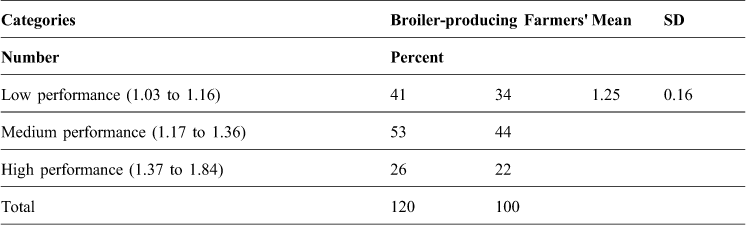
The observed performance ranged from 1.03 to 1.84 with the mean and standard deviation (SD) of 1.25 and 0.16 respectively. The broiler farms were classified into three categories on the basis of their performance in broiler production as shown in Table 1.
Distribution of the broiler-producing farmers on the basis of their performance in broiler production.
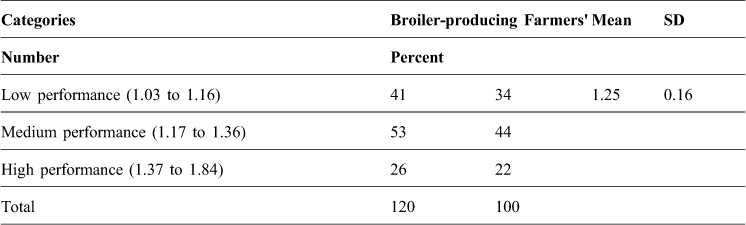
Findings revealed that an overwhelming majority (78%) of the farms reported low to medium performance in broiler production, compared to only 22% having high performance. Various factors may influence performance in broiler farming and various types of problem faced by farmers may cause this.
Selected factors of the broiler-producing farmers
Thirteen characteristics of broiler-producing farmers were considered for this study; age, education, land possession, family size, annual family income, training on poultry rearing, broiler farming experience, broiler farm size, capital invested in broiler production, credit need, contact with extension services, problem faced in broiler production and feed conversion ratio.
Education of the broiler-producing farmers was measured in terms of formal years of schooling. Land possession was determined by the area of land on which the farmer carried out their agricultural operations, including homesteads, and was expressed in hectares. The number of family members determined the working units of the farm. Annual family income was measured by the total yearly earnings (in thousand taka) from different sources by the members of a broiler farmer's family. Training exposure on poultry rearing was measured by the number of days of training received on poultry rearing by the farmers. Broiler farming experience was measured by the actual years of involvement in broiler farming. The total area of broiler shed(s) was used to determine broiler farm size and was expressed in square-feet. Capital used in broiler production of a broiler farmer was determined by the total capital used by the farmer in broiler production and was expressed in thousands taka.
Credit need for broiler production of a respondent was computed by using the following formula as suggested by Kashem (Reference KASHEM1986), and was expressed in percentage:
![Credit need = \begin{eqnarray} \frac{{{\rm{ Requirement of credit - credit received}}}}{{{\rm{Requirement of credit}}}} \end{eqnarray}] x 100](https://static.cambridge.org/binary/version/id/urn:cambridge.org:id:binary:20151024024335253-0736:S0043933910000127_eqn2.gif?pub-status=live)
Extension contact score of a broiler farmer was computed by summing up the farmers obtained scores against eleven selected communication media with five alternative responses as 'regular', 'often', 'occasional', 'rare' and 'not at all' contact. Scores were assigned for these alternative responses as 4, 3, 2, 1 and 0 respectively and logical frequencies of visits were considered for these alternative responses.
Problems faced in broiler production by farmers were ascertained by adding the scores of responses against 23 selected problem factors regarding the classification of the problems as severe, moderate, small and not at all and scores were assigned as 3, 2, 1 and 0 respectively. Thus, problem faced in broiler production by the broiler-producing farmers ranged from 0 to 69, where 0 indicating no problem and 69 indicating high problems.
Feed conversion ratio (FCR) of production was determined by the average FCR of the previous three batches of broilers. Bangladesh farmers typically sell their broilers after 30 days of age, depending on the body weight and market price. For this reason, in most cases it is only possible to record feed intake by the birds up to 30 days of age. This amount was added together for all birds of each batch and averaged
Average live body weight of broilers was recorded at 30 days of rearing. To obtain average live body weight of the broilers, researchers randomly selected 10 birds from each batch, and these were expressed as averages. This, in combination with feed intake, was used to calculate the average FCR for each farm.
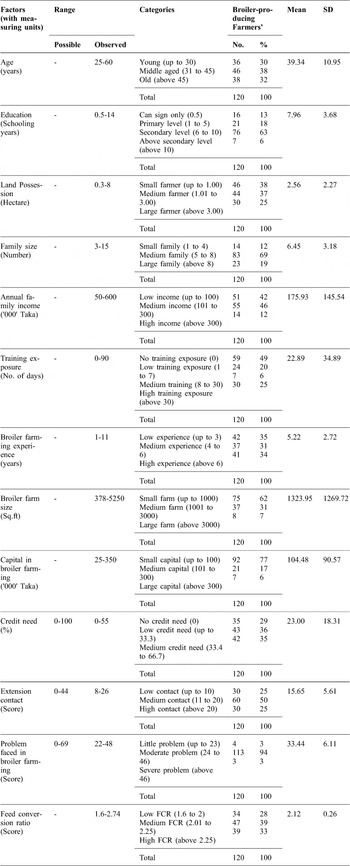
Salient features, including possible and observed ranges, numbers and percentage distribution, mean, standard deviation (SD) and categories of the 13 selected factors of the broiler-producing farmers are presented in Table 2.
Salient features of the selected factors of the broiler-producing farmers.

Relationship between the selected factors of the farmers and their performance in broiler production
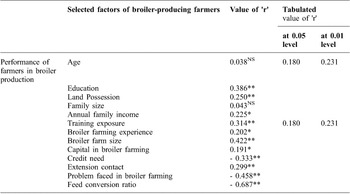
To determine the relationship between the performance of broilers with their selected factors, Pearson product moment correlation analysis was conducted. The results revealed that, out of 13 selected factors, education, land possession, annual family income, training exposure, broiler farming experience, broiler farm size, capital in broiler farming and extension contact had significant positive relationships with broiler performance (Table 3). It is logical that larger training exposure with higher education and higher experience makes a farmer better able to do his job properly. Larger land holdings per individual may help increase annual family incomes which could in turn help in higher capital investment in the broiler enterprise. Ultimately, larger broiler farm sizes could improve overall performance. On the other hand, more contact with different extension media by an individual could help the farmer collect up to date information on broiler farming which could help minimise certain problems in broiler farming and increase production.
Credit needs, management problems and feed conversion ratio had a significant negative relationship with broiler performance. More capital investment may be beneficial in overall productive performance. High feed conversion ratio is an important factor leading to lower productive performance. The remaining two variables, namely age and family size, had no significance relationship with broiler performance.
Summarized results of 'r' related to relationship between the selected factors of the farmers and their performance in broiler production.

NSNot Significant
*Significant at 0.05 level
**Significant at 0.01 level
Severity of problems faced by the farmers in broiler production
To determine the severity of the problems faced by the farmers in broiler production, a Problem Faced Index (PFI) and rank order was used. PFI of each problem was determined by using the following formula:
PFI = 3×fs + 2×fm + 1×fl + 0×fn
Where,
fs = Number of broiler-producing farmers faced severe problem
fm = Number of broiler-producing farmers faced moderate problem
fl = Number of broiler-producing farmers faced little problem
fn = Number of broiler-producing farmers faced no problem
PFI was made with all 23 selected problems. PFI of the problems could ranged from 0 to 360, where 0 indicated severe problems and 360 indicated no problems. Rank order was made by the descending order of PFI of all the problems, in order to compare the severity of the problems.
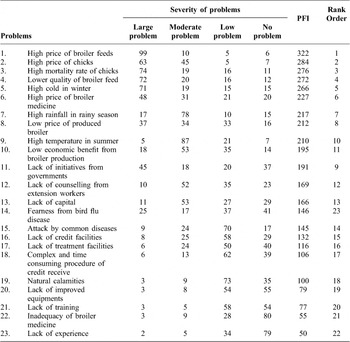
On the basis of PFI, the high price of broiler feeds ranked first followed by high price of chicks, high mortality rate of chicks, lower quality of broiler feed, cold temperatures in winter, high price of broiler medicine, high rainfall in rainy season etc. Lack of experience ranked the lowest problem. Severity of the selected problems are listed in Table 4.
Problem faced index with ranking order in broiler production.

USAID (Reference USAID2008) reported that high price of feed is a major problem in Bangladesh due to raw materials (maize, wheat, and soya meal) being imported from other countries. It is therefore difficult for a feed manufacturer to keep continuous track of each raw material consignment. The problem is further aggravated by the lack of proper technologies for processing feeds.
Conclusions and recommendations
1. The overwhelming majority (78%) of broiler farmers reported low to medium performance, compared to only 22% with high performance.
2. Therefore, it is recommended that the concerned authorities should take necessary steps to ensuring better inputs in the market, providing necessary treatment and management information etc. allowing farmers to get improved broiler production.
3. Education, training exposure, broiler farming experience and extension contact of the broiler-producing farmers had significant positive relationship with their performance in broiler farming. Therefore, it is recommended that concerned authorities should make available educational and motivational programmes, like targeted training, workshops and group discussions, to increase scientific knowledge.
4. Land possession, annual family income, broiler farm size and capital had significant positive relationship with performance. Therefore, it is recommended that low or no interest credit should be made available by the concerned authorities.
5. Feed conversion ratio had a significant negative relationship with broiler performance. It is recommended that higher quality feed and day-old chicks should be made more readily available.
6. Overall, it is recommended that concerned authorities, such as the District Livestock Officers, should pay attention to minimise the problems identified in this survey to ensure more efficient and economical broiler production in Bangladesh.
Acknowledgement
The research was conducted with financial support of Bangladesh Agricultural Research Council (BARC).