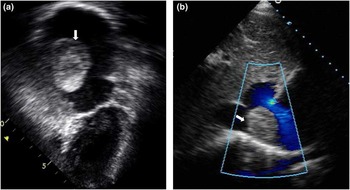
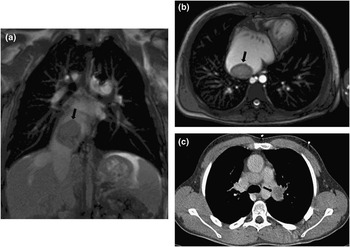
A 22-year-old male patient, who had undergone atriopulmonary Fontan operation for tricuspid atresia, 18 years before, was hospitalised for hypotension and hypoxia. He was in rapid atrial fibrillation. The International Normalised Ratio was 2.1 (warfarinised). Transthoracic echocardiography revealed a large, mobile thrombus (Fig 1: A modified apical two-chamber view (a) and subcostal long-axis view (b)) measuring approximately 43 × 39 × 55 millimetres, at the junction of a dilated right atrium with the inferior caval vein. Computed tomography (Fig 2c) showed the extension of the thrombus into the left pulmonary artery (arrow). These findings were confirmed on magnetic resonance imaging with contrast (Fig 2a and b) performed the next day, to provide baseline images for future comparison. The predisposing factors for the intracardiac thrombus in this case were the giant right atrium from his atriopulmonary Fontan operation and recent-onset rapid atrial fibrillation. He was digitalised and given a 500 micrograms per kilogram loading dose of Alteplase, followed by a maintenance infusion of 300 micrograms per kilogram per hour. This was stopped after 36 hours, when the fibrinogen level fell to 0.5 grams per litre, with oozing from the venepunctures. He was heparinised and after 4 days the clot could no longer be visualised echocardiographically. Resolution was confirmed with repeat magnetic resonance imaging. He was then cardioverted, started on amiodarone and recommenced on warfarin. He subsequently underwent conversion to a lateral tunnel total cavopulmonary connection, after which warfarin was continued.
Figure 1

Figure 2

Thromboembolism is a major cause of morbidity and mortality after the Fontan operation. There are no clear guidelines for the management of massive intracardiac thrombus, and the literature regarding this is sparse. Given the life-threatening situation of our patient, we elected to use a higher loading dose of Alteplase than previously published.Reference Zenz, Muntean, Beitzke, Zobel, Riccabona and Gamillscheg1 This strategy proved efficacious, while heparin sustained ongoing thrombolysis, thus avoiding emergency surgery.