Many studies show that reduction or omission of the dry period in dairy cows compromises milk yield in the subsequent lactation (reviewed by Bachman & Schairer, Reference Bachman and Schairer2003; Grummer & Rastani, Reference Grummer and Rastani2004; Overton, Reference Overton2005) and that a dry period between two successive lactations is required to allow a complete turnover of the mammary epithelial cells (Capuco & Akers, Reference Capuco and Akers1999; Annen et al. Reference Annen, Collier, McGuire and Vicini2004a).
However, several authors still consider the reduction or omission of the dry period as an alternative model for milk production. First of all, economic modelling of totally persistent lactation (Rotz et al. Reference Rotz, Zartman and Crandal2005) suggests that there may be a significant financial advantage in suppressing the dry period. Secondly, the reduction of milk yield may be, at least in part, compensated by some strategies aiming to enhance epithelial cell proliferation and/or reduce apoptosis, such as bovine somatotropin treatment (Annen et al. Reference Annen, Collier, McGuire, Vicini, Ballam and Mormore2004b) or increased milking frequency (Sorensen et al. Reference Sorensen, Muir and Knight2008). Moreover, feeding techniques may be able to modulate mammary cell proliferation and apoptosis and local IGF system (Weber et al. Reference Weber, Purup, Vestergaard, Akers and Sejrsen2000; Stefanon et al. Reference Stefanon, Colitti, Gabai, Knight and Wilde2002). Finally, several reports suggest that shortening or eliminating the dry period can improve energy balance and metabolic status, simplify feeding management (Andersen et al. Reference Andersen, Madsen, Larsen, Ingvartsen and Nielsen2005; Rastani et al. Reference Rastani, Grummer, Bertics, Gumen, Wiltbank, Mashek and Schwab2005; Madsen et al. Reference Madsen, Nielsen, Anderven and Ingvartsen2008) and lead to earlier post-partum ovulation (Gumen et al. Reference Gumen, Rastani, Grummer and Wiltbank2005).
The involvement of oxidative stress (OS) and antioxidant deficiency in the alteration of physiological processes and development of many pathological conditions in dairy cows is well documented (Miller et al. Reference Miller, Brzezinska-Slebodzinska and Madsen1993). Around calving, dairy cows are exposed to various metabolic pressures to face high milk yield, and the consequent increase in metabolic demand results in augmented rates of free radical production. If free radical generation is faster than their neutralization by antioxidant mechanisms, disturbance of the redox balance may occur and OS develops (Castillo et al. Reference Castillo, Hernandez, Bravo, Lopez-Alonso, Pereira and Benedito2005; Tanaka et al. Reference Tanaka, Kamiya, Kamiya, Shioya and Nakai2007). The possibility that the cow's metabolic activity might determine oxidant status has been suggested because various correlations between metabolic and oxidative biomarkers depending on the physiological condition of the cow have been detected (Castillo et al. Reference Castillo, Hernandez, Bravo, Lopez-Alonso, Pereira and Benedito2005). Indeed, modifications of plasma and erythrocyte oxidants and antioxidants during the transition period were observed in the study of Bernabucci et al. (Reference Bernabucci, Ronchi, Lacetera and Nardone2002) . In addition, the peri-partum period (particularly post partum) was characterized by a depleted antioxidant status and a progressive decline in antioxidant activity as lactation progressed (Bernabucci et al. Reference Bernabucci, Ronchi, Lacetera and Nardone2005) probably owing to the depletion of fat-soluble antioxidants through the milk (Castillo et al. Reference Castillo, Hernandez, Bravo, Lopez-Alonso, Pereira and Benedito2005).
The present study aimed to investigate the modifications of blood OS indicators in response to omission of the dry period and their relationship with plasma parameters of metabolic adaptation.
Materials and Methods
Experimental design
Seventeen Holstein Friesian dairy cows belonging to the experimental farm at the University of Padova (Italy) were randomly allocated in a control dried group (DRY; n=8) with a dry period of 55 d and a continuously milked group (CM; n=9). Experimental groups were homogeneous for average milk yield, expressed as mature equivalent (DRY=10 508±1157 kg; CM=10 925±1425 kg), days from expected calving (DRY=109±80; CM=99±79) and parity (DRY=1·75±1·04; CM=1·89±0·78). Three and four primiparous cows were included in the DRY and CM groups, respectively, while pluriparous cows were equally distributed in both groups, i.e. 5 animals each. DRY group cows were dried by a single daily milking for 5 d and milking was omitted on the 6th day. CM cows were continuously milked until parturition (i.e. no stop in milking). All procedures were carried out in respect of Italian legislation on animal care (DL n.116, 27/1/1992). Cows had free access to water and were fed once daily. During the dry period, cows of DRY group received ad libitum a total mixed ration (TMR) containing 11·6% crude protein (CP), 56% neutral detergent fibre (NDF) and 0·74 Milk Feed Units (MFU) on a dry matter (DM) basis. From 55 d before the expected calving date, the CM group received a TMR with 12·3% CP, 52·8% NDF and 0·80 MFU on DM basis. Animals of both groups were subjected to a steaming-up programme from 20 d before calving with increasing amounts of a commercial mixed feed for lactating cows (1–4 kg/d per head; Petrini Group, Italy). During the subsequent lactation period the two groups were fed ad libitum with a TMR containing 15·3% CP, 36% NDF and 0·91 MFU on DM basis, balanced to meet nutritional requirements of cows producing milk at 20 kg/d. To cover additional requirements due to milk production, a separate concentrate mixture was given through automatic feeders in accordance with milk yield. All nutritional requirements were obtained from INRA (1988) and NRC (2001) . More details on diets used during the experimental period are reported elsewhere (Mantovani et al. Reference Mantovani, Marinelli, Bailoni, Gabai and Bittante2010). Body condition score (BCS) was evaluated using a five-point scale (1=thin; 5=obese; Edmonson et al. Reference Edmonson, Lean, Farver, Farver and Webster1989) at 55 d and 15 d before expected parturition and at 1 d, 15 d, 30 d, 60 d and 90 d after calving. Individual BCS changes were calculated as differences between each recorded value and the individual value obtained at 55 d before calving.
Blood samples were collected from the jugular vein into heparinzed tubes at 60 d, 50 d, 40 d, 30 d and 7 d before expected parturition, and at 1 d, 7 d, 15 d, 30 d, 60 d and 90 d after parturition. An aliquot of whole blood was used to measure glutathione peroxidase (GPx) activity. Plasma was obtained by centrifugation at 1500 g at 4°C for 15 min.
Laboratory analysis
Commercial colorimetric kits were used to determine blood concentration of haemoglobin (No. 525-A, Sigma-Aldrich S.r.l., Milan, Italy) and GPx activity (Ransel, Randox Laboratories Ltd., Crumlin, UK). Unless otherwise stated, all chemicals used for both malondialdehyde (MDA) and GSH analysis were obtained from Sigma Aldrich S.r.l. (Milan, Italy). Plasma MDA was measured by the fluorimetric method described by Wasowicz et al. (Reference Wasowicz, Nève and Peretz1993) and expressed as thiobarbituric acid reactive substances. Briefly, 1 ml of 0·4% thiobarbituric acid in 0·2 m-HCl and 50 μl of 0·2% BHT in 95% ethanol were added to 0·1 ml of blood plasma in a sealed Pyrex tube. The mixture was heated in boiling water for 30 min. The reaction was stopped on ice and extraction was carried out with 3 ml of n-butanol. The butanol extracts were read on a fluorimeter (LS 50B, Perkin Elmer, Norwalk, USA) utilizing excitation and emission wavelengths of 532 nm and 553 nm, respectively. Total plasma GSH was determined by an enzymic recycling method adapted for microtitre plate reader (Baker et al. Reference Baker, Cerniglia and Zaman1990).
An indirect potentiometric analyser (Hitachi 911, Roche Boehringer, Mannheim, Germany) was used to analyse non-esterified fatty acids (NEFA, enzymic-colorimetric, Randox) glucose, urea, cholesterol and triglycerides (Roche Boehringer, Mannheim, Germany).
Plasma insulin was determined by a commercial kit (Coat-a-Count insulin®, Diagnostic Products Corporation, Los Angeles CA, USA) following the manufacturer's instructions. Coefficients of variation (CV) were 5·7% within assay and 8·5% between assays. Plasma cortisol was measured using a solid phase microtitre RIA after diethyl ether extraction (Gabai et al. Reference Gabai, Mollo, Marinelli, Badan and Bono2006). Intra- and inter-assay CV was 5·1% and 8·8%, respectively. The sensitivity of the assay was defined as the dose of hormone at 90% binding (B/B0) and was 3·125 pg/well.
Statistical analysis
Blood metabolites and BCS changes were analysed using the same hierarchical linear model for repeated measures using PROC MIXED (SAS Institute, 2000). After checking of the best fitting method for covariance structure between repeated measures, the autoregressive type was retained for the variables: cholesterol, triglycerides, insulin and GSH. Otherwise, a compound symmetry was assumed for the remaining variables. The model used was as follows:

where:
yijkl=single record of cow k in lactation group i and parity j;
μ=overall mean;
Gi=fixed effect of group (i=1, DRY; i=2, CM);
Pj=fixed effect of parity (j=1, primiparous; j=2, pluriparous);
GPij=fixed effect of interaction between group i and parity j;
Ck:ij=random effect of cow within GP;
Sl=repeated effect of sampling time l at fixed period before expected calving date or after calving (l=1–11 for blood metabolites and l=1–7 for BCS changes);
GSil=fixed effect of interaction between group i and sampling time l;
PSjl=fixed effect of interaction between parity j and sampling time l;
GPSijl=fixed effect of interaction between group i, parity j and sampling time l;
eijkl=random error term ~N(0, σ2e).
The ‘cow within GP’ variance (15 degrees of freedom) was directly used by PROC MIXED (SAS Institute, 2000) as error term for G, P and GP effects (main plot). For all analysed variables the degrees of freedom of the GS effect were used for testing the null hypotheses of differences between DRY and CM groups pooling the data obtained both before and after calving. For a more accurate analysis of blood metabolites over the entire experimental period, the null hypotheses of difference between groups at single sampling time was also evaluated using the PDIFF and Bonferroni t statistics adjustment method (SAS Institute, 2000).
Results
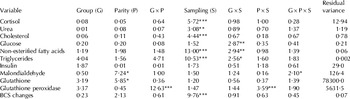
Results of statistical analysis on all factors accounted in the model are reported in Table 1. From the estimated residual variance the general se obtained for each variable ranged from 0·01 to 0·07 of the general mean for the metabolic indicators and 0·15 for BCS changes, owing to the lower number of measures taken over time for this variable than for metabolic indicators.
Results of mixed model analysis of variance for blood metabolites and BSC changes recorded (F statistic with significance for each effect and estimated residual variance)

*** P<0·001; ** P<0·01; * P<0·05; when absent P>0·05
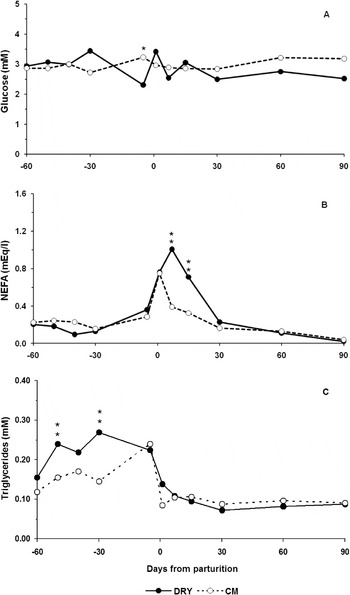
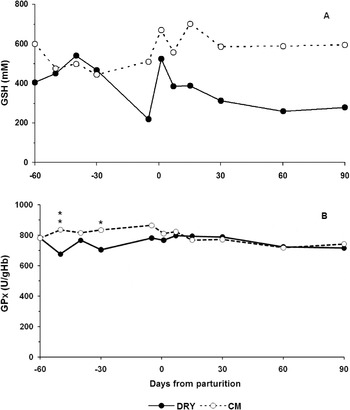
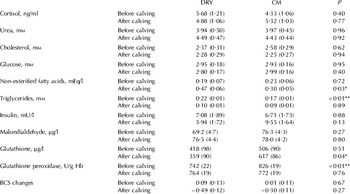
Sampling time significantly affected plasma concentrations of cortisol, urea, cholesterol, NEFA, triglycerides and BCS changes (P<0·01; Table 1). A significant effect of the interaction between groups and sampling time was observed in the plasma concentrations of glucose and NEFA (P<0·01) and triglycerides (P<0·05). The patterns of these metabolites are shown in Fig. 1. Plasma glucose concentrations were more stable in CM animals and they were significantly lower in DRY cows at 7 d before calving (P<0·05; Fig. 1A). Plasma NEFA concentrations (Fig. 1B) were very similar in the two lactation groups before parturition. After calving, circulating NEFA were greater (P<0·01) in DRY animals at 7 d and 15 d, resulting in overall greater (P<0·05) plasma NEFA concentrations in DRY cows after calving (0·47 v. 0·30 mEq/l for DRY and CM, respectively; Table 2). Plasma triglycerides concentrations were greater (P<0·01) in DRY cows before calving (0·22 v. 0·17 mm for DRY and CM, respectively; Table 2), showing greater concentrations (P<0·01) on day 50 and day 30 before calving (Fig. 1C). Plasma insulin concentrations were not significantly affected by omission of the dry period (Table 2). The effect of the interaction between groups and sampling time was not significant for OS indicators (Table 1). However, plasma MDA concentrations were greater (P<0·05) in pluriparous than in primiparous cows (82·9 v. 67·5 μg/l, respectively). On average, total plasma GSH concentrations were greater (P<0·05) in CM animals after parturition in comparison with DRY cows (617 v. 359 μg/l, respectively; Fig. 2A; Table 2). In addition, plasma GSH concentrations were greater in pluriparous than in primiparous cows (592 v. 358 μg/l, respectively; P<0·05). Plasma GPx concentrations were greater (P<0·01) in CM than in DRY cows before parturition (826 v. 742 U/g Hb, respectively; Table 2) with differences between groups that were significant at 50 d (P<0·01) and 30 d before parturition (P<0·05) (Fig. 2B). BCS changes showed a similar pattern both before and after calving (Table 2).
Plasma concentrations of glucose (A), non-esterified fatty acids (NEFA) (B) and triglycerides (C) measured throughout the experimental period in cows having a 55-d dry period (DRY; black circles) and cows milked continuously (CM; open circles). * P<0·05; ** P<0·01 at each sampling time comparison.

Plasma concentrations of glutathione (GSH) (A) and glutathione peroxidase (GPx) (B) measured throughout the experimental period in cows having a 55-d dry period (DRY; black circles) and cows milked continuously (CM; open circles). * P<0·05; ** P<0·01 at each sampling time comparison.

Mean (se) blood metabolite concentrations and mean (se) body condition score (BCS) changes in cows having a 55-d dry period (DRY) and cows milked continuously (CM) before and after parturition

Discussion
To our knowledge, this is the first reported investigation of the effect of omission of the dry period on blood indicators of OS in the transition cow. Data concerning milk yield and quality are described thoroughly elsewhere (Mantovani et al. Reference Mantovani, Marinelli, Bailoni, Gabai and Bittante2010). However, to understand the whole picture, here we report that milk production recorded over the whole lactation resulted in a 24% reduction in CM cows, confirming that continuous lactation seems detrimental to milk production, particularly in primiparous cows, which suffered a greater reduction (33%) than pluriparous (15%).
Although the modifications of blood metabolic indicators and BCS changes were in agreement with the characteristic metabolic adaptations described for the transition cow (Bell, Reference Bell1995) in both groups, the present data suggest that these adaptations were milder in CM animals.
Apparently, omission of the dry period did not affect metabolic adaptations occurring before calving, and only circulating triglycerides were greater in CM group during most of the dry period. In ruminants, plasma triglycerides are mainly a component of very low density lipoproteins (VLDL) which are a source of lipids for the mammary gland. Hence, the lower plasma triglycerides observed in CM cows may be explained by milk fat synthesis and secretion (Bernard et al. Reference Bernard, Leroux, Chilliard and Bosze2008). BCS was not significantly different between groups as in Andersen et al. (Reference Andersen, Madsen, Larsen, Ingvartsen and Nielsen2005), indicating that continuous milking does not affect the body reserve reconstitution, which occurs well before the dry-off (Knight, Reference Knight2001). On the contrary, Rastani et al. (Reference Rastani, Grummer, Bertics, Gumen, Wiltbank, Mashek and Schwab2005) report a significant reduction of BCS after calving in traditionally dried cows with respect to CM animals. Despite BCS changes observed in our study being not different between groups after calving, CM cows showed changes of metabolic indicators that seemed to indicate a reduced mobilization of body reserves. In particular, the variations of plasma insulin, glucose and NEFA were similar to those observed in continuously milked cows by Andersen et al. (Reference Andersen, Madsen, Larsen, Ingvartsen and Nielsen2005) who hypothesized that CM cows experienced a less negative post-partum energy balance owing to the lower milk yield. Less negative energy balance in the post-partum period of CM cows was also reported by Rastani et al. (Reference Rastani, Grummer, Bertics, Gumen, Wiltbank, Mashek and Schwab2005) . In our experiment, however, it is noteworthy to observe that plasma NEFA were significantly lower in the CM group at 7 d and 15 d after calving, when milk yield was not yet markedly different between the groups (Mantovani et al. Reference Mantovani, Marinelli, Bailoni, Gabai and Bittante2010), somehow anticipating milk yield energy demand. In our opinion, post-partum energy balance does not totally explain the lower degree of NEFA mobilization observed in CM animals, which might be controlled by events occurring before parturition such as feeding level. Loor et al. (Reference Loor, Dann, Janovick Guretzky, Everts, Oliveira, Green, Litherland, Rodriguez-Zas, Lewin and Drackley2006) observed that the plane of nutrition prepartum alters the expression profile of hepatic genes, which can partly explain differences in blood metabolites. In particular, these authors observed that animals fed a restricted energy intake prepartum showed lower concentrations of plasma NEFA post partum and a more pronounced up-regulation of hepatic genes related to fatty acid oxidation. It is possible that dietary differences prepartum related to continuous milking influenced the level of expression of key genes involved in fat mobilization.
Plasma glucose was similar in DRY and CM cows after calving, despite milk yield being considerably different between groups (Mantovani et al. Reference Mantovani, Marinelli, Bailoni, Gabai and Bittante2010). Rastani et al. (Reference Rastani, Grummer, Bertics, Gumen, Wiltbank, Mashek and Schwab2005) found no differences in glucose and NEFA level prepartum, but increased glucose and decreased NEFA post partum. Moreover Andersen et al. (Reference Andersen, Madsen, Larsen, Ingvartsen and Nielsen2005) observed lower NEFA and greater glucose and insulin concentrations in continuously milked cows. However, in the study of Andersen et al. (Reference Andersen, Madsen, Larsen, Ingvartsen and Nielsen2005) plasma concentrations of insulin, glucose and NEFA were significantly different between groups during both the pre-partum and post-partum periods. Differences between our study and that of Andersen et al. (Reference Andersen, Madsen, Larsen, Ingvartsen and Nielsen2005) might be explained by the different expected milk yield that was greater in the cows used by the Danish authors than in ours (45 v. 35 kg of expected milk yield at peak, respectively).
MDA is a toxic by-product generated by lipid peroxidation, while GPx is the most important peroxide-scavenging enzyme in mammalian cells. Both MDA concentration and GPx activity can be considered to be two common indicators of oxidative stress (Halliwell, Reference Halliwell1994). Other authors observed that plasma MDA increased post partum (Bernabucci et al. Reference Bernabucci, Ronchi, Lacetera and Nardone2002; Reference Bernabucci, Ronchi, Lacetera and Nardone2005). In the present study, plasma MDA was quite stable and not different between groups. Previously (Gabai et al. Reference Gabai, Testoni, Piccinini, Marinelli and Stradaioli2004) it was observed that a combination of factors such as recovery from negative energy balance and diet composition may influence the circulating levels of MDA. It is thus possible that plasma MDA is not sensitive enough to detect moderate OS conditions, and the different physiological status of cows among the different studies might be the major factor responsible for the discrepancies observed in MDA concentrations.
Bernabucci et al. (Reference Bernabucci, Ronchi, Lacetera and Nardone2002) observed that erythrocyte GPx levels did not vary significantly around parturition. However, the same authors (Bernabucci et al. Reference Bernabucci, Ronchi, Lacetera and Nardone2005) observed a distinct drop in erythrocyte GPx concentrations between days −4 and +11 relative to parturition. In the present experiment, we measured whole blood GPx and did not observe any modification of this parameter around parturition. However, greater blood GPx levels were observed in the CM group before calving, when these animals received a diet aimed to support milk secretion. On the contrary, plasma GPx concentrations were not different between groups after calving, when lactation started in the DRY group and the two groups were fed a similar diet.
It is noteworthy that the differences in milk synthesis observed in this experiment did not affect the circulating levels of MDA and GPx after parturition. These observations support the hypothesis that diet composition rather than milk synthesis and secretion may explain the slightly greater degree of oxidative stress observed in CM group before calving.
GSH is the most abundant non-protein thiol in mammalian cells and can be considered a good indicator of the blood oxidative scavenging capacity (Wu et al. Reference Wu, Fang, Yang, Lupton and Turner2004). In the present study, plasma GSH was greater in the CM group but these differences were not related to modifications of GPx activity. For this reason, we hypothesized that the GSH variations observed in this experiment are unlikely to be related to OS. Rather, they may be related to metabolic adaptations such as sulphur-amino acid sparing. In this respect, it is important to remember that GSH is also an important source of storage and transport of cysteine (Wu et al. Reference Wu, Fang, Yang, Lupton and Turner2004). As the enzyme γ-glutamyl transpeptidase, which degrades GSH to form γ-glutamyl amino acids, is located on the extracellular surface of the mammary secretory cells (Baumrucker et al. Reference Baumrucker, Pocius and Riss1981) and its activity increases greatly during lactation (Johnston et al. Reference Johnston, Kitson, Tweedle, Davis and Lee2004), it is likely that the mammary gland utilizes the constituent amino acids of GSH for milk protein synthesis. Indeed, cows of the CM group produced less milk and, accordingly, spared circulating GSH. However, this observation is not in agreement with the level of circulating insulin, which was not different between groups after calving.
The results of this study confirmed that abolishing the dry period leads to an improved energy balance and metabolic status of the cows. Probably this may depend not only upon the reduced milk yield, but also on other factors such as pre-partum feeding. In general, the degree of OS observed in this study was not detrimental for animal health. Modifications of MDA and GPx observed before calving were mild and possibly related to milk secretion. During the subsequent lactation, plasma MDA and blood GPx were similar in the two groups despite the differences in milk yield. Differences in plasma GSH observed in the subsequent lactation are probably related to sulphur-amino acid sparing occurring in CM cows.
This study was supported by the Italian Ministry of University (PRIN 2001 and PRIN 2005). The authors are grateful to Dr Laura Da Dalt, Dr Alberto Simonetto and Mr Tommaso Brogin for their skilled technical support and to the anonymous reviewers for helpful comments and suggestions on the manuscript.