Foraging pollinators are often affected by population size and density of plants, which produce floral rewards for their visitors. According to the model proposed by Rathcke (Reference RATHCKE and Real1983), the effect of density can be positive as well as negative. At lower flower densities an increase in density leads to an increase in visitation rates. At higher flower densities, visitation rates decrease because visitor abundance has reached its upper threshold and plants compete for pollinators. However, the effect is scale dependent because pollinators must be able to perceive the differences in flower density (Jakobsson et al. Reference JAKOBSSON, LÁZARO and TOTLAND2009, Wagenius Reference WAGENIUS2006). The so-called effective floral neighbourhood is the radius, in which the abundance of flowers or plants affects visitation rates of a single plant (Jakobsson et al. Reference JAKOBSSON, LÁZARO and TOTLAND2009). It depends on the pollinator's biology, ecology and environmental variables. These characteristics are often not known and difficult to determine. One way to overcome this problem is to determine the effect of density at increasing distances from a focal plant and to identify the radius at which the density affects visitation rates.
This study aims to delimit the effective floral neighbourhood of Clusia blattophila, which is pollinated by the cockroach Amazonina platystylata (Vlasáková et al. Reference VLASÁKOVÁ, KALINOVÁ, GUSTAFSSON and TEICHERT2008). It aims to tests the following hypotheses: (1) There is a critical distance up to which the number of flowering plants influences visitation rates of C. blattophila; (2) Up to the critical distance, visitation rates change in relation to the sex ratios of flowering plants (C. blattophila is dioecious, and its female flowers provide no reward); and (3) The amount of shrub vegetation influences visitation rates.
The study was undertaken on the Nouragues inselberg in the Nouragues Natural Reserve, French Guiana (4°5′N, 52°41′W). This massive granite outcrop is a physiographic island of a so-called rock savanna surrounded by primary lowland rain forest. Inselberg vegetation consists of distinct communities closely adapted to varying microclimatic conditions (Sarthou & Villiers Reference SARTHOU and VILLIERS1998). Exposed rocks overgrown with a cryptogamic crust surround patches of vegetation (Sarthou Reference SARTHOU, Bongers, Charles-Dominique, Forget and Théry2001).
Clusia blattophila M. H. G. Gust. & B. Vlasáková (Clusiaceae, Clusia sect. Oedematopus) is a dioecious shrub that usually grows 2–10 m tall. This species dominates the shrub vegetation on the Nouragues inselberg. Female flowers open for two nights; male flowers bloom for one night only. Plants usually carry only few open flowers. Nocturnal flowers are pollinated mainly by Amazonina platystylata cockroaches (Vlasáková et al. Reference VLASÁKOVÁ, KALINOVÁ, GUSTAFSSON and TEICHERT2008). Female flowers offer cockroaches no reward and are pollinated only by mistake; male flowers produce a liquid secretion from glands located at the base of the androecium (Vlasáková & Gustafsson Reference VLASÁKOVÁ and GUSTAFSSON2011).
Amazonina platystylata Hebard (Blaberoidea, Blattellidae) is a South American cockroach species whose range extends from Venezuela to Peru and Argentina (Hebard Reference HEBARD1926, Princis Reference PRINCIS and Beier1969). Adults are 9–13 mm long, capable of active flight while nymphs are flightless (Hebard Reference HEBARD1929, Vlasáková et al. Reference VLASÁKOVÁ, KALINOVÁ, GUSTAFSSON and TEICHERT2008). Very little is known about the behaviour and ecology of this species. The litter layer under Clusia bushes is probably the principal living habitat on the Nouragues inselberg (pers. obs.).
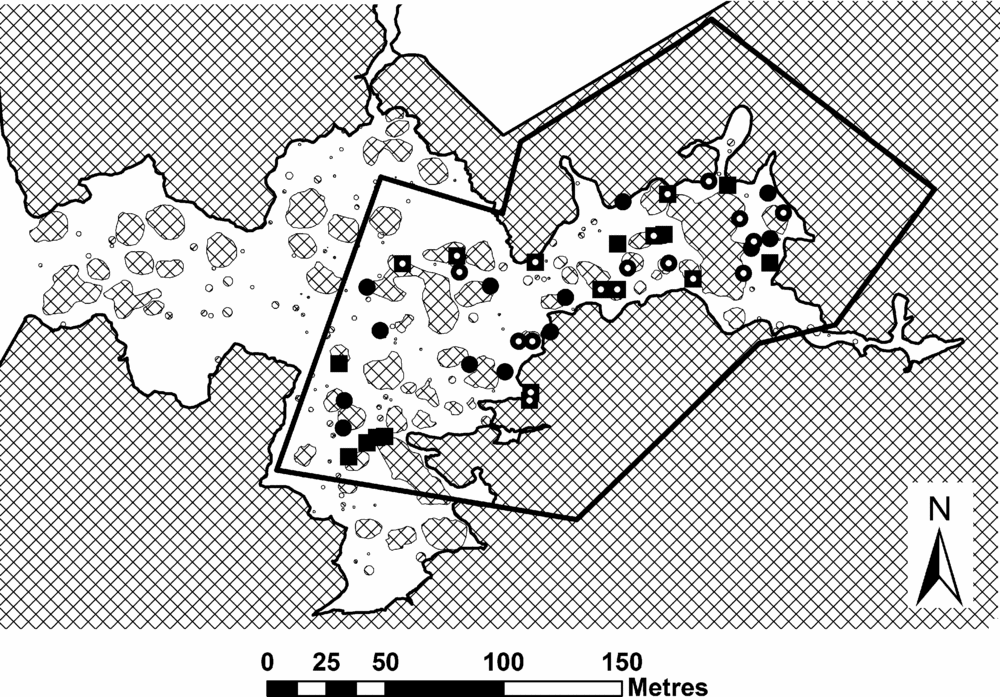
The positions of all flowering plants (27 female plants and 29 male plants) were marked in a 1.5-ha study area. Recordings of 13 male flowers and 25 female flowers from nine male and 10 female plants were taken between 19h00 and 05h00 under infrared illumination using Sony Handycam camcorders. Mean visit duration and the total number of cockroach visitors were determined for each recording session. The study plants were chosen haphazardly (Figure 1). In ArcMap 9.2 (Esri Inc.), eight zones were created around each study plant delimited by concentric circles with increasing radius. The radius of the zones ranged from 10 to 45 m in 5-m increments. For each zone, the number of flowering plants, flowering males and females was calculated. Total shrub area in each zone was calculated from the available map. Only shrub communities were considered because other communities did not seem to provide any particular food resource to the cockroaches. Only zones completely within the study area were included.
Map of the study site where the dependence of flower visitation by Amazonina platystylata on density of Clusia blattophila and total shrub area was examined. The crosshatched areas outline shrub patches and low forest. The line depicts the study area. Squares (■) represent female flowering plants; circles (●) represent male flowering plants. Symbols with empty dot inside depict the study plants.

Non-parametric Kruskal–Wallis test was used to test the differences in number of visitors among flower stages (male, first-night female, second-night female). Generalized linear regression models (GLZ) with Poisson distribution and log link were fitted and analysis of deviance performed to test the effect of spatial predictors on the number of cockroach visitors. Two outliers were omitted from the analyses. One-way ANOVA was used to test the differences in mean visit duration among flower stages. Linear regression models (GLM) were used to analyse the effects of spatial predictors on mean visit duration. Mean visit duration was log-transformed to attain normal distribution. Two analyses for each dependent variable were carried out per each zone. The models for each zone included flower sex (covariate) and the following spatial predictors: (1) the number of flowering plants or the ratio of flowering male plants to all flowering plants and (2) total shrub area. When multiple tests are performed on inter-related data the probability of Type I error increases. To reduce the risk, the α-value was corrected using the modified FDR (false discovery rate) procedure by Benjamini & Yekutieli (Reference BENJAMINI and YEKUTIELI2001) and set to 0.015. All analyses were performed in STATISTICA version 12 (StatSoft, Inc.).
In many plant species that have the female phase separated from the male phase, only male phases provide reward to pollinators and flowers in the female phase are visited by mistake (Renner Reference RENNER and Waser2006). Accordingly, the number of cockroach visits does not differ between flowers sexes in C. blattophila (Kruskal–Wallis χ2 = 2.4, P = 0.31) but cockroaches spend significantly less time on the rewardless female flowers (F1,20 = 6.4, P < 0.003). It suggests that cockroaches are not able to distinguish between the sexes until after the visit has begun.
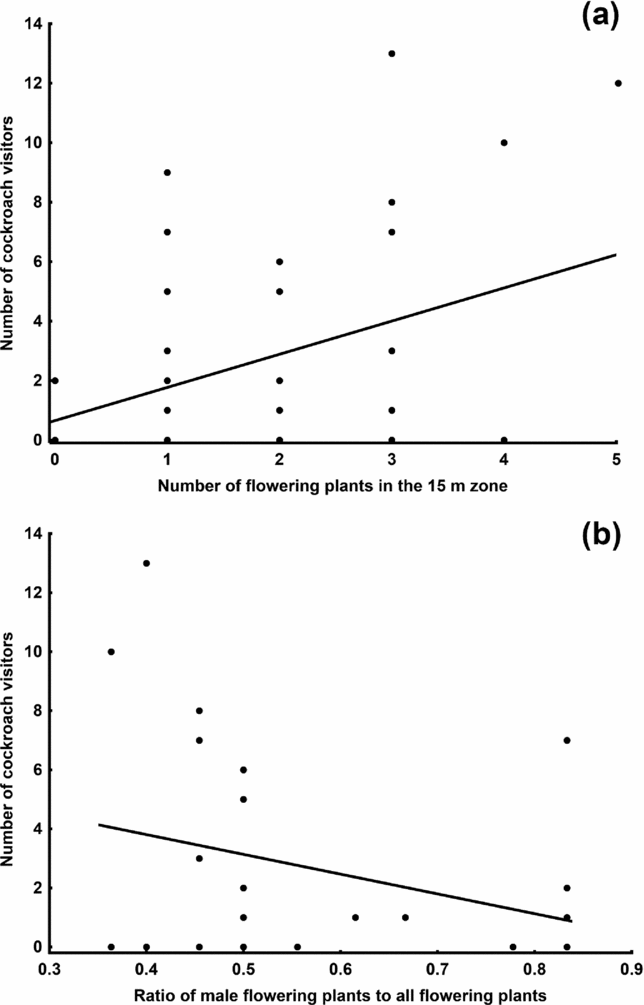
Both facilitative and competitive effects of plant density were documented at different scales. On the small scale (15-m radius) increasing abundance of flowering plants led to an increase in the number of visits (Figure 2a, χ21,31 = 17.8, P < 0.0003). The positive effect likely resulted from increased floral display (floral scent concentration), because density of all flowering plants had a facilitative effect, although only males provide any reward. The results suggest high mobility of cockroaches at the 15-m radius because the cockroaches can apparently evaluate differences in flowering plant densities at this scale.
Plot of the generalized linear model with Poisson distribution depicting the dependence of the number of cockroach visitors of Clusia blattophila on the number of flowering plants in the 15-m zone (a) and ratio of flowering male plants to all flowering plants in the 35-m zone (b).
On the large scale, in the 35-m (Figure 2b, χ21,23 = 13.3, P < 0.0003), 40-m (χ21,23 = 11.3, P < 0.0003) and 45-m zone (χ21,20 = 10.5, P < 0.003), an increase in male plant abundance leads to a decrease in the number of visits, which indicates competition of plants for pollinators (Brys et al. Reference BRYS, JACQUEMYN and HERMY2008, Steven et al. Reference STEVEN, ROONEY, BOYLE and WALLER2003). This suggests that cockroaches cannot evaluate differences in flowering plant density at this scale because they do not regularly wander and forage across such ranges. The connection between pollination services and foraging ranges was also suggested by Wagenius (Reference WAGENIUS2006) for solitary bees. In this study, only male plants were the relevant competitors because only increasing number of male plants caused an increase in resource availability. Hence, the number of males had a significant effect on visitation rates whereas the number of all flowering plants did not.
Permeability of landscape structures by insects is species-specific (Cant et al. Reference CANT, SMITH, REYNOLDS and OSBORNE2005, Krewenka et al. Reference KREWENKA, HOLZSCHUH, TSCHARNTKE and DORMANN2011, Mauremooto et al. Reference MAUREMOOTO, WRATTEN, WORNER and FRY1995). In this study, the amount of shrub vegetation had no effect on visitation rates (no significant results in the tests). These results suggest that it did not affect cockroach mobility.
Visit duration depends on many small-scale factors such as the resource content received at last-visited flowers, local flower density or distances between flowers on one plant (Goulson Reference GOULSON2000, Harder Reference HARDER1990, Kadmon & Shmida Reference KADMON and SHMIDA1992). Visitors evaluate these signals to optimize their foraging (Pyke et al. Reference PYKE, PULLIAM and CHARNOV1977). Such small-scale differences were not examined in this study. On the larger scales, mean visit duration was not affected by the distribution of flowering plants and the abundance of shrub patches (no significant results in any of the analyses). Hence, the effective neighbourhood, which determines the mean visit duration, could not be delimited.
This study demonstrates that environmental factors affecting visitation rates operate at different scales. Hence, sizes of the effective neighbourhood differ depending on the environmental predictors and the biological processes behind them.
ACKNOWLEDGEMENTS
I wish to thank Veronika Chroustová, Jan Pinc and Zuzana Ježková for field assistance and data processing. This study was supported by the Czech Science Foundation (grant No. P505-12-P039) and by the long-term research development project No. RVO 67985939.