This article reviews recent changes in social protection in Latin America, focusing particularly on the emergence of new forms of social assistance, including large scale income transfer programmes and integrated anti-poverty programmes such as Chile Solidario. The growing literature on these programmes is testament to the enormous interest they elicit, not least from researchers working in developing countries concerned with poverty and the reduction of vulnerability. The main focus of this literature has been on determining the impact of these programmes and the effectiveness, or otherwise, of their innovative design features. This is to be welcomed, especially as knowledge of the effectiveness of anti-poverty programmes must surely qualify as a global public good. However, it is also important that broader questions posed by the emergence of these programmes are addressed. How do the new programmes fit into the broader social protection and social policy in Latin America? What conceptual frameworks underpin them? What do they tell us about the future of social protection in the region? This article focuses on these questions, which have hitherto been somewhat neglected in the literature.Footnote 1 It also aims to contextualise and conceptualise emergent forms of social assistance in the region.
Social protection is defined here as ‘public actions taken in response to levels of vulnerability, risk and deprivation, which are deemed socially unacceptable within a given polity and society’.Footnote 2 Social protection has three main components: social insurance, social assistance, and labour market regulation. Social insurance refers to programmes providing protection against life course and employment hazards, financed out of contributions from employers, workers and governments. Social assistance includes programmes supporting those in poverty, and is largely financed from government revenues. Labour market regulation includes protection against unfair dismissal, and the right to voice and representation of workers.Footnote 3 Before the 1980s, the three main components of social protection in Latin America followed the pattern of southern Mediterranean countries, with social insurance funds providing protection for formal sector workers.Footnote 4 Social assistance was residual and provided minimal and patchy support for impoverished groups. Labour market regulation emphasised job protection, through placing restrictions on dismissals.Footnote 5 In common with southern Mediterranean countries, social insurance and employment protection supported families through an assumed ‘male breadwinner’, and social assistance was strongly maternalistic.Footnote 6 However, in contrast to Mediterranean countries (with the exception of Costa Rica, Uruguay and perhaps Argentina), these forms of protection did not reach the majority of the labour force engaged in informal employment, and their dependants. The expectations of policy makers were that economic development would gradually reduce, and eventually eliminate, informality.
The forms of social assistance currently emerging in the region signal a new emphasis and direction for social protection, and represent a significant break with the past. This shift in social protection reflects a very radical change in the development model in the region. The acute economic crisis which affected Latin America at the beginning of the 1980s, commonly referred to as ‘the lost decade’, marked the beginning of a fundamental change in the broad model of capitalist accumulation and development, from ‘import substitution industrialisation’ (ISI) to ‘export led growth’.Footnote 7 The crises and the structural adjustment which followed produced a steep rise in poverty and vulnerability.Footnote 8 This also forced changes in the political settlement sustaining the development model, with important implications for social protection.Footnote 9 In broad terms, the ISI model was sustained by a coalition of urban formal sector workers and industrial interests, buttressed by state institutions and programmes. These state institutions bore the brunt of structural adjustment, and proved inadequate to cope with the social impact of the crises.
In the aftermath of the 1980s crisis, the focus of policy was on the reform of social insurance, and especially pension funds.Footnote 10 This extended to health insurance too, in those countries where pensions and health insurance were bundled together.Footnote 11 Labour market liberalisation was far reaching, adding to the already large, and growing, share of workers in informal employment.Footnote 12 During the late 1990s, the weight of social policy shifted towards social assistance, with the emergence of large scale programmes focusing on poverty and vulnerability reduction. This has involved the reform and extension of income transfer programmes,Footnote 13 such as non-contributory pensions in Brazil or Bolivia; conditional cash transfer programmes, such as Progresa/Oportunidades in Mexico, Bolsa Escola/Bolsa Familia in Brazil, or Trabajar/Jefes y Jefas in Argentina; and integrated anti-poverty programmes, such as Chile Solidario.
Policy debates on new forms of social assistance in Latin America have focused on conditional cash transfer programmes; income transfer programmes focused on poor and poorest households which are made conditional on access to education or health services, or the supply of labour.Footnote 14 However, conditional cash transfer programmes are not the only innovation worthy of our attention among new forms of social assistance in the region; pure or unconditional income transfers and integrated poverty programmes, which bundle several interventions together, are also reviewed.Footnote 15 It is argued here that conceptualising and contextualising new forms of social assistance is essential to: (i) understanding their emergence, role and impact; (ii) making sense of the design innovations the new social assistance programmes have introduced, including the much discussed issues of targeting, conditionalities, time windows and graduation expectations; and (iii) placing the emergent forms of social assistance within wider changes in the development model and political settlement.
The remainder of this article is divided into four sections. Section one provides a brief overview of social protection before the ‘lost decade’ and traces social protection responses in the aftermath of the 1980s crisis. Section two outlines the new forms of assistance which have emerged in the region in the last decade. It identifies common features suggesting a distinctive approach, and explores the conceptual frameworks which underpin them. Section three discusses key issues around new forms of assistance: scale and scope, impact, time windows and exit strategies, finance and delivery. A final section draws out the main conclusions and identifies lessons for other developing countries.
Social Protection Before and After ‘The Lost Decade’
The evolution of social protection before the ‘lost decade’ was initially influenced by the example of southern Mediterranean countries,Footnote 16 and later by the International Labour Organisation (ILO) in the 1950s and 1960s.Footnote 17 Its core consisted of social insurance funds, cajas de previsión, financed by contributions from workers and their employers. These provided a degree of protection from life course and work related contingencies. Social insurance funds were initially established for specific groups of workers. Later they were extended to cover a wider range of workers and contingencies. The expectation among policy makers was that economic development would eventually lead to the incorporation of the entire formal labour force, thus replicating the spread of social protection in European countries ‘from the strong to the weak’.
Mesa-Lago distinguishes three groups of countries in the region.Footnote 18 In the first group, the pioneer countries, stratified social insurance funds developed in the 1920s. This group includes Chile, Uruguay, Argentina, Cuba and Brazil. A second group of intermediate countries includes Colombia, Costa Rica, Mexico, Paraguay, Peru and Venezuela, in which social insurance developed after the 1940s. A third group of mainly Central American countries, the latecomers, developed social insurance institutions much later, in the 1950s and 1960s. The ‘pioneer’ countries from the Southern Cone made significant advances towards a European-style social insurance. Employment stability for the assumed male bread-winner ensured that the protection carried over to his dependants. The emphasis on social insurance and employment protection meant that social assistance was at best residual, both in terms of contingencies and groups covered. By contrast to social insurance, social assistance was strongly maternalistic, with an emphasis on family and in kind benefits.Footnote 19 By the end of the 1970s, in Chile, Brazil, Uruguay and Argentina the share of the labour force covered by social insurance schemes had reached over 70 per cent.Footnote 20 For most other countries in the region, informality set hard limits to the development of social insurance funds. Employment protection was essential to this model. Social protection in Latin America was ‘truncated’ at the margins of formal employment.Footnote 21
The political settlement associated with ISI is an important part of the explanation for the ‘truncated’ nature of social protection institutions and for the residual role of social assistance. Support from formal sector workers, especially those in the public sector, military and police, and key export sectors, was essential to sustaining the development model. Social protection ensuring minimum levels of security for these workers was a key element in the political settlement which provided a measure of stability for the development model. The focus on workers in formal employment also meant that social assistance was not only residual, but also did not necessarily focus on the poor and poorest. Indeed social protection in Latin America is largely regressive in distributional terms. Regressivity arises both from the incidence of taxation and from the large public transfers to social insurance.Footnote 22 A recent paper has coined the term ‘reverse Robin Hood’ to describe the distributional impact of social protection in Latin America, in that it takes income mainly from the poor only to give it mainly to the non-poor.Footnote 23
The 1980s crisis, and the structural adjustment which followed, led to extensive liberalisation of trade and factor markets. The incidence of labour market informality is a good indicator of the impact of liberalisation. According to ILO figures, the share of employees in the urban labour force not covered by social insurance increased from 33.4 per cent in 1990 to 36.3 per cent in 2002, thereafter declining to 25.2 per cent in 2006. Meanwhile, the share of the urban population in work (including employees and the self-employed) who are not covered by social insurance grew from 48.2 per cent in 1990 to 51.2 per cent in 2002, declining to 39.2 per cent in 2006.Footnote 24 The upward trend in urban informality up to 2002 seriously challenges the expectations held before the 1980s regarding the gradual extension of social protection. It also calls into question the extent to which employment-based social protection systems in the region could ever reach beyond the minority of the labour force, mainly consisting of public and formal sector workers.Footnote 25 In some countries, the decline in the labour force coverage of social insurance was precipitous. Argentina is a case in point: while in 1980 around 70 per cent of the labour force was contributing to a social insurance fund, by 2003 this figure had dropped to 35 per cent, thereafter recovering to 45.4 per cent in 2006.Footnote 26
Emergency responses to the rise in poverty and vulnerability in the wake of the crisis proved inadequate. The residual social assistance institutions in place before the 1980s did not have the capacity to provide an effective response to the rapid rise in poverty and vulnerability, and in any case structural adjustment hit public agencies – and their budgets – hardest.Footnote 27 Some countries, with support from international institutions, put in place emergency safety nets, mainly in the form of public works and in kind transfers. These proved insufficient and highly divisive given the blunt and discretionary nature of the targeting instruments employed. Emergency responses then gave way to social funds and sectoral programmes targeting ‘vulnerable’ groups. Social funds were set up to support demand-led community initiatives, and involved emergent NGOs,Footnote 28 but they rarely reached the scale required to address widespread poverty and vulnerability, and the creation of parallel structures to government agencies meant that they were unlikely to make a significant contribution to developing long term social assistance institutions and the social contracts needed to underpin them.Footnote 29 Some countries focused social programmes on vulnerable population groups such as indigenous people, senior citizens, or women, which created fragmented sectoral institutions with little flexibility to respond to the overall dynamics of poverty. These did not prove successful either, as they failed to exploit opportunities for economies of scale in programme design and implementation, and often targeted the same population many times with separate but insufficient forms of support.
New Forms of Social Assistance
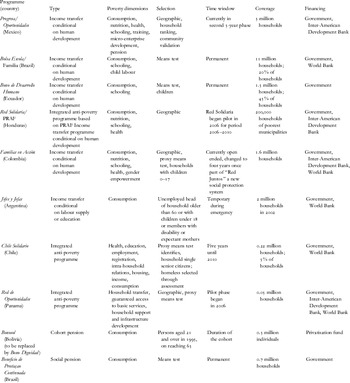
In this section we focus on the new forms of social assistance currently emerging in the region. Table 1 provides some examples of new social assistance programmes in the region, and the text that follows discusses the main common features defining a distinctive approach. The table is not intended to provide a comprehensive listing of new social assistance programmes in the region.Footnote 30 Instead, our objective is to show the range of social assistance programmes based around income transfers to poor households, and introduced in the last decade or so. The table provides examples of pure income transfers, non-contributory pensions in Bolivia and Brazil; income transfers conditional on human development and on labour supply in Mexico, Brazil, Ecuador, Colombia, Honduras and Argentina; and integrated poverty programmes in Chile and Panama.Footnote 31 The common features discussed below may not apply in full to all new forms of social assistance, as there is considerable diversity in programme design, but our aim here is to capture the main elements of a new approach.
New forms of social assistance in Latin America. Selected programmes

Source: Barrientos, A. and Holmes, R. (2007) Social Assistance in Developing Countries database, version 3.0, available from www.chronicpoverty.org
Income transfers are a central component in all of these programmes. These aim at supplementing household consumption. The fact that transfers provide regular and reliable support for an extended period of time has the additional advantage of facilitating household investment. The period of time during which transfers are promised varies across countries. There is also an expectation about beneficiaries' exit or ‘graduation’ from these programmes which is not uniform. Political, efficiency and equity criteria might provide competing criteria for deciding when to terminate such transfers. The regularity and reliability of transfers enables households to invest in human, physical and social capital, holding out the promise of securing longer term reductions in poverty and vulnerability.
Many programmes include a mix of income transfers and service provision. They act on both the demand and the supply sides, but the emphasis is largely on the demand side. This reflects a perception that strengthening the supply of education and health care, important as this is, may not be sufficient to reach the poorest. The poorest face higher relative costs in accessing these services. These include direct costs, such as transport, school uniforms and books; and indirect costs, such as foregone earnings from child labour. Whilst education and health infrastructure is a precondition for education and health demand subsidies to be effective, the latter are essential for the very poorest.
The programmes focus on the household as the unit of support. This is anchored in the belief that sustained reductions in vulnerability to poverty require strengthening the agency of the poor, and that this agency lies with the household unit. More traditional social assistance focused on vulnerable individuals, defined in terms of broader groups, such as the elderly, children, or single mothers. This approach did not take into account the fact that these vulnerable individuals normally live in households and share their social and economic situation. This new focus on the household as the unit of support and agency does not preclude paying attention to significant inequalities in intra-household allocation of income and resources. In fact some programmes incorporate design features aimed at strengthening the bargaining power of the least advantaged members of poor households, for example by routing the transfers through the mother. Women are also commonly the transfer recipient in these programmes because of accumulated evidence about their stronger preference for household consumption expenditure.
Without exception, these programmes target the poorest. This is a key difference with previous social assistance in the region. The programmes use a variety of selection methods, including geographic, means tests, proxy means tests and community participation. These are intended to distinguish the poor from the non-poor, but also to enable identification of the poorest, as many of the programmes reviewed above generate a ranking of households according to the depth of their poverty.
To a greater or lesser extent, the programmes are grounded on a multidimensional view of poverty. Consequently they aim to act on several dimensions of poverty at once. The scope of multidimensionality varies across programmes. Conditional transfer programmes focus mainly on income, health, education and nutrition. Chile Solidario holds the widest perspective on poverty and aims to improve well being and inclusion along several dimensions. The programmes also acknowledge that poverty can be persistent over time. They pay explicit attention to the channels through which poverty is repeated across generations, and aim to break the cycle of intergenerational poverty. In this respect, and to a greater or lesser extent, the programmes aim both to reduce poverty in the short run and in the long run. For example, Oportunidades focuses on the key objective of raising investment in children's human capital. Whether focused on poverty reduction in the short run or the long run, the main instrument in these programmes is a regular cash transfer.
Another important characteristic of these programmes is that they pursue a range of objectives. Programme objectives extend to the protection of poor households, the promotion and strengthening of their capabilities particularly human capital investment, and the reduction of their exclusion and powerlessness. Finally, most of the programmes incorporate, either implicitly or explicitly, voluntary participation by households on the basis of a contract or agreement. Chile Solidario does this explicitly. Some programmes include conditionalities, schooling or access to primary health care, as part of a contract or agreement with beneficiaries. These common characteristics describe the main parameters of a new approach to social assistance focused on poverty and vulnerability reduction.
It is generally assumed that poverty reduction strategies in the region are influenced by the social risk management approach developed by the World Bank.Footnote 32 This approach promotes the creation of market instruments and institutions to deal with prospective loss of income due to adverse shocks, and support households in insuring themselves against these risks. The objective is to maintain household consumption. Within this approach, social protection is understood as a framework aimed to assist poor households in dealing with diverse social risks. Social protection is seen as an efficient tool to accelerate poverty reduction – through the reduction of household's economic vulnerability – and to sustain economic growth and social development.Footnote 33
It is interesting to pose the question of whether the spread of conditional cash transfer programmes targeting poor households fully reflects the social risk management framework of the World Bank. Taking conditional cash transfer programmes, some are mainly focused on supporting investment in human capital for children while others have a dual focus on supporting children and other members of the household. The main difference between them has to do with the fact that the latter give a more pronounced emphasis to linking short run improvements in consumption with strengthening capacities, including earnings capacity, in the medium and long run. It would be difficult to make a case for placing conditional cash transfer programmes squarely within a social risk management framework, as they lack explicit risk management components to deal with different adverse shocks that could affect household's current human, physical and social capital. Many conditional cash transfer programmes lack an explicit focus on risk management.Footnote 34 It could be argued that the policy challenge for Latin America is to develop social protection strategies that integrate interventions to address current poverty with interventions that reduce the likelihood of poverty in the future.
In fact, the dominant conceptual framework underpinning new forms of social assistance in the region, including conditional cash transfer programmes, has at its core a multidimensional and intergenerational understanding of poverty. The combination of income transfers with access to basic services in many of the emergent forms of social assistance in the region, for example, reflects an understanding that poverty describes deficits along a range of dimensions.Footnote 35 The emphasis on strengthening human development, particularly among children, reflects an understanding of the significance of poverty persistence.Footnote 36 These features indicate that the conceptual bases framing the new forms of social assistance owe more to a multidimensional understanding of poverty than to the social risk management approach. In the case of integrated anti-poverty programmes, such as Chile Solidario, they share a specific grounding in the capability approach to assessing well being. In the capability approach, well being is assessed in terms of the ‘beings’ and ‘doings’ which are within the reach of individuals and households.Footnote 37 In this approach, poverty is understood as significant deficits in well being extending beyond purely monetary or welfarist indicators. The shift towards a multidimensional and intergenerational focus to anti-poverty programmes matches the focus of capability theory. This also applies to the dynamics of the new forms of social assistance, and especially the widening of the interventions combined under these programmes. Integrated anti-poverty programmes, such as Chile Solidario, explicitly adopt a capability approach to programme design and evaluation.Footnote 38 Integrated programmes often include complex design and implementation features and require the coordination of financial, organisational and political processes by several public agencies. Integrated programmes make greater demands on public agencies.
Key Issues
This section discusses key issues arising from the new forms of social assistance, and their dynamics.
Scale and scope
Without exception, new forms of social assistance in Latin America target the poor and poorest.Footnote 39 The selection of beneficiaries explicitly aims to identify the poor and poorest households and to focus programme resources on them. In most cases, this involves a mix of selection techniques. Progresa used geographic targeting to identify communities in rural Mexico with the highest levels of marginalisation, then a proxy means test to rank households on several deficit indicators, and finally community validation. This is closely replicated in the PRAF II programme in Honduras, except that poverty incidence in marginalised communities is so high that it makes more sense to select out the non-poor than to select in the poor. In Brazil's Bolsa Familia, and BPC, the targeting mix involves a comparison of per capita household income with the national poverty line. This is combined with category-based indicators, such as a minimum age of entitlement (BPC). Chile Solidario relies on a proxy means test ranking households on a range of deficit indicators, and is used jointly as a selection tool for all programmes focused on the poor in Chile.Footnote 40 Finally, the BONOSOL employs categorical and cohort targeting as it applies to all those over aged 21 by 1995 in Bolivia, on reaching the age of 65.Footnote 41
Assessments of the selection mechanisms deployed in some of these programmes suggest they are effective in reaching the poor and in reducing leakages to the non-poor, but that their coverage of the poor is insufficient.Footnote 42 This is a generalised lesson from the literature on targeting.Footnote 43 In terms of reaching the poorest, selection processes that rank the poor are essential. Addressing the deficits of the poorest requires that attention is paid to the depth of poverty, not just its incidence.Footnote 44
In addition to deficiencies in coverage arising from resource constraints and from operational deficiencies in the implementation of programmes, it is useful to pay some attention to the exclusion of some of the poor and poorest arising from programme selection and design. Programmes that focus on strengthening enrolment and schooling select poor households with children of school age in communities where schooling infrastructure is in place. This has the effect of excluding poor households with children below school age, those without children, and those in communities without schooling infrastructure. The design of Progresa, for example, enforced these exclusions. It is important to distinguish between exclusions that arise out of detailed consideration of poverty profiles, from those that are unintended. It could be argued that Jefes y Jefas' work requirement, which excluded households made up only of older people, could be justified on the grounds that the majority of these households had access to pensions, though this may well not be the case for poorest households. It could also be argued that Progresa exclusions were necessary in order to meet the overall programme objectives. However, this simply shifts the argument over to the selection of programme objectives. Unintended exclusions of the poor and poorest are harder to justify.
The scaling up of new social assistance programmes in Latin America has moved along two main routes. The first is the extension of local programmes or pilot schemes to national level, as occurred in the case of Bolsa Escola in Brazil and Chile Solidario in Chile. A second route has been to remove exclusions from the programmes, for example the extension of Progresa to all rural and urban areas of Mexico as Oportunidades, or the extension of Bolsa Escola to all poorest households regardless of their composition (a factor in the design of Bolsa Familia). This also applies to the recent extension of Familias en Acción in Colombia to national level and the planned transformation of the scheme into an integrated social programme similar to Chile Solidario.Footnote 45 It is apparent that new social assistance programmes are beginning to reach the scale required for them to have an impact on poverty, but that there is some way to go to reach optimal scale in terms of poverty reduction. Political factors have been the main drivers behind the scaling up of programmes in Latin America, a point which is discussed in more detail below.
Another fundamental break with the old forms of social assistance relates to the way in which new forms of social assistance incorporate and operationalise an understanding of the multidimensional nature of poverty, and particularly extreme poverty. In older models of social assistance, there was a reliance on family allowances and in kind transfers. The new forms of social assistance discussed here are increasingly designed as integrated interventions based around income transfers. Progresa, for example, combined income transfers with interventions on nutrition, schooling, and health, and when scaled up to Oportunidades additional services included training, job search, youth inclusion, saving instruments, and micro-enterprise development. This widening of the scope of the programmes follows on from the recognition that overcoming poverty requires integrated support on a number of dimensions, especially in a context in which basic services and insurance programmes exclude large numbers of poor and poorest households. Income transfers are unlikely to be sufficient on their own to pull poor households out of poverty, even assuming their level could be raised significantly. Chile Solidario has the widest scope, focusing on seven dimensions and 53 basic achievements.
This links up with two complex issues in need of unravelling. The first is a concern often expressed about the role of conditionalities, introduced in many of the programmes reviewed above. The concern is to do with whether conditionalities are necessary or effective in achieving programme objectives, for example in ensuring that children in beneficiary households are sent to school. There is very little hard evidence on the effectiveness of conditionalities, say on whether including or removing conditionalities would seriously impair achieving programme objectives.Footnote 46 At any rate, the effects are likely to be small, for example in Mexico school enrolment rates in primary education were above 90 per cent before the introduction of Progresa, so the effect of conditionalities could at best lock in the 10 per cent of children not enrolled at school. A point often missed in policy discussions is that it is the marginal, not the average, effect of conditionalities that indicates their effectiveness.Footnote 47
Perhaps of greater significance and interest is the linkage between the increasingly integrated multi-intervention programmes and conditionalities. This is a second area of concern. There are strong ‘normative’ implications for programme design arising from integrating several dimensions. Income transfers on their own have fewer implications for the behaviour of poor households than, say, Chile Solidario for example. The latter requires action on the part of households to achieve a range of up to 53 targets. Undoubtedly, multidimensional interventions raise important ethical and behavioural issues which need detailed consideration. A key issue is to ensure that programmes strengthen the agency of the poor and empower them, which necessarily involves learning, self-realisation and behavioural change.
Impact
The potential gains from improving our understanding about what works in reducing and preventing poverty are large, and the evaluation results from some programmes in the region are already making a good contribution to existing knowledge. The strength of evaluation processes associated with Progresa, for example, have become a ‘gold standard’ for anti-poverty programmes elsewhere. The quality of impact evaluation is not uniform across programmes in the region. In many cases complete and comprehensive impact evaluations are not yet available, but the findings to date suggest that programmes have had greater success in ensuring investment in human capital than in lifting poor households out of poverty. Regarding programme impact on school enrolment, health prevention and nutrition levels, we can conclude that conditional cash transfer programmes have produced significant improvements on these variables.Footnote 48 In general, it has been demonstrated that these programmes often meet their stated objectives over school enrolment and child health and nutrition. Because transfer levels are a fraction of what is required to lift households out of poverty presently, the poverty impact of social assistance programmes is stronger on the poverty gap than on the poverty headcount.Footnote 49 In addition, most programmes lack any linkages to interventions supporting employment or economic activity. There is still more work to be done to identify with greater precision the impact on current poverty of a good number of these programmes. This is because these programmes are relatively new and in many cases impact evaluations have either not been carried out, have still to be completed, or have not focused on income poverty.Footnote 50
Are there trade offs arising from a focus on current or future poverty? Information on current programmes suggests the need to avoid such trade offs. Investing in human development reduces the likelihood of poverty for future generations but, without bolstering the consumption of households directly, longer term objectives will not be met. Providing new forms of social assistance are well designed, beneficiary households will have positive incentives to participate, will experience a reduction in current poverty, and be in a better position to prevent future poverty. For some conditional cash transfer programmes, it will be necessary to strengthen their capacity to tackle current poverty. It should also be possible to improve the insurance component of existing programmes in order to protect poor households from the effects of adverse income shocks. In addition it is important to strengthen the linkages of new forms of social assistance to measures aimed at integrating poor households into economic activity, such as vocational training, labour market inclusion and micro-enterprise development. Oportunidades, Chile Solidario, Jefes y Jefas (the latter, in Argentina) have combined interventions aimed at labour market inclusion.Footnote 51 Integrating interventions that reduce current poverty with interventions that enhance labour market participation and inclusion remains an important challenge for programme designers.
Time windows and exit strategies
Another important feature of new social assistance relates to the time window for interventions. Old forms of social assistance consisted mainly of policies supported and delivered by permanent institutions, such as family allowances or non-contributory pensions. New forms of social assistance are more commonly programmes or projects, that is, interventions with a pre-defined time span. Progresa was introduced initially with a five year window, and was later extended for a further five years. Chile Solidario has the same expected length of operation. Other programmes such as Bolsa Familia and Familias en Acción have an open-ended time frame but are not designed or perceived as having a permanent institutional structure.
Several factors are behind the shorter term window of the new social assistance programmes in Latin America. In some cases, this is tied to funding horizons. This applies especially to programmes that receive a significant share of donor funding, such as PRAF II. In the case of BONOSOL, the time frame was determined by the fact that it was financed from the proceeds from the privatisation of utilities. In Chile Solidario the time window is determined by the aim of eradicating extreme poverty in five years. This reflects a programme approach to social assistance, and raises some interesting issues at a more fundamental level.
Limited time windows reflect a concern to avoid institutionalising dependency. It is a feature of new social assistance programmes that they identify some ‘graduation’ process for beneficiary households. Most programmes include a regular review of eligibility, in the case of Progresa and BPC this occurs every three years, something which could establish ‘graduation’ for some households.Footnote 52 Eligibility conditions also provide ‘graduation’ milestones, such as children growing beyond school age or the death of pension beneficiaries. Looking at the issue of ‘graduation’ purely from the perspective of the effectiveness of the programme, it could be questioned whether it constitutes a feasible objective. The evidence for developing countries suggests there is significant mobility of poor households over time,Footnote 53 with the implication that aiming for ‘graduation’ is justified if programmes cover all poor households. However, to the extent that programmes focus on the extreme or chronic poor, or where a large proportion of programme beneficiaries are in these two groups, ‘graduation’ is problematic.
‘Graduation’ points to a deeper issue, the role of social assistance within social protection. New forms of social assistance have a more complex role than that of traditional forms. Most of the programmes above aim to protect the poor from the negative effects of persistent poverty; but they also aim to strengthen their productive capacity through facilitating investment in schooling, health, and nutrition; and to strengthen their agency. The optimal time windows might well be different for each of these different functions. The protection role would be best performed by permanent institutions that come into play whenever households fall into poverty. The promotion role would be most effectively performed at specific points, such as school age children, expectant mothers, and so forth. It is hard to envisage a time window for empowerment, though in practice it would be most effectively done with a mix of time-specific interventions and rights. Time windows reflect in part that one or other of these functions is dominant.Footnote 54
Time windows also reflect political factors. There is evidence from attitudinal studies that Latin Americans share a strong concern about poverty, and perceive poverty as arising largely from social and economic factors. Graham discusses the significance of public attitudes on public assistance and for emergence of ‘social contracts’.Footnote 55 She contrasts public perceptions of the causes of poverty in the USA and Latin America, and finds that Latin Americans are more inclined than the USA public to see poverty as due largely to factors outside the control of those in poverty.Footnote 56 Why have these perceptions not been reflected in policy, and especially in the field of social assistance, which is the main component of social protection addressing poverty and vulnerability? Several answers are possible, but the issue of the credibility of social protection policies is important.Footnote 57 As Graham puts it, ‘Latin America comes from a very weak tradition of effective redistribution …, with countless attempts in the past having been captured by relatively privileged groups at the expense of the very poor’. Much of the approach to programme design and orientation present in the new social assistance programmes addresses this issue. It is important to insulate social assistance programmes from clientelism and patronage, which have undermined social assistance initiatives in the past.Footnote 58 Time windows are one of the design features aimed at building credibility around social assistance programmes.Footnote 59
An important question is whether time windows will effectively block advancement towards more comprehensive, integrated, social protection systems. It would be useful to begin by identifying the main barriers to the development of a ‘social contract’ in the region. Top of the list is the strong path dependence of acutely unequal social and economic institutions in the region.Footnote 60 The role of inequality in undermining the emergence of a social contract cannot be underestimated. At a different level, there is lack of consensus on the respective roles of social insurance, labour market regulation and social assistance within social protection. Related to this, there is lack of consensus on the financial basis of a renewed ‘social contract’. A further barrier, linked to the last two, is the fact that a political settlement supporting the ‘export-led growth’ model is still in the making.Footnote 61 Against this backdrop, new forms of social protection in the region provide two important elements in any emerging political settlement: a more significant and complex role for social assistance, as opposed to its residual nature in traditional forms; and an emphasis on tax-financed social protection, as opposed to the employment-based emphasis of social insurance models.Footnote 62 It is too early to assess whether new forms of social assistance will be important drivers for an emerging ‘social contract’ in the region.
The design of time windows and ‘graduation’ mechanisms should also take into account the nature, quality and coordination of the institutions charged with delivering public programmes. Graduation from a programme in a context in which supplementary programmes ensure ‘propulsion’ away from poverty for beneficiary ‘graduates’ will be very different from graduation in a context where the end of income transfer throws beneficiary households straight back into precarious livelihoods. In the latter, graduation is problematic. It is a matter for concern that some governments in the region are setting up new forms of social assistance with very limited time frames and no structure of intervention after graduation supposedly occurs. Without appropriate consideration being given to follow up interventions helping graduating households avoid falling back into poverty, the success of new forms of social assistance programmes will be limited.
Finance and delivery
A concern with ensuring financial and operational effectiveness is also an important feature of new forms of social assistance. The delivery of complex, multi-intervention programmes can make large demands on the capacity of public agencies. There is a wide range in the levels of administrative competence and resources available to social assistance agencies, both across and within countries. Introducing conditional income transfer programmes in countries with poor delivery capacity constitutes a significant challenge. Conditionalities, for example, require of a measure of efficiency in the coordination and delivery of programmes and subsidies involving different agencies and ministries, especially the Ministries of Health or Education. Chile Solidario works through a consolidated budget, incorporating the budgets of its associated programmes, under the coordination of the Ministry of Planning. The annual budget legislation allocates resources to the Ministry of Planning, which in turn negotiates allocations to the final executing agencies through formal contracts. Colombia's Familias en Acción opted to allocate resources directly to the executing agencies, while specifying the destination and use of the resources in the annual budget legislation. In Brazil, Chile and Colombia, municipalities coordinate many areas of programme implementation. In Mexico and Panama, programme implementation is centralised. The point here is to ensure financial and economic efficiency through authorised and effective institutional practices.
It is essential to achieve effective coordination and delivery via an integrated information system. The information system: (i) matches beneficiaries with their entitlements, thus avoiding any duplication or mis-delivery of benefits and transfers; (ii) enables programme officers to access the ‘social history’ of beneficiaries, tracking any change in their socioeconomic condition, and re-deploying support accordingly; and (iii) identifies potential needs and available provision geographically (including the location of schools, surgeries, hospitals, municipal buildings, banks or public offices able to deliver cash transfers, public transport, roads, and so forth). This system must have the capacity to enable users to input and access information directly, thus enabling spaces for interaction between programme officials and beneficiaries and the fine-tuning and personalisation of programmes at the local level. Transparency and accountability are important, especially in administrative processes dealing with appeals and representation.
The relative advantages and disadvantages of ‘communitarian’ and ‘contractarian’ approaches to beneficiary participation need to be considered in advance of implementation. Some countries, such as Chile or Colombia, include the strengthening of local community development as an objective of social assistance programmes, but this is not a stated objective in the programmes in place in Uruguay or Mexico. In Panama, even basic levels of community development are lacking, implying that some types of interventions are not feasible.Footnote 63 The rights and responsibilities of the different stakeholders need to be made explicit, and agreed. Where financial and institutional development is too weak to support a full exercise of these rights and responsibilities, capacity building is a priority.
Conclusions
This article has reviewed recent changes in social protection in Latin America, in particular the emergence of new forms of social assistance. Much of the existing literature focuses on issues of design and effectiveness, but our focus here has instead been on addressing the broader questions regarding the evolution of social protection institutions, the conceptual frameworks which underpin them, and the fit with the new development models emerging in the region. These processes are currently unfolding, and therefore our findings should be taken as provisional.
We have argued that the new forms of social assistance emerging in Latin America represent a significant break with the past. Before the acute economic crisis which affected the region in the 1980s, the evolution of social protection was led by social insurance institutions, with social assistance playing at best a residual role. In the 1990s, new forms of social assistance, pure income transfers, conditional income transfers, and integrated poverty programmes shifted the focus of social protection. These programmes focus on poor and poorest households, and increasingly combine income transfers with access to services.
It was proposed here that conceptualising and contextualising these new forms of social assistance in the region is important to understand their emergence, design and fit within broader development models in the region. The conceptual framework underlying these new programmes owes more to multidimensional and intergenerational understanding of poverty than to social risk management perspectives. The design of these programmes reflects these perspectives on poverty and vulnerability, as well as learning from the failures and limitations of past poverty reduction policies.
Is it right to focus on those in greatest need? New forms of social assistance in the region are strongly focused on the poor and poorest, and have developed sophisticated processes to rank households on the basis of their socioeconomic conditions.Footnote 64 Reconnecting social policy with poverty and vulnerability reduction is an encouraging development in the region. A focus on poverty and the poorest reflects the new dynamics of poverty in the region, and especially vulnerability. It is also a reflection of the limitations of employment-based forms of social protection in the context of high and rising informality. Above all, it reflects on the absence of a political settlement to support the new economic orthodoxy dominant in the region. Governments concerned with the threat of social unrest and opposition, and with limited room for manoeuvre on economic policy, could do worse than to pay attention to social protection, and especially social assistance.
The deficits associated with poverty and extreme poverty are to be found along several dimensions: education, health, identification, housing, self-esteem, political voice, employment opportunities, and security, to name some of the most important. New forms of social assistance and social protection in the region are grounded on the understanding that poverty is multidimensional and intergenerational. This is a fundamental shift in policy suggesting that social protection in the region is moving in the right direction. New forms of social assistance are worlds apart from the compensatory and palliative focus of old social assistance.Footnote 65 The focus now is on supporting the capacities of household in poverty, strengthening and protecting their consumption, agency and human capital. The experience of Chile Solidario is especially interesting in this respect, because it tests whether a conceptual framework targeting human development and focused on enhancing and equalising basic capabilities can provide the basis for social protection policies in the region.
This article has sought to address the broader questions posed by the emergence of new forms of social assistance in the region. We have argued that these programmes signal a new emphasis and direction for social protection in the region. Social assistance no longer has a residual role in social protection, but its new role is still in the making. The evolution of new forms of social protection emphasise a greater integration of social assistance and social and economic policy, but this is very much work in progress. In countries where effective new forms of social assistance with non-discretionary mechanisms for the selection of beneficiaries are in place, the present challenge is to develop a comprehensive package of social protection programmes to tackle vulnerability in a comprehensive and sustainable way. In countries where social assistance programmes are at an early stage of development, it will be important to ensure that these are widely appropriated and supported. Short time windows in some programmes facilitate their introduction, and meet the horizons of international aid, but it will be important to ensure they do not block advancement towards more comprehensive and integrated social protection.
The shape, scope and institutional basis of future social protection systems in the region are in urgent need of more research. The ‘from the strong to the weak’ strategy which characterised the spread of social protection in European countries, and which appeared to be underway in Latin America before the 1980s, does not fit the conditions of the last two decades. Alternative strategies, reflected in the growth of social assistance, prioritise poorest and vulnerable households. New forms of social assistance are demonstrating a capacity to reach large numbers and effectiveness in reaching their short term objectives. Their institutionalisation is also progressing rapidly. The changes in the structure of social protection in Latin America, to which they contribute, are an important element in the search for a new political settlement and ‘social contract’ to work along side the development model.