1. INTRODUCTION
Over the course of the history of French, progressivity has been expressed in different ways, both by means of simple tenses, like the present and the imperfect tenses, and by means of periphrases. Interestingly, the French present tense has no morphological marker of progressivity whereas one of the functions of the imperfect form is to mark this aspectual value. See the constructed examples below, where (1) can express progressivity, whereas (2) excludes progressivity:
(1) Pierre chantait (‘Peter was singing’)
(2) Pierre chanta / a chanté (‘Peter sang’).
The purpose of the present article is to characterize each of the periphrases expressing progressivity Pierre est / va / s’en va / vient / s’en vient chantant, Pierre est à / après chanter, Pierre est en train de chanter as members of a progressive paradigm, and to provide arguments in favour of including the so-called deictic relative construction (Je vois) Pierre qui chante in this paradigm. The status of periphrases in general and of these constructions in particular has been thoroughly studied (see e.g., Gougenheim, Reference Gougenheim1971 [1929]; Wolf, Reference Wolf1973; Werner, Reference Werner1980; Talmy, Reference Talmy and Shopen1985; Heine, Reference Heine1993; Bybee et al., Reference Bybee, Perkins and Pagliuca1994; Lamiroy, Reference Lamiroy and Bat-Zeev-Shylskrot1999; Pusch and Wesch, Reference Pusch and Wesch2003; Vetters, Reference Vetters, Moline and Vetters2010; Gosselin, Reference Gosselin2011). These are indeed grammaticalized periphrases, implying that they should be regarded grammatically, not only lexically. If our argumentation is correct, the deictic relative construction (Je vois) Pierre qui chante can be analyzed as a member of the progressive (sub-)paradigm, and therefore of the French tense, aspect, and mood (TAM) paradigm.
1.1. Definitions
The terminology in the domain of TAM is often confusing. In order to be clear, we therefore need to define our level of analysis. We distinguish between at least three levels of analysis. Firstly, we must identify the morphological form of the verb: present, perfect, simple, composed past, and so on. Each of these forms has its specific grammatical content. For example, the simple past form chanta has the grammatical content ‘past’, the future form chantera has the grammatical content ‘future’, whereas the present form chante differs from the two forms just mentioned by indicating not only ‘present’, but also a number of values, including habitual aspect, progressive aspect, recent past, near future, and so on. Secondly, we must distinguish between the verbal morphological form and the actual use of this form, whether simple or periphrastic, in a given sentence. Not all scholars distinguish between this level and the levels of morphological form and lexical aspect, but the actual use of a given lexical verb depends on other elements present in a sentence, for example, the arguments of the verb, as shown by Vet (Reference Vet1980) and more recently, Gosselin (Reference Gosselin2011). This level often receives semantic labels such as perfective vs. imperfective, including durative, progressive, and habitual aspect. Thirdly, we must identify the lexical aspect, also referred to as Aktionsart or actional aspect. The following four lexical aspects introduced by (Vendler, Reference Vendler1957) are traditionally distinguished: activities, accomplishments, achievements, and states (see Gosselin, Reference Gosselin2011, for a discussion on lexical aspect applied to French).
The interplay between the three levels is complicated. A special difficulty concerns the distinction between lexical and grammatical aspect. Some scholars consider only morphological markers to be grammatical, others consider that all verbal lexical periphrases (aller / venir de + inf, être en train de + inf, etc.) are grammatical markers; still others distinguish between lexical and grammatical periphrases: see Gosselin (Reference Gosselin2011) for a presentation of the different analyses. The inherent difficulty of this distinction is, of course, due to the fact that these periphrases are undergoing a process of grammaticalization. They have originated in the free combination of lexical items, and have reached different levels of grammatical status. In our study, we intend to investigate the systematic relation between grammatical forms and the content conveyed by these forms at specific stages of French, and the focus will be on forms and periphrases expressing progressivity. We use the label progressivity to refer to the speaker's or the writer's vision of an event as on-going (see Squartini, Reference Squartini1998).
1.2. Methodology
Our study combines theoretical and empirical investigations and is rooted in the Danish project on grammaticalization (Nørgård-Sørensen et al., Reference Nørgård-Sørensen, Heltoft and Schøsler2011). In accordance with this project, much of our background originates in Functional European Linguistics, in particular Danish Functional Linguistics, hence our focus on semantic and pragmatic issues (Engberg-Pedersen et al., Reference Engberg-Pedersen, Fortescue, Harder, Heltoft and Jakobsen1996). Our theoretical background is presented in section 2.
We intend to answer the following research question: what is the status of the deictic relative construction (Je vois) Pierre qui chante? This question implies a number of sub-questions to be examined:
• What is the distribution of the deictic relative in time, space, and text type compared to other ways of expressing progressivity in French from the earliest texts to modern times?
• What is the relation between the different ways of expressing progressivity, among other things, in terms of markedness?
• Is the deictic relative a member of the progressive (sub-)paradigm and, consequently, of the TAM paradigm?
Our investigation is corpus-based. The period up to 1600 is based on Schøsler (Reference Schøsler, Labeau, Vetters and Caudal2006). The data on which the empirical analyses after 1600 are based are collected in the electronic text corpus Frantext (http://www.frantext.fr). In order to provide sufficient data for diaphasicFootnote 2 analyses, we have included three different text genres, each representing a level of formality, namely essay, novel, and theatre. Although theatre consists of constructed speech, this genre represents the style closest to actual speech available to research.Footnote 3 The genre of the novel consists of both narrative speech and constructed direct speech while the essay genre is included in order to illustrate a more formal register. The corpus comprising theatre, novel, and essay is distributed over four periods:
• 17th century (Classical French I): 14,001,908 words;
• 18th century (Classical French II): 29,553,664 words;
• 19th century (Modern French I): 31,83,367 words;
• 20th and 21st centuries (Modern French II): 65,466,933 words.
1.3. Structure
Our article is structured as follows: In Section 2, we define a number of theoretical key concepts: paradigm, grammaticalization, reanalysis, and actualization. Section 3 provides a general presentation of forms and periphrases expressing progressivity and introduces the progressive constructions found in French up to 1600: Pierre est / va / s’en va / vient / s’en vient chantant. Section 4 focuses on the period after 1600 with the rise of the periphrases Pierre est à / après chanter, Pierre est en train de chanter. Section 5 introduces the characteristic features of the deictic relative construction (Je vois) Pierre qui chante compared to the other constructions, providing diatopic evidence from Creole and Canadian French and setting forth some of the theoretical implications of this evidence. Finally, we focus on paradigmatic relationship between the constructions in our conclusions (Section 6).
2. INTRODUCTION TO THE KEY CONCEPTS OF THIS ARTICLE: PARADIGM, GRAMMATICALIZATION, REANALYSIS, AND ACTUALIZATION
2.1. Introducing the paradigm
In accordance with Nørgård-Sørensen et al. (Reference Nørgård-Sørensen, Heltoft and Schøsler2011: xi), we claim that grammaticalization always involves paradigmatization and, moreover, that paradigmatic organization or reorganization is an essential part of grammaticalization. This is true for more than just grammatical items that are traditionally associated with paradigms, such as morphological markers (inflections) and grammatical words (auxiliaries, particles, prepositions, etc.). Paradigmatic organization is also characteristic of all other layers of grammatical organization, including constructional syntax.
Here we use the term construction in a technical sense,Footnote 4 implying that it is a complex sign with an internal syntax and a semantic coding. Its grammatical status is defined by the position in a paradigm. This is an important point of difference between our view and that of Construction Grammar (e.g. Goldberg, Reference Goldberg1995) and Radical Construction Grammar (Croft, Reference Croft2001).
In the tradition of linguistics, a paradigm is identified as a set of grammatical elements alternating in one and the same syntagmatic context (Lyons, Reference Lyons1968: 73). Without rejecting this fundamental understanding, we wish to go a step further and point to paradigmatic organization as the defining feature delimiting the grammatical system from non-grammatical patterns of linguistic organization (lexical, phrasal, etc.). This is a major distinction from other theoretical approaches, for example that of Lehmann (Reference Lehmann1995).
The grammatical paradigm can be identified through a set of five defining features (Nørgård-Sørensen, Heltoft and Schøsler, Reference Nørgård-Sørensen, Heltoft and Schøsler2011: 5–6). Let us illustrate them by means of three simple tense forms of Modern French.
First, the grammatical paradigm is a closed set of items, the number of members being fixed at a given language stage.Footnote 5 In Modern French, the simple forms comprise the present, the past and future tenses: chante, chanta, chantera.
Second, for every paradigm, the domain, that is, the syntagmatic context in which it applies must be specified. In Modern French, the domain is the simple finite verb of a given sentence.
Third, a paradigm has a semantic frame, that is, a common semantic denominator within which the content of the individual members is defined in opposition to one another. Semantic frames are language specific and cannot be taken to be equivalent to the use of cognitive networks in Croft (Reference Croft2001) and Croft and Cruse (Reference Croft and Cruse2004). Here, the frame comprises tense and aspect in Modern French.
Fourth, the choice between the members is obligatory, in the sense that in the given syntagmatic context defining the domain of the paradigm, speakers cannot avoid picking one of the members, that is, speakers must choose one of the three verbal forms, the present, the past, or the future.
Fifth, a paradigm is asymmetric, distinguishing between marked and unmarked members, possibly in a hierarchical structure. The markedness organization of a paradigm is an important part of its semantic language specificity. In Modern French, the present tense is the unmarked form, because it appears in both perfective and imperfective contexts displaying the following values: present, habitual, progressive, recent past, near future, and so on. Compared to the present tense, the simple past and the future are marked, that is, restricted, both with regard to the type of context in which they appear, and with regard to their values.
Whereas the domain refers to the syntagmatic delimitation of the paradigm on the expression level, the frame is its counterpart on the content level. A paradigm is not a pure expression system, but a sign system with the domain/frame pair constituting a unity of expression and content (according to the terminology of the Danish Functional tradition, see Engberg-Pedersen et al., Reference Engberg-Pedersen, Fortescue, Harder, Heltoft and Jakobsen1996).
Summing up: Pierre chante (‘Peter sings’) is a member of the French TAM paradigm. If we consider the three simple tense forms only, the present (unmarked form) is opposed to the past form Pierre chanta and the future form Pierre chantera (both marked forms). When expressing the singing of Peter as a present, a past, or a future activity, the speaker cannot avoid picking one of the forms of the closed paradigm of tenses.
Besides the simple tense forms mentioned here, which are obvious members of the tense paradigm, French displays a number of simple and analytic forms that express different values related to TAM.
2.2. Grammaticalization
Our approach to grammaticalization differs on a number of points from that of Lehmann (Reference Lehmann1995), although it is based on similar reflections. We believe that Lehmann is right when he states that one should start by defining what is grammatical, whereas most research on grammaticalization neglects this major point. Lehmann (Reference Lehmann1985) includes six parameters of grammaticalization, among which appears paradigmatization. We find that his five additional parameters (integrity, scope, bondedness, paradigmatic variability, syntagmatic variability) can be derived from the processes leading towards paradigmatization. Our basic view is that paradigmatic organization is a distinctive feature at all levels of grammar, including morphology, word order, and constructions.
In the traditional approach to grammaticalization, this term indicates a) a change by which an element enters a grammatical paradigm or b) a change within or among grammatical paradigms. In order to distinguish between these two types, we follow Andersen (Reference Andersen2006: 232–233), who has introduced the more precise labels grammation and regrammation respectively.
2.3. Reanalysis
Language change presupposes a usage-based reanalysis,Footnote 6 that is, a new analysis of received usage due to structural ambiguity without immediate surface manifestation of change. Following the received presentation of language change from A (Grammar 1) to B (Grammar 2), we assume that the speaker interprets the content of a given string first as A, then as B. Further reanalysis of B leads to C (Grammar 3). Reanalyses are caused by an abductive reinterpretation of ambiguous input concerning the structural rules presupposed by the community (Andersen, Reference Andersen1973, Hopper and Traugott, Reference Hopper and Traugott2003 [1993]: 40–43, Andersen, Reference Andersen and Eythórsson2008). In accordance with Heltoft (Reference Heltoft, Coussé and Mengden2014) and Nørgård-Sørensen (Reference Nørgård-Sørensen, Coussé and von Mengden2014), we assume that grammatical structures arise and change through usage and that any instance of usage presupposes the speakers’ cognitive awareness of grammatical structure. In contrast to formal approaches, functional approaches do not assume that reanalysis takes place only during the period of language acquisition.
2.4. Actualization
According to Andersen's actualization theory, changes spread from below or from above. Innovation ‘from below’ spreads from unmarked to marked contexts: ‘Typically in internally motivated change, an innovation is extended to unmarked contexts earlier than to corresponding marked contexts’ (Andersen, Reference Andersen and Eythórsson2008: 36). Pragmatically speaking, unmarked contexts should be understood as non-formal text types close to orality. Syntactically speaking, unmarked contexts are typically the basic ones, for example, main clauses as opposed to subordinate clauses, the present tense as opposed to past or future tenses. An innovation ‘from above’, on the other hand, spreads from marked to unmarked contexts and is typically introduced in a situation of language contact. This could, for example, consist of an influence from the standard language on dialects or influence from a foreign language of prestige. When an innovation starts from below and is internally motivated, we expect to find the first occurrences in unmarked contexts, represented in our study by the genre of theatre (which is the text genre closest to direct speech) or stretches of constructed direct discourse inserted in narrative texts. Later, innovations spread to other contexts such as the novel and essay genre (which, in terms of text genres, are marked compared to the former contexts).
Our empirical analyses in the following sections draw on the theoretical points made in section 2.
3. FORMS AND PERIPHRASES (CONSTRUCTIONS) EXPRESSING PROGRESSIVITY IN FRENCH BEFORE 1600
3.1. Methodological considerations
The earliest known progressive periphrases combine an auxiliary (a form of to be or of a verb of movement) and a present participle: Pierre est / va / s’en va / vient / s’en vient chantant, meaning ‘Peter is singing’. This type is found from the early texts until the 18th century. Later appear progressive periphrases formed with the auxiliary ‘to be’, a preposition or a prepositional phrase followed by the infinitive, see section 4.1. Finally, we propose that the deictic relative construction be included among progressive periphrases, see section 4.2. In the following, we present the different progressive periphrases following the chronology of their first appearance in French texts, and provide arguments in favour of the view that the first type and subtypes are grammaticalized constructions. We use tests to support our claim that these are constructions, that is, part of grammar, not of the lexicon. We illustrate the progressive periphrases mainly in the present tense. The tests are provided only for the first progressive periphrases. Mutatis mutandis, our arguments are applicable for the other subtypes.
3.2. Pierre est / va / s’en va / vient / s’en vient chantant (V1+V2)
These periphrases are present from the earliest French texts. In Schøsler (Reference Schøsler, Labeau, Vetters and Caudal2006), three tests are proposed to determine whether they are free combinations or grammaticalized constructions. These tests are reproduced in the following. Although it is in principle impossible to determine whether a given sentence of a text language (i.e., a language which is no longer spoken, Fleischman, Reference Fleischman, Herring, Reenen and Schøsler2000)) is grammatical or not grammatical, we provide examples that we believe to be convincing, because they draw on lexical selectional restrictions, which can be verified for previous periods, for example, be means of the electronic Middle French dictionary (http://www.atilf.fr/dmf/). The relevant references are provided in notes 7 and 8. As appears below, the lexical restrictions studied in the examples of Old French are identical to those of Modern French, see, for example, Le Trésor de la Langue Française (http://atilf.atilf.fr/tlf.htm).
Test 1: valency selections of the subject
The first test concerns the valency selections of the subjects of V1 and V2 and more specifically the case of different valency selections between the two verbs. If those of V2 differ from those of V1 in such a way as to make the subject of V2 odd for V1, it is probably a grammaticalized construction. See the following example, meaning that the protagonists will soon be committing a sin, using the periphrasis va (‘go’) tardant (‘delay’):
(3) Leur pechié ne va point tardant (Le mystère de la Passion nostre Seigneur, 15th century, v. 882) ‘their sin is not delaying’
Although the sentence containing the term pechié was written some 600 years ago, Old French pechié refers to an abstract notion, just like it does in contemporary French.Footnote 7 Consequently, it seems legitimate to claim that it is implausible to interpret ‘to go’ as a verb of movement, and improbable to consider that ?Leur pechié ne va point (‘their sin does not go / is not going’) to be a well-formed grammatical sentence. We take this as an argument in favour of the status of va . . . tardant as a verbal periphrasis. The verb of movement has been reanalysed as an auxiliary and is part of a grammaticalized periphrasis.
Test 2: ±possibility of deletion of the auxiliary
If V1 is an auxiliary, it implies that when this auxiliary is deleted and replaced by V2, the sentence provides a meaning close to that of the periphrasis. Indeed, it seems plausible that Leur pechié ne tarde point (‘their sin does not delay’) is a grammatical sentence.Footnote 8 A paradigm has marked and unmarked members. We claim that the present tense is unmarked (cf. section 2.1) and that the periphrases illustrated by means of example (3) is a marked member of the progressive paradigm.
Test 3: coordination of V1 and V2
The third test consists of the coordination of V1 and V2. If the result appears natural, it implies that it is a free combination, not a periphrasis. If it seems odd, it suggests that it is a periphrasis. As appears from the consultation of the Middle French dictionary, these words are used in older stages of French in ways which are comparable to those found in Modern French.Footnote 9 Applied to the previous example (3), the result suggests that this is indeed a periphrasis and that the coordination of V1 and V2 is not natural (as suggested here by means of a question mark):
(4) Leur pechié ne va point tardant
(5) ?Leur pechié ne va ni ne tarde point (‘their sin is neither going nor delaying’)
Summing up: we have used three tests in order to determine the status of the progressive periphrases before 1600. We conclude that these are marked members of a sub-paradigm of progressivity opposed to the simple forms (cf. section 2.1). Consequently, they are constructions, part of grammar, and not lexical items.
4. FORMS AND CONSTRUCTIONS EXPRESSING PROGRESSIVITY/PROGRESSIVE CONSTRUCTIONS IN FRENCH AFTER 1600
We will now focus on the period after 1600. Our corpus (see section 1.2) comprises 3,721 occurrences in which one of the listed eight progressive constructions appears.Footnote 10
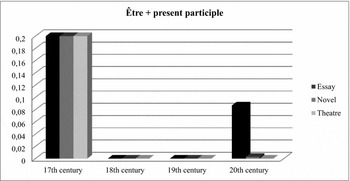
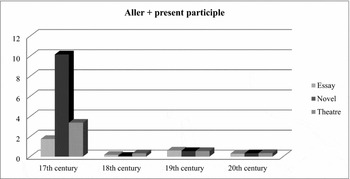
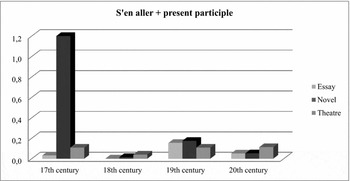
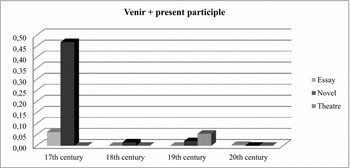
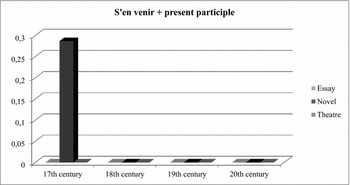
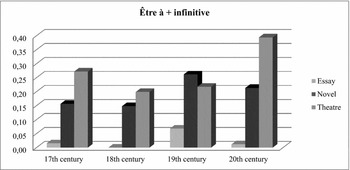
The distribution of occurrences of the individual construction is illustrated in Figure 1 to Figure 5 and shows a relatively clear tendency.
Chronological distribution of occurrences of être + present participle in three genres

Chronological distribution of occurrences of aller + present participle in three genres

Chronological distribution of occurrences of s'en aller + present participle in three genres

Chronological distribution of occurrences of venir + present participle in three genres

Chronological distribution of occurrences of s'en venir + present participle in three genres

Please note that the intervals between units of the y-axis are not equal; all numbers refer to the number of occurrences of the construction per 100,000 words. They differ widely in frequency, but all decline after 1700.
The construction with être + present participle declines after 1700 in all three text types. Even in the 17th century, the construction is fairly rare, with 0.2 occurrences per 100,000 words, and only a very modest use survives in the 20th century, almost exclusively in the genre of the essay. It seems that the construction never really gained a foothold; see Figure 1.
The construction aller + present participle is of relatively frequent use in the 17th century and diminishes later on; see Figure 2.
While in the 17th century aller + present participle appears 10 times per 100,000 words in the genre of the novel, the construction preceded by the reflexive pronoun and en never reaches the same frequency; see Figure 3.
Venir + present participle and s’en venir + present participle are more frequent in the 17th century than être + present participle, at least in novels, but are still much less frequent than the constructions with aller + present participle; see Figure 4 and Figure 5.
In summary, the constructions studied in this subsection occur most often in novels, that is, in a text type that is characterized by narration but which may also have passages of direct discourse, whereas neither essay (which is the most formal register) nor theatre (which represents the genre closest to direct discourse) seem to make much use of the constructions. We may recall that these constructions were found in the earliest texts but decline from the Renaissance onwards, according to previous studies (Werner, Reference Werner1980; Schøsler, Reference Schøsler, Labeau, Vetters and Caudal2006).
4.1. Pierre est à / après chanter, Pierre est en train de chanter
From the 16th century, new constructions with progressive function arise: first in a form of to be, a preposition, and the infinitive: Pierre est à / après chanter and later, from the 18th century, in a more complex construction: Pierre est en train de chanter; see Schøsler (Reference Schøsler, Labeau, Vetters and Caudal2006). Compared to the simple forms, they are marked and display diasystematic differences (diachronic, diatopic, and diastratic). For interesting though less known diatopic variants of relevance for our topic, see section 5.2.
Être à + infinitive spreads from the 15th century. It is now a regional and Francophone variant, found especially in Louisiana, Québec, Acadia, and Île de la Réunion. Our corpus study confirms diastratic observations found in recent studies, for example, Squartini (Reference Squartini1998). Indeed, the construction is most frequent in theatre, that is, a text type close to orality; see Figure 6. In Québec, it is now diastratically marked as formal style, written or spoken.Footnote 11
Chronological distribution of occurrences of être à + infinitive in three genres

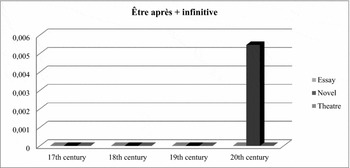
According to Gougenheim (Reference Gougenheim1971 [1929]) and Squartini, être après + infinitive is frequent in Quebec but diastratically marked as colloquial. Our informants confirm that this construction is widespread in speech, but unacceptable in writing. This diastratic tendency is not reflected in our corpus, see Figure 7. The construction is absent from our corpus, with an astonishing exception in novels from the 20th century. The peak is, however, of minor importance, as it represents only two occurrences out of a corpus of 36,566,980 words.
Chronological distribution of occurrences of être après + infinitive in three genres

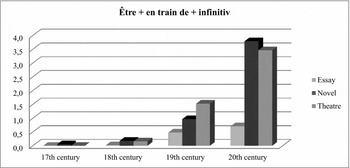
According to Squartini (Reference Squartini1998: 121–123), the periphrasis Pierre est en train de chanter indicates only progressivity and not durativity and thus has a more restricted use than does Pierre est / va / s’en va / vient / s’en vient chantant. It does not occur with perfective forms (passé simple or passé composé). Our corpus studies reveal a strong increase in the use of this construction in the 20th century, when it seems to have more or less defeated all of its rivals; see Figure 8 and Figure 9. It is found in all text types but is less frequent in high style. It is also the default progressive construction, both written and spoken, in Modern Quebec French.
Chronological distribution of occurrences of être + en train de + infinitive in three genres

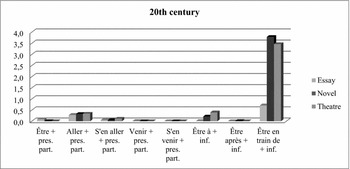
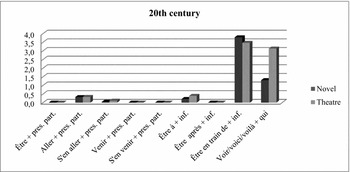
Distribution of progressive constructions in the 20th century in three genres

Figure 9 shows the distribution of the different constructions in the 20th century. It is clear that only the periphrasis être en train de + infinitive is productive.
4.2. (Je vois) Pierre qui chante
In Kragh and Schøsler (Reference Kragh, Schøsler, Coussé and von Mengden2014), we have proposed an analysis of the deictic relative construction as yet another way of expressing progressivity: (Je vois) Pierre qui chante. Interestingly, Squartini (Reference Squartini1998: 34) includes among progressive periphrases a number of comparable ‘subordinative periphrases’ in Italian varieties, that is, two finite verbal forms linked by a subordinative complementizer.Footnote 12 Our purpose here is to highlight the differences between the deictic relative construction and those previously mentioned.
The deictic relative clause is a nexus construction. It is characterized by three pragmatic features, rooted in the deictic restrictions concerning time (simultaneity), place (locally tied to its place of origin), and person, implying a) the presence of a person who perceives, b) his or her relation to the perceived object, c) the activity in which it is involved, and d) an addressee. The common point of reference for both perceiver/speaker and the perceived object (and, in principle, the addressee) is the time and location of the activity. Thus, the process presented in the deictic relative cannot happen in the future or have happened in the past without a link to the present situation, that is, perceptible traces of an accomplished or future event. According to our interpretation, the feature of coinciding with the moment of perception is reanalysed as the feature of progressivity. Furthermore, the fact that the perceiver perceives the object at the same time as he or she perceives the activity of the object grants the perception a holistic dimension. In addition to the simple verb voir ‘to see’, the complex formations voici/voilà (originally free combinations of the imperative form of the verb ‘to see’ and the locative particles ci or là) combine with a deictic relative: (voici/voilà) Pierre qui chante.Footnote 13 Our corpus study includes deictic relatives with the simple verb voir, with voici, and voilà.
The interpretation of the deictic relative as a part of this holistic vision is demonstrated by means of example (6):
(6) . . . si le tienent par le giron; / virent les plaies qui li sainent, / mout le dolosent et le plaignent, (Anonymous, Roman de Renart, circa 1180, p. 56, verses 1666–69) ‘they hold him by the lap / they saw his wounds that were bleeding / they commiserate with him and pity him much’
In this example, it is unlikely that those who pity first discover the wounds and then discover that these wounds are bleeding. What is discovered is more likely the bleeding of the wounds, that is, a holistic vision as the person uttering/writing this sentence has the sight of the wounds bleeding in mind as one holistic observation. In addition to being described as a holistic vision, the vision is progressive, by which term we refer to an ongoing process performed by the referent of the direct object of the verb of perception (see Kragh and Schøsler, Reference Kragh, Schøsler, Coussé and von Mengden2014, for an account of the reanalyses leading to the grammation of the deictic relative).
The deictic relative clause, in contrast to the other types of relative clauses, is not subordinate but is related to the matrix clause by a nexus relation (Jespersen, Reference Jespersen1924; Hjelmslev, Reference Hjelmslev1943). Formally this is manifested by the possibility of having a pronominal antecedent, which is excluded in the subordinate relatives,Footnote 14 cf. (6ʹ):
(6ʹ) . . . il les virent qui li sainent ‘they saw them bleeding’
It is not possible to have a time reference, durative or non-durative, in the nexus relative since the temporal scope of the relative is included in that of the matrix clause. In case of the need for temporal precision, this is placed in the matrix clause and is relevant for both the matrix clause and the deictic relative (see (7)). We emphasize that only punctual adverbs are possible in connection with a deictic relative (see (8)).
(7) À deux heures, je le vois qui travaille. ‘At two o’clock I see him who is working’
(8) *En deux heures, je le vois qui travaille. ‘In two hours I see him who is working’
Furthermore, we have investigated whether any of the competing progressive constructions described in Sections 3.2 to 4.1 can be combined with the deictic relative clause, and the result is convincing: none of the progressive constructions can be combined with the deictic relative. We take this incompatibility as a convincing argument in favour of our interpretation that the function of the deictic relative is to express the holistic presentation of a progressive activity.
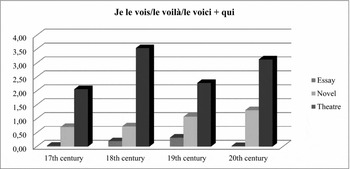
As shown in Figure 10, and in previous corpus studies (Kragh and Strudsholm, Reference Kragh, Strudsholm, Durst-Andersen and Müller2011, Reference Kragh, Strudsholm, Kragh and Lindschouw2013; Kragh and Schøsler, Reference Kragh, Schøsler, Coussé and von Mengden2014), the distribution of voir, voici, and voilà combined with the deictic relative indicates that the deictic relative construction belongs to oral language. Figure 10 shows a clear preference for the deictic relative clause in theatre compared to the more formal genres of the novel and essay. However, it also indicates an increasing use in novels, which suggests that the innovation spreads from unmarked contexts, close to orality, to marked contexts in accordance with the theories of markedness and actualization (cf. sections 2.1 and 2.4). The occurrences in theatre texts are, of course, to be taken as instances of constructed – rather than genuine – speech, but in addition to stretches of direct discourse in novels, they are nevertheless the contexts that come closest to orality. The result is not trivial since almost all previous research on the construction considers the deictic relative to be marked and used in formal language.Footnote 15
Frequency of the deictic relative construction in three genres over four centuries

5. THE DEICTIC RELATIVE CONSTRUCTION
In the following sections, we go into detail concerning the deictic relative construction. First, we take a closer look at its characteristic features, after which (section 5.2) we consider relevant diatopic evidence from Francophone variants including Creole and Canadian French, which are not normally integrated in the TAM discussions. Finally (section 5.3), we draw theoretical implications from this evidence.
5.1. Characteristic features of the deictic relative construction compared to other constructions
Compared to the progressive constructions presented in sections 3.2 and 4.1, the deictic relative (Je vois) Pierre qui chante presupposes the existence of two different protagonists represented by the subject of the verb of perception and by the subject of the relative respectively.
Verbs of perception are also labeled ‘valency augmenting verbs’ just like causative verbs (see e.g., Tesnière, Reference Tesnière1988 [1959]) because they permit the addition of an extra protagonist. It should be observed that the deictic construction is possible only with verbs of perception and not with causative verbs, which, however, on many other points display similar syntactic particularities. Indeed, these two verb classes are normally treated together because they permit the accusative + infinitive-construction: Je vois / entends / laisse Pierre chanter - je fais chanter Pierre (‘I see / hear / make Peter sing – permit to sing’). However, causative verbs are excluded from the deictic relative construction: Je vois / entends / *fais / *laisse Pierre qui chante. This is in perfect accordance with the restrictions and characteristic features described in section 4.2 because the deictic relative presupposes the simultaneity of the activities of V1 and V2 whereas the use of causative verbs focuses on the (future) consequences.
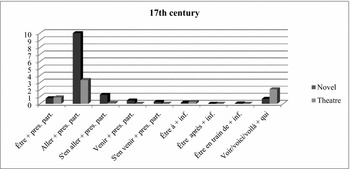
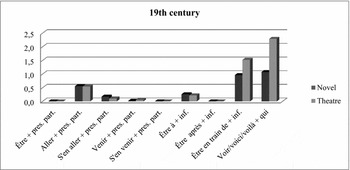
Figure 11 to Figure 14 show the distribution of the eight progressive constructions plus the deictic relative construction over the last four centuries.Footnote 16 It is remarkable that the deictic relative construction has apparently played the major role in expressing progressivity. In the 17th century, the deictic relative construction is the only alternative to the predominant progressive construction aller + present participle. It is notable that the high frequency of aller + present participle (10 occurrences per 100,000 words) is found in the novel genre whereas the construction is only found three times per 100,000 words in theatre. This may be taken as an indication that the construction aller + present participle is not used in the genre closest to orality. We interpret the distribution of the deictic construction with voir / voici / voilà with two occurrences per 100,000 words in theatre and less than one occurrence per 100,000 words in novels as an indication that this construction is in the process of spreading from oral to less oral text types.
Distribution of progressive constructions and the deictic relative construction in the 17th century in novel and theatre

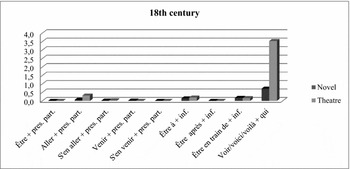
Distribution of progressive constructions and the deictic relative construction in the 18th century in novel and theatre

Distribution of progressive constructions and the deictic relative construction in the 19th century in novel and theatre

Distribution of progressive constructions and the deictic relative construction in the 20th century in novel and theatre

In the 18th century, the deictic relative construction far exceeded the aller + present participle construction. It is still mainly found in theatre, where the deictic relative appears 3.5 times per 100,000 words.
Figure 13 shows that in the 19th century there are still remnants of aller + present participle, while the new construction être en train de + infinitive is gaining ground, especially in theatre. There is a slight decrease in the use of the deictic relative to 2.3 occurrences per 100,000 words in theatre. On the other hand, the use of the deictic relative in the novel genre is stable with 0.7 occurrences per 100,000 words in both the 18th and the 19th centuries.
In the 20th century, the periphrasis être en train de + infinitive has more or less wiped out the competing constructions, except for the deictic relative. Interestingly, the periphrasis être en train de + infinitive has spread from the text type closest to orality (theatre) to less oral contexts (novels). The deictic relative is still frequent in theatre but has also gained ground in novels.
In Modern French, we find two competing and almost equally frequent members of the progressive paradigm. Our challenge is to identify the differences between these two rivals. Since we believe that they are members of the same paradigm, they ought never to be combined. This is indeed confirmed by our corpus studies. However, these two rivals are found in similar contexts, that is, after the expressions of visual perception voir, voilà, and voici. Let us now consider these contexts in order to highlight the different semantic and pragmatic contents of the two constructions. This part of our investigation is based on corpus examples with être en train de + infinitive. In analysing this corpus, we have manipulated examples in order to test our hypotheses concerning their grammaticality. We have tested their grammaticality by submitting manipulated examples to francophone colleagues. Not surprisingly, our colleagues disagree on the acceptability of the manipulated examples. In the following, we comment on a number of typical corpus examples and their manipulated versions.
Most of the occurrences of être en train de + infinitive appear in contexts where the deictic relative would not be the best choice because of the restrictions on the deictic relation.
In examples (9) être en train de is the best choice, because a second protagonist is absent. When S1 = S2, we cannot use the deictic relative construction, since a person cannot perceive his or her own activity at the same time as he or she is doing it, see (9ʹ) As stated above (section 4.2), voir followed by a deictic relative requires a perceiver, a perceived person executing an activity, and an addressee. In example (9), the perceiver and the perceived person are identical. It is not a counter argument that one could imagine a person looking at him or herself in a mirror or imagining him or herself doing something. Moreover, the double is not really acting, only imagining. Consequently, (9ʹ) is pragmatically problematic. On the other hand, example (9ʹʹ) shows that the deictic relative is possible when there are two protagonists, that is, when a person perceives the activity performed by another person.
(9) J’imagine qu’il se voyait assez bien en train de marcher à l'échafaud ou au poteau d’exécution en compagnie du doyen et d'échanger quelques propos (ORMESSON. J. D’, AU PLAISIR DE DIEU, 1974, p. 598, TROISIÈME PARTIE, V) ‘I imagine that he sees himself walking to the scaffold or to the execution stake accompanied by the dean and exchanging a few sentences.’
(9ʹ) ?J’imagine qu’il se voyait assez bien qui marchait à l'échafaud. . .
(9ʹʹ) Il le voyait qui marchait à l'échafaud.
Combined with an inanimate subject of the progressive, être en train de is the best choice, because an inanimate subject is unable to perform a perceived activity, see example (10):
(10) Il m’avait semblé, alors, voir l’histoire en train de se faire à travers la famille. (ORMESSON. J. D’, AU PLAISIR DE DIEU, 1974, p. 497, TROISIÈME PARTIE, II) ‘It seemed to me that he was watching the history creating itself through the family’.
If we replace l’histoire with a personal pronoun la, the relative becomes unequivocally a deictic relative. However, the sentence (10ʹ) is grammatically problematic with the pronoun là referring to l’historie.
(10ʹ) *Il m’avait semblé, alors, laFootnote 17 voir qui se faisait à travers la famille.
In example (11), both progressives are possible, but with slightly different meanings:
(11) Je l’ai vue en train de partir avec ce petit garçon. . .! (DJIAN. P, 37.2 LE MATIN, 1985, p. 311, 24) ‘I have seen her departing with this little boy’
If we substitute en train de with a deictic relative, the latter acquires a different meaning with respect to the temporal scope, in accordance with the deictic features presented in 4.2, meaning that the speaker has a holistic perception of the woman leaving with the child (11ʹ). Therefore, the event presented in the deictic relative is within the temporal scope of the matrix verb, whereas the temporal scope of the progressive construction in (11) exceeds that of the matrix verb.
(11ʹ) Je l’ai vue qui partait avec ce petit garçon
Similarily, the temporal scope of the progressive construction in example (12) exceeds that of the matrix (in this case the presentative voilà), with the result that the progressive construction en train de has been chosen:
(12) Le voilà en train de lancer à travers le pays toute sa clique d’agents secrets et de détectives, le grand Fabius et consorts. (ROBBE-GRILLET. A, LES GOMMES, 1952, p. 78, chapitre premier, 5), ‘Here we see the great Fabius and company sending his entire gang of secret agents and detectives throughout the country’
Our informants consider the choice of the deictic relative possible in this context; see (12ʹ). We find, however, that this example is in conflict with the basic features of the deictic relative, since, in contrast to (11’), we find it difficult to perceive this as a holistic vision. We wish to emphasize, however, that we do not find attested examples of this type in our corpus, which we take as an indication that even if the deictic relative is possible in such contexts, as claimed by our informants, they are not frequently used.
(12ʹ) ?Le voilà qui lance à travers le pays toute sa clique d’agents secrets et de detectives, . . .
In the case of irrealis, hypothetical, interrogated or negated contexts, see examples (13), (14), (15), and (16), être en train de is most often the best choice. The presence of a deictic relative construction in these examples is highly problematic, because these contexts are in conflict with the characteristics of the deictic relative. However, for different reasons, the deictic relative seems to spread to such contexts, which is confirmed by our informants.
In example (13), the main problem for the use of the deictic relative is due to the absence of a protagonist. As stated above (section 4.2), voir followed by a deictic relative requires a perceiver, a perceived person executing an activity, and an addressee. In example (13), the addressee and the perceived person are identical. In case of a different perceived person, the example would be acceptable with a deictic relative. Furthermore, we believe that another difficulty of using the deictic relative is due to the irrealis-context which is in contradiction to the deictic restrictions, whereas some of our informants find example (13ʹ) acceptable. In a realis-context (and with a third person as perceived object), the deictic relative is fully acceptable; see example (13ʹʹ):
(13) Je préférerais te voir en train de te balader, ou bayer aux corneilles, je trouverais ça tout à fait normal. (DJIAN.P, 37.2 LE MATIN, 1985, p. 74, 7) ‘I would prefer to see you strolling around or gawking, I would find that completely normal.’
(13ʹ) ?Je préférerais le voir qui se balade, . . .
(13ʹʹ) Je le vois qui se balade, . . .
The manipulated version with the deictic relative of example (14), which is in a hypothetical context, that is, (14ʹ), is accepted by our informants, but only in informal registers:
(14) c’est comme si je voyais un type en train de te viser, là et qu’on discute du danger des balles de revolver. . . (MALRAUX.A, LA CONDITION HUMAINE, 1933, p. 294, TROISIÈME PARTIE 29 MARS) ‘It is as if I saw somebody pointing at you, while we are discussing the danger of bullets’
(14ʹ) c’est comme si je voyais un type qui te vise, là et qu’on . . .
In example (15), at least three conflicting factors make the deictic relative problematic: the interrogative context, the absence of an addressee (cf. example (9)), the stylistic incongruity between the use of the polite second plural form (vous) and the informality of the deictic construction in this context. But the manipulated version in example (15ʹ) is acceptable to our informants, but not in an interrogative context:
(15) - Vous voilà aussi en train de faire vos provisions pour le déjeuner, mademoiselle? (ROMAINS. J, LUCIENNE, 1922, p. 72, VI), ‘There you are doing the shopping for breakfast, young lady?’
(15ʹ) ?- le voilà qui fait ses provisions pour le déjeuner.
In example (16), the factor that makes the use of the deictic relative improbable is the absence of an addressee. Again, the introduction of a perceived person makes the deictic relative more acceptable, although informal (16ʹ):
(16) Je n’avais pas envie qu’on te voie en train de dormir sous mon porche. (ORMESSON. J. D’, LE BONHEUR A SAN MINIATO, 1987, p. 126, I, Le temps des épreuves), ‘I did not want you to be seen sleeping under my entry porch.’
(16ʹ) ?Je n’avais pas envie qu’on le voie qui dort sous mon porche.
In all the cases examined above, the periphrasis être en train de + infinitive has been the obvious choice to express progressivity in modern French, but the deictic relative would have been possible in at least some of the cases. However, it would entail a particular style and content. Thus, être en train de is the unmarked progressive construction compared to the deictic relative construction.
5.2. Diatopic evidence from Creole and Canadian French
Our interpretation of the deictic relative as a marked member of the progressive paradigm is, we think, original. It might be argued that the progressive nature of this construction is epiphenomenal rather than primary. To address such an objection we discuss relevant aspects in the following two sections. First, in the present section, we provide independent diatopic evidence for our interpretation, and in the following section 5.3 we take a closer look at the theoretical implications of this evidence.
We saw above (section 4.2) that the deictic relative is present in novels and theatre attested in our corpus from the 17th century. From the 16th century, French has spread to different parts of the world, taking the form of Colonial French or French Creole. We have already seen that a number of progressive variants that are no longer used in standard French persist in varieties of French outside of France (Section 4.1). Following suggestions from a number of colleagues,Footnote 18 we have investigated how the progressive aspect is expressed in Caribbean French and French Creoles.
The Francophone variants of St. Barth and of St. Thomas are particularly interesting for our topic because they have a progressive paradigm in the present, the past, and the future. The present of dêt’ (=‘to be’) and a deictic relative expresses the progressive, and the imperfect form of dêt’ is used to express the past progressive. The present of dêt’ + va (‘go’) and an infinitive expresses the future progressive (Corne, Reference Corne1999: 136–140, examples quoted from page 139):Footnote 19
(17) T’es qui veille (standard French: Tu es qui voit) ‘you are watching’
(18) Alle était qui disait (Standard French: Elle était qui disait) ‘she was saying’
(19) On est qui va le faire: ‘we are going to do it’
A similar construction is found in the Creole of Réunion. The French variety of Réunion generally expresses the progressive by means of the construction être après + infinitive, as indicated in section 4.1. Examples are provided in Corne and Baker (Reference Corne and Baker1982: 23–27). In the Réunion Creole, complex verb formations are explicitly referred to as a parallel to the aforementioned progressive Patois forms of St. Barth and to the Creole of St. Thomas.Footnote 20 Nevertheless, the formation appears similar, with a reduced embedded relative clause ki, sometimes reduced to the simple i, following a complex lete, subject to further reduction and stemming from an imperfect of the verb ‘to be’: était.
(20) muê lete ki dize (Corne and Baker, Reference Corne and Baker1982: 21)
GLOSS moi lete ki dize < étais qui disais, ‘moi je disais’
Corne and Baker (Reference Corne and Baker1982: 22) present alternative forms with reduction of some of the elements, as in (21):
(21) muê lete ki mâz / muê lete i mâz / muê te ki mâz / muê te i mâz
GLOSS moi lete ki mâz < étais qui mangeais, ‘moi je mangeais’
The evidence from the Caribbean and the Indian Ocean prompts Corne to assume that the progressive forms are genuine French forms spoken by the French who emigrated in the 17th century, and that these were features of original French dialects (Corne, Reference Corne1999: 140). Corne and Baker (Reference Corne and Baker1982: 29–30) present a similar analysis of the feature as being originally French.
This analysis is further confirmed by Canadian evidence. In the Quebec variant of Canadian French, we find widespread use of the deictic relative, expecially in spoken narrative contexts, both the variant voilà qui and il est là qui with obligatory presence of the deictic particle là. These are presentatives, but nevertheless relevant in this context because they all are markers of progressive aspect:
(22) v’là le bus qui arrive (‘the bus is arriving’)
(23) il est là qui arrive avec sa voiture (‘he is arriving with his car’)Footnote 21
(24) Y’est là qui fait ça < il est là qui fait ça (‘he is doing it’)
(25) A’est là qu’a fait < elle est là qui a fait (‘she has been doing it’)
We interpret the Francophone evidence above as independent confirmation of our hypothesis that the reanalysis of the subordinate relative into a deictic relative implies a progressive aspectual value. The deictic relative was grammaticalized as a proper progressive in the Patois of St. Barth and the Creole of St. Thomas and interpreted in the Creole of Réunion as a habitual, backgrounding form. In Canadian French, the progressive aspect is found with a presentative. We find that the reanalysis of the original aspectual value progressive into the value of on-going / habitual / background, as is the case in the Creole of Réunion does not seem implausible, although this grammaticalization path is not included in Heine and Kuteva (Reference Heine and Kuteva2002) among the paths having the progressive as source or target value.
5.3. Theoretical implications
In section 4.2, we presented arguments in favour of our interpretation of the deictic relative construction as a marked progressive variant, and we presented arguments explaining that the progressive aspectual value is linked to the pragmatic features of the deictic relative. The deictic relative construction presents a holistic, progressive vision of the activity. This holistic vision is not linked to one specific part of the construction and is not a direct consequence of either of the components, matrix verb/presentative, relative pronoun, direct object, and so on. As the progressive aspect cannot be derived directly from the parts of the construction, it is the result of a grammation, that is, ‘a change by which an expression through reanalysis is ascribed grammatical content’ (Andersen, Reference Andersen2006: 232–233). This process implies a previous reanalysis of the relative from A to B, as described in Kragh and Schøsler (Reference Kragh, Schøsler, Coussé and von Mengden2014). Indeed, the first reanalysis changes the status of the subordinate, attributive relative, which is part of the lexicon, into part of a nexus functioning as an object (A > B). Subsequently, the deictic relative is reanalysed as a member of the progressive paradigm (B > C), most clearly in Francophone and Creole varieties. This is a regrammation (cf. 2.2). The reanalysis has the result of changing a secondary feature into a primary one, and the primary feature in this deictic relative construction is the holistic, progressive vision of the activity. We conclude that the progressive aspectual value is not a secondary feature of the grammaticalized construction.
6. CONCLUSIONS – PARADIGMATIC STRUCTURES
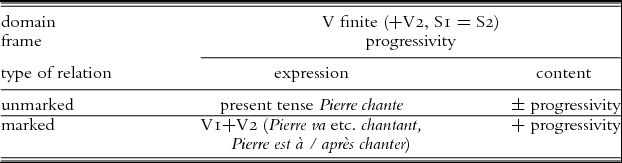
We conclude by drawing the paradigmatic consequences of our analyses. Let us first take into account finite constructions, simple and composed, with one protagonist involved (i.e., the domain is V finite (+V2, S1 = S2)). Here, French has the possibility of expressing progressivity either explicitely or implicitly (i.e., the frame is ± progressivity). In the simple present tense, the sentence Pierre chante is unmarked with respect to progressivity: It may or may not be the case that Peter is actually singing.Footnote 22 On the other hand, French can choose to explicitely express progressivity by means of a construction. By choosing, for example, Pierre va chantant / Pierre est en train de chanter, the speaker or writer unequivocally presents his vision of an event as ongoing.
Progressivity in French, illustrated by the present and progressive constructions
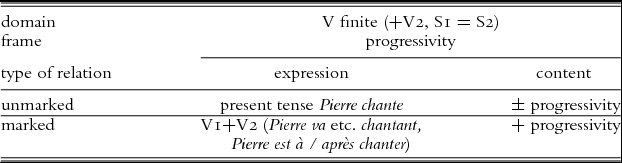
We have studied a number of constructions that are explicitely marked as progressive, in contrast to the unmarked simple form (Pierre chante). The constructions have distinctive features that permit us to characterize them individually. These features are of different natures: Firstly, diasystematic ones, including diachronic, diatopic, and diastratic differences. Secondly, linguistic features, including the number of protagonists involved (S1 = S2 or S2≠S2) and ±holistic vision. The common domain of these constructions is the combination of two verbs: V1 +V2, with identical or different protagonists as subjects of the two verbs. The common frame is +progressivity.
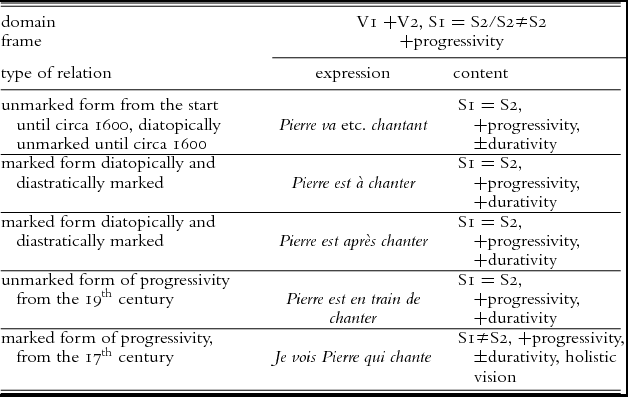
We may recall that members of a paradigm are opposed to one another in terms of markedness. With respect to diastratic features, Pierre est / va / s'en va / vient / s'en vient chantant is the unmarked construction, both diatopically and diastratically, from the early texts, whereas Pierre est à / après chanter are marked, both diatopically and diastratically. The relationship of markedness has changed since the 19th century, with Pierre est en train de chanter taking over the role as unmarked form while Pierre va chantant and other variants of forms disappear. Interestingly, the old periphrases first disappear in text types close to orality (theatre) and persist in text types far from orality (novel) whereas the new periphrases first appear in theatre and later spread to novels. This actualization pattern confirms that the innovation is spreading ‘from below’, in accordance with the theory of Andersen (Reference Andersen and Andersen2001).
Already from the 18th century, Je vois Pierre qui chante is relatively frequent, but its content is more specific, that is, marked, than the other periphrases and it is only in Francophone and Creole varieties of French that it has developed into an unmarked progressive construction (see sections 5.2–5.3). In standard French, the construction Je vois Pierre qui chante has the particularity of always involving two different protagonists (S1≠S2). Moreover, the deictic relative is the only construction to provide a holistic perception of the activity, perceived in its progression.
According to our informants, the use of the deictic relative seems to spread from exclusively deictic contexts in Standard French to contexts which do not meet all the deictic requirements. We must make it clear, however, that our corpus has not provided evidence that confirm this interpretation. The extension in use is mainly found in informal style which is typical for an innovation ‘from below’, and which may also explain why the construction is difficult to find in text corpora. In accordance with Andersen (Reference Andersen2006), we interpret this change as a regrammation, that is, a reanalysis leading to a change from one grammatical status (B) to another (C).
Insight from Francophone and Creole varieties of French confirms that progressivity is a primary, not a secondary (epiphenomenal), feature of this construction. However, the gramma(ticaliza)tion of the deictic relative as a member of the progressive paradigm has reached a more mature stage in the Francophone and Creole variants than in Standard French (concerning the term maturity, see Dahl, Reference Dahl2004).
More specifically concerning the aspectual values of the periphrases, Pierre va etc. chantant shows no limitation (i.e., it is unmarked) with respect to the nature, durative or not, of the context, (cf. Table 2).
Progressivity in French, progressive constructions
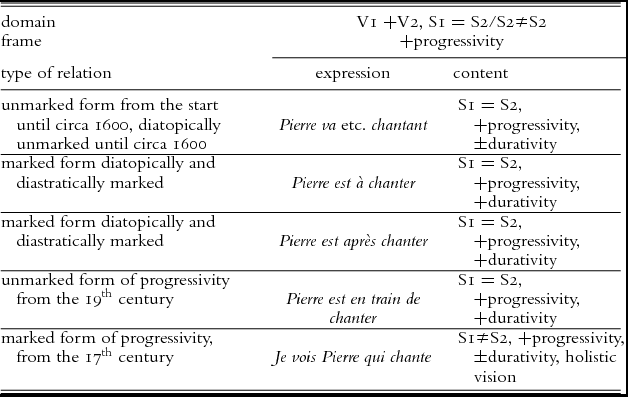
Indeed, it is used in both durative and non-durative contexts, in contrast to Pierre est à / après chanter, found only in durative contexts. Pierre est en train de chanter is found in durative contexts, according to Gougenheim (Reference Gougenheim1971 [1929]) and Squartini (Reference Squartini1998). The deictic construction (Je vois Pierre qui chante) is aspectually restricted to express the imperfective and lexically restricted to activity verbs (Kragh and Strudsholm, Reference Kragh, Strudsholm, Durst-Andersen and Müller2011). More research, however, is needed on these points.