Introduction
Tetralogy of Fallot with pulmonary atresia is an anomaly comprising atresia of the pulmonary valve, a large sub-aortic ventricular septal defect, and sometimes major aorto-pulmonary collateral arteries. This anomaly is present in 0.04 births per 1000 live births, and it accounts for about 36% of the tetralogy of Fallot population.Reference Hoffman and Kaplan 1 – Reference Egbe, Uppu, Lee, Ho and Srivastava 3 Unlike tetralogy of Fallot with pulmonic stenosis, tetralogy of Fallot and pulmonary atresia are characterised by more profound pulmonary arterial abnormalities and increased risk for right ventricular hypertension.Reference Reddy, McElhinney and Amin 4 – Reference Carrillo, Mainwaring and Patrick 11 As a result, patients with tetralogy of Fallot and pulmonary atresia are more likely to have multiple palliative procedures (palliative shunts and unifocalisation) prior to tetralogy of Fallot repair and often require surgical and transcatheter interventions after initial tetralogy of Fallot repair predominantly because of residual/recurrent pulmonary outflow tract and pulmonary arterial lesions.Reference Reddy, McElhinney and Amin 4 – Reference Carrillo, Mainwaring and Patrick 11 There are limited outcomes data in adults with tetralogy of Fallot and pulmonary atresia, and most of the available studies have focused on outcomes after initial repair and reinterventions in childhood.Reference Reddy, McElhinney and Amin 4 – Reference Carrillo, Mainwaring and Patrick 11 The purpose of the study was to describe the incidence of re-operation and all-cause mortality in adults with repaired tetralogy of Fallot and pulmonary atresia.
Methods
This is a retrospective review of patients (age ≥18 years) with repaired tetralogy of Fallot and pulmonary atresia who received care at the Mayo Adult Congenital Heart Disease Clinic, Minnesota, from 1 January, 1990 through 31 December, 2016. The Mayo Clinic Institutional Review Board approved this study and waived informed consent for patients who provided research authorisation. We reviewed the following records: clinical notes, electrocardiogram, Holter monitor, transthoracic echocardiograms, cardiac catheterisation procedures, cardiopulmonary exercise test, surgical records, and cardiac magnetic resonance imaging reports. Tetralogy of Fallot repair was defined as implantation of right ventricular to pulmonary artery conduit, patch closure of ventricular septal defect, and ligation/unifocalisation of aorto-pulmonary collateral arteries or patent ductus arteriosus.Reference Reddy, McElhinney and Amin 4 – Reference Carrillo, Mainwaring and Patrick 11
Data were presented as mean ± standard deviation, median (interquartile range), or number (%). All-cause mortality was calculated as quotient of deaths and cumulative follow-up (in patient-years) from the time of first presentation to the Adult Congenital Heart Disease Clinic, and expressed as events per 100 patient-years. The risk factors for all-cause mortality were assessed using a multi-variable Cox proportional hazard model, and only the variables that were statistically significant on univariable analysis were incorporated into the multi-variable model. The variables included in the univariable analysis were age at tetralogy of Fallot repair, age at the beginning of the study, prior palliative shunt, confluent branch pulmonary arteries, atrial fibrillation, atrial flutter, coronary artery disease, hypertension, sustained ventricular tachycardia, non-sustained ventricular tachycardia, right ventricular systolic dysfunction, tricuspid regurgitation, pulmonary regurgitation, right ventricular outflow tract obstruction (peak conduit gradient), and left ventricular ejection fraction. For variables such as age where there are no clinically meaningful curve points, receiver operating characteristic curve was used to determine the cut-off point for dichotomizing the continuous variables prior to entry into the multi-variable model. The strength of association between risk factors and outcome was expressed as hazard ratio and 95% confidence interval. All statistical analyses were performed with JMP software (version 13.0; SAS Institute Inc, Cary, North Carolina, United States of America).
Results
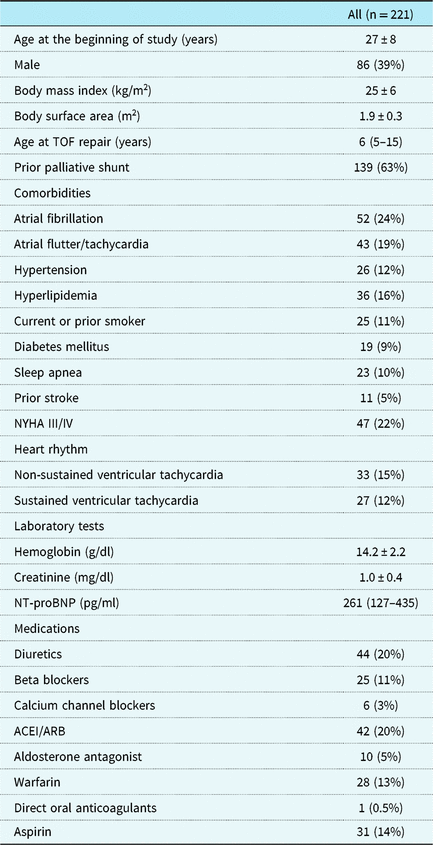
There were 221 patients (male 86 [39%]) with repaired tetralogy of Fallot and pulmonary atresia who received care at the Mayo Adult Congenital Heart Disease Clinic within the study period (Table 1). The age at the time of tetralogy of Fallot repair was higher in the first half of the study period (1990–2003) versus the second half of the study period (2004–2016), 8 (5–13) versus 5 (2–8), p = 0.022. Of the 221 patients, 51 (23%) had completed one-stage unifocalisation and intracardiac repair through a midline, 56 (25%) had completed unifocalisation in a single stage with the ventricular septal defect left open, and 114 (52%) had staged unifocalisation through sequential thoracotomies followed by complete repair and placement of right ventricular to pulmonary artery conduit. Of the 221 patients, 22 (10%) had 22q11 deletion, 1 (0.5%) has Down syndrome, 2 (1%) had Noonan syndrome, and 2 (1%) had Turner syndrome. Table 1 shows baseline clinical data of the cohort.
Baseline characteristics.

ACEI/ARB=angiotensin converting enzyme inhibitor/angiotensin receptor blocker; NT-proBNP=N-terminal pro b-type natriuretic peptide; NYHA=New York heart Association; TOF=tetralogy of Fallot
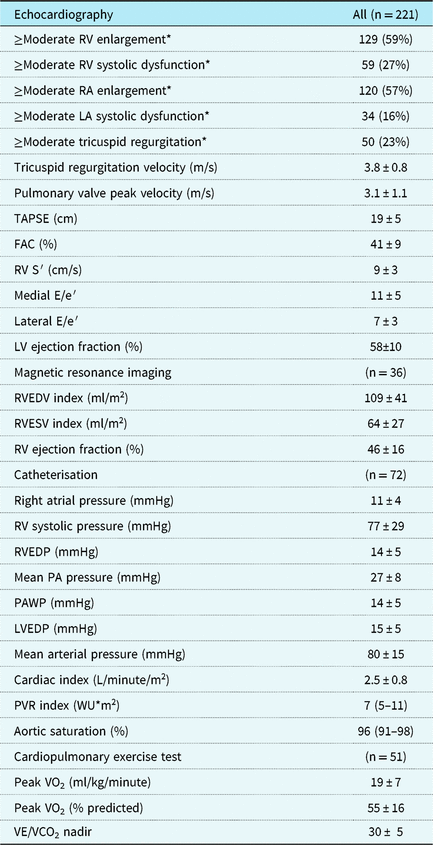
Table 2 shows the baseline echocardiographic, magnetic resonance imaging, invasive haemodynamic, and cardiopulmonary exercise data. At the time of initial presentation to the clinic, 197 (89%) patients had at least one re-do sternotomy for right ventricular to pulmonary artery conduit replacement, and the interval from initial tetralogy of Fallot repair to initial presentation to the clinic was 22 ± 3 years. These patients were followed up in the Adult Congenital Heart Disease Clinic for 8 ± 3 years, and the mean interval from initial tetralogy of Fallot repair to last follow-up was 31 ± 14 years. During this period, all patients had at least one re-do sternotomy for right ventricular to pulmonary artery conduit replacement. The average number of re-do sternotomies for right ventricular to pulmonary artery conduit implantation after initial tetralogy of Fallot repair was 3 ± 2, and the average interval between sternotomies was 8 ± 3 years. The average size of the right ventricular to pulmonary artery conduit was 26 ± 3 mm. The mean cardiopulmonary bypass time was 128 ± 33 minutes and aortic cross-clamp time was 76 ± 34 minutes.
Haemodynamic data.

FAC=fractional area change; LA=left atrial; LV=left ventricle; LVEDP=right ventricular end-diastolic pressure; PA=pulmonary artery; PAWP=pulmonary artery wedge pressure; PVR=pulmonary vascular resistance; RA=right atrial; RV=right ventricle; RVEDP=right ventricular end-diastolic pressure; RVEDV=right ventricular end-diastolic volume; RVESV=right ventricular end-systolic volume; TAPSE=tricuspid annular plane systolic excursion; VE/VCO2=ventilatory equivalent for carbon dioxide; VO2=oxygen consumption; WU*m2=wood units × meter squared
* Quantitative assessment
Of the 221 patients, 43 (19%) underwent at least one transcatheter intervention, and 3 patients had 2 transcatheter interventions yielding a total of 46 transcatheter interventions. These transcatheter interventions were branch pulmonary artery dilation and/or stent implantation (n = 37), right ventricular to pulmonary artery conduit dilation (n = 2), transcatheter pulmonary valve implantation (n = 2), and occlusion of aorto-pulmonary collateral arteries (n = 5).
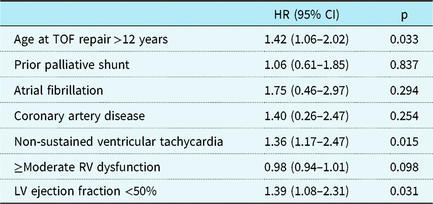
There were 31 deaths (14%) at an average age of 41 ± 14 years. The causes of death were end-stage heart failure (n = 17), sudden cardiac death (n = 9), post-operative death after cardiac surgery (n = 2), sepsis with multi-system organ failure (n = 2), and unknown (n = 1). One patient (0.5%) underwent heart transplantation for end-stage heart failure at age 42 years. These 221 patients were followed up for 1812 patient-years, and all-cause mortality rate was 1.7 per 100 patient-years. The risk factors for all-cause mortality were older age (>12 years) at the time of repair (hazard ratio 1.41, 95 confidence interval 1.06–2.02, p = 0.033), non-sustained ventricular tachycardia (hazard ratio 1.36, 95 confidence interval 1.17–2.47, p = 0.015), and left ventricular ejection fraction less than 50% (hazard ratio 1.39, 95 confidence interval 1.08–2.31, p = 0.031) (Table 3).
Multi-variable analysis of risk factors for death.

CI=confidence interval; HR=hazard ratio; LV=left ventricle; RV=right ventricle; TOF=tetralogy of Fallot
A subgroup analysis was performed in the 77 (35%) patients with non-confluent branch pulmonary arteries. Compared to the 144 patients with confluent branch pulmonary arteries, the 77 patients with non-confluent branch pulmonary arteries were older at the time of tetralogy of Fallot repair (9 [7–13] versus 4 [1–6] years, p < 0.001) and had higher tricuspid regurgitation velocity (4.2 ± 0.3 versus 3.6 ± 0.6, p = 0.029). Otherwise, no other significant differences in baseline characteristics were found. Also, there was no significant difference in the all-cause mortality rate between the patients with non-confluent branch pulmonary arteries and patients with confluent branch pulmonary arteries (1.9 versus 1.6 per 100 patient-years, 0.072). However, this lack difference may be related to a small sample size.
Discussion
In this study, we reviewed outcomes of 221 adults with repaired tetralogy of Fallot and pulmonary atresia and reported an all-cause mortality rate of 1.7 events per 100 patient-years. The mean age at the time of death was 41 years, and end-stage heart failure and sudden cardiac death were responsible for 55 and 29% all-cause mortality, respectively. Most of the studies conducted in adults with tetralogy of Fallot were derived almost exclusively from patients with tetralogy of Fallot and pulmonary stenosis, and as a result, there are limited outcome data in adults with tetralogy of Fallot and pulmonary atresia.Reference Khairy, Harris and Landzberg 12 – Reference Bokma, Winter and Vehmeijer 16 A multi-centre study based on the INDICATOR cohort reported outcomes in 873 patients with tetralogy of Fallot and the all-cause mortality was 4% in that cohort.Reference Valente, Gauvreau and Assenza 14 In a different multi-centre study of 121 patients with tetralogy of Fallot (median age 33 years), Khairy et al reported an all-cause mortality of 8%.Reference Khairy, Harris and Landzberg 12 None of these studies performed a subgroup analysis to assess outcomes in patients with tetralogy of Fallot and pulmonary atresia. It is important to highlight the significant differences in the age distribution and follow-up time between the Khairy et al study and the current study. These differences should be taken into consideration while comparing these results.
The risk factors for all-cause mortality in the current study were older age (>12 years) at the time of repair, non-sustained ventricular tachycardia, and left ventricular ejection fraction less than 50%. Several studies of outcomes after tetralogy of Fallot and pulmonary atresia repair focused on perioperative survival and outcomes in the childhood period.Reference Reddy, McElhinney and Amin 4 – Reference Carrillo, Mainwaring and Patrick 11 The current study provides important perspective on outcomes in adult survivors with tetralogy of Fallot and pulmonary atresia. The risk factors described in the study will be important for risk stratification of patients for intervention.
Another important observation was that 89% of the patients had at least one re-do sternotomy for right ventricular to pulmonary artery conduit replacement (after initial tetralogy of Fallot repair), likely reflective of their body growth necessitating bigger conduit, prior to their first presentation at the Adult Congenital Heart Disease Clinic, and all patients subsequently had right ventricular to pulmonary artery conduit reintervention before the age of 40 years.Reference Bokma, Geva and Sleeper 15 , Reference Bokma, Winter and Oosterhof 17 , Reference Bokma, Winter and Oosterhof 18 This rate of reintervention is significantly higher than that reported in studies of patients with tetralogy of Fallot and pulmonary stenosis further highlighting the differences in the natural history between both diseases.Reference Khairy, Harris and Landzberg 12 – Reference Bokma, Winter and Vehmeijer 16 There were relatively few transcatheter pulmonary valve replacements in this cohort, likely reflecting an older era of clinical practice. Perhaps, the advent of transcatheter pulmonary valve replacement, which is now the standard of care, will potentially reduce the need for repeat sternotomies.
Limitations
This is not a cohort study of all tetralogy of Fallot and pulmonary atresia patients with surgical repair at our institution but rather a study of a selected population of tetralogy of Fallot and pulmonary atresia patients who survived until adulthood. The study design introduces significant selection bias. The study period span a period of 27 years, and hence long-term survival could have been influenced by changes in surgical and medical therapies over time, which we did not control for. Notwithstanding these limitations, the current study provides implant outcomes data for adult patients with tetralogy of Fallot and pulmonary atresia. The median age presentation suggests that patients may have followed up in other clinics prior to presentation at the Adult Congenital Heart Disease Clinic. The Mayo Clinic is a referral centre, and the demographic characteristics of the population may be different from those of the general tetralogy of Fallot population. This introduces a selection bias that may limit the generalisability of the results. Another potential limitation of the study is that the results of the study could have been influenced by other unknown confounders that were not adjusted for in the regression model.
Conclusions
Based on a review of 221 adults with repaired tetralogy of Fallot and pulmonary atresia, the all-cause mortality rate was 1.7 events per 100 patient-years, and the risk factors for all-cause mortality were older age (>12 years) at the time of repair, non-sustained ventricular tachycardia, and left ventricular ejection fraction less than 50%. The current study provides important clinical information about the long-term outcomes for this disease.
Author ORCIDs
Alexander C. Egbe 0000-0002-8810-3631
Acknowledgement
None.
Financial support
Dr. Egbe is supported by National Heart, Lung, and Blood Institute grant K23 HL141448-01.
Conflicts of interest
None.
Ethical standards
The study methodology adhered to at ethical standards stipulated by the institutional review board.