Introduction
Cognitive assessment involves examination of higher cortical functions, particularly memory, attention, orientation, language, executive function (planning activities) and praxis (sequencing of activities). Impairment of these functions may occur in any disease process that causes structural brain damage, such as a head injury, brain tumour or stroke, but this article will focus on cognitive assessment for people with suspected dementia. This is a common clinical syndrome with an estimated prevalence of 20% in people aged over 80 years.1 Dementia is defined as a clinical syndrome characterized by severe memory decline and loss of function in at least one other cognitive domain of sufficient severity to interfere with social or occupational functioning.2 Accurate cognitive function assessment is therefore the cornerstone for the diagnosis of dementia. Health care staff are poor at identifying people with dementia. In the UK, less than 50% of people with dementia have received a diagnosis.3
The key to the reliable diagnosis of dementia is to integrate three components: patient observations, an informant account and the results of cognitive tests. The patient observations that suggest dementia may be subtle (hence commonly overlooked). Close attention to the content, organization and presentation of the patient's narrative is a critical step. Impaired fluency with language (common in early dementia), or a vagueness with dates and event sequence, a tendency to repeat phrases, or a predilection to dwell excessively on distant events (impaired memory) may be noticed. The discussion with the patient can be sensitively directed to enquiries about intrusions into everyday life, such as forgetting appointments, problems with finances, mislaying objects, and kitchen mishaps. An informant history is important because it can clarify symptom onset and relationship to baseline functioning – factors that are critical to an accurate diagnosis. Informant reports of memory difficulties are typically reliable and an accurate predictor of dementia.Reference Carr, Gray and Baty4
The third key component in the diagnosis of dementia is formal cognitive assessment. In England and Wales, the National Dementia Strategy5 has emphasized the issue of early diagnosis of dementia. This, it is argued, facilitates more timely access to treatments and support services for patients and their carers. Increased use of cognitive assessment tools is therefore expected. Indeed, improvements in the detection of dementia have recently been financially incentivized, as highlighted in the Dementia Commissioning for Quality and Innovation (CQUIN) framework.6 This requires acute hospital trusts to embed screening algorithms to ‘Find, Assess, Investigate, Refer’ (FAIR). These algorithms use brief congitive assessment tools but the particular tool has not been prescribed; rather, each trust has to select an instrument based on locally developed dementia care pathways.
This article provides a structured literature review of the brief cognitive tests that have been developed and investigated to support the diagnosis of dementia in routine care. The evidence for the psychometric properties of the identified tests has been examined, with particular emphasis on their performance and utility for use by health care professionals working in primary or secondary care.
Brief cognitive tests
An ideal test should be quick, simple to score and interpret, and not require special equipment or training. It should have a high sensitivity (the proportion of people with dementia who are correctly identified) and specificity (the proportion of people without dementia who are correctly identified). For brief screening instruments, where high sensitivity is essential (to avoid missing cases), modest specificity values are acceptable. High inter-rater and re-test reliability, and patient acceptability, are also important aspects. Different tests assess different domains of cognitive function but most instruments include assessment of memory and orientation impairments. They require between one and approximately ten minutes to complete and provide a numerical value. This can be useful to assess dementia severity, and with repeated scores, disease progression. Repeated scores also help with the diagnosis of delirium (e.g. pre- and post-operative scores). Careful interpretation is particularly required for people with a low educational background, or with deafness, depression or communication impairments, as falsely low scores may be obtained. Ceiling effects are common and people with mild cognitive impairment, particularly if they have high educational attainment, may perform well on these tests.
Review methods
A keyword search of MEDLINE, CINAHL, EMBASE, PSYCINFO, AMED, Web of Science and the Cochrane Library between 1990 and 2012 was undertaken using the following search term string: ‘assessing cognitive ability in older people’. Over 4500 article titles/abstracts were screened and reduced to 432 using pre-specified inclusion and exclusion criteria. Inclusion criteria were tests in English that had been developed to screen for and identify dementia, primarily Alzheimer's disease. Exclusion criteria were: where the focus was on a specific dementia (e.g. vascular, Parkinson's disease or post-head injury); related to a specific patient group (e.g. people with a physical disability such as blindness); instruments designed to stage a dementia; or instruments for which special equipment was required.
The retained articles were then obtained for examination. The size and population studied (community, hospital or memory clinic) were noted. The proportion of the study population with dementia was also noted, as a population with a high proportion of cases will over-estimate the performance of the test. The reference standard for diagnosis of dementia is the Diagnostic and Statistical Manual for Mental Disorders, 4th edition (DSM IV) (preceded by DSM-R-III). Therefore studies incorporating these standards are likely to be more reliable. However, we noted that many studies used the Mini-Mental State Examination (MMSE) score as a reference standard. Some caution is required in the interpretation of these studies, as a diagnosis based solely on MMSE scores is potentially unreliable. Since a significant number of healthcare encounters in primary and secondary care occur without an informant present, instruments that required informant input were excluded. We found that many instruments were too resource intensive for use in non-specialist routine care. We have therefore included in the review only those instruments that were equivalent or shorter than the MMSE score (delivery time approximately 10 min).
Results
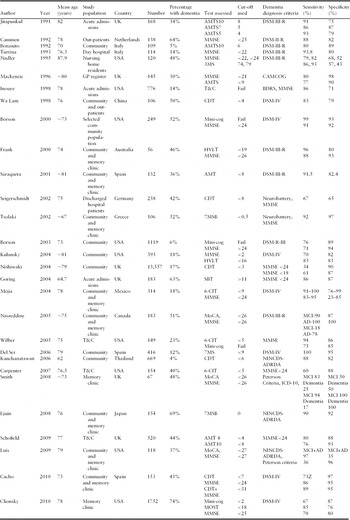
135 articles reporting on 12 brief cognitive assessment tests were retained for data extraction. Tables 1 and 2 summarize the tests.
Summary of the cognitive tests included in the review

AMT, Abbreviated Mental Test; CDT, Clock Drawing Test; MOST, Memory Orientation Screening Test; BAS, Brief Alzheimer's Screen; SBT, Short Blessed Test; 6-CIT, 6-item Cognitive Impairment Screen; T&C, Time and Change; HVLT, Hopkins Verbal Learning Test; MMSE, Mini-Mental State Examination; MoCA, Montreal Cognitive Assessment; 7MSB, Seven Minute Screen Battery.
Summary table of studies reviewed

AD, Alzheimer's dementia; AMTS, Abbreviated Mental Test score; BDRS, Blessed Dementia Rating Scale; CAMCOG, Cambridge Cognitive Examination; CDT, Clock Drawing Test; DSM-III-R, Diagnostic and Statistical Manuel of Mental Disorders; ICD-10, International Statistical Classification of Diseases and Related Health Problems; HVLT, Hopkins Verbal Learning Test; MCI, mild cognitive impairment, MMSE, Mini-Mental State Examination; MoCA, Montreal Cognitive Assessment; MOST, Memory Orientation Screening Test; SBT, Short Blessed Test; T&C, Time and Change; 3MS, Modified Mini-Mental State; NINCDS-ADRDA, National Institute of Neurological and Communicative Disorders and Stroke-Alzheimer's Disease and Related Disorders Association; 6-CIT, 6-item Cognitive Impairment Screen; 7MSB, 7 Minute Screen Battery.
Mini-Mental State Examination
The MMSE is a widely used, well-validated 30-point cognitive assessment questionnaire that comprises 11 items and takes approximately 8 min to complete. The items test for memory, orientation, attention, language and praxis impairments.Reference Jones and Gallo7 It was developed in 1975 by Folstein et al. from a variety of brief items, many of which were already well established in the clinical assessment of cognitive function. The suggested cut-off for considering dementia is <24 points but other cut-offs values ranging from <26 to <22 have also been proposed depending on the population of interest.Reference Mitchell8, Reference Nadler, Relkin and Cohen9 The MMSE score can be used to severity grade the impairment with scores of 21–24, 10–20 and 9 or less indicating mild, moderate and severe cognitive impairment, respectively. Repeated scores have been used to detect the onset of delirium or progression of dementia. Although widely available on internet sites, copyright protection has been recently enforced and the MMSE must now be purchased from the publishers (http://www.parinc.com/). This retrospective enforcement of copyright has had a negative impact on MMSE score use.
A meta-analysis that incorporated 31,388 participants from 34 dementia studies suggested that the performance of the MMSE was not as good as reported in the original study. The pooled analysis reported a modest sensitivity estimate of 77% and specificity of 90% in the context of high dementia prevalence specialist settings, and a sensitivity of 81% and specificity of 87% in low prevalence primary care settings.Reference Mitchell8
The main disadvantage of the MMSE is that the score values obtained are influenced by educational attainment. People with a high educational attainment achieve higher scores, thus potentially masking cognitive decline. Conversely, people with low educational attainment have unduly low scores with the potential for a false positive diagnosis.Reference Mitchell8–Reference Turrina, Dewey and Siani12 The items with the strongest correlation to education are the serial sevens and spelling ‘world’ backwards.Reference Mitchell8 Some studies have tried to adjust for the influence of education by adding one point to the score of people with low educational attainment,Reference van der Cammen, van Harskamp and Stronks11 or by using complex calculations to adjust for the effects of education bias.Reference Mejia, Gutierrez and Villa13
The other criticism of the MMSE is that it has a low ceiling and is therefore less effective than other instruments at identifying people with mild cognitive impairment (MCI).Reference Vardon and Blessed14
Abbreviated Mental Test Score
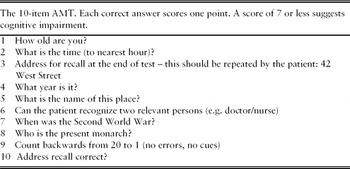
The Abbreviated Mental Test Score (AMT) is a 10-item assessment (Table 3) with a score of <8 out of a possible 10 suggesting cognitive impairment. Derived from the longer Blessed Roth Hopkins test by Hodkinson et al. in 1972, the AMT was designed for use in hospitals. It assesses the domains of memory, orientation and attention. It is widely used in clinical practice, takes an average of 2 min to complete and is acceptable to both patients and physicians.Reference Vardon and Blessed14 It has the advantage of being suitable for people with visual or motor deficits. Comparative studies have shown that it has lower sensitivity and specificity to detect cognitive impairment than the MMSE.Reference MacKenzie, Copp, Shaw and Goodwin10, Reference Swain and Nightingale15, Reference Hooijer, Jonker and Lindeboom16
Abbreviated Mental Test Score

There are several problems to the structure of the test. Some questions are open to interpretation bias: time, counting backwards from twenty and place. The address for recall and two persons identified are not standardized. The items: monarch, 20–1, and the dates of World War II are influenced by education and culture.Reference Rocca, Bonaiuto and Lippi17 Finally, the AMT has been subject to question item drift; a study involving junior hospital doctors reported that only 14% used the correct questions (and 19% were unaware of the correct cut-off value).Reference Jitapunkul, Pillay and Ebrahim18 Thus it is important to have printed copies of the questions easily available, or embedded in clerking pro formas. However, with attention to accurate question items, the AMT performed reasonably with a sensitivity 81% and specificity 85% for a cut-off score of <8 points in a hospital population, in which 34% had dementia according to DSM-III-R criteria,Reference Jitapunkul, Pillay and Ebrahim18 and a robust sensitivity of 91% and specificity of 82% using a cut-off value of <8 points compared with the MMSE score.Reference Billick, Siedenburg and Burgert19
Shorter versions of the AMT
Cognitive assessment in time-sensitive acute settings such as emergency departments or medical assessment units can be particularly challenging. Therefore studies have investigated the potential to shorten the AMT. Five- and 7-item versions, with retained questions covering recall, identification of two people, date of birth, monarch, 20–1, with or without time and place, had reasonable accuracy.Reference Jitapunkul, Pillay and Ebrahim18 A 4-item version, the AMT4, was specifically developed for use in emergency care settings.Reference Swain and Nightingale15 The included items were age, date of birth, place and year, and were purposefully selected to minimize interpretation error. In comparison with the 10-item AMT, the AMT4 had a predictive efficiency of 91% and there was preliminary evidence for clinical utility and effectiveness in detecting cognitive impairment in patients attending emergency departments.Reference Schofield, Stott and Tolson20
Clock Drawing Test
The Clock Drawing Test (CDT) was developed in the 1990s. Although primarily designed to assess visuo-spatial impairment and constructional apraxia, it also assesses auditory processing, memory (visual, numerical and long term) and abstract thinking. These are functional impairments commonly found in the dementias. It therefore compliments the brief cognitive assessment tests described above that predominantly address orientation and memory. It has an added advantage that repeated testing provides a visual log of cognitive decline. It is quick to perform (under 1 min) and is readily acceptable to older people, particularly if they are unwell.
The main difficulty with the CDT is the lack of a consistent scoring system. Indeed, many studies do not clearly document the scoring system used and hence results can be difficult to interpret. This perhaps explains the widely varying sensitivities (34–83%) and specificities (13–97%).Reference Jitapunkul, Pillay and Ebrahim18, Reference Lee, Kim and Hong21–Reference Kanchanatawan, Jitapunkul and Supapitiporn25 However, a comprehensive review of the CDT reported a mean sensitivity of 85% and specificity of 85%.Reference Shulman26 Comparison studies between the CDT and the MMSE using DSM-IV as the reference standard have reported reasonable correlation.Reference Adamis, Morrison and Treloar27, Reference Lam, Chiu and Ng28
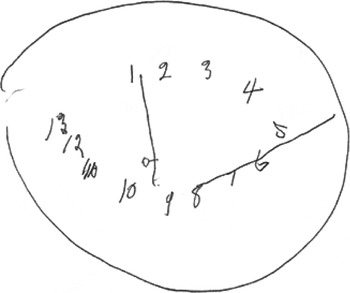
The simplest scoring system is a 3-point scale with one mark allocated to a correctly drawn circle, evenly spaced clock face numbers and correctly positioned hands (typically ‘10 past 11’) (see Fig. 1). Failure on any item (i.e. a score of 2 or less) suggests moderate/severe cognitive impairment (sensitivity 77%, specificity 87%) but the CDT is less reliable in detecting mild cognitive impairment.Reference Seigerschmidt, Mösch and Siemen23
An example of the Clock Drawing Test.

The CDT provides a reasonable alternative to the MMSE with the particular advantages of ease of use and less influence from education status,Reference Shulman26 with the exception of individuals who are visually and physically disabled to such an extent that it precludes ability to perform the CDT. A standardized approach to the scoring is essential. Studies directly comparing various scoring systems have recommended the 3-point scoring system described above on the basis of simplicity and reliability.Reference Seigerschmidt, Mösch and Siemen23, Reference Esther, Hagen and Sandilands29 It may be that the increasing use of digital clocks will result in the CDT becoming obsolete.
Mini-cog
The Mini-cog was specifically developed to augment the narrow cognitive domain focus of the CDT whilst retaining brevity, simplicity and acceptability.
Participants are given three items to remember (such as apple, watch, penny), then asked to complete the CDT, both to contribute to the test score, and as a distraction task before asking for recall of the three items. The clock is scored by awarding 2 points if the numbers, hands and time are all correct, and 0 points in the presence of any mistake. Then one point is awarded for each correct word recalled. The score range is from 0 to 5 and a score of <5 implies dementia. The Mini-cog is simple to use and score. A study that compared skilled and naïve examiners reported an agreement rate of 89%.Reference Borson, Scanlan and Brush30 The Mini-cog is less influenced by culture and education than the MMSE.Reference Borson, Scanlan and Brush30 Performance is comparable to the MMSE. A community-based study of 1119 older adults with a dementia prevalence of 6.3% for people living at home and 38% for people resident in in care homes, reported a sensitivity of 76% and specificity of 89% for the Mini-cog, and 71 and 94% for the MMSE. This study also included a separate analysis of the CDT. The Mini-cog increased the sensitivity of the CDT to detect cognitive impairment from 79 to 99%.Reference Borson, Scanlan and Chen31, Reference Setter, Neumiller and Johnson32
Memory Orientation Screening Test
The Memory Orientation Screening Test (MOST) is a further development of the Mini-cog. Temporal orientation (year, season, month, date, day and time) and the recall of a 12-item grocery list have been added. The Mini-cog's advantage of brevity is retained with 92% of patients (including people with severe dementia) completing the test in 4.5 min. The MOST outperformed the MMSE and Mini-cog in a large-scale study of 1752 participants with a high dementia prevalence of 74%.Reference Clionsky and Clionsky33
Brief Alzheimer Screen
The Brief Alzheimer Screen (BAS) test is a shorter version of the MMSE that was developed to improve sensitivity to detect early dementia. Two large population databases were used to determine the MMSE items that optimized discrimination between cognitively healthy people and people with early dementia. The identified items were the 3-word recall, date, and spelling ‘world’ backwards. An additional item, verbal fluency (number of animals named in 30 s), was also included. The sensitivity and specificity of the resulting new test, as calculated from the deriving data set, were 99 and 97%, respectively.Reference Mendiondo, Ashford and Kryscio34 In a small comparison study of 163 patients presenting to an emergency department, the performance of the BAS was assessed against the MMSE using a cut-off score of <24. The sensitivity and specificity were 95 and 52%, respectively. The low specificity is a reflection of the brevity of the BAS in comparison with the MMSE.
Short Blessed Test
The Short Blessed Test (SBT), also called the Blessed Orientation Memory Concentration Test, was derived from the 26-item Blessed Information Memory Concentration Scale. It comprises six questions assessing temporal orientation, recall, counting backwards from 20–1, and naming the months in reverse order. The scoring system is weighted with an emphasis on the recall item, hence aiming to identify early dementia. One point is assigned for each incorrect item to a maximum score of 28. A score of >10 suggests dementia. It takes less than 5 min to complete. The main limitation is the need to calculate the score, which makes the SBT less attractive for use in time-sensitive environments such as acute care facilities. Comparable performance to the MMSE was reported for a hospital population.Reference Mejia, Gutierrez and Villa13 There is evidence that it is less influenced by education and literacy attainment.Reference Mendiondo, Ashford and Kryscio34 This attribute, its speed of completion and low risk for interpreter bias means the SBT has advantages over the MMSE.
6-Item Cognitive Impairment Test
The 6-item Cognitive Impairment Test (6-CIT) is widely used in primary care. Like the SBT, it has weighted questions, so is a little complex to use away from a computer. It is a shorter version of the SBT with only temporal orientation and a shorter recall item.
In a community-based population of 287 people, the 6-CIT performed better than the MMSE, especially in mild dementia with a sensitivity of 79% and specificity of 100% for a cut-off of 7/8.Reference Brooke and Bullock35 In a study conducted in an emergency department, the 6-CIT was compared with the Mini-cog and superior performance was reported for the 6-CIT.Reference Wilber, Lofgren and Mager36, Reference Carpenter, Krall and Tibrewala37
Time and Change test
The Time and Change (T&C) test was developed in the United States to assess executive function based on a commonplace daily task, thereby minimizing education bias. The test comprises two parts: (1) time : the participants have 1 min and two attempts to read the time on a large clock set at 11:00; and (2) change: the participants are asked to make a dollar from three quarters, seven dimes and seven nickels in 3 min. Failure on either task suggests cognitive impairment.
In a study comparing the MMSE score, the modified Blessed Dementia Rating Scale (mBDRS) and the T&C test, the T&C agreed moderately with the other instruments but not sufficiently strongly to meet desirable standards for dementia detection. Attempts to improve the performance by decreasing the time testing task to 3 s, and allowing only one attempt on the change task over 10 s, increased the sensitivity to 98% but at the cost of an unacceptable specificity of 24%.Reference Inouye, Robison and Froehlich38 The main attractions of the T&C test are speed (the average completion time is 23 s); acceptability (only 5% refusal); and reliability (inter-rater agreement 88%). However, an English version is yet to be developed and investigated. Another limitation is that it would not be suitable to detect MCI, which in its definition is memory loss without interference in functional ability.
Hopkins Verbal Learning Test
Developed by Brandt in 1991, the Hopkins Verbal Learning Test (HVLT) is a brief assessment of verbal recall and recognition. It takes 5 min to complete and involves providing participants with a list of words to remember. Three trials to freely recall all the words are allowed, followed by the patient being supplied with words from semantic categories to provide cues. Two studies with a focus on detecting mild dementia, one small and heavily weighted with demented participants, and one larger population study, showed good sensitivity and specificity and both correlated with the MMSE.Reference Frank and Byrne39, Reference Kuslansky, Katz and Verghese40 The HVLT is not routinely available and needs to be purchased through the internet, further limiting utility.
Montreal Cognitive Assessment
The Montreal Cognitive Assessment (MoCA) is a 10 min assessment developed with the specific aim of detecting mild dementia by incorporating an emphasis on tasks of frontal executive functioning. It assesses eight cognitive domains and has weighted scores to increase sensitivity. Tasks include the CDT, memory, cube copying, orientation, trail-making, verbal fluency, sustained attention, serial 7s and naming objects. A website with full instructions is readily available (http://www.mocatest.org). It contains three drawing tasks which may limit its use for people with physical impairments, for example people with Parkinson's disease or stroke-related disability.
Most studies have demonstrated that the MoCA performs better than the MMSE in the identification of people with MCI and mild dementia. The sensitivity of the MoCA for detecting MCI ranges from 83 to 90%, whereas for the MMSE it is considerably lower at 17–18%.Reference Nasreddine, Phillips and Bedirian41–Reference Luis, Keegan and Mullan43 For the detection of mild dementia, the MoCA has sensitivities of 94–100% compared with 25–78% for the MMSE. However, the superior sensitivity of the MoCA is offset by an inferior specificity of 50–87%, compared with the MMSE with a specificity of 100%.Reference Nasreddine, Phillips and Bedirian41–Reference Luis, Keegan and Mullan43
Seven Minute Screen Battery
The optimistically named Seven Minute Screen Battery (7-MSB) incudes: cued recall, the CDT, temporal orientation and category fluency but requires an average 9–13 min for completion.Reference Tsolaki, Iakovidou and Papadopoulou44–Reference Skjerve, Nordhus and Engedal47 The 7-MSB has been validated in a variety of populations with high and low proportions of dementia and varying levels of education. It has produced results comparable to the MMSE.Reference Tsolaki, Iakovidou and Papadopoulou44–Reference Skjerve, Nordhus and Engedal47 For example, in a population of 589 participants from a memory clinic, 91% with dementia, the reported sensitivity of 93% and specificity of 93.5% for Alzheimers’ disease (AD) was superior to the performance of the MMSE.Reference Meulen, Schmand and van Campen45 It appears to be less affected by education or age, and is better at detecting patients with MCI or mild dementia.Reference Ijuin, Homma and Mimura48
Discussion
The timely diagnosis of dementia is recommended to improve the treatment, information provision, support and care for people with dementia and their families.1 It is easy to miss clues to a possible dementia in time-constrained clinical encounters. Non-specific symptoms such as ‘not coping’, unexplained weight loss (neglecting food), poor medication compliance, or frequent falls are typical clues of dementia in older people. However, the high prevalence of dementia, and its potential for considerable morbidity, implies an ideal situation for routine screening of older people presenting with ill health. This is the role of the brief cognitive impairment tests. It is important to understand that these tests do not in themselves diagnose dementia: they merely indicate the possibility. Reliable diagnosis requires a detailed assessment that includes gathering information from an informant, blood tests and brain imaging as described in the NICE guidance.Reference Prince, Bryce and Ferri49 In the UK, memory clinics have been established to undertake this task. The role of primary and secondary care health care professionals is to identify people with possible dementia and ensure they are referred to the local memory clinic for assessment.
Using a systematic search process, this review has identified twelve brief cognitive assessment tests. We have been purposely pragmatic to identify tools suitable for use by non-specialist staff in routine care where available time is a practical issue. Therefore we have sought evidence for brief cognitive assessment tools that are effective at identifying early dementia, succinct enough for routine clinical use and suitable for use in an increasingly culturally diverse UK population.
Several of the 12 instruments (BAS, SBT, T&C, HVLT, MOST and 7MSB) are, as yet, insufficiently well studied. Some have only been studied by the developers of the test – a situation in which over-estimates of the accuracy are obtained due to inherent superior knowledge of the test. Several of the better-studied tests are suitable for use in routine care. The MMSE score is long established and well studied. However, it has fast become less popular now that the copyright has been (retrospectively) enforced. Thus each copy that is used must be paid for. Moreover, it is far from a perfect test. It performs less well at identifying people with early dementia and is influenced by educational attainment. Fortunately, there are several tests that might be used as an alternative to the MMSE score. The 10-item AMT test has reasonable sensitivity to detect cognitive impairment with the proviso that the questions are standardized. The recent derivation from the AMT of the AMT4 appears to perform as well as the parent instrument, particularly in emergency medicine departments where its brevity is a major advantage. Furthermore, the four questions contained in the AMT4 are free from interpreter bias, it is easier to remember and less culturally specific. The long-established CDT, and its extension (the Mini-cog) are also quick and easy to use and are not influenced by culture or education. The main acceptability issue is for patients with visual or physical impairment, who may not be able to draw the clock face. The 6-CIT has been specifically developed for use in primary care where most consultations take place with ready access to a computer to calculate the weighted scores. This may limit its use for bedside assessments in secondary care.
There has been increasing interest in the ‘pre-dementia’ syndrome of MCI. MCI is defined as cognitive decline greater than expected for an individual's age and level of education but which does not interfere notably with functional activities.Reference Gauthier, Reisberg and Zaudig50 Studies have shown that progression to dementia in people with MCI might be as high as 100% over 10 years.Reference Morris, Storandt and Miller51 Hence the interest in the timely identification of MCI: an intervention that could delay the onset of AD by just 12 months could lead to 9.2 million fewer cases of AD worldwide.Reference Petersen, Roberts and Knopman52 Currently, candidate treatments for MCI remain the subject of research studies. The special advantage of the MoCA test is its high sensitivity to MCI and early dementia, though at the expense of specificity. If accurate diagnosis of MCI is required (currently in the context of research studies) a detailed neurocognitive assessment is necessitated.Reference Petersen53
Conclusion
In this structured review, we have identified 12 brief cognitive assessment tests of which six (MMSE, AMT, CDT, Mini-cog, 6-CIT, MoCA, 7MSB) are sufficiently well studied to allow recommendation for use in routine care. Practitioners should become familiar and competent with just a few instruments, selection being based on local use so that communication between teams and services is maximized.
Conflicts of interest
The authors have no conflicts of interest to declare.