

The sweeping decentralization reforms implemented in the early 2000s have granted Indonesian districts substantial prerogatives in several policy areas. As a result, local government has performed a key role in addressing pressing policy issues such as poverty alleviation and the delivery of social services. Our understanding of the outcomes of Indonesian decentralization, however, remains incomplete, as the quality of democracy in Indonesian regions remains a persistent concern. This article studies democratic accountability in Indonesia with an analysis of the local-level implementation of Jamkesmas (Jaminan Kesehatan Masyarakat, or Social Health Insurance), the national free healthcare program for the poor. This scheme, implemented from 2008 to 2013, provided about seventy-six million low-income Indonesians with free basic healthcare services, and has allowed a dramatic expansion in access to healthcare among the poor. I argue that, although key policy challenges remain, local district heads have responded to the electoral incentives introduced with the implementation of local direct elections, known in Indonesian as pilkada langsung or pilkada: in election years, Jamkesmas benefits are more accurately targeted to low-income recipients. However, I also find evidence that the benefits of pilkada are limited to districts with competitive local politics. These results suggest that local politics plays a crucial role in the implementation of national social policy programs such as Jamkesmas.
In the literature on Indonesian politics, a critical view of the democratization process has long prevailed (Hadiz Reference Hadiz2010; Hadiz and Robison Reference Hadiz and Robison2005, Reference Hadiz2013; Winters Reference Winters2013, Reference Winters2011). From this perspective, post-Suharto Indonesia displays substantial continuity with its authoritarian past, and its local politics feature the persistence of oligarchic domination and elite capture. As powerful structural forces and predatory interests have survived the New Order, the democratic institutions introduced after authoritarian breakdown have mostly failed to produce meaningful and sustainable political change. This view has come under increasing criticism, however, due to its inability to explain major developments in contemporary Indonesian politics such as the large-scale expansion of pro-poor social security programs both at the national and at the local level. More recent research has highlighted the emergence of new opportunities for previously marginalized social sectors, and the increasing political clout of various civil society groups (Aspinall Reference Aspinall2013; Mietzner Reference Mietzner2013a; Rosser Reference Rosser2015; Davidson Reference Davidson2007). This new focus on political agency and shifting power relations between established and new political actors is a valuable development, as it allows a more accurate appraisal of recent changes in several policy areas.
My contribution to the literature on democratic accountability in Indonesian local politics is threefold. First, analyzing policy outcomes across Indonesia in a policy field in which dramatic subnational variation is observed, I am able to investigate the full range of variation in policy outcomes and possible explanatory factors. Although the nexus between health politics and democratic accountability has been fruitfully studied from different perspectives (Aspinall Reference Aspinall2014; Aspinall and Warburton Reference Aspinall and Warburton2013; Dwicaksono, Nurman, and Prasetya Reference Dwicaksono, Nurman and Prasetya2012; Rosser and Wilson Reference Rosser and Wilson2012; Kristiansen and Santoso Reference Kristiansen and Santoso2006; Dwicaksono et al. Reference Dwicaksono, Nurman, Muluk, Wulandari and Ramdan.2010; Nurman and Martiani Reference Nurman and Martiani2008), existing scholarship is mostly based on case studies or theoretical argumentation, and subnational data have not been fully exploited to study the relationship between democratic accountability and local policy outcomes. By combining cross-sectional, district-level data on health insurance policy outcomes, sociodemographic factors, fiscal and institutional variables, and electoral politics for more than 400 Indonesian districts,Footnote 1 I am able to ascertain whether, and to what degree, local politics shapes how a major social policy program is implemented.
Second, I study observable outcomes, namely reported Jamkesmas coverage rates among low-income households, in a policy area that has a major and direct impact on the lives of the most vulnerable Indonesians. To be sure, social policy implementation in Indonesian local government has been extensively analyzed in development and health economics, and the issue of targeting social services to the poor has received special attention (Alatas et al. Reference Alatas, Banerjee, Hanna, Olken, Purnamasari and Wai-Poi2013; Alatas et al. Reference Alatas, Banerjee, Hanna, Olken and Tobias2012; Sparrow, Suryahadi, and Widyanti Reference Sparrow, Suryahadi and Widyanti2013). This literature, however, is primarily policy-related in its activities, such as evaluating the impact of social programs or finding optimal implementation procedures: we do not know the extent to which local politics and political accountability affect policy outcomes.
Finally, I present some new insights on a topic hotly debated in Indonesian politics and media, namely the practice of direct elections for local leaders. Since their introduction in 2005, pilkada elections have generated a debate between their proponents and opponents. From one perspective, pilkada are a crucial step in the consolidation of democracy in Indonesia, as they grant citizens the right to choose directly their representatives in local government. Perhaps the most adamant supporters of this view are Indonesian citizens themselves, as public opinion surveys show that almost ninety percent of them prefer pilkada to indirect election of district heads (Gabrillin Reference Gabrillin2014). Critical concerns, however, have been raised both by scholars and political elites. Some students of Indonesian politics have exposed the prevalence of clientelistic practices, illicit political financing, auctioning of party endorsements, and increasing entrenchment of local political dynasties (Buehler Reference Buehler2013; Buehler and Tan Reference Buehler and Tan2007; Mietzner Reference Mietzner2008). Prominent national political figures such as former Minister of the Interior Gamawan Fauzi and presidential hopeful Prabowo Subianto have argued that the excessive cost of campaigns for local direct elections threatens democratic politics. Despite the political saliency of the issue and extensive coverage in Indonesian media, we still lack systematic evidence about the role of pilkada in strengthening democratic accountability in local politics. My results show that local politicians are responsive to the incentives introduced by pilkada, but only if local politics is sufficiently competitive.
The remainder of this article proceeds as follows. The next section outlines the development of national welfare state institutions and health insurance schemes in Indonesia. I then focus on local government, analyzing the proliferation of local health insurance schemes since decentralization reforms and the role of district authorities in Jamkesmas implementation. The following sections proceed to data analysis of an original quantitative dataset with district-level information on health policy and local governance. Using district-level Jamkesmas coverage rates for low-income Indonesians, I first discuss some descriptive statistics and patterns of subnational variation in policy outcomes. I then focus on the incidence of poverty and electoral competition as factors explaining health insurance coverage rates. I find through multivariate regression analysis that coverage rates among the poor increase as a function of the incidence of poverty, and that the relationship between poverty and coverage is stronger in election years. Incumbents are more responsive to the preferences of their poor constituents when they are running for reelection, but only if local elections are competitive. The final section concludes by discussing the implications of the findings for democratic accountability in Indonesia and identifying some venues for further research.
HEALTH INSURANCE IN INDONESIA: FROM EMPLOYMENT BENEFITS TO SOCIAL SECURITY
Access to healthcare is an important, hotly debated political issue in contemporary Indonesia. In local politics, the electoral fortunes of many prominent politicians, including the current president Joko Widodo, have been closely tied to the provision of “free healthcare” services. At the national level, the government is currently implementing an ambitious plan to reach universal health insurance coverage by 2019, which would make Indonesia the largest single-payer health system in the world.
The current health insurance system is the result of a long process in which coverage was gradually extended to increasingly large sectors of the Indonesian population. The foundations of today's policies date back to the early years of the Indonesian state, with the introduction of social insurance plans for civil servants and formal sector workers in 1963 and 1964 respectively (Suryahadi, Febriany, and Yumna Reference Suryahadi, Febriany and Yumna2014, 6). Health insurance schemes were revamped and expanded at various stages during the New Order years. Most notably, a reform of social security in 1992 established two main agencies that would manage health insurance plans, namely PT Askes for civil servants and the military, and Jamsostek for the workforce employed in the formal economy. Health insurance before democratization was thus a privilege reserved to three professional categories; when Suharto's regime collapsed in 1998, only about seventeen million Indonesians, or eight percent of the population, were enrolled in a health insurance plan (Achmad Reference Achmad1999, 9). Although excluded from formal health insurance schemes, the rest of the population benefited from other health-related policies implemented under authoritarianism. The network of local clinics or puskesmas, for instance, was expanded substantially, especially in rural areas, providing basic healthcare services at a modest cost to a large number of patients.Footnote 2 Furthermore, the launch of JPKM (Program Jaminan Pemeliharaan Kesehatan Masyarakat) in the mid-1970s was a first attempt to facilitate access to healthcare for the poorest Indonesians. A community health insurance program implemented at the village level, JPKM was designed to mitigate the adverse effects of declining oil revenues on social spending, and it allocated funds to help indigent citizens to cover healthcare costs. The coverage of this program, however, was very limited, including a mere 1.87 percent of the population in 1998 (Soendoro Reference Soendoro2009, 98–99).
The Asian Financial Crisis of the late 1990s exposed the vulnerability of indigent households to economic shocks. As the poverty rate spiked with the dramatic contraction of economic activity, the utilization of healthcare services declined sharply, and drug shortages and cutbacks in government social spending contributed to a deterioration in the quality of the services delivered at the puskesmas level (Sparrow Reference Sparrow2008, 189–190). These developments highlighted the alarming contingencies of the social welfare gains attained during the New Order, and prompted policy makers to implement a social safety net package of measures known as JPS or Jaring Pengaman Sosial. The JPS programs, designed in consultation with the World Bank, included a health card for the poor (kartusehat), rice subsidies, support for education, employment creation initiatives, and a community-driven development program based on the allocation of block grants to selected communities (Sumarto, Suryahadi, and Widyanti Reference Sumarto, Suryahadi and Widyanti2002). Although the JPS was an ad hoc response to the economic crisis and suffered from major implementation problems, it provided an embryonic framework for the expansion and development of future social programs. Perhaps most importantly, the Asian financial crisis and the JPS increased the saliency of social security as a political issue, and broadened support for a more active role of the state in sheltering the most vulnerable from economic fluctuations.
In 2005, the coverage of the JPS health program was expanded dramatically with the implementation of Askeskin, renamed Jamkesmas and expanded in 2008, a health insurance program targeting about 60 million low-income Indonesians. With this scheme, patients could receive free basic outpatient care and inpatient services in puskesmas and public hospitals, which could then submit claims to government agencies for the services provided to members of the program. As Aspinall convincingly argues, this substantial expansion of free healthcare for the poor was closely tied to the democratization process, as politicians of all ideological orientations soon discovered the electoral attractiveness of pro-poor policy appeals (Aspinall Reference Aspinall2014).Footnote 3 Regardless of the motives that inspired its implementation, however, Jamkesmas was a turning point in the development of social security institutions in Indonesia, as it was unprecedented in scope of coverage and range of benefits provided. To be sure, the program was not without flaws: it encountered important implementation challenges, and various episodes of mismanagement and corruption have surfaced throughout the years.Footnote 4 Yet there is little doubt that Askeskin and Jamkesmas have significantly improved access to healthcare for many low-income Indonesian households. In 2012, Jamkesmas boasted more than seventy-six million members, a budget of Rp. 7.38 trillion, and the involvement of over 1,000 public and private hospitals (Faizal Reference Faizal2013). Existing studies of its implementation suggests that the bulk of Jamkesmas resources have been channeled towards poor and near-poor beneficiaries, and that they have increased the utilization of health services among the beneficiaries (Harimurti et al. Reference Harimurti, Pambudi, Pigazzini and Tandon2013; World Bank 2012; Vidyattama, Miranti, and Resosudarmo Reference Vidyattama, Miranti and Resosudarmo2014).
In 2014, Jamkesmas and three other existing health insurance programs were merged into the National Social Security System (SJSN) established by Law 40/2004. The new National Health Insurance plan aims at achieving universal health coverage by 2019, and it was designed as a single-payer system that would eventually incorporate and unify all existing government health insurance programs, both national and local. As the focus of this article is on local-level governance, an analysis of this landmark reform is beyond its scope.Footnote 5 However, I discuss in the conclusions some possible implications of the transitions to the new system for the role of local government in health policy.
DECENTRALIZATION AND LOCAL HEALTH INSURANCE SCHEMES
Local government in Indonesia has long played a role in health policy and development programs. The already mentioned JPKM program in the mid-1970s is an example of a policy initiative in which local authorities (village heads) had substantial autonomy in deciding how to allocate the funds they received. The room for maneuver of local government during the New Order, however, was in general very limited. At the village level, the central government maintained a tight grip on political activity, crippling any attempt at independent social mobilization or policy activism (Antlov Reference Antlov1994). At the district level, autonomy was limited by the scarcity of the available resources and by strict regulations and control by the central government on how to allocate them. The institutional context in which local government was embedded, however, was not the sole reason for its limited role in health policy during the New Order. Health policy implementation was severely affected by low rates of healthcare service utilization, due to factors such as the prevalence of traditional healing practices, out-of-pocket costs, and distance from health facilities (Achmad Reference Achmad1999, 73–76). As a result, healthcare was not a priority for many local leaders, who were more interested in the development of infrastructure such as roads, electricity, and irrigation projects (Achmad Reference Achmad1999, 32–33).
The breakdown of authoritarianism led to a profound restructuring of the Indonesian state and a redefinition of the role of local government. In the late 1990s, the Indonesian parliament approved a package of institutional reforms that would quickly transform Indonesia into a more democratic and decentralized political system. In shifting substantial powers to local government, security issues were a prominent concern for legislators, as the institutional reforms were implemented in a context of unrest and instability (Mietzner Reference Mietzner2007; Aspinall and Berger Reference Aspinall and Berger2001). However, federalist institutional arrangements were also discussed as possible solutions to governance issues such as efficient government, effective social service provision, democratic development and civil society empowerment (Sularto and Koekerits Reference Sularto and Koekerits1999). Law 22/1999, in particular, incorporates principles of democratic accountability and good governance by mandating that provinces and districts have full autonomy to govern according to the preferences and priorities of their local constituents.Footnote 6 While there has been some confusion about the specific powers that the law reserves to the various levels of government (Seymour and Turner Reference Seymour and Turner2002, 43), Article 11, Paragraph 2 of Law 22/1999 states explicitly that districts are required to carry out government functions in several areas, including health policy. In 2004, the decentralization laws were updated to strengthen provincial government authority. Articles 13 and 14 of Law 32/2004 stipulate that healthcare is a mandatory function not only of district, but also of provincial governments. In short, in decentralized Indonesia health policy is designated as an area of shared responsibility: district, provincial, and national authorities can take policy initiatives where they deem it appropriate.
This transition towards a decentralized, multi-level political system has changed the local politics of healthcare in two fundamental ways. The first is that the scope for local authorities, and districts in particular, to implement health policy broadened dramatically. A radical departure from the institutions of the New Order era, decentralization provided a legal basis for local government to take a much more active role in social service delivery, and to allocate their budget in complete autonomy. The results of this institutional shock in health policy were already visible in the early 2000s, when a small number of districts located in various regions started to experiment with policies that expanded access to healthcare among the poor. To be sure, these health insurance programs, known in Indonesia as Jamkesda (Jaminan Kesehatan Daerah), varied dramatically in crucial aspects such as legal and institutional status, membership criteria, benefit packages, implementation strategies and financing mechanisms (Dwicaksono, Nurman, and Prasetya Reference Dwicaksono, Nurman and Prasetya2012; Thabrany et al. Reference Thabrany, Sari, Tilden, Dunlop and Hajaraeni2015). Yet such early Jamkesda programs may be considered as local-level responses to a common policy challenge: as national plans to build a more inclusive health system were experiencing delays and obstacles, some districts were filling a policy vacuum with innovative policy solutions, as in the frequently-cited case of Jembrana in Bali, where the district head implemented a universal health insurance scheme that offered free basic healthcare to the district's residents (Rosser and Wilson Reference Rosser and Wilson2012). A survey conducted in June 2007 by the Indonesian Ministry of Health, followed by a series of field visits, found that twenty-four districts had already been running local health insurance schemes for at least one year, and that an additional seventy-two districts had plans to implement similar programs (Gani et al. Reference Gani, Thabrany, Pujianto, Yanuar, Tachman, Siregar, Wahyu, Soerachmad, Widyastuti, Yulherina, Nurbaiti and Dunlop2008). They could have done so only on their own initiative.
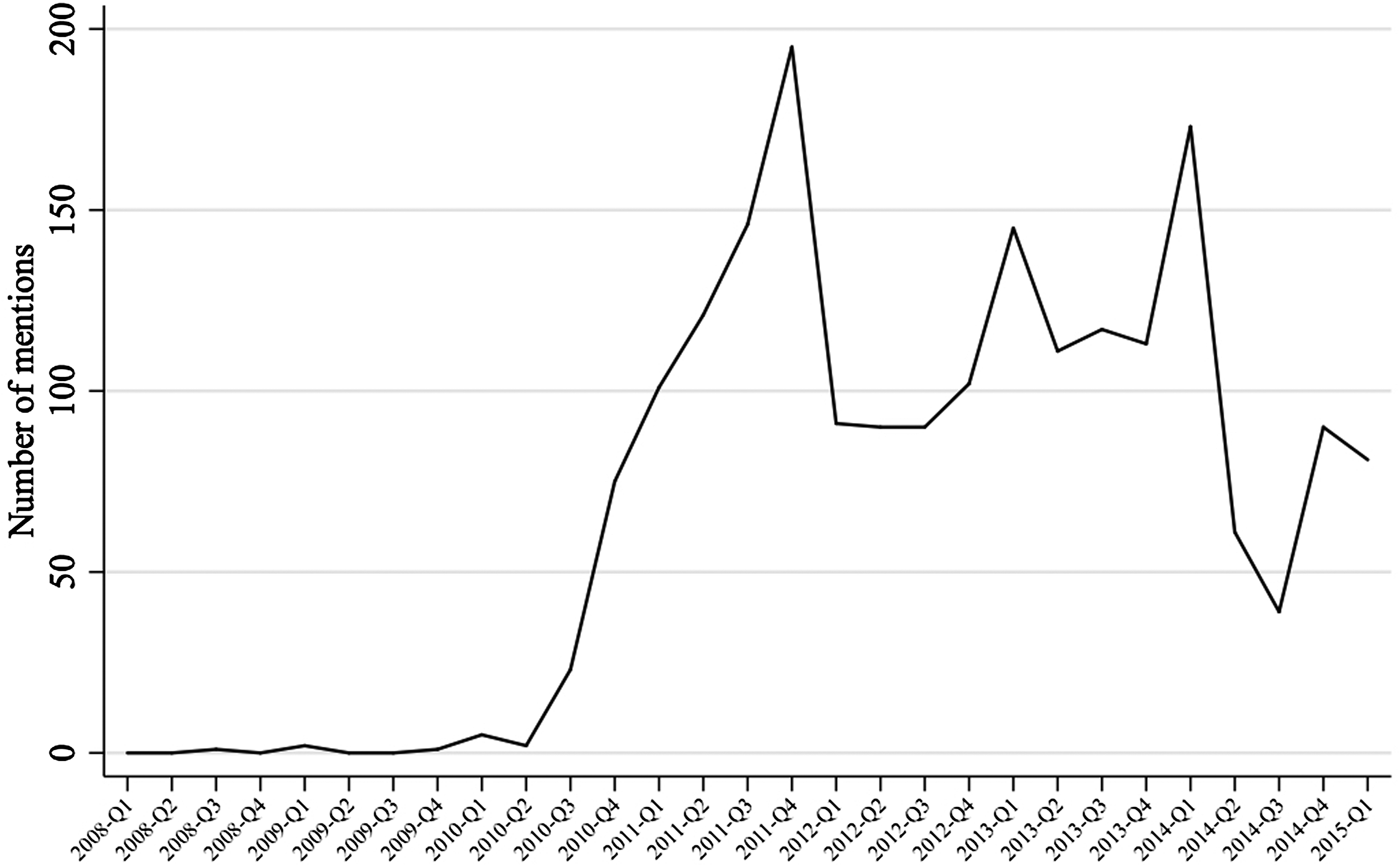
The second factor that transformed the politics of healthcare in Indonesian regions was the introduction of pilkada, the local direct elections for province and districts heads, established with Law 32/2004 on local government. Even before the first round of pilkada started in 2005, the prospect of direct local elections provided an immediate, strong incentive for local leaders to promise and implement pro-poor policies such as free healthcare schemes. As politicians of all political parties soon appreciated the electoral appeal of Jamkesda policies, many of them have used free healthcare to build successful political careers and reputations as reformist leaders: it is now common to witness local electoral campaigns in which free healthcare features as one of the key political issues being debated (Aspinall Reference Aspinall2014, 814–815). Plausibly due to these pressures, a large-scale policy diffusion process took place in concomitance with the first round of pilkada, with most districts starting Jamkesda implementation between 2008 and 2011. Although yearly diffusion data is not available, Figure 1, charting the mentions of the word “Jamkesda” in a sample of twenty-five Indonesian newspapers, shows that local health insurance programs were a salient issue in Indonesian politics by late 2010.Footnote 7 Thabrany et al. (Reference Thabrany, Sari, Tilden, Dunlop and Hajaraeni2015, 20) cite a study of the Center for Health Insurance Financing of the Indonesian Ministry of Health carried out in January 2011, according to which 479 districts, or more than ninety-seven percent of the total, reported implementing Jamkesda or having plans to do so by the end of 2011. In short, local health insurance schemes quickly transitioned from being a policy innovation benefiting a very limited number of Indonesian citizens to a standard practice in local government, covering an estimated fourteen percent of the population in 2012 (Departemen Kesehatan R. I. 2013, 234).
Salience of Jamkesda in Indonesian newspapers

LOCAL GOVERNMENT IN THE JAMKESMAS ERA AND BEYOND
The local policy experiments discussed above unfolded as policy-makers at the national level were showing interest for the expansion of health insurance programs as well. However, the introduction of large-scale welfare programs such as Askeskin and Jamkesmas did not marginalize the role of local government in providing access to healthcare for the poor. The design and implementation of Jamkesmas, in particular, suggest that there are two reasons why local government has maintained a key role in this policy area even in the wake of increased activism by national government. The first is that the Jamkesmas quotas allotted to districts were in many cases inadequate to cover the poor population. On one hand, with a total membership of about seventy-six million, Jamkesmas excluded a large number of “near-poor” Indonesians. Although these people do not qualify as indigent, they typically do not have health insurance of any kind, and their incomes, since they often come from employment in the informal sector, are highly vulnerable to economic fluctuations. On the other hand, some of the district quotas were intentionally designed as being insufficient to cover the poor population. While some districts received quotas much larger than the size of their low-income population, others had less than what they needed to insure all poor households. This is because poverty rates were only one of the two main criteria used to determine Jamkesmas quotas, the other being “fiscal capacity”: districts with a larger tax base or with non-tax revenues from natural resources were allocated relatively smaller quotas, under the assumption that local government had sufficient resources to cover the excluded poor.Footnote 8 Since the implementation of Jamkesmas, national government officials have repeatedly stressed that local government is expected to provide health insurance to the poor not covered by national schemes.Footnote 9
Second, and more crucially, the implementation and socialization of Jamkesmas relies heavily on local government. The process of targeting, in particular, has entailed a prominent role for local administrations, as the lists of Jamkesmas beneficiaries used by the Ministry of Health is compiled according to input from local government (Sri Lestari and Subardi Reference Sri Lestari and Subardi2012, 36). In other words, district authorities have been in charge of deciding who qualifies as “poor.” Such discretionary targeting procedures, especially in the early years of Jamkesmas implementation, have provided ample scope for clientelistic practices at the local level. As a result, a substantial share of the resources allocated to Jamkesmas is channeled towards higher-income recipients: data from the 2010 National Socioeconomic Survey suggest that about twenty percent of Jamkesmas beneficiaries are from the top three income deciles, and that only about forty-eight percent of the recipients are from the three lowest (Harimurti et al. Reference Harimurti, Pambudi, Pigazzini and Tandon2013, 13). Besides the potential for clientelism and leakage of resources, corruption has been a major concern in the implementation of social welfare programs. For instance, in one of the many episodes reported in the media, a health official in South Palu Regency (South Sulawesi) was found guilty of using her personal bank account to manage Jamkesmas funds and embezzling about $31,000 (2010). Furthermore, the practice of charging low-income patients with illegal fees, or delivering lower quality services if they refuse to pay, is common (Rosser Reference Rosser2012). Finally, a recent audit by the watchdog government agency BPK (Badan Pemeriksa Keuangan) has found extensive delays in another area for which local government is responsible, namely the verification and reimbursement of claims for the services delivered by healthcare providers (Sandi Reference Sandi2013).
The role of local government has therefore remained pivotal even in the wake of major health policy initiatives at the national level, and the implementation of Jamkesmas thus provides the opportunity to study the link between democratic accountability and policy outcomes at the local level. Plans for the new National Social Security System, however, could lead to a de facto recentralization in this policy domain. If universal coverage is achieved in the next years, the presence of a colossal single-payer system enrolling more than 250 million Indonesians could substantially limit the scope of action for local government. The SJSN implementation schedule stipulates that the hundreds of Jamkesda schemes currently running be merged into BPJS Kesehatan (the agency that runs the new national health insurance scheme) by the end of 2016. Available data suggest that this process is slowly taking place, as 107 local government joined the new system before its nation-wide implementation in 2014 (Thabrany et al. Reference Thabrany, Sari, Tilden, Dunlop and Hajaraeni2015, 161). However, it is still unclear whether the demise of local health insurance schemes is imminent, as suggested by national government officials. The regulation instituting BPJS, Law 24/2011, is silent about the role of local government in SJSN, and the Indonesian legal system provides strong foundations for an active role of local authorities in health policy. As discussed, regional autonomy laws are explicit in designating healthcare as a field in which local government can, and should, be active. A decision of the then new Constitutional Court in 2005 (007/PUU-III/2005)Footnote 10 further clarified this issue, stating that, even in a single-payer health system, local administrations have the right to design health insurance schemes and to establish institutions to implement them. Furthermore, among local policy-makers there is considerable confusion about the meaning of “integration” into BPJS Kesehatan. A recent survey of local health policy executives reports that, while fifty-five percent of respondents think that Jamkesda should be eliminated after 2016, the remaining forty-five percent believe that it should continue existing, although with a more “specialized” role (Thabrany et al. Reference Thabrany, Sari, Tilden, Dunlop and Hajaraeni2015, 163). Similarly, interviews with health policy officers in several regions conducted by TNP2K, the Team for the Acceleration of Poverty Reduction, show beliefs among some respondents that local government will have major responsibilities in the integrated system, including designing contracts with healthcare facilities and managing claim reimbursements (TNP2K 2014, 161–166).
ARE THE POOR GETTING WHAT THEY SHOULD?
So far, I have discussed a number of issues that are familiar in the literature on Indonesian politics. The proliferation of health insurance programs after democratization suggests that they follow an electoral logic. We also know that the implementation of these programs, although beneficial for millions of low-income Indonesian households, has been inadequate in various dimensions. Most crucially, there is abundant evidence of extensive subnational variation in how well health insurance programs are implemented. As I have argued, such variation stems from the key role that local government has maintained in this policy area despite a growing activism from national policy-makers.
In the remainder of the paper, I focus on the implementation of Jamkesmas to address two questions that have received less attention in the literature. The first is descriptive: it regards the extent and the patterns of subnational variation in the quality of Jamkesmas implementation. Although several empirical studies offer an overall picture of Jamkesmas implementation (Harimurti et al. Reference Harimurti, Pambudi, Pigazzini and Tandon2013; World Bank 2012), the extent to which it varies across district is to a large extent unexplored. The second question concerns the origins of such variation in health policy implementation. Indonesian districts vary dramatically with regard to the incidence of poverty, and for this reason poverty alleviation programs may be more salient, and better implemented, in localities in which poverty is an issue of greater concern. I will show through quantitative analysis that the link between the incidence of poverty and the quality of Jamkesmas implementation is affected by local electoral cycles, and that the magnitude of such electoral effects is conditional on the competitiveness of local politics. The key measures I use to investigate these three questions are built from the 2013 implementation of Susenas, the Indonesian National Socioeconomic Survey. There are, in particular, two variables I am using to provide an overall indicator of the quality of the implementation of health insurance programs for the poor. The first is a survey question that asks respondents if Jamkesmas covered them in 2013, the last year the program was implemented. The second tracks reported household income, which allows me to determine if a given household can be considered as “poor” or “near-poor.” More precisely, I classify households as intended Jamkesmas recipients if they fall below the thirty percent of the national income distribution; this is same threshold that was adopted to determine the overall Jamkesmas membership.Footnote 11 By matching these two indicators, I am able to determine the district-level share of poor households (i.e., of households that should be covered by Jamkesmas) reporting coverage in the Susenas survey. The simple idea behind this measure is that district government is using Jamkesmas funds effectively when it channels them towards their intended recipients, namely poor and near-poor households: the higher the share of intended recipients reporting coverage, the better job local authorities are doing at implementing free healthcare for the poor.
The choice of measuring the quality of health policy implementation with coverage rates obtained from survey data can present some challenges. The first is that coverage may be underreported in survey data, as many respondents may be unaware of their benefits. However, this is precisely a reason why using survey data is so important for measuring implementation quality. As discussed in the previous section, socialization is a key responsibility of local government in implementing Jamkesmas: the fact that many poor households are unaware of the benefits to which they are entitled reflects insufficient efforts by local authorities in socializing the program. For this reason, I maintain that the indicator I am using as a dependent variable, although a measure of the extent of health insurance coverage, is also an accurate indicator of the quality of health policy implementation. A second potential weakness is that coverage is not the only dimension that captures the quality of health policy implementation. There may be districts in which reported coverage rates are high, but the quality of delivered services is low because health facilities are difficult to access, in poor conditions, overcrowded, and so forth. I assume here that the case of a local government that is performing well in socializing Jamkesmas and poorly in running it through its health facilities, although theoretically possible, is empirically rare. A more plausible and common case is that of local health authorities claiming high coverage levels and implementing their health insurance schemes poorly, or in a clientelistic fashion. By using survey data instead of the patchy coverage numbers provided by local government, I obtain a more accurate measure of implementation quality.
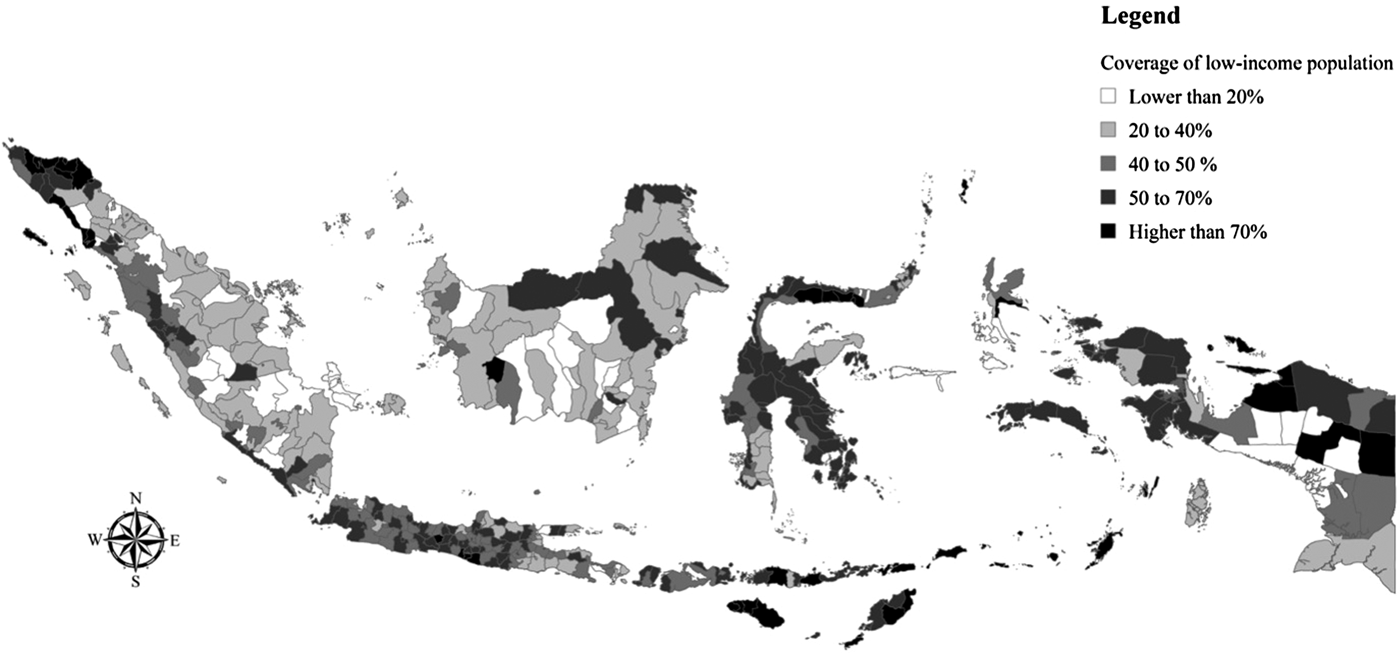
The data on coverage rates among poor Indonesian households show that only a minority of Jamkesmas's intended beneficiaries report being insured by the program: on average, only about forty-five percent of the poorest Indonesians report coverage, while the remaining fifty-five percent say they are not covered by Jamkesmas. These figures suggest fairly low overall levels of local government responsiveness to the preferences of low-income Indonesians, as less than half of entitled recipients report being covered. However, the map of district-level Jamkesmas coverage shown in Figure 2 suggests that subnational variation in coverage rates is wide. Districts are represented with gray gradients and classified in five categories, ranging from those that are performing particularly poorly (coverage rates below 20%, represented in white) to districts with exceptionally high coverage (black in the map, with coverage rates above 70%). The map shows that Indonesian islands and provinces differ significantly in how effectively they are insuring their low-income citizens. For example, while Javanese provinces show values around the national average, very low rates are reported in provinces in Kalimantan (average coverage of 33%) and Sumatra (36% on average, although the figure jumps to sixty nine percent in the special autonomy region of Aceh). Higher coverage rates appear in regions receiving generous Jamkesmas quotas in Eastern Indonesia, such as West and East Nusa Tenggara (53% and 71% average coverage, respectively) and Maluku (58%). In other islands, provinces differ substantially in average coverage rates: in Sulawesi, for instance, values range from fourty two percent in North Sulawesito seventy two percent in Gorontalo.
Jamkesmas coverage rates by district
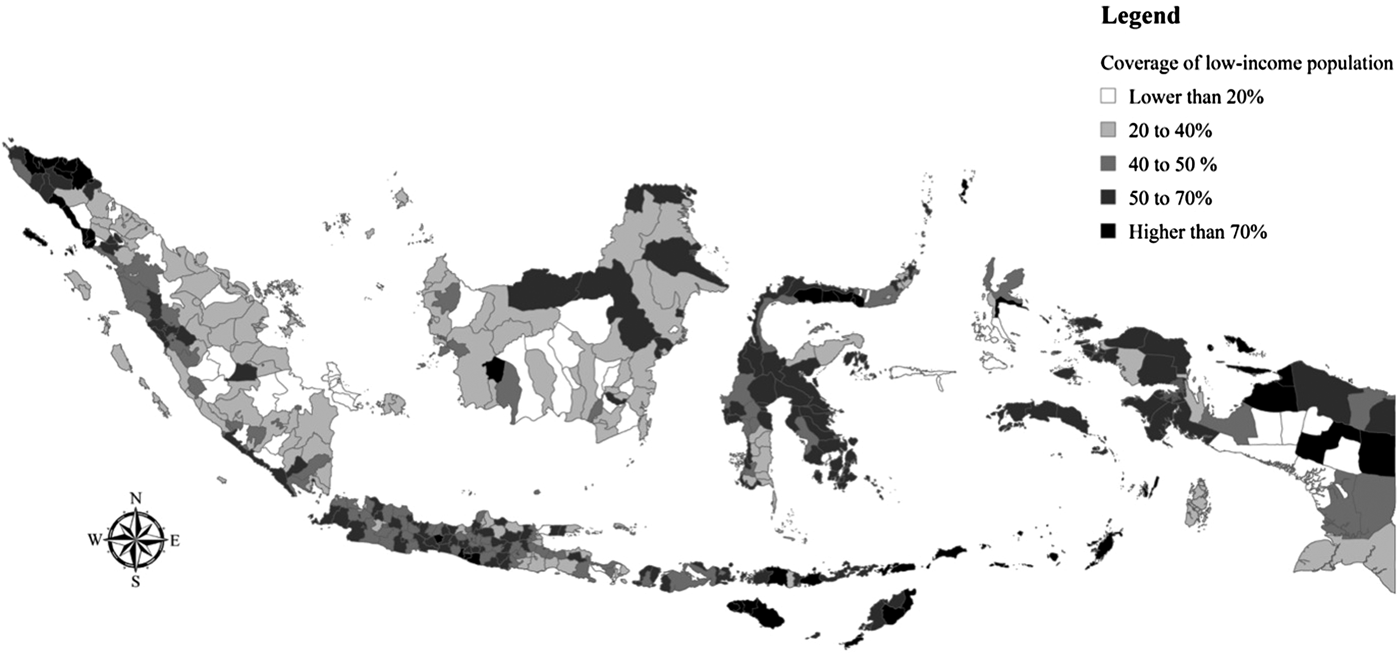
In sum, the map shows that subnational variation is extensive and that it escapes broad categorizations such as a divide between poor and rich provinces, or between the center and the periphery of the archipelago. However, while visual inspection reveals some interesting contrasts, it is important to turn to multivariate analysis to gauge the relationship between Jamkesmas implementation quality and theoretically relevant local-level factors.
PREFERENCES, ACCOUNTABILITY AND POLICY OUTCOMES IN INDONESIAN LOCAL POLITICS
A possible driver of variation in how effectively Jamkesmas is implemented is that Indonesian regencies and municipalities vary in their incidence of poverty, and this could have a direct impact on the implementation of pro-poor policies like Jamkesmas. In districts with a high incidence of poverty, demand for free healthcare services for the poor may be higher, and the provision of free healthcare to the poor tends to be a more salient political issue. In these localities, elected government officials may have stronger incentives to target low-income voters accurately, as they constitute a larger share of the population and could thus carry more weight in electoral competitions. By contrast, in districts where poverty is low, low-income citizens represent a smaller share of the population, and could thus be a less decisive social group in shaping the outcomes of local electoral contests. We can thus hypothesize that in districts in which poverty alleviation is not a particularly salient political issue, targeting low-income voters is not as crucial for incumbents to secure electoral support, and leakages of Jamkesmas resources to middle and upper classes are more common.
Still, there are various reasons why the incidence of poverty may not translate into better implementation of pro-poor policies. For example, low levels of socioeconomic development may also be associated with lack of awareness on health issues, the absence of advocacy for broadening the access to healthcare among the poor, and the prevalence of traditional healing practices. More generally, the mechanism of democratic accountability between voters and elected politicians may not work because of the poor quality of local electoral institutions, which is closely related to levels of civic engagement and transparency in local government (Pepinsky and Wihardja Reference Pepinsky and Wihardja2011).
In Indonesian local politics, a key development in the institutionalization of electoral accountability has been the introduction in 2005 of local direct elections for district heads and provincial governors (Erb and Sulistiyanto Reference Erb and Sulistiyanto2009). Assessing whether the introduction of pilkada has had an overall positive effect on Indonesian democracy is a daunting task, since the quality of democracy is a complex idea that presents several conceptual dimensions (Diamond and Morlino Reference Diamond, Morlino, Diamond and Morlino2005). Furthermore, identifying the causal effects of pilkada implementation is particularly challenging, as their introduction unfolded alongside broader patterns of democratization, decentralization and economic development. For these reasons, I will not attempt in this paper to provide a general evaluation of the effectiveness of pilkada in fostering democratic accountability. However, it is possible to investigate if, and to what degree, elected politicians respond to the incentives of direct electoral competition.
The literature on political budget cycles in industrial democracies has robustly documented that elections have a direct effect on government spending patterns, especially in young democracies like Indonesia (Drazen and Eslava Reference Drazen and Eslava2010; Shi and Svensson Reference Shi and Svensson2006; De Haan and Klomp Reference De Haan and Klomp2013; Brender and Drazen Reference Brender and Drazen2005). This approach proposes that the electorate votes retrospectively, leading voters to condition their support for incumbents on incumbents' performance while in office. Although this approach has traditionally been applied to studies of fiscal policy, the same logic may extend to policy implementation: assuming that voters will reward elected officials for effectively implemented policies, incumbents have an incentive to target their constituents more accurately when they are running for reelection. To be sure, the occurrence of an electoral contest in itself is not a guarantee that health policy will be better implemented, as policy preferences vary across districts. Furthermore, electoral cycles can also produce perverse incentives for policy makers, as research on illegal logging in Indonesia has shown (Burgess et al. Reference Burgess, Hansen, Olken, Potapov and Sieber2011). However, direct elections may strengthen and consolidate the relationship between policy preferences and implementation. For Jamkesmas implementation, we can hypothesize that local government responsiveness to the preferences of low-income voters is higher in election years. In other words, the relationship between incidence of poverty and Jamkesmas coverage rates identified in the previous section is stronger in years for which pilkada elections are scheduled.
The staggered introduction of pilkada across Indonesian districts and provinces provides an ideal empirical setting to test this proposition. Local direct elections were implemented for the first time in 2005, but only in some districts, as there is cross-district variation in electoral cycles (i.e., in several districts the term of service for the incumbent district heads fell after 2005). We can therefore treat the timing of pilkada election implementation as exogenous to local politics, which provides powerful analytical leverage to investigate the role of electoral incentives for political elites. In 2013, the year in which the Susenas survey I used to calculate Jamkesmas coverage rates was implemented, a total of 130 Indonesian districts held local direct elections to choose their heads of government.Footnote 12 I am thus able to build a dichotomous variable that tracks pilkada implementation in 2013, dividing the sample between districts that did and did not run local elections in that year. The argument I propose is that preferences over health insurance policy implementation interact with the pilkada schedule in shaping health policy outcomes. A suitable empirical test is to estimate a regression model with a multiplicative term between these two factors. I thus expect the interaction term between the incidence of poverty and the dummy variable for pilkada in 2013 to be positively signed and statistically significant.
A QUANTITATIVE ANALYSIS OF LOCAL POLITICS AND HEALTH POLICY IMPLEMENTATION
I test this hypothesis through regression analysis of district-level data collected from various sources. The dependent variable I use is the same indicator displayed in Figure 2, namely Jamkesmas reported coverage rates among the poorest thirty percent of the Indonesian population. As discussed above, this variable is built from survey data, which makes it a suitable measure of local-level efforts in implementing and socializing the national health insurance scheme. The incidence of poverty at the district level, which I expect to be positively correlated with reported coverage, is measured with the official poverty rates reported in the INDO-DAPOER, the World Bank's Indonesia Database for Policy and Economic Research.Footnote 13 In all models, I control for district type (regency vs. municipality) and for several other factors that may be related to incidence of poverty and health policy outcomes. First, I include a host of sociodemographic control variables, namely total population, population density, ethnic fractionalization, and socioeconomic development (per capita GDP).Footnote 14 Second, I build a measure of total revenues per capita to account for the possibility that resource-rich districts may be allocating additional resources to Jamkesmas implementation.Footnote 15 Third, I include measures of associational life to capture the degree of civic engagement at the local level.Footnote 16 Fourth, I have built indicators of the overall structure of the local health system, namely the number of puskesmas and hospitals, morbidity rates, and the density of grassroots government organizations.Footnote 17 Finally, I include an indicator of the quality of governance at the local level, namely the KPPOD index of Local Economic Governance, which measures the quality of district-level economic governance with survey data.Footnote 18
As for the estimation method, linear regression analysis may be inadequate since the dependent variable, the share of low-income citizens reporting Jamkesmas coverage, has values bounded between zero and one. I thus estimate a fractional logistic model in which the response variable, reported free healthcare coverage, is assumed to have a binomial distribution, and is linked to the regressors by a logit-link function (Papke and Wooldridge Reference Papke and Wooldridge1996). To model unobservable province-specific factors, I include fixed effects for provinces in all estimations, and I estimate cluster-robust standard errors for provinces to account for possible clustering in the data. I expect the estimated coefficient for the interaction between poverty rate and election year to be positive and statistically significant at conventional levels, and to be greater in magnitude in electorally competitive districts.
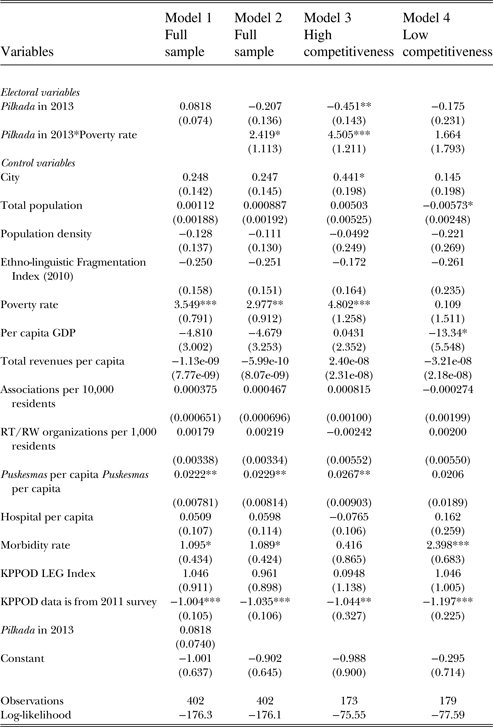
Table 1 reports estimation results for models in which Jamkesmas coverage is a function of the incidence of poverty, electoral cycles, the interaction between the two, and the control variables discussed previously. In the first column, I estimate a model with no interaction effects between poverty rates and the implementation of local direct elections. The coefficient for poverty rate, estimated at 3.500, is positively signed, of sizeable magnitude and significant at .001 level. This suggests that the relationship between the incidence of poverty and the quality of Jamkesmas implementation is positive and strong in all Indonesian regions: the reported coverage of intended Jamkesmas recipients increases in districts with higher poverty rates. The estimation results reported in Table 1 allow us to calculate expected Jamkesmas coverage rates at various levels of poverty, controlling for the sociodemographic and governance-related factors included in the list of covariates. The predicted values of coverage change substantially as we move along the poverty rate range. For instance, while a district with a low incidence of poverty such as five percent is expected to have a coverage rate of only fourty percent, the expected coverage increases to fifty two percent for a district with a high incidence of poverty of twenty percent. As for the coefficient of the dichotomous variable tracking the implementation of pilkada elections, it is positively signed (0.102) but not statistically significant. This indicates that direct elections themselves do not have a systematic, positive effect on the quality of Jamkesmas implementation. Rather, as the results of the three other models show, it is the interaction between local preferences and electoral institutions that can affect how effectively health insurance programs are implemented.
Elections, electoral competitiveness and Jamkesmas implementation

Robust standard errors in parentheses. All models include dummy variables for provinces, not reported. *** p < 0.001, ** p < 0.01, * p < 0.05
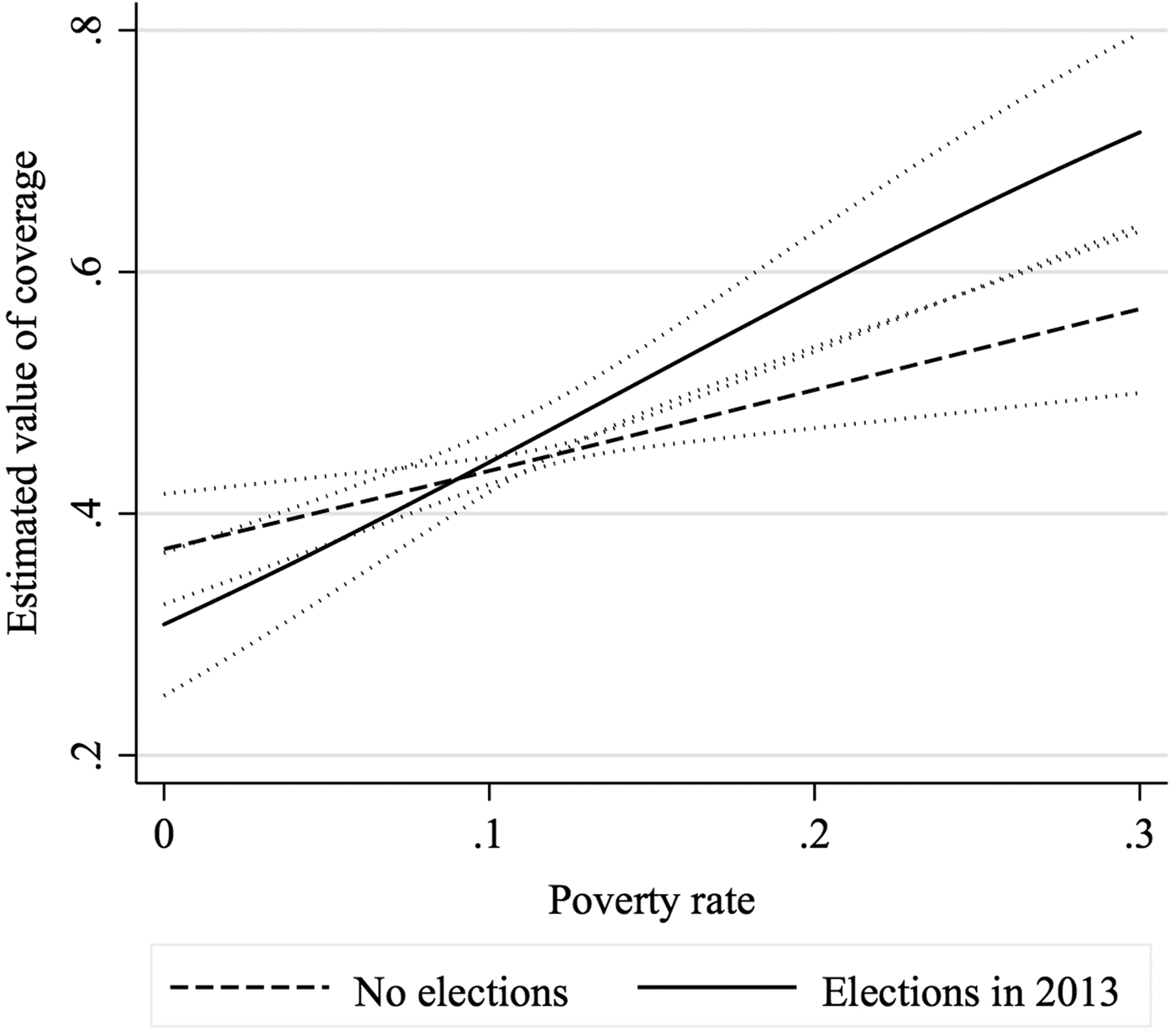
Model 2 estimates a multiplicative interaction between poverty rate and election year with the full sample for which data are available. Regression analysis estimates the coefficient for the interaction term at 3.072, and different from 0 at the .05 level of statistical significance. To illustrate the meaning of these results, recall the example discussed in the previous section about the difference in estimated coverage between a low-poverty district (poverty rate of 5%) and a high-poverty one (20%). In that example, the poorer district is expected to have a coverage rate of fifty two percent, about twelve percent higher than what is expected in the district with a low incidence of poverty. Now, consider what changes when we introduce in the model an interactive term between poverty rates and the pilkada electoral cycle. In years in which no elections are scheduled, the difference between the two districts is only about 9.5 percent; however, in election years, the gap between the rich and the poor district increases considerably to about twenty percent. Figure 3 visualizes the difference between these two scenarios by plotting two curves and their relative ninety five percent confidence intervals: one, the continuous line, represents estimation results for districts where a pilkada election took place in 2013; the other, dashed, displays estimated values for the remaining districts. As the figure shows, the line for election years is steeper, suggesting that differences in poverty rates (and thus, in preferences over Jamkesmas implementation) have a more decisive effect on coverage rates in election years. Although the difference between the two groups of districts is not dramatic, these results are consistent with the argument that policy-makers show increased responsiveness to the preferences of their constituents when they are up for reelection.
Effect of pilkada on government responsiveness

The results reported for Model 2 may seem surprising, since it is well known that there is wide variation in how democratic institutions work at the local level, both in Indonesia and elsewhere. While governance in some districts benefits from competitive politics, an engaged citizenry and civic-minded leaders, some other communities are mired in corruption, predatory government, and elite domination. As mentioned before, there are various dimensions to the quality of democracy (Diamond and Morlino Reference Diamond, Morlino, Diamond and Morlino2005), and producing a comprehensive measure for a large number of districts is prohibitively costly. However, even by analyzing only some aspects of the functioning of local politics, we should be able to observe differences in accountability patterns between these two types of districts. To explore this intuition, I have collected data on pilkada election outcomes for all districts in the sample. As a measure of electoral competitiveness, which should be a suitable proxy for the quality and competitiveness of local democratic politics within districts, I use the share of votes for the winning candidate in local direct elections, and I classify observations as competitive or non-competitive districts. Ideally, data from the second round of pilkada (2010–2014) should be used to measure electoral competitiveness for all districts. However, since official data is missing for many observations, I use data from the first round of pilkada (2005–2009) whenever more recent electoral returns are not available. This assumes that local institutions show a certain degree of stability over time, and that no dramatic institutional changes occurred in this period. A potentially important development at this regard is the process of pemekaran, or district proliferation, through which many Indonesian districts underwent territorial change after decentralization (Firman Reference Firman2013; Pierskalla Reference Pierskalla2012). To account for this confounding factor, I restrict the analysis to the 391 districts in the sample that did not experience “district splitting” from 2005 to 2013.Footnote 19
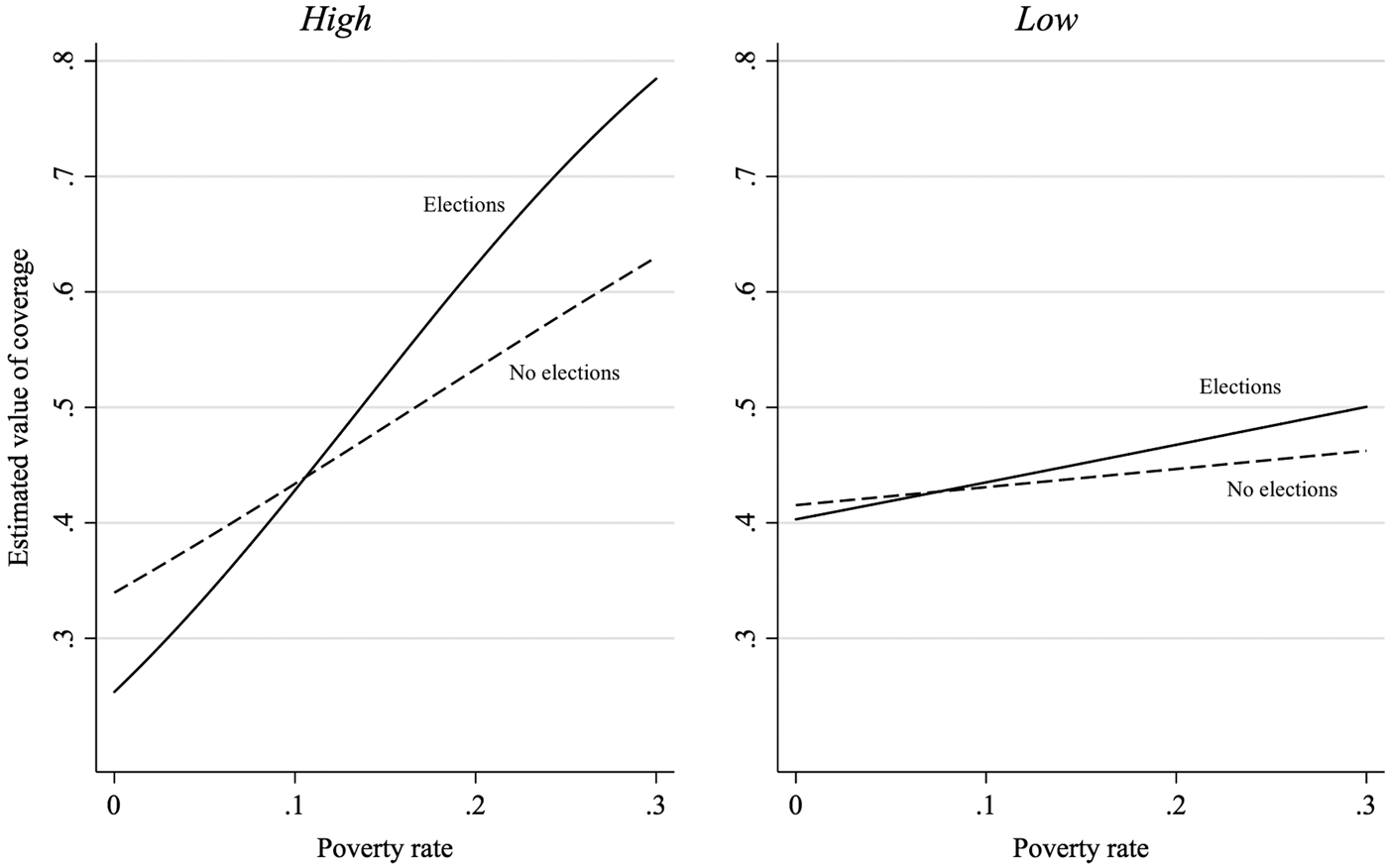
Models 3 and 4 in Table 1 show striking differences between competitive and uncompetitive districts. For high-competition districts (Model 3), the interaction term between poverty rates and election year is estimated at 3.915, larger than in the model with the full sample, and statistically significant at the .01 level. By contrast, the same coefficient for less competitive districts (Model 4), although positively signed, is much more modest in magnitude (0.678), and it does not reach conventional levels of statistical significance. Figure 4 shows these stark differences by comparing estimated coverage rates for Model 3, in the left panel of the figure, and Model 4 in the right panel. For both groups of districts, the effect of local direct elections is displayed with curves similar to those in Figure 3. As shown, electorally competitive districts have steeper curves for both election an non-election years, indicating that relationship between poverty rates and the quality of Jamkesmas implementation is much stronger when local politics is competitive. Furthermore, the difference between the solid and the dashed curve is much more substantial in the left panel, which suggests that the implementation of local direct elections has a stronger effect on democratic accountability in politically competitive districts. For example, in a competitive district with a high incidence of poverty (20%), an increase of 8.5 percentage points in reported coverage rates is observed in pilkada years; for non-competitive districts with similarly high poverty rates, the same difference is only 1.9 percent.
Effect of pilkada on responsiveness, by degree of electoral competitiveness

Overall, these results suggest that subnational variation in the competitiveness of local politics has a strong effect on how national social programs for the poor are implemented at the local level. Electoral incentives introduced by direct elections may change the behavior of elected local officials, but the competitiveness of local democratic politics plays a central role in translating local policy preferences into policymaking outcomes.
CONCLUSIONS
This paper has investigated whether, and to what degree, local government in Indonesia is responsive to the preferences of low-income citizens. It advances our understanding of democratic accountability and local politics Indonesia by focusing on a policy area that directly affects the most vulnerable Indonesians, namely the implementation of Jamkesmas, the national health insurance program for the poor, and by analyzing the full extent of subnational variation in local government accountability and policy outcomes. By employing this research design, I am able to identify how the electoral incentives associated with the introduction of local direct elections shape the responsiveness of local government to the policy preferences of the poor. The empirical analysis finds that local politicians are responsive to their low-income constituents, as the electoral incentives introduced by pilkada, the local direct elections for district heads, are positively affecting policy implementation. However, the results also indicate that the positive effects of local direct elections on democratic accountability are only observed in districts with sufficiently competitive local politics. As a result, a large share of the intended beneficiaries of pro-poor social policy programs may not be benefiting from their implementation.
The main implications of this paper's findings concern the debate on the quality of democracy in Indonesian regions. As mentioned in the introduction, students of Indonesian local politics are divided in their assessment of democratization in Indonesian local government. While some emphasize the continuities with the authoritarian past (Hadiz Reference Hadiz2010; Winters Reference Winters2011), others see signs of increasing agency and clout from civil society groups (Aspinall Reference Aspinall2013; Davidson Reference Davidson2007; Rosser Reference Rosser2015; Mietzner Reference Mietzner2013a). This paper argues that both perspectives offer useful analytical insights. On one hand, Indonesian government has shown increased responsiveness to the policy preferences of the poor. At the national level, a large-scale health insurance program for the poor was launched in 2005, and it has been gradually expanding to include new beneficiaries. At the local level, politicians have implemented a variety of pro-poor health policies that are benefiting many low-income Indonesian households. Elected policy makers have thus responded, at least to a certain degree, to the incentives for providing broad-based social services introduced by democratization, and the introduction of pilkada elections appears to have strengthened the prospects for more accountable local government. On the other hand, there is ample evidence that these ambitious initiatives are often plagued by implementation shortcomings such as inefficiencies, corruption and stubbornly high leakages of funds to non-poor recipients. Furthermore, this paper has documented dramatic regional variation in Jamkesmas reported coverage rates for low-income Indonesians, and it has shown that such variation is closely related to how democracy works at the local level. In many Indonesian regions, despite democratization and sustained economic development, access to healthcare is still an insurmountable challenge for many poor households.
The findings reported here also speak to the comparative literature on the nexus between democracy and the provision of social services. A long-standing debate in the scholarship on democratization has been on whether broad based-social services such as basic healthcare and education are better provided under democratic politics. While some studies have failed to establish an empirical connection between democracy and outcomes such as poverty or inequality (Ross Reference Ross2006; Sirowy and Inkeles Reference Sirowy and Inkeles1990), many others have argued that democracy is conducive to pro-poor policy outcomes and improved provision of social services (Brown and Hunter Reference Brown and Hunter1999; Sen Reference Sen2001; Przeworski et al. Reference Przeworski, Alvarez, Cheibub and Limongi2000; Besley and Kudamatsu Reference Besley and Kudamatsu2006; Kudamatsu Reference Kudamatsu2012; Harding and Stasavage Reference Harding and Stasavage2014; Stasavage Reference Stasavage2005; Lake and Baum Reference Lake and Baum2001). Democracy opens up opportunities for the poor to mobilize and gain political influence, and it introduces incentives for politicians to provide public goods more broadly than in authoritarian regimes. My analysis of the implementation of Jamkesmas in Indonesian districts provides additional empirical evidence that increased political competition improves the delivery of social services. It also suggests that the degree of electoral competitiveness and the structure of the party system may be crucial moderating factors in the relationship between democracy and social policy outcomes. Finally, the evidence presented here indicates that, as proposed by Lake and Baum (Reference Lake and Baum2001), Stasavage (Reference Stasavage2005), and Harding and Stasavage (Reference Harding and Stasavage2014), local direct elections in Indonesia are improving social policy outcomes by introducing new electoral incentives for local political elites, rather than by unleashing bottom-up pressures from grassroots mobilization.
Further research may probe the argument proposed in this paper and address its limitations along various avenues. A first, important caveat about the findings reported here is that the data I have analyzed do not allow a sufficiently thorough study of the nature of the accountability relationship observed between citizens and politicians in this policy area. In particular, it is unclear if the responsiveness patterns identified here are due to meaningful dynamics of democratic accountability or to a more superficial intensifying of clientelistic practices. Increased electoral competition may strengthen democratic accountability by providing incentives for programmatic linkages between voters and elected officials, as clientelism is typically associated with the lack of genuine competition among contenders for public office (Medina and Stokes Reference Medina and Stokes2002). In the case of Jamkesmas implementation, electoral incentives may have engendered a virtuous process through which the quality of health services gradually increases by incremental steps, with positive policy feedback effects that incentivize citizens to participate in local politics and defend their newly acquired entitlements. Some preliminary evidence from news reports about the implementation of the new National Health Insurance suggest that this is a likely scenario, as citizens appear to be increasingly aware of their rights and increasingly willing to complain when they are not fulfilled (BBC Indonesia 2014). However, electoral competition can also increase the potential for vote buying and materialistic exchanges between voters and politicians, especially in constituencies with low levels of socioeconomic development (Weitz-Shapiro Reference Weitz-Shapiro2012). In many localities, politicians implementing Jamkesmas may still be able to exploit information asymmetries between them and their voters, and to deploy various strategies to condition the delivery of social services on electoral support. Additional empirical research is thus needed to ascertain the causal mechanisms connecting local preferences, electoral dynamics, and policy outcomes.
Second, a profitable extension to this article would be to investigate whether my findings apply to other policy areas. Local government responsibilities in Indonesia extend well beyond the provision of health insurance for the poor, and many of the prerogatives of local administrations have a close relationship with electoral politics. For example, free healthcare packages are often promised and offered in conjunction with other pro-poor policies such as free education. Subnational variation in policy outcomes is not limited to social policy, as it extends to areas as disparate as implementing e-government reforms (Kristiansen et al. Reference Kristiansen, Dwiyanto, Pramusinto and Putranto2009), setting minimum wage regulations (Caraway and Ford Reference Caraway and Ford2014), designing moral and religious laws (Buehler Reference Buehler2008), and many others: each of these fields offers great potential for exploration of the nexus between electoral incentives for political elites and policy outcomes. Third, I have argued that local government is still crucial even in a policy area, that of social security, that is experiencing strong re-centralization pressures. The extent to which this will remain an accurate characterization of health policy in the near future, however, should be assessed by further research, as the emergence of a universal health insurance system is slowly unfolding. Finally, this paper has not considered the role of political parties. In omitting to do so, it has assumed that there is no consistent and consequential difference in the social policy platforms articulated by political parties at the local level. Although this is a widely shared view among scholars of Indonesian politics, there have been signs of increasing consolidation of the Indonesian party system in recent years (Mietzner Reference Mietzner2013b). Further research may investigate the presence of partisan effects in social policy, and perhaps hypothesize if such effects foreshadow the emergence of a left-right divide in Indonesian politics.