Case
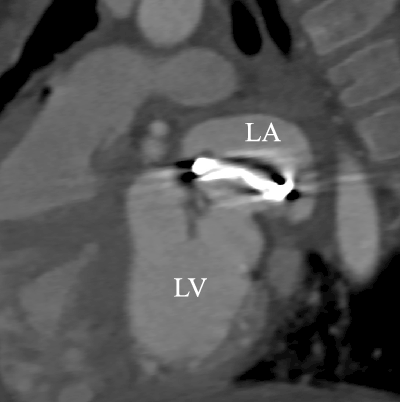
A female weighing 3258 g was born at 40 weeks of gestation and diagnosed with mitral valve stenosis and coarctation of the aorta. Three months after birth (weight 4.9 kg), coarctation repair was accomplished through a median full sternotomy. No surgical intervention was performed for the mitral valve because the mitral valve stenosis was mild and morphologically difficult to repair. At the age of 1 year (weight 6.7 kg), we performed mitral valve replacement using the chimney technique through a median full sternotomy and right-sided left atriotomy. At this time, the tricuspid regurgitation pressure gradient (as an estimation of pulmonary hypertension secondary to mitral valve stenosis) was 45 mmHg. We used an 18-mm extended polytetrafluoroethylene graft and a 16-mm ATS AP 360 (Medtronic Medical, Santa Rosa, California, USA). Her mitral annulus was 8 mm, and her native valve tissue could not be preserved. The graft was sutured supra-annularly. The left atrium was not enlarged. Anticoagulation was started with intravenous heparin after hemostasis was achieved and switched to oral warfarin with the target of 2.0–2.5 of the prothrombin time international normalized ratio. The mean pressure gradient of the mitral valve and tricuspid regurgitation pressure gradient were 7 and 36 mmHg, respectively. Mitral valve stenosis gradually increased three months post-operatively (weight 7.6 kg). Although leaflet mobility was intact, subvalvular stenosis was obvious by contrast-enhanced CT (Fig 1). Moreover, pulmonary hypertension and moderate tricuspid valve regurgitation were observed. Therefore, mitral valve re-replacement was performed 1 year post-operatively (weight 9.1 kg). Before re-replacement, the mean pressure gradient of the mitral valve and tricuspid regurgitation pressure gradient were 18 and 60 mmHg, respectively, and the pulmonary arterial pressure was 62/30 (45) mmHg.
Pre-operative contrast-enhanced computed tomography. Subvalvular stenosis was observed. LA, left atrium; LV, left ventricle.

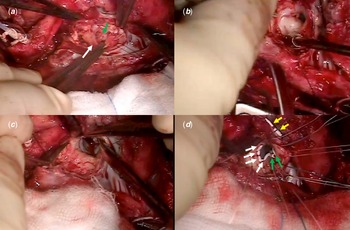
Through a standard median full sternotomy with cardiopulmonary bypass and cardioplegic arrest, the mitral valve was exposed by the superior transseptal approach via a right atriotomy. The leaflet mobility was intact. The old prosthesis was removed. The graft was folded inside, and extreme pannus formation was seen on the inside of the graft and the native annulus (Fig 2a-c). The pannus was excised where the native atrial wall and annulus could be seen. The mitral annular size was 14 mm by the Hegar dilator; therefore, intra-annular replacement was impossible. We implanted a 17-mm SJM Regent (Abbott Laboratories, Chicago, Illinois, USA) to have smooth haemodynamics in her left atrial geometry and to avoid subvalvular interference. Posterior stitches were on the native annulus, anterior stitches were on the interatrial septum from the right atrium, and the other stitches were on the left atrium (Fig 2d). The mobility of the new prosthetic leaflets was confirmed to be intact. The left atrium was enlarged with a 0.4-mm expanded polytetrafluoroethylene patch. Tricuspid valve repair was performed concomitantly. Anticoagulation was done as with the first replacement. The mean pressure gradient of the mitral valve and tricuspid regurgitation pressure gradient were 5 and 27 mmHg, respectively. Her post-operative course was uneventful. Three years after re-replacement (weight 15.4 kg), she is asymptomatic without prosthetic valve dysfunction. Currently, the mean pressure gradient of the mitral valve and tricuspid regurgitation pressure gradient are 8 and 27 mmHg, respectively.
Intraoperative image. ( a ) The folded graft (white arrow) was detached from pannus (green arrow). ( b ) Native annulus was narrowed due to extreme pannus. ( c ) After removal of pannus. ( d ) Stitches of the replacement. White arrows were on the annulus, green arrows were on the left atrial wall, and yellow arrows were on the interatrial septum.

Discussion
Mitral valve repair is preferred for mitral valve disease in paediatric patients, but mitral valve replacement is required when repair is not feasible. Commercially available prosthetic valves are too large to implant in paediatric patients with small annuli. In these patients, supra-annular replacement is useful. We have used chimney technique Reference González Rocafort, Aroca, Polo, Rey and Villagrá1 temporarily, but there are few reports about this technique with a 2.1-year follow-up duration. Reference Kwon, Kim and Lee2 In our case, the peak velocity of the mitral valve inflow increased only 3 months post-operatively and required re-replacement.
During the operation, the graft was folded inside and extreme pannus formation was seen from the inside of the graft to the native annulus. Pannus formation after prosthetic valve replacement is an important complication. It usually occurs in the late post-operative period, but Shi et al. Reference Shi, Bai, Hu, Zhang and Guo3 and Al-Alao et al. Reference Bassel, Urszula, Brian and Haralabos4 reported a case of re-replacement as short as 3 months post-operatively. Beierlein et al. Reference Beierlein, Becker and Yates5 reported that re-replacement was needed 7.5 years post-operatively and that all patients had variable degrees of pannus in childhood.
Pannus formation is related to chronic inflammatory or immunologic response. Moreover, blood turbulence is reported as a risk factor. Reference Bassel, Urszula, Brian and Haralabos4 In our case, the folded graft might make blood turbulence easy to occur, and the pannus was formed early. After re-replacement without the chimney technique, the patient is in a good course. Therefore, the graft seemed to strongly affect pannus formation. A too-long graft decreases left atrial volume and affects blood turbulence and pannus formation. However, when the graft is short, prosthetic leaflets may interfere with the native annulus or subvalvular apparatus. The length should be adjusted in each case when using the chimney technique.
In conclusion, we experienced the case of early pannus formation after mitral valve replacement using the chimney technique. Pannus formation may proceed by blood turbulence owing to the graft’s folding. The length of the graft should be carefully decided.
Financial support
This research received no specific grant from any funding agency, commercial, or not-for-profit sectors.
Conflicts of interest
None.
Ethical standards
The authors assert that all procedures contributing to this work comply with the ethical standards of the relevant national guidelines on human experimentation and with the Helsinki Declaration of 1975, as revised in 2008, and has been approved by the institutional review board (Hyogo Prefectural Amagasaki General Medical Center, ID: 4-94).