Speaking about the nascent planning profession in late 1913, James Patrick Hynes, the Toronto architect and planning advocate, observed, ‘no Canadians. . .have really made it their business to do this character of work [town planning].’Footnote 1 Frustrated that the ‘Yankee’ City Beautiful expert Edward H. Bennett had been chosen to create a plan for Ottawa over a British planner, Hynes was, strictly speaking, correct in his assessment: few Canadians viewed or advertised themselves as town planners prior to World War I.Footnote 2 However, though Canada lacked planning professionals, many individuals had ‘made it their business’ to learn of developments made in planning far beyond their borders. These urban reformers and planning advocates linked themselves to the international urban planning movement that emerged in the early 1900s. They built networks to allow the importation and circulation of foreign knowledge and expertise across Canada and pushed for the adoption of outside advances in Canada.
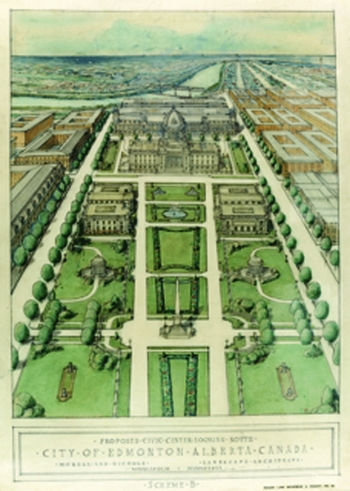
Consequently, by 1914, several Canadian municipalities had ‘borrowed’ foreign innovations and employed foreign professionals. For example, Vancouver, Regina and Calgary hired the British-born City Beautiful expert Thomas Mawson to create plans (1912–14), while Edmonton, Prince Rupert and Kitchener engaged American City Beautiful planners (Figure 1).Footnote 3 In 1910, American planner Frederick Law Olmsted Jr advised Montreal on city and park design while Frederick Todd, an American-trained, Canadian-based landscape architect and planner, worked across Canada.Footnote 4 Additionally, in the pre-war years, New Brunswick, Nova Scotia and Alberta all adopted British-influenced provincial planning legislation.
Morell and Nichols, Proposed Civic Centre Looking South, City of Edmonton, Alberta, Canada (1912). Courtesy of the City of Edmonton Archives, EAA-29-2.

Although borrowed plans and legislation did ‘differ slightly’ from their parent innovations, they were often highly derivative.Footnote 5 Canadians, eager to replicate the successes of foreign municipalities, did little to change fundamentally what they imported. Such borrowing has led to a suggestion that Canadians possessed little knowledge of outside planning theory. Imitation, however, did not necessarily equate to ‘blind mimicry’.Footnote 6 Canadians may not have extensively changed the ideas they adopted, but local actors were far from passive receptors of outside planning expertise.Footnote 7 Their decisions rested on an extensive knowledge of the international planning movement gained from their active participation within it.
This article reveals the complex nature of Canada's planning movement by exploring English-Canadians as participants within the international urban planning cohort and, in particular, highlighting their broad knowledge of outside developments. After first situating Canada's early planning movement within the wider, local urban reform context from which interest in planning emerged, I explore the four key channels through which knowledge of foreign planning innovations was acquired and circulated from the 1900s to 1914. Drawing on primary source material alongside contemporary scholarship, I argue that English-Canadian planning advocates were dynamic and informed transnational actors who critically circulated, imported and rejected outside expertise based on local needs and concerns.
The local urban context
The turn of the twentieth century saw the city become a central point of discussion for most industrialized nations. In this, Canada was no different. As rapid urbanization saw municipalities grow into complex economic and social centres, new attention turned to how they should be organized, and to the quality of life within them. These discussions were often fuelled as much by actual urban conditions as by issues of religion, class, race, nationalism and the concurrent re-making of liberalism taking place at that time.Footnote 8 Those advocating for municipal change were overwhelmingly members of the upper and middle classes. Their interest in civic issues was intricately connected to the Protestant church's implementation of social evangelism, and to elite and middle-class efforts to affirm the predominance of Anglo-Protestantism in a nation undergoing rapid change.Footnote 9 While many expressed genuine concern for urban conditions, a growing recognition of the interconnected nature of society, and a fear of the repercussions of unchecked urbanization on the lives of upper classes, was a constant undercurrent to their discussions.
From these debates sprang several urban-centred movements, roughly divided into two groups: those centring on urban conditions (including moral reform, sanitation, health, housing, parks and playgrounds and civic beautification) and those focusing on urban governance and efficiency. These categories were never discrete as their concerns often overlapped, easing inter-organizational co-operation.Footnote 10 Such fluidity was exemplified by G. Frank Beer, a Torontonian businessman and reformer during this period. As historian Lorna Hurl writes of Beer, ‘to ascribe. . .fear, religion, patriotism, economic gain, or self importance. . .as the primary factor which motivated [him]’ would ‘overly simplify’ the complexity of his reform interests.Footnote 11 By 1912, Beer sat as president of Toronto's branch of the Canadian Manufacturers’ Association (CMA), using his office to promote the capitalistic benefits of social reform and influence the branch to support such causes.Footnote 12
Beer's efforts were not exclusively motivated by economic concerns. A fervent Protestant, Beer drew inspiration from his religious beliefs, identifying with the progressive, Social Gospel groups likewise promoting urban reform at the time. Though he embraced capitalism, he denounced the individualism that he felt blinded upper- and middle-class Canadians to physical, and moral, urban decay amongst the working class.Footnote 13 He called for the reform of municipal government, specifically focusing on the need for impartial experts, rather than elected officials, to oversee urban developments.Footnote 14 He also connected environmental concerns to moral ones, stating that ‘the morals of a community. . .ideals and refinement’ would surely die unless a decent standard of living could be established for the nation's working class.Footnote 15
Like many of planning's early supporters, both within and outside Canada, Beer embraced planning as a solution to other reform goals. Indeed, planning was seen as an answer to a host of urban issues: it was a tool that could be wielded to improve housing, the urban environment and, therefore, the health and economic productivity of the working class. As owner of a handsome home in Toronto's upper-middle-class Annex neighbourhood, Beer, in concert with other property owners and developers in cities across Canada, likely also appreciated the potential of restrictive planning efforts.Footnote 16 While Toronto did not implement a comprehensive zoning law until 1940, as early as 1904, neighbourhood groups began pushing for de facto zoning measures.Footnote 17 Those lobbying for such measures viewed planning as a means by which they could bolster land values and protect upper-class neighbourhoods from encroachment by industry, manufacturing and working-class housing developments. Furthermore, the growing argument that urban planning should be undertaken by trained experts, rather than government officials, satisfied the goals of those advocating for municipal reform while fuelling the professional aspirations of Canada's architects, surveyors and engineers.
By 1912, Beer sat as director of the newly established Toronto Housing Company (THC), an organization of Torontonian reformers seeking to build co-partnership housing for working-class residents. Like Beer, those within the THC saw planning as a partial solution to issues of residential congestion. Impressed by Britain's success in combining co-partnership housing with planning efforts within that nation's Garden Cities, one of the THC's first major projects was spearheading a cross-Canada campaign asking the federal Commission on Conservation (COC) to hire British Garden City planning expert Thomas Adams as a national advisor.Footnote 18 In undertaking the latter effort, Beer and the THC elevated planning's national profile, paving the way for the later emergence of the Town Planning Institute of Canada (TPIC) under Adams’ direction.
As the example of Beer illustrates, in the years before World War I, a heterogeneous group of English-Canadian actors came to embrace planning as a means through which physically to mould and improve the city. Most interestingly, as the THC's notice of Thomas Adams demonstrates, these individuals had recognized common cause with reformers in nations outside Canada's boundaries and had begun looking beyond their borders for new solutions to urban ills. In the process, they connected to the emerging international urban planning movement, instigating complex networks through which planning expertise was acquired, circulated and adopted across Canada.
Canadians within the international planning movement
As Gerald Hodge states in his examination of early planning in Canada, ‘the roots of Canadian local planning. . .did not differ that much’ from those in similarly industrialized nations.Footnote 19 The common experience of trying to perfect ‘the city’ and attend to the realities of rapid urbanization created a shared language, and, increasingly, a shared set of solutions. A transnational planning movement grew as civic actors, local officials, professionals and urban reforms took advantage of developments in land and overseas travel and communication. They began corresponding and journeying over traditional geographic and political boundaries, learning of, and then circulating, innovations in urban planning. By 1909, international planning conferences and exhibitions also emerged, providing forums for the discussion of new ideas.Footnote 20
The emergence of this international planning cohort has been well documented; however, though Canada's place within this wider movement has been considered, few interpretations fully account for the complexity of Canadian involvement.Footnote 21 For example, in his influential work, Planning the Twentieth Century, Stephen V. Ward identifies two central means through which to categorize the diffusion of planning innovations: imposition (authoritarian, contested or negotiated), and borrowing (undiluted, selective or synthetic).Footnote 22 Placing Canada in the second category, Ward classifies it as an ‘undiluted borrower’ of foreign planning expertise: one that displayed little ‘conscious selectivity’ and had only ‘a limited grasp of the underlying theory and concepts’ of the innovations it adopted. While, as Ward states, Canada did import many ideas, under deeper scrutiny, the country's status as an ‘undiluted borrower’ becomes less convincing. As Ward himself notes, classifying a nation's planning system as strictly ‘undiluted’ can easily ‘exaggerate the aspect of external borrowing’ and obscure the fact that importing countries made the ultimate decisions as to which innovations to import. As Joe Nasr and Mercedes Volait similarly assert, even in seemingly highly derivative situations, local actors and concerns crucially shaped the ‘choice, adaptation, and realization’ of planning innovations.Footnote 23
Research on the growth of the international urban reform movement, and the urban networks that built and sustained it, offers a new framework through which to view the evolution and dynamism of Canada's early planning movement. Such work has established what Pierre-Yves Saunier defines as the urban internationale, ‘the international milieu. . .dedicated to the study of issues relating to cities’ that formed during the early twentieth century.Footnote 24 As historians John Griffiths and Marjatta Hietala have shown, studying this urban internationale through an analysis of the networks developed to facilitate the cross-municipal circulation of urban expertise and innovations highlights the role of local actors.Footnote 25 It also underscores the extent to which even agents in seemingly smaller or less developed municipalities were aware of foreign developments and used such knowledge to guide their movements within the urban internationale.
In her work, Hietala identifies four channels through which the diffusion of urban innovations between municipalities took place between 1870 and 1920: the engagement of outside experts, the use of personal connections and study abroad, the circulation of journals and attendance at international conferences and exhibitions. The remainder of this article applies such a framework to Canadian planning developments from 1900 to the outbreak of World War I, demonstrating the channels Canadians developed to operate as part of the international planning cohort and, in so doing, highlighting the extent to which local actors and priorities drove such networking. Though diverse, these connections can likewise be grouped into four types of channels of importation and knowledge circulation: those established by the personal connections of elite individuals; those built by individuals who sought out foreign ideas through travel and study; those created through the attendance of Canadian planners at national and international conferences and exhibitions and those formed domestically through the circulation of ideas in associational journals.Footnote 26 The following sections of this article expand on these key categories, illustrating them through the use of representative case-studies.
Early elite planning brokers
One of the first channels for the importation and dissemination of outside planning innovations was established by Canadian elites with an interest in planning who used their political, business and social connections to create links between Canadian and outside planning movements. Philanthropic as well as professional concerns led these individuals to learn of and embrace foreign planning innovations. They then exercised their influence to support planning efforts and worked to connect Canada with the international movement. While some preferred to stand back and put their networks at the disposal of domestic, and at times foreign, planning advocates, others took a more active role, using their connections to supplement and benefit their own campaigns in support of planning initiatives. The most prominent member of this group, and indeed one of Canada's earliest planning supporters, was Canada's governor general Earl Grey who, throughout his tenure from 1904 to 1911, acted as a steady bridge between Canada's and Great Britain's planning movements and continuously promoted the importation of British innovations.Footnote 27
Earl Grey, Canada's ninth governor general, first cultivated his interest in town planning in Great Britain. He presided over the opening ceremonies at Letchworth, the first Garden City, and served on the board of the Hampstead Garden Suburb Trust.Footnote 28 When he took up his Canadian post, his social reform concerns travelled with him. According to a contemporary, Grey expressed ‘a personal interest in. . .[the] social and national welfare’ of his new country of residence and this extended to issues of town planning.Footnote 29 He first acted to bring British planning ideas to Canada through sponsoring British housing and planning expert Henry Vivian's national tour in 1910. Between March and October, Vivian travelled from Saint John to Victoria and back again, touring municipalities, meeting with local officials and delivering addresses. Vivian so impressed Canada's planning advocates that many credited him, and Grey, with bringing housing and town planning to ‘the attention of Canadians’.Footnote 30
Grey's patronage did not end with Vivian's tour. He began a network of interchanges and new connections between Canada and Great Britain and, through this work, awakened British planners to Canada's urban development.Footnote 31 He gained a reputation in Britain as an ally to planners interested in bringing their ideas overseas. When Raymond Unwin and Patrick Geddes sought to bring their Cities and Town Planning Exhibit (CTPExh) to Canada in 1911, Grey was one of the first individuals the pair contacted.Footnote 32 Grey felt Canadians would ‘gladly welcome [the CTPExh]’ and directed his friend, architect Colborne Powell (C.P.) Meredith, to aid the effort.Footnote 33 Although the scheme failed, the attempt highlights the importance of Grey as a broker between Canadian and British experts and the existence of other ties between the two movements.
Although Grey was perhaps the most prominent of the elite planning brokers, he was not alone in his efforts. C.P. Meredith was an elite broker in his own right. As son of Edmund Allen Meredith, former Canadian secretary of state, and Fanny Jarvis, daughter of a founding Toronto family, Meredith's social connections were near unmatched. As an executive member of the Royal Architectural Institute of Canada, his professional connections were likewise impressive. While much of Meredith's interest in foreign innovations sprang from a wish to see Ottawa properly planned, he also helped spread outside planning knowledge across Canada. He was a champion of British City Beautiful expert Thomas Mawson and helped organize Mawson's Canadian speaking tours in the early 1910s.Footnote 34 Meredith also corresponded with Unwin and Geddes, and kept in constant contact with Grey.Footnote 35
Individual interest and travel
Though elite brokers provided crucial patronage, they were neither alone in their concern for civic conditions, nor in their efforts to interact with wider urban planning developments. They were joined in their work by a group of lesser connected, but no less passionate local, provincial and national actors. Such individuals, likewise driven to learn of planning through a prior interest in urban reform, created purpose-built planning networks resulting from their scholarship, travel and correspondence with foreign experts. William Fotherby Burditt, a planning advocate from Saint John, New Brunswick, was characteristic of municipal level planning advocates within this category. As a local businessman with an interest in housing reform, he developed a self-proclaimed ‘natural bent’ for planning and, in a 1919 letter, even stated that ‘perhaps no one in Canada. . .has given more study and attention to [urban planning]’.Footnote 36
Burditt's ‘natural bent’ led him to undertake an extensive analysis of the writings of American and British planning experts, obtain membership within American planning organizations and travel to attend the American National Conference on City Planning.Footnote 37 Subsequently, Burditt used his knowledge of town planning, in particular, British town planning to lobby his city, and the province, to adopt legislation.Footnote 38 In 1912, due in part to his persistence, New Brunswick became the first province in Canada to introduce a Town Planning Act.
At the same time as Burditt laboured to learn of and import planning innovations to Eastern Canada, planning advocates in Western Canada followed similar paths. From 1913 to 1921, Saskatoon, Saskatchewan's city commissioner Christopher James Yorath worked to introduce the city to international planning developments. As a Welsh-born engineer who oversaw housing and town planning initiatives during his tenure as deputy engineer to the municipal borough of Acton in 1912, Yorath provided a direct line between the Canadian and British planning movement.Footnote 39 In the same year, he entered the competition to design the Australian federal capital and made the shortlist.Footnote 40 Once in Saskatoon, Yorath made his ambitions for a city plan known. Addressing the local real estate board just six weeks after his arrival, he stated, ‘[o]ur city should be beautiful and well planned. . .If we allow Saskatoon to grow on the check-board system, we will come in for the contempt of the future generation.’Footnote 41
While Yorath submitted a plan for Saskatoon in 1913, the city council proved unwilling to accept his work in a time of economic distress and growing international conflict.Footnote 42 Despite this setback, Yorath continued to promote planning in Saskatoon and across Canada within his addresses and journal articles.Footnote 43 He also supported the introduction of provincial planning legislation in 1917, remarking that its absence in the 10 years prior had cost Saskatoon untold millions and contributed to its debt.Footnote 44 Although Saskatoon did not establish a Town Planning Board until 1927, Yorath's work paved the way for this development, cultivating an interest planning and alerting Saskatoon's citizens to innovations in places far outside the city limits.
While individuals like Burditt and Yorath used knowledge of foreign innovation to influence the introduction of planning measures in their home cities and provinces, actors within this second group also provided a channel through which foreign planning innovations could be championed and made known at a national level. A central example of this lies in the work of Dr Charles Hodgetts. Thanks to his position on the executive of the COC, Hodgetts translated his personal interest in foreign planning developments into that organization's agenda, lending planning a national platform.
Hodgetts, a Torontonian, was one of Canada's most strident planning supporters. As a provincial medical inspector and later chief health officer of Ontario, Hodgetts witnessed the conditions within the province's poorest neighbourhoods, and consequently became a fervent critic of ‘the army of land speculators and jerry builders’ whose work aggravated poor housing conditions.Footnote 45 His efforts in public health and reform led to his appointment as medical advisor to the COC soon after its founding.Footnote 46 From this position, Hodgetts set in motion a transnational planning agenda for the COC that grew to dominate its work.Footnote 47 In 1911, he undertook a three-month trip to Great Britain, Ireland and Germany specifically to study urban innovations first-hand. Upon his return, Hodgetts stated that, more than ever, ‘the importance of the town-planning and housing question [should command] a foremost place’ on the COC's agenda.Footnote 48 Although he attended planning conferences in Boston, Philadelphia and Chicago, Hodgetts remained largely unimpressed with American planning efforts.Footnote 49 He railed against the Americans’ introduction of skyscrapers, accusing them of further increasing insanitation and calling them ‘modern towers of Babel’.Footnote 50 Instead, he promoted the British Garden City, naming Letchworth ‘the most interesting and illuminative model for our new Canadian towns’.Footnote 51
Hodgetts continued his work up until the onset of World War I, travelling within and outside of Canada and delivering ‘a considerable number of addresses’ to clubs, trade boards and school teachers, ‘stimulating and informing the public opinion’.Footnote 52 Through his work, he promoted planning and personally conveyed news of American and European developments to his varied audiences, stressing that Canada would do well to learn from the examples set by outside nations. When, in 1914, he left the COC to serve as the Canadian Red Cross’ chief commissioner in Great Britain, Canada's planning movement lost one of its greatest champions.
Conferences and exhibitions
For planning advocates of the early twentieth century, few venues offered more scope for learning of new innovations than international planning conferences and exhibitions. These events provided the context for discussions to take place in an environment largely ‘unfettered. . .by the constraints of practical politics’.Footnote 53 By centralizing international planning knowledge, participants could learn at once of developments far outside their national borders. Inundated with the latest advances in planning practice, they were in essence presented with an international toolkit of solutions to modern urban and civic issues.
In the early 1900s, international conferences offered English-Canada's dispersed planning enthusiasts unique entrance into the international planning scene. Central amongst these was the Royal Institute of British Architect's (RIBA) First International Town Planning Conference and Exhibition held in London in October 1910. Several Canadians attended this event, travelling from Fernie, an isolated mining town in British Columbia, from Winnipeg, Manitoba, and also from the large metropolitan centres of Montreal and Toronto.Footnote 54 They joined an international cohort of town planning advocates eager to learn from one another. As presenter Stanley Adshead stated, RIBA's conference was born of, and contributed to, ‘an age of constant international communication’.Footnote 55 It has been deemed ‘a site. . .in which a genuinely cosmopolitan community of experts shared ideas and created new international networks’.Footnote 56 While Canadians did not contribute as presenters or exhibitors, by attending the event they gained an opportunity to learn and network. A few even took the chance to enter the conference debates.Footnote 57 Although Canada's progress was less developed than most countries on display at RIBA's conference, news of the conference reaching Canada, and then attracting a cross-country audience, speaks to the steady emergence of the nation's urban planning movement.
English-Canadians continued to attend international events long after 1910. For example, the American National Conference on City Planning (NCCP) consistently attracted a Canadian contingent with the 1911 NCCP proving integral to the future of the nation's planning movement. It was there that the campaign leading to the COC's hiring of Thomas Adams gained its two most influential advocates: Dr Charles Hodgetts and Sir Edmund Boyd Osler, a Conservative member of parliament, noted businessman and philanthropist from Toronto. Adams’ remarks at this conference struck a chord with the two COC members. Speaking at the conference, Adams drew attention to a key difference between the American and British approach to planning. While American city planning had effectively separated itself from an earlier connection with housing and congestion by 1911, British town planning continued to emphasize housing. In his remarks, Adams stressed the link between the two, stating ‘[p]lan the town if you like. . .[d]ignify the city by all means, but not at the expense of the health of the home[.]’Footnote 58
Adams’ argument appealed to a Canadian audience. The early 1910s saw a transition away from the City Beautiful approach.Footnote 59 Attacks on the City Beautiful grew steadily and ‘reached a crescendo’ throughout World War I as, by 1914, a condemnation of existing housing conditions paralleled a national housing shortage.Footnote 60 While housing and planning were severed in America, in Canada, by 1914, the term ‘housing and town planning’ had been widely popularized, illustrating a new approach to planning focused on ‘the efficient provision of suburban housing’.Footnote 61
Adams so impressed Hodgetts and Osler that, at the Commission's next meeting, both supported the THC's request that the COC hire Adams as its planning advisor. Perhaps knowing that such an appeal necessitated a strong show of support, the THC had reached out to organizations across the country. As a result, the COC received petitions supporting Adams’ hiring from provincial governments and groups like the National Council of Women, the CMA, and the Canadian Public Health Association.Footnote 62 However, these efforts were frustrated until Toronto hosted the NCCP in 1914.
Hosting the NCCP proved a watershed moment in the evolution of Canada's planning movement. Through holding the established, international conference, Canada announced itself as a member of the wider planning community. Furthermore, its central location made it accessible to Canadian planners, giving many their first direct access to foreign planning experts. Adams later stated that the sheer size of the audience and the breadth of material covered made the conference ‘one of the most successful so far held on this continent’.Footnote 63 Most importantly, it gave the COC a chance to meet with him: Adams’ biographer indicates that he agreed to accept the position of town planning advisor at the Toronto conference.Footnote 64 In this role, Adams became integral to the development of planning in Canada, helping provinces implement planning legislation, re-planning parts of Halifax, Nova Scotia, after a devastating explosion in 1917, and formalizing the planning profession through spearheading the creation of the TPIC in 1919. As Canada's hosting of the NCCP demonstrates, international events were central to the importation of foreign planning practice, ideology and, crucially, personnel to Canada.
Planning in print
In the early 1900s, several English-language Canadian journals adopted the planning cause, becoming one of the most reliable domestic networks for the circulation of planning ideas across the nation. While personal involvement in transnational planning networks might have delivered the most immediate and perhaps exciting links between Canadian, European and American planning movements, this type of participation was out of reach for many. Particularly for those who lived in Western Canada, factors of time, cost and distance often limited their ability to undertake extensive travel. Though events like Vivian's tour introduced international planning ideas to a cross-national audience, and though Canadians did journey to attend planning conferences, these were all one-time, or, at best, annual, events. Journal circulation, therefore, became one of the most consistent methods of information dissemination.
While the TPIC's Town Planning Journal was the first Canadian periodical devoted to urban planning, it was hardly the first to report on planning developments. In the years before the Journal’s appearance in 1921, several other circulars embraced planning as part of a wider support for urban reform and civic improvement. Central amongst these was the Canadian Municipal Journal (CMJ), the official journal of the Union of Canadian Municipalities (UCM), an organization founded in 1900.
The subject of urban planning fit within the UCM's agenda as one of the ‘subjects common to all municipalities’ it sought to study.Footnote 65 Information about advances in civic design outside of Canada appeared within the first year of its publication, in 1905, with articles more specifically focused on housing and planning growing in number through the early 1900s.Footnote 66 These latter articles can generally be grouped into two categories. The first type was formulated in a question-and-answer style, presenting a problem in Canadian civic development and suggesting a solution through the use of foreign planning measures. For example, a 1911 article, ‘Town planning suggestions for Canadian municipalities’, critiqued municipal governments for focusing on ‘extravagant bragging’ and growth at the cost of investing in permanent solutions to civic ills. Providing the example of Great Britain's Local Government Board, the article called on municipalities to take responsibility for their development by establishing Town Planning Commissions to facilitate ‘the diffusion of tried and proven ideas in civic improvement’.Footnote 67
The second type of article was descriptive, providing explanations of innovations in planning outside Canada. The most vibrant articles in this category invited CMJ readers to become armchair tourists through recounting the author's own travels. Joseph Guerin, then mayor of Montreal, vividly recounted all he saw during a 1911 tour of Hampstead Garden Suburb arranged for him by Earl Grey. Through his eyes, Hampstead became a sunshine-filled utopia. Its homes were ‘bright, white, [and] clean. . .[with] every kind of modern commodities’. The gardens had ‘flowers such as someone might dream of finding somewhere in a luxuriant Southern clime’. He recollected that a feeling of ‘good fellowship. . .prevail[ed]’, and noted that all Hampstead citizens were ‘thoroughly alive’ to their responsibilities of home maintenance.Footnote 68 While Guerin was perhaps overly effusive in his praise, his inviting and descriptive writing style transported his readers to the suburb, allowing them to, essentially, ‘see’ a Garden City.
The CMJ was not the only Canadian journal to publish on planning. Publications aimed at architects, surveyors, builders and health professionals likewise reflected a growing interest in the new practice. In 1905, the Canadian Architect and Builder wrote of Britain's Garden City movement.Footnote 69 It was joined by the Canadian Engineer, whose authors likewise reported on international planning developments, calling for the development of town planning at home.Footnote 70 Local and regional journals also provided forums for the discussion of planning and newspapers too began reporting on planning innovations.Footnote 71 In early 1914, for example, the Toronto Globe’s coverage of Calgarian businessman G. Wray Lemon's tour of German planning innovations proved so captivating that it was partly reproduced New Zealand's Evening Post.Footnote 72
These periodicals established an informal network for the exchange of planning ideas prior to the inaugural issue of the TPIC's Journal in 1921, including planning within their contents because it reflected their larger agendas.Footnote 73 While planning was not yet any one journal's singular focus, these periodicals’ ability to reach a cross-national audience frequently made them effective conduits for the spread of international and national planning developments in the years before 1914. The information contained within them illustrates that these journals’ English-Canadian authors, and readers, were well-versed in the advances made beyond national borders, and were eager to bring these practices to Canada.Footnote 74
Conclusion: Canadian planning: undiluted or selective?
From the early 1900s to 1914, a dedicated group of local actors took up the cause of urban planning. Challenged by industrial-era urbanization, they familiarized themselves with foreign planning innovations, looking beyond their municipal, provincial and national borders for solutions and new expertise. Elite planning brokers and individual planning advocates worked to exploit and form channels to foreign movements and experts. International exhibitions and conferences were used as key forums for education and network building. Throughout, domestic journals linked this dispersed early cohort of national planning advocates, providing space for their thoughts and debates, and circulating knowledge of outside planning developments from province to province.
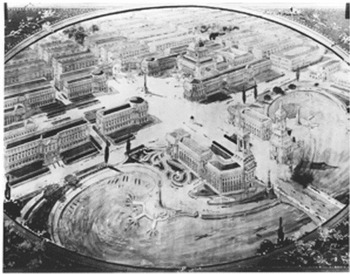
These individuals connected to foreign movements to learn of and select the innovations they felt might improve conditions at home. Their general failure neither to articulate innovations of their own, nor to move to significantly adapt those foreign ideas they did use, however, has led to Ward's characterization of English-Canadians as ‘undiluted’ borrowers. Mawson's 1914 City Beautiful-style plan for Calgary, in particular, seemingly highlights Ward's argument that ‘undiluted’ borrowed innovations are ones demonstrating little to no consideration of local conditions – or financial realities (Figure 2). At an estimated cost of $10 million, Mawson's vision for Calgary amounted to a sweeping overhaul of the city's existing structure, recommending, for example, the building of diagonal roads flowing out of the city centre, the creation of parks along the Bow River, the erection of elaborate civic buildings and the introduction of a vast glass-roofed open-air market in the city's core.Footnote 75
Thomas Mawson, Plan for Civic Centre (1914). Courtesy of the Mawson Digital Collection, Canadian Architectural Archives, University of Calgary.

Aside from its cost, the most crucial issue with Mawson's plan was that it prioritized built and natural beauty over practical concerns. Calgary needed a plan, in part, to deal with issues of unregulated urban expansion. Thanks to mass Western migration in the early 1900s, Calgary had grown from a population of over 4,000 in 1901, to nearly 44,000 in 1911.Footnote 76 In the haste to subdivide and expand, little thought had been given to organization: commercial and industrial zones intruded on residential areas, land along Bow River was lined with tents and lumber mills, and downtown businesses shared space with lumberyards.Footnote 77 Though Mawson's Calgary plan and the accompanying illustrations were captivating aesthetically, they did fit the city's reality and have largely been deemed a ‘grandiose fantasy’.Footnote 78
Yet, despite the plan's ‘undiluted’ quality, Mawson was purposefully selected by Calgary's City Planning Commission (CPC), a body fully conversant in international planning developments. CPC secretary G. Wray Lemon presented at the 1912 NCCP in Boston and extensively toured German innovations in early 1914. Fred C. Lowes, CPC member and leading land developer, had previously designed City Beautiful inspired suburbs for Calgary.Footnote 79 The CPC members chose Mawson because his work reflected their interpretation of Calgary's needs. Although they supported improved civic organization, they were likewise invested in the wider promotion of Calgary as an emerging cultural and economic metropolis rather than a dusty, isolated frontier town. They did not hire Mawson for an imminently practical plan; of greatest import was that the cityscape visually complemented their dreams for Calgary's future. Mawson himself noted that his vision for Calgary ‘appeal[ed] with overwhelming power to the imagination’.Footnote 80 Mawson's drawings and descriptions of lush boulevards, columned civic buildings and sweeping riverside parks fulfilled the CPC's vision of what Calgary could be. Mawson kept the CPC abreast of his work throughout 1913. The final plan received the CPC's full endorsement.Footnote 81 Had nation-wide economic depression and World War I not rendered Mawson's work economically and socially unfeasible, Calgary's city council may have acted on the CPC's recommendation that the plan be quickly implemented.
As the example of Calgary's plan further illustrates, classifying English Canada as strictly an ‘undiluted borrower’ of outside planning innovations during the early twentieth century is a simplification. Instead, it fits somewhere between Ward's categories of ‘undiluted’ and ‘selective’ borrowing. Although English-Canadians did not radically change the innovations they adopted, in line with Ward's definition of selective borrowing, ‘the priorities of the importing country (at least as understood by. . .the local planning movement). . .[took] precedence’.Footnote 82 Furthermore, as the concurrent support for both the City Beautiful and Garden City styles throughout the early 1900s shows, the movement was never solely under the sway of anyone outside ideology. However, when the popularity of the City Beautiful style waned in the 1910s, planning advocates displayed sensitivity towards Canadian needs, turning towards British planning and hiring Thomas Adams. English-Canadians did not sit outside the international planning cohort and wait for ideas to come to them. Instead, they worked to move within and learn from it. In the process, they created channels through which experts in America and Great Britain learned of, and took interest in, the evolution of planning in Canada. What grew from this was a movement of advocates more discerning, complex and knowledgeable than has previously been recognized.