Following a large-scale disaster, victims can suffer from psychological distress due to the tremendous changes in their lives and the loss of family, friends, property, belongings, and/or jobs.Reference Norris, Friedman and Watson 1 Additionally, because of these extraordinary impacts, some victims may experience stress-related mental health problems that include sleep disturbances,Reference Lavie 2 , Reference Matsumoto, Yamaoka and Inoue 3 posttraumatic stress disorder,Reference Pietrzak, Van Ness and Fried 4 anxiety disorders, depression,Reference Tang, Liu and Liu 5 and even suicidal ideation.Reference Suzuki, Tsutsumi and Fukasawa 6 Although psychological distress typically refers to a nonspecific mental health problem that is a normal emotional reaction to a stressor, it can also be characterized by depression and anxiety symptoms.Reference Montazeri, Baradaran and Omidvari 7 Furthermore, psychological distress can be a risk factor for cerebrovascular disease.Reference Pan and Rexrode 8 Thus, leaving psychological distress could result in serious health-related issues. Following a disaster, psychological distress can be prolonged,Reference Nakamura, Kitamura and Someya 9 and assessment of the risk of such distress among survivors may allow for the provision of appropriate care. Indeed, such assessment is among the most important public health and health care services related to a disaster, even when it occurs many years later.Reference Pietrzak, Tracy and Galea 10 , Reference Phifer and Norris 11
Differential Impacts of Disasters on Women and Men
Disasters disproportionally impact women relative to men. 12 Previous disasters have killed more women than men,Reference Neumayer and Plümper 13 and this was also the case with the Great East Japan Earthquake (GEJE) in 2011.Reference Nakahara and Ichikawa 14 , Reference Ishiguro and Yano 15 In addition to the direct effects associated with disasters, women and men might also have different experiences during various phases following a disaster due to a variety of biological and sociocultural variables.Reference Enarson and Chakrabarti 16 The socially constructed differences between women and men are derived from the social roles that women and men voluntarily and involuntarily assume,Reference Neumayer and Plümper 13 and these could be considered gender differences.
Similarly, the psychological impacts of natural disasters on women and men may also differ. Gender differences have been identified in postdisaster stress, distress, and disorders,Reference Norris, Friedman and Watson 1 with females being more adversely affected.Reference Norris, Friedman and Watson 17 Additionally, women and men may differ with respect to both risk and protective factors.Reference Amaratunga and O’Sullivan 18
Importance of the Midterm Recovery Period
The four-phase model of comprehensive emergency management after a disaster, which is known as the “disaster cycle,” includes mitigation, preparedness, response, and recovery phases.Reference Phillips 19 , Reference Wisner and Adams 20 In the response phase, a variety of measures are taken by governmental and nongovernmental organizations with the goal of recovering from the damage. In the recovery phase, which may continue for a number of years after the disaster, efforts are usually directed toward returning life to normal or to improving conditions.Reference Phillips 19 However, as time passes, the volunteer organizations that provide material support for survivors slowly withdraw. 21 Due to the far-reaching effects of the losses caused by the disaster, such as loss of family members and changes in income, survivors’ lives are usually not fully reconstructed within the 1- to 2-year postdisaster period; therefore, it is important to assess psychological distress and identify any associated factors to mitigate the risks.
The Great East Japan Earthquake
The GEJE involved a 9.0 magnitude earthquake and a huge tsunami that hit the Tohoku region of northeast Japan on March 11, 2011. 22 The catastrophic power of the GEJE took nearly 20 000 lives, and nearly 400 000 houses were completely or partially destroyed. 23 Furthermore, since the GEJE, considerable impact of this event on mental health has become increasingly evident.Reference Harada, Shigemura and Tanichi 24
Ishinomaki City
Ishinomaki City is a coastal dwelling located in the Miyagi Prefecture, in the northern part of Japan, which suffered significant damage due to the GEJE. According to a census conducted in 2010 prior to the GEJE, 25 the total population was approximately 161 000, and there were approximately 58 000 households. Compared to the entire Japanese population, there was a slightly higher proportion of elderly residents (Ishinomaki City vs all of Japan: 26.9% vs 23.0%) and the labor force participation rate was lower in both sexes (male, 69.1% vs 73.8%; female, 43.9% vs 49.6%). Large industries in the city included manufacturing, wholesale, and retail industries as well as health care and welfare, which followed the same trends seen at the national level. However, the proportions of persons employed in the agriculture sector and fisheries were greater than for Japan overall.
Previous Research on Mental Health Issues After Natural Disasters
The risk factors for mental health problems associated with a disaster include young age,Reference Oyama, Nakamura and Suda 26 being female,Reference Suzuki, Tsutsumi and Fukasawa 6 , Reference Yokoyama, Otsuka and Kawakami 27 – Reference Seplaki, Goldman and Weinstein 30 low socioeconomic status,Reference Seplaki, Goldman and Weinstein 30 relocation,Reference Cao, Jiang and Pang 29 , Reference Kiliç, Aydin and Taşkintuna 31 and lack of a social network.Reference Oyama, Nakamura and Suda 26 , Reference Yokoyama, Otsuka and Kawakami 27 , Reference Seplaki, Goldman and Weinstein 30 , Reference Teramoto, Matsunaga and Nagata 32 According to gender-based studies investigating the response and short-term recovery phases, economic support is useful for men.Reference Yokoyama, Otsuka and Kawakami 27 For working-age (20-64 years) men living in temporary housing, a lower Kessler Psychological Distress Scale (K6) score was related to having social support from families, including emotional, informational, and instrumental support.Reference Teramoto, Matsunaga and Nagata 32 On the other hand, the authors of that study reported that no variables were significantly associated with psychological distress in women.
To date, no studies have clearly identified gender-based risk and protective factors for psychological distress during the mid-term recovery period, and there is little evidence concerning victims who stayed in their homes and did not relocate to temporary housing after the GEJE. These victims were living in homes that had been seriously damaged by the tsunami and received less support from governmental agencies than did the individuals in temporary housing.Reference Ishiguro, Togita and Inoue 33
The socioeconomic status of working-age people is generally different from that of older people,Reference Brekman and Kawachi 34 and it is more likely that working-age people would be economically protected by income. However, in terms of social isolation, the working-age population may be more vulnerable because they may have fewer close relationships with neighbors, work in the daytime, and/or have not lived in their community for a long time due to marriage, work, or their children being educated at schools. People in the workforce usually engage in social interactions in the workplace. However, if a working-age individual loses their job due to a disaster, they may engage in fewer social interactions compared to before the disaster. In fact, it was reported that working-age people were at risk of social isolation after the GEJE.Reference Inoue, Matsumoto and Yamaoka 35
Aim of the Present Study
Because psychological distress in working-age victims is a crucial issue, the present study aimed to investigate gender-based risk and protective factors associated with psychological distress among working-age victims who stayed in their homes in the Ishinomaki City in Japan during the 1- to 2-year postdisaster period following the GEJE.
METHODS
Setting and Study Design
This cross-sectional household survey was conducted in Ishinomaki City in the Miyagi Prefecture, which is the municipality with the largest number of casualties caused by the GEJE. More than 70% of the total households in Ishinomaki City (approximately 42 000 households) were inundated by the tsunami that occurred following the earthquake.Reference Ishiguro and Yano 15 , 36
Procedure (Data Collection)
The Health and Life Revival Council in Ishinomaki District (RCI), which is a nongovernmental organization, conducted a household survey of victims in Ishinomaki City who remained living in their home despite the severe damage caused by GEJE. The RCI was established by the staff of the You Home Clinic, which has provided home-visit medical care in Ishinomaki City since August 2011. This service was provided because the clinic staff were aware that victims who continued to live in their seriously damaged homes had various lifestyle-related needs.Reference Muto 37
The first-phase survey was conducted between October 2011 and March 2012 (6-12 months after the GEJE), and the second survey was conducted between May and December 2012 (14-21 months after the GEJE). The data from the second-phase survey were analyzed for the present study. The primary objectives of the surveys were to identify households in need of health and living support and to provide appropriate support to the victims.Reference Muto 37 The details and results of the first-phase survey are described elsewhere.Reference Ishiguro, Togita and Inoue 33 , Reference Inoue, Matsumoto and Yamaoka 35 , Reference Matsumoto, Yamaoka and Inoue 38 , Reference Furukawa, Takeuchi and Yano 39
The second-phase survey consisted of two steps: a face-to-face interview and a self-administered questionnaire.Reference Matsumoto, Yamaoka and Inoue 3 , Reference Muto 37 RCI interviewers visited houses in the tsunami-inundated area and conducted face-to-face interviews with representatives of the households using a semistructured schedule that assessed the overall situation of the household, including family structure and the severity of damage. All interviewers were trained with an instruction manual and on-the-job training during home visits with experienced interviewers before starting the survey by themselves. Additionally, a self-administered questionnaire was distributed to each household member aged 13 years or older and was either completed and collected at that time, returned by mail or to a collection box at the Ishinomaki City Hall, or collected by RCI staff members during a subsequent visit. This individual-level questionnaire evaluated health conditions and lifestyle factors, including psychological distress. Both instruments were designed by the RCI, and the project was commissioned by Ishinomaki City.
Participants and Recruitment
The survey was conducted in areas where households experienced tsunami inundation above a floor level or in which more than 70% of houses were completely destroyed. The survey was conducted at households in which the members were at home at the time of the visit; if nobody was home, the interviewers left an absence contact slip and revisited the household when it was convenient for that household. Participants who were younger than 19 years of age or older than 65 years of age, who were students, or who did not complete the questions regarding psychological distress or gender were excluded from the final analyses.
Ethics
All study participants provided written informed consent prior to participation, and ethical approval for this study was granted by the Institutional Review Board of Teikyo University (No. 12-079). This study was conducted in such a way as to ensure that it was culturally and socially appropriate, and the questionnaire was designed not to include questions about sensitive or intimate matters. In order to minimize participants’ burdens, the interview was designed to be completed in less than 30 minutes, including the informed consent process. Additionally, the interviewers were trained in respectful listening and appropriate empathy. At the time of the survey, the interviewers ensured that the residents understood that participation was voluntary and consent could be withdrawn at any time.
Data Sources
Psychological Distress
Data regarding participants’ psychological distress were obtained using a validated Japanese version of the K6,Reference Kessler, Andrews and Colpe 40 , Reference Furukawa, Kawakami and Saitoh 41 a 6-item scale widely used to screen for psychological distress in community epidemiological studies. The items include questions such as, “During the last 30 days, about how often did you feel so depressed that nothing could cheer you up?” Each question is rated on a 4-point Likert scale from 0 (not at all) to 4 (always); the total score ranges from 0 to 24, and a higher score indicates a greater risk of psychological distress. When screening for nonspecific psychological distress, such as mood or anxiety disorders, in the Japanese general population, a score of ≥5 is widely recommended as the cutoff pointReference Sakurai, Nishi and Kondo 42 ; this criterion was also used for the present analyses, where this study aimed to investigate factors associated with psychological distress.
Demographic Characteristics
Data on the following demographic characteristics of participants were collected: gender, age, number of household members, sources of household income (3 categories: [1] salary only; [2] pension and salary; and [3] pension only, social welfare including public livelihood assistance and unemployment allowance, no regular income, or other), and type of occupation (3 categories: [1] full-time or self-employed, [2] part-time, and [3] unemployed or seeking work).
Social Characteristics
Participants were categorized according to how many times they usually left home in a week: (1) 5 times or more, (2) 3 to 4 times, and (3) twice or less. Additionally, the amount of social support perceived by participants was assessed across 3 dimensions: informational, emotional, and instrumental. These 3 items addressing the following were developed based on a series of social surveysReference Furukawa, Kawakami and Saitoh 41 : (1) whether the respondent had anyone to provide information to them (informational support), (2) whether the respondent had anyone to consult with about their problems (emotional support), and (3) whether the respondent had anyone who provided physical support, care, or financial support (instrumental support). Survey-specific questions, such as, “Is there any person you can rely on in the neighborhood?” and “If yes, who is the person?” (open-ended question) were used to assess these items.
Damage Due to Disaster
The severity of the physical damage to participants’ homes was categorized into 5 levels which were determined by Ishinomaki City: completely destroyed, largely destroyed, half-destroyed, partially destroyed, or not damaged. Changes in family structure were defined as any change in the number of household members due to the disaster, including due to the death or relocation of family members. Changes in family structure or income as a result of the disaster were coded dichotomously.
Health Complaints
Health complaints were evaluated using the question, “Do you have any subjective symptoms that have lasted for longer than 1 month that may affect your daily life?” If yes, and the participant provided at least 1 positive response to the following items, the participant was categorized as “having health complaints”: headache, dizziness, palpitation, stomachache, loss of appetite, overeating, asthma, sore throat, cough and sputum, blurred vision, dermatitis, allergy, stiff shoulders, lower back pain, knee pain, sleep difficulties, oversleeping, and others.
Data Management and Analysis
All survey data were collected by RCI interviewers using a paper-and-pencil-based instrument and then entered into a password-protected computer. In collaboration with Teikyo University, the RCI transferred the data, without the names or detailed addresses of participants, to Teikyo University researchers.
The participants’ characteristics, including demographics, social characteristics, damage due to disaster, and health complaints, were summarized with descriptive statistics. Chi-square tests t tests and were used for comparison of these characteristics among people with high and low K6 scores.
Data were analyzed with multivariate logistic regression analyses using the stepwise selection method (inclusion and exclusion criteria of 0.20) to calculate the odds ratios (ORs) and 95% confidence intervals (CIs) of the outcome variables (psychological distress: K6 score ≥5). All analyses were independently performed for each gender.
All analyses were performed using SAS version 9.4 (SAS Institute; Cary, NC, USA). All tests were 2-sided, and values with 95% CIs that did not reach 1.0 or had P values <0.05 were considered to indicate statistical significance.
RESULTS
Participants
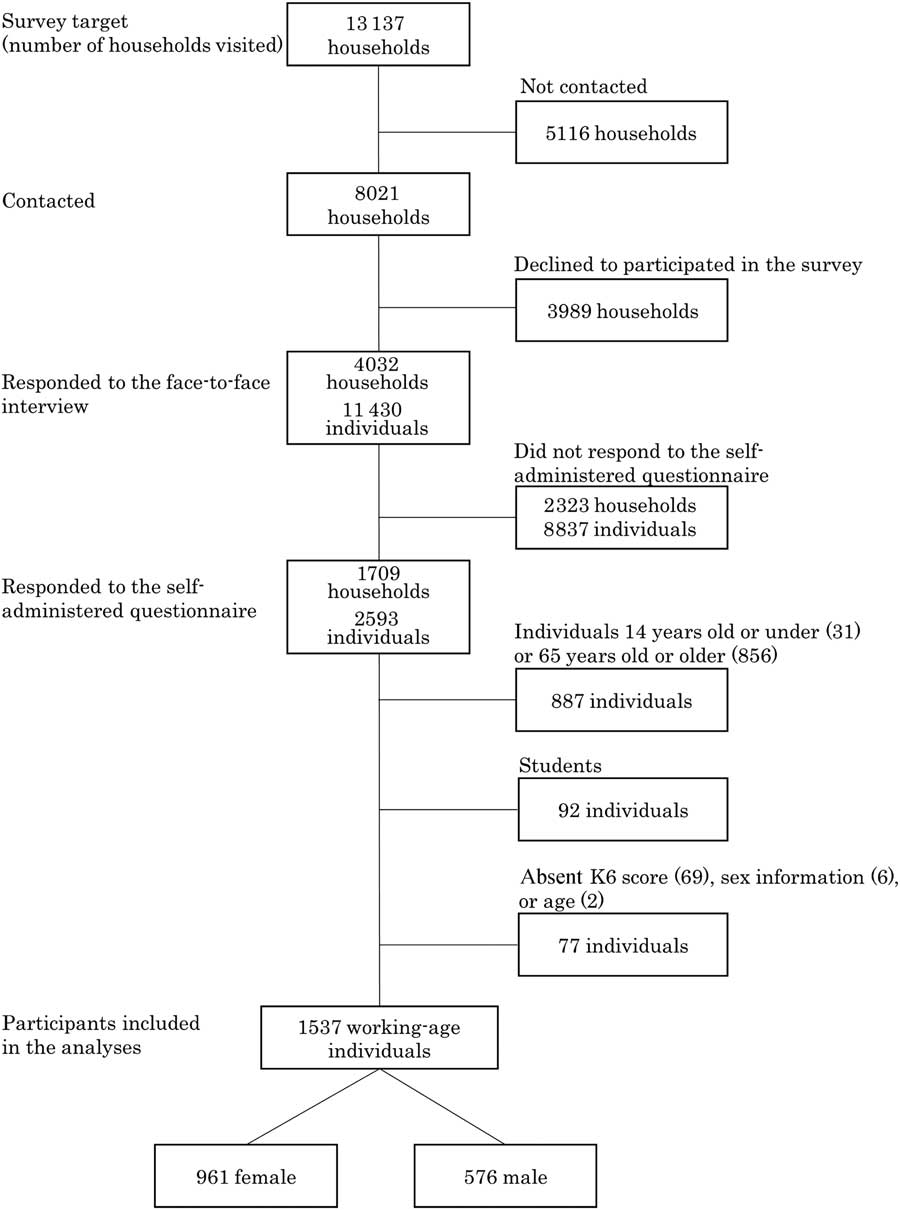
The RCI interviewers visited 13 137 houses and were able to contact members of 8021 households in which the members had continued to reside in their own houses despite severe damage. The other houses (5116 households) were no longer occupied or no one was at home at the time of the visit. Household members in 4032 households (11 430 individuals) completed the face-to-face interview, and 2593 individuals in 1709 households responded to the self-administered questionnaire. Individuals who were age 14 or younger (n = 31), were age 65 or older (n = 856), were students (n = 92), did not complete the K6 (n = 69), and/or did not specify their gender (n = 6) or age (n = 2) were excluded from the final analyses. In total, data from 1537 individuals (961 female participants and 576 male participants) were analyzed (Figure 1).
Participant Flow Chart.

Participant Characteristics
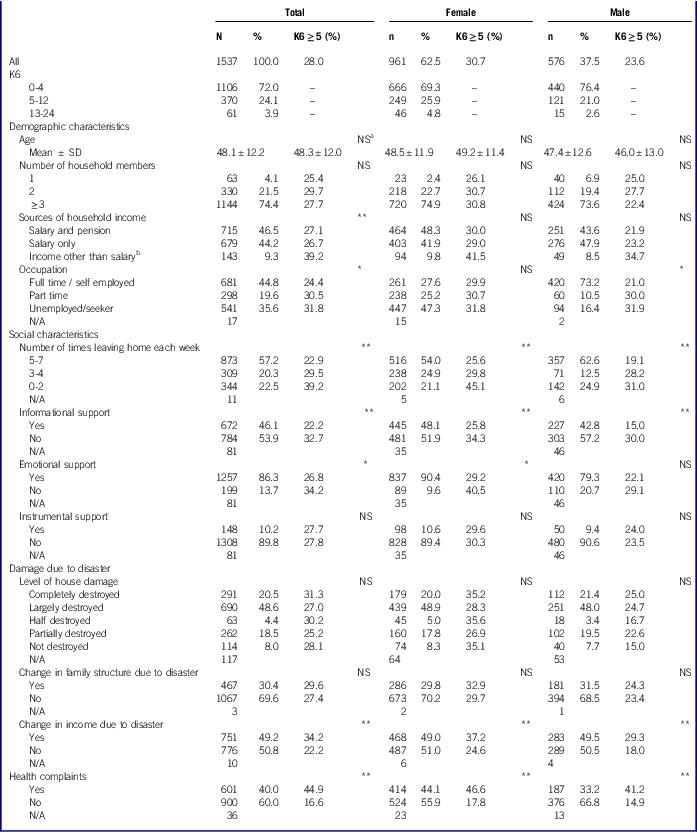
The participant characteristics and the prevalence of psychological distress are summarized in Table 1, along with results of statistical comparison using t tests and chi-square tests. Most participants were women (62.5%), the mean age was 48.1 years (standard deviation [SD]: 12.2), and the number of household members typically exceeded 2. Slightly less than half the women were not employed, whereas approximately three-quarters of the men were employed as full-time workers or in self-employed positions. Women had more social support than men, approximately 70% of participants experienced complete or major destruction of their houses, and the income levels of half of the participants were changed due to the GEJE. Psychological distress (K6 score ≥5) was observed in 28.0% of participants, and in more women than men.
Participant Characteristics and Prevalence of Psychological Distress

a NS, nonsignificant, *, P < 0.05; **, P < 0.01.
b Pension only, social welfare including public livelihood assistance and unemployment allowance, no regular income, or other.
Main Results
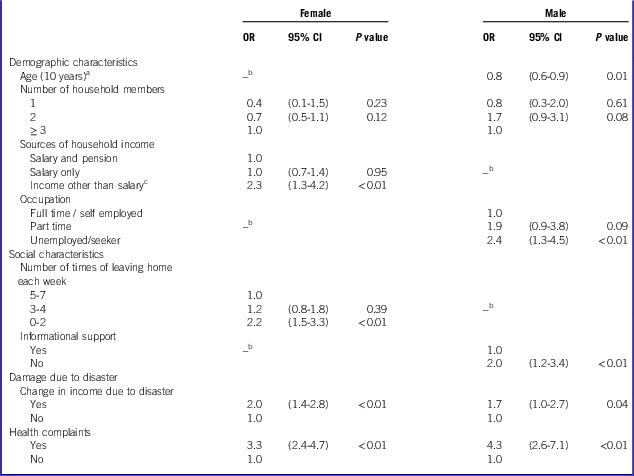
Table 2 presents the ORs for experiencing psychological distress according to the multivariate logistic regression analyses. Among women, having source of income other than a salary (pension only, social welfare including public livelihood assistance and unemployment allowance, no regular income, or other) and a lower frequency of leaving the house (number of times leaving the house: 0-2 per week) were positively associated with psychological distress. Among men, young age, unemployment or job seeker status, and a lack of informational support were positively associated with psychological distress. Among both men and women, experiencing a change in income due to the disaster and having health complaints was associated with psychological distress.
Odds Ratios of Experiencing Psychological Distress (K6≥5), Calculated With a Multivariate Logistic Regression Model

a Age (10 yrs): Odds ratios when the age increased by 10 years.
b Variables not selected by the stepwise selection method.
c Pension only, social welfare including public livelihood assistance and unemployment allowance, no regular income or other.
DISCUSSION
The present study investigated the specific risk and protective factors for psychological distress by gender among working-age survivors of the GEJE in Ishinomaki City during the 1- to 2-year postdisaster period. Overall, psychological distress was observed more commonly in women than men, and different factors were associated with psychological distress in women and men. Household income from a source other than a salary and a low frequency of leaving the house were associated with psychological distress in women, whereas young age, unemployment or job seeker status, and no informational support were associated with psychological distress in men. Income change due to the GEJE and having health complaints were associated with psychological distress among both genders.
Originality and Strength
The present study is the first to investigate the gender-based risk and protective factors for psychological distress in victims of the GEJE who stayed in their homes during the midterm recovery period. A survey of this magnitude investigating individuals who remained in their homes after the disaster is rare because entire communities were destroyed by the tsunami and many neighborhood associations were dissolved after the disaster. As a result, it was difficult for the Ishinomaki City government to understand the needs and conditions of residents. These households received less support from governmental and nongovernmental organizations because the recovery efforts tended to concentrate on people living in shelters or temporary housing. Therefore, this survey was entrusted to the RCI by Ishinomaki City.Reference Muto 37
Limitations
This study had several limitations that should be acknowledged. First, because it used a cross-sectional design, causal relationships among variables could not be inferred. Second, participants in this study were not randomly selected from the disaster survivors in Ishinomaki City but were instead chosen by visiting each house, including unoccupied homes, and asking household members to participate. Thus, background information on nonrespondents was not available, and it is possible that the results reflect sampling and participation biases. It is also possible that some high-risk populations did not participate in the survey because they may have refused to communicate with other individuals, including interviewers. If so, the results of this study may have underestimated the damage caused by this disaster. On the other hand, those who worked outside the home may not have been available to respond to the survey because they were not at home at the time of the visit; thus, the findings may represent an overestimate of the damage. These possible selection biases may reduce the generalizability of the present findings and thus should be recognized as a limitation. Nevertheless, results for a specific target population can provide important insights into the prevention and early discovery of psychological distress following a disaster among individuals in a tsunami-inundated community who remained in their homes.
Interpretation
Although the prevalence of psychological distress in the present study (28.0%) was comparable to the rates identified by previous reports from disaster-stricken areas, it was still lower. For example, more than 40% of working-age women and men experienced psychological distress in the first year following the GEJE,Reference Yokoyama, Otsuka and Kawakami 27 , Reference Teramoto, Matsunaga and Nagata 32 and it has been shown that relocation is a risk factor of psychological distress.Reference Yokoyama, Otsuka and Kawakami 27 , Reference Cao, Jiang and Pang 29 The differences between the present study and previous studies suggest that residents who stay in their own community during the midterm recovery period may have a specific type of resilience. Additionally, a young age in males and health complaints in both genders can be risk factors for psychological distress at 6 to 11 months after a natural disasterReference Yokoyama, Otsuka and Kawakami 27 ; these findings are consistent with the present results. Physical problems can result in mental health issues and vice versa. Severe economic difficulty is also a risk factor for poor mental health, regardless of gender or age.Reference Yokoyama, Otsuka and Kawakami 27 Consistent with this finding, working-age women and men in the present study who experienced an income change due to the GEJE were at a higher risk of psychological distress. However, there were gender differences in source of household income and occupation. Unsalaried household income was a risk factor for psychological distress in women while unemployment was associated with psychological distress only among men. Because approximately half of the women in this study were not employed, many may have had to continue to fulfil their traditional role as housewives and had no choice but to rely on family income. Thus, an unstable household income source (ie, other than a salary) might have had a greater psychological influence on women, especially during the midterm recovery phase when victims tend to consider future restabilization. On the other hand, the occupational status of men might have been more significantly related to psychological distress than was the source of household income. This may be due to gender norms in a society, for example, the expectation that men should work outside the home. The actual employment situation, which differed between men and women, would also be relevant. There are still remarkable gender gaps in economic participation and opportunities in Japan, 43 and it has been reported that women had fewer employment opportunities than men after the disaster. 44 Accordingly, men may have felt that they could not rely on the income of their wife and this employment-related stress could have in turn resulted in psychological distress. It has been reported that the tendency of men to identify with a job role, and stronger breadwinning obligations, could affect their mental health.Reference Backhans and Hemmingsson 45
The frequency of leaving the house may be a generic indicator of health, including mental health.Reference Fujita, Fujiwara and Kumagai 46 In the present study, women with a low frequency of leaving the house were more likely to report psychological distress. Of course, it is also possible that psychological distress made it less likely that these individuals would leave the house; in any event, however, women who cannot go out frequently should be provided with appropriate services.
In terms of support, a previous survey of survivors living in temporary housing 10 months after the GEJE showed that social support from family, including informational, emotional, and instrumental support, was related to lower levels of psychological distress in the male working-age population.Reference Teramoto, Matsunaga and Nagata 32 Additionally, the lack of a social network as a result of having few family and friendship ties may have been a risk factor for poor mental health, regardless of gender, at 6 to 11 months after the GEJE.Reference Yokoyama, Otsuka and Kawakami 27 The present study examined associations between psychological distress and 3 kinds of support: informational, emotional, and instrumental. Informational support from neighbors was associated with low psychological distress for working-age men, whereas psychological distress was not related to the availability of support among working-age women. It is possible that male workers seemed to have a difficult time participating in their neighborhood community to obtain necessary information, and this may have led to higher levels of anxiety.
Implications for Policy and Practice
These findings carry several possible implications for policy and practice. First, efforts should be made to aid women in finding employment and to foster an environment in which women can achieve a balance between work and family. Continuous financial support may be useful for households in situations in which it is difficult to work, and both women and men whose incomes change due to a disaster should be supported. Support for men should involve facilitating the acquisition of stable employment but avoiding excessive pressure stemming from masculinity norms would also be important. Second, informational support from neighbors may be beneficial for men, and this may be accomplished by building a neighborhood network outside of the workplace or by improved accessibility to useful information from the local government. Third, more opportunities to leave the house are needed for women, possibly including neighborhood gatherings or events for women. However, it may be challenging to realize these opportunities in a community that has scattered following a disaster.
CONCLUSION
The present study showed that different factors for psychological distress were identified among working-age women and men who stayed in their homes during the midterm recovery period after the GEJE. Living in a household without a salaried income and rarely leaving the house can be risk factors for psychological distress among women, whereas young age and lack of occupation and informational support can be risk factors among men. A change of income due to the disaster and the presence of a health complaints may be risk factors in both genders. These factors may be useful contributors to gender-based support efforts directed at mitigating psychological distress during the midterm recovery period after a disaster.
Acknowledgment
We thank the members of the Health and Life Revival Council in the Ishinomaki District, including Shinsuke Muto, Ai Sonoda, Kohei Shiozawa, Miyuki Osaka, and other staff members and volunteers, for their contributions in conducting the stay-at-home victims survey, as well as members of the Teikyo Ishinomaki Research Group, including Eiji Yano and Yuriko Togita, for their collaboration and feedback in this study. This work was supported by The Ministry of Education, Culture, Sports, Science and Technology of Japan, Grant-in-Aid for Young Scientists (B), number 26870596 and 16K21381 (PI: Aya Ishiguro), and The Japanese Society of Public Health (Special Grant for public health project for the Great East Japan Earthquake) in 2012. The authors declare no conflicts of interest associated with this manuscript.
SUPPLEMENTARY MATERIAL
To view supplementary material for this article, please visit https://doi.org/10.1017/dmp.2018.80