Introduction
Life expectancy continues to increase globally. In 2015, the global life expectancy was 71.4 years, 73.8 years for females, and 69.1 years for males (WHO, 2016). Longer life expectancy is partly due to a decline in mortality resulting from advances in rehabilitative medicine and effectiveness and coverage of healthcare (Mathers et al., Reference Mathers, Stevens, Boerma, White and Tobias2015), which also reduces impairment in functioning and disability over the life course (Chatterji et al., Reference Chatterji, Byles, Cutler, Seeman and Verdes2015). Nevertheless, high suicide rates in older adulthood indicate that suicide is a major public health concern and further suicide prevention efforts are needed (Shah et al., Reference Shah, Bhat, Zarate-Escudero, De Leo and Erlangsen2016).
Several suicide risk factors have been identified among older adults including psychiatric illnesses, physical illnesses, functional impairment, interpersonal problems, bereavement, widowhood, stressful life events such as loss of autonomy, and financial problems (Harwood et al., Reference Harwood, Hawton, Hope and Jacoby2006; De Leo et al., Reference De Leo, Draper, Snowdon and Kõlves2013). In a previous study, individuals aged 65 years and over had higher prevalence of widowhood, living conditions such as being alone or in a nursing home, physical illnesses, bereavement, and paying attention to suicide in the media as compared to middle-aged adults (Koo et al., Reference Koo, Kõlves and De Leo2016). However, there is a need to consider that older adulthood may not be representative of a homogenous group of individuals as suicide rates seem to remarkably differ among specific age sub-groups (Shah et al., Reference Shah, Bhat, Zarate-Escudero, De Leo and Erlangsen2016). Moreover, it is important to capture the varying life stages of older adults (e.g. young-old, middle-old, and old-old) as the broad term “older adults” does not adequately capture the entire life cycle (Neugarten, Reference Neugarten and Neugarten1996). However, there is a lack of research investigating specific age groups of older adults and, on the other hand, age classification of these groups varies from study to study. For example, some classifies the “oldest old” as individuals 75 years of age and over (Paraschakis et al., Reference Paraschakis2012), while others consider them to be 85 years and over (Zizza et al., Reference Zizza, Ellison and Wernette2009; Vasiliadis et al., Reference Vasiliadis, Lamoureux-Lamarche and Guerra2016). Nevertheless, researchers seem to agree that older adulthood commences at 65 years of age (e.g. Waern et al., Reference Waern, Rubenowitz and Wilhelmson2003; Kjølseth et al., Reference Kjølseth, Ekeberg and Steihaug2010; Erlangsen et al., Reference Erlangsen, Stenager and Conwell2015; Koo et al., Reference Koo, Kõlves and De Leo2016). This study aims to compare differences in sociodemographic variables, recent life events, and mental and physical illnesses between three age groups within older adults who died by suicide: young-old (65–74 years), middle-old (75–84 years), and oldest old (85 years and over) by using the Queensland Suicide Register (QSR). We examined suicide methods, life events, psychiatric illnesses, somatic illnesses, and other characteristics of suicidal behavior.
Methods
The QSR is a comprehensive database on suicide mortality maintained by the Australian Institute for Suicide Research and Prevention (AISRAP). The QSR holds records for all suicides in Queensland since 1990. All information (e.g. psychiatric diagnoses, physical illnesses, and sociodemographic variables) is collected from various sources such as police reports to a Coroner (Form 1), post-mortem autopsy reports, toxicology reports, and Coroner's findings, including narrative of circumstances of death (who the deceased person was, and how, when, and where the person died). Documents are crosschecked with records from the National Coronial Information System (NCIS – www.ncis.org.au), an Australian databank that registers all deaths that coroners judged as due to suicide. Following the Suicide Classification Flow Chart developed by AISRAP, all suicide cases in the QSR are classified into one of three categories: Beyond Reasonable Doubt, Probable, or Possible (Potts et al., Reference Potts, Kõlves, O'Gorman and De Leo2016). For the present analyses only those cases falling into the categories of either Beyond Reasonable Doubt or Probable were included. In the current analyses, we scrutinized data from 2000 to 2012.
All QSR procedures are approved by the Griffith University Human Research Ethics Committee (CSR/02/10/HREC).
Statistical analysis
Average annual suicide rates were calculated. In order to make comparisons between the three age groups, univariate odds ratios (OR) with 95% confidence intervals (95% CI) and Chi-square (Χ 2) test for trend were calculated to measure change across three age groups. Age group 75–84 years was used as reference group when calculating OR. With small numbers (less than 5), Fisher's exact test was used. To calculate mortality rates, population data were obtained from the Australian Bureau of Statistics. SPSS 23.0 was employed for all data analyses.
Results
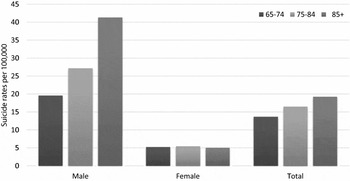
Between 2000 and 2012, a total of 978 suicide cases of older adults aged 65+ years were recorded in the QSR. The three subgroups involved 486 suicides for persons aged 65–74 years (males = 383 and females = 103), 351 persons aged 75—84 years (males = 281 and females = 70), and 141 suicides of persons aged 85+ years (males = 114 and females = 27). The average annual rates were 13.71 per 100,000 for persons aged 65–74 (young-old), 16.51 per 100,000 for persons aged 75–84 (middle-old), and 19.26 per 100,000 for persons aged 85+ years (oldest old). The average suicide rate for 2000–2012 increased with age for males, whereby the highest suicide rate was observed for oldest old males at 41.43 per 100,000, followed by older males at 27.19 per 100,000 and young-old males at 19.59 per 100,000. Meanwhile, suicide rates in females were relatively stable ranging from 5.07 per 100,000 for oldest old females, 5.25 per 100,000 for young-old females, to 5.46 per 100,000 for middle-old females (Figure 1). Considering the small numbers in oldest old female subgroup (n = 27), the following analyses were not split by gender.
Suicide rates by sex and age groups in Queensland, Australia, average of 2000–2012.

The majority of the young-old and middle-old were married (47.1% and 43.0%, respectively), while the majority of the oldest old were widowed (37.6%). Compared to the middle-old, the young-old were significantly more likely to be separated (OR: 2.34, 95% CI: 1.16–4.71), and were less likely to be widowed (OR: 0.40, 95% CI: 0.27–0.60). Moreover, the oldest old were significantly more likely to be widowed than the middle-old (OR: 1.85, 95% CI: 1.16–2.96). The majority of individuals were out of the work force (young-old = 70.4%, middle-old = 89.1%, and oldest old = 91.9%), proportion increased significantly with age (χ2 trend = 45.65, df = 1, p < 0.01). More specifically, the young-old were less likely to be out of the workforce compared to the middle-old (OR: 0.29, 95% CI: 0.19–0.44). The majority were living with friends/family (young-old = 47.7%, middle-old = 45.0%, and oldest old = 39.7%). However, no significant differences in living arrangement were observed.
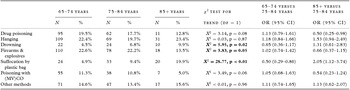
In young-olds, the most frequent method employed was firearms and explosives (22.6%), followed by hanging (22.4%) (Table 1). Similarly, firearms and explosives (22.2%) were followed by hanging (19.7%) in the middle-old. For oldest old, hanging (23.4%) was the most frequent method followed by suffocation by plastic bag (19.9%). There were no significant differences between the main suicide methods between age groups, except for suffocation by plastic bag, which increased with age (χ2 trend = 28.77, df = 1, p < 0.01). Similarly, drowning was increasing with age (χ2 trend = 5.95, df = 1, p = 0.02), meanwhile firearms and explosives method were decreasing with age (χ2 trend = 3.83, df = 1, p = 0.05).
Suicide methods by age group

Results in bold indicate to significant results (p < 0.05).
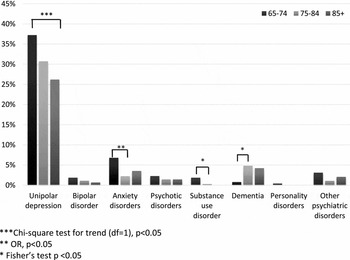
Prevalence of any type of psychiatric treatment (χ2 trend= 9.50, df = 1, p < 0.01), consultation with a mental health professional in the last three months (χ2 trend= 3.82, df = 1, p = 0.05), and psychiatric disorders decreased significantly with age (χ2 trend = 7.75, df = 1, p < 0.01). As shown in Figure 2, anxiety disorders (OR: 3.13, 95% CI: 1.43-6.86) and substance use disorders (p = 0.05) were more prevalent in the young-old compared to the middle-old. Of all psychiatric disorders, unipolar depression was the most common and the prevalence declined with age (young-old = 37.2%, old = 30.8%, oldest old = 26.2%, χ2 trend = 7.60, df = 1, p = 0.01). History of suicide attempts during lifetime was more prevalent in the young-old compared to the middle-old (OR: 1.90, 95% CI: 1.31–2.76).
Prevalence of psychiatric disorders by age groups. *** χ 2 test for trend (df = 1), p < 0.05. ** OR, p < 0.05. * Fisher's test p < 0.05.

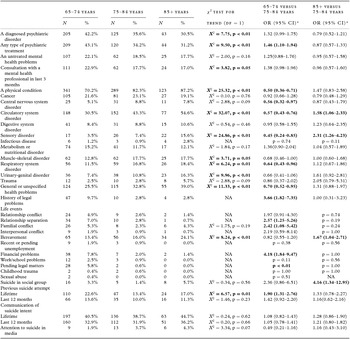
A physical condition was present in the majority of these older adult suicide cases and increased with age (χ2 trend=25.32, df = 1, p < 0.01). The oldest old were significantly more likely to have a diagnosed circulatory system disorder (OR: 1.58, 95% CI: 1.06–2.33) and sensory disorder (OR: 2.31, 95% CI: 1.26–4.23) compared to the middle-old. With regard to life events, relationship separation, family conflict, financial problems, and pending legal matters were significantly more prevalent in the young-old compared to the middle-old. History of legal problems was also significantly more prevalent in the young-old compared to the middle-old (OR: 3.66, 95% CI: 1.82–7.35). Bereavement was increasing in prevalence with age (χ2 trend=9.39, df = 1, p = 0.01), whereby prevalence of bereavement and the prevalence of suicide in the decedent's social group were higher in the oldest old compared to younger groups (Table 2). Additionally, across all age groups, bereavement was predominantly from death of spouse (young-old =10%, old=18.4%, and oldest old=7.2%).
Prevalence of different characteristics among young-old, middle-old, and oldest old who died by suicide

a – 75–64 years age group has used as the reference group.
NA – Not applicable, at least one group has less than five persons.
Results in bold indicate to significant results (p < 0.05).
Discussion
Suicide in older adults is still a neglected topic in suicide research, and there is the lack of suicide prevention activities in older adults (Lapierre et al., Reference Lapierre2011). Our earlier study showed a number of differences between suicide in older adults and middle age adults (Koo et al., Reference Koo, Kõlves and De Leo2016). The aim of this study was to examine differences between suicides in older adults across three age groups: young-old (65–74 years), middle-old (75–84 years), and oldest old (85+ years). Suicide rates differed between age subgroups. The average annual suicide rate from 2000 to 2012 was highest among the oldest old at 19.26 per 100,000 followed by 16.51 per 100,000 for the middle-old and 13.71 per 100,000 for young-old. The average suicide rates increase as age increases for males; meanwhile, for females they remain relatively low and stable. Furthermore, as expected, suicide rates were higher in males, and sex differences in accordance with male suicide rates also increased with age.
Prevalence of drowning and suffocation by plastic bag increased with age, while firearms and explosives decreased with age. In all three age groups, firearms and explosives were the most frequently used suicide methods in the young-old and in the middle-old followed closely by hanging, while hanging and suffocation by plastic bag were more frequent in the oldest old. Moreover, previous research showed that an increasing proportion of oldest old men die by hanging and suffocation and also suggested that suicide intention is more determined, when a more violent method (i.e. higher in lethality) is employed (Erlangsen et al., Reference Erlangsen, Bille-Brahe and Jeune2003). Restricting access to means is an effective method of suicide prevention (Yip et al., Reference Yip, Caine, Yousuf, Chang, Wu and Chen2012). However, the possibility of means substitution in older adults must be considered (i.e. switching to other suicide methods). The implementation of the National Firearms Agreement (1997) in Australia was not inspired by suicide prevention concerns; it has been associated with a significant decline in firearm suicide rates, especially in younger males, but not in older males (Klieve et al., Reference Klieve, Barnes and De Leo2009a). Klieve et al. (Reference Klieve, Barnes and De Leo2009b) also found a relationship between older age in both firearms license possession and firearms use as the method of suicide. In addition, firearms were the preferred method of suicide for current gun licensees compared to those who were unlicensed; for the latter, hanging was the most common method. Thus, it could be speculated that the higher prevalence of hanging and suffocation by plastic bag compared to firearms in the oldest old might also be related to loss of gun license due to health problems.
We also found that suffocation by plastic bag increased significantly with age and one-fifth of oldest-old individuals employed this method. It is worth remembering that after the publication of the book Final Exit in 1991 (which described the use of plastic bags as a possible suicide method and provided an “exit bag”) the number of suicides in New York City involving this method increased from 8 to 33 between 1990 and 1991 (Marzuk et al., Reference Marzuk1993). There was also an increase in death by plastic bag asphyxiation through helium inhalation in The Netherlands from 2005 to 2014 (van den Hondel et al., Reference van den Hondel, Buster and Reijnders2016) following a movie and a book describing how to die using helium and the exit bag. During external examination of corpses, these books and DVDs about helium inhalation were found. Similarly, an increase in death by helium inhalation was observed in United Kingdoms from 2001–2011 and Coroner's records showed the evidence of Internet involvement in choice of them as a method (Gunnell et al., Reference Gunnell2015). All these studies indicate that the publicity and circulation of information is likely to have an influence on rising trends of a given suicide method. A previous study (Koo et al., Reference Koo, Kõlves and De Leo2016) found that older adults aged 65 years and over pay more attention to suicide in the media than middle-aged adults. Despite some increase with age in older adulthood, this phenomenon of attention to suicide in the media did not reach statistical significance in the current analysis.
Prevalence of any type of psychiatric treatment and psychiatric disorder decreased significantly as age increased, meanwhile physical illnesses increased with age. A recent study by Fegg et al. (Reference Fegg, Kraus, Graw and Bausewein2016) investigated reasons for suicide and observed that chronic physical and mental illnesses may lead individuals to die by suicide. They found that physical illnesses appeared to be more of a reason to die by suicide, particularly at an older age. Meanwhile, mental illnesses appeared to be a greater reason to die by suicide in younger adults. The authors suggest that mental disorders could have a more acute in burden of suffering, compared with physical illnesses, which were often more chronic in nature, and thus may lead to a later decisions to suicide.
With regard to psychiatric disorders, anxiety disorders and substance use disorder were more prevalent in young-olds. Depression was the most frequent psychiatric disorder in all age groups, decreasing significantly with age. This is consistent with previous research indicating that older adults who die by suicide suffer often, but not always, from depression compared to middle aged adults (De Leo et al., Reference De Leo, Draper, Snowdon and Kõlves2013; Koo et al., Reference Koo, Kõlves and De Leo2016), and that the presence of depression could have been overestimated in previous studies. A recent qualitative study also showed that depression and psychiatric disorders might be overemphasized; that is, older adults may express sadness in acknowledging that life is coming to an end rather than being clinically depressed (Kjølseth et al., Reference Kjølseth, Ekeberg and Steihaug2010).
The oldest old were significantly more likely to have circulatory system disorders and sensory disorders, which is consistent with previous research showing that many oldest-old adults (85+ years old) have impairments in sensory, motor, and cognitive domains, leading to reduced independence and thus reduced mobility (Dodge et al., Reference Dodge, Kita, Takechi, Hayakawa, Ganguli and Ueshima2008). Several studies have also shown that loss of autonomy and physical conditions are important risk factors for suicide in later life (Paraschakis et al., Reference Paraschakis2012; Erlangsen et al., Reference Erlangsen, Stenager and Conwell2015). The same have also found that sensory impairments in combination with symptoms of depression explained the decline in social activities among the oldest old. Erlangsen et al. (Reference Erlangsen, Stenager and Conwell2015) evidenced that cataract and heart diseases were associated with elevated suicide risk in older adults. Kjølseth et al. (Reference Kjølseth, Ekeberg and Steihaug2010) investigated how older adults who died by suicide experienced life prior to death and found that many individuals described life as a burden revolving around illness and loss. Moreover, older adults who experienced non-threatening illnesses still perceived illness as a burden on life. Physical illness is not only an important suicide risk factor in older adults when compared to living controls (older adults without physical illness) (Rubenowitz et al., Reference Rubenowitz, Waern, Wilhelmson and Allebeck2001). Other case-control studies, including other types of deaths (e.g. sudden deaths and deaths due to accidents), have also observed similar or even higher prevalence of physical illness (Harwood et al., Reference Harwood, Hawton, Hope and Jacoby2006; De Leo et al., Reference De Leo, Draper, Snowdon and Kõlves2013).
Lifetime prevalence of suicide attempts was significantly higher in young-olds compared to the middle-olds. Moreover, over a third of participants in all the age groups had communicated suicidal intent in the last 12 months and lifetime. Thus, it is important that all medical practitioners investigate the possible presence of suicidal ideation and conduct suicide risk assessment in addition to identification of physical illnesses. More importantly, older adults of different age groups may seek health professionals for different reasons (e.g. the oldest old for physical conditions and the young-old for psychiatric illnesses).
Our findings revealed that young-olds were significantly more likely to be separated, and less likely to be widowed compared to the middle-old. Meanwhile, the oldest old were significantly more likely to be widowed. Paraschakis et al. (Reference Paraschakis2012) also found that those aged 60–74 years were more frequently single or separated, while those aged 75 years and over were more frequently widowed. This illustrates how marital status may impact on well-being of individuals. More specifically, living long without a partner may be perceived as intolerable and trigger a “life review” process (i.e. reflecting back on their life), which may make suicide an attractive way of ending life (Paraschakis et al., Reference Paraschakis2012). Moreover, the death of a spouse is also associated with grief, pervasive sense of loneliness, and disruptions in daily routines and activities (Naef et al., Reference Naef, Ward, Mahrer-Imhof and Grande2013). Thus, social support and companionship is important in preventative strategies throughout older adulthood.
The trajectory of an older adult's lifespan and the impact of life events during older adulthood vary through different stages of the aging process. As age increases, older adults are less likely to be in the work force or experience work-related problems or financial problems; meanwhile, bereavement is more common in older adulthood. Hence, the oldest old who died by suicide had significantly higher prevalence of bereavement, while work-related, financial, legal, and relationship stressors were less frequent. However, financial and relationship problems can still be associated with suicide in older adults as shown in case control studies (Rubenowitz et al., Reference Rubenowitz, Waern, Wilhelmson and Allebeck2001). Nevertheless, bereavement was the most prevalent life event identified for all older adult suicides in the QSR. Similarly, Harwood et al. (Reference Harwood, Hawton, Hope and Jacoby2006) found that bereavement was a significant life event associated with death by suicide in older adults, but this was not evidenced in other case-control studies (Rubenowitz et al., Reference Rubenowitz, Waern, Wilhelmson and Allebeck2001; Waern et al., Reference Waern, Rubenowitz and Wilhelmson2003). Bereavement of a spouse or a close person is related to periods of grief, loneliness, and other psychological reactions (Naef et al., Reference Naef, Ward, Mahrer-Imhof and Grande2013). This may subsequently increase the risk of social isolation, since living alone and being widowed were more frequent in the oldest olds of the present study. Additionally, McLaren et al. (Reference McLaren, Gomez, Gill and Chesler2015) found that being widowed is associated with lowers levels of belonging but with higher levels of suicidal ideation in men. The authors explained that for men, marital status is a function of belonging. Therefore, men may lose some of their sense of belonging during bereavement process. Although social isolation has been previously targeted in a few suicide prevention activities for older adults’ (e.g. Lapierre et al., Reference Lapierre2011), only a modest effect has been observed. For example, in Japan, a community-based suicide prevention program designed to improve social relationships and give psychoeducation to older adults over the age of 65 years showed a significant decline in suicide risk only for older females, but not for males (Oyama et al., Reference Oyama2005).
Limitations
A number of limitations should be considered in interpreting our results. First, the number of suicides in older olds was relatively small, especially in females. Moreover, despite the fact that the QSR is a comprehensive suicide mortality database, it is reliant on external sources such as police/coronial information along with the conjectures of the next of kin. Thus, the accuracy of information depends on the quality of the investigating process; in fact, some relevant information related to the person's death can go unrecorded if not systematically inquired by the investigating officer. In addition, accuracy of data may also be hindered by the informant's lack of knowledge of a particular aspect of the deceased's life (e.g. presence of medical or psychiatric diagnosis, drug abuse, precipitating life events). Lastly, due to the use of the QSR, our analysis was limited to cases of suicide only and no control groups were adopted.
Conclusion
Suicide across older adulthood is not a homogenous phenomenon. This study confirms there are different factors and life events for older adults across the lifespan. For example, psychiatric problems, suicidal behavior, legal and financial stressors, and relationship problems decrease as age increases, meanwhile physical conditions, bereavement, and harsher life events such as suicide in social group increases with age. At least in Australia, older adults’ suicide prevention should not be limited to the care of psychiatric conditions but would require truly holistic and comprehensive approaches taking into consideration prevailing life events and typical aspects of older adults’ lives.
Conflict of interest
None.
Description of authors’ roles
KK and DDL designed the study and supervised the write up of the paper. YWK conducted data analyses and drafted the paper. All authors contributed to and have approved the final manuscript.
Acknowledgment
We would like to acknowledge funding of the Queensland Suicide Register by Queensland Mental Health Commission and Queensland Health.