INTRODUCTION
Enhancing the performance of small-scale farmers is one key objective of crop improvement research aiming to increase productivity, reduce poverty and improve livelihoods through sustainable use of land, water and other resources. Increasing small-scale farmers’ production and hence incomes is expected to improve livelihoods of rural poor households through spillover effects, which stimulate rural economies as a whole. However, the direct link between research outputs and human development objectives in the capacity and performance of national extension systems is needed. At the same time, the effort endeavours to increase incomes and livelihoods of small-scale farmers in diverse agricultural production systems through increased productivity and resource use efficiency. The link between agricultural research and these ultimate goals is being increasingly investigated, as all types of smallholder performance improvement have not necessarily triggered substantial poverty reduction (FAO, 2004). Studies have reported limited direct technology impacts on household income and poverty status (e.g. Bellon et al., Reference Bellon, Adato, Becerril and Mindek2003; Bourdillon et al., Reference Bourdillon, Hebink, Hoddinott, Kinsey, Marondo, Mudege and Owens2003; Hossain et al., Reference Hossain, Lewis, Bose and Chowdhury2003). In a review, Kerr and Kolavalli (Reference Kerr and Kolavalli1999) concluded that it is difficult to make generalizations about the impacts of agricultural research on the poor, and that the distribution of benefits depends on underlying social and political institutions rather than specific technologies. In contrast, Kijima et al. (Reference Kijima, Otsuka and Serunkuuma2007) found that households that adopted new rice varieties in Uganda experienced higher income from the crop and reduced poverty, although they used hypothetical and not actual sample incomes due to data limitations. These findings have raised concern among national and international agriculture research centres, policy makers and research investors who have increased their calls for early monitoring of technology adoption and evaluation of their impacts on households.
Chickpea (Cicer arietinum) is an annual grain legume used extensively for human consumption. It provides important economic advantages to small farm households as an alternative source of protein, cash income and soil improvement through rotations in cereal-dominated farming systems. Despite its importance, chickpea productivity has remained very low: the major constraints to productivity are low yield potential of landraces and their susceptibility to biotic and abiotic stresses, and poor cultural practices (Mazid et al., Reference Mazid, Amegbeo, Shideed and Malhotra2009).
Winter chickpea technology development and transfer
The International Center for Agricultural Research in the Dry Areas (ICARDA) has a global mandate for crop genetic improvement of kabuli chickpea. Given its mission to meet the challenges posed by harsh, stressful and variable environments, ICARDA is involved in the development and delivery of improved technologies to national programs in collaboration with national agricultural research systems and advanced research institutions.
In the Central and West Asia and North Africa (CWANA) region, farmers traditionally plant chickpeas in spring, after the main winter rainfall is over. This often leads to poor yields because the crop later faces drought and heat stress. Scientists at ICARDA have been tackling this problem by breeding drought-resistant chickpea varieties and by encouraging farmers to plant the crop during winter. Researchers at ICARDA have detected differences in the alleles conferring high chickpea yields in low-yielding environments compared to those conferring high yields in favourable environments where there are more inputs and adequate rainfall (ICARDA, 1987). Using this knowledge, they have identified genotypes that give high yields with low inputs and are tolerant to cold and Ascochyta blight. By also factoring in traits like early seedling establishment, early growth vigour and canopy development, and early flowering and maturity, they have been able to identify potentially useful lines. Following pedigree breeding, lines that are both Ascochyta blight and cold tolerant have been distributed to national research systems for evaluation, and then adoption and release.
The first winter-sown chickpea variety developed by ICARDA and released in Syria in 1982 was Ghab1. It was followed by a second variety, Ghab2, in 1986; then followed by Ghab3 in 1991. Two other new varieties, Ghab4 and Ghab5, which have relatively larger seed size than Ghab3, were adopted and released by the Ministry of Agriculture in Syria in 2003. The five new varieties offer the potential of considerably increasing national chickpea productivity.
Improved agronomic packages were nascent up by ICARDA in collaboration with the Syrian national programs, very useful information on dates of planting, plant populations, rhizobia inoculation, weed control (including herbicides and mechanical harvesting) were generated. ICARDA carried out an on-farm assessment of chickpea practices in northwest Syria (Pala and Mazid, Reference Pala and Mazid1992). There were 30 on-farm trials conducted with chickpeas in northwest Syria during 1985–1989: changing sowing dates from spring or late winter to early winter increased seed yields. Rhizobium inoculation produced an inconsistent seed yield response. Weed control increased seed yields compared with unweeded controls, but was less effective than hand weeding. Application of 50 kg ha−1 of phosphate fertilizer (P2O5) increased seed yields. Drilling chickpea seed increased yield by 10% compared with the broadcast sowing commonly practiced by farmers. Thus a combination of early winter sowing, drilling, weeding and, where appropriate, phosphorus (P) application is likely to maximize net revenues and produce high seed yields (Pala and Mazid, Reference Pala and Mazid1992).
ICARDA in collaboration with the Agricultural Extension Directorate in the Syrian Agricultural Ministry and the General Commission of Scientific Agricultural Research in Syria (GCSAR) have played a vital role in dissemination of winter chickpea technology in Syria. Many field days were organized by ICARDA and the Syrian national programs in farmers’ fields; small amounts of seed of new varieties were distributed to chickpea producers, in addition to printing and distributing extension materials or publications on winter-sown chickpea.
Currently, the recommended winter-sown chickpea package comprises main and optional components. The main components include:
• Using the improved varieties Ghab3, Ghab4 and Ghab5
• Seeding rate of 120 kg ha−1
• Planting date in the first half of January
• Chemical seed treatment
• Protecting spray against fungi during the second half of March
• Weed control when plants reach a height of 10 cm
The optional components include:
• Reliable seed source
• Using drill for planting
• Fertilizer rate of 100 kg ha−1 of super phosphate
• Using herbicide before planting
• Using mechanical weed control
• Using additional spraying (1–2 times) when needed
For the purpose of winter chickpea technology transfer in Syria, ICARDA conducted chickpea grower meetings and distributed seed of the variety Ghab3 for winter planting in 2003. There was a good response from farmers, and chickpea productivity increased in the target areas.
Two other new varieties, Ghab4 and Ghab5, were released officially by the Ministry of Agriculture in Syria. Seed of these varieties was multiplied at ICARDA research stations and shared with the General Organization of Seed Multiplication (GOSM). In 2004, ICARDA distributed small quantities of seed of these two varieties to about 150 farmers for their evaluation and seed increase, and also supplied a considerable amount to GOSM for multiplication, and some to GCSAR for demonstrations in Syria. In 2005, ICARDA supplied about 7.2 tonnes of seed of Ghab4 and Ghab5 to farmers in Aleppo, Idleb, Suweyda and Al-Ghab Provinces, sufficient to plant an area of 0.2 ha per farmer. The Agricultural Extension Directorate also distributed seed to small-scale farmers and to new villages where there had been little or no previous distribution.
OBJECTIVES AND METHODS
Impact assessment of an agricultural research program is generally conducted to evaluate how well the research program has done in the past, to inform stakeholders on the return to their investment. It is also to convince researchers to draw lessons from past performance for improving efficiency of research programs (IAEG, 1999).
This paper is based on a study conducted by ICARDA in collaboration with the Syrian Agricultural Extension Directorate, by collecting information from chickpea farmers regarding the performance of winter-sown chickpea compared to traditional spring plantings. Impact analysis of winter chickpea technology was also conducted on constraints, if any, to the adoption of winter chickpea technology for ICARDA backup research. However, the main objective of this paper was to document, at an early stage of adoption, whether winter-sown chickpea technology disseminated in Syria had any impact on the livelihoods of small-scale farmers in terms of productivity, income, poverty and employment opportunities by gender.
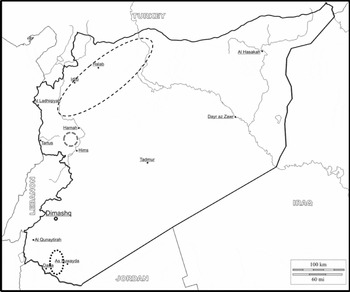
A farm household survey was conducted during 2006/2007 season in close collaboration with the Agricultural Extension Directorate. The survey covered four provinces (Aleppo, Idleb, Al-Ghab and Dara'a; Figure 1), which are the most important provinces in chickpea area and production.
Locations of the study areas.

Syria has been divided into five agricultural stability zones according to average annual rainfall. The zones are defined in terms of stability for rainfed crops production, and to some degree the probability of rainfall. This study focused on Zones 1 and 2. The annual rainfall in Zone 1 is >350 mm and rainfed crops can be successfully planted, e.g. wheat, legumes and summer crops. The range in annual rainfall in Zone 2 is 250–350 mm and >250 mm during two-thirds of the monitored years. In Zone 2, it is possible to get two barley crops every three years and wheat, legumes and summer crops can also be grown.
A cross-sectional sample stratified by provinces was used, which included farmers that received winter chickpea seeds from official sources such as ICARDA or GOSM, in addition to other farmers who grew chickpea. The households surveyed were drawn randomly from lists of farmers growing winter chickpea as provided by the Extension Directorate and GOSM. In addition, other lists of farmers who grew chickpea, either spring and/or winter, in the target areas were also used. The sample included 470 farmers on the basis of their seed sources and provinces, and covered about 160 villages in the four provinces. The survey questionnaire focused on many subjects, e.g. the place of chickpea in the farming system, cultivation practices, production economics, crop performance and yield, household assets, household livelihood and farmer evaluation of adoption potential. About half of the sample obtained seeds from official sources and used new chickpea varieties and the other half obtained seeds from other sources. About 63% of farmers in the sample grew only winter chickpea, 27% grew spring chickpea and 10% grew both.
The analysis focused on estimates of sample averages as well as the distribution of selected indicators on productivity, income and poverty. It also used econometric analysis to determine the roles of household livelihood assets (Mazid et al., Reference Mazid, Amegbeo, Shideed and Malhotra2009). However, this paper focuses on descriptive analyses, which are useful techniques to organizing and summarizing the data, and are particularly useful when large amounts of data need to be interpreted.
Some researchers may argue that there is a potential for selection bias towards adoption, as extension services and information are not widely available or easily accessible to all categories of farmers in most developing countries (e.g. Diagne and Demont, Reference Diagne and Demont2007). In the present study, winter-sown chickpea technology development and dissemination was implemented through participative methods, and targeted farmers by means of variety testing, demonstration fields, as well as several farmer field days organized to achieve maximum exposure. Therefore, all farmers in the study area were aware and had enough knowledge of winter-sown chickpea varieties – hence, selection bias should not be an issue. Therefore, the logistic regression method (logit model) was applied to identify factors influencing winter chickpea adoption. This model can be used to estimate the probability of adopting a new technology, given certain conditions. It is a useful tool to estimate the quantitative relationship between adoption and factors influencing adoption and to make predictions about whether or not a farmer will adopt the new technology based on a series of farm and farmer characteristics. The probability of adoption (P) can be estimated as:
 \begin{linenomath}\begin{equation*}
P = 1/\big[1 + \exp (- b_0 - \sum {b_j X_{ij}) } \big],\end{equation*}\end{linenomath}
One main challenge in impact assessment is to show how technology affects farmers of different socio-economic status. Campbell et al. (Reference Campbell, Jeffrey, Kozanayi, Luckert, Mutambo and Zindi2002) used wealth index and wealth quartile methods to study the household livelihoods in semi-arid regions. This can be done by first classifying households into different socio-economic types using their assets (e.g. human, natural, physical, social and financial) and then determining the adoption of technology in these household-types. This allows determining whether the technology is beneficial to both poor and wealthier households. For this purpose, the wealth index was created using factor analysis, which is a statistical technique similar to principal components analysis. These analyses have the common objective of reducing relationships between many interrelated variables to a small number of factors. However, the primary purpose of factor analysis is to describe the relationships among the many variables in terms of a few underlying but unobservable factors; thus many original variables are combined into a few derived variables. In calculating the wealth index, the coefficients of variables estimated by factor analysis were multiplied by standardized values of the respective variables for each factor (Xi). Household-specific wealth indices were constructed from scores obtained from factor analysis, according to:
 \begin{linenomath}\begin{equation*}
X^{*} = \sum {w_i X_i },\end{equation*}\end{linenomath}
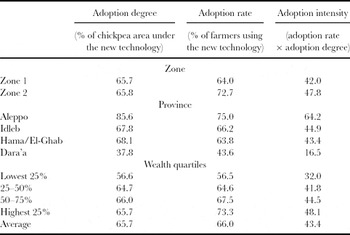
Several adoption and impact indicators were used; technology adoption refers to the continuous use of the improved varieties practically for two or more years with or without the other components of the technology package. Three adoption indicators were used to measure winter chickpea adoption namely: (1) adoption rate, which represents the percentage of farmers using the technology; (2) degree of adoption, which represents the proportion of chickpea area under the new varieties and (3) intensity of adoption, which is measured as the product of the rate × the degree of adoption (Shideed et al., Reference Shideed and El Mourid2005). Indicators used to measure the impact of the new technologies include: (1) productivity, (2) profitability, (3) household income and (4) employment.
RESULTS AND DISCUSSION
Farmers’ perceptions of winter chickpea technology
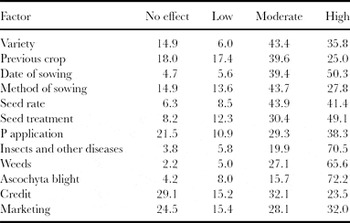
Farmers’ assessments of new varieties provided insights into their adoption decision-making process. Understanding the criteria that farmers use to evaluate new crop varieties allows breeders to effectively set priorities and target different breeding strategies to different communities in the dry areas. For this purpose, farmers were asked to rank the factors that may affect productivity of winter chickpea technology. It is important to note here that these farmer assessments were not facilitated by any agricultural professional, hence they were independent, individual, farmers’ views based on their own judgments of the performances of the varieties and their preferences. Ascochyta blight, insects and other diseases, and weeds were the three most important factors that negatively affected the productivity of winter-sown chickpea (Table 1). Variety was an important factor but was ranked as moderate by the surveyed farmers.
Factors effecting productivity of winter chickpeas (% of farmers).

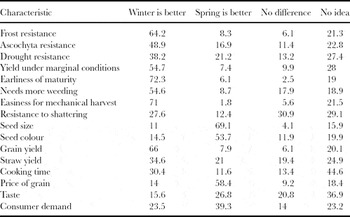
The ranking of winter chickpea varieties compared to spring cultivars was done by farmers who planted the varieties and observed their yield performance and other attributes. Farmers indicated that the characteristics of winter chickpea were better than spring chickpea except for seed size, grain colour and price of grain (Table 2).
Comparing characteristics of winter chickpea to spring chickpea (% of farmers).

Contribution of chickpea production to farmers’ livelihoods
In the dry areas of Syria, as in other CWANA countries, rural livelihoods and agriculture are interlinked. A livelihood comprises the assets, activities and access to these as mediated by institutions and social relations – together they determine the living gained by individuals or households (Chambers and Conway, Reference Chambers and Conway1992). Building livelihoods is an ongoing process with constantly changing elements, and alterations in the quality and quantity of natural resources. These elements affect crops that farmers can grow and have direct implications on the livelihoods of those who depend on them. In the short-term, such changes in resources and crops grown have a great effect on people's livelihoods.
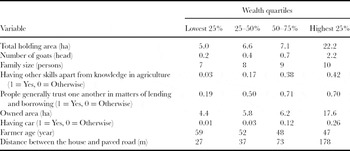
Households usually use a variety of resources as inputs into their production processes as they attempt to meet their needs. The wealth index, based on the status of household assets, was used for ranking households in the sample. In the wealth ranking, variables important in distinguishing households from each other were identified by factor analysis. Wealth quartiles were used to explore patterns of income distribution in households. Five main elements (human, natural, financial, physical and social capitals) were hypothesized to represent household well-being. Several variables were selected and used to represent each element. The variables used to create the wealth index were total area of holding, number of goats, family size, having other skills apart from knowledge in agriculture, people generally trusting one another in matters of credit worthiness, having a car, farmer's age and the distance between the house and a paved road.
Wealth index, calculated based on factor analysis, was used to sort wealth categories and classify households into four welfare quartiles (Table 3).
Household characteristics by wealth quartiles.

Households in the target areas had diversified livelihoods, grew several crops, kept different types of animals and participated in diverse off-farm and non-farm activities. The livelihoods of farmers in the area depended mainly on crop production, which represented about 75% of household income. Mixed farming was practiced and farmers made income from both crops and animal husbandry. There were also some people who made a living from off-farm activities as labourers or government employees.
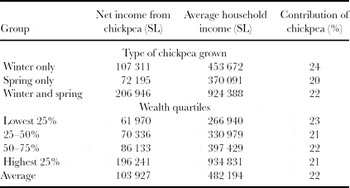
Crop production, as mentioned, was the dominant source of net income for most farmers. Wheat, barley, chickpea and lentil were the most important crops. On average, chickpea contributed about 22% to household income with 24% for winter and 20% for spring chickpea growers (Table 4). A closer look at the income variable showed that the net contribution of chickpea to household income was 24% for the lowest quartile in the wealth index scale, compared to 21% for the highest quartile (Table 4), showing that income from chickpea was relatively more important for poor households.
Contribution of chickpea to average household income (%).

p < 0.05 between averages income from chickpea by type of chickpea grown.
p < 0.01 between averages household income by type of chickpea grown.
p < 0.001 between averages income from chickpea by wealth quartiles.
p < 0.001 between averages household income by wealth quartiles.
Adoption of improved varieties and management practices
Any innovation or new technology has two components: hardware and software. These components are clear in computer technology, where the machine is hardware and the program is software. This is true in other technologies including agricultural technologies (Van den Ban and Hawkins, Reference Van den Ban and Hawkins1988), where the new varieties are hardware and other techniques such as land preparation, weed control, fertilization and irrigation are software. For this reason, we first studied adoption of winter chickpea varieties, and then examined the components.
Table 5 shows adoption rate, adoption degree and adoption intensity by zones, provinces and wealth quartiles. Adoption of winter chickpea expanded in Zone 2, which is drier than Zone 1, and is not traditionally a chickpea production area. As a result, Aleppo Province that covers part of Zone 2 also showed a high intensity of adoption compared to other provinces. Dara'a Province is a traditional chickpea production area; however, adoption was relatively low for many reasons, such as the shortage of extension support to farmers and being a dominantly spring-planted area due to winter rain not allowing winter planting of chickpea. It is also evident that the intensity of adoption was highest for well-off farmers, and poorer farmers were generally sensitive to risk associated with early adoption of any new technology, and took time to observe positive effects before increasing adoption.
Adoption rate and adoption intensity of winter chickpea varieties.

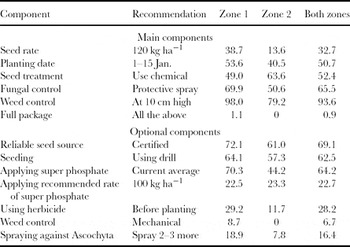
The Syrian Extension Directorate provided farmers with the full package and the farmers decided on the uptake of individual components or the full package. The results indicated that only three among all the sampled farmers adopted the full package and that most farmers adopted one or few technology components in addition to a winter chickpea variety (Table 6). In addition to a new variety, >50% of farmers adopted planting date, seed treatment, and fungal and weed control. These results are consistent with previous adoption studies that showed a clear tendency of farmers to adopt individual technological components rather than the full package.
Adoption rate of winter-sown chickpea components by zones (% of farmers).

The ultimate effect of technology on producers and consumers depends on many factors such as household resources, markets, social assets and institutional context. The existence or absence of an effective extension mechanism, markets, favourable credit systems and social assets greatly determines the uptake of the agricultural technology, thereby determining their ultimate effect on the well-being of producers and consumers. Economic gains from a technology among different social groups may vary depending on their control of resources and access to information, credit and markets. At an early stage of introduction of a new technology, the poor may not adopt the technology until they are sure that the risk of adoption is minimal. Thus, at initial stages, the benefits derived from adoption of technology go to the well-off farmers, who can absorb risks associated with new technology.
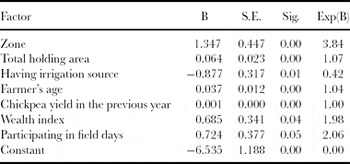
The logit model indicated that stability zone, total holding area, having an irrigation source, farmer's age, chickpea yield obtained by farmers in the previous year, wealth index score and farmer's participating in field days were the most important factors influencing farmer decisions to adopt winter chickpea technology. All these factors were significant and positively affected farmer decisions to adopt winter chickpea technology, except for having access to an irrigation source (Table 7).
Coefficients of factors influencing adoption of winter chickpea.

Note: −2 Log likelihood = 292.747; Cox and Snell R 2 = 0.251; Nagelkerke R 2 = 0.349;
Percentage of correct prediction = 76%.
Impact of chickpea technology
Impact assessment of research is a special form of evaluation and deals with effects of research output on target beneficiaries (IFPRI, 2004). In general, it attempts to look at both intended and unintended effects. The typical impact chain starts from the set of inputs and activities of a project or program to the most highly aggregated results, such as productivity, profitability, poverty reduction, food security and environmental protection. The chain also specifies all the main intermediate steps: the project activities, the output, the use that others make of the output, the direct and possible indirect effects and the implications of the use of outputs on the ultimate beneficiaries. Impact also refers to measurable effects of outputs and outcomes on the well-being of the ultimate beneficiaries of the research and development efforts: the poor, the food-insecure, undernourished households and the environment. Most socio-economic impacts and developmental impacts fall in this category (IFPRI, 2004).
Impact on productivity
Agricultural productivity is a widespread indicator for impact assessments of new technology. Successfully increasing the productivity of resources devoted to crop production will increase real income of farmers. A simple measurement, specifically grain yield per unit area, was used in this study to measure changes in factor productivity.
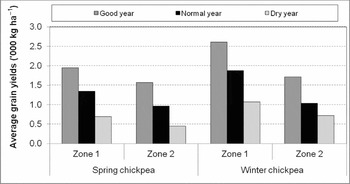
The winter-sown technology had a positive effect on crop productivity. Yields obtained by farmers, in both Zones 1 and 2, who adopted the full or some components of the technological package were higher compared to non-adopters during good, normal and dry years (Figure 2). The range of yield increases of winter compared to spring chickpea obtained by farmers were 33–54% in Zone 1, and 9–61% in Zone 2, and depended on rainfall and other climatic conditions. Improved varieties were an important component in increasing yields; the spatial distribution of yield due to the change to winter production using improved varieties, increased average yield by 32% in Zone 1, and 18% in Zone 2.
Estimated average chickpea yields in good, normal and dry seasons.

Impact on profitability
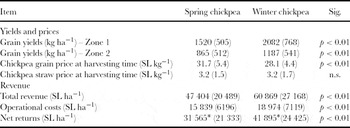
Net return, defined as the difference between gross revenue and operational costs, is one of the most commonly used measures of profitability. Gross margin is a useful tool in farm management for selecting from different input and technology mixes, measuring returns net of variable costs, and determining the contribution of each production activity to the profitability of the whole farm. It indicates likely returns or losses due to the use of a particular crop, but does not account for fixed costs relating to buildings, machinery or equipment depreciation. In this study, gross is computed as the product of crop yields and prices for the two outputs (grain and straw) from both winter and spring chickpea. The average winter chickpea yields are higher than that of spring chickpea by about 37% (Table 8), but the grain price of winter chickpea is less than spring chickpea by 11% while straw price is the same for both. Total revenue, operational costs and net revenue for winter chickpea are also significantly higher than that of spring chickpea.
Averages of yields, prices, operational costs and net revenue by winter and spring chickpea.

Notes:
(1) Figures in parentheses are standard deviations.
(2) Yield, price, revenue, cost and returns data for each observation were collected and averaged to produce the values in the table above. Hence, the product of the average prices and the average yields are not expected to give the average total revenue.
*Official exchange rate at the time of the study was 1 US$ = 42 SL.
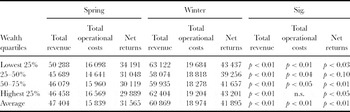
The analysis indicated that winter chickpea is profitable technology for farmers, it is possible to increase the net revenue by about 10 000 Syrian Lira per hectare, and the ratio of the net revenue increase to the additional costs is about 318%. All categories of farmers very poor, poor, moderate, and well-off (Table 9) obtained higher net revenues from winter chickpea as opposed to spring one. This result provides evidence of the appropriateness of the technology for all type of farmers.
Costs and revenue of spring and winter chickpeas (SL ha−1).

Note: Pair wise comparisons across all wealth quartiles show that there is no significant difference between any two of the wealth quartiles showing that the benefits of the old and new technologies are uniformly distributed across all wealth quartiles.
Impact on household income
Income is widely used as a welfare measure, as it is strongly correlated with the capacity to acquire items associated with an improved standard of living. Net income gains are a valid indicator of impacts because productivity gains attributable to adoption of technologies should logically be reflected in income gains.
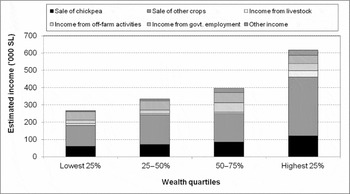
Households and farmers in the target areas had many activities contributing to their livelihoods. The average annual household income in the sample was estimated at 482 000 Syrian Lira. The net contribution of chickpea to total household income was about 22%, distributed between winter and spring chickpea (15 and 7%, respectively). Chickpea's net contribution was higher for farmers who grew winter chickpea, and for poor compared to well-off farmers (Figure 3).
Average annual and components of household net income by wealth quartiles.

Impact on employment
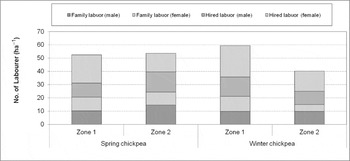
Adoption of winter chickpea technologies generated job opportunities for labourers. Adopter farmers started using hired labour for different farm operations and this generated local job opportunities for rural labourers. The estimated number of labourers needed per hectare by gender for winter and spring chickpea for Zones 1 and 2 is shown in Figure 4. Winter chickpea clearly increased labour requirements for certain operations, such as weeding. Weeding operations are mostly carried out by family and non-family female labour in rural areas, so increased adoption of winter chickpea provided more employment opportunities for women.
Estimated number of labourers needed per hectare for winter and spring chickpea.

CONCLUSION
In partnership with the Syrian national program, ICARDA's winter chickpea research has made important contributions to household economies in Syria, and created the conditions for significant additional increases in production of a nationally important crop. Chickpea productivity has been improved by introducing resistant varieties that have overcome the key constraints of cold and Ascochyta blight that earlier prevented cultivation of winter-sown chickpea. These efforts have also strengthened national research and extension capacity, and developed strong partnerships between the national research organizations and ICARDA. The Syrian research system has benefited from information exchange, technology dissemination and acquisition of germplasm and advanced materials for its breeding program.
Cultivation of winter-sown chickpea in the study area is expected to expand. Farmers believe that Ascochyta blight, insects and weeds are the most important factors constraining the productivity of winter-sown chickpea in the country. Improved winter varieties have been widely adopted, and most farmers have also adopted some components of the recommended crop management package for these varieties. There has been a noticeable expansion of the winter chickpea area in Zone 2 in Aleppo Province, where annual rainfall is 250–350 mm. Our results indicate that this technology is profitable and suitable for all segments of the farming community (across all wealth quartiles). All growers achieved higher net returns from growing winter-sown chickpea compared to their traditional spring-sown crop. Household incomes increased correspondingly, and the positive impact was relatively greater among poorer farmers. Adoption of winter chickpea also increased labour demand (mainly for weed control), representing new employment opportunities, particularly for women.
The spatial impact of shifting from spring to winter production on yield gain was much higher in Zone 1 compared to Zone 2. The incremental impact of winter chickpea on farm income was higher for Zone 2 compared to Zone 1.
Policy implications arising from this work suggest that more effort to further promote adoption of winter-sown chickpea by the Agriculture Extension Directorate would have immediate impacts in improving rural livelihoods in Syria. This model can be out-scaled to other countries in the CWANA region.