





Introduction
Virtual reality (VR) delivers immersive, multisensory environments via head-mounted displays, providing safe and controlled simulations that enhance engagement through interactive and gamified experiences. VR has demonstrated potential across diverse therapeutic applications in psychiatry (Freeman et al., Reference Freeman, Reeve, Robinson, Ehlers, Clark, Spanlang and Slater2017; Maples-Keller, Bunnell, Kim, & Rothbaum, Reference Maples-Keller, Bunnell, Kim and Rothbaum2017; Riva, Malighetti, & Serino, Reference Riva, Malighetti and Serino2021). Previous systematic reviews and meta-analyses have reported that immersive VR interventions may improve clinical outcomes across psychiatric disorders and are generally feasible and acceptable (Carl et al., Reference Carl, Stein, Levihn-Coon, Pogue, Rothbaum, Emmelkamp, GJG, Carlbring and Powers2019; Fodor et al., Reference Fodor, Coteț, Cuijpers, Szamoskozi, David and Cristea2018; Maples-Keller et al., Reference Maples-Keller, Bunnell, Kim and Rothbaum2017; Valmaggia, Latif, Kempton, & Rus-Calafell, Reference Valmaggia, Latif, Kempton and Rus-Calafell2016; Zeka et al., Reference Zeka, Clemmensen, Valmaggia, Veling, Hjorthøj and Glenthøj2025). However, these reviews have primarily focused on outpatient populations or psychiatric disorders broadly, providing limited insight into the implementation, feasibility, and effectiveness of VR in psychiatric inpatient settings.
Although psychiatric inpatient care primarily emphasizes pharmacological stabilization (Alzahrani, Reference Alzahrani2021), psychosocial interventions targeting key recovery processes such as social connectedness, emotional regulation, and coping may further support personal recovery (Clemmensen et al., Reference Clemmensen, Jørgensen, Gundersen, Smith, Midtgaard, Bouchard, Thomsen, Turgut and Glenthoj2023; Dupont et al., Reference Dupont, Raucher-Chéné, Mercier, Demers, Wang, Beauchamp, Lepage and Thibaudeau2026; Roe & Ronen, Reference Roe and Ronen2003). Their implementation is often limited by cost, resource constraints, and difficulties with personalization (Clemmensen et al., Reference Clemmensen, Jørgensen, Gundersen, Smith, Midtgaard, Bouchard, Thomsen, Turgut and Glenthoj2023). VR may help address these barriers by providing engaging, adaptable, and scalable recovery-oriented interventions as an adjunct to usual care (Clemmensen et al., Reference Clemmensen, Jørgensen, Gundersen, Smith, Midtgaard, Bouchard, Thomsen, Turgut and Glenthoj2023).
Inpatient settings represent a unique clinical context in which VR may encounter distinct barriers, facilitators, and outcomes (Alzahrani, Reference Alzahrani2021; Dupont et al., Reference Dupont, Raucher-Chéné, Mercier, Demers, Wang, Beauchamp, Lepage and Thibaudeau2026; Roe & Ronen, Reference Roe and Ronen2003). Hospitalized individuals often present with acute symptom exacerbations, severe functional impairment, or elevated distress requiring intensive care (Alzahrani, Reference Alzahrani2021; Roe & Ronen, Reference Roe and Ronen2003). Many are also admitted involuntarily or experience coercive practices, reduced autonomy, and restricted access to stimulating environments, all of which may influence engagement in psychosocial interventions and recovery (Clemmensen et al., Reference Clemmensen, Jørgensen, Gundersen, Smith, Midtgaard, Bouchard, Thomsen, Turgut and Glenthoj2023; Dupont et al., Reference Dupont, Raucher-Chéné, Mercier, Demers, Wang, Beauchamp, Lepage and Thibaudeau2026). At the organizational level, implementation is shaped by short lengths of stay, high patient turnover, staffing and space constraints, and competing clinical priorities (Dupont et al., Reference Dupont, Raucher-Chéné, Mercier, Demers, Wang, Beauchamp, Lepage and Thibaudeau2026; Riches et al., Reference Riches, Nicholson, Fialho, Little, Ahmed, McIntosh, Kaleva, Sandford, Cockburn, Odoi, Azevedo, Vasile, Payne-Gill, Fisher, van Driel, Veling, Valmaggia and Odoi2023; Waldemar, Esbensen, Korsbek, Petersen, & Arnfred, Reference Waldemar, Esbensen, Korsbek, Petersen and Arnfred2018). Conversely, inpatient care also offers unique opportunities for VR implementation, including continuous clinical supervision, structured daily routines, intensive intervention schedules, and close monitoring of treatment response and safety (Raphael et al., Reference Raphael, Price, Hartley, Haddock, Bucci and Berry2021). These contextual characteristics are likely to influence not only the feasibility of VR interventions, but also the types of interventions delivered and the outcomes achieved. A clearer understanding of VR use in psychiatric inpatient settings is therefore needed to guide evidence-based implementation and identify interventions most likely to benefit hospitalized individuals.
This systematic review aimed to (1) characterize VR use in psychiatric inpatient settings, (2) document barriers and facilitators to implementation, and (3) evaluate outcomes in these settings.
Methodology
A systematic review was conducted following PRISMA guidelines (Page et al., Reference Page, McKenzie, Bossuyt, Boutron, Hoffmann, Mulrow, Shamseer, Tetzlaff, Akl, Brennan, Chou, Glanville, Grimshaw, Hróbjartsson, Lalu, Li, Loder, Mayo-Wilson, Steve and Brennan2021) (PROSPERO #CRD42023446524). Relevant references were identified through searches of Ovid, ScienceDirect, Web of Science, Cochrane Library, WorldCat, ProQuest, and OpenGrey. The search covered publications from 1983 to 2025, beginning with the publication of the DSM-III and the emergence of contemporary VR systems. Keywords related to psychiatric disorders and VR were used (see Supplementary Material S1). Bibliographies of included studies, systematic reviews, and meta-analyses were also examined. Studies were included if participants were psychiatric inpatients or if at least 85% of the sample consisted of psychiatric inpatients. Detailed eligibility criteria are presented in Table 1.
Inclusion and exclusion criteria

Table 1. Long description
The table consists of two columns: Criteria and Details.
* Participants: Includes those diagnosed with a mental health disorder (D S M-III to D S M-5, I C D 9/10). Exclusion: neurodegenerative (e.g. Alzheimer’s) or neurodevelopmental (e.g. Autism spectrum) disorders.
* Setting: Participants clearly identified as psychiatric inpatients, or the sample was predominantly composed of psychiatric inpatients (greater than or equal to 85 percent). Exclusion: Studies involving mixed inpatient/outpatient samples where inpatient-specific data could not be isolated.
* Intervention: Immersive 360 degree V R.
* Publication date: 1983 or later.
* Study design: Any study design included. Exclusion: conference abstracts, editorials, book chapters, literature reviews (e.g. systematic reviews, meta-analyses).
* Language: English, French, or Spanish.
All references were imported into Covidence for double-blind screening. Two independent reviewers screened each article at the title/abstract and full-text stages. Discrepancies were resolved through discussion, with a third reviewer involved if needed. Corresponding authors were contacted for missing information relevant to eligibility. Methodological quality was appraised using the Mixed Methods Appraisal Tool (MMAT) (Hong et al., Reference Hong, Fàbregues, Bartlett, Boardman, Cargo, Dagenais, Gagnon, Griffiths, Nicolau, O’Cathain, Rousseau, Vedel and Pluye2018), following the same independent review process.
Data were extracted using a pre-developed Excel template, pilot-tested on five articles. Extracted information (Supplementary Material S2) included study and participant characteristics, VR use details, implementation variables, and outcomes. For the first objective, VR applications were categorized based on their primary purpose: relaxation and mindfulness, social skills training, cognitive-behavioral therapy (CBT) and exposure, cognitive training, and assessment. For the second objective, implementation outcomes were classified as feasibility, acceptability, and safety. For the third objective, all reported outcomes were extracted and subsequently grouped into four domains: clinical, psychosocial, cognitive, and physiological. Clinical outcomes referred to psychiatric symptoms. Psychosocial outcomes included functioning, self-efficacy, self-esteem, readiness to change, and general well-being. Cognitive outcomes encompassed both neurocognitive (e.g. memory) and social cognitive domains (e.g. emotion recognition). Physiological outcomes included autonomic stress markers (e.g. heart rate) as well as body-related outcomes such as body mass index. Descriptive statistics and summary tables supported a narrative synthesis for all three objectives.
Results
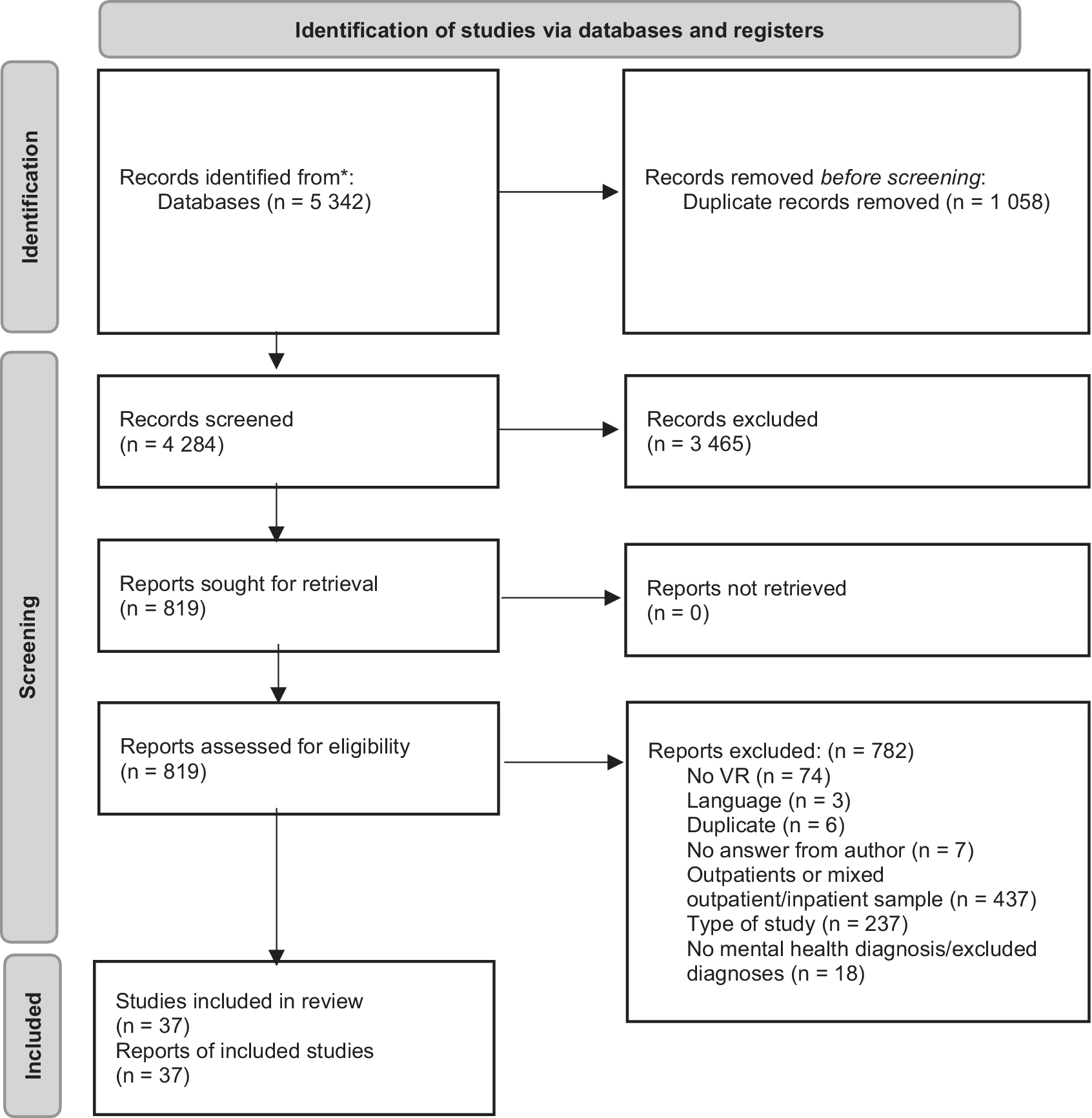
After removing duplicates, 4,284 references were identified. Title and abstract screening yielded 819 articles. Following the full-text review, 782 studies were excluded, resulting in 37 studies being included (Figure 1). Findings are presented by objective, with higher-quality evidence discussed first, followed by nonrandomized studies, pilot studies, and qualitative studies. The PRISMA checklist is provided in Supplementary Material S3, and mixed inpatient/outpatient studies excluded from the synthesis are summarized in Supplementary Material S4.
PRISMA flowchart.

Figure 1. Long description
The flowchart is organized into three vertical phases labeled on the left: Identification, Screening, and Included.
1. Identification Phase:
* Top box: Identification of studies via databases and registers.
* Left box: Records identified from Databases (n = 5 342).
* Right box (exclusion): Records removed before screening: Duplicate records removed (n = 1 058).
2. Screening Phase:
* Left box: Records screened (n = 4 284).
* Right box (exclusion): Records excluded (n = 3 465).
* Left box: Reports sought for retrieval (n = 819).
* Right box (exclusion): Reports not retrieved (n = 0).
* Left box: Reports assessed for eligibility (n = 819).
* Right box (exclusion): Reports excluded (n = 782). Reasons include: No V R (n = 74), Language (n = 3), Duplicate (n = 6), No answer from author (n = 7), Outpatients or mixed outpatient/inpatient sample (n = 437), Type of study (n = 237), and No mental health diagnosis/excluded diagnoses (n = 18).
3. Included Phase:
* Final box: Studies included in review (n = 37) and Reports of included studies (n = 37).
Study characteristics
The 37 studies included 1,004 participants; characteristics are summarized in Table 2. Six diagnostic categories were identified: schizophrenia spectrum disorders (SSD [n = 12]), mixed psychiatric samples (n = 8), eating and food intake disorders (n = 8), substance use and addictive disorders (SUD [n = 6]), and mood disorders (n = 3). Methodological quality is summarized in Table 3, whereas VR applications and outcomes are summarized in Table 4.
Demographic data

Table 2. Long description
The table contains 9 columns: Article, N, Sex ratio (M:F), Age (S D), Diagnosis (n), Duration of illness, Medication (Y/N), Hospitalization duration (days), and Country.
Key entries include:
* Borelle and Forner (2024): 7 participants, 6:1 sex ratio, Substance-use or Gambling disorder, France.
* Bouchard et al. (2017): 34 participants across two studies, Gambling disorder, Canada.
* Cesa et al. (2013): 27 females, Binge eating disorder, Italy.
* Choi et al. (2010): 26 participants, Schizophrenia, Korea.
* Faulkner et al. (2024): 42 participants, Alcohol use disorder, United States.
* Klein Tuente et al. (2020): 64 participants, multiple diagnoses including Schizophrenia and Personality disorders, Netherlands.
* Li et al. (2022): 62 participants, Schizophrenia, China.
* Lotfinia et al. (2024): 60 males, Opioid use disorder, Iran.
* Overall sample: 1,004 total participants (446 men, 473 women, 1 other). Mean age is 35.31 years (S D = 15.82). Diagnoses distribution: Schizophrenia spectrum/psychotic disorders 32.8 percent, Mood disorders 6.5 percent, Eating disorders 17.9 percent, Substance use disorders 22.4 percent, and Other 15.8 percent. Geographic distribution: Italy 17.4 percent, Korea 17.1 percent, China 11.9 percent, and Other countries 53.6 percent.
Abbreviations used: I C D for International Statistical Classification of Diseases and Related Health Problems, N A for not applicable, N R for not reported, and V R for virtual reality.
Note: ICD = International Statistical Classification of Diseases and Related Health Problems; NA = not applicable; NR = not reported; VR = virtual reality.
Ratings of study quality

Table 3. Long description
The table lists 37 studies with their respective study types and quality ratings (Yes, No, or I D) for five criteria labeled C 1 through C 5.
* Borelle and Forner (2024), Qualitative study: Yes for all criteria.
* Bouchard et al. (2017), Randomized controlled trial: Yes for C 1, C 3, C 5; I D for C 2, C 4.
* Brown et al. (2022), Qualitative study: Yes for all criteria.
* Cesa et al. (2013), Randomized controlled trial: Yes for C 1; No for C 2, C 3, C 5; I D for C 4.
* Choi et al. (2010), Cross-sectional case-control study: Yes for C 1, C 3, C 4, C 5; I D for C 2.
* Faulkner et al. (2024), Randomized controlled trial: Yes for C 1, C 4, C 5; I D for C 2; No for C 3.
* González Moraga et al. (2024), Qualitative study: Yes for all criteria.
* Greenwald et al. (2024), Nonrandomized study (single-arm): Yes for C 1, C 2, C 3, C 5; No for C 4.
* Holsteg et al. (2024), Mixed methods study: Yes for C 1, C 2, C 3, C 5; I D for C 4.
* Ilioudi et al. (2023), Nonrandomized study (with control): Yes for C 1, C 2, C 3, C 5; I D for C 4.
* Jang et al. (2005), Cross-sectional observational study: I D for C 1, C 2; Yes for C 3, C 4, C 5.
* Klein Tuente et al. (2020), Randomized controlled trial: Yes for C 1, C 2, C 5; No for C 3, C 4.
* Komemi et al. (2024), Nonrandomized study (single-arm): I D for C 1; Yes for C 2, C 3, C 5; No for C 4.
* Lee et al. (2009), Nonrandomized study (with control): I D for C 1; Yes for C 2, C 3, C 4, C 5.
* Li et al. (2022), Randomized controlled trial: Yes for C 1, C 3, C 4, C 5; No for C 2.
* Lotfinia et al. (2024), Randomized controlled trial: Yes for C 1, C 2, C 4; I D for C 3, C 5.
* McLachlan et al. (2022), Nonrandomized study (single-arm): Yes for C 1, C 3, C 5; No for C 2, C 4.
* Mölbert et al. (2018), Cross-sectional observational study: I D for C 1; No for C 2; Yes for C 3, C 4, C 5.
* Park et al. (2011), Randomized controlled trial: Yes for C 1, C 2, C 3, C 5; I D for C 4.
* Park, Kim, Ku, et al. (2009), Cross-sectional observational study: No for C 1, C 4; Yes for C 2, C 3, C 5.
* Park, Ku, Park, et al. (2009), Randomized controlled trial: Yes for C 1, C 2; No for C 3, C 5; I D for C 4.
* Park, Ku, Kim, et al. (2009), Cross-sectional observational study: Yes for C 1, C 2, C 3, C 5; No for C 4.
* Paslakis et al. (2017), Nonrandomized study (single-arm): Yes for C 1, C 3, C 4, C 5; No for C 2.
* Porras-García et al. (2020), Randomized controlled trial: I D for all criteria.
* Provenzano et al. (2019), Cross-sectional observational study: Yes for all criteria.
* Rault et al. (2022), Nonrandomized study (single-arm): Yes for C 1, C 3, C 4, C 5; No for C 2.
* Riches et al. (2023), Mixed methods study: Yes for C 1, C 2, C 3, C 5; I D for C 4.
* Riva et al. (2000), Nonrandomized study (single arm): I D for C 1; Yes for C 2, C 3, C 5; No for C 4.
* Riva et al. (2003), Randomized controlled trial: Yes for all criteria.
* Riva et al. (2002), Randomized controlled trial: Yes for C 1, C 2, C 4, C 5; I D for C 3.
* Scala et al. (2024), Cross-sectional observational study: No for C 1; Yes for C 2, C 3, C 4; I D for C 5.
* Shah et al. (2015), Nonrandomized study (single-arm): No for C 1; Yes for C 2, C 3, C 5; I D for C 4.
* Shen et al. (2022), Randomized controlled trial: Yes for C 1, C 2, C 4, C 5; No for C 3.
* Stefaniak and Aleksandrowicz (2024), Nonrandomized study (with control): Yes for C 1, C 2, C 3, C 4; No for C 5.
* Tan et al. (2021), Randomized controlled trial: Yes for all criteria.
* Van Doren et al. (2024), Mixed-methods study: Yes for C 1, C 2, C 3, C 5; I D for C 4.
* Wang et al. (2022), Randomized controlled trial: Yes for all criteria.
Summary of results

Table 4. Long description
The table is organized into five main diagnostic categories.
1. Schizophrenia and related psychotic disorders: Includes 12 studies (Choi et al. 2010 to Wang et al. 2022). Applications include assessment, cognitive training, and social skills training. Key results show V R is effective for assessing atypical eye gaze, inducing social anxiety for assessment, and improving cognitive functioning and social skills. Effect sizes range from r = 0.22 to eta-squared = 0.703.
2. Eating and food intake disorders: Includes 8 studies (Cesa et al. 2013 to Riva et al. 2003). Applications focus on C B T and exposure therapy for binge eating, anorexia nervosa, and obesity. Results indicate V R helps prevent weight regain and reduces body-related attentional bias. Effect sizes include d = 0.25 and eta-squared values up to 0.32.
3. Mood disorders: Includes 3 studies (Holsteg et al. 2024, Ilioudi et al. 2023, Shah et al. 2015). Applications cover roleplay, relaxation, and mindfulness. Results show increased well-being and reduced stress/anxiety, with one study reporting d = 0.78.
4. Substance use disorders and addictive disorders: Includes 6 studies (Borelle and Forner 2024 to Lotfinia et al. 2024). Applications use C B T and exposure to manage cravings. Results show significant reductions in alcohol and substance cravings. Effect sizes include d = 0.40 and eta-p-squared up to 0.9.
5. Mixed samples combining multiple diagnoses: Includes 8 studies (Brown et al. 2022 to Van Doren et al. 2024). Applications include aggression prevention training (V R A P T), relaxation, and emotion recognition assessment. Results show improved communication, reduced violent incidents in wards, and increased state mindfulness. Effect sizes range from d = 0.02 to d = 1.4.
Notes: AN = anorexia nervosa; CBT = cognitive-behavioral therapy; CUD = cannabis use disorder; DiSCoVR = Dynamic Interactive Social Cognition Training in Virtual Reality; ECT = VR-enhanced cognitive behavior therapy; MCCB = MATRICS Consensus Cognitive Battery; NR = nonreported; PANSS = Positive and Negative Syndrome Scale; SZ = schizophrenia; TAU = treatment as usual; VR = virtual reality; VR-SCIT = virtual reality-based social cognition and interaction training.
Objective 1: Types of VR use
Relaxation and mindfulness
Seven studies used VR-based relaxation and mindfulness interventions. Two RCTs were identified. Lotfinia et al. (Reference Lotfinia, Yaseri, Jamshidmofid, Nazari, Shahkaram, Yaztappeh and Kianimoghadam2024) compared VR environments to treatment as usual (TAU) for stress reduction in SUD. In a mixed psychiatric sample, Tan, Chng, Lau, and Klainin-Yobas (Reference Tan, Chng, Lau and Klainin-Yobas2021) assessed a VR-based stress management program.
Five nonrandomized studies extended this work by evaluating guided relaxation in SSD (Rault, Lamothe, & Pelissolo, Reference Rault, Lamothe and Pelissolo2022), VR compared with physical calm rooms (Ilioudi et al., Reference Ilioudi, Lindner, Ali, Wallström, Thunström, Ioannou, Anving, Johansson, Hamilton, Falk and Falk2023), and VR-based stress management (Shah et al., Reference Shah, Torres, Kannusamy, Chng, He and Klainin-Yobas2015) in mood disorders, as well as VR relaxation and mindfulness interventions in mixed psychiatric samples (Riches et al., Reference Riches, Nicholson, Fialho, Little, Ahmed, McIntosh, Kaleva, Sandford, Cockburn, Odoi, Azevedo, Vasile, Payne-Gill, Fisher, van Driel, Veling, Valmaggia and Odoi2023; Van Doren, Ng, Rawat, McKenna, & Blonigen, Reference Van Doren, Ng, Rawat, McKenna and Blonigen2024).
Social skills training
Four studies examined VR-based social skills interventions, including two RCTs. Park et al. (Reference Park, Ku, Choi, Jang, Park, Kim and Kim2011) examined VR role-playing integrated into social skills training in SSD, and Klein Tuente et al. (Reference Klein Tuente, Bogaerts, Bulten, Keulen-de Vos, Vos, Bokern, SV, CNW and Veling2020) assessed VR aggression prevention training in forensic psychiatry.
A mixed-methods single-arm study evaluated therapist-guided VR role-plays integrated into psychodynamic psychotherapy in mood disorders (Holsteg et al., Reference Holsteg, Askeridis, Krajewski, Mildner, Freitag, Müller, Schnieder, Gieselmann and Karger2024), while a qualitative study explored patient experiences with VR-assisted aggression prevention training in a mixed psychiatric sample (González Moraga et al., Reference González Moraga, Enebrink, Perrin, Sygel, Veling and Wallinius2024).
CBT and exposure therapy
Thirteen studies examined VR-based CBT and exposure interventions. Five RCTs evaluated VR as an adjunct to inpatient psychotherapy, including four in eating disorders examining VR-enhanced CBT and exposure (Cesa et al., Reference Cesa, Manzoni, Bacchetta, Castelnuovo, Conti, Gaggioli, Mantovani, Molinari, Cárdenas-López and Riva2013; Porras-García et al., Reference Porras-García, Serrano Troncoso, Carulla-Roig, Soto-Usera, Ferrer, Fernández del Castillo-Olivares and Díaz-Marsá2020; Riva, Bacchetta, Baruffi, & Molinari, Reference Riva, Bacchetta, Baruffi and Molinari2002; Riva, Bacchetta, Cesa, Conti, & Molinari, Reference Riva, Bacchetta, Cesa, Conti and Molinari2003), and one in gambling disorder integrating VR into inpatient CBT (Bouchard et al., Reference Bouchard, Robillard, Giroux, Jacques, Loranger, St-Pierre, Chrétien and Goulet2017).
Six nonrandomized studies extended these findings to eating disorders, SUD, SSD with comorbid social anxiety, and mixed psychiatric samples, primarily evaluating the feasibility and preliminary effects of VR-enhanced CBT and exposure interventions (Greenwald et al., Reference Greenwald, Berger, Wilson, Greenwald, Lannon, Johnson-Smith, Bergman and Wilens2024; Lee et al., Reference Lee, Han, Oh, Lyoo, Lee, Renshaw and Lukas2009; McLachlan, Mehdikhani, Larham, & Centifanti, Reference McLachlan, Mehdikhani, Larham and Centifanti2022; Paslakis et al., Reference Paslakis, Fauck, Röder, Rauh, Rauh and Erim2017; Riva et al., Reference Riva, Bacchetta, Baruffi, Rinaldi, Vincelli and Molinari2000; Stefaniak & Aleksandrowicz, Reference Stefaniak and Aleksandrowicz2024).
Two qualitative studies examined the implementation of VR-CBT in routine psychiatric care, including one study in SUD (Borelle & Forner, Reference Borelle and Forner2024) and another assessing the acceptability of automated VR cognitive therapy in a mixed psychiatric sample (Brown et al., Reference Brown, Waite, Lambe, Jones, Jenner, Diamond and Freeman2022).
Cognitive training
Four studies evaluated VR-based cognitive training in SSD, including three RCTs. Li et al. (Reference Li, Liu, Sun, Wei, Shen, Xu and Huang2022) used VR cognitive remediation targeting neurocognition, while Wang, Kou, Meng, and Yu (Reference Wang, Kou, Meng and Yu2022) used a VR serious game to target working memory and executive functioning. Shen, Liu, Wu, Lin, and Wang (Reference Shen, Liu, Wu, Lin and Wang2022) used a VR version of the Social Cognition and Interaction Training (VR-SCIT) targeting social cognition and functioning.
One nonrandomized single-arm study evaluated the feasibility and preliminary efficacy of an ecological VR-based cognitive remediation program targeting neurocognition (Komemi, Tubenbaltt, Harel, Nahum, & Lipskaya-Velikovsky, Reference Komemi, Tubenbaltt, Harel, Nahum and Lipskaya-Velikovsky2024).
Assessment
Nine studies used VR for assessment. Two RCTs evaluated VR-based assessment of social competence during antipsychotic treatment in SSD (Park et al., Reference Park, Kim, Ku, Jang, Park, Kim, Kim and Kim2009) and a VR buffet paradigm to assess food selection during pharmacological treatment for alcohol use disorder (Faulkner et al., Reference Faulkner, Farokhnia, Lee, Farinelli, Browning, Abshire, Daurio, Munjal, Deschaine, Boukabara, Fortney, Sherman, Schwandt, Akhlaghi, Momenan, Ross, Persky and Boukabara2024).
Seven cross-sectional studies assessed social cognition and social behavior in SSD (Choi et al., Reference Choi, Ku, Han, Kim, Kim, Park and Kim2010; Jang et al., Reference Jang, Ku, Park, Kim, Kim, Kim, Kim and Kim2005; Park, Kim, Ku, et al., Reference Park, Kim, Ku, Jang, Park, Kim, Kim and Kim2009), body image disturbance in eating disorders (Mölbert et al., Reference Mölbert, Thaler, Mohler, Streuber, Romero, Black, Zipfel, Karnath and Giel2018; Provenzano et al., Reference Provenzano, Porciello, Ciccarone, Lenggenhager, Tieri, Marucci, Dazzi, Loriedo and Bufalari2019), and facial emotion recognition in immersive versus nonimmersive VR in a mixed psychiatric sample (Scala et al., Reference Scala, Sánchez-Reolid, Sánchez-Reolid, Fernández-Sotos, Romero-Ferreiro, Alvarez-Mon, Lahera, Fanelli, Serretti, Fabbri, Fernández-Caballero and Fabbri2024).
Objective 2: Barriers and facilitators
Across study designs, VR was generally feasible, acceptable, and safe for use in psychiatric inpatient settings. However, evidence primarily originated from pilot and feasibility studies, and implementation outcomes were reported inconsistently.
Feasibility
Available evidence suggests that VR can be successfully implemented across psychiatric inpatient settings, with barriers mostly related to organizational factors. Common challenges included early discharge, short lengths of stay, limited availability of private spaces, competing clinical priorities, staff workload, technical difficulties, and, in some studies, COVID-19 disruptions (Brown et al., Reference Brown, Waite, Lambe, Jones, Jenner, Diamond and Freeman2022; Holsteg et al., Reference Holsteg, Askeridis, Krajewski, Mildner, Freitag, Müller, Schnieder, Gieselmann and Karger2024; Komemi et al., Reference Komemi, Tubenbaltt, Harel, Nahum and Lipskaya-Velikovsky2024; Riches et al., Reference Riches, Nicholson, Fialho, Little, Ahmed, McIntosh, Kaleva, Sandford, Cockburn, Odoi, Azevedo, Vasile, Payne-Gill, Fisher, van Driel, Veling, Valmaggia and Odoi2023). Clinicians also emphasized the importance of staff training, technical support, and flexible scheduling (Brown et al., Reference Brown, Waite, Lambe, Jones, Jenner, Diamond and Freeman2022; Holsteg et al., Reference Holsteg, Askeridis, Krajewski, Mildner, Freitag, Müller, Schnieder, Gieselmann and Karger2024; Riches et al., Reference Riches, Nicholson, Fialho, Little, Ahmed, McIntosh, Kaleva, Sandford, Cockburn, Odoi, Azevedo, Vasile, Payne-Gill, Fisher, van Driel, Veling, Valmaggia and Odoi2023). Technical specifications of VR systems are presented in Supplementary Material S5.
Despite these challenges, reported implementation indicators were encouraging. Greenwald et al. (Reference Greenwald, Berger, Wilson, Greenwald, Lannon, Johnson-Smith, Bergman and Wilens2024) reported that 33 of 62 eligible patients (53%) enrolled in an inpatient opioid withdrawal program, and completion rates were higher in the VR group than in the TAU group (63% vs. 45%), with discontinuations primarily related to medical care or discharge rather than the intervention. Similarly, Komemi et al. (Reference Komemi, Tubenbaltt, Harel, Nahum and Lipskaya-Velikovsky2024) reported completion of an 8-session VR cognitive remediation program by 23 of 31 participants (74%), with most attrition attributable to early discharge. Across the remaining studies, authors consistently concluded that VR could be integrated into inpatient psychiatric care when adequate organizational support and technical resources were available (Ilioudi et al., Reference Ilioudi, Lindner, Ali, Wallström, Thunström, Ioannou, Anving, Johansson, Hamilton, Falk and Falk2023; Rault et al., Reference Rault, Lamothe and Pelissolo2022; Stefaniak & Aleksandrowicz, Reference Stefaniak and Aleksandrowicz2024; Tan et al., Reference Tan, Chng, Lau and Klainin-Yobas2021; Van Doren et al., Reference Van Doren, Ng, Rawat, McKenna and Blonigen2024).
Acceptability
Acceptability was consistently high across RCTs (Ilioudi et al., Reference Ilioudi, Lindner, Ali, Wallström, Thunström, Ioannou, Anving, Johansson, Hamilton, Falk and Falk2023; Li et al., Reference Li, Liu, Sun, Wei, Shen, Xu and Huang2022), nonrandomized studies (Greenwald et al., Reference Greenwald, Berger, Wilson, Greenwald, Lannon, Johnson-Smith, Bergman and Wilens2024; Van Doren et al., Reference Van Doren, Ng, Rawat, McKenna and Blonigen2024), and qualitative or mixed-methods studies (Brown et al., Reference Brown, Waite, Lambe, Jones, Jenner, Diamond and Freeman2022; Holsteg et al., Reference Holsteg, Askeridis, Krajewski, Mildner, Freitag, Müller, Schnieder, Gieselmann and Karger2024; Riches et al., Reference Riches, Nicholson, Fialho, Little, Ahmed, McIntosh, Kaleva, Sandford, Cockburn, Odoi, Azevedo, Vasile, Payne-Gill, Fisher, van Driel, Veling, Valmaggia and Odoi2023). Participants described VR as engaging, immersive, enjoyable, and clinically meaningful, while facilitating relaxation, motivation, emotional engagement, and realistic yet safe opportunities to practice social interactions, emotion regulation, exposure, and everyday activities (Brown et al., Reference Brown, Waite, Lambe, Jones, Jenner, Diamond and Freeman2022; Ilioudi et al., Reference Ilioudi, Lindner, Ali, Wallström, Thunström, Ioannou, Anving, Johansson, Hamilton, Falk and Falk2023; Just, Lütt, Siegle, & Döring-Brandl, Reference Just, Lütt, Siegle and Döring-Brandl2024; McLachlan et al., Reference McLachlan, Mehdikhani, Larham and Centifanti2022; Park, Kim, Ku, et al., Reference Park, Kim, Ku, Jang, Park, Kim, Kim and Kim2009; Riches et al., Reference Riches, Nicholson, Fialho, Little, Ahmed, McIntosh, Kaleva, Sandford, Cockburn, Odoi, Azevedo, Vasile, Payne-Gill, Fisher, van Driel, Veling, Valmaggia and Odoi2023; Tan et al., Reference Tan, Chng, Lau and Klainin-Yobas2021). Quantitative findings supported these observations: 94% of participants in Greenwald et al. (Reference Greenwald, Berger, Wilson, Greenwald, Lannon, Johnson-Smith, Bergman and Wilens2024) reported satisfaction with VR, while Van Doren et al. (Reference Van Doren, Ng, Rawat, McKenna and Blonigen2024) found high ratings of satisfaction, usability, presence, confidence, and mindfulness. Similarly, Park et al. (Reference Park, Ku, Choi, Jang, Park, Kim and Kim2011) reported greater treatment interest and better generalization of social skills, and Shen et al. (Reference Shen, Liu, Wu, Lin and Wang2022) observed higher adherence with VR-based SCIT than with traditional SCIT.
Clinicians also viewed VR positively, highlighting its value for enhancing engagement and experiential learning (Bouchard et al., Reference Bouchard, Robillard, Giroux, Jacques, Loranger, St-Pierre, Chrétien and Goulet2017; Brown et al., Reference Brown, Waite, Lambe, Jones, Jenner, Diamond and Freeman2022; Holsteg et al., Reference Holsteg, Askeridis, Krajewski, Mildner, Freitag, Müller, Schnieder, Gieselmann and Karger2024; Riches et al., Reference Riches, Nicholson, Fialho, Little, Ahmed, McIntosh, Kaleva, Sandford, Cockburn, Odoi, Azevedo, Vasile, Payne-Gill, Fisher, van Driel, Veling, Valmaggia and Odoi2023; Van Doren et al., Reference Van Doren, Ng, Rawat, McKenna and Blonigen2024). However, successful implementation depended on adequate staff training, technical support, and organizational readiness. Reported challenges included technical glitches, interruptions during role-plays, equipment maintenance, privacy considerations, and integration into routine unit activities (Brown et al., Reference Brown, Waite, Lambe, Jones, Jenner, Diamond and Freeman2022; Holsteg et al., Reference Holsteg, Askeridis, Krajewski, Mildner, Freitag, Müller, Schnieder, Gieselmann and Karger2024; Riches et al., Reference Riches, Nicholson, Fialho, Little, Ahmed, McIntosh, Kaleva, Sandford, Cockburn, Odoi, Azevedo, Vasile, Payne-Gill, Fisher, van Driel, Veling, Valmaggia and Odoi2023).
Safety
VR was generally well tolerated across psychiatric inpatient populations, and no study reported serious adverse events directly attributable to VR. When assessed, cybersickness was uncommon and typically mild and transient, consisting primarily of headaches, dizziness, eye irritation, headset discomfort, or temporary distress (Li et al., Reference Li, Liu, Sun, Wei, Shen, Xu and Huang2022; Riches et al., Reference Riches, Nicholson, Fialho, Little, Ahmed, McIntosh, Kaleva, Sandford, Cockburn, Odoi, Azevedo, Vasile, Payne-Gill, Fisher, van Driel, Veling, Valmaggia and Odoi2023). Likewise, studies evaluating VR relaxation (Rault et al., Reference Rault, Lamothe and Pelissolo2022), CBT and exposure (Riva et al., Reference Riva, Bacchetta, Baruffi, Rinaldi, Vincelli and Molinari2000; Riva et al., Reference Riva, Bacchetta, Baruffi and Molinari2002; Stefaniak & Aleksandrowicz, Reference Stefaniak and Aleksandrowicz2024), stress management (Shah et al., Reference Shah, Torres, Kannusamy, Chng, He and Klainin-Yobas2015), mindfulness (Van Doren et al., Reference Van Doren, Ng, Rawat, McKenna and Blonigen2024), and opioid withdrawal (Greenwald et al., Reference Greenwald, Berger, Wilson, Greenwald, Lannon, Johnson-Smith, Bergman and Wilens2024) reported no major safety concerns.
Although several interventions intentionally elicited anxiety, craving, body-related distress, or aggressive impulses as part of therapeutic exposure, these reactions occurred within the expected therapeutic framework and were not associated with unexpected adverse events (Klein Tuente et al., Reference Klein Tuente, Bogaerts, Bulten, Keulen-de Vos, Vos, Bokern, SV, CNW and Veling2020; Paslakis et al., Reference Paslakis, Fauck, Röder, Rauh, Rauh and Erim2017; Porras-García et al., Reference Porras-García, Serrano Troncoso, Carulla-Roig, Soto-Usera, Ferrer, Fernández del Castillo-Olivares and Díaz-Marsá2020). Similarly, Park, Kim, Ku, et al. (Reference Park, Kim, Ku, Jang, Park, Kim, Kim and Kim2009) reported transient increases in social anxiety during VR-based social interactions in SSD, but concluded that responses reflected the emotional content of the stimuli rather than the VR technology itself. A few studies reported emotional overload or suggested that VR was unsuitable for patients who were too acutely unwell or perceived the intervention as irrelevant (Brown et al., Reference Brown, Waite, Lambe, Jones, Jenner, Diamond and Freeman2022; Holsteg et al., Reference Holsteg, Askeridis, Krajewski, Mildner, Freitag, Müller, Schnieder, Gieselmann and Karger2024; Riches et al., Reference Riches, Nicholson, Fialho, Little, Ahmed, McIntosh, Kaleva, Sandford, Cockburn, Odoi, Azevedo, Vasile, Payne-Gill, Fisher, van Driel, Veling, Valmaggia and Odoi2023). Overall, reported safety concerns were primarily related to the therapeutic content and patient selection rather than to the VR technology.
Objective 3: Treatment outcomes
Clinical symptoms
Higher-quality evidence from RCTs suggests mixed but generally promising effects of VR-based interventions on clinical symptoms across psychiatric diagnoses. Lower-level evidence from nonrandomized and mixed-methods studies was generally consistent with these findings.
Regarding VR-based relaxation and mindfulness, results from an RCT comparing VR-based relaxation/mindfulness with waitlist controls in a mixed psychiatric sample showed improved perceived relaxation and stress-management knowledge, with large effect sizes (Tan et al., Reference Tan, Chng, Lau and Klainin-Yobas2021 [N = 40]). The results were supported by mixed-methods studies reporting large improvements in relaxation, stress, anxiety, and sadness (Riches et al., Reference Riches, Nicholson, Fialho, Little, Ahmed, McIntosh, Kaleva, Sandford, Cockburn, Odoi, Azevedo, Vasile, Payne-Gill, Fisher, van Driel, Veling, Valmaggia and Odoi2023 [N = 28]), as well as significant increases in positive affect and decreases in negative affect (Van Doren et al., Reference Van Doren, Ng, Rawat, McKenna and Blonigen2024). In SUD, an RCT revealed that naturalistic VR environments reduced stress and cravings relative to an active control condition, although effects were small to moderate (Lotfinia et al., Reference Lotfinia, Yaseri, Jamshidmofid, Nazari, Shahkaram, Yaztappeh and Kianimoghadam2024 [N = 60]). Findings in mood disorders were less consistent. Ilioudi et al. (Reference Ilioudi, Lindner, Ali, Wallström, Thunström, Ioannou, Anving, Johansson, Hamilton, Falk and Falk2023 [N = 40]) found no significant differences between VR and a physical calm room. In contrast, a single-arm study by Shah et al. (Reference Shah, Torres, Kannusamy, Chng, He and Klainin-Yobas2015 [N = 22]) reported significant reductions in subjective stress, anxiety, and depressive symptoms, together with increased perceived relaxation and knowledge of stress management. In SSD, Rault et al. (Reference Rault, Lamothe and Pelissolo2022 [N = 13]) reported improvements in anxiety in a single-arm study.
Regarding CBT/exposure therapy, four RCTs evaluated VR-enhanced CBT and exposure-based interventions in eating disorders. Overall, these studies consistently reported improvements in body-related outcomes, mood, and eating disorder psychopathology compared with TAU, conventional CBT, nutritional interventions, or waitlist controls (Porras-García et al., Reference Porras-García, Serrano Troncoso, Carulla-Roig, Soto-Usera, Ferrer, Fernández del Castillo-Olivares and Díaz-Marsá2020 [N = 9]; Riva et al., Reference Riva, Bacchetta, Baruffi and Molinari2002 [N = 20]; Riva et al., Reference Riva, Bacchetta, Cesa, Conti and Molinari2003 [N = 36]). Evidence for reductions in core eating disorder symptoms was less consistent, with one trial reporting greater reductions in binge eating following VR-based Experiential Cognitive Therapy than active control conditions (Riva et al., Reference Riva, Bacchetta, Cesa, Conti and Molinari2003 [N = 36]), whereas another found comparable improvements across treatment conditions despite greater benefits for body satisfaction and motivation for change in the VR group (Riva et al., Reference Riva, Bacchetta, Baruffi and Molinari2002 [N = 20]). A preliminary RCT in anorexia nervosa further reported small improvements in urges to engage in physical activity and eating disorder symptoms following VR body exposure (Porras-García et al., Reference Porras-García, Serrano Troncoso, Carulla-Roig, Soto-Usera, Ferrer, Fernández del Castillo-Olivares and Díaz-Marsá2020 [N = 9]). Finally, a single-arm study in binge-eating disorder reported reductions in binge eating together with improvements in body-related outcomes following VR-based experiential cognitive therapy (Riva et al., Reference Riva, Bacchetta, Baruffi, Rinaldi, Vincelli and Molinari2000 [N = 25]). Likewise, preliminary RCTs in gambling disorder found reductions in gambling cravings comparable with standard CBT (Bouchard et al., Reference Bouchard, Robillard, Giroux, Jacques, Loranger, St-Pierre, Chrétien and Goulet2017) (Study 2, N = 20; Study 3, N = 14). In SUD, VR interventions reduced craving and negative affect, with one pilot study reporting large improvements in depressive symptoms, tension, and craving following repeated exposure to naturalistic VR environments (Greenwald et al., Reference Greenwald, Berger, Wilson, Greenwald, Lannon, Johnson-Smith, Bergman and Wilens2024 [N = 32]) and another showing greater reductions in alcohol craving than conventional CBT in alcohol use disorder (Lee et al., Reference Lee, Han, Oh, Lyoo, Lee, Renshaw and Lukas2009 [N = 20]). In mixed psychiatric samples, McLachlan et al. (Reference McLachlan, Mehdikhani, Larham and Centifanti2022 [N = 29]) reported moderate-to-large improvements in beliefs regarding the malleability of emotions following a brief VR-based psychoeducational intervention. In SSD, VR-CBT reduced symptom severity, social anxiety, and depressive symptoms compared to TAU (Stefaniak & Aleksandrowicz, Reference Stefaniak and Aleksandrowicz2024 [N = 11]) in a nonrandomized study.
Regarding social skills training, VR-assisted aggression prevention therapy produced small-to-moderate improvements in anger control, impulsiveness, and hostility in forensic psychiatry, although effects on primary aggression outcomes were negligible and were not maintained at 3-month follow-up (Klein Tuente et al., Reference Klein Tuente, Bogaerts, Bulten, Keulen-de Vos, Vos, Bokern, SV, CNW and Veling2020 [N = 64]).
Psychosocial outcomes
Higher-quality evidence from RCTs suggests that VR interventions may improve psychosocial functioning across several psychiatric populations.
Regarding VR-based relaxation and mindfulness, Ilioudi et al. (Reference Ilioudi, Lindner, Ali, Wallström, Thunström, Ioannou, Anving, Johansson, Hamilton, Falk and Falk2023 [N = 40]) found no significant differences in well-being when comparing a VR calm room with a physical calm room in mood disorders, although both interventions produced moderate-to-large within-group improvements. A mixed-methods study in a mixed psychiatric sample reported large improvements in happiness, relaxation, and connectedness to nature following immersive nature-based VR (Riches et al., Reference Riches, Nicholson, Fialho, Little, Ahmed, McIntosh, Kaleva, Sandford, Cockburn, Odoi, Azevedo, Vasile, Payne-Gill, Fisher, van Driel, Veling, Valmaggia and Odoi2023 [N = 28]).
Regarding CBT, two RCTs in eating disorders showed improvements in self-efficacy, readiness to change, and self-esteem compared with TAU, conventional CBT, or waitlist controls (Riva et al., Reference Riva, Bacchetta, Baruffi and Molinari2002 [N = 20]; Riva et al., Reference Riva, Bacchetta, Cesa, Conti and Molinari2003 [N = 36]). A single-arm study in binge-eating disorder also reported reduced social avoidance and greater social engagement following VR-based experiential cognitive therapy (Riva et al., Reference Riva, Bacchetta, Baruffi, Rinaldi, Vincelli and Molinari2000 [N = 25]). In SSD, VR-based CBT improved global functioning but did not reduce internalized stigma (Stefaniak & Aleksandrowicz, Reference Stefaniak and Aleksandrowicz2024 [N = 11]).
Regarding social skills training, one RCT in SSD showed that VR-assisted social skills training improved conversational ability and assertiveness compared with an active control group (Park et al., Reference Park, Ku, Choi, Jang, Park, Kim and Kim2011 [N = 33]).
Regarding cognitive remediation, a single-arm study found that ecological VR-based cognitive remediation improved functional capacity and participation in everyday activities (Komemi et al., Reference Komemi, Tubenbaltt, Harel, Nahum and Lipskaya-Velikovsky2024 [N = 23]).
Cognitive outcomes
Higher-quality evidence from RCTs suggests that VR interventions improve both neurocognition and social cognition in SSD. VR-based cognitive training was associated with improvements in visual learning and reasoning/problem-solving, with a large overall treatment effect compared with TAU (Li et al., Reference Li, Liu, Sun, Wei, Shen, Xu and Huang2022 [N = 62]). Similarly, Wang et al. (Reference Wang, Kou, Meng and Yu2022 [N = 31]) reported moderate-to-large improvements in executive functioning and working memory following a VR serious game intervention compared with TAU. Additional evidence from an RCT supports the use of VR to target social cognition. Shen et al. (Reference Shen, Liu, Wu, Lin and Wang2022 [N = 26]) found that VR-based SCIT improved emotion recognition, theory of mind, metacognition, and social functioning while reducing hostile attribution bias compared with traditional SCIT and a waiting-list control.
Consistent preliminary evidence was provided in a single-arm study by Komemi et al. (Reference Komemi, Tubenbaltt, Harel, Nahum and Lipskaya-Velikovsky2024 [n = 23]) who reported small-to-moderate improvements across several neurocognitive domains, including processing speed, cognitive flexibility, verbal fluency, and functional capacity following ecological VR-based cognitive remediation.
Physiological outcomes
Higher-quality evidence from RCTs suggests that VR-based interventions may improve selected physiological outcomes, although findings remain limited.
Regarding VR-based relaxation and mindfulness, naturalistic VR environments improved physiological indicators of stress, including respiratory rate and skin conductance in an RCT with SUD compared with active and passive control conditions (Lotfinia et al., Reference Lotfinia, Yaseri, Jamshidmofid, Nazari, Shahkaram, Yaztappeh and Kianimoghadam2024 [N = 60]). In a mixed psychiatric sample, Tan et al. (Reference Tan, Chng, Lau and Klainin-Yobas2021 [N = 40]) found no clear effects on objective physiological stress markers compared to a waiting-list control in an RCT despite improvements in perceived relaxation and stress-management knowledge. In mood disorders, Shah et al. (Reference Shah, Torres, Kannusamy, Chng, He and Klainin-Yobas2015 [N = 22]) reported improvements in physiological markers of relaxation in a single-arm study, including increased skin temperature, following a VR-based stress management program. Similarly, in a nonrandomized study comparing a VR calm room with a physical calm room, Ilioudi et al. (Reference Ilioudi, Lindner, Ali, Wallström, Thunström, Ioannou, Anving, Johansson, Hamilton, Falk and Falk2023 [N = 40]) found no significant between-group differences for physiological indicators such as heart rate or blood pressure.
Regarding CBT, a small number of studies examined body-related outcomes in eating disorders. In binge-eating disorder, an RCT found that VR-enhanced CBT was associated with better maintenance of weight loss and lower relapse rates at 1-year follow-up compared with TAU (Cesa et al., Reference Cesa, Manzoni, Bacchetta, Castelnuovo, Conti, Gaggioli, Mantovani, Molinari, Cárdenas-López and Riva2013 [N = 27]). Similarly, a preliminary RCT in anorexia nervosa reported improvements in BMI and body-related attentional bias following VR body exposure compared with non-VR interventions, with small-to-moderate effects (Porras-García et al., Reference Porras-García, Serrano Troncoso, Carulla-Roig, Soto-Usera, Ferrer, Fernández del Castillo-Olivares and Díaz-Marsá2020 [N = 9]).
Discussion
This systematic review synthesized evidence regarding the use, feasibility, acceptability, safety, and effects of VR in psychiatric inpatient settings. Overall, findings indicate that VR has been applied across diverse psychiatric diagnoses and therapeutic contexts, including relaxation/mindfulness, social skills training, CBT/exposure, cognitive training, and assessment. These applications largely mirror those reported in outpatient settings (Freeman et al., Reference Freeman, Reeve, Robinson, Ehlers, Clark, Spanlang and Slater2017; Maples-Keller et al., Reference Maples-Keller, Bunnell, Kim and Rothbaum2017; Valmaggia et al., Reference Valmaggia, Latif, Kempton and Rus-Calafell2016). However, CBT/exposure and assessment accounted for most studies, reflecting the current stage of VR implementation in psychiatry (Benbow & Anderson, Reference Benbow and Anderson2019; Carl et al., Reference Carl, Stein, Levihn-Coon, Pogue, Rothbaum, Emmelkamp, GJG, Carlbring and Powers2019; Fernández-Álvarez et al., Reference Fernández-Álvarez, Rozental, Carlbring, Colombo, Riva, Anderson, Baños, Benbow, Bouchard, Bretón-López, Cárdenas, Difede, Emmelkamp, García-Palacios, Guillén, Hoffman, Kampann, Moldovan, Mühlberger and Botella2019).
Across studies, VR was associated with improvements in clinical, psychosocial, cognitive, and physiological outcomes and was generally feasible, acceptable, and safe for both inpatients and clinicians. Nevertheless, these findings should be interpreted cautiously given the substantial heterogeneity in VR modalities, psychiatric populations, intervention protocols, and methodological quality.
Benefits of VR-based treatments in inpatient settings
Overall, VR-based interventions demonstrated benefits across multiple outcome domains despite the greater clinical acuity typically encountered in inpatient settings. Clinical improvements were reported across SSD, mood disorders, eating disorders, SUD, and mixed psychiatric samples, while psychosocial benefits included enhanced interpersonal functioning, well-being, relaxation, and self-efficacy. These findings are consistent with previous outpatient-focused reviews (Carl et al., Reference Carl, Stein, Levihn-Coon, Pogue, Rothbaum, Emmelkamp, GJG, Carlbring and Powers2019; G. Riva, Wiederhold, & Mantovani, Reference Riva, Wiederhold and Mantovani2019 ; Wechsler, Kümpers, & Mühlberger, Reference Wechsler, Kümpers and Mühlberger2019) and the recent meta-analysis by Zeka et al. (Reference Zeka, Clemmensen, Valmaggia, Veling, Hjorthøj and Glenthøj2025), which concluded that VR interventions may benefit several psychiatric disorders while emphasizing that the certainty of the evidence remains low to moderate because of methodological limitations. The immersive and interactive characteristics of VR may partly explain these findings by promoting presence and facilitating safe engagement with avoided or emotionally salient stimuli (Riva et al., Reference Riva, Wiederhold and Mantovani2019). Such features may be particularly valuable in inpatient care, where emotional dysregulation, reduced motivation, and avoidance can limit participation in conventional psychosocial interventions (Clemmensen et al., Reference Clemmensen, Jørgensen, Gundersen, Smith, Midtgaard, Bouchard, Thomsen, Turgut and Glenthoj2023; Roe & Ronen, Reference Roe and Ronen2003).
VR also showed promise for cognitive remediation in inpatient care. Consistent with the previous meta-analysis of inpatient cognitive remediation by Cella et al. (Reference Cella, Price, Corboy, Onwumere, Shergill and Preti2020), RCTs demonstrated improvements in neurocognition and social cognition (Li et al., Reference Li, Liu, Sun, Wei, Shen, Xu and Huang2022; Shen et al., Reference Shen, Liu, Wu, Lin and Wang2022; Wang et al., Reference Wang, Kou, Meng and Yu2022). Beyond improving cognitive functioning, VR may provide a more engaging and ecologically valid platform for practicing cognitive and social cognitive skills than conventional approaches.
Evidence for physiological effects was more limited, but suggests that VR may influence autonomic stress response alongside psychological outcomes (Lotfinia et al., Reference Lotfinia, Yaseri, Jamshidmofid, Nazari, Shahkaram, Yaztappeh and Kianimoghadam2024; Porras-García et al., Reference Porras-García, Serrano Troncoso, Carulla-Roig, Soto-Usera, Ferrer, Fernández del Castillo-Olivares and Díaz-Marsá2020; Shah et al., Reference Shah, Torres, Kannusamy, Chng, He and Klainin-Yobas2015). However, the durability of these effects remains uncertain because most studies assessed only short-term outcomes and some benefits diminished at follow-up. Future studies should therefore examine post-discharge maintenance and long-term effects on functioning, symptoms, and quality of life. Although beneficial effects were observed across several diagnoses, evidence remains preliminary.
Feasibility, acceptability, and safety
Overall, VR interventions were found to be feasible, acceptable, and safe in psychiatric inpatient settings. Users reported high levels of satisfaction, realism, and engagement, and most completed the interventions. Reported dropout rates were low, which may have been supported by the gamification component of VR but also by the inpatient setting where structured routines and real-time monitoring facilitate adherence and individualized delivery (Balachander et al., Reference Balachander, Bajaj, Hazari, Kumar, Anand, Manjula, Sudhir, Cherian, Narayanaswamy, Jaisoorya, Math, Kandavel, Arumugham and Janardhan Reddy2020; Raphael et al., Reference Raphael, Price, Hartley, Haddock, Bucci and Berry2021). Further, successful implementation depended primarily on organizational factors rather than on the technology itself. Consistent with previous reviews (e.g. Maples-Keller et al., Reference Maples-Keller, Bunnell, Kim and Rothbaum2017), adequate staff training, technical support, and institutional readiness emerged as key facilitators, whereas limited staffing, technical difficulties, equipment maintenance, and restricted physical space represented the principal barriers (Raphael et al., Reference Raphael, Price, Hartley, Haddock, Bucci and Berry2021; Riva et al., Reference Riva, Wiederhold and Mantovani2019). These findings suggest that implementation efforts should focus as much on organizational readiness as on the technology itself.
Although occasional emotional overload or transient symptom exacerbation was reported, these events should be interpreted within the therapeutic context of the interventions. Several VR applications intentionally incorporated exposure to anxiety-provoking, emotionally salient, or craving-related stimuli as part of evidence-based CBT/exposure. Consequently, temporary increases in distress or emotional activation likely reflect the expected therapeutic process rather than adverse effects of VR technology. The distinction may be particularly relevant in psychiatric inpatient settings, where patients often present with greater clinical instability than outpatient populations. Appropriate patient selection, clinician supervision, gradual exposure, and structured debriefing therefore remain essential to maximize therapeutic benefits while minimizing unnecessary distress (Maples-Keller et al., Reference Maples-Keller, Bunnell, Kim and Rothbaum2017; Riches et al., Reference Riches, Nicholson, Fialho, Little, Ahmed, McIntosh, Kaleva, Sandford, Cockburn, Odoi, Azevedo, Vasile, Payne-Gill, Fisher, van Driel, Veling, Valmaggia and Odoi2023).
Implications for implementation of VR in inpatient care
This review highlights several practical considerations for implementing VR in psychiatric inpatient care. First, clinician training and access to technical support appear essential for successful adoption. Second, user-friendly and clinically accessible VR applications may facilitate implementation by reducing technical complexity and staff burden. Third, staffing constraints remain an important challenge, although certain interventions, such as relaxation/mindfulness, and cognitive training may be delivered by nonspecialized staff following appropriate training, potentially improving feasibility and accessibility. Finally, future studies should clarify the influence of psychoactive medications and symptom severity on the safety and effectiveness of VR-based interventions. Although no evidence of serious harm was identified, these factors remain largely unexplored.
Review strengths and limitations
This review followed PRISMA guidelines and included a comprehensive search of peer-reviewed and gray literature, reducing the risk of publication bias. Study quality was generally adequate according to the MMAT. Another strength is the geographical diversity of the included studies. Although VR may be perceived as a technology used in high-income countries, several studies originated from diverse settings, including Brazil, China, and Iran, suggesting growing global interest in VR applications for psychiatric care.
Several limitations should also be acknowledged. Inconsistent reporting of inpatient status and the absence of author responses resulted in the exclusion of potentially relevant studies. Excluding study protocols may also have omitted forthcoming evidence. Additionally, many studies included small and heterogeneous samples, and the diversity of interventions, outcomes, study designs, and psychiatric diagnoses precluded quantitative synthesis and limited direct comparisons across studies. Unlike broader meta-analyses (e.g. Zeka et al., Reference Zeka, Clemmensen, Valmaggia, Veling, Hjorthøj and Glenthøj2025), this review specifically focused on psychiatric inpatient settings and therefore adopted a narrative synthesis to capture the diversity of interventions, implementation factors, and study designs. Publication bias also cannot be excluded, as studies with positive findings may have been more likely to be published. Finally, limited reporting of hospitalization duration prevented examination of how length of stay may influence VR implementation, dosage, or outcomes.
Conclusion
This review found that VR has been applied across a broad range of psychiatric inpatient settings and that available evidence generally supports its feasibility, acceptability, and safety while suggesting potential benefits across clinical, psychosocial, cognitive, and physiological outcomes. However, the current evidence remains preliminary because of small sample sizes, methodological heterogeneity, and limited long-term follow-up. VR therefore appears to represent a promising complement to, rather than a replacement for, conventional inpatient care. Future research should prioritize adequately powered trials, standardized intervention and safety procedures, and long-term follow-up to better define the role of VR in psychiatric inpatient practice.
Supplementary material
The supplementary material for this article can be found at http://doi.org/10.1017/S0033291726105662.
Funding statement
This research received no specific grant from any funding agency, commercial, or not-for-profit sectors.
Competing interests
The authors declare none.



 Open access

