INTRODUCTION
Organic agriculture has its roots in the backlash against the development and use of synthetic fertilizers and other agrochemicals. It is distinct from many other agricultural innovations because those involved in its development were not primarily agriculturalists, but had strong involvement with other relevant parts of society including both biologists and consumer groups (Michelsen Reference Michelsen2001). While the development of synthetic fertilizers and pesticides began in the 19th century it had no real impact until the industrialized manufacture of these products in the 1940s. A number of histories of the organic movement are available (e.g. Conford Reference Conford2001; Heckman Reference Heckman2006) which tell the story in different ways. However, one of the key values recognized in all accounts is that the health of soil, plant, animal and man are ‘one and indivisible’ (Balfour Reference Balfour1943). Encompassed within that statement are both a social and an environmental framework for agriculture. To some extent the social aspirations of the early organic movement were overshadowed in the development of the more recent organic movement that followed on from Rachel Carson's Silent Spring (Carson Reference Carson1962). In the four decades since that seminal work was published, the organic movement has grown exponentially worldwide. Key milestones are the founding of the International Federation of Organic Agricultural Movements (IFOAM) and the definition and setting of legally based standards for organic agriculture, e.g. in Europe, Regulations EC 2092/91 (European Commission 1991) and 1804/99 (European Commission 1999). It is interesting to note that a major driver for the organic standards has been protection of the consumer, with legislation being developed to regulate the use of the term ‘organic’. Hill & MacRae (Reference Hill and MacRae1992) also note the role of trading standards in this development. IFOAM recognizes four basic principles which are the roots from which organic agriculture grows and develops. These are: the principle of health; the ecological principle; the principle of fairness and the principle of care (IFOAM 2005). Inherent within those principles is still the idea of farming systems and the links between the production methods and the health of the consumer. Organic agriculture is now practised in 120 countries worldwide and more than 31 million ha are managed on at least 623 147 farms (Willer & Yussefi Reference Willer and Yussefi2006). In terms of continent, Australia/Oceania has the greatest share of the total organically managed land (0·39) followed by Europe (0·21) and Latin America (0·20).
Since the 1980s, research on organic farming in developed countries has, like organic farming itself, moved into the mainstream. It has reached the point that the body of published research is sufficiently substantial that it is being reviewed and summarized in its own right. There are a number of recent books (e.g. Halberg et al. Reference Halberg, Alroe, Knudsen and Kristensen2006; Holt & Reed Reference Holt and Reed2006; Kristiansen et al. Reference Kristiansen, Taji and Reganold2006), special issues of journals (e.g. Soil Use and Management Special issue on Soil Fertility in Organic farming 2002) and individual review papers on aspects of organic farming such as animal health (Kijlstra & Eijick Reference Kijlstra and Eijck2006), food quality (Bourn & Prescott Reference Bourn and Prescott2002), etc. The purpose of the present paper is not to provide yet another summary of research by discipline on organic farming but to stand back and take a view of whether the research carried out and published in organic farming is really different from research in conventional agriculture. Has research on organic farming truly addressed the systems questions which this form of agriculture poses? The current paper starts with a brief discussion of the drivers of the research agenda for organic farming. The questions of whether research for organic and conventional farming asks fundamentally different questions and whether they use the same or significantly different methodologies are then addressed. In the assessment of methodology, the focus is mainly on production and environmental aspects of organic production rather than on socio-economic aspects.
DRIVERS OF THE ORGANIC RESEARCH AGENDA
One of the earliest recorded examples of research on organic farming is the comparison of organic and conventional farming systems at Haughley, Suffolk, England, initiated by Eve Balfour (Balfour Reference Balfour1943). Howard's Agricultural Testament (Howard Reference Howard1943) refers particularly to research on the return of nutrients in recycled organic materials and composting. Both are topical issues some 60 years later, but were radical at the time as they opposed Justus von Liebig's ideas which focused on the chemistry of mineral nutrition of plants rather than on soil biology (Van der Ploeg et al. Reference Van Der Ploeg, Bohm and Kirkham1999). Friend Sykes similarly questioned the values of chemical soil analysis and experimented with soil fertility on his own farm (Sykes Reference Sykes1947). While today's scientists may not recognize some of these reports as scientific experiments, there is still some useful information to be gleaned from such early pioneers of organic farming (Blakemore Reference Blakemore2000).
During the 20th century, a number of private organizations committed to research on organic food and farming were formed across the world, e.g. the Rodale Institute in 1947, Forschungsinstitut für biologischen Landbau (The Research Institute of Organic Agriculture in Switzerland, Germany and Austria (FiBL)) in 1974 and Elm Farm Research Centre in 1982. Some of the private organizations, e.g. the Louis Bolk Institute, were founded to allow researchers to pursue research that was not accepted by conventional science organizations, for example homeopathic studies (Van Mansfeld & Amons Reference Van Mansfeld and Amons1975). Public funding for research on organic agriculture became available during the 1980s and departments of ecological and organic agriculture began to appear in universities in Europe. Niggli & Lockeretz (Reference Niggli, Lockeretz and Oestergaard1996) describe the first IFOAM conference in 1977 as the debut of organic research. The founding of the journal Biological Agriculture and Horticulture in 1982 and the American Journal of Alternative Agriculture (now Renewable Agriculture and Food Systems) in 1986 were landmarks in the publication of scientific information relating to organic agriculture. Publication of organic farming research in mainstream journals was rare before the late 1980s and early 1990s (Watson & Atkinson Reference Watson and Atkinson2002); for example, the first publication in the Journal of Agricultural Science, Cambridge was in 1993 (Fowler et al. Reference Fowler, Watson and Wilman1993). The history of organic research in 11 European countries is described in Lange et al. (Reference Lange, Williges, Saxena and Willer2006). Biodynamic agriculture, based on Rudolph Steiner's ideas, has received little funding from public sources although considerable work has been carried out in private research institutes. A short description of the development of biodynamic research and institutions in Europe and the USA is given in Koepf (Reference Koepf1993). While biodynamic systems have been included in a number of well established comparative trials on agricultural systems (see for example Reganold et al. Reference Reganold, Glover, Andrews and Hinman2001 and Mäder et al. Reference Mäder, Fliessbach, Dubois, Gunst, Fried and Niggli2002c), it is only relatively recently that research concerned with the use of biodynamic preparations has been published in mainstream journals, e.g. Carpenter-Boggs et al. (Reference Carpenter-Boggs, Kennedy and Reganold2000). The most recent addition to journals publishing in this area is the Journal of Organic Systems, launched in 2006 and focusing specifically on organic research in Australia, New Zealand, Asia and the Pacific Islands (MacGregor & Hill Reference MacGregor and Hill2006).
In different parts of the world the organic research agenda has been, and continues to be, driven by different goals. United States Department of Agriculture (USDA) funding for organic research is currently aimed at increasing on-farm production, whereas in Australia many aspects of the supply chain both on and off farm feature, with a strong emphasis on market development and communication (Watson et al. Reference Watson, Kristensen, Alroe, Kristiansen, Taji and Reganold2006). In Europe, policy support to provide area based payments for organic farming has been a major driver of the expansion of organic farming and consequently of research. A European Action Plan for Organic Food and Farming was launched in June 2004 (SEC(2004)739; European Commission 2004). Action 7 relates specifically to strengthening research on organic agriculture and production methods.
Public economic support for organic agriculture in the EU was first introduced in Denmark in 1987, to provide compensation for economic loss during the conversion period (Michelsen Reference Michelsen2001). Policy support for organic farming was developed within the EU agri-environment measures because organic farming has the potential to address a range of concerns about both environmental protection and rural development (Haring et al. Reference Haring, Dabbert, Aurbacher, Buchler, Eichert, Gambelli, Lampkin, Offermann, Olmos, Tuson and Zanoli2004). In 2001, organic farming support made up around 0·15 of the EU expenditure on agri-environment measures (Haring et al. Reference Haring, Dabbert, Aurbacher, Buchler, Eichert, Gambelli, Lampkin, Offermann, Olmos, Tuson and Zanoli2004). The development of organic farming and the policy mechanisms which have supported that growth have been the subject of a considerable body of both natural and social science research. There are numerous studies from across the world of both biophysical and economic consequences of the conversion to organic farming, e.g. Delate & Cambardella (Reference Delate and Cambardella2004). There have also been a number of studies of farmer motivation both before and after the availability of policy support (reviewed by Padel Reference Padel2001; Rigby et al. Reference Rigby, Young and Burton2001). Other studies have addressed why organic farmers abandon registered organic production (Rigby & Young Reference Rigby and Young2000). Similarly, the development of organic farming has given rise to its own literature in terms of consumers' willingness to pay for organic food and their attitudes towards perceived benefits of organic food and farming. In a broad sense, this body of literature may parallel similar studies associated with any major innovation in agriculture. Perhaps the most pertinent example at this time is the introduction of genetically modified (GM) crops to world agriculture. Although the adoption of this technology is currently at an earlier stage of development than organic production, there are studies relating to consumer perception (Singh et al. Reference Singh, Ghai, Paul and Jain2006), environmental impact (Andow & Zwahlen Reference Andow and Zwahlen2006) and adoption of practices (Halford Reference Halford2004).
Agricultural policy has also been instrumental in shaping the technical research agenda for organic agriculture. For example, as a result of specialization in conventional farming, large agricultural areas in Europe lack grazing livestock, e.g. Eastern and South Eastern Denmark, Eastern Germany and East Anglia in the UK (Høgh-Jensen Reference Høgh-Jensen, Olesen, Eltun, Gooding, Jensen and Köpke1999). For conventional stockless farmers wishing to convert to mixed organic agriculture, the infrastructure costs are frequently prohibitive (Lampkin Reference Lampkin1990) and so the area of organic land farmed using stockless organic systems is increasing (Mueller & Thorup-Kristensen Reference Mueller and Thorup-Kristensen2001). Stockless systems face a number of technical challenges, particularly related to crop nutrition and weed management. A number of recent studies have addressed this in rotational experiments at the plot and field scale (Schmidt et al. Reference Schmidt, Phillipps, Welsh and Von Fragstein1999; Cormack et al. Reference Cormack, Shepherd and Wilson2003; Huxham et al. Reference Huxham, Sparkes and Wilson2005). Indeed, the desire by Scottish organic growers for specialist information on stockless systems suited to their climate was a key driver in the recent modification of one of the mixed rotations in the Scottish Agricultural College (SAC) long-term organic experiment (described by Taylor et al. Reference Taylor, Younie, Matheson, Coutts, Mayer, Watson and Walker2006) to a stockless rotation. The link between policy and delivery of public goods has also resulted in a large number of comparative studies of the impact of organic agriculture on issues such as biodiversity (e.g. Fuller et al. Reference Fuller, Norton, Feber, Johnson, Chamberlain, Joys, Mathews, Stuart, Townsend, Manley, Wolfe, MacDonald and Firbank2005; Hole et al. Reference Hole, Perkins, Wilson, Alexander, Grice and Evans2005; Roschewitz et al. Reference Roschewitz, Gabriel, Tscharntke and Thies2005), air, soil and water quality (reviewed by Shepherd et al. Reference Shepherd, Pearce, Cormack, Phillips, Cuttle, Bhogal, Costigan and Unwin2003) and animal welfare (reviewed by Lund & Algers Reference Lund and Algers2003).
There is widespread debate worldwide on how to set research priorities for agriculture and an increasing recognition of the need to integrate supply and demand driven approaches, as well as assessing short- and long-term research needs (Dalrymple Reference Dalrymple2006). In order to inform government on demand priorities for organic research in the UK, a recent stakeholder consultation was carried out through 15 regional participatory workshops (Department for Environment, Food and Rural Affairs (DEFRA) 2006). This exercise was successful in engaging consumers in setting the organic research agenda, possibly for the first time in the UK. The exercise was markedly less successful in engaging with the retail sector. One of the difficulties encountered was in getting participants to express their aspirations for organic farming as researchable questions. The identification of research priorities and the actual funding of research clearly depend on a number of steps including availability of funding and the priorities of both government and private funders. It is interesting that Buchting & Elmsheuser (Reference Buchting and Elmsheuser1978) speculated that varietal development for organic farming would require a different approach to plant breeding from the mainstream approaches being used at the time. Almost 30 years later this is still an area that needs development, although there has been some progress, for example, van Bueren et al. (Reference Van Bueren, Struik and Jacobsen2003) and Phillips & Wolfe (Reference Phillips and Wolfe2005).
WHAT CHARACTERIZES RESEARCH ON ORGANIC SYSTEMS?
Organic agriculture is distinct from conventional agriculture through alternative agricultural practices, world view and values (Watson et al. Reference Watson, Kristensen, Alroe, Kristiansen, Taji and Reganold2006). Organic agriculture follows an explicit set of principles and standards for production and processing. It is important to understand that the standards certify the process rather than the final product itself. Organic standards have changed over time and some research that was carried out in the past may have used organic systems that are very different from contemporary ones. An example of this is the farm described by Watson et al. (Reference Watson, Fowler and Wilman1993) which imported large volumes of conventionally produced poultry litter; this research was picked up by Trewavas (Reference Trewavas2001) as evidence that organic farming is unsustainable. However, the system used would no longer be certifiable, and hence the argument loses much of its impact. Similarly, local variations in standards need to be taken into account when interpreting experimental results, particularly from the literature, as Lund & Algers (Reference Lund and Algers2003) describe examples of three different organic livestock husbandry standards used by three neighbouring European countries. Working within the principles of organic agriculture and thus acknowledging the values of the system is also an important context for research. Agricultural research clearly integrates ecological, technological and social components and therefore cannot be independent of human values. This applies to both organic and conventional agriculture but is perhaps more widely recognized amongst the organic research community. Alrøe & Kristensen (Reference Alrøe and Kristensen2002) suggest that reflexive objectivity should be a key criterion of organic research. They define this as the ability of research to investigate and describe its own societal, intentional and observational context, working explicitly with the goals and values involved, to facilitate peer criticism and the use and critique by different users and stakeholders. This should perhaps be a criterion for all agricultural research but the role of values in organic farming makes it particularly applicable here. It is these values which, in some cases, sets research for organic farming clearly apart from research in conventional systems, for example, breeding goals for livestock suited to organic systems may differ significantly from those of conventional systems (Hirt et al. Reference Hirt, Bestmann, Nauta, Philipps, Spoolder, Hovi and Baars2001).
WHAT RESEARCH HAS BEEN PUBLISHED ON ORGANIC FARMING?
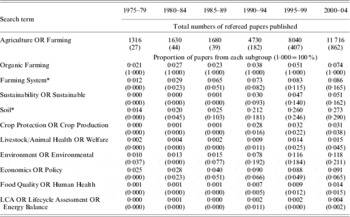
An assessment, using Web of Science, of the number of ‘organic farming’ refereed papers as a proportion of the total quantity of refereed papers published investigating farming or agricultural research for a range of key topics was made for 5-year periods between 1975 and 2004 (Table 1). This analysis showed that the proportion of papers investigating organic farming has increased significantly over this 30-year period, with only 0·021 of the total number of papers being conducted on organic farming between 1975 and 1979, whereas by the period between 2000 and 2004, this figure had risen to 0·074. When the sub-categories are considered, systems research is much higher up the agenda of organic agriculture (two-fold) than agriculture as a whole in terms of the proportion of published papers from this agricultural sub-discipline, particularly since 1990. Likewise, research on sustainability issues and the environment has been dominated by organic research in terms of the proportion of published papers from within this sub-discipline compared with agricultural research as a whole. The proportion of research from these two sources on environmental topics has only started to converge significantly over the last 10 years. The proportion of papers devoted to livestock/animal health and welfare issues have increased marginally from 0·002 to 0·015 for agricultural research as a whole between 1975 and 2004. The proportion of organic papers (0·045) on this subject appearing in peer-reviewed journals has increased dramatically in this latter period from a baseline of zero in the 1970s. In terms of academic output, economics and policy have been strong drivers for research on agriculture as a whole, particularly over the last 15 years in comparison with the sub-division of organics. This is interesting as there are a number of active organic research groups working in this area, but the majority of their work tends to be published in government reports and conference proceedings rather than in peer-reviewed journals used as a measure of research output here. Perhaps also surprisingly, the number of refereed papers on food quality and human health issues were similar for both conventional and organic research. However, proportionally there has been up to six times more ‘grey’ literature (based on CAB Abstract searches, which include conference proceedings and some other reports) produced on this topic derived from organic research than from conventional sources (data not shown). A similar story unfolds when comparing lifecycle assessment (LCA) and energy balance type studies.
Proportion of papers from the Total Number of ‘hits’ for Web of Science Abstract searches using ‘agriculture OR farming’ AND the subgroup search terms defined in the text for each 5-year period. The figures in parentheses are for the equivalent categories for ‘organic farming’ or its derivatives [*=wildcard]

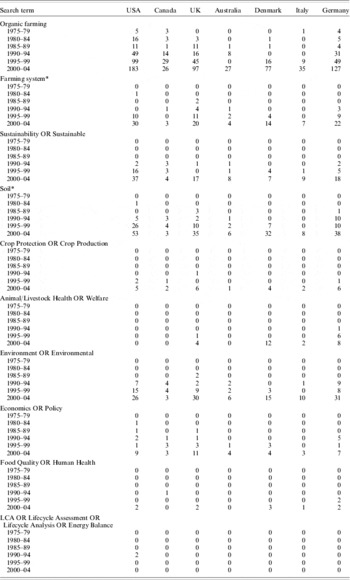
An analysis of organic farming scientific research outputs, using Web of Science, between seven countries (USA, Canada, UK, Australia, Denmark, Italy and Germany) with well established organic agriculture research groups was undertaken (Table 2). Researchers in the USA, Germany and the UK have been major contributors to the outputs from organic farming research from the 1970s to the present day. In the last 10 years, there has been a considerable increase in the outputs from Demark and Italy, from a relatively slow start 30 years ago. The output from Canada and Australia has shown a slow but steady increase in organic farming orientated research papers over the same period of time. The USA, Germany and the UK have taken the lead on research on systems, soils, the environment and economics/policy issues. The USA has tended to lead the publication of research into sustainability, with the UK, Germany and other countries only making an increased contribution in this area in the last 10 years. Surprisingly few peer-reviewed papers have been published on crop protection issues in organic farming, however when the ‘grey’ literature is also considered (based on CAB Abstracts searches not shown here), the largest number of papers originated from the USA, although more papers have come from Germany, the UK and Denmark over the last 10–15 years. Germany, the UK and Denmark also have the strongest research publication output for livestock/animal health and welfare issues. Contrastingly there is very little research published on organic livestock from the USA, Canada or Australia.
Number of papers with ‘organic farming’ (or its derivatives) in the search term AND the subgroup terms defined in the text for each 5-year period for seven different countries [*=wildcard]

In addition to the peer-reviewed science and ‘grey’ literature from conference proceedings, etc. as outlined above, there is also a wealth of other ‘grey’ literature available; an internet search for ‘organic farming’ using Google, the internet search engine, yielded over 1·3 million hits (30 November 2006). There are likely to be many other sources of ‘grey’ literature, e.g. advisory reports and leaflets, which are not accounted for in the information searches described, but the information within these is often of great practical relevance to farmers and growers. Although the internet is a very powerful method of making information available to the world, there is a need to scrutinize the information objectively as there is no quality assurance for this source of information. This relates to the dissemination of information from pressure groups that are either aiming to increase organic production, or attempting to undermine some of the organic movement's claims. The increased acceptance of research investigating all aspects of organic farming into peer-reviewed journals, as outlined by the increasing volume of papers accepted by such publications, can only benefit this situation.
HOW HAS RESEARCH ON ORGANIC FARMING BEEN CARRIED OUT AND IS IT REALLY DIFFERENT FROM RESEARCH ON NON-ORGANIC FARMING?
Holistic approaches based on the idea that the whole is greater than the sum of its parts have, since the early days of organic research, been seen by many to be more appropriate than reductionist approaches to the same problems. Those who champion the holistic approach to organic research look to the whole philosophy of organic farming and the belief that the ‘health of soil, plant, animal and man is one and indivisible’ (Balfour Reference Balfour1943), as making this approach infinitely justifiable and appropriate. However, not all sides agree that this is the best or only way forward. Based on an analysis of the research of the two contrasting systems published by the American Journal of Alternative Agriculture over a period of 10 years and a number of conference proceedings, Lockeretz (Reference Lockeretz, Alföldi, Lockeretz and Niggli2000) concluded that there was virtually no distinction between conventional and organic research. He suggested that generally the difference between the two was in what was being studied rather than the way in which it was being studied. He notes individual exceptions to this such as the holistic methods of measuring food quality being developed in organic research that are discussed elsewhere in this paper. However, despite this, Lockeretz (Reference Lockeretz, Alföldi, Lockeretz and Niggli2000) admits there is still merit in using holistic research methods under certain circumstances, and as such, an analysis of this approach is worth considering in a little more detail.
The complexity of all farming systems means that it is not easy to study them as a whole. One of the key difficulties of systems studies is that in studying the whole system results represent the net effect of management practices on a system rather than the impact of changes in individual management practices. Lockeretz & Boehncke (Reference Lockeretz and Boehncke2000) argue however that a systems approach is particularly suited to organic farming because organic farming is based on systems that work as closely as possible with natural processes rather than using production systems based on artificial environments. Furthermore, aspects of organic regulations such as the requirement for organically produced livestock to be fed completely organic diets means that livestock and crop aspects of production systems are often more closely integrated than crop and livestock production in conventional systems.
In order to get results of publishable precision, research has tended to move away from the scale and complexity of problems at the farm scale and take a reductionist approach (Squire & Gibson Reference Squire, Gibson, van Gardingen, Food and Curran1997). Analytical, reductive methods do not attempt to portray the complex reality of the system. However, they seek to maintain objectivity to the science, and hence other broader-based methods are viewed as being un-scientific. A focus on reductionist approaches has sometimes created a mismatch between the knowledge that farmers and policy makers need and the knowledge gained from research (Squire & Gibson Reference Squire, Gibson, van Gardingen, Food and Curran1997). There is however an increasingly accepted view that mechanistic, reductionist science cannot provide the complete information necessary to solve the complex issues associated with ecosystem functioning (see for example, Huesemann Reference Huesemann2001). The use of a more systemic orientated approach does not imply that traditional disciplinary science should be dismissed; however, it does imply that the answers that the science provides must take into account the consequences of reduction. Good science will highlight a range of contexts to the research, including societal, the intentional and the observational aspects, all of which, ideally, should be used to communicate and critique the results, and act as a lever in improving co-operation between different branches of science (Alrøe & Kristensen Reference Alrøe and Kristensen2002). The use of a hierarchical systems approach can be thought of as a means of integrating reductionist studies within a broader frame and should allow knowledge to be integrated from a range of scales to describe processes operating at the scale and degree of complexity required (Squire & Gibson Reference Squire, Gibson, van Gardingen, Food and Curran1997). This should provide a more holistic approach to farm management.
Over the years, there has tended to be a polarized view of ‘reductionist’ and ‘holistic’ science in relation to agricultural and ecological research (Lockeretz & Anderson Reference Lockeretz and Anderson1993; Thompson Reference Thompson1995; Rowe Reference Rowe1997), which has raised barriers to a cross-discipline approach. There are many definitions of ‘interdisciplinary research’, organic farming could benefit from what Rosenfeld (Reference Rosenfeld1992) defines as ‘trans-disciplinary’ research which uses a shared conceptual framework drawing together disciplinary specific theories, concepts and approaches as well as ‘interdisciplinary’ research referring to joint work from a disciplinary standpoint. An interesting example of a trans-disciplinary approach in organic research is from Martini et al. (Reference Martini, Buyer, Bryant, Hartz and Denison2004) who questioned the conclusions of single discipline research that yield changes following conversion to organic farming related to soil health and suggested instead that they resulted from improved skill on the part of the farmer. Trans-disciplinary research approaches must develop an understanding of the different methods available and how these relate to their research situation (Watson et al. Reference Watson, Kristensen, Alroe, Kristiansen, Taji and Reganold2006). In laboratory research, field trials, crop rotation experiments and on-farm research, for instance, there is a difference between their complexity and also in the conditions available for the control of experimentation, and therefore for reproduction of the measurements and events that have taken place. Ethical issues are also different in these situations.
Comparisons of organic and non-organic farming systems (including both low input and conventional approaches) are a major feature of the published research on organic farming. At the whole systems level both economic and environmental studies which compare organic and non-organic farming can be justified for a variety of reasons (Lampkin Reference Lampkin, Lampkin and Padel1994). This type of comparative information is useful for both informing future policy development and for looking at policy impacts. It can also help individual farmers to make decisions about converting to organic production, although as Lampkin (Reference Lampkin, Lampkin and Padel1994) points out farmers really need information relating to their own farms rather than generalities. There is a clear demarcation amongst the approaches used to compare organic and non-organic farming. Some studies undertake a direct comparison of organic and conventional systems, whilst others compare different management approaches within the organic system in order to try and improve it. Comparison of organic with conventional systems is complex and difficult, as there are often no clear definitions of the systems described, and the boundaries are somewhat blurred. In addition, there can be quite wide variation between farming systems over a relatively narrow geographical area, making interpretation of results even more difficult (Trewavas Reference Trewavas2004). However, if the actual practices used on the organic farms are known, and the purpose of the study is defined explicitly, then useful comparisons can be made (Spedding Reference Spedding1975), as the basis of the comparison is open and fair. In particular, the definition of starting points, boundaries and timescale are important in this context.
A controversial issue in the comparison of organic and conventional farming systems relates to the basis of that comparison. Studies can be interpreted quite differently when comparisons are made of, for example, energy used per kilo of product compared with per unit of land area. This leads into debate on resource use in different systems and land areas required for organic production. Different interpretations can also be made depending on the timescale of the study. For example, nitrogen leaching from organic farms is known to be high following incorporation of grass leys (Watson et al. Reference Watson, Fowler and Wilman1993; Stopes et al. Reference Stopes, Lord, Philipps and Woodward2002), however, in the context of a whole farm system this large loss may occur only once in 6 or 7 years and not in every year. Wildhagen & Brandt (Reference Wildhagen and Brandt2003) recommend that the minimum time required to recognize trends in soil properties and thus changes in soil fertility is one complete rotation. Researchers concerned with only one season's cropping, need to be aware of such issues when drawing any conclusions from their results. Although much useful information can be gleaned from such studies, the conclusions need to be interpreted within a systems context before valid arguments for or against a particular system can be made.
The published literature on organic farming uses a number of methodological approaches, these include (a) holistic research methods, (b) farm system experiments and long term crop trials, (c) stakeholder involvement in a participatory approach, utilizing on-farm and action research, (d) case studies, (e) surveys and (f) reductionist and disciplinary approaches. Here, we review these approaches with a view to their ability to describe and evaluate organic farming from a holistic perspective.
‘HOLISTIC METHODS’
There is an important distinction between researching aspects of the system that are to be investigated on a whole system level, rather than those which can be compared on a small scale, e.g. plot trials (Atkinson & Watson Reference Atkinson and Watson2000). Resource use is a topic which lends itself to analysis at the systems scale in most types of farming system. These include nutrient budgeting (e.g. Watson et al. Reference Watson, Bengtsson, Ebbesvik, Løes, Myrbeck, Salomon, Schroder and Stockdale2002) aimed at quantifying the nutrient inputs and outputs to the system at various scales. Energy balance models (Fredriksson et al. Reference Fredriksson, Baky, Bernesson, Nordberg, Noren and Hansson2006) attempt to quantify the energy use efficiency of the system under test and may be a stand alone model, or a component of a LCA type approach. LCAs may attempt to include environmental and economic quantification of the system under investigation (Nemecek & Erzinger Reference Nemecek and Erzinger2005; Williams et al. Reference Williams, Audsley and Sandars2006). On a broader scale, whole farm system models may include some or all of these approaches in an integrated package, with some models being developed to undertake a similar analysis on a landscape or even a regional scale. The University of Hertfordshire EMA programme is a good example of an environmental auditing tool with a linked product, OrgPlan, aimed at aiding decision-making for farmers converting to organic production (Padel et al. Reference Padel, Tziliviakis, Measures, Stockdale, Watson and Powell2002). The use of models to evaluate economic, environmental and technical aspects of the conversion to organic farming has recently been reviewed by Acs et al. (Reference Acs, Berentsen and Huirne2005).
Other examples of holistic approaches in organic research arguably include plant breeding for organic systems which has focused on the whole plant in relation to its local environment and using techniques such as composite cross populations to exploit this (see van Bueren et al. Reference Van Bueren, Struik and Jacobsen2003; Phillips & Wolfe Reference Phillips and Wolfe2005). The controversial area of food quality in relation to organic production systems is one exception to Lockeretz's (Reference Lockeretz, Alföldi, Lockeretz and Niggli2000) conclusions that there are no differences between organic and conventional research. Woodward (Reference Woodward2002) argues that although new methodologies are being introduced to investigate this phenomenon, the holistic approach to scientific investigations in agriculture, although valid, are at present more of an aspiration than a reality. The key point here is whether or not there are food qualities that are important to health and well-being, which are not understood well enough for relevant measurements to be made (Atkinson et al. Reference Atkinson, Watson, Pearce, Woodward, Wolfe, Welsh and Nowack2002). Recent discoveries such as the ability of anti-oxidants to remove or protect against the impact of free radicals (Ramirez-Tortosa et al. Reference Ramirez-Tortosa, Anderson, Gardner, Morrice, Wood, Duthie, Collins and Duthie2001) suggest that there is still much to learn about the links between food and health. Holistic organic research methods have concentrated on identifying links between food quality and the production methods used, for example the use of crystallization methods developed by Pfeiffer (Reference Pfeiffer1975) and others. The conventional scientific communities often still regard such concepts with contempt or baffled indifference (e.g. Williams Reference Williams2002). These methods, however, are only holistic to a certain degree, concentrating on how food quality is measured in a laboratory, and samples may come from organic and conventional production systems or trials anyway. Lauridsen et al. (Reference Lauridsen, Jørgensen, Halekoh, Christensen and Brandt2005) investigating the influence of organic diets on rat health, therefore combining both holistic and rigorous contemporary scientific methods of research is another example. The perception of many consumers of organic food is that it is healthier than conventional food, but it is extremely difficult to test this hypothesis in a robust, scientific manner. For example, any effects of the organic diet on health may be masked by a number of other factors, which either cannot or are not measured during the research. Generalizations linking the holistic state of health to measurements of single components of organic diets are also very challenging. The rat study undertaken by Lauridsen et al. (Reference Lauridsen, Jørgensen, Halekoh, Christensen and Brandt2005) proved that comprehensive measures of the effects organic diets have on health under standardized experimental conditions could be obtained, as in some respects the rats' health improved when fed an organic diet. A similar result was obtained by Finamore et al. (Reference Finamore, Britti, Roselli, Bellovino, Gaetani and Mengheri2004), with conventional wheat providing a greater risk to rat lymphocyte function than organic wheat, even though the organic wheat had a greater concentration of mycotoxins. They suggested this difference was probably due to other contaminants in the conventionally produced wheat over-riding any advantage of having reduced levels of mycotoxins.
FARM SYSTEM EXPERIMENTS AND LONG-TERM CROP TRIALS
In relation to crops, most of the systems studied address rotational aspects of organic agricultural and horticultural production, with the exception of the Washington State apple production systems trial (Reganold et al. Reference Reganold, Glover, Andrews and Hinman2001), which is investigating a perennial cropping system. These systems often have an animal component in the form of ley or forage/fodder production within the rotation, but few actually include livestock grazing as part of the experimental protocols, this being simulated by cutting and manuring regimes. Some of the studies have no livestock component at all and are entirely stockless arable or horticultural systems, or a combination of the two. There have been reports of system experiments on a range of scales from relatively small plot type trials, e.g. the DOC Trial (Mäder et al. Reference Mäder, Fliessbach, Dubois, Gunst, Fried and Niggli2002c; comparing Dynamic, Organic and Conventional systems) up to field/farm scale with plots of several hectares, e.g. Leake (Reference Leake1996). There are some concerns, however, as to whether these trials are truly comparing the farming system, or just the rotations within them. Experiments that involve factorial crop rotations (e.g. Watson et al. Reference Watson, Younie, Armstrong, Olesen, Eltun, Gooding, Jensen and Köpke1999; Mäder et al. Reference Mäder, Fliessbach, Dubois, Gunst, Fried and Niggli2002a), or field scale testing of rotations that have factorial experiments incorporated within them, e.g. Cormack (Reference Cormack, Olesen, Eltun, Gooding, Jensen and Köpke1999), can all help researchers to understand the functioning of different crop rotations. Irrespective of the production system, as soon as a crop or variety within the rotation is changed, there will be an impact not only on yield and productivity, but also on soil structure and other environmental parameters. It is known that the most productive choice of crops and varieties in a rotation will differ depending on whether the system being used is conventional or organic, and that this is strongly linked to soil and climatic conditions. This often highlights questions as to whether differences in biophysical aspects of the rotation are due to the rotation itself, or the management system being used (e.g. conventional or organic). A wealth of useful information on soil properties, crop protection and production has resulted from the DOC Trial at FiBL which has compared the same crop rotation under different manuring and pest management regimes since 1978 (Mäder et al. Reference Mäder, Fliessbach, Dubois, Gunst, Fried and Niggli2002c). There are, however, questions relating to how relevant this information is in terms or real world situations on practical, working farms. Although forage legumes are relied upon for their fertility building properties in many organic systems, very few trials actually use grazing stock as part of their protocols, tending to rely on manures to mimic whole systems. The SAC crop rotations trial (Taylor et al. Reference Taylor, Younie, Matheson, Coutts, Mayer, Watson and Walker2006) is the only long-term replicated plot trial known to the authors that includes grazing livestock rather than simulated grazing. Applying manure as a surrogate for grazing animals can never accurately represent the real situation of livestock grazing in the fields or plots.
There are a number of reports reflecting the difficulties associated with running rotation trials, e.g. Taylor et al. (Reference Taylor, Younie, Coutts, Matheson and Mayer2002). Olesen (Reference Olesen, Olesen, Eltun, Gooding, Jensen and Köpke1999) suggests involving external experts in order to improve the rigour of experimental design for these long-term trials, for example making sure that plot sizes are appropriate for the types of measurements being undertaken. Availability of research funding, together with the need for long-term funding commitments, has undoubtedly affected the design of rotational trials. For example, in the SAC crop rotations trial (Taylor et al. Reference Taylor, Younie, Matheson, Coutts, Mayer, Watson and Walker2006) it is evident that replication has been limited to allow large plot size and thus the inclusion of grazing livestock. In that case, however, the power of the design is strengthened by the fact that all courses of the rotation are present in every year giving significant value in testing effects, over time since conversion, on various parameters. This is particularly so as the greatest source of variation is invariably due to seasonal differences, rather than due to the treatments imposed. Having completed two full six course cycles of the rotations, initiated in 1991, the longer the trial remains in operation, the greater the statistical power will be from which to derive conclusions about, for example, yield stability and quality, or soil parameters against climatic variability (both short- and long-term).
A number of long-term cropping trials have been established in order to compare organic and non-organic farming, with a broad spectrum of systems and environments currently being investigated. A number of these are summarized in Raupp et al. (Reference Raupp, Pekrun, Oltmanns and Köpke2006) and Watson et al. (Reference Watson, Kristensen, Alroe, Kristiansen, Taji and Reganold2006). These experiments have, in virtually all cases, been designed to establish the long-term feasibility of converting from conventional to organic farming, for example, in terms of yield stability, economic feasibility, soil nutrient and structural sustainability, as well as other environmental criteria, e.g. impacts on biodiversity, greenhouse gas emissions and energy use.
In parallel to the above trials, a number of long-term systems experiments have been established that compare different organic systems (e.g. Haggar & Padel Reference Haggar and Padel1996; Olesen et al. Reference Olesen, Rasmussen, Askegaard, Kristensen, Olesen, Eltun, Gooding, Jensen and Köpke1999; Philipps et al. Reference Philipps, Welsh, Wolfe, Olesen, Eltun, Gooding, Jensen and Köpke1999; Watson et al. Reference Watson, Younie, Armstrong, Olesen, Eltun, Gooding, Jensen and Köpke1999). The aim with these experiments is invariably to provide information that allows organic farmers to optimize their systems for the range of parameters previously described for the organic and conventional system comparisons. In all cases, these long-term experiments, whether comparing organic to conventional systems, or comparing more than one organic system, are particularly useful demonstration tools. When used effectively, they can inform end-users of both the potential benefits and pitfalls of conversion, as well as striving to develop effective and environmentally benign practices which may be employed on commercial organic farms. These long-term trials also have a role to play in informing policy makers of the strengths and weaknesses, at a range of levels, of the different systems being developed and tested. The principles laid down by IFOAM (2005) specify that organic farms must avoid agricultural pollution and maintain genetic diversity of the system and its surroundings, including habitat protection. Under these principles, production and economic viability share equal weight with environmental protection as a primary outcome of good organic farming practice.
PARTICIPATORY RESEARCH
Participatory research has been widely used in developing countries for many years (e.g. Bellon Reference Bellon2001), but now industrialized countries are utilizing this approach on a much greater scale than before for both organic (e.g. Krell & Zanoli Reference Krell and Zanoli2000; Andrews et al. Reference Andrews, Mitchell, Mancinelli, Karlen, Hartz, Horwath, Pettygrove, Scow and Munk2002) and conventional farming (e.g. Cerf et al. Reference Cerf, Gibbon, Hubert, Ison, Jiggins, Paine, Proost and Röling2000). Participatory research can be split into different categories, from action research to various forms of on-farm research. Action research has goals that are determined by the actors in the system under investigation. On-farm research is more fluid, with the ‘participatory’ element being dependent on the level of involvement of the farmer, farm workers, advisors, etc in the research process. One of the values of this type of research is that it often has benefits beyond the life of the project, particularly in empowering farmers to try out their own ideas (Johnson et al. Reference Johnson, Lilja and Ashby2003). An example of this is the work co-ordinated by the Henry Doubleday Research Association (HDRA) in the UK, in bringing together the experiences of a wide range of organic farmers and advisors and their collective experiences of weed problems including their efforts, either successful or not, to control these. The crossover of information between researchers, advisors and farmers and vice versa has enabled the participants to improve the focus of their weed management strategies based on the group experiences, especially where similar problems to their own have been encountered (Davies et al. Reference Davies, Turner, Bond and Gibbon2006).
CASE STUDIES
Case studies provide an opportunity to observe real systems and begin to ask appropriate systems level questions about how farming systems really function. They can be very valuable in helping to frame research questions but are not a substitute for other forms of scientific experimentation (US National Research Council 1989). This is a useful way of exploring the complex interactions between divergent aspects of farming systems and linking the socio-economic and biophysical aspects of organic farming. Working in an interdisciplinary team, Cobb et al. (Reference Cobb, Feber, Hopkins, Stockdale, O'Riordan, Clements, Firbank, Goulding, Jarvis and MacDonald1999) addressed nutrient cycling, vegetation change, faunal diversity as well as carrying out a socio-economic audit on a farm in Gloucestershire, UK. Other case studies compare different approaches to farming organically, e.g. Weller & Jackson (Reference Weller and Jackson2006), and organic and conventional systems (Bengtsson et al. Reference Bengtsson, Oborn, Jonsson, Nilsson and Andersson2003). One of the advantages of case studies is their ability to monitor change over time in a way that is difficult to achieve in other experimental approaches because of resource limitation. Kaffka & Koepf (Reference Kaffka and Koepf1989), for example, present data on long-term sustainability for a biodynamic farm using farm records over a 20-year period. For this particular farm, energy use over a 30-year period has also been published (Kaffka Reference Kaffka, Edens, Fridgen and Butterfield1985). The information collated as part of these case studies provides useful messages for both researchers and advisors and in practical terms, the organic farmers themselves.
SURVEYS
There are many published studies of both farms and product quality in organic farming, which contain both quantitative and qualitative information and often focus on comparisons between organic and conventional agriculture. Numbers of representative organic farms within an accessible geographic area, and willingness of farmers to participate, has often limited the information available (see for example, Shearer et al. Reference Shearer, Kohl, Wanner, Kuepper, Sweeney and Lockeretz1981). Validity of comparisons is once again an issue in this type of study. Entz et al. (Reference Entz, Guilford and Gulden2001) surveyed crop yield and nutrient status on 14 organic farms in the northern Great Plains. The study provides a description of rotations on the farms. It then compares yield with information on non-organic crops from the Manitoba Crop Insurance Corporation. Despite this limitation, this type of local information is extremely useful for advisors and for farmers considering conversion to organic production. However, when comparison studies such as these are made, it is important to acknowledge that any differences observed may in fact be due to factors associated with variety or breed, soil type, climatic or other biotic/abiotic variables not accounted for in the methodology. Similar issues are sometimes overlooked in product comparisons when the use of samples from different, varieties or breeds can lead to invalid results. Ideally the products being tested should also be the same age and have undergone exactly the same post harvest/post slaughter procedures. The same arguments are also relevant to research investigating, for example, pesticide residues or other chemically derived indicators of food quality between production systems.
Some of these issues are also reflected in the existence of unbalanced studies, e.g. Ogini et al. (Reference Ogini, Stonehouse and Clark1999) who compared 8 organic and 120 conventional farms. This raises questions about how representative of farm system types the samples are and whether an individual farm within the smaller group can bias results. Edaphic, climatic, topographical and historical factors may also affect results more strongly than farm type in some circumstances (see for example, Bender Reference Bender2001). Other examples of very unbalanced sample numbers include Baker et al. (Reference Baker, Benbrook, Groth and Benbrook2002) who quotes USDA's Pesticide Data Program looking at pesticide residues in food where >0·80 of the samples are from retail outlets (127 organic, 195 Integrated Pest Management, 26 571 conventional samples). In the right context, however, paired farm approaches can help with the problem of background factors. Clustered groups of farms are also useful in preventing individual farms from biasing results, e.g. Haggar & Padel (Reference Haggar and Padel1996) and Fowler et al. (Reference Fowler, Lampkin and Midmore2000). However, even with a good statistical sample to work with, variation of the data can still be a problem due to such factors as the technical management skills of the individual farmer (Martini et al. Reference Martini, Buyer, Bryant, Hartz and Denison2004). This is illustrated to some extent by the British Trust for Ornithology (BTO) study (Fuller et al. Reference Fuller, Norton, Feber, Johnson, Chamberlain, Joys, Mathews, Stuart, Townsend, Manley, Wolfe, MacDonald and Firbank2005) which used almost all the available organic farms in England and Wales that fitted the selection criteria required for their study. This consequently made comparison with the conventional farms difficult as there was a much greater pool of conventional farms which matched the selection criteria to use in the comparison, and hence potential bias associated with technical skill may have inadvertently been introduced (R. Fuller, personal communication).
REDUCTIONIST AND DISCIPLINARY APPROACHES
Analytical, reductive methods are inherently reductionist, and consequently are frequently viewed as poor science from a holistic perspective because they do not effectively portray the complex reality of the system. However, from a reductionist stance, analytical and reductive methods at least maintain some objectivity to the science, and hence other (more holistic) methods are often perceived as being un-scientific. There is, however, an increasingly accepted view that mechanistic, reductionist science cannot provide the complete information necessary to solve the complex issues associated with ecosystem functioning (see for example, Huesemann Reference Huesemann2001). There are clear examples of where reductionist and disciplinary approaches are important for the development of organic agriculture. For example, understanding the biology of organisms such as arbuscular mycorrhizal fungi or rhizobium is fundamental for the management of these organisms in organic systems.
As with the difficulty of comparing defined organic farming systems with other types of system as described above, a major difficulty in interpreting product quality studies, particularly in the older literature, has been failure to use accredited schemes to categorically define food produced in specific systems. For example, in the case of contamination of apple juice with Escherichia coli 0157, Avery (Reference Avery1998) confuses ‘natural’ apple juice with organic apple juice. Similarly, Ahrenhöfer (Reference Ahrenhöfer, Vogtmann, Boehncke and Fricke1986) reports on a major German study (Verband Deutscher Landwirtschaftlicher Untersuchungs- und Forschungsanstalten (The German Association of Agriculture Testing and Experiment Stations) VDLUFA) which compared pesticide residues in 360 conventionally grown foods with residues in 360 foods from ‘alternative and modern offer’. This latter term included food that was not known to be registered with an organic certification organization.
TRANSFERRING ORGANIC RESEARCH INTO PRACTICE?
Ramsden (Reference Ramsden2003) emphasizes that there is a clear distinction between the transfer of information (knowledge) to the recipient and the ability for them to utilize it effectively (learning). Knowledge transfer providers attempt to achieve both of these aims, although not always as successfully as they might have hoped. For example, the UK organic research priorities setting exercise in 2005 highlighted an ineffective knowledge transfer chain in the UK as many producers were unaware of significant amounts of information available from government funded research (Advisory Committee on Organic Standards (ACOS) 2006) This situation is not solely limited to the organic sector. In all cases, Garforth et al. (Reference Garforth, Angell, Archer and Green2003) indicates that the appropriate form of knowledge transfer will vary depending on the situation; and except where the main task is to solely make information available, facilitation to provide assistance or support in utilizing the information is important.
The knowledge needs of organic farmers have been characterized by Morgan & Murdoch (Reference Morgan and Murdoch2000) as very specific because of the need not only to understand specialized aspects of organic farming but also how to apply this to the local conditions on their own farm. Although difficult to quantify, there may be subtle differences between organic and conventional farmers in relation to uptake of information. Organic farmers, on the whole, appear to be slightly more pro-active and open to change on the basis of advice from researchers and advisors, as well as by conducting small experiments themselves to help them develop their own system. In addition to this, because the organic community (researchers, advisors and farmers) is relatively small compared with the conventional farming community (even at a global level), knowledge transfer is probably slightly more rapid in the former (D. Younie, personal communication). To illustrate this, between April 1998 and March 2006, SAC received 10 250 enquiries about organic farming and delivered around 250 presentations to 8100 attendees throughout Scotland. Much of the information delivered to end-users by SAC was derived from a range of organic research activities from the UK and around the world. Much of this advice is being acted on by the farmers, with a similar situation evident from the organic networks existing elsewhere in the world (D. Younie, personal communication).
Palmer et al. (Reference Palmer, Stockdale, Shiel and Gowing2006) describe four main ways in which knowledge transfer is communicated to farmers: (a) publication of information (e.g. booklets, leaflets and videos), (b) workshops and advisory activities (including farm walks, open days and one-to-one advice), (c) courses and (d) web resources (both interactive and non-interactive). A fifth element that could be considered here is described by Garforth et al. (Reference Garforth, Angell, Archer and Green2003) in that ‘an almost universal finding from studies of farmers’ sources of information and influence is that other farmers are their most frequently reported source'. This has been shown to be an important route for transfer of information between organic farmers in specific geographic areas (e.g. Oldrup & Just Reference Oldrup, Just, David, Bernard and Just2000). Padel (Reference Padel2001) also suggests that organic farmers actively seek information from other farmers. She also highlights the importance of knowledge networks in organic farming which link producers, advisors and researchers. A series of organizations and networks exist in different countries which aim to link researchers and advisors/producers, facilitating not only knowledge transfer but engagement of practitioners in research priority setting. These include the Organic Farming Research Foundation (Organic Farming Research Foundation 2006) in the USA and the UK Colloquium of Organic Researchers (Colloquium of Organic Researchers 2002).
As long ago as 1943, Sir Albert Howard commented on the absence of real linkages between science and practice in agriculture (Howard Reference Howard1943). The UK experience in 2005 highlighted by the ACOS report, described above, provides evidence that although information may be readily available to farmers, unless the farmers are made aware of the information's existence, they will not be able to put it into practice, with or without expert advice.
RESEARCH ON ORGANIC FARMING – WHERE NEXT?
A number of authors have reflected on past difficulties faced by scientists working on organic farming and the acceptance of both the research and the scientists themselves in the wider research community (e.g. Wynen Reference Wynen and Krell1997; Lund & Algers Reference Lund and Algers2003; Watson et al. Reference Watson, Kristensen, Alroe, Kristiansen, Taji and Reganold2006). These include reports of difficulties with publications and career development, as well as accusations of bias. Research on organic farming has been reported as being biased through the involvement of individual researchers committed to organic ideals (Tinker Reference Tinker2000). Personal, institutional and socio-cultural bias are likely to affect most aspects of agricultural and environmental research (see Huesemann Reference Huesemann2002), and a more relevant, but unanswered question, is perhaps whether any of these types of bias are more extreme in organic farming then in any other area of agricultural research, particularly in emotive areas such as GM crops or animal welfare. The issue of bias also applies to peer-reviewing of grant applications. It has been shown on more than one occasion that this is a particular problem in areas of interdisciplinarity or controversy (e.g. Luukkonen Reference Luukkonen1995). Rasmussen et al. (Reference Rasmussen, Langer and Alroe2006) studied whether prior experience of organic farming research influenced the reviewers' evaluation of research proposals on organic farming. They found that researchers experienced in organic production were in greater agreement with the end-users of the research on project relevance than those not experienced in organic farming. This may have some relevance to the comments of D. Younie (personal communication) in the previous section describing the strong links within the relatively small organic community (researchers, advisors and farmers). In their study, Rasmussen et al. (Reference Rasmussen, Langer and Alroe2006) also found a high correlation between relevance and scientific quality in both groups. This clearly poses questions about the most appropriate mechanisms for peer-reviewing of both grant applications and publications. Difficulties in publishing inter-disciplinary research, particularly at the social and natural science interface are not a phenomenon only of organic research and are often cited by others working in areas such as animal welfare (Lund et al. Reference Lund, Coleman, Gunnarsson, Appleby and Karkinen2006). There is an interesting link between publication in highly respected scientific journals and research approaches. For example, the journals Nature, Science and Proceedings of the National Academy of Science of the United States of America have published a total of eight papers of direct relevance to organic farming since 1970. All these have been concerned with comparisons of organic and conventional farming, mostly within classical experimental designs. The majority have a strongly environmental focus. Of the two articles published in the journal Nature which appear in a search on ‘organic farming or agriculture’, one focuses on a classically designed replicated block orchard experiment (Reganold et al. Reference Reganold, Glover, Andrews and Hinman2001) and the other on soil erosion on one pair of adjacent organic and conventional farms in Washington, USA (Reganold et al. Reference Reganold, Elliott and Unger1998). Additionally there is an article on the Rodale Farming Systems Experiment (Pennsylvania, USA), also a classical design, although the article itself uses the term legume-based cropping systems rather than organic farming (Drinkwater et al. Reference Drinkwater, Wagoner and Sarrantonio1998). It is a similar story in Science with a paper referring to the DOC Trial in Switzerland (Mäder et al. Reference Mäder, Fliessbach, Dubois, Gunst, Fried and Niggli2002c). There is one early exception to reports of classically designed experiments in this journal which is a paper by Lockeretz et al. (Reference Lockeretz, Shearer and Kohl1981) describing a survey of farm practice on organic and conventional farms in the mid-West corn belt. The Proceedings of the National Academy of Science of the United States of America has published one article on organic farming, this reports the same orchard experiment referred to in one of the Nature articles (Kramer et al. Reference Kramer, Reganold, Glover, Bohannan and Mooney2006). Both Science and Nature have also published editorial comments and letters highlighting a range of view points on the environmental impacts of organic farming (e.g. Trewavas Reference Trewavas2001, Mäder et al. Reference Mäder, Fliessbach, Dubois, Gunst, Fried and Niggli2002a, Reference Mäder, Fliessbach, Dubois, Gunst, Fried and Nigglib).
As discussed earlier, Lockeretz (Reference Lockeretz, Alföldi, Lockeretz and Niggli2000) suggested that published research highlights few differences between organic and conventional research methodologies. This begs the question as to whether they should be different in the future. As discussed above, a raft of issues related to institutions and funding mechanisms, not least long-term stability of these, will influence research agendas both in terms of subject and methodology. The need to assess crop and soil management as well the impact of these on livestock health and nutrition systems on the basis of a complete rotation rather than an individual season requires long-term funding commitments, including for example the setting up of long-term soil monitoring as recommended by Quintern et al. (Reference Quintern, Joergenesen and Wildhagen2006). This long-term aspect is also likely to be reflected in the ability of the researchers to publish, as a result of the time-lag between implementation of an experiment and analysable results. Both inter- and trans-disciplinary research approaches clearly have an important part to play in future agricultural research, whether this is primarily aimed at organic or non-organic systems. In many areas of agriculture and environmental science, the value of stakeholder involvement in both the design and the process of the research is being recognized more widely. These issues have important consequences for resource management and training of future researchers and research managers. Without a doubt both holistic and reductionist approaches have an important role to play in future organic farming research.
The value of research conducted in non-organic farming should not be over-looked; much ecological research is of clear value to organic production. There are also places where it may be necessary to use research tools which could not be used within a certified organic system, for example, stable isotopes, but which will allow process based understanding which can be transferred to organic systems. On the other hand, the principles and standards of organic agriculture mean that some areas of conventional research will not be of value for organic production. There are examples from the past where misunderstanding of the organic system has resulted in claims that conventional research is relevant to organic farming but this has not in fact been the case. Watson et al. (Reference Watson, Kristensen, Alroe, Kristiansen, Taji and Reganold2006) cite the example of the inapplicability of zero-N or zero-agrochemical treatments in conventional variety trials. These are not relevant to organic systems as they fail to take into account the nutritional and crop health aspects conferred by organic rotations – the so called ‘memory’ effect (Olesen Reference Olesen, Olesen, Eltun, Gooding, Jensen and Köpke1999). Looking to the future, changes in agricultural and health policies and public expectations of farming, together with the more limited availability of agrochemicals to the conventional sector are likely to result in greater applicability of research in non-organic systems to organic ones and vice versa.
CONCLUSIONS
Research allows new knowledge to be developed, and thus if we are to improve the sustainability of organic agriculture in the long-term, there will continue to be a place for a range of research approaches to be used. The research methods used in organic farming are rarely different from those used in conventional agriculture. However, the combination of interdisciplinary approaches and the need to interpret research within the context of the principles of organic research does in some cases set organic research apart. Increasing recognition of the value of trans-disciplinary approaches by agricultural science researchers, and of the involvement of stakeholders in setting out and conducting research means that research in organic and conventional systems may become more similar in future. The future goal for all agricultural research must surely be ‘fit-for-purpose’ methodology, recognizing that some problems require holistic approaches, but disciplinary science is the best solution for others. Without a doubt organic farming research must continue to have a strong practical context but not at the expense of rigorous science. The literature is dominated by comparisons of organic and conventional agriculture and interpretation of these studies is fraught with difficulty. It is vital that future comparative research is grounded in an improved understanding of the nature of farming systems themselves, allowing more valid comparisons to be made. The publication of research on organic farming in both peer-reviewed and grey literature has increased exponentially over the past 30 years with particularly important contributions from Europe, North America and Australasia. Soils, environment and sustainability issues appear to have been high on the research agenda in all these places. European countries have however made the greatest impact in the livestock area. The economics and social science areas are less well represented than the natural sciences in the peer-reviewed literature. There have, however, been remarkably few publications on product quality or human health issues in organic farming. A major challenge for the future is developing methods which link production systems to product quality and onwards into both livestock and human health and well-being. This has been, and in fact still remains, a basic tenet of organic agriculture that has not yet been fully explored.
Research on organic farming at SAC is sponsored by SEERAD. The authors wish to thank Benjamin Albert for helping to source literature and format the paper.