Teotihuacan, located in the Basin of Mexico, has long been regarded as a city with important craft production sites. At its height, Classic period Teotihuacan (approximately a.d. 300–600) was the most populous city in Mesoamerica. Craftsmen fabricated the comforts of life inside its walls; now archaeologists are plumbing the city's remains for clues about its industries. Archaeologists discovered large surface deposits of obsidian material often associated with large public buildings. These sizable deposits formed the basis of many theories about the economic reach of the city within Mesoamerica (Andrews Reference Andrews1999; Clark Reference Clark and Isaac1986, Reference Clark and Hirth2003a:27–30; Cowgill Reference Cowgill1997; Millon Reference Millon, Bricker and Sabloff1981; Pasztory Reference Pasztory1997; Santley Reference Santley and Hirth1984; Spence Reference Spence1967, Reference Spence1977, Reference Spence1981) and are still being investigated (Carballo Reference Carballo2005). Furthermore, subsequent excavations have demonstrated production of other materials within the city, such as ceramics (Sheehy Reference Sheehy1992), figurines (Sullivan Reference Sullivan2004), and lapidary objects (Widmer Reference Widmer1991). Excavation in the outskirts of the city have also revealed areas of craft production (Cabrera Cortés Reference Cabrera Cortés2004; Turner Reference Turner1987).
This paper will determine the workshop status, output, and organization of a specialized biface workshop from Coyotlatelco phase Teotihuacan, which coincides with the Epiclassic period (roughly a.d. 650–800). Although Teotihuacan's earlier Classic period economic structure has been the focus of multiple projects (Drennan et al. Reference Drennan, Fitzgibbons and Dehn1990; Spence Reference Spence, Tapia and Rattray1987), much less is known about its Epiclassic-period economy or inhabitants (Diehl Reference Diehl, Diehl and Berlo1989; Moragas Segura Reference Moragas Segura2005). Even though the Coyotlatelco phenomenon is interesting in its own right (Solar Valverde Reference Solar Valverde2006), a full discussion of its issues are beyond this paper. Suffice to say that the Coyotlatelco phase at Teotihuacan was a period of comparatively low population and partial abandonment, with unoccupied buildings providing convenient locations for material storage and refuse disposal. Yet, strong continuity in craft production persisted within the city. The Otumba obsidian mines continued to provide raw material for large atlatl darts produced within the Hacienda Metepec barrio (Nelson Reference Nelson2000:42). This reanalysis of the Hacienda Metepec obsidian workshop debitage provides new information on the nature of obsidian production in Epiclassic-period Teotihuacan.
THE HACIENDA METEPEC WORKSHOP EXCAVATION
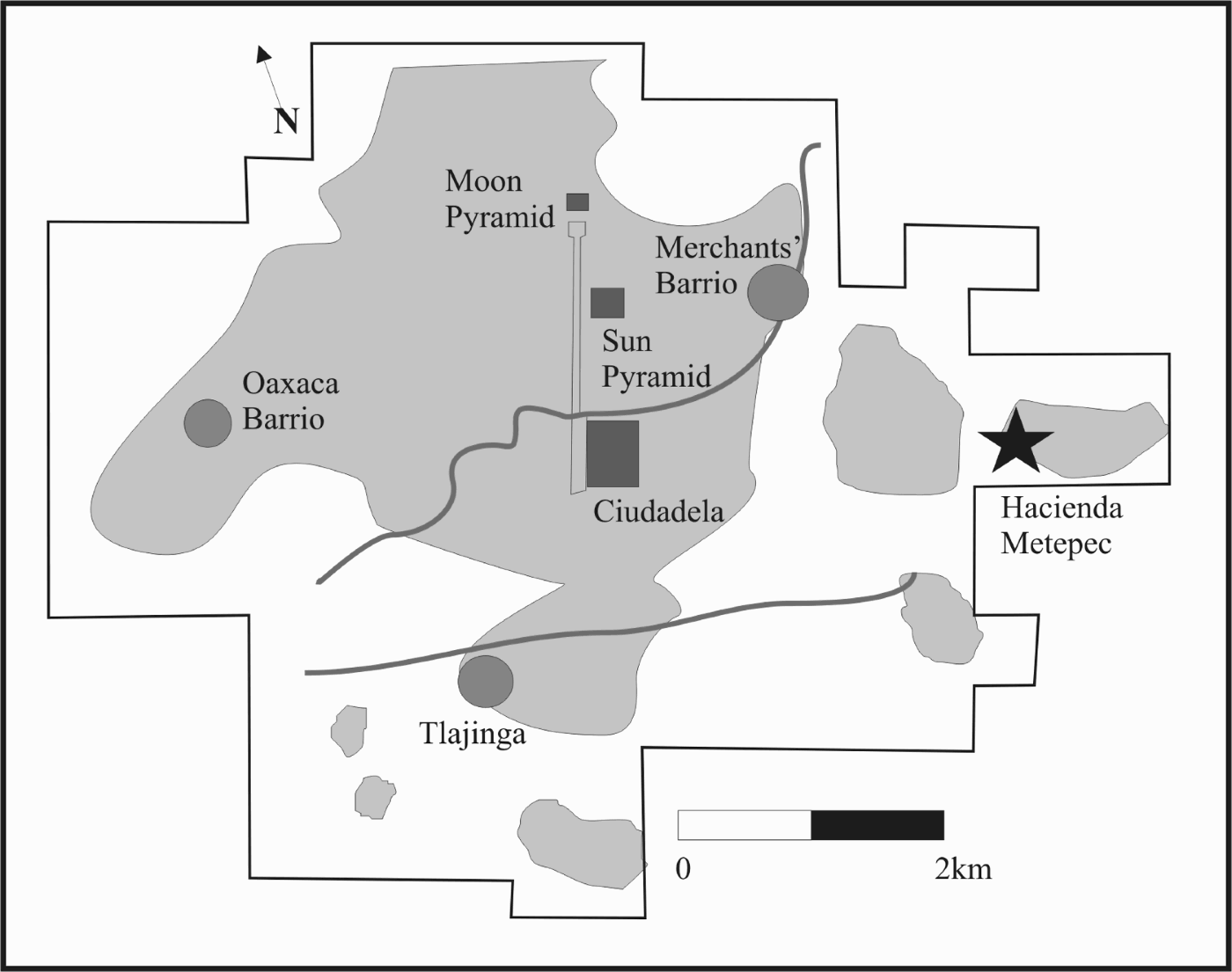
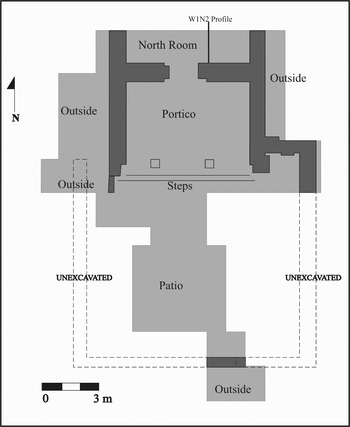
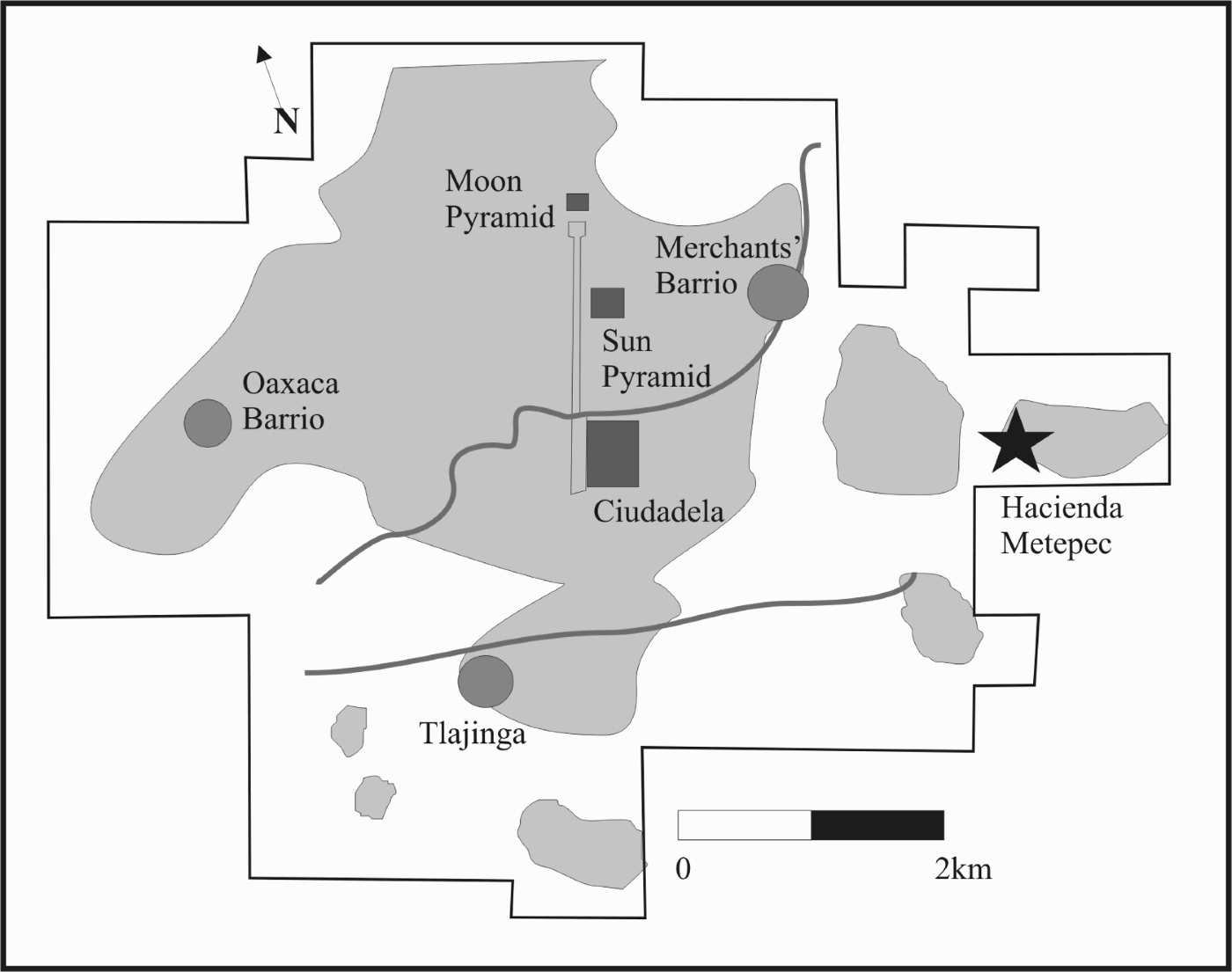
The obsidian workshop at Hacienda Metepec was excavated by Evelyn Rattray in 1979. The Hacienda Metepec barrio is on the far eastern side of Teotihuacan's East Avenue (Figure 1) (see also Millon et al. 1973:Map 82 section 9:N1E7). Excavations realized within this barrio uncovered a large deposit of obsidian debris in a workshop setting (Rattray Reference Rattray1979, Reference Rattray1980, Reference Rattray1981). This location was initially selected for excavation because of the abundance of Coyotlatelco ceramic material on the surface. During the course of excavation, a large subsurface deposit of obsidian debris was recovered within and around the remains of a Metepec-phase apartment compound that was reused as a Coyotlatelco residence with a workshop and associated dump (Rattray Reference Rattray, González and Clark1989:243) (Figure 2).
Schematic plan of Teotihuacan (after Millon et al. Reference Millon, Drewitt, Cowgill and Millon1973; Pasztory Reference Pasztory1997:35) modified to show Coyotlatelco-phase ceramic distribution (after Ian Robertson's figure in Gómez Chávez and Cabrera Castro Reference Gómez Chávez, Castro and Valverde2006:238).
Plan map of Hacienda Metepec excavations.

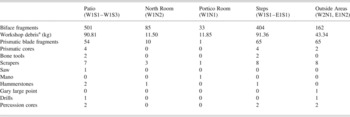
The apartment compound was a standard Teotihuacan residence (Pasztory Reference Pasztory1997:48) in style, consisting of a sunken patio with stairs leading to a columned small room (the portico), then a second larger room (north room) behind the first. It had been abandoned for perhaps 50 years prior to its reuse by Coyotlatelco peoples (Rattray Reference Rattray, González and Clark1989:243). The portico area measures 5.5 m by 7 m (Rattray Reference Rattray1979:5) while the patio measures 10.5 m by 12.5 m (Rattray Reference Rattray, Tapia and Rattray1987:454). The initial excavation centered on the portico area. However, on encountering obsidian deposits mixed with household refuse in clearly secondary context on the steps, the patio area was included in the excavation, yielding large obsidian deposits in situ nearly devoid of other cultural material (Rattray Reference Rattray, González and Clark1989:243). An area of approximately 170 m2 was excavated, and archaeologists recovered 275 kg of obsidian debris, with obsidian flakes 50 cm deep in places. For ease of discussion, the excavation is divided into five units based upon architecture and obsidian concentrations: north room, portico, steps, patio, and outside areas (Table 1).
Artifacts found in direct association with workshop deposit

aIncludes the weight of preforms and flakes.
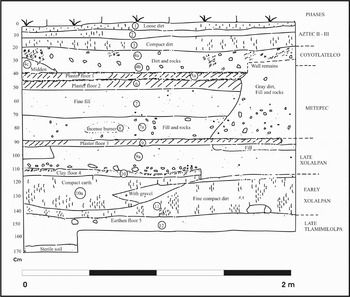
Although this paper focuses on the Coyotlatelco-phase workshop, material corresponding to other ceramic phases was also recovered. The stratigraphy of the excavation consists of Aztec material on the surface (plow zone), followed by Coyotlatelco material lying on top of a possible mud floor. Then there is Metepec material over a plaster floor and continuing down two subsequent floors. Next is late Xolalpan material, then early Xolalpan material, and finally late Tlamimilolpa artifacts above sterile soil (Figure 3) (see Rattray Reference Rattray1980).
Stratigraphy at Hacienda Metepec, W1N2 East profile (after Rattray Reference Rattray1980:Figure 5c).

DATA SET AND PROCEDURES
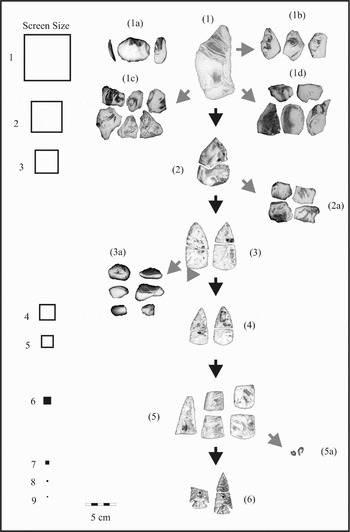
Excavated soil was initially sieved through a 4.76-mm screen in the field and the artifacts were picked out by hand. In addition, Rattray took five to 10 liters of soil samples for microdebitage analysis from selected features (Rattray Reference Rattray, Tapia and Rattray1987). After her analysis (Rattray Reference Rattray1980), the microdebitage and macrodebitage were bagged and packed up. This next section details the procedures followed during this reanalysis, not Rattray's original analysis of the workshop (1980). All of the lithic material recovered from the Hacienda Metepec excavations were examined for this reanalysis. Shelby Saberon was responsible for most of the initial sorting, sieving, and counting operations under the general supervision of John Clark. This work is documented in his 1997 undergraduate honor's thesis. The obsidian artifacts (micro- and macrodebitage) passed through nine nested screens that separated it by size for later analysis (Figure 4) (Saberon Reference Saberon1997). Screens 1–5 (sieve openings of 7.5, 5.0, 3.75, 2.5, and 1.9 cm) trapped the bifaces and large percussion debris, while screens 6 and 7 (sieve openings of 1.25 and 0.63 cm) collected the smaller percussion material and larger pressure flaking debris, and screens 8 and 9 (sieve openings of 0.28 and 0.20 cm) caught mainly pressure flakes and some percussion debitage. The material that passed through the smallest screen was also collected and analyzed (see Saberon Reference Saberon1997 for more details). After the material was screened, the obsidian in each screen was separated according to its visual and technological characteristics (e.g., biface fragment versus flakes) and bagged. Once the biface fragments were removed, the flakes were divided by size and attributes. Complete counts were made for several lots of all the flakes and their technological characteristics.
This complex figure shows the screen sizes compared with artifact size on the right with the production cycle for a Ramec point also on the right. All objects are to the same scale. A blank (1) is reduced via percussion into a percussion biface 1 (2). Flakes removed during this process include bulbar flakes (1a), primary blank flakes (1d), secondary blank flakes (1b), and tertiary blank flakes (1c). A percussion biface 1 is reduced via percussion into percussion biface 2 (3). The debitage includes bifacial thinning flakes (2a). Percussion biface 2 is reduced via percussion into a percussion biface 3 (4) with small percussion flakes (3a) as debitage. Percussion biface 3 is reworked with pressure flaking into a pressure biface (5). Pressure flakes are not pictured. Pressure bifaces are an end product. A pressure biface may be notched into a Ramec point (6). Notching flakes (5a) are then produced.

Next the large debitage (>1.9 cm) was individually weighed, measured, and examined. Biface fragments were classified along a proposed manufacturing sequence. The scars left by knapping errors and the type of break were recorded (e.g., straight or transverse) for each biface fragment. Flakes were also classified by their surface characteristics into categories, such as primary percussion (only one flake scar on ventral surface), secondary (two flakes scars on ventral surface), tertiary (more than two flake scars on ventral surface), and bifacial thinning flakes. Cortex bearing flakes were also tallied. Smaller debitage did not receive a thorough analysis. Most lots were examined for notching flakes, but other flakes were not tallied by type except in a few instances for comparative purposes.
The reconstructed manufacturing sequence for the workshop consists of the following activities (Figure 4) (see Nelson Reference Nelson2000 for a more detailed version). Large obsidian percussion flakes were struck from cores at the Otumba quarry. These flakes (i.e., tool blanks) were brought to Hacienda Metepec, where they were worked into bifaces by percussion. Percussion biface 1s are modified blanks with few percussion scars. Percussion biface 2s are modified percussion biface 1s with rough, unsymmetrical faces. Percussion biface 3s are bifacial knives with even edges and symmetrical faces. The length of a percussion biface 3 biface was generally 1.67 times its width and averages 0.7 cm in thickness. Upon finishing the percussion work, the bifaces were reworked with pressure flaking to smooth out any irregularities (pressure bifaces) and often corner-notched. The resulting corner-notched atlatl dart points ideally measured 4.63 cm by 2.86 cm, and resembled a San Marcos point in the Texas typology, which are nicknamed “Ramec” dart points to distinguish them from the cultural affiliation of San Marcos points (Figure 5) (see Hester Reference Hester1986; Nelson Reference Nelson2000). Ramec is a compound word formed from “RAttray and Hacienda MEtepeC”. Thus, two possible final product types were the focus of this workshop effort, a projectile point preform/bifacial knife (pressure biface) or a Ramec dart point.
Top: Ramec projectile points from Hacienda Metepec. Bottom: Ramec projectile points from nearby areas within Teotihuacan.

Fortunately for archaeologists, this sequence of events did not always result in a finished projectile point. Mistakes occurred, and it is through the knapping errors that the manufacturing process was reconstructed. Unfortunately for the knapper,Footnote 1 he broke 1,241 percussion bifaces and 234 pressure bifaces, allowing his actions to be reconstructed in detail. In addition, flakes were removed at each stage in the manufacturing process. Flakes are debris removed from the bifaces. Their shape and form indicate whether the knapper was using percussion or pressure for their removal. Unlike other kinds of production by-products, such as ceramic wasters, obsidian flakes are both readily identifiable and hard to destroy, thus providing an excellent window into production. Individual flakes can be assigned by size and type to particular stages in the manufacturing process. In particular, notching flakes serve as indicators to the number of finished products as they occur last in the manufacturing process. Thus, special efforts were made to identify and count the notching flakes found in each screen.
WORKSHOP STATUS
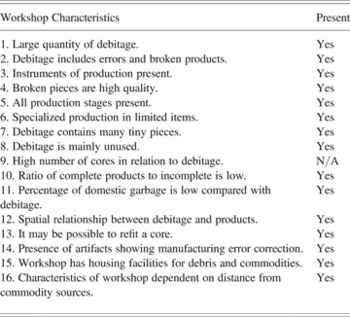
Rattray thought that she found an obsidian workshop, and this section will evaluate whether her deposit represents a workshop (with adjacent dump) or just a workshop dump. The focus of this effort hinges upon the identification of the type of deposit that Rattray excavated, that is, workshops should have different attributes than dumps. Workshops are not refuse deposits (Behm Reference Behm1983; Clark Reference Clark, González and Clark1989, Reference Clark, Yamamoto and Puche1990, Reference Clark, Staski and Sutro1991; Healan Reference Healan1992; Hester and Shafer Reference Hester and Shafer1992; Mallory Reference Mallory1986; Moholy-Nagy Reference Moholy-Nagy1990, Reference Moholy-Nagy1992; Shafer and Hester Reference Shafer and Hester1986). They are “delimitated spaces where workers regularly perform [a] specialized activity or activities, to make products, which are also specialized, destined for sale or exchange. The products produced exceed the workers' own needs” (Clark Reference Clark, González and Clark1989:213; author's translation). Unfortunately, it is far easier to identify the workshop refuse than the workshop itself. John Clark (Reference Clark, González and Clark1989) published a list of attributes for correctly identifying workshops. Table 2 summarizes these attributes and whether they pertain to Hacienda Metepec. Based on these criteria, Hacienda Metepec represents a workshop with an associated dump (Nelson Reference Nelson2000).
Workshop characteristics

Production loci may be determined by microdebitage. Healan (Reference Healan1995) and Moholy-Nagy (Reference Moholy-Nagy1990) have placed particular emphasis on microdebitage (i.e., flakes <2 mm) as indicators of production loci. Their (separate) arguments posit that periodic cleaning of the production area would remove all but the smallest debitage. Even though microdebitage can also be found in dumps, they feel that it has the most potential for identifying places of production. Unfortunately, Hacienda Metepec was excavated in 1979, before this realization occurred. Yet, Rattray's soil samples included microdebitage, and those samples were taken from areas that she thought were important in defining workshop loci. Microdebitage at Hacienda Metepec was recovered from 29 squaresFootnote 2 and sorted by weight. There is a clear break in the amount of debitage found in three different squares:Footnote 3 W1N2 (north room), W1S1 (steps), and W1S2 (patio).
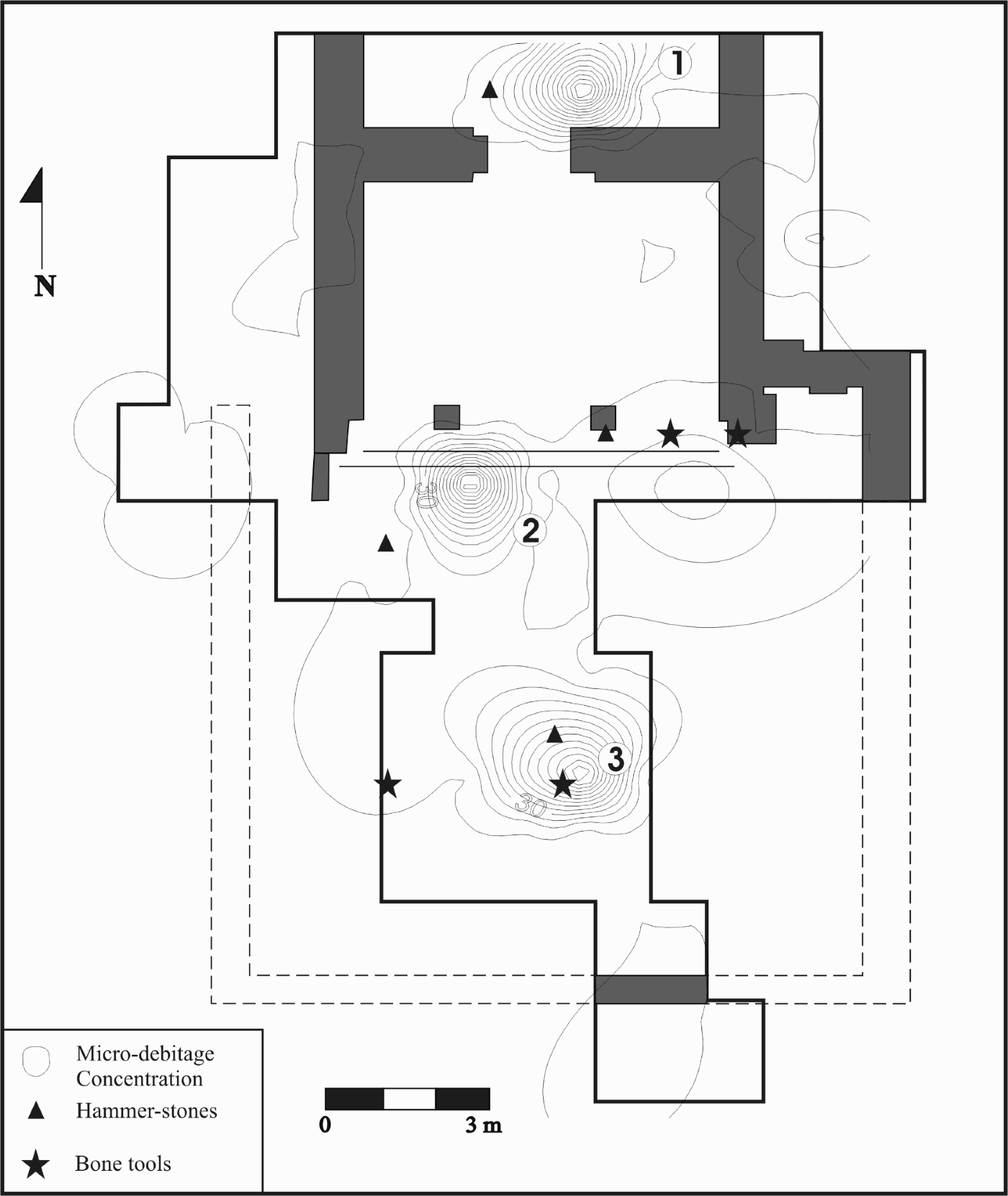
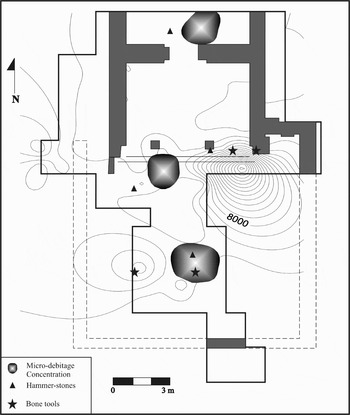
The distribution of microdebitage at Hacienda Metepec (Figure 6) by weight shows three loci of high concentration with each locus possessing greater than 140 g of obsidian. The next greatest concentration, 70 g, lies next to the high concentration in the patio. Because these three areas have twice the microdebitage by weight than other places in the excavation, they are likely production loci. These three areas are spatially segregated from each other, namely, one in the possible living quarters in the north room, one on the steps,Footnote 4 and another in the patio. Additionally, the distribution of all obsidian debitage (micro- and macrodebitage) shows high concentrations near, but not over, these production loci (Figure 7); however, lighter concentrations of microdebitage (0–70 g) are under areas of high obsidian concentrations, suggesting that abnormally high concentrations of microdebitage indicate primary deposition while lower concentrations indicate secondary deposition (see Healan Reference Healan1995). The pattern shown by the distribution of hammerstones and bone pressure tools (Figures 6 and 7) likewise provide indirect support for the production loci. The plot of their individual locations place these discarded tools around the presumed production loci and within the concentrations of obsidian debris. An explanation for these loci could be weather-related. On nice days, it is possible that the knapper worked outside in the patio or on the steps. When the weather was inclement, knapping occurred inside.
Microdebitage distribution: (1) W1N2: C2/4, D4, E4; (2) W1S1: A2/3, B2/3; (3) W1S2: C4.
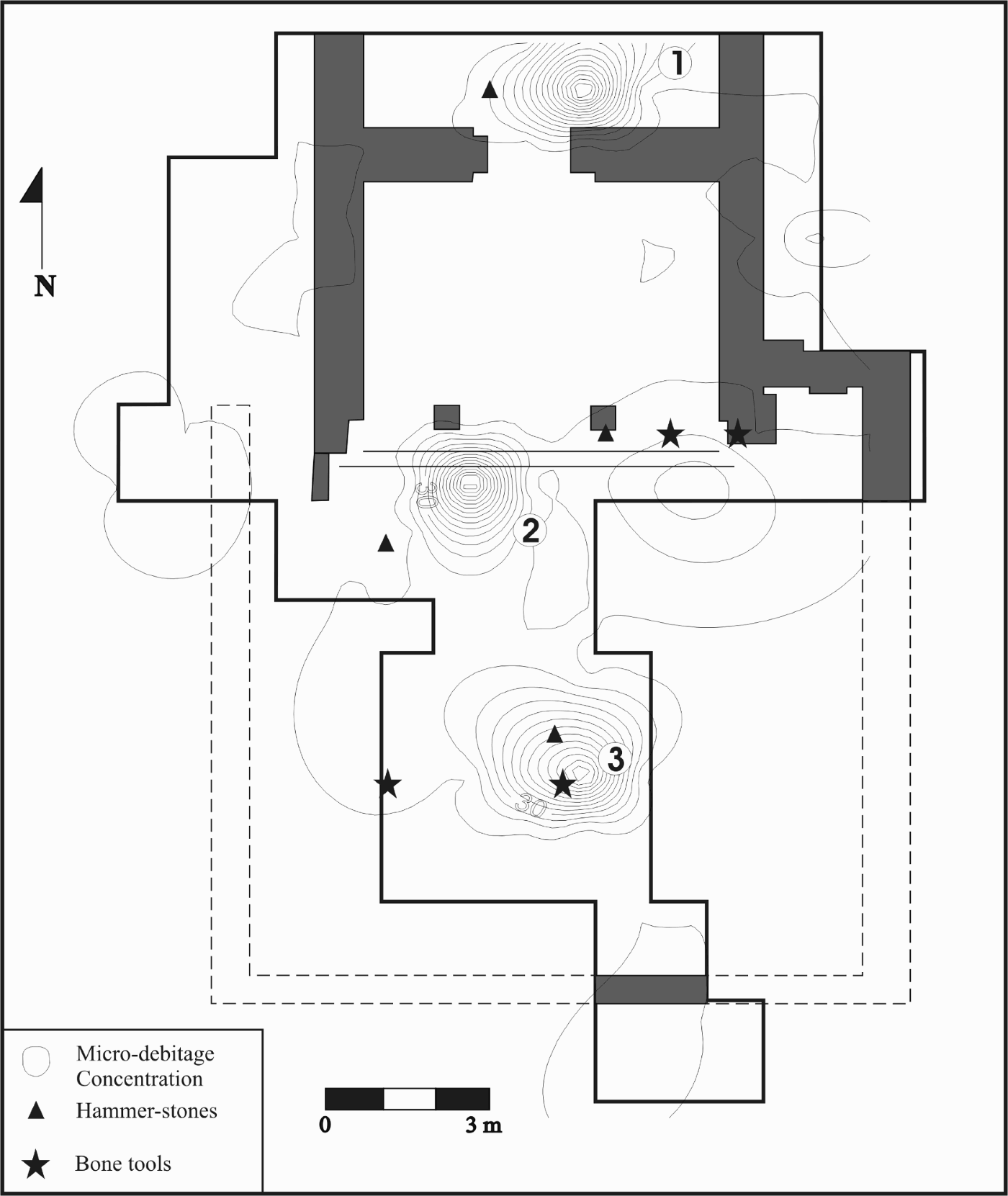
Total obsidian distribution in grams. Note that the microdebitage loci (patterned X) are not in areas of dense obsidian material.

Macrodebitage (flakes and production failures >2 mm) comprise the bulk of the obsidian recovered from Hacienda Metepec (99.7%).Footnote 5 Macrodebitage recovered includes broken bifaces, flakes, and a few other tools. The deposit is quite extensive for a biface-producing workshop in a city better known for prismatic blades, albeit at an earlier time period. Production errors in the form of broken bifaces, overshot flakes, and other error-correcting flakes are present in the debitage.
All the available evidence indicates that the production of bifacial knives and corner-notched atlatl dart points were the focus of this workshop. Finished products were exported out of the workshop, leaving behind debitage and broken bifaces. A few broken bifaces could be refitted after hours of looking for matches. These provide information on the final workshop products. The pressure flaking pattern on the dart points was regular and even. The points themselves were well-thinned, with good balance and form. The standard variation in biface thickness decreases from blanks to percussion biface 2 stage then increases slightly during pressure flaking and decreases with the final product (Nelson Reference Nelson2000:42–43). The manufacturing sequence, as outlined previously, was designed to turn unmodified blanks into high-quality knives and dart points by a gradual process of removing mass and irregularities. Hence, the flakes and obsidian bifaces recovered in this context do not have visual evidence of use or wear. A few bifaces, less than 3%, may have been used as expedient tools, but the vast majority of flakes and bifaces show no use wear.
The production loci and associated dump constitute the biface workshop at Hacienda Metepec. Three areas of unusually high microdebitage concentrations have been identified as production loci. They are surrounded by heavy deposits of obsidian manufacturing debris believed to be in situ. The remarkable characteristic of this workshop is not its size but its location and product—specialized bifaces. Hacienda Metepec lies on the outskirts of Teotihuacan, far from the center of the city and its Classic-period political core. Additionally, bifaces are relatively uncommon in artifact assemblages in the area, as the major stone tools were prismatic blades. These considerations will be addressed after the output of this workshop has been calculated.
PRODUCTION ESTIMATES AND SCALE OF PRODUCTION
Production estimates are useful in determining the number of workers at a workshop and the market for the workshop products (Costin Reference Costin and Schiffer1991; Costin and Hagstrom Reference Costin and Hagstrum1995). However, production estimates are difficult to generate because the product is destined for outside consumption and the debitage remaining in the production area represents the last manufacturing episode of the workshop. It is possible that the workshop area was cleaned periodically of production debris. Thus, any production estimates are, by their nature, minimal estimates based on the assumption that the workshop had never been cleaned and that the full extent of the deposit was excavated. Three methods are used to estimate the number of finished products from this workshop: diagnostic artifacts, weight-reduction, and replication experiments.
Diagnostic artifacts can be useful indicators of production when they occur at a particular point in the manufacturing process, such as the primary tranchet flakes in the production of tranchet bifaces at Colha (Shafer and Hester Reference Shafer and Hester1991:86–87). The ratio of diagnostic artifacts to finished products provides a ready indicator of the quantity of finished products. Unfortunately, there is no clear diagnostic artifact for the manufacture of Ramec points. The most diagnostic artifacts are notching flakes, which are struck off the pressure biface at the end of the manufacturing sequence. Though many lots were casually examined for notching flakes, six units in particular were chosen for detailed analysis based upon weight and size gradient as likely to contain high numbers of notching flakes. The counted number of notching flakes is 865, from these six different contexts. Estimating from the relative proportion of notching flakes in these samples by weight, the total number of notching flakes within the total excavated area would be 7,378 to 11,937 flakes if every single bag were analyzed for notching flakes and assuming that all notching occurred in the workshop (Nelson Reference Nelson2000:106–107). Replication experiments suggest that each Ramec point required a minimum of three notching flakes per corner to shape the biface haft. This is a conservative estimate that if applied to flake estimates for the entire deposit yields a production estimate of 1,230 to 1,990 total Ramec points. This production estimate is too low, because the mass of the deposit is too large for only 1,990 darts being produced. For this reason, Ramec points must not have been the sole production target. Pressure bifaces and Ramec points were both end products.
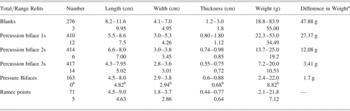
Another way of estimating production output involves calculating the weight lost between each stage in the manufacturing process. Knapping is a reductive process, so the difference in average weight between bifaces of different stages gives an indication of the weight removed in the course of production. For these calculations, it is necessary to use information from complete (refitted) bifaces (see Table 3). The dimensions in this table were reconstructed by measuring bifaces that had a complete dimension (such as a complete length from base to tip) or were refitted and hence complete. Weights were recorded from complete or refitted bifaces.
Dimensions of all bifaces versus complete and refitted bifaces

aThis is the difference in weight of each biface type compared with Ramec points. bNo pressure bifaces had complete dimensions, so these values are averaged between percussion biface 3s and Ramec points.
The difference in weight from blanks to the Ramec points equals the weight of the flakes removed during production. The weight of the obsidian debitage recovered (minus the weight of the blanks and biface fragments) divided by the average weight reduction per stage gives an estimate of the number of bifaces produced:
Workshop production = Total obsidian flake weight / Change in weight.
The average weight difference between blanks and Ramec points is 47.88 g. This much weight was converted into percussion and pressure flakes. The weight of the entire obsidian deposit recovered (275,270.41) minus the weight of the blanks and bifaces (22,282.5) equals 252,987.91 g (Nelson Reference Nelson2000). Then, 252,987.91 g divided by 47.88 g/point equals the possible number of points produced: 5,284. This is the best single estimate for the workshop because it uses the entire mass of the recovered material in the calculation.
The weight difference between percussion biface 1s and finished Ramec points is 27.37 g. Instead of dividing the entire deposit by this sum, it makes more sense to use the weight from screens 6–9 (sieve opening 1.25–0.20 cm), because the material from screens 2–5 was mainly blank fragments and large flakes created from the reduction of blanks into percussion biface 1s. Screens 6–9 recovered percussion and pressure flakes. This gives a reduced amount (230,014.6 g) and suggests that 8,405 bifaces were produced (230,014.6 g divided by 27.37 g/point).
Again, using a similar method, the difference between percussion biface 2s and Ramec points is 12.08 g. The flakes removed from percussion biface 2s would fall into screens 7–9 with sieve openings of 0.63–0.20 cm (105,815.7 g). Accordingly, it appears that 8,760 Ramec points were produced (105,815.7/12.08).
Finally, the difference in weight between percussion biface 3s and Ramec points is 3.41 g. The flakes removed should correspond to screens 8 and 9 (0.28 and 0.20 cm) based upon the size of the flake scars on the bifaces. The weight of screens 8 and 9 is 16,251.7 g. This gives an estimated production of 4,773 projectile points. This estimate is low, perhaps because this sized material would have fallen through the screens initially used in the field.
The estimates based on weight change give a production range indicating that between 4,773 and 8,760 pressure bifaces and Ramec points were manufactured. This range exceeds the notching flake minimal number estimate and provides a better representation of possible production quantities, based upon the amount of debitage recovered from the excavations.
Another way of estimating production is by replication experiments. Rattray published an estimate of this workshop's production based upon replication experiments done by Jeffrey Kalin: 6,000–9,000 as the range with an 87.5% success rate (Rattray Reference Rattray, Tapia and Rattray1987:460). This estimate is based upon the number of replication failures and the amount of debitage that is produced when replicating this dart point (Rattray Reference Rattray, Tapia and Rattray1987:460).
Specialized production is difficult to measure because the finished products are removed from workshops. This forces the investigator to estimate the probable production based upon the debitage that remains. Estimating from notching flakes gives the probable production range of 1,230–1,990 points. The weight-change estimate increased the range to 4,773–8,760 points. Kalin's experimental data (6,000–9,000 points) mimics the weight-change range, thereby providing additional support. Thus the probable range in Ramec-point production lies between 4,773 and 8,760 points. Because there were 596 irreparable bifacesFootnote 6 discovered in the deposit, this indicates that 4,177–8,404 Ramec points are missing from the deposit. These missing points represent the finished, exported products of Hacienda Metepec.
A final production issue refers to irreparable errors and error rates. How proficient was the knapper? Irreparable errors are bifaces that broke in such a way that the knapper could not use any of the biface pieces to fashion a shorter but still functional biface or dart.Footnote 7 There were 596 irreparable bifaces found within the deposit. The production range, 4,773–8,760 points, gives an error rate of 12.5% for the lower estimate (596/4,773) and 6.8% on the higher estimate (596/8,760). Coincidentally, Rattray notes that during Kalin's replication experiments, they had an error rate of 12.5% (1987:459).
ORGANIZATION OF PRODUCTION
The number of workers within a workshop and the time spent in working influence the output of the workshop (Donham Reference Donham1981). As the number of workers increases, the social organization within the workshop may also become more complex (Kenoyer et al. Reference Kenoyer, Vidale and Bhan1991). People may need to supervise the production, or production may be facilitated by assembly-line task specialization (Carrier Reference Carrier1992:548). Theories on task management and labor specialization abound, differentiated by the potential number of laborers within a given establishment and their relationship to management (Carrier Reference Carrier1992). Ancient workshop organization can only be approximated, due to the difficulty of reconstructing social behavior from material refuse. Likewise, archaeologists can only provide estimates based on the debris excavated, which may not include all the debris from the workshop. The method used here to estimate the number of knappers in the workshop is to work backward from the output, assuming that low product output would be comparable to low worker input. Ramec dart production required a specialized knowledge of knapping and commensurate skill and each stage of the manufacturing process could be performed by a single individual.
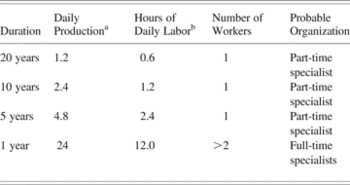
The time involved in the creation of a single Ramec projectile point aids in roughly estimating the duration of the workshop. The workshop has been dated to a single ceramic phase that represents several decades. If the workshop lasted 50 years with the high estimated output of roughly 8,760 points, then a single worker could easily make 180 points a year (8,760/50) if he made one every other day. However, if the workshop produced 8,760 projectile points within a single year, then a case could be made for a more complex type of organization (see Costin Reference Costin and Schiffer1991:31 for a similar example). But how much time did the production of a Ramec point require? In the process of verifying the manufacturing sequence, John Clark replicated a Ramec style point in 45 minutes. Although this is not a definitive measure of prehistoric or modern activity, it serves as a cautious measure of the time involved. If the worker was more adept at his craft than Clark, then he could make a projectile point in 30 minutes. At this rate, the workshop would have been in operation for a maximum of 4,500 hours, ceteris paribus, not including any time estimates on tasks that took place outside of the workshop such as quarrying the raw material and transport time. Given these rather subjective time estimates, the organization of production changes according to the duration of the workshop (Table 4).
Workshop duration, output, and organization

aDaily production = 8,760 points / duration / 365 days. bHours of daily labor = daily production × 0.5 hours/point.
For long duration periods (i.e., more than five years), the darts produced would not have required more than the occasional labor of a single person. Thus, a long duration workshop could feasibly involve only a single individual. However, if the duration is less than five years, or even a single year, then the amount of production would have exceeded the reasonable activity of a single person (Shafer and Hester Reference Shafer and Hester1986:162) and probably required a more complex organization within the workshop.
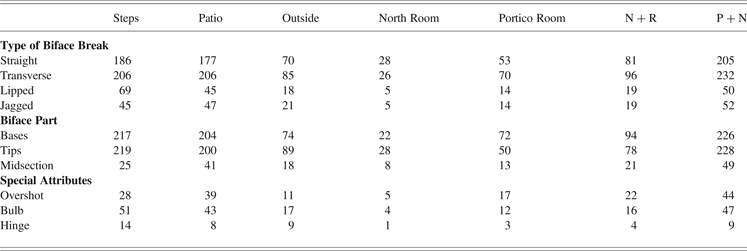
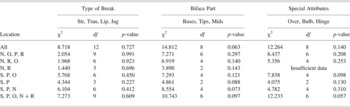
In an attempt to estimate the number of knappers, the excavation was divided into architectural sectors: north room, portico room, steps, patio, and outside. Also combinations of sectors—north room + portico room, and patio + north room—to test ideas about breakage. Next these areas were compared with each other via a series of Chi-square tests with combinations of the following attributes (see Nelson Reference Nelson2000 for additional descriptions of types): type of breaks quantity (straight, transverse, lipped, and jagged), biface fragment quantity (bases, tips and midsections), and special attribute quantity (overshots, bulbs of percussion, and biface surface hinge fractures) (Table 5). These attributes all measure skill (or its lack), that is, the ability of the knappers to successfully remove flakes without destroying the biface. Each break is a knapping error resulting from the force and direction of a blow through the biface. Finally, special attributes indirectly measure (1) knapping preferences and (2) flaking ability in unusual cases, such as overshooting the biface edge when removing flakes or if the blank's bulb of percussion was removed, and (3) the presence of large hinge scars on either face of the biface.
Quantity of biface breaks and error types
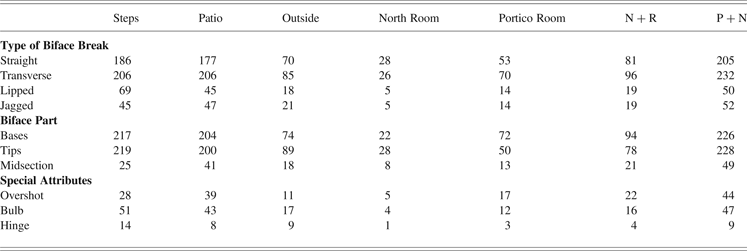
N + R = north room + portico room; P + N = patio + north room.
The Chi-square test measures the difference between populations. A low p value (<0.05) indicates that the populations are different, that is, there may have been more than one person knapping, assuming that different levels of competence equals different knappers. The large p values (see Table 6) suggest that the populations are nearly homogenous—that is, one person could have created all the debitage found in each area. This suggests that a single knapper was at work.
Chi-square tests

Jag = jagged; Lip = lipped; Mids = midsection; N = north room; O = outside area; Over = overshot; P = patio; R = portico room; S = steps; Str = straight; Tran = transverse.
USE AND DISTRIBUTION OF PRODUCT
Atlatl darts have limited use—either hunting or warfare—and presumably there would be little game left in the neighborhood, or even the valley, to support an atlatl industry. A low population estimate for Coyotlatelco-phase Teotihuacan suggests that around 20,000 people lived in the remnants of the city, scattered in small communities, such as Hacienda Metepec (Rattray Reference Rattray1979). If the usage of Coyotlatelco projectile points is similar to estimated Classic period peasant families' use (Sanders and Santley Reference Sanders, Santley, Vogt and Leventhal1983:252), then 20,000 people would use approximately 55,000 projectile points per year.Footnote 8 Higher population figures increase this estimate. Thus the complete output of this obsidian workshop would have been insufficient to maintain the city for a single year. Further, there is no reason to assume that this is the only bifacial workshop operating at that time. Michael W. Spence (personal communication 2008; Spence 1967:509–510) notes that surface debitage in the region indicates that multiple possible workshops/dumps are awaiting excavation. Trade or warfare within the Teotihuacan region could cause thousands of darts to be consumed in a relatively short period of time.
However, the social aspects of Coyotlatelco-phase Teotihuacan are beyond the scope of this paper. This phase “apparently lacked an architectural tradition, large public construction efforts, monumental art, and even a definable art style. We cannot even detect an elite, although it surely existed. Apparently the ideology and power that held together the Teotihuacan world for so many centuries ceased to exist and was not replaced” (Diehl Reference Diehl, Diehl and Berlo1989:16). Yet, social processes were still continuing during this period. Either attached specialists under elite control were manufacturing weapons for the state or independent specialists were creating knives for a more general distribution (such as trade). Either interpretation indicates unrest in the Teotihuacan area. These darts and bifaces were produced for specific purposes. In any event, the distribution of these projectile points is not yet known. They occur within other areas of the Hacienda Metepec barrio and within Teotihuacan itself (Rattray Reference Rattray1980), and they also arrived at Xochicalco (Kenneth Hirth, personal communication 2002), but further research is necessary to define their spatial distribution.
CONCLUSIONS
This paper sought to determine the workshop status and to estimate the output and organization of an obsidian projectile point production locale within Coyotlatelco-phase Teotihuacan. Hacienda Metepec was the site of an Epiclassic-period biface workshop with its associated debris. This workshop had three spatially distinct areas of production, separated one from another by varying quantities of obsidian debitage. Production focused on bifacial knives and corner-notched atlatl dart points rather than the more common prismatic blades. Atlatl dart production is surprising considering that prismatic blades, rather than large darts capable of killing deer or men, would have been used more within semi-urban domestic settings. The output of the workshop lies between 4,773 and 8,760 points with 596 irreparable bifaces. It is believed that a single knapper was responsible for creating all the darts and bifaces.
The workshop probably lasted only a few years because the obsidian deposits are fairly clean with little admixture of domestic trash (except on the stairs), and the error rate is low (6.8%–12.5%), suggesting continuous work rather than intermittent practice. The distribution of the projectile points is currently unknown, but the output of the workshop would have been insufficient to service the population of Teotihuacan at that time.
RESUMEN
Aunque Teotihuacan ha sido un centro de comercio importante en Mesoamerica, son poco los talleres excavados en ello. Se presenta aquí los resultados de un re-análisis de una taller lítico del fase Coyotlatelco (approx. d.C. 650–800) que fue excavado por Evelyn Rattray en 1979. El proposito aquí no es discutir sobre las características del período epiclásico, sino enforcar en un taller y sus restos para dar una explicación amplia de ello. Las excavaciones realizadas en el barrio Hacienda Metepec revelaron una gran cantidad de deshechos líticas hasta 50 cm de profundidad en algunos lugares. En total, Rattray excavó 170 m2 de un apartamento residencial de Teotihuacan y se recuperó 275 kg de obsidiana. La obsidiana fue cernida en el campo por un cernidor de 4.76 mm y algunas muestras de suelo también fueron recuperadas. Casi veinte años después, todo esta obsidiana fue re-analizado. Shelby Saberon con John Clark segregaron la lítica por tamaño y tipo. La obsidiana fue cernida otra vez por nueve cernidores de tamaño variable. Los cernidores más grandes (Cernidores 1–5) recuperaron artefactos > 1.9 cm como fragmentos de cuchillos bifaciales. Cernidores 6–7 tenían los artefactos medianos de 0.63–1.9 cm. Cernidores 8–9 contenían los artefactos pequenos de 0.20–0.63 cm. La materia que paso por ellos también fue colecciónada. Después de pasar por cernidores, los artefactos fueron contado, medido, y examinada por tamaño y atributos visuales. Los rasgos de las lascas fueron notados como atributos de tecnología. Los artefactos bifaciales recibieron más atención en analizar sus atributos.
Lo que fue evidente es que había una secuencia de manufactura en hacer los artefactos bifaciales. Primero, lascas grandes (“tool blanks”) de obsidiana de la fuente de Otumba fueron extraído de allí hasta Hacienda Metepec. En el taller fueron reducidos por percusión. “Percusión Biface 1” es un cuchillo bifacial rustico con poco evidencia de huellas en su superficie. “Percusión Biface 2” es una forma avanzada de Percusión Biface 1, aun con caras no-simétrica. “Percusión Biface 3” es una forma simétrica de Percusión Biface 2 con medidas 1.67 longitud/ancho y un por medio de 0.7 cm de grosor. En este momento, se terminó de hacer percusión y empezó a trabajar por presión. “Pressure Biface” es un Percusión Biface 3 que han sido trabajado por presión para sacar lugares irregulares de sus caras y filo. Si un “Pressure Biface” tiene una muesca en los lados, se pareció com tipo “San Marcos”. Aquí este tipo de punto proyectil fue denominado como tipo “Ramec” para distinguirlo de la asociación cultural del tipo San Marcos.
Al hacer los puntos proyectiles Ramec, muchos fueron quebrados durante la secuencia de manufactura. En total, 1241 preformas de percusión fueron encontrados y 234 de presión. Ademas de miles de lascas que venían de todas las etapas de la secuencia de manufactura. El taller de Hacienda Metepec incluye áreas identificadas como lugares de producción. Estas áreas son demarcadas por alta concentraciones de lascas finas <2 mm (microdebitage). En base de cantidad de lascas finas, tres áreas fueron notadas: Cuarto norte, escalera, y en el patio. El producto del taller puede ser estimado. En algunos talleres hay artefactos específicos que pueden ser contados para estimar producción como en Colha. Pero no hay en Hacienda Metepec. Entonces producción fue estimada por comprobar los pesos de producto terminados con los preformas para saber cuanto peso fue sacado por etapa. Al comprobar la diferencia en preformas quebrados pero completas, se notó que 47.88 g fueron sacado de los “tool blanks” para hacer un punto “Ramec”. Entonces cada 47.88 g de lascas de obsidiana es equivalente a un punto proyectil. Se estima que 5284 puntos proyectiles fueron manufacturados en el taller, o un rango de 4773 hasta 8760. También, estima que el obrero tenía un rango de quebrar de 6.8–12.5% basado en el tipo de errores que hizo. Aunque sería imposible saber cuantas personas trabajaron en el taller, una distribución “Chi square” no encontró diferencias entre lugares en el taller. Quiere decir que toda la obsidiana pudo ser trabajada por solo una persona. Si solo una persona trabajaba allí, entonces la organización del taller debe ser simple y quizás el taller no duró por mucho tiempo. De todas formas, el taller excavado por Rattray nos ayuda entender un poco un período algo desconocido. Los puntos proyectiles hechos en el taller de Hacienda Metepec y en talleres aun no-excavados tomaron un parte pequeño en la historia de Teotihuacan y sus alrededores.
ACKNOWLEDGMENTS
I am very grateful to Evelyn Rattray for the opportunity to study the material she excavated. Also, the New World Archaeological Foundation and its director, John Clark, were very generous with their facilities and support in this work. Shelby Saberon and John Clark did much of the initial processing and subsequent analysis of the material. Ken Hirth and John Clark aided this paper with their comments. Diligent reviewing by Tom Charlton, Michael W. Spence, and an anonymous reviewer advanced this article greatly.