1. INTRODUCTION
The dominance of electoral competition by two competing parties marks one of the principal regularities of American politics, but it has not always been so. In the early years of the Republic, a wide variety of legislative factions tied to electoral coalitions (Federalists, Anti-Federalists, Democratic-Republicans, National Republicans, Jeffersonian Republicans) competed for legislative and executive office. In general, the electoral space was characterized by instability, especially after the demise of the Federalist Party in the wake of the War of 1812, a development officially struck at the Hartford Convention (1814–1815). With the emergence of the “Era of Good Feelings” in 1816, the young nation did not shrink from politics, but in organization and rhetoric, American politics became less structured by party, at least for a short time. As a label, the Democratic-Republican ticket won the plurality of elective offices in this period, but the party did not offer a systematic linkage of voters to legislators that earlier elite factions or later mass parties did. The Democratic-Republicans were not officially organized in most states and were inactive at the national level. Even in the 1820s, the various democratic, labor-based, and minority voices that emerged—and which were expressed and organized with increasing fervor and sophistication—did not structure themselves in party organizations until the end of the decade.Footnote 1
Only with the rise of the Whigs and Democrats—as two parties whose legislative coalitions were linked to citizen organizations of mass suffrage—did the first modern two-party system emerge. In part, this development remains largely, perhaps principally, a Democratic story, as the election of 1828 tied sophisticated electoral organization to patronage and to a more searching and strategic mode of electoral competition.Footnote 2 Yet, in part, the story of a two-party system—in which the parties adopted strategies of electoral competition, organizing themselves in states, districts, and localities; advancing platforms on a range of issues; and using patronage and other tools of government to offer benefits to voters—requires accounting for the emergence of the Whig Party. This has been masterfully elaborated and systematically studied in Michael Holt's pioneering The Rise and Fall of the American Whig Party. In ways that echo many of Holt's arguments and that, we think, complement them, we propose that in the development of the early Whig Party, and perhaps in other cases,Footnote 3 practices of petitioning allow scholars and students of political history to predict the emergence of party organization. Pre-Whig patterns of petitioning over financial issues allow the analyst to predict where Whig voting would arise two to fourteen years later, and when studied more closely, the bank petitions we examined also shed light on state party organization and the larger role of the Bank War in Whig Party formation. Assembling a new and unique data set of petitions sent to Congress in 1834, we arrayed the petitions geographically by county and then examined partial correlations of these petitions (their numbers and their relative tendencies for or against restoration of the deposits) with larger patterns of Whig voting. We found that an intense petitioning campaign in 1834, fought over the removal of deposits from the Second Bank of the United States (BUS), leaves scholars with a footprint of petitions that anticipates, in ways that have not previously been revealed, the emergence and evolution of Whig Party voting in the decade following the Bank War.
Our hypothesis is that petitions sent to Congress that supported or contested the removal of BUS deposits are, in their geographic variations, predictive of later patterns of Whig Party voting. To be clear, our hypothesis is not that the petitioning caused party formation in a general or specific sense, in part because we think (and Holt shows) that the relationship between bank petitioning and Whig Party formation is far more complicated, and in part because we do not have the means to construct any sort of internally valid statistical demonstration of the point. Still, insights drawn from this moment of petitioning figure importantly in the larger story of the development of the Whig Party. Our argument is that these petitions indicate the emergence of a cleavage over financial issues but also the emergence of anti-Jacksonian sentiment, expression, and even organization. It is this second route—the petitions as expressive of opposition to the dominant party of the antebellum period, as well as to its executive figurehead—that appears to us the most plausible interpretation of the correlations we find. We can rule out the notion that the emergence of these petitions was strictly endogenous to (otherwise put, caused by) Whig Party organization itself; there was no national Whig organization in 1834 capable of coordinating a petition campaign. Thus the petitions we study cannot be dismissed as simply the activity of a preexisting party.Footnote 4
While our study is historically situated, we emphasize here that the early nineteenth-century history of American political parties is critical for several reasons. First, it was in this period that the first mass parties connecting large electoral blocs emerged. The suffrage expansions following the War of 1812, flowing as well from the democratic movement in the states,Footnote 5 combined with the new systems of patronage to erect organizational and ideological linkages between coalitions of voters and coalitions of legislators. Second, it was in this period that movement toward two major parties continued, not just at the level of district (the prediction made by Duverger's Law) but also at the national level. Unlike the political organizations of the Era of Good Feelings and of the 1820s, the Democrats and Whigs were truly national party organizations. While important third-party energies arose and fell (principally in antislavery contestation in the Liberty and Free Soil Parties) and in anti-immigrant and nationalist movements (principally in the Know-Nothing and American Parties), the Democrats and Whigs dominated national elections in this period. Third, it was the fall of the Whig Party that marked both a cause and symptom of the sectional conflict that led to the Civil War. Understanding the Whig Party is thus central—as Holt has demonstratedFootnote 6 —to understanding the larger contours of American political history more generally.
For at least two other reasons, the wave of BUS petitioning that crested in the spring of 1834 carries added significance for the study of American political development. First, it broadens and adds to other evidence suggesting that widespread, coordinated petitioning campaigns were conducted in many areas and on many issues in the Jacksonian period. In June 1834, Henry Clay could remark that more than 150,000 signatures had appeared on pro- and anti-BUS petitions since the preceding December. For a six-month period, this matches and in some cases exceeds the total signatures gathered by antislavery canvassers in the same decade.Footnote 7 The 1830s in particular saw a wave of new petitioning and activist practices, many by people who were not formally incorporated into the political system. This wave comes largely before the mass petitions of the Chartist movement in England, which began in 1839, though certainly ran in cross-Atlantic currents of mobilization.
Second, and perhaps more important, the Bank War petitioning struggle also points to the vitality of petitioning on economic and financial issues in the antebellum era. The literature in history and associated social sciences has generally focused on campaigns related to civil rights, slavery and, in many cases, women's issues and religious issues such as temperance and anti-Sabbatarianism.Footnote 8 Yet evidence from a range of debates suggests that petitioning on economic issues—including those where the stakes were national, and not merely local as in river and harbors projects—was widespread in the nineteenth-century United States. Petitions to state legislatures requesting a charter for state bank operations were common, and petitions to the New York state banking superintendent asked for increases to bank capital or changes in permissible operations. Other studies have located resistance to various forms of taxation in petitioning practices, including by newly emergent business and corporations in the late nineteenth and early twentieth centuries.Footnote 9 Yet the anti-BUS petitions differ from these earlier efforts in two ways. First, many of them come not from those directly affected by deposits removal, but by persons who were ideologically supportive of, or opposed to, the BUS. Given that this debate was carried out in part on the basis of the BUS's constitutionality and its appropriate place in American political economy, this ideological tinge is important and helps to link BUS petitioning with other petitions on issues often regarded as more “social” or “institutional.” Second, as a national-level issue, the Bank War petitioning campaign was massive in scale and intensive in activity, resulting in dozens of petitions descending simultaneously upon Congress, many with hundreds of individual signatures and some (from Erie County, for example, as we discuss below) with thousands of signatures.
2. WHY WHIG PARTY FORMATION CAN BE STUDIED THROUGH PETITIONS
2.1. What Is Party Formation?
The first thing to note about the term party formation is that it is not new. Historians and other scholars working on the nineteenth century, especially Ronald Formisano and Richard McCormick, have used the term for much of the past half-century. At some level the term refers to the rise of a party where there was not one before. Yet for party formation to be truly significant and autonomous as a concept, we must separate it from the simple relabeling or realignment of parties (the reemergence of the Republican Party in the South after 1960 might amount to party formation, but might not, especially when legislators and electors simply switched parties). Parties organize in electoral competition when they are able to enter candidates in a wide range of local races, uniting these candidates under a common label (and in many cases, a platform) and delivering electoral and policy services to these candidates and their supporters through party organization. Party formation is the emergence of a new network of organizations, with distinctive labels, policy positions, and practices, that are centered upon a coalition of legislators linked to a coalition of electors. It is party formation that supplies somewhat durable organizations that can be separated from the candidates they sponsor; hence third parties (Liberty, Populist, Socialist) can be distinguished from parties associated with third candidates (Ross Perot, Theodore Roosevelt, George Wallace) by their organizational instantiation and their relative durability in local-level races.Footnote 10
Party formation is a core problem of political development, defined by Orren and Skowronek as a durable shift in the governing institutions of a country.Footnote 11 And party formation forms one of the central transformations of American political development, insofar as mass party organizations linking voters (and nonvoters) to politicians emerged in this period. These organizations formed the basic template for the major political parties in the contemporary United States and, indeed, much of the world. As Formisano recognized over four decades ago, this institutional shift was also a cultural transformation.
Modern American political culture took shape in the 1820s and 1830s with the formation of mass party organizations. In most states a mass electorate had internalized party loyalty on so vast and intense a scale that by 1840 a new context for political activity was constituted. Professional politicians had moved in behind Andrew Jackson's 1828 victory to secure substantial power over the processes of government. With their cohorts in the states they worked to create an institutional environment which favored disciplined and cohesive organizations in the competition for majorities in electoral campaigns. Any political majority in a country of so many contrasts would have to be coalitional…. Binding ties of action needed to be developed to rationalize political activity, get political power, maximize the usefulness of power, and provide criteria for the distribution of rewards.Footnote 12
Formisano's summary points to critical and necessary steps that “needed to be developed” in order for the process of mass party formation in America to unfold: the development of coalitions that unite heterogeneous voters, cohesive and disciplined organizations, and “binding ties of action.” The pathways by which these necessary conditions were satisfied were (and remain) manifold, but the mass culture and pattern of petitioning in American political development figures into each of them, as we discuss shortly.
2.2. The Value of Petitioning: Several Hypotheses
Petitioning can be used to study party formation in part because, like parties, petitions link the expressed interests and wishes of voters to policy actions taken (or not taken) by governing officials.Footnote 13 Citizens petition their government for manifold reasons, but when a range of citizens draw up, circulate, and send in petitions on a common issue, they are harnessing a means of politics that requires some organization (preexisting or emergent). The petitions may be solicited by elected leaders who wish to demonstrate popular support for/against an argument or bill, or they may emerge more from grassroots efforts, but in either case, the petitions are to some degree substituting for the operation of party machinery. If a group of citizens has a well-organized party that inscribes its wishes into a policy platform and commands the allegiance of its aligned legislators, such a group will have less (perhaps little or no) need for a petitioning campaign in order to make its point to the government.
Not every petition and not every petitioning campaign will necessarily express the kind of cleavage that may later be structured as, or incorporated into, a party system. Indeed, a very small minority of such petitions will qualify. Parties can separate on lines of ethnicity and race, religion, region, and policy—though primarily the last of these divisions provides the basis for party formation predicted by petitioning.
It is this link between petitioning and successful party formation that gives our article a substantially different focus than other work that has examined petitioning in the Jacksonian Era.Footnote 14 For instance, Wyatt-Brown details the “techniques of agitation,” including petitioning, that evangelicals employed in the Sabbatarian project to repeal a postal regulation requiring Sunday mail delivery.Footnote 15 The evangelical religious community sought to mobilize because they were appalled by an “array of Democratic [party] trappings, from chauvinistic drum-beating to secret bribes.”Footnote 16 But entrenched Democratic lawmakers and an inability to agree on a unified strategy plagued the Sabbatarian efforts. The petitioning campaign met with failure—petitions were “forwarded to the postal committees,” Wyatt-Brown remarks, and “summarily dismissed at a later date.”Footnote 17 In short order, the Sabbatarian cause was abandoned; however, Wyatt-Brown's account links these failed attempts at influence to the subsequent efforts of abolitionists—who employed techniques learned as Sabbatarians—years later. Sabbatarian efforts in the 1820s were thus a prelude to abolitionism.
While we similarly recognize petitioning's potential as a tool for mobilization, our article focuses far more heavily on petitioning's immediate role in the development of the Whigs. The Sabbatarian efforts bore fruit only decades later. We identify a link between petitioning on the removal of the deposits and Whig Party development within two years. Still, perhaps the common thread between petitions on Sabbatarianism and on the removal of the deposits was the recognition that petitioning could be useful for mobilizing public opinion. In this manner, both illustrate an important condition for the development of mass parties.
Following recent literature, we define a petition as an organized request for political redress or policy of some sort, which contains two essential elements: a “prayer” (or request, or expression of grievances) and a signatory list presenting those persons who have affixed their name in approval of the prayer.Footnote 18 In the period of mass party formation in America, petitions so understood offered several mechanisms by which new parties could be constructed. First, at the most basic level, the prayer of the petition provided and disseminated information on issue positions taken by an emerging organization. Often enough, as in the case of slavery, temperance, immigration, or national finance, these were emerging issues on which the existing political factions did not split, or for which existing party debates and party labels were poor guides to interpretation. Second, the experimental process of petitioning meant that organizational entrepreneurs could try different arguments and strategies for attracting the public to their cause. To preview slightly, this learning dimension of the petition became evident in Henry Clay's evolving strategy in the early 1830s, as he discovered that protestation against the Jackson administration's “executive tyranny” was a more effective rhetorical cudgel than were appeals to retain deposits in the second BUS. Petitioning could be used to search for that bundle of issues that would, in Formisano's words, build an essential coalition and potentially hold it together. Third, beyond the direct value of information, the fact that others signatories signed petitions—sometimes in great numbers, sometimes in small numbers but with notable elite names attached—meant that citizens and politicians could reduce uncertainty and manage political risk by following a petitioning campaign. Finally, as has been argued elsewhere, the signatory list became a rich political resource as it gave political entrepreneurs information on who their emerging friends were (and where they might be found geographically, socially, economically, and politically). The signatory list and the process of petitioning could assist in building the critical “binding ties of action” that Formisano saw as critical to the emergence of the American mass party. The networks of petitioning—represented on paper, but existing in social and political space beyond paper—could become ingredients for organizations.Footnote 19
3. THE BANK WAR AND PARTY DEVELOPMENT IN THE UNITED STATES
The Bank War of the 1830s was both a moment of crisis for an industrializing economy and a moment of reconfiguration in national and state politics. The emergence of the Democrats as a party organization, united under Andrew Jackson but clearly capable of carrying their force beyond the general, meant that until the late 1830s, one party was hegemonic in American politics. The organization inspired by Duff Green's strategy, combined with the simultaneous expansion of the American electorate and the postal system, all united under Jackson's democratic and nationalist symbolism, rendered previous forms of opposition futile. The Democrats were particularly effective in organizing in the one true prize of nineteenth-century national electoral politics: New York. In the absence of city political organizations in New York and Albany, the Democrats would not have enjoyed the dominance they displayed until the Panic of 1837.
The BUS was one of the preeminent administrative institutions of the early American nation, and probably the most controversial by a wide margin. The brainchild of Alexander Hamilton, the BUS was created in 1791 and then suffered its first demise in 1811 after failing to achieve rechartering. In part because of the disruptions to state banking incurred during the War of 1812, national legislators reasoned that the BUS served a previously under-acknowledged regulatory function.Footnote 20 President James Madison's premised his advocacy for a second BUS upon the need for uniform national currency, the need to efficiently finance national government operations, and the specter of “embarrassments” in the international arena in the absence of a unified monetary system. In the pivotal Fourteenth Congress, led by Speaker Henry Clay and with John C. Calhoun chairing the House Committee on the National Currency, legislators voted to reauthorize the institution in 1816.Footnote 21 By the 1830s, as state banks continued to proliferate, the regulatory role of the BUS gained in importance: “state banks issued circulating notes universally, and in consequence central bank pressure for their redemption was a regulatory measure universally felt. It was the United States Bank's chief regulatory device; the discount rate was not.”Footnote 22 The institution, headquartered in Philadelphia, also continued to serve as a depository home for vast wealth held both domestically and abroad. Its organizational development in the 1820s was marked by relative stability, not least because of the McCulloch v. Maryland (1819) decision legitimating the institution and because the disruptions of the early Madisonian period were behind it.
Andrew Jackson's plan to remove the deposits had both constitutional and partisan logics. Jackson invoked Jeffersonian principles in rejecting the BUS's constitutionality, and in his famous BUS veto message of 1832 he invoked his authority as president to weigh in on the issue separately from, and co-equally with, the Supreme Court.Footnote 23 Politically, the deposits removed from the national bank branches would, according to Jackson's plan, be placed in state banks that were known to be loyal to the Jacksonian cause. Principles of “small-f” federalism thus dovetailed with electoral considerations to give Jackson rationale and incentive to remove the deposits. Treasury Secretary Roger Taney, later chief justice of the Supreme Court, played a key role in the removal of the deposits, outlining the Jackson administration's logic in a government circular and using his power as treasury secretary to effectuate removal of assets from the BUS.Footnote 24
BUS president Nicholas Biddle had other ideas, and he was not about to let the BUS disappear without combat. He began systematically curtailing new loans and calling in old ones, and a minor panic set in. As historians have widely recognized,Footnote 25 Biddle's plan massively backfired, generating resentment in the business community and all but proving President Jackson's point that the powers of finance were not to be entrusted to a single incorporated institution. By early 1835, Biddle had made a quiet and stunning volte face, recapitalizing the BUS to its pre-1832 levels. With the American economy in full swing in 1835 and 1836, the BUS expired quietly. Yet the forces given life by the BUS-related petitioning campaign of 1832–1834 would live on.
4. PETITIONING IN RESPONSE TO REMOVAL OF THE DEPOSITS
The petitioning campaign coincided with a new cohesion among Jackson's opponents in Congress in 1833. National Republicans, Nullifiers, and southern state-rights supporters all opposed Jackson's move against the BUS, even if for a disparate set of reasons. Henry Clay took the lead in orchestrating a response. He sought passage of two motions of censure, one rejecting Secretary Taney's report outlining the logic for removal of the deposits, the other rebuking Jackson for executive usurpation.Footnote 26
Even one year earlier, this level of cohesion would have been hard to foresee. In 1832 Clay expressed a mix of pessimism and concern about the lack of organized opposition to the “tyrant of the White House.” The advancement of the Jacksonian agenda, culminating in the first bank rechartering veto of July 10, 1832, left a wide range of politicians dismayed. Many of these turned to Clay for advice and support. Erastus Montague of Waltham, Virginia, told Clay that the “wealth and prosperity of our people” and nothing less than the “very existence of republic institutions” rested on Clay's shoulders. Clay had tried to organize an anti-Jacksonian opposition to help support the recharter bill and to prepare for the upcoming general election. Yet as he took a survey of the country, he noted the profound challenges facing anti-Jacksonian forces. In New York, the electoral prize of the antebellum republic, Clay understood that the National Republicans were simply too weak on their own to combat the administration, and he hoped for “the progress of measures to produce cooperation between the anti-Masons and the National Republicans” in the state. If such a coalition could be forged, “the Jackson party could be defeated in New York, there is only wanting a perfect persuasion of that result, throughout the Union, to insure a signal overthrow of Jackson at the approaching election.” Nor was the need of alliance confined to the particular politics of New York. Clay and his allies were actively trying to facilitate cooperation between anti-Masons, Clay loyalists, and Calhoun loyalists in Kentucky and Ohio.Footnote 27
The 1832 election demonstrated the futility of these attempts. As the adverse election results rolled in from state after state in November 1832, Clay displayed a mix of despondency and resignation. With palpable distress, he confided to friends and allies that American liberty, indeed the very foundations of the young republic, were at risk. Yet as the sorry weeks of November and December 1832 unfolded, Clay and his allies took political lessons from the election results. One of the most painful but obvious of these lessons concerned the weakness of the National Republican position, both its own organization and its alliances with the anti-Masons. In state after state—New York, Pennsylvania, Ohio—National Republican hopes based upon alliances with anti-Masons were dashed as anti-Masonic voters went to Jackson. Anti-Masons could not be trusted to deliver votes. As Charles Shaler of Pittsburgh wrote to Clay, the 1832 election was a defeat for the entire National Republican party, and “its coalition with Anti-Masonry was its death warrant.” A new political coalition was needed, and Clay earnestly sought the bases on which to build one.Footnote 28
The National Republican defeat of 1832 left but a congeries of anti-Jackson forces in the early 1830s, and individually and collectively, they faced the challenges of building new organizations and new alliances. Petitioning on the bank deposits gathered steam for many reasons, but key among these was that its practice facilitated the identification and recruitment of a new coalition. Coalition building was all the more important to anti-Jackson forces than to Jacksonian Democrats for three reasons. First, older lines of cleavage and organization were not reliable in the wake of the defeat of 1832. The National Republican coalition was falling apart, and in forging campaigns at the state level, anti-Jackson leaders often found it necessary to assemble coalitions with state-rights parties and anti-Masonic movements. After November 1832, however, Clay and his allies knew that state-rights and anti-Masonry alliances were stopgap measures insufficient to defeat Jackson's organization. Alliances based upon new principles and upon opposition to the administration would be needed. Second, and relatedly, the anti-Jacksonian opposition was weakly organized at the state level save for southern states like Virginia, where many state-rights enthusiasts organized against what they perceived as an aggressive executive imperative on the part of the administration, and South Carolina, where nullification energies were surfacing. Third and perhaps most important, the anti-Jacksonians lacked the partisan organization, and the opportunities to build such an organization at least partially through policy and patronage, that had been enjoyed and exploited by the Jackson administration for four years.
In short, as Holt recognized, the emergence of the Whigs entailed the emergence of a new kind of party organization, one that responded to, but did not mirror, the patterns of Democratic mobilization.Footnote 29 In the new world of American politics after the expansion of suffrage, such a party had to engage in what we call the countability of voice, the necessity to identify salient “units” of public sentiment and public opinion and to enumerate them. Those who led the bank petitioning campaigns in the early 1830s also swam in broader currents of publicity and organized “public sentiment.” To begin with, mass petitioning on a range of issues had become more common since the late 1820s, particularly on issues of temperance, the removal of the Cherokee from their ancestral lands, and, increasingly, slavery.Footnote 30 Second, the transformation of the press into a more polarized partisan tool meant print-based technologies of politics were increasingly serving partisan ends. The competing journals of legislative affairs—the Jacksonian Congressional Globe, which began in December 1833, and the anti-Jacksonian Register of Debates—started in 1825 and which would die out in 1837—serve as examples that reported news on national politics itself was subject to partisan production and refraction. Many speeches and reports from the administration were, simultaneously or afterwards, published and distributed as pamphlets. Hence Bank War petitioning emerged in the midst of a print-based publicity war over the deposit removal issue and over the terms and stakes of the Jackson administration more generally.Footnote 31
Comprising hundreds of memorials for and against the removal of bank deposits, bank petitioning in 1833 and 1834 bore similarities to and distinctions from other forms of petitioning in the antebellum United States. The issuance of petitions from meetings of interested citizens— whether those opposed to or in support of deposit removal—distinguished bank petitioning from the mass circulation and canvassing that characterized the temperance, anti-Cherokee-removal, or antislavery movements.Footnote 32 When the meetings called by Jacksonians or partisans of Clay and the BUS came together, moreover, they assembled not under the auspices of an existing moral reform society or an antislavery organization, but on an issue that united newer and more issue-specific interests and passions and that was part of a concerted effort to influence the votes cast by members of Congress.
Indeed, while Clay and his allies controlled the Senate—holding roughly an eight-person advantage over the Jacksonians—they found themselves outnumbered substantially in the House. The shortfall in votes in the House prevented passage of the proposed censures as well as any attempt to address removal of the deposits. Clay conceived an idea to pressure undecided House members and Jackson himself. He would encourage supporters to petition Congress, outlining their distress at the removal of the deposits. A forceful show of public opinion might break the gridlock preventing a meaningful response to Jackson's removal.Footnote 33
Clay's letters reveal that he had an early hand in the organization of public meetings and the submission of resolutions and memorials. In a December 1833 letter to bank president Nicholas Biddle, Clay hinted that “it would be well to have a general meeting of the people to memorialize Congress in favor of a restoration of the deposites. Such an example might be followed elsewhere; and it would be more influential as it might be more general.” Biddle responded affirmatively to Clay's request and immediately set to work organizing meetings in Philadelphia. Several weeks later, in a letter to his son, Clay remarked that “Popular meetings are taking place everywhere, and our success in [the House] will depend upon the extent of the re-action among the people. Do you intend at Lexington to have a meeting? It might do good.” Clay also engaged in an ongoing correspondence with Littleton W. Tazewell in Virginia. Critical to Clay's strategy was the fact that Tazewell was not a National Republican but represented instead the emergent state-rights faction in the Virginia legislature (he would be elected governor by that faction and began service in March 1834).Footnote 34
The timing of these appeals to friends and allies coincided with a subtle but powerful change in rhetorical strategy, one that emphasized directing attention away from the bank issue and toward the “usurpations” and purportedly tyrannical behavior of Jackson himself. Five days after writing Biddle, Clay took to the Senate floor and delivered a celebrated address on the floor. The addresses spanned two days (December 26 and 30) between which the Senate adjourned, and Southard would rise to give a similar address focused more directly on the bank deposits issue on January 8, 1834, but Clay's December 26 address was a clear shift in tone and subject.Footnote 35
While some other Jackson opponents and partisans of the BUS focused upon financial questions, Clay began in December 1833 to connect a number of issues—the conduct of Indian wars, rotation in office, the behavior of Taney, and, more generally, the purported lawlessness and constitutional disrespect demonstrated by President Jackson. “We are in the midst of a revolution,” he began, “hitherto bloodless, but rapidly tending towards a total change of the republican character of the Government, and to the concentration of power in the hands of one man.” Consistently deploying the old republican term “civil liberty” and making explicit and implicit reference to a Montesquieuvian vision of separated and shared powers, Clay argued that nothing less than the achievement of the Revolution of 1776–1777 and the founding was at stake. He interpreted Treasury Secretary Roger Taney's initiative to remove deposits as a larger pattern of executive liquidation of contracts and tantamount to the creation of an executive-centered partisan state: “Let this doctrine be once established, and there is an end to all regulated government, to all civil liberty. It will become a machine, simple enough. There will be but one will in the State; but one bed, and that will be the bed of Procrustes! Sir, such an enormous and extravagant pretension cannot be sanctioned.” In Clay's accounting, there was scarcely an aspect or actor in the American polity that was not victim to Jacksonian aggression. The aggrieved included not merely those who suffered directly from the president's decisions, but also the judiciary (with its power reduced and its legitimacy disregarded), Congress (whose authorities were, Clay claimed, violated by Taney's initiative in removing the bank deposits), the press (Clay made allusion to the Sedition Act of 1798), and American voters who would be subject, he claimed, to Jackson's wish to regulate the franchise from the federal level.
Concluding his remarks on Thursday, December 26, Clay poetically cast the issue as one of law and fidelity to the country's essential institutions.
For more than fifteen years, Mr. President, I have been struggling to avoid the present state of things. I thought I perceived, in some proceedings during the conduct of the Seminole war, a spirit of defiance to the constitution and to all law. With what sincerity and truth, with what earnestness and devotion to civil liberty, I have struggled, the Searcher of all human hearts best knows. With what fortune, the bleeding constitution of my country now fatally attests. I have, nevertheless, persevered; and, under every discouragement, during the short time that I expect to remain in the public councils, I will persevere. And if a bountiful Providence would allow an unworthy sinner to approach the throne of grace, I would beseech Him, as the greatest favor He could grant to me here below, to spare me until I live to behold the people rising in their majesty, with a peaceful and constitutional exercise of their power, to expel the Goths from Rome; to rescue the public treasury from pillage; to preserve the Constitution of the United States; to uphold the Union against the danger of the concentration and consolidation of all power in the hands of the Executive; and to sustain the liberties of the people of this country against the imminent perils to which they now stand exposed.Footnote 36
In the early months of 1834, Clay came to see public outcry expressed through petitions as an increasingly important lever for swaying members of Congress sympathetic to Jackson. After the state legislatures in New Jersey and Ohio passed resolutions instructing their representatives to oppose restoration of the deposits, Clay remarked that “unless the popular demonstration should be very powerful and general the administration will maintain its majority in the House.”Footnote 37 While Clay and his allies clearly encouraged and orchestrated the early public meetings, the wave of petitioning also quickly gained a momentum of its own, giving an outlet to citizen concerns about the crisis.
The volume of meetings and petitions submitted to Congress quickly expanded beyond Clay's immediate network of contacts. In fact, the leaders of public meetings—often a committee whose members' names were published—had few formal links to state or national politics. Rather, most meeting organizers appear to have been local notables, leaders of guilds or unions, and occasionally even military officers.Footnote 38
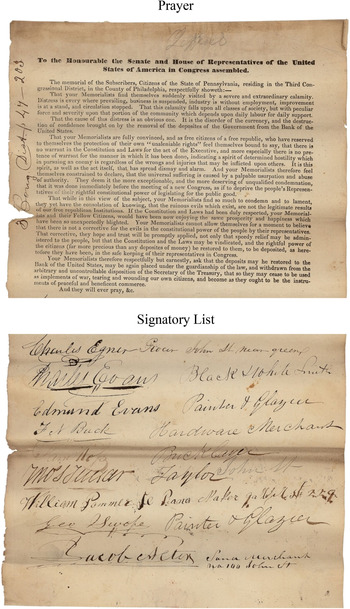
Memorialists sent in a variety of different resolutions, though most shared some version of the common themes of decrying executive tyranny and deploring the “pecuniary embarrassment” following removal of the deposits. A sample petition from Philadelphia appears in Figure 1 (which displays the petition's prayer and its signatory list). The prayer calls attention both to the “distress … everywhere prevailing” caused by the threat of deposit removal and to a set of themes anchored in republican political discourse. Most of the petition's prayer is devoted not to currency and financial issues, but to the actions of the Jackson administration. “There is no warrant in the Constitution and Laws for the act of the Executive,” the memorialists complained, and they prayed that Congress would remove the deposits from “the arbitrary and uncontrollable disposition” of Taney. The signatory list suggests that, in fact and in self-presentation, the petitioners described themselves as laborers—painters and glazers, hardware merchants, piano makers, bricklayers, smiths. Clay would seize upon this point to note that the petitions were coming from a wide range of social interests and that it was not merely the deposits issue, but the inflammatory actions of “Jackson men,” that were sowing such broad discontent.
Example Prayer and Signatory List. This figure displays an example of the prayer of a petition (from March 24, 1834) asking for the restoration of the deposits as well as the signatory list that accompanied it. (Source: National Archives Record Group 233).

Petitions of this sort both reflected and attracted the action of a broad range of antebellum elites. Key allies such as Virginia's Littleton Tazewell joined in the action. As the Spectator of Norfolk reported in January 1834, Tazewell's leadership at a Norfolk meeting was centered upon the issue of executive usurpation: “Mr. Tazewell's gigantic mind was elicited on this important occasion—the flood of light which he shed upon all the topics connected with it, and the strong illustration which his facts and his arguments afforded of a dangerous assumption of power by the Executive—carried conviction to every mind present.”Footnote 39 Some went further and expressed a lack of confidence in the state banks (now holding the deposits removed from the BUS), defended borrowing practices, warned against the risks of a metallic currency, thanked members of Congress for their actions against removal of the deposits, or even asked for a recharter of the BUS. Resolutions asking for a recharter provide additional evidence that the petitioning campaign expanded beyond the hands of members of Congress. Communicating with allies and taking stock of the situation in Congress and state electorates, Clay came to realize early on that a recharter would be impracticable and a strategic misstep. In early February, he wrote to Biddle that “the Bank ought to be kept in the rear; the usurpation in front. If we take up the Bank, we play into the adversarys hands [sic] … we may and probably would divide about the terms of the charter, and finally do nothing leaving things as they are.”Footnote 40
Although comforted and energized by the wave of petitions, Clay began to express doubts over the prospect of success for the petitioning campaign in Congress by the end of March 1834. In a letter to his son, he noted that while no direct vote in either the House or the Senate had occurred, it was “well understood that a majority in the H. of R. still exists in favor of the measure of the Executive.”Footnote 41 Furthermore, he began mentioning upcoming elections in Kentucky, New York, and Virginia as alternative demonstrations of public opinion that might influence members of Congress. That is, it appeared to Clay that the petitions had not done enough, at least in the House. On March 27, Clay gave a closing speech on the removal of the deposits and his resolutions for censure. His measure for censure against Jackson passed in the Senate by a vote of 26–20. But with no movement in the House, he confided in Tazewell that there was “no prospect of Congress regaining its lawful custody of the Treasury, unless the president shall voluntarily loosen his grasp of it.”Footnote 42 Even as Clay had expressed reservations, petitions continued to stream into Congress through April, May, and June. Considering that prospects for restoration of the deposits had likely dimmed at this point, we view the fact that petitions continued to come in as additional evidence of mobilization that went beyond manipulations from elites in Congress.
Yet throughout the spring of 1834, Clay and his allies began to detect that the petitioning campaign was helpful in shaping and even measuring public opinion even as the House was a lost cause. At the dawn of a new year, New York ally Peter B. Porter could write to Clay that the state of public opinion looked hopeless: “The people of this country appear to be perfectly spellbound. Lulling at their ease, in wealth and luxury, they seem to be entirely unconscious of the causes of their prosperity, and insensible to the dangers which threaten it; and if they are not awakened to a sense of their true situation by the bold and prophetic expostulations of yourself and copatriots, nothing short of the actual adversity which must soon follow (and which, if not the best, is always the most infallible instructor) can teach them practical wisdom.” Yet just six weeks later, Porter wrote of his sense that the tide was turning against Jackson, and that the debate had exposed weaknesses in the administration. Clay himself began to focus less upon restoration of deposits and more on the immediate aim of shaping the “will” of the public, an entity that could be shaped, expressed, produced, displayed, and even enumerated. As he wrote to his ally James Brown of Philadelphia, restoration of the BUS's deposits “depends upon the People, and demonstrations of their will. They can produce it.” And to Littleton Tazewell, now on his way to taking office as governor of Virginia, Clay could write that “We are gaining ground, and I am not without hopes of final success in the H. of R. It will depend on the amount of public opinion brought to act upon it. And in that respect the movements in Virginia have been of inestimable service.”Footnote 43
While expressing mixed opinions of his prospects for restoration in the House, Clay expressed his growing sense that the petitioning momentum was expanding, that anti-Jackson energies were appearing in several states, and that support for the petitioning campaign extended well beyond the anti-Jackson vote of 1832. In March, April, and May, Clay took repeatedly to the Senate floor to draw attention to the size of the individual petitions, the diversity of towns and states that were producing them, and to the breadth of support. Even “Jackson men” and committed “Administration men” were petitioning and remonstrating Congress against deposit removal, and many of the petitions mentioned the theme of executive usurpation. In late March and early April, Clay's focus turned more numerical, even statistical. After being alerted to an Erie County petition with between 4,000 and 5,000 signatures, Clay formally proposed that the Senate collect and summarize all of the petitions that had been received on the deposits issue. In April and in June, he took the Senate floor to draw attention to the Senate's tally (150,000) of signers of petitions and memorials critical of Jackson's fiscal policies and praying Congress for economic relief. He even chided the opposition for not seeing this as “one of the best tests of public opinion, next to the evidence which the ballot-boxes afford.”Footnote 44
The character of the petitioning campaign suggests that two complementary conditions contributed to its wide reach. First, its origins came from above (i.e., members of Congress), which resulted in some distinct organizational advantages. While no party infrastructure existed to aid in collecting signatures, existing networks between members of Congress in Washington, DC, and local elites made a coordinated response possible. Furthermore, memorialists situated themselves within a broader anti-Jackson movement and would at times even refer in their own petitions to text produced in neighboring towns or counties. Second, there was sufficient public opinion against Jackson and his move against the bank to facilitate a petitioning campaign. The campaign could not have occurred if Jackson had held uniform support among citizens.Footnote 45
The logic above helps inform our view of the significance of petitioning against removal of the deposits. Higher rates of petitioning reflected a set of local conditions favorable to future Whig Party organization—despite the fact that no developed party organizations existed at the time of the crisis over the bank. Studying the public meetings and the petitions that came out of them has allowed us to identify several factors that account for the correlation between anti-Jackson petitioning in 1834 and subsequent Whig Party success.
Anti-Jackson meetings demonstrated the relative strength of the links between national party leaders such as Clay and operatives at home who could be called upon to organize citizens. This is demonstrated not only by the correspondence between leaders like Clay and key organizers of the meetings, but also by the fact that it was common for local leaders of meetings on removal of the deposits to travel to Washington, DC, and hand-deliver their petitions. In some cases, local meetings can even be directly linked to attempts to organize for local elections and develop the beginnings of a state party infrastructure. For example, the resolutions from one meeting in Ohio explicitly stated that they would be appointing delegates to travel to an upcoming convention where a candidate would be chosen to run in the upcoming race for governor.Footnote 46
Perhaps more importantly, the petitioning campaign itself played a role in developing capacity for later Whig Party organization at the state and local level. Indeed, the meetings provided an outlet through which to develop additional organizational expertise. Invariably, newspaper accounts of such meetings described the appointment of a committee or board to lead the event. For example, the Alexandria Gazette recounted: “On motion of R.H. Henderson, Esq. Col. William Ellsey was called to the chair and F. Hixon, Esq. appointed Secretary. Cuthbert Powell, Esq. addressed the Meeting, going into a general examination of the subject; and moved that a committee … be appointed to report resolutions.”Footnote 47 Furthermore, committees drafted points of order and resolutions, and they were also responsible for the submission of the agreed-upon memorial to Congress. As noted previously, some committees went so far as to travel to Washington, DC, where they would deliver the petition directly to a representative and attempt to meet in person with those sympathetic to their position. The committees also sought coverage of their activities in local newspapers, which represented a concerted effort to gain publicity and spread their message. Resolutions drafted at the meetings often contained explicit instructions to distribute the meeting minutes for publication to nearby newspapers.
While the systematic tracing of nineteenth-century political careers is beyond the scope of this article, we occasionally observe that meeting attendees subsequently served as Whig Party politicians. Examining who was on leadership committees for just a handful of meetings (recorded in local newspapers) allowed us to identify several people who held office as Whigs, sometimes many years later. The Alexandria Gazette reported that one Cuthbert Powell, Esq., served on the leadership committee at a January 13, 1834, public meeting in Loudon County, VA.Footnote 48 Powell later served as a Whig in the Twenty-Seventh Congress.Footnote 49 David Crooker Magoun led a March 8, 1834, meeting in Bath, Maine;Footnote 50 he later served as the town's Whig mayor.Footnote 51 That said, attending such a meeting by no means ensured a life of service to the Whigs. Nathan Beverley Tucker helped lead a January 9, 1834, meeting at New Kent County, Virginia.Footnote 52 But throughout the 1830s and later, he remained a state-rights proponent and never fully embraced the Whig Party.
All told, petitioning served a variety of purposes as a political tool after Jackson's removal of the deposits. It linked meeting attendees in states such as Maine or Ohio to the political maneuverings of Henry Clay back in Washington, DC; it allowed members of Congress to formally register the opinions of constituents at home, while also giving voice to newly mobilized groups roused by the economic downturn and suspicion of Andrew Jackson; it even played a role in the evolution of Clay's thinking as he tested different angles for his anti-Jackson appeal. Common to all these notions is the idea that this form of political communication served as connective tissue linking citizens and government before a party organization was in place. In this manner, petitioning played a key role in the development of the newly emergent Whigs. To test the empirical implications of this hypothesis more fully, we set out to gather data on the petitions systematically.
5. DATA
5.1. Petitions
Using a combination of sources, staff members at the National Archives compiled a database tracking petitions submitted to Congress in response to the removal of deposits from the BUS. We have supplemented this database by gathering data on petitions from information available in the Congressional Globe.
Constructing our database required confronting the issue of how to search through thousands of pages of text to find the relevant petitions. With the digitization of historical congressional publications, this has recently become a manageable task. Using a digitized version of the Congressional Globe as our source material, we performed a keyword search on the text of the Globe in the Twenty-Third Congress. We used regular expressions to identify all passages in the Globe in which a term in {petition, memorial, prayer, proceeding, resolution, memo} was within a distance of 100 words of a term in {bank, deposit, credit, finance, currency, pecuniary} and vice versa.
This approach produces a substantial number of Type I errors (false positives) but, we believe, limits the number of Type II errors.Footnote 53 Combing through the set of returned “hits,” we identified relevant petitions and recorded data including the date at which the petition was read, the petition's place of origin, whether or not the petition supported the removal of the deposits, and the member of Congress who presented the petition to the floor.
For example, a search of the Congressional Globe from January 11, 1834 (see Figure A1 in the Supplementary Appendix), returned evidence of several petitions, here referred to as “memorials.” In fact, multiple petitions are mentioned in the span of a few lines: the first, a memorial from Philadelphia on the “derangement” of the currency; a second petition, of a similar subject; and, finally, a third memorial on a different topic—the invention of a steam plough-ship. Through the reading of this passage as well as the petition mentioned before it (not visible here), we record the information in this passage as two distinct petitions from Philadelphia expressing views against the removal of the deposits.
After applying this approach to the full text in the Congressional Globe for the Twenty-Third Congress, we merged our results to the existing database compiled at the National Archives. The resulting database provides a valuable snapshot—both geographically and temporally—of public action responding to the removal of the deposits.Footnote 54
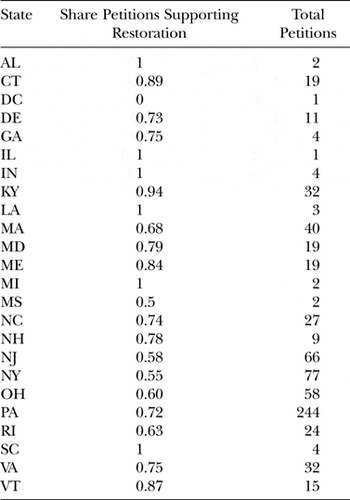
In practice, the petitions in the database span from December 1833 to June 1834. There was at least one petition from a total of twenty-three states or territories, ranging from a single petition from Illinois to 244 from Pennsylvania. Table 1 displays the number of total petitions, as well as the share of petitions favoring restoration of the deposits, by state. Among states whose residents submitted more than thirty petitions, Kentucky—home state of Henry Clay, an architect of the protestations against President Andrew Jackson—had the greatest share favoring restoration of the deposits. On the other hand, New York, which stood to benefit greatly from the removal of the deposits, had the lowest share (at 55 percent) of petitions (among states with over thirty petitions) expressing a desire for the restoration of the deposits.Footnote 55
Petitions by State

This table displays the number of petitions on the subject of restoration of deposits by state, along with the share of petitions in favor of restoration.
In the analysis conducted in this article, we aggregated the petitions' locations to the county level. Thus, while the text of the Globe often refers to a petition's city of origin, we translated this information into county-level data. Table A1 in the Supplementary Appendix displays the twenty-five counties that submitted the greatest number of petitions. Not surprisingly, Philadelphia County (home of the BUS main branch) heads the list and, in fact, submitted three times more petitions than the next most prolific county.
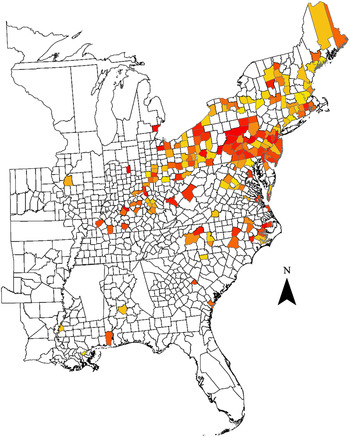
Figure 2 displays the total number of petitions per capita (either pro- or antirestoration). The greatest degree of petitioning per capita clearly occurred in the Northeast, with a particularly high concentration radiating out from Philadelphia County stretching west into Ohio and East/Northeast into New Jersey, New York, Connecticut, and Massachusetts. Southern and western states exhibited a lower volume of petitioning; furthermore, the few counties in states such as Georgia and Alabama that sent petitions to Congress tended to be located near centers of trade and, as a result, near a BUS branch.
Geographic Distribution of Petitions Per Capita After Removal of the Deposits, 1833–1834. This figure displays a heat map representing petitions per capita. Dark (orange) counties have more petitions per capita. Light (yellow) counties have fewer petitions per capita. Uncolored counties submitted no petitions.

The majority of petitions submitted to Congress favored the restoration of the deposits. In all, 70 percent of the 715 petitions in the database supported restoration. This should not be interpreted as an unbiased measure of public opinion. For one, citizens immediately outraged by the removal of the deposits appear to have been more likely to notify Congress of their displeasure than their counterparts who approved of Jackson's action against the bank. Figure 3, which displays the geographic distribution of petitions over the course of the crisis, bears this story out. In the first several months after removal of the deposits, the counties that had sent petitions to Congress primarily urged restoration of the deposits. Only by March 1834 do we begin to observe significant volume, in some cases responding to earlier petitions from the same county, that supported Jackson in his quarrel with the bank.
Time Lapse Response. Darker (orange) counties had a majority of petitions favoring restoration of the deposits. Lighter (yellow) counties had a majority of petitions supporting President Jackson in the removal of the deposits.

The interpretation advanced in this article sees the volume of petitions—at least those in favor of restoration of the deposits—as reflective of early stirrings of political activity, which over time developed into more substantial organizing for the Whig Party. Thus, we view the geographic variation in political activity captured by the petitions as a measure of factors, potentially otherwise unobserved, that proved important for subsequent party development.
5.2. Banking Data
The removal of the deposits varied in terms of immediate economic impact depending on a county's level of financial activity and ties to BUS and state bank branches. Bray Hammond, quoting from the writings of Jabez Hammond, an observer of the crisis, notes: “The state banks believed that if the United States Bank should be annihilated, these immense deposits would be made in their own vaults, and hence all the benefits arising from deposits and also the whole profits of the very great circulation of the United States Bank notes would be transferred from the United States to the state banks—without compelling them to increase their own capital to the amount of a single dollar.”Footnote 56 While, in fact, state banks themselves were among the greatest proponents of Jackson's aggression toward the BUS, the immediate fallout from removal of the deposits was not unmitigatedly positive for state banks and their borrowers. The economic downturn touched off by Jackson's action against the BUS and exacerbated by Nicholas Biddle's contractionary response forced state banks to retrench as well.Footnote 57
To capture variation in financial activity across counties, we employ data on the geographic locations of BUS and state bank branches along with county-level state bank characteristics. Hammond provides a list of geographic locations for BUS branches.Footnote 58 Location data for state bank branches, as well as a host of other information, is contained in a database compiled by researchers at the Federal Reserve Bank of Minneapolis.Footnote 59 This information allows us to observe the geographic distribution of banks in operation immediately before the crisis. Figure A2 in the Supplementary Appendix maps banking locations in the year before the removal of the deposits, in 1832.
These location data allow for the construction of variables measuring the distance (in miles) from the border of a county to the nearest BUS branch and to the nearest state bank branch. This provides a blunt measure of access to capital for each county, particularly those without a state bank or BUS branch. The historical state banking data also allow for the construction of additional county-level banking variables. For the two years before the banking crisis (1831–1832), we track the number of state banks in operation in a county, the capital of state banks in a county, as well as the ratio of loans outstanding to deposits in a county. These serve as additional measures of preexisting access to credit in a given county.
5.3. Elections Data
We use historical election data assembled by the Inter-university Consortium for Political and Social Research.Footnote 60 The analysis in this article makes use of presidential election returns for the years 1828–1852. In order to retain comparability over time, we restrict the sample to only those counties in existence at the time of the crisis over the removal of the deposits. As an example, Figure A3 in the Supplementary Appendix displays county-level election results for the presidential election in 1840. In general, geographic areas with no election data at the time of the crisis were not yet states (e.g., Florida, Michigan), were Indian Territories, did not choose electors through a popular vote (South Carolina),Footnote 61 or in rare cases were simply missing from the data.
5.4. Census Data
We employ county-level control variables using 1830 and 1840 Census data.Footnote 62 Data collected for the 1830 Census, the closest census year before the removal of the deposits, were very sparse. We employ in our analysis only the following: total population, foreign-born nonnaturalized population (percent), non-White population (percent), slave population (percent), female population (percent), urban population (percent, places over 2,500, and places over 25,000).
The 1840 Census captures a richer set of county characteristics. In addition to the characteristics from the 1830 Census, these include occupations (mining, agriculture, manufacturing, and trades), and learned professions/engineering (percent), university population (percent), and newspapers in circulation (daily, weekly, and biweekly).
6. ANALYSIS
6.1. The Relationship between Petitioning and Whig Party Development
To what degree did petitioning activity, arising from the crisis caused by Jackson's removal of the deposits, anticipate later patterns of Whig Party development and voting? To answer this question, we estimate an equation of the form:
 $$\eqalign{\hbox{Whig Vote Share}_{s,c,t} &= {\rm \alpha} _{\rm s} + {\rm \theta} _1 \hbox{Petitions Supporting}_{s,c,1834} \cr & + {\rm \theta} _2 \hbox{Petitions Against}_{s,c,1834} \cr & + {\rm \theta} _3 \hbox{Petitions Supporting}_{s,c,1834} \cr & \times \hbox{Petitions Against}_{s,c,1834} + X_{s,c,t} {\rm \beta} \cr & + {\rm \varepsilon} _{s,c,t}}$$
where s indexes state, c indexes county, and t indexes time. We include a vector of controls, X s,c,t , and state fixed effects α. Our variables of interest, the number of petitions supporting restoration of the deposits and the number of petitions against restoration of the deposits, are normalized by county population. Tables A3–A7 in the Supplementary Appendix present results for each presidential election between 1836 and 1852. We present regression coefficients on our measures of petitioning in several ways: with no controls, with only state fixed effects, and with controls meant to capture county-level financial and population characteristics.
Across this set of election years and the full range of specifications, we find that petitions supporting restoration are a robust predictor of a county's later Whig Party vote in presidential elections—direct evidence in support of our hypothesis. On the other hand, a county's number of petitions against restoration never has an effect that is statistically distinguishable from zero. This finding is consistent with our theory of petitioning as not an unqualified indicator of party development but rather highly dependent on political conditions. The notion that not all petitioning predicts subsequent party development is illustrated here: Petitions against restoration are not strongly correlated with future Democratic Party vote share.Footnote 63 That said, the direction of the effects does match our intuition. Additional petitions in favor of restoration (and against Jackson) are associated with an increase in the Whig Party vote; additional petitions against restoration (and in favor of Jackson) are associated with a slight decrease.
We also include an interaction between petitions for and against restoration. This variable captures the differential effect an additional petition has, given a positive number of petitions expressing the opposing view. For instance, we might suspect that additional petitions against restoration, when there are already petitions supporting restoration, reflect a stronger level of support for the Jacksonian Democrats. In practice, the estimated effect is consistently negative, though it is small and not persistent in later election years.
Our specifications include a variety of controls in an attempt to account for county-level characteristics correlated with both petitioning and Whig Party vote. The banking controls capture variation in a county's level of financial development that might influence both the level of petitioning and Whig Party vote. Including the banking controls does not have a substantial impact on the estimated effect. The population controls capture county-level variation in population characteristics, including a county's percentage of foreign-born population and urban population. We hypothesized that these two variables in particular might play an important role, as scholars have argued that socioethnic factors explain variation in the Whig Party vote.Footnote 64 Despite this possibility, conditioning on these and other population controls still does not alter our result. Even if socioethnic factors correlate strongly with Whig Party vote, they do not appear to correlate with in state variation in levels of petitioning in a meaningful way when holding other factors constant.
Finally, we include a set of controls designed to measure county composition of the workforce. Guilds, boards of trade, and other occupational associations provided an important organizational structure through which petitioners gathered signatures before submitting a memorial to Congress. For example, an examination of petitions from Pennsylvania in February and March 1834 reveals an extremely wide variety of occupation-based groups who refer to themselves directly in petitions.Footnote 65 The census data do not reflect the full extent of this diversity, but controlling for the share of population employed in manufacturing and trades, along with the number of newspapers in circulation, captures some of the variation and does not alter the estimated effect.
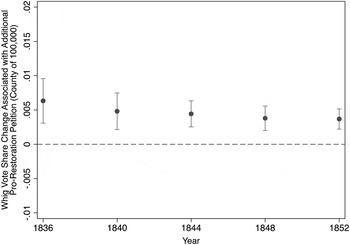
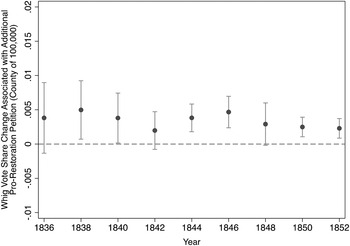
Figure 4 illustrates the estimated association between an additional petition in favor of restoration and Whig Party vote share across all years in the sample.Footnote 66 Because we normalize by population, the interpretation of the effect deserves additional explanation. Specifically, we normalize by petitions per 100,000 citizens. Thus, the effect we report is most apt for a large county such as Worcester County, Massachusetts. For a smaller county, an additional petition per 100,000 suggests an even larger corresponding increase in Whig vote share. For example, in a county of 20,000 people the effect size of an additional petition would be increased fivefold. For example (using the point estimates from specification 4 of the model estimating the effect on the 1836 Whig presidential election), an additional pro-restoration petition would be associated with a roughly 3 percent increase in vote share for the Whigs. Considering the magnitude of this effect, it grows clear that even one additional petition in favor of restoration was quite a strong marker of future electoral success.
Petitioning and Whig Party Vote Share, All Counties. The association between petitions in favor of restoration of the deposits and subsequent Whig Party presidential vote share starts out as positive and statistically distinguishable from zero. In subsequent elections the size of the effect diminishes.

Looking across time, the magnitude of the effect diminishes—though it remains precisely estimated. From 1836 to 1852, the effect dissipates by 0.0015, or by roughly 40 percent. We interpret the persistent correlation between petitioning in support of restoration of the deposits and later Whig vote share as evidence that petitions served as a prepartisan indication of subsequent party development. High levels of petitioning indicated places where a cleavage had formed in response to Jackson's removal of the deposits, where there were emerging linkages between local citizens and anti-Jacksonian representatives, and where citizens had begun developing organizational capacity through holding meetings on the removal of the deposits. In other words, counties with a large number of petitions expressing outrage and calling for restoration of the deposits were on their way to developing a party structure designed to transmit policy preferences—opposing Jackson's perceived “executive tyranny” and decrying periodic financial downturns—to political representatives of their choosing.
The crisis over the removal of the deposits features centrally in this theory because it created the necessary conditions for the formation of a cleavage that Whig politicians could exploit. The results presented above suggest that standard economic and socioethnic factors do not capture all of the within state variation in support for Whig candidates. Our measure of petitioning helps explain part of the additional variation.
6.2. Alternative Explanations
6.2.1. Petitions Reflect Only Preexisting Public Opinion
One interpretation of the observed relationship is that petitioning reflects preexisting public opinion. Under this interpretation, geographic variation in petitioning serves as something resembling a rudimentary public opinion poll and reflects not a moment of change in party development but rather a tally of preexisting anti-Jackson opinions. Of course, Clay himself pointed to the outpouring of petitions in favor of restoration of the deposits as a demonstration of the public's will. Viewing petitioning as a proxy for preexisting public opinion does not call into question the internal validity of the correlation we have identified, but rather suggests that the implications of the finding are less interesting than we contend. Our account of the wave of petitioning provided a range of reasons arguing that petitioning after removal of the deposits cannot be considered as only an indicator of preexisting public opinion. However, we also have tried a statistical evaluation of this critique.
To assess this critique and as a robustness check, we estimate specifications that include the county-level vote share for the 1828 National Republican presidential candidate John Quincy Adams. While it would be a mistake to draw too direct a line from the National Republicans to the Whigs in the next decade, there is no denying that former National Republicans composed a notable faction within the Whigs. More importantly, support for the National Republicans in 1828 should correlate strongly with preexisting anti-Jacksonian sentiments floating among the electorate while still providing a snapshot of sentiments before the BUS became a pressing national issue. Indeed, we use the 1828 election results as a control rather than 1832 because controversy over Jackson's veto of the renewal of the BUS charter tinged the 1832 election.
We also provide estimates of our original specification with 1828 National Republican vote share included as a robustness check (Table A8 in the Supplementary Appendix). Across all years, with the lone exception of the 1840 election, the estimated effect retains a p value under .05. In addition, the result still persists when including higher order polynomials of the 1828 National Republican vote share (Table A9 in the Supplementary Appendix).Footnote 67 This is not to say that the vote share for National Republicans in 1828 has no explanatory power—in fact, our estimates show that 1828 National Republican voting had a significant positive relationship with later Whig voting. And, including National Republican vote share substantially improves the fit of the model, as R-squared increased by 0.2 on average across the five election years. Given that we control for a measure of underlying political predispositions in each county, the persistence of the correlation between petitions in favor of restoration and subsequent Whig Party vote share likely reflects a relationship distinct from what we would observe if the results were entirely due to preexisting public opinion.
6.2.2. Presidential Vote Share Is a Poor Measure of Party Development
This study measures electoral performance within a county and asserts that it captures the extent of Whig Party development in a county. Such an approach certainly deserves some qualification. For one, party development is conceptually distinct from the electoral performance measured in this study. Furthermore, of the available proxies for party development, presidential vote share might serve as a particularly poor one. Candidates in national elections who have national reputations may win votes in a county even in the absence of a developed party structure. On the other hand, performance within the congressional district or in local elections ought to reflect more accurately the strength of a party organization.
While the general critique that electoral outcomes are not equivalent to party development applies to our approach, we can examine data from congressional elections to ensure that the results we find using presidential elections are not an artifact of this choice. Figure 5 presents the effect estimated when using Whig Party vote share in congressional elections as the outcome variable. The point estimates from these regressions are actually quite close to our initial estimates. This should allay some of the concerns we have outlined.Footnote 68 To the extent that state-level elections provide a better indication of party development than presidential elections, our results suggest a link between petitioning after the removal of the deposits and subsequent Whig Party development.
Petitioning and Congressional Whig Party Vote Share. The pattern observed between petitioning and Whig vote share in congressional elections follows much the same pattern as in presidential elections.

7. STATE PARTIES AND THE PREDICTIVE POWER OF PETITIONS
An important remaining factor in Whig Party development concerns the strength and vitality of state party organization.Footnote 69 State-level Whig Party organizations are important to our findings for at least two reasons. First, the evidence presented indicating a link between petitioning and Whig Party development at the county level for the nation as a whole should also hold up for state party development. Second, state party development likely played a mediating role in the link between petitioning and party development at the national level: We hypothesize that the relationship between petitioning and Whig Party development reflected by Whig presidential vote share will be strongest in states with strong state party organizations.
The data on petitioning during the BUS conflict cannot, on their own, illuminate the critical factor of state party development in the late 1830s and 1840s. Yet it is possible to examine the predictive power of Bank War petitions across states with an eye to the structural integrity of state parties. While the measurement of state legislative party strength is difficult,Footnote 70 data from state legislative contests can help provide clues: State legislatures where a party's candidates are more numerously represented indicate a party's ability to run candidates at the local level for a variety of offices. This was all the more so in the early to middle nineteenth century, before the nationalization of party organizations.Footnote 71 Holt himself describes “how important taking distinctive stands on state issues was to the development of competitive and coherent state Whig organizations.”Footnote 72 And, he continually employs data on state legislative elections to measure the variable strength of state party organizations and the force of the Whig Party label.Footnote 73
Looking across states, the number of pro-restoration petitions in 1834 is positively associated with state Whig Party strength, as measured by years of control of the lower house of the state legislature. (See Figures A4 and A5 in the Supplementary Appendix for an illustration of the relationship graphically.) While aggregating the political activity to the state level makes it infeasible to estimate a statistical relationship as we did at the county level, the association we observe provides compelling additional evidence because measures of state party strength are perhaps an even more precise indicator of party development than presidential election returns. Examining party control of state legislatures further confirms the relationship between petitioning and subsequent state party strength. Table A10 in the Supplementary Appendix groups states based upon state party strength from 1836 to 1848. We classified a state in which the lower house of the state legislature was controlled by a Whig supermajority for more than six years (i.e., a majority of years) as one of the “strongest” Whig states; states with more than six years of Whig majority control were classified as “strong” Whig states; states with fewer than six years of Whig state party control were classified as “not strong.” Among these three groups, there are notable differences in the number of pro-restoration petitions. In fact, the median “strongest” Whig state sent twenty-nine pro-restoration petitions; the median “strong” Whig state sent fifteen pro-restoration petitions; finally, the median “not strong” Whig state sent only two pro-restoration petitions.
We also chose four states—Kentucky, New York, Ohio, and Pennsylvania—to illustrate the state party dynamics at work in more detail.Footnote 74 The narrative evidence in Holt suggests that among the four states, Kentucky had the strongest Whig Party organizations, Pennsylvania had the weakest Whig Party organization, and New York and Ohio were somewhere in between. Holt remarks that state Whigs' “unpopular stand on a specific state economic policy” put the Pennsylvania party “at a fatal disadvantage in the October 1836 elections.”Footnote 75 On the other hand, because “Ohio's Whig Party successfully differentiated itself from Democrats on specific state policies, it had, by the end of 1836, developed much greater stability and a clearer partisan identity than its counterparts in Indiana, Illinois, Missouri and Mississippi.”Footnote 76 Kentucky's strong Whig organization is derived in part, Holt suggests, from the carryover effects of National Republican organization there.Footnote 77
Using the data on state legislative party seats (measured as the party's share of the legislative seats after given electoral campaigns), it becomes clear that by this measure too, Kentucky, followed in decreasing order by Ohio, New York, and finally Pennsylvania, harbored the strongest Whig Party organization. After the 1837 contests, Whigs held 71 percent of lower-chamber legislative seats in Kentucky and 56 percent in Ohio. Pennsylvania had a 44 percent Whig lower chamber. At this time New York saw the highest Whig electoral success with fully 78 percent of seats being taken by Whigs. Yet by 1840, this level had fallen by 26 percentage points to 52 percent in 1840. Meanwhile in 1840, Kentucky continued with 77 percent of its lower-chamber seats in Whig hands and Ohio had 71 percent. Pennsylvania's rose slightly, enough to “tie” New York at 52 percent.Footnote 78 Similarly, from 1844 to 1848, the Whig share of Kentucky's legislature went from 76 percent to 64 percent and never fell below 59 percent, while in Ohio, the Whig share went from 57 percent and remained ever a majority, ending the decade at 53 percent. Pennsylvania saw high variability, but only once in the years from 1844 to 1848 did state Whigs achieve a clear majority (1846, at 59 percent), their representation ranging from 32 percent (1845) to 45 percent (1848) in other years. New York Whigs again saw great variability, starting in 1844 with only 36 percent of the lower chamber, then rocketing to 71 percent in 1846 and further to 84 percent in 1848.Footnote 79
In terms of pro-restoration petitions sent, Pennsylvania is an outlier among those states where the Whig Party never gained a strong foothold. Despite the 175 pro-restoration petitions—clearly a function of the location of the BUS headquarters in Philadelphia—the state Whig Party controlled the lower house of the state legislature in only two years between 1836–1848. However, Kentucky, New York, and Ohio also all ranked among the top five states in terms of pro-restoration petitioning and also all had state parties that controlled the lower house of the state legislature in a majority of years between 1836–1848.
If, as we have suggested, an outflow of petitions indicated fertile ground for subsequent Whig Party development, then we expect this relationship to hold up both within and across states. The results presented above along with the first specification (without state fixed effects) in our main results (Tables A3–A7 in the Supplementary Appendix) confirmed that petitioning predicted variation in Whig Party success across states, and the result held up within states as well when we included state fixed effects. State-specific analysis conducted on our four sample states (and presented in Table A11 in the Supplementary Appendix) further demonstrates that within state variation conforms with our expectations. In the state of Pennsylvania, where Whig Party organization was weakest throughout the period, the 1834 petitions are not consistently predictive of later Whig voting patterns. In Kentucky, New York, and Ohio, petitions against bank removal do predict Whig Party voting in general elections from 1836 to 1852, with the result holding up in Kentucky in four of five election years, in Ohio for three of five election years, and in New York for two of five election years. Thus, within state variation in pro-restoration petitioning appears to be correlated with subsequent election results in the states where stronger state parties developed. This finding suggests that the development of a state Whig Party may have served as a crucial mediating factor in translating political activity indicated by petitioning in 1834 into subsequent electoral success in presidential elections.
8. CONCLUSION
Andrew Jackson's removal of deposits from the BUS stoked an intense and massive wave of petitioning activity. Those petitions, and the organizing activity that sponsored them, did more than place financial issues at the center of the national agenda. Even while ultimately unsuccessful, the antiremoval petitioning campaign raised important questions of executive power and helped to crystallize a structure and ideology of opposition to Jacksonian Democracy. The historical source comprising these petitions captures one of the first systematic outpourings of political sentiment expressed through petitioning on an economic policy issue in the United States. Our investigation of antiremoval petitions suggests they began as part of a remarkable campaign carried out by Henry Clay and his colleagues in the Senate. Clay's correspondence and the sheer mass of the petitions and signatures produced reveal that the wave of petitioning achieved unanticipated levels of significance, both for Clay at the time and, we argue, for analysts of political behavior. Pro-restoration petitioning shaped the emergence of the Whig Party, organizing and identifying a new line of Jacksonian opposition and permitting Old Hickory's opponents to dispense with older lines of National Republican rhetoric and organization. The historical narrative and empirical results presented in this article support this claim. We document a persistent correlation between county-level variation in petitions supporting restoration of the deposits and later Whig vote share. This correlation is robust across a range of specifications—including when controlling for 1828 National Republican vote share and when using congressional rather than presidential election results. In addition, we observe a similar relationship with pro-restoration petitioning serving as a predictor of subsequent state-level Whig Party strength.
Petitions sent in response to the BUS crisis thus provide a window into the development of the Whig Party. As Clay sought to persuade his colleagues to censure Jackson, he would note that success depended “on the amount of public opinion brought to act upon it.” The petitions sent to Congress were material proof of anti-Jacksonian sentiment; they demonstrated the viability of a political movement built upon a set of issues—executive tyranny, pecuniary embarrassment, and so forth—that might provide the basis for an enduring coalition. Insofar as they aided the rise of the Whigs, petitions helped facilitate the transition to a political landscape with mass parties.
For scholars of parties then and now, the story of Bank War petitioning and the Whig Party points to thorny and yet unanswered questions about how parties emerge. In political science, a robust and important debate about American political parties casts them as either the tools of politicians seeking to manage elections or, in a recent contribution focused upon “group-centric parties,”Footnote 80 as driven by coalitions of intense “policy demanders” who seek to use government to advance their ends. The case of petition-driven early Whig Party development both supports and undermines these characterizations. The groups that petitioned in response to removal of the deposits surely did have a strong policy demand; however, the historical evidence illustrates that, at least with regard to the petitioning campaigns, the rise of the Whigs was crucially orchestrated by the entrepreneurial Henry Clay. His decision to pivot from an emphasis on the BUS toward a focus on executive tyranny is reminiscent of a model in which politicians search for the issues to build a durable party line.Footnote 81 Furthermore, his letters demonstrate his crucial role in sparking meetings that brought together anti-Jacksonian citizens. Still, it would be a mistake to downplay the role played by grassroots policy demanders. Our empirical results suggest that the Whig Party came to be strongest in precisely those areas with more intense petitioning, and this surely reflects the importance of groups willing to mobilize behind a set of issues, even in the absence of party organization. In this light, the patterns of petitioning that we observe might be seen as reflecting a back and forth between policy demanders on the one hand and election-minded politicians on the other before a more rigid party organization takes shape.
The deeper question in much of this literature is one that has been examined by historians more than by political scientists. Where do groups of “policy demanders” come from? How do their coalitions form? If they have not already formed, then presumably some combination of information constraints, incentive compatibility issues, institutional rules of the game, or behavioral limitations prevent them from doing so. Rather strikingly, and almost indirectly, scholars in the “group-centric” school of parties point to a form of petitioning as a means by which coalition partners detect their shared interests.Footnote 82 Yet whether the entity in formation is a new mass party entirely or a new bloc within an existing party,Footnote 83 scholars of American political development have written little about this process. Not all petitioning waves, or even “movements,” become parties or blocs within parties. Yet enough do so that the question of party formation and party purposes cannot be examined without attention to these dynamics. The rich data and narrative to be found in petitions offer to students of American political development a unique and perhaps unparalleled resource for inquiring when demands become organized into parties and when they do not.
Supplementary Materials
To view supplementary material for this article, Please visit http://dx.doi.org/10.1017/S0898588X15000073.