





Impact statement
Perinatal depression carries a large mental health burden for women in low- and middle-income countries, yet few evidence-based interventions have been adapted to the cultural and health system realities of Sri Lanka. The World Health Organisation’s Thinking Healthy Programme (THP) is a cognitive-behavioural intervention designed for delivery by non-specialist workers. Before it can be used safely in Sinhala-speaking communities, the original English manual requires careful translation, cultural adaptation and validation. We translated and culturally adapted the THP manual into Sinhala using Bernal’s Ecological Validity Framework, pre-tested the draft with five Public Health Midwives (PHMs) across five Medical Officer of Health areas in Galle District, and validated the final version through a Modified Delphi process with a nine-member multidisciplinary expert panel. The scale-level Content Validity Index was 0.96, and the panel reached unanimous consensus, indicating that the adapted manual is linguistically clear, conceptually equivalent to the original and culturally appropriate for Sinhala-speaking women in this setting. The adapted manual provides a structured resource for future field-testing within Sri Lanka’s established Reproductive, Maternal, Newborn, Child, Adolescent and Youth Health Programme. Embedded within routine PHM home visits and mother support groups, THP could offer a feasible pathway for task-shared perinatal mental health support without creating a separate workforce. The findings apply most directly to Sinhala-speaking women in the Southern Province, and clinical effectiveness has not yet been established. Tamil translation, direct involvement of women with lived experience and pragmatic field trials are needed before wider scale-up can be recommended.
Introduction
Perinatal depression is a major global public health concern that affects between 7% and 20% of women worldwide (Rahman et al., Reference Rahman, Fisher, Bower, Luchters, Tran, Yasamy, Saxena and Waheed2013; Alhusen and Alvarez, Reference Alhusen and Alvarez2016). The perinatal period brings substantial physiological, hormonal, social and psychological change, and is associated with a higher vulnerability for the onset or recurrence of mental disorders (Biaggi et al., Reference Biaggi, Conroy, Pawlby and Pariante2016; Dagher et al., Reference Dagher, Bruckheim, Colpe, Edwards and White2021). Defined as a non-psychotic depressive episode occurring during pregnancy or the postpartum period, perinatal depression is one of the most common complications of childbirth (Howard et al., Reference Howard, Molyneaux, Dennis, Rochat, Stein and Milgrom2014; Dagher et al., Reference Dagher, Bruckheim, Colpe, Edwards and White2021). Although postpartum depression has received more attention historically, antenatal depression remains under-recognised even though more than half of women diagnosed postpartum first experience symptoms during pregnancy (Howard et al., Reference Howard, Molyneaux, Dennis, Rochat, Stein and Milgrom2014; Gelaye et al., Reference Gelaye, Rondon, Araya and Williams2016). Antenatal depression is also one of the strongest predictors of postpartum depression (Grote et al., Reference Grote, Bridge, Gavin, Melville, Iyengar and Katon2010; Biaggi et al., Reference Biaggi, Conroy, Pawlby and Pariante2016; Gelaye et al., Reference Gelaye, Rondon, Araya and Williams2016).
The consequences of perinatal depression extend well beyond maternal mental health. Affected mothers show reduced sensitivity to newborn cues, which can shape early parent-child attachment, and maternal depression and anxiety are associated with obstetric complications, preterm labour and suboptimal breastfeeding (Alder et al., Reference Alder, Fink, Bitzer, Hösli and Holzgreve2007; Prince et al., Reference Prince, Patel, Saxena, Maj, Maselko, Phillips and Rahman2007; Waxler et al., Reference Waxler, Thelen and Muzik2011; Klawetter et al., Reference Klawetter, Greenfield, Speer, Brown and Hwang2019). Their infants carry higher risks of impaired cognitive development, irritability, reduced attentiveness and emotional difficulties in later childhood and adolescence (Yonkers et al., Reference Yonkers, Wisner, Stewart, Oberlander, Dell, Stotland, Ramin, Chaudron and Lockwood2009; Stein et al., Reference Stein, Pearson, Goodman, Rapa, Rahman, McCallum, Howard and Pariante2014; Klawetter et al., Reference Klawetter, Greenfield, Speer, Brown and Hwang2019).
The burden of perinatal depression is disproportionately higher in low- and middle-income countries (LMICs), particularly among women facing socioeconomic disadvantage and limited access to health care. Prevalence rates as high as 35%–40% have been reported in some LMIC populations (Alhusen and Alvarez, Reference Alhusen and Alvarez2016), and meta-analytic estimates suggest that approximately one in four women experiences antenatal depression and one in five experiences postpartum depression (Gelaye et al., Reference Gelaye, Rondon, Araya and Williams2016). Poverty, limited social support, exposure to violence and barriers to maternal health care further compound this burden (Roddy Mitchell et al., Reference Roddy Mitchell, Gordon, Lindquist, Walker, Homer, Middleton, Cluver, Tong and Hastie2023; Pan et al., Reference Pan, Zeng, Chai, Wen, Tan and Sun2024). In Sri Lanka, available studies have reported substantial perinatal depressive symptoms, including 16.2% antenatal depressive symptoms among pregnant women in Anuradhapura and 27.1% postnatal depression in a Sri Lankan maternal cohort (Agampodi et al., Reference Agampodi, Wickramasinghe, Horton and Agampodi2011; Agampodi and Agampodi, Reference Agampodi and Agampodi2013), and 7.8%–15.5% postnatal depression in another population-based study (Fan et al., Reference Fan, Long, De Silva, Gunarathna, Jayathilaka, Dabrera, Lynn and Østbye2020).
Although classified as an LMIC, Sri Lanka has made substantial gains in maternal health indicators. The maternal mortality ratio was 25.0 per 100,000 live births in 2023, down from 33.8 per 100,000 in 2016 (Family Health Bureau, 2024). Sustained public health efforts have eliminated several communicable diseases, including measles, rubella and malaria (Ramanayake et al., Reference Ramanayake, Aluthgama, De Silva and Premadasa2022). However, perinatal mental health problems remain prevalent, particularly in rural areas (Ramanayake et al., Reference Ramanayake, Aluthgama, De Silva and Premadasa2022; Agampodi and Agampodi, Reference Agampodi and Agampodi2023). Given that approximately 77% of the Sri Lankan population resides in rural settings, this represents a pressing policy and service delivery challenge. Maternal mental health problems have also been linked to self-harm ideation and suicide in Sri Lankan women (Agampodi and Agampodi, Reference Agampodi and Agampodi2023). Evidence suggests that, as maternal physical-health indicators have improved, the development of interventions targeted to maternal mental health has been comparatively overlooked (Agampodi and Agampodi, Reference Agampodi and Agampodi2013).
Sri Lanka is an island nation in South Asia with a population of approximately 21.9 million (World Bank, 2024). Despite recent political, environmental and health system challenges, the country has been recognised for a strong public health system, reflected in immunisation coverage and life expectancy that exceed many middle-income peers (World Health Organization, 2022). Most primary preventive care is delivered by community health workers (CHWs), non-specialists responsible for home-based maternal and child health services (Jayasinghe et al., Reference Jayasinghe, Hewamalage, Sumathipala, Sikander and Rahman2025). In Sri Lanka, Public Health Midwives (PHMs) are appointed by the government as the principal CHWs for maternal and child care at field level (Wijesinghe, Reference Wijesinghe2021; Udayanga et al., Reference Udayanga, De Zoysa and Bellanthudawa2024). PHMs receive comprehensive training in areas such as maternal nutrition, breastfeeding, weaning, postnatal care and vaccination (Wijesinghe, Reference Wijesinghe2021). In 2024, 97.2% of mothers reported at least one PHM visit during pregnancy and 94.4% reported at least one postpartum visit within the first 10 days after birth (Family Health Bureau, 2024). While dedicated maternal mental health services are limited, PHMs hold a strong reputation in their communities and have the potential to support maternal well-being and daily functioning (Udayanga et al., Reference Udayanga, De Zoysa and Bellanthudawa2024).
Recent evidence indicates that evidence-based prenatal psychological and psychoeducational programmes, when delivered in local communities, can address perinatal depression effectively (Waxler et al., Reference Waxler, Thelen and Muzik2011). However, such programmes must be culturally adapted when transferred to contexts different from those in which they were developed (Fisher et al., Reference Fisher, Nguyen, Mannava, Tran, Dam, Tran, Tran, Durrant, Rahman and Luchters2014, Reference Fisher, Rowe, Wynter, Tran, Lorgelly, Amir, Proimos, Ranasinha, Hiscock, Bayer and Cann2016). One notable example is the THP manual, developed as a complement to the World Health Organisation’s mhGAP Intervention Guide to support the management of perinatal depression in non-specialist settings (World Health Organization, 2015). The THP manual has been translated, culturally adapted and field-tested in several countries, including India (Fuhr et al., Reference Fuhr, Weobong, Lazarus, Vanobberghen, Weiss, Singla, Tabana, Afonso, De Sa, D’Souza, Joshi, Korgaonkar, Krishna, Price and Patel2019), Peru (Eappen et al., Reference Eappen, Aguilar, Ramos, Contreras, Prom, Scorza, Gelaye, Rondon, Raviola and Galea2018), Turkey (Boran et al., Reference Boran, Dönmez, Atif, Nisar, Barış, Us, Altaş, Hıdıroğlu, Save and Rahman2023), Vietnam (Fisher et al., Reference Fisher, Nguyen, Mannava, Tran, Dam, Tran, Tran, Durrant, Rahman and Luchters2014) and China (Nisar et al., Reference Nisar, Yin, Yiping, Lanting, Zhang, Wang, Rahman and Li2020). The manual was originally designed for CHWs and encourages frequent home visits integrated into primary maternal and child health care across the perinatal period.
Existing research suggests that adapting and implementing THP across cultures can support maternal mental health. In Turkey, qualitative work with mothers and nurses participating in pregnancy schools described the group version of THP as beneficial to maternal well-being (Boran et al., Reference Boran, Dönmez, Atif, Nisar, Barış, Us, Altaş, Hıdıroğlu, Save and Rahman2023). In Vietnam, women reported that the programme was helpful in identifying and replacing thoughts that increased worry or sadness (Fisher et al., Reference Fisher, Nguyen, Mannava, Tran, Dam, Tran, Tran, Durrant, Rahman and Luchters2014). A small pilot of 22 women in Malawi found a reduction in Edinburgh Postnatal Depression Scale scores after completion (Ng’oma et al., Reference Ng’oma, Atif, Meltzer-Brody, Chirwa and Stewart2024), and additional studies have reported lower depressive symptoms after THP completion (Vanobberghen et al., Reference Vanobberghen, Weiss, Fuhr, Sikander, Afonso, Ahmad, Atif, Bibi, Bibi, Bilal, De Sa, D’Souza, Joshi, Korgaonkar, Krishna, Lazarus, Liaqat, Sharif, Weobong, Zaidi, Zulfiqar, Patel and Rahman2020). Consistent results across diverse settings suggest a capacity to support maternal mental health when sufficient cultural and linguistic tailoring is in place. Research on adaptation and delivery has highlighted the importance of a strong primary-care infrastructure and integration with existing maternal services (Nisar et al., Reference Nisar, Yin, Yiping, Lanting, Zhang, Wang, Rahman and Li2020; Boran et al., Reference Boran, Dönmez, Atif, Nisar, Barış, Us, Altaş, Hıdıroğlu, Save and Rahman2023; Jayasinghe et al., Reference Jayasinghe, Hewamalage, Sumathipala, Sikander and Rahman2025). Several studies have also reported the feasibility of training non-specialist workers in maternal mental health interventions, especially in countries with few mental health specialists (Rahman et al., Reference Rahman, Fisher, Bower, Luchters, Tran, Yasamy, Saxena and Waheed2013). The WHO reported 0.6 psychiatrists and 2.9 mental health nurses per 100,000 people in Sri Lanka in 2020 (World Health Organization, 2022), a workforce that is unlikely to meet population mental health needs. In the context of the country’s recent economic crisis and constrained specialist services, task-shifting maternal mental health care to trained non-specialist providers such as PHMs has been proposed as the most realistic way forward for Sri Lanka (Jayasinghe et al., Reference Jayasinghe, Hewamalage, Sikander, Rahman and Sumathipala2024). PHMs already use postpartum depression screening tools and have expressed interest in expanding their mental health competencies, suggesting that task-shifting may be a viable direction for maternal mental health promotion in Sri Lanka (Jayasinghe et al., Reference Jayasinghe, Hewamalage, Sumathipala, Sikander and Rahman2025). Given the country’s established primary-care system, the limited specialist workforce, the existing role of PHMs in maternal care and their interest in receiving mental health training, the PHM service offers a strong opportunity to integrate task-shared support for maternal mental health.
A recent study by Jayasinghe et al. (Reference Jayasinghe, Hewamalage, Sumathipala, Sikander and Rahman2025) translated and culturally adapted the THP manual for the Colombo and Monaragala districts using a co-design approach, in which end-users, CHWs and other stakeholders collaboratively refined the content through participatory workshops, and found the programme relevant and potentially applicable to existing maternal health care. The present study explicitly builds on this pioneering work while addressing a distinct gap. First, it was conducted in Galle District in the Southern Province, a setting not covered by the earlier adaptation, and the manual was adapted around delivery by PHMs within their routine home visits and mother support groups under the district health system. Second, it used a different validation methodology: a Modified Delphi technique emphasising structured, independent expert consensus, with quantified content validity indices (Lawshe’s Content Validity Ratio and a scale-level Content Validity Index), to establish face, content and consensual validity of the Sinhala manual through iterative review rounds. The two studies are therefore intended to be complementary rather than duplicative, providing different evidence streams (participatory co-design and structured expert consensus) for a context-appropriate Sinhala THP, and their adapted manuals could be compared and harmonised in future implementation research.
Previous research on THP has highlighted the importance of careful translation and culture-specific adaptation (Rahman et al., Reference Rahman, Fisher, Bower, Luchters, Tran, Yasamy, Saxena and Waheed2013). Sri Lanka is a multicultural country in which Sinhalese is the majority language; many people from other ethnic groups are also fluent in Sinhala, and the majority of PHMs are Sinhalese. Translation into Sinhala and adjustment for religious practices, dress and social norms are needed before THP can be implemented locally. To improve comprehension while preserving the foundational components of THP, input from serving PHMs was incorporated before expert validation and direct input from perinatal women remains an important next step. The aim of the present study was therefore to translate, culturally adapt and validate the THP manual for perinatal depression into Sinhala for use among pregnant women in Galle District, Sri Lanka.
Methods
Study design overview
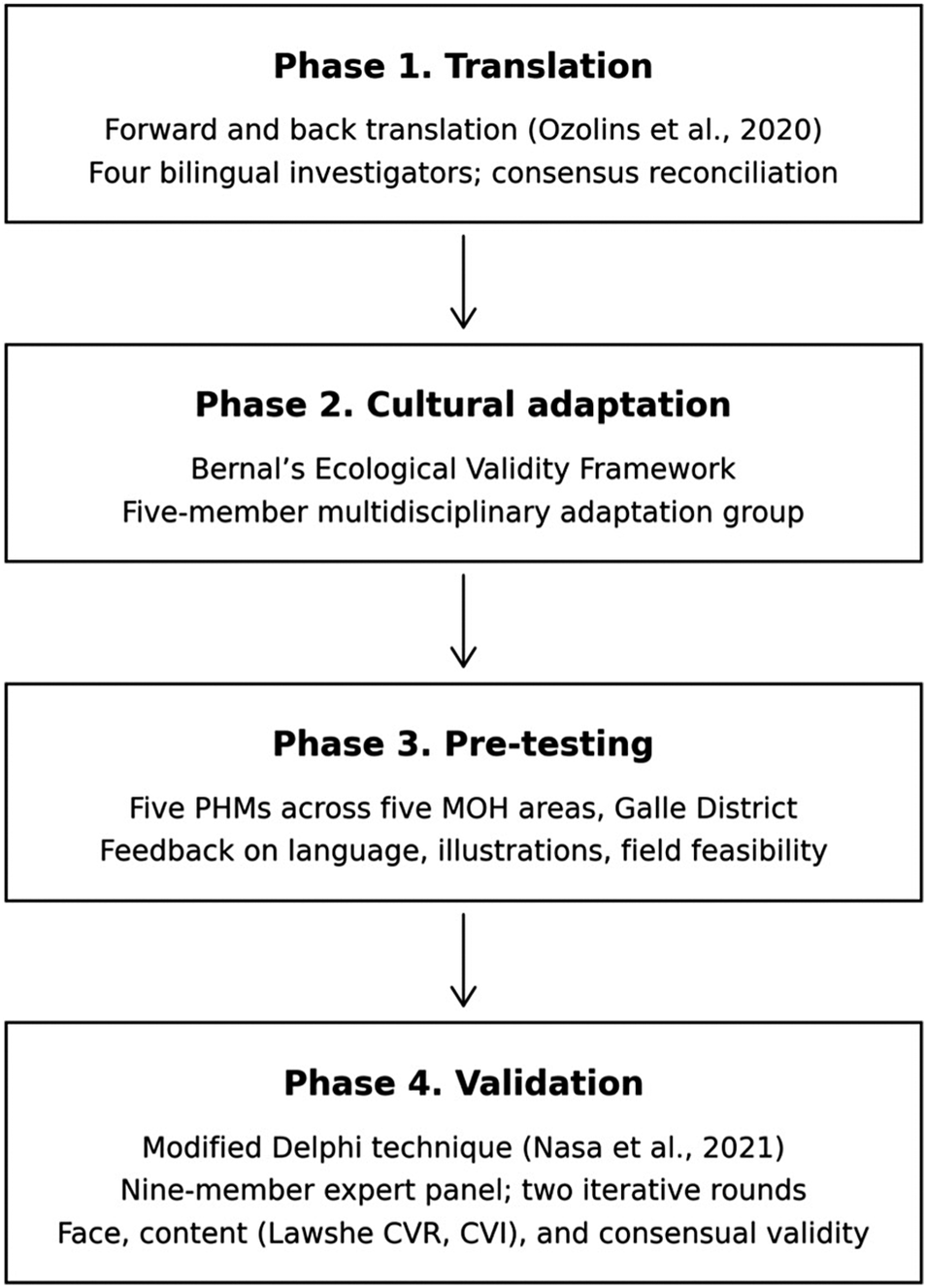
A validation study was conducted in 2024 to translate, culturally adapt and validate a Sinhala version of the THP for perinatal depression in Sri Lanka. The study used the Modified Delphi technique (Nasa et al., Reference Nasa, Jain and Juneja2021) to assess face, content and consensual validity through expert consensus and structured quantitative evaluation. The process comprised four sequential phases (Figure 1): translation, cultural adaptation, pre-testing and validation through expert-judgement approaches covering face, content and consensual validity.
Methodological overview of the translation, cultural adaptation, pre-testing and validation of the Thinking Healthy Programme manual for Sri Lanka.

Figure 1. Long description
The flowchart consists of four rectangular boxes arranged vertically, connected by downward-pointing arrows.
* Phase 1. Translation. This phase involves forward and back translation based on Ozolins et al., 2020. It utilizes four bilingual investigators and consensus reconciliation.
* Phase 2. Cultural adaptation. This phase applies Bernal’s Ecological Validity Framework with a five-member multidisciplinary adaptation group.
* Phase 3. Pre-testing. This phase involves five PHMs across five MOH areas in the Galle District. It focuses on feedback regarding language, illustrations, and field feasibility.
* Phase 4. Validation. This phase uses a modified Delphi technique based on Nasa et al., 2021. It involves a nine-member expert panel and two iterative rounds to establish face, content using Lawshe CVR and CV I, and consensual validity.
Translation
The original WHO THP manual (handbook and health calendar) was translated from English into Sinhala using the standard forward and back translation method (Ozolins et al., Reference Ozolins, Hale, Cheng, Hyatt and Schofield2020). Four bilingual investigators, all native Sinhala speakers fluent in English, conducted the forward translation. Conceptual equivalence was prioritised over literal translation to preserve the original meaning and intent. Clear and simple language was used to support accessibility for THP recipients with different educational backgrounds. Back translation was performed independently by two qualified translators who were unaware of the original English text. The research team compared the back-translated version with the original to identify discrepancies, and revisions were agreed by consensus to ensure semantic, idiomatic, experiential and conceptual equivalence.
Cultural adaptation
Following translation, the Sinhala version of the THP manual underwent a structured cultural adaptation guided by Bernal’s Ecological Validity Model (Bernal and Domenech Rodríguez, Reference Bernal and Domenech Rodríguez2012). A multidisciplinary five-member expert group, comprising a consultant community physician, a psychiatrist, a psychologist, a sociologist and a PHM, reviewed the translation for cultural suitability. This composition was chosen to bring clinical, psychological and community perspectives relevant to Sri Lanka’s maternal health context to bear on the adaptation.
The adaptation process followed five sequential steps (Figure 2). First, the translated manual was reviewed by the expert group for conceptual equivalence and cultural appropriateness within the Sri Lankan context. Second, revisions were made along Bernal’s eight ecological dimensions (language, persons, metaphors, content, concepts, goals, methods and context) to support cultural resonance while preserving fidelity to the THP framework. Third, all proposed modifications were discussed and finalised through expert consensus to maintain internal consistency. Fourth, illustrative materials and contextual examples were adjusted to reflect local cultural norms, family structures and social practices. Finally, the culturally adapted version was reviewed by the PHM member to evaluate feasibility and comprehension in field settings prior to pre-testing.
Five-step cultural adaptation process based on Bernal’s Ecological Validity Framework.

Figure 2. Long description
A vertical flowchart with five numbered rectangular boxes connected by downward-pointing arrows.
* Step 1. Initial expert review. The translated manual is reviewed by a five-member group for conceptual equivalence and cultural appropriateness.
* Step 2. Revisions along Bernal’s eight dimensions. Modifications are made across the eight ecological dimensions to support cultural resonance while preserving fidelity. An arrow points right from this box to a separate list titled Bernal’s eight ecological dimensions, which includes: Language, Concepts, Persons, Goals, Metaphors, Methods, Content, and Context.
* Step 3. Consensus on modifications. All proposed changes are discussed and finalised by expert consensus to maintain internal consistency.
* Step 4. Contextual examples and illustrations. Illustrative materials and contextual examples are adjusted to reflect local cultural norms and family structures.
* Step 5. PHM feasibility review. The culturally adapted version is reviewed by the PHM members to evaluate feasibility prior to field pre-testing.
Pre-testing
The pre-final Sinhala version was pre-tested with five PHMs drawn from five different Medical Officer of Health (MOH) areas in Galle District. Pre-testing focused on clarity, comprehensibility and field feasibility. PHMs reviewed language, illustrations and format, and provided feedback on practical challenges that might arise during home visits. The sample of five PHMs was selected to permit feedback from each of five distinct MOH service areas, with the aim of capturing variation across sub-district contexts while remaining feasible within the study timeline. This sample size is consistent with methodological guidance indicating that small samples of approximately 5–15 participants are generally sufficient for cognitive pre-testing of materials (Willis, Reference Willis2005). By the final pre-testing interviews, no new comprehension or usability problems were being identified, suggesting that adequate informational feedback saturation had been reached for the purposes of pre-testing. Based on this feedback, minor modifications were made to simplify terminology, improve the readability of instructions and refine the cultural appropriateness of illustrations.
Expert panel and validation
A nine-member expert panel was convened for the validation phase. The panel comprised two consultant community physicians (one academic and one from the Ministry of Health), one psychiatrist, one psychologist, one sociologist, one Family Health Bureau representative, one public health nursing sister and two PHMs. All members had at least 5 years of professional experience in maternal or mental health. Two-thirds of the panel were female, and the mean (SD) age was 43.5 (5.8) years. Panel composition and key expertise are summarised in Table 1.
Composition of the multidisciplinary expert panel (N = 9)

Table 1. Long description
The table consists of six columns and nine rows of data.
* Expert 1 (M): Consultant community physician (academic), age 45, 12 years experience. Expertise in maternal and child health research and perinatal mental health. Background: MBB S, MSc, and MD (Community Medicine).
* Expert 2 (F): Consultant community physician (Ministry of Health), age 48, 15 years experience. Expertise in national maternal health programmes and public health implementation. Background: MBB S, MSc, MD (Community Medicine), and PG Dip.
* Expert 3 (M): Consultant psychiatrist, age 42, 10 years experience. Expertise in maternal mental health and depression screening. Background: MBB S, MD (Psychiatry).
* Expert 4 (F): Clinical psychologist, age 40, 8 years experience. Expertise in psychological counselling and cognitive-behavioural approaches. Background: BSc, MSc, and PhD (Clinical Psychology).
* Expert 5 (F): Sociologist, age 44, 9 years experience. Expertise in social determinants of maternal health. Background: B A, M A, Ph D.
* Expert 6 (M): Family Health Bureau representative, age 46, 14 years experience. Expertise in maternal and child health policy. Background: MBB S, MSc, MD (Community Medicine), and PG Dip.
* Expert 7 (F): Public health nursing sister, age 50, 11 years experience. Expertise in field supervision and service delivery. Background: Diploma (Nursing), BSc (Nursing) with midwifery training.
* Expert 8 (F): Public Health Midwife, age 39, 7 years experience. Expertise in community-based maternal and child care. Background: Diploma (Midwifery).
* Expert 9 (F): Public Health Midwife, age 38, 6 years experience. Expertise in community-based maternal and child care. Background: Diploma (Midwifery).
Both the finalised Sinhala translation of the THP manual and the original English version were sent to the nine-member panel for expert judgement validation. The manual contains six sections, each with one module. These are the Introductory session, Module 1 (Preparing for the baby), Module 2 (The baby’s arrival), Module 3 (Early infancy), Module 4 (Middle infancy) and Module 5 (Late infancy). All six sections were reviewed for equivalence, accuracy and cultural appropriateness. Three forms of validity were assessed using a Modified Delphi approach: face validity, content validity and consensual validity. The process comprised two structured scoring rounds followed by a final roundtable discussion. Experts were given 2 months for the initial review (Round 1) and 1 month for the second review (Round 2). All nine experts completed both rounds and attended the final roundtable, giving a response rate of 100% in each round with no attrition. During the two scoring rounds, experts returned their ratings and written comments independently to the research team and remained anonymous to one another; anonymity was lifted only at the final roundtable, which was convened to reconcile any remaining differences.
Face validity was assessed by comparing the Sinhala and English versions of the manual. Each panel member independently assessed overall clarity, comprehensibility and the appropriateness of language and visual materials. Because face validity reflects subjective expert judgement about the apparent appropriateness of the material, rather than an objective psychometric property, these appraisals were treated as structured expert opinion. The panel appraised the relevance of each section and unanimously considered the translated manual to demonstrate acceptable face validity.
Content validity was examined to determine whether critical aspects of perinatal depression were adequately covered in the Sinhala THP manual. The assessment considered relevance of each section, clarity of content and strength of the content, with reference to Lawshe’s Content Validity Ratio (CVR) and the scale-level Content Validity Index (CVI), and was further informed by COSMIN guidance on evaluating content validity (Terwee et al., Reference Terwee, Prinsen, Chiarotto, Westerman, Patrick, Alonso, Bouter, de Vet and Mokkink2018). Experts rated each section of the Sinhala manual on a four-point ordinal scale.
Relevance. 1 = Not relevant; 2 = Item needs some revision; 3 = Relevant but needs minor revision; 4 = Very relevant.
Clarity and strength. 1 = Not clear; 2 = Needs major revision; 3 = Clear with minor revision; 4 = Very clear.
The Content Validity Ratio (CVR) was calculated to quantify expert agreement on the essentiality of each section, using the standard Lawshe formula (Rutherford-Hemming, Reference Rutherford-Hemming and Frey2018).
where ne is the number of experts identifying an item as “essential” and N is the total number of experts. Sections rated 3 (relevant but needs minor revision) or 4 (very relevant) on the relevance scale were classified as “essential” for the purpose of the CVR calculation, so that content validity was computed at the section (item) level, yielding one CVR per section. The scale-level Content Validity Index (CVI) was then computed by the averaging method, as the mean of the six section-level CVR values, reflecting the overall strength of content validity of the manual (Rutherford-Hemming, Reference Rutherford-Hemming and Frey2018).
Consensual validity assessed the degree of agreement between the conceptual framework of perinatal depression prevention and the translated manual’s content. This evaluation drew on the professional and field-based contextual expertise of the panel members (Atif et al., Reference Atif, Lovell, Husain, Sikander, Patel and Rahman2016). Using the Delphi technique, experts participated in two iterative rounds of feedback and scoring. After the first round, all suggestions arising from both face and content validity assessments were reviewed by the research team and the manual was revised accordingly; Round-1 revisions mainly concerned simplification of terminology, more idiomatic Sinhala phrasing and the cultural appropriateness of examples and illustrations. The modified version then underwent a second Delphi round, after which only minor editorial refinements were required. Consensus was defined a priori as agreement of 80% or more of the panel, and items achieving this threshold were retained; items falling below the threshold were revised in light of the written comments and re-rated. Remaining disagreements were carried forward for discussion at the final roundtable. Experts were also invited to propose new or locally relevant content, and any such additions were subjected to an additional Delphi review.
After a one-month second review window, a final roundtable discussion was held to reconcile remaining differences and confirm consensus on the validated Sinhala THP manual. The final version was endorsed unanimously by the panel and judged appropriate for use in future field-testing and evaluation studies (Supplementary Material 1).
Data analysis
Quantitative analysis was used to summarise the validation process. Ratings from all nine experts were aggregated to compute mean and standard deviation scores for relevance and clarity across modules. Face-validity outcomes were summarised descriptively based on expert agreement regarding linguistic accuracy, cultural appropriateness and conceptual clarity. Content validity was quantified by calculating CVR values for each module and deriving a scale-level CVI. For a nine-member panel, a CVR of 0.78 or higher was considered acceptable, based on Lawshe’s threshold and consistent with COSMIN recommendations that content validity judgements be based on explicit criteria (Terwee et al., Reference Terwee, Prinsen, Chiarotto, Westerman, Patrick, Alonso, Bouter, de Vet and Mokkink2018). Consensual validity was determined through analysis of Delphi-round data, with agreement percentages calculated for each round to assess convergence across experts. Items achieving 80% or more consensus were considered validated.
Qualitative comments from experts were coded thematically to capture feedback on translation accuracy, contextual relevance and usability. Integrated quantitative and qualitative findings guided the final synthesis of results.
Ethical considerations
All experts provided written informed consent prior to participation. Ethical approval was obtained from the Ethical Review Committee of the Faculty of Medicine, University of Ruhuna, Sri Lanka (Reference 2024/P/026, 20 June 2024).
Results
Translation and cultural adaptation
The translation and back-translation produced a linguistically accurate and conceptually equivalent Sinhala version of the THP manual. The core elements of the original THP (its structure, session sequence, cognitive-behavioural strategies and delivery methods) were preserved unchanged and were judged culturally acceptable. Alongside this preservation of the core intervention, a number of contextual modifications were made to surface content, including language, examples, metaphors and illustrations, to support cultural resonance and comprehension. These modifications were contextual rather than structural: none altered the underlying therapeutic techniques, the number or sequence of sessions or the goals of the programme.
Using Bernal’s Ecological Validity Framework, the adaptation incorporated culturally appropriate expressions, examples and metaphors. The content was modified to include references to local customs and practices while preserving alignment with Sri Lankan social norms. For example, illustrations of psychosocial stressors were contextualised to include family conflicts within mother-in-law and daughter-in-law relationships, occupational stress during pregnancy and culturally rooted beliefs such as Balagiri Doshaya (sometimes translated as evil eye), which replaced the term “curse” in the original manual. Module-level examples of the adaptations are shown in Table 2.
Examples of cultural adaptations made to the THP manual, mapped to Bernal’s dimensions

Table 2. Long description
The table consists of five columns and fourteen rows of data categorized by module.
* Introductory session: ‘Curse’ adapted to ‘Balagiri Doshaya’ (evil eye) for language and metaphors to use culturally recognized concepts. ‘Community health workers’ adapted to Public Health Midwives (P HMs) for persons and context to align with Sri Lanka's maternal care system. ‘Unhealthy thoughts’ adapted to ‘Thoughts that increase worry or sadness during pregnancy’ for language and concepts to simplify comprehension.
* Module 1 (Preparing for the baby): ‘Attend prenatal classes to learn coping skills’ adapted to ‘Participate in home visits and mother support groups led by PHMs’ for methods and goals. ‘Plan self-care individually’ adapted to ‘Encourage self-care within family routines and social practices’ for goals and methods to align with collective family structures. ‘Nuclear family support’ adapted to ‘Living with parents or extended family during pregnancy’ for concepts to reflect local caregiving structures.
* Module 2 (The baby's arrival): ‘Ask for help from a counsellor or mental health professional’ adapted to ‘Discuss problems with PHMs, family or trusted elders’ for persons and delivery due to limited specialist access. ‘Examples of stress relating to work-life balance’ adapted to ‘Family conflicts (e.g. mother-in-law/daughter-in-law tensions); occupational stress’ for content and context to reflect local stressors.
* Module 3 (Early infancy): ‘Generic illustrations of mothers’ adapted to ‘Images showing Sri Lankan mothers in traditional clothing and home settings’ for methods and content. ‘Recognise signs of depression and anxiety’ adapted to ‘Recognise feelings of sadness, worry or fatigue that interfere with daily routines’ for language and concepts.
* Module 4 (Middle infancy): ‘Encourage independence in infant care’ adapted to ‘Encourage joint care with family members while maintaining maternal well-being’ for concepts and persons. ‘Set aside personal time’ adapted to ‘Take small breaks during daily household or childcare routines’ for goals and methods.
* Module 5 (Late infancy): ‘Promote social engagement with peers’ adapted to ‘Encourage family and community interaction during child-development activities’ for content and context. ‘Positive reinforcement for infant’ adapted to ‘Praise and care practices consistent with local cultural values’ for metaphors and language.
The concept of family structure was adjusted to reflect the Sri Lankan social context, in which many expectant mothers reside with their parents during pregnancy. References to CHWs were replaced with PHMs, who are the principal maternal health service providers in Sri Lanka. All materials were written in simple Sinhala, using conceptually equivalent rather than literal translations to support comprehension among health practitioners and service recipients. Examples of culturally adapted pictorial modifications are provided in the validated Sinhala manual (Supplementary Material 1) and attachment (Supplementary Material 2).
Programme delivery feasibility
To support active participation among mothers and service providers, the adapted THP manual was designed to be compatible with future integration into Sri Lanka’s existing maternal care framework, subject to feasibility testing. The Home Visits and Mother Support Group components of the national maternal health programme were identified as potential platforms for THP delivery. The role of PHMs as long-standing community-based providers of perinatal and postpartum care was central to this integration. Replacing the general term CHWs with PHMs aligned the manual with the existing health-service delivery structure. The number and sequence of THP sessions remained unchanged, preserving fidelity to the original programme while supporting future feasibility testing within routine perinatal care. Workload, training time and supervision requirements should be assessed during field implementation.
Validation results
The validation process assessed face, content and consensual validity. Experts compared the English and Sinhala versions and unanimously considered the translation to demonstrate acceptable face validity, reflecting their judgement of conceptual and linguistic equivalence, clarity and cultural appropriateness.
Content validity was evaluated for the six sections of the manual based on relevance and clarity using Lawshe’s method (Table 3). All section-level Content Validity Ratios (CVRs) met or exceeded the 0.78 threshold recommended for nine experts. The Introductory section had a CVR of 0.78, while all five modules achieved 1.00. The scale-level Content Validity Index (CVI) was 0.96, indicating high agreement among experts. After two rounds of Delphi review, the panel reached full consensus on all sections, indicating satisfactory consensual validity. The mean (SD) scores were 3.8 (0.7) for relevance and 3.8 (0.1) for clarity. Experts agreed that the adapted THP manual maintained fidelity to the original intervention while achieving cultural and linguistic appropriateness for Sri Lanka.
Content validity assessment of the Sinhala THP manual

Table 3. Long description
The table consists of five columns: Section, Content, Relevance mean S D, Clarity mean S D, and CV R.
* Section 1: Introductory session. Relevance 4.0 0.0. Clarity 3.7 0.5. CVR 0.78.
* Section 2: Module 1. Preparing for the baby. Relevance 3.7 0.5. Clarity 3.7 0.5. CVR 1.00.
* Section 3: Module 2. The baby’s arrival. Relevance 3.9 0.3. Clarity 3.9 0.3. CVR 1.00.
* Section 4: Module 3. Early infancy. Relevance 3.7 0.5. Clarity 3.9 0.3. CVR 1.00.
* Section 5: Module 4. Middle infancy. Relevance 4.0 0.0. Clarity 3.7 0.5. CVR 1.00.
* Section 6: Module 5. Late infancy. Relevance 4.0 0.0. Clarity 3.9 0.3. CVR 1.00.
* Overall: Sinhala THP manual. Relevance 3.8 0.7. Clarity 3.8 0.1. The final column for the overall row indicates a Scale-level CVI equal to 0.96.
Note: Bold values indicate the overall scale-level summary across all six sections of the Sinhala THP manual. CVI, Content Validity Index; CVR, Content Validity Ratio; SD, standard deviation. A CVR of 0.78 or higher was considered acceptable for the nine-member expert panel.
Discussion
The THP is a structured, evidence-based cognitive-behavioural intervention designed to support perinatal mental health and positive mother-infant interaction. It emphasises behavioural activation, problem-solving and cognitive restructuring, and can be delivered by non-specialist workers, which makes it well suited to settings with limited specialist capacity. Its adaptability has supported implementation across a range of cultural and health system settings, with reports of reductions in depressive symptoms and improvements in maternal well-being in particular contexts (Rahman et al., Reference Rahman, Fisher, Bower, Luchters, Tran, Yasamy, Saxena and Waheed2013; Fuhr et al., Reference Fuhr, Weobong, Lazarus, Vanobberghen, Weiss, Singla, Tabana, Afonso, De Sa, D’Souza, Joshi, Korgaonkar, Krishna, Price and Patel2019; Boran et al., Reference Boran, Dönmez, Atif, Nisar, Barış, Us, Altaş, Hıdıroğlu, Save and Rahman2023).
This study showed that the content of the Sinhala THP manual was judged culturally acceptable by a multidisciplinary expert panel and required only minor adjustments. The adapted manual was rated as comprehensible and culturally appropriate for Sri Lanka. The study offers a structured method for translating and culturally adapting a perinatal mental health intervention in a country with a distinct language and cultural context, and may be useful as a reproducible approach for adapting similar interventions. The findings indicate that the core structure, procedures and methods of the original THP could be preserved for the Sinhalese community in Sri Lanka, while contextual modifications to language, examples and illustrations, as documented in Table 2, were necessary to support cultural alignment and comprehension.
Although local adaptation is widely recognised as necessary before implementation, the original THP manual did not specify a standardised process for such modifications (Rahman et al., Reference Rahman, Fisher, Bower, Luchters, Tran, Yasamy, Saxena and Waheed2013). Researchers have therefore drawn on a range of frameworks to guide adaptation. In a Chinese study, Bernal’s framework supported systematic content adaptations and documentation across multiple domains, allowing transparent recording of changes and the rationale for them. The Bernal framework has also been used to adapt self-help interventions for psychological distress among refugees in African settings (Tol et al., Reference Tol, Augustinavicius, Carswell, Leku, Adaku, Brown, García-Moreno, Ventevogel, White, Kogan, Bryant and van Ommeren2018). In Peru, although a community-based organisation used a pre-translated Spanish version of the THP manual, the Replicating Effective Programs framework guided the implementation process (Kilbourne et al., Reference Kilbourne, Neumann, Pincus, Bauer and Stall2007; Eappen et al., Reference Eappen, Aguilar, Ramos, Contreras, Prom, Scorza, Gelaye, Rondon, Raviola and Galea2018). However, owing to limited reporting of the adaptation steps, the specific modifications made and their justification remain unclear. In Vietnam, an adaptation approach based on the WHO’s Integrated Management of Childhood Illnesses adaptation toolkit was used to translate and adapt the THP manual (Nisar et al., Reference Nisar, Yin, Yiping, Lanting, Zhang, Wang, Rahman and Li2020). The present study adopted a comparable approach but added a structured content validity evaluation using Lawshe’s CVR and a scale-level CVI to assess relevance, clarity and strength for each component. The results of THP-China (Nisar et al., Reference Nisar, Yin, Yiping, Lanting, Zhang, Wang, Rahman and Li2020) and THP-Vietnam (Fisher et al., Reference Fisher, Nguyen, Mannava, Tran, Dam, Tran, Tran, Durrant, Rahman and Luchters2014) were similar to those of the present study, suggesting that THP’s fundamental structure, procedures and methods are largely transferable across cultures, while language and cultural adjustments are needed for contextual fit.
The Sinhala THP manual may be a useful addition to Sri Lanka’s Reproductive, Maternal, Newborn, Child, Adolescent and Youth Health Programme (RMNCAYHP), which is the national programme for maternal and child care and is coordinated by the Family Health Bureau (Family Health Bureau, 2024). RMNCAYHP aims to strengthen health services for women, children and adolescents, with objectives that include improving maternal health, reducing newborn and child mortality and supporting the well-being of young people. As the country advances its primary health care model toward Universal Health Coverage, the integration of mental health interventions such as THP into maternal care services is both timely and consistent with system priorities. Successful integration will require addressing supply-side barriers (such as staffing constraints and limited access to specialist services) and demand-side barriers (such as gaps in knowledge and awareness, gender inequities, household dynamics, cultural beliefs and constraints on women’s autonomy).
In Sri Lanka, PHMs are the principal frontline workers delivering maternal and child health care at the community level. Their routine schedule includes three home visits during pregnancy and four in the postpartum period, with two occurring in the first 10 days after birth (Family Health Bureau, 2024). Given the trust and rapport PHMs build with mothers, they may be well placed to support THP delivery within existing service contacts, provided that training time, supervision and workload impact are assessed in future feasibility testing. Whether PHMs can deliver THP effectively was not evaluated in this study. Evidence from other settings, in which non-specialist providers delivered THP with appropriate training and supervision (Rahman et al., Reference Rahman, Fisher, Bower, Luchters, Tran, Yasamy, Saxena and Waheed2013; Fuhr et al., Reference Fuhr, Weobong, Lazarus, Vanobberghen, Weiss, Singla, Tabana, Afonso, De Sa, D’Souza, Joshi, Korgaonkar, Krishna, Price and Patel2019), suggests that this is plausible, but it remains to be demonstrated empirically in Sri Lanka. Embedding THP into PHM-delivered services therefore represents one potentially feasible, culturally appropriate pathway for strengthening maternal mental health care in Sri Lanka’s public health system, contingent on the results of future feasibility and effectiveness studies.
Strengths and limitations
A key strength of this study is the use of an established global mental health intervention together with a multidisciplinary expert panel, frontline PHM input and a structured Bernal-guided adaptation approach combined with Lawshe’s CVR and scale-level CVI to assess relevance, clarity and strength of content. Several limitations should be considered. First, end-users (i.e. perinatal women themselves) were not directly involved in the Delphi panel, which constrains direct ascertainment of acceptability from the recipient perspective. We adopted an expert consensus design because the primary aim of this phase was to establish linguistic equivalence and expert-judged content validity of the manual, and because a participatory co-design adaptation involving Sri Lankan end-users had recently been completed elsewhere in the country (Jayasinghe et al., Reference Jayasinghe, Hewamalage, Sumathipala, Sikander and Rahman2025), providing complementary evidence. We acknowledge, however, that current recommendations increasingly favour participatory and co-design methods during cultural adaptation, and the involvement of women with lived experience of perinatal depression is planned as an integral component of the forthcoming field-testing phase. Second, expert ratings may be subject to social-desirability bias, particularly in small panels in which members may know one another professionally. We sought to reduce this risk through structured independent scoring and through the inclusion of both academic and Ministry of Health perspectives. Third, the adapted manual is in Sinhala only. Given Sri Lanka’s multilingual population, in which Tamil is an official language spoken by a substantial share of the population, a separate translation and cultural adaptation into Tamil, attentive to the distinct cultural and religious practices of Tamil-speaking communities, is needed before applicability to ethnic and linguistic minorities can be claimed. Fourth, clinical effectiveness has not yet been established. Field trials with PHMs and pregnant women will be needed to assess whether the adapted manual reduces perinatal depressive symptoms in routine service settings. The adapted manual is most directly applicable to Sinhala-speaking women in the Southern Province, and further work is needed before broader applicability can be claimed.
Conclusions
The Sinhala-translated and culturally adapted THP manual was judged acceptable, comprehensible and culturally appropriate by a nine-member multidisciplinary expert panel using a Modified Delphi process. This work provides a content-validated Sinhala resource that can be field-tested with PHMs in Galle District as a first step; it does not, by itself, establish feasibility, acceptability to mothers, fidelity of delivery or clinical effectiveness. Further studies will be needed to assess effectiveness in reducing perinatal depressive symptoms, to test feasibility of integration with existing maternal health services and to extend the work to Tamil-speaking populations before broader scale-up. The methods used here may also serve as a reference for similar adaptation efforts in other LMIC settings.
Open peer review
To view the open peer review materials for this article, please visit http://doi.org/10.1017/gmh.2026.10326.
Abbreviations
- CHW
-
Community Health Worker
- CVI
-
Content Validity Index
- CVR
-
Content Validity Ratio
- LMIC
-
low- and middle-income country
- MOH
-
Medical Officer of Health
- PHM
-
Public Health Midwife
- RMNCAYHP
-
Reproductive, Maternal, Newborn, Child, Adolescent and Youth Health Programme
- THP
-
Thinking Healthy Programme
- WHO
-
World Health Organisation
Supplementary material
The supplementary material for this article can be found at http://doi.org/10.1017/gmh.2026.10326.
Acknowledgements
The authors thank all participants in the validation of the THP manual, including the field experts and Public Health Midwives who contributed their time and insight. The authors also thank the staff of the participating MOH areas in Galle District for their support during pre-testing.
Author contribution
Conceptualisation and study design: Q.F., N.D., Vij.D.S.; Data collection and field coordination: N.D., I.D.S., Vis.D.S., Vij.D.S.; Formal analysis: N.D., Vis.D.S.; Funding acquisition: Q.F.; Methodology: Q.F., N.D., Vis.D.S.; Supervision: Q.F., N.D., Vij.D.S.; Validation: Q.F.; Writing (original draft): Q.F., N.D., K.M.; Writing (review and editing): all authors. All authors reviewed and approved the final version of the manuscript.
Competing interests
The authors declare none.
Data availability statement
De-identified expert rating data and Delphi-round summary records that support the findings of this study are available from the corresponding author on reasonable request. The validated Sinhala THP manual is available as Supplementary Material 1.
Ethics and approvals
The authors assert that all procedures contributing to this work comply with the ethical standards of the relevant national and institutional committees on human experimentation and with the Helsinki Declaration of 1975, as revised in 2008. Ethical approval was granted by the Ethical Review Committee of the Faculty of Medicine, University of Ruhuna, Sri Lanka (Reference 2024/P/026, 20 June 2024). All expert panel members provided written informed consent prior to participation.
Funding statement
This research was supported by the Department of Public Health Sciences of Clemson University.
AI statement
A generative AI tool (ChatGPT, OpenAI) was used by the authors to support proofreading and language polishing of the manuscript; all content was reviewed, verified and approved by the authors.
Inclusivity statement
The authorship team includes researchers based in Sri Lanka, the United States and Saudi Arabia, spanning disciplines that include public health, psychology, community medicine, psychiatry, epidemiology and midwifery, and includes both early-career and senior researchers. The adapted manual described here is currently available in Sinhala, the majority language of Sri Lanka, and is suited most directly to Sinhala-speaking women in the Southern Province. We acknowledge that this language scope limits direct applicability to Tamil-speaking and other minority communities in Sri Lanka, and we identify translation into Tamil and further co-design with minority communities as priorities for ongoing work. Throughout the adaptation, we sought to incorporate the perspectives of frontline Public Health Midwives, who carry out home-based maternal and child health care across diverse Sri Lankan communities. We agree with the journal’s emphasis on the centrality of marginalised voices in global mental health research, and we intend to build on this work by including women with lived experience of perinatal depression in subsequent stages of evaluation.


 Open access

