1 Introduction
Arguably, the primary aim of sociophonetic research is to uncover the variable aspects of speech communication for which phonetic variants indicate social-indexical information (i.e. speaker sex, social class, ethnicity, geographical origin, or speaking style); typically, these variants occur in gradient fashion (see Thomas Reference Thomas2011, Foulkes Reference Foulkes and Brown2012 for review). In spite of its many empirical accomplishments, one elusive objective of sociophonetic research has been to establish a direct working relationship between the domains of linguistic inquiry that it unites: variationist linguistics (i.e. traditional sociolinguistics) and phonetic sciences. Jannedy & Hay (Reference Jannedy and Hay2006) comment on this state of affairs in a recent editorial, noting that current models of speech communication offer little explanation on how phonetic production is conditioned by social factors in combination with widely-recognized linguistic factors. Of concern, there are often incongruities between the methodological practices of the ‘lab speech’ paradigm and those of the variationist paradigm; this has generated debate on whether laboratory speech is in fact ‘natural’ speech (see Lickley, Schepman & Ladd Reference Lickley, Schepman and Ladd2005, Local & Walker Reference Local and Walker2005, Xu Reference Xu2010, Walker Reference Walker, Sidnell and Stivers2012). Still, there is growing evidence that social and linguistic details are entwined in the cognitive representations of sounds and sound patterns (see Foulkes & Docherty Reference Foulkes and Docherty2006 for review), and there are now proposals that account for how social identity and phonetic and phonological patterns emerge simultaneously in cognitive representations, based mostly on an exemplar-based mental representations (Johnson Reference Johnson2006). Unfortunately, such proposals account for variation at the segmental level of analysis and offer little direct insight for the sociophonetic modeling of prosodic or intonational structure. This is an unexpected outcome, since one accomplishment of the field of phonetic sciences has been the development of a widely accepted theoretical framework of intonational structure, namely, the autosegmental-metrical approach to intonational phonology (Goldsmith Reference Goldsmith1979, Pierrehumbert Reference Pierrehumbert1980, Beckman & Pierrehumbert Reference Beckman and Pierrehumbert1986, Ladd Reference Ladd2008, but see also Xu Reference Xu2005, Xu & Xu Reference Xu2005). Work in sociophonetics also shows that languages use intonational differences to communicate social-indexical characteristics (e.g. Warren & Daly Reference Warren, Daly and Holmes2000, Reference Warren2005; Cruttenden Reference Cruttenden2007; Simonet Reference Simonet2010, Reference Simonet2011); Warren (Reference Warren2005b) acknowledges that the autosegmental-metrical framework is a useful apparatus for defining the linguistic categories that encode social information.
This paper is designed to push the limits of our knowledge on the social reality of intonational categories, providing a case study of the Spanish spoken in a rural town in south-central Spain. More specifically, the goal is to determine whether differences in speech style contribute to differences in the production of intonational categories. The experimental analysis is based on an acoustic examination of declarative questions and wh-questions, and the aim is to account for variation in fundamental frequency (f0) production by adhering to principles in autosegmental prosodic structure (e.g. Goldsmith Reference Goldsmith1979, Pierrehumbert Reference Pierrehumbert1980, Beckman & Pierrehumbert Reference Beckman and Pierrehumbert1986, Ladd Reference Ladd2008) and stylistic (task-based) variation (e.g. Labov Reference Labov1966, Reference Labov and Labov1972; Coupland Reference Coupland1980, Reference Coupland1985, Reference Coupland2007; Bell Reference Bell1984, Reference Bell, Coupland and Jaworski1997; Eckert Reference Eckert, Denning, Inkelas, Knox and Rickford1987; Rickford & McNair-Knox Reference Rickford and McNair-Knox1994; Schilling-Estes Reference Schilling-Estes1998; Eckert & Rickford Reference Eckert and Rickford2001). Previous experimental work on prosodic variation shows that different social situations allow for different intonational strategies (Yaeger-Dror Reference Yaeger-Dror1985, Reference Yaeger-Dror2002; Yaeger-Dror, Hall-Lew & Deckert Reference Yaeger-Dror, Hall-Lew, Deckert and Meyer2003), and in this paper we explore what is a less understood issue, that is, how to interpret intonational data in variationist terms (Yaeger-Dror Reference Yaeger-Dror1996: 44).Footnote 1 The data collection methods respond to a growing need in laboratory research in intonation to create task-oriented dialogue speech materials whose results allow for principled comparisons with read speech data (Face Reference Face2003, Lickley et al. Reference Lickley, Schepman and Ladd2005, Cruttenden Reference Cruttenden2007, Henriksen Reference Henriksen2009). As the review of literature will show, there is still little consensus on whether read speech materials are a valid means of investigating the phonetic details of intonational contours. We argue based on these findings that multiple speech conditions are necessary if one wishes to make inferences about the social value of a particular intonational contour. Speaker sex is also widely documented as an important motivating factor in intonational variation (Britain Reference Britain1992; Warren & Daly Reference Warren, Daly and Holmes2000, Reference Warren2005; Daly & Warren Reference Daly and Warren2001; Warren Reference Warren2005b; Innes Reference Innes2007; Simonet Reference Simonet2008), and in this study a similar overall effect is found. Motivated finally by recent experimental research on variation in intonation throughout the Spanish-speaking world (Sosa Reference Sosa1999, Prieto & Roseano Reference Prieto and Paolo2010b), this study examines the intonational patterns of speakers of Peninsular Spanish who reside in the town of Socuéllamos, Spain.
The town of Socuéllamos is located in central Spain, with a population of roughly 13,000. It belongs to the Ciudad Real province, which forms part of the larger Castile-La Mancha autonomous community (hence the gentilicium ‘Manchego’). The variety of Spanish spoken in Castile-La Mancha is generally considered Castilian or Peninsular Spanish, spoken in the central and northern regions of mainland Spain, although in the present paper we focus on one sub-variety of Peninsular Spanish known as Manchego Spanish. Descriptions of the Spanish spoken in Castile-La Mancha are scarce (see Serna Reference Serna1974), and research on intonation in this dialect is only recently available (Henriksen Reference Henriksen2012, Reference Henriksen2013). However, results of a series of pilot studies conducted on speakers of this dialect indicate much variability in terms of the f0 contours used to ask questions. Furthermore, there is growing cross-linguistic evidence for stylistic variation in intonation production (Yaeger-Dror Reference Yaeger-Dror1985, Reference Yaeger-Dror1996, Reference Yaeger-Dror2002; Sosa Reference Sosa2003; Cruttenden Reference Cruttenden2007; Henriksen Reference Henriksen2009; Savino Reference Savino2012), and informal personal communication with speakers from the Manchego area indicates that they are taught how to read questions and statements as part of their elementary school curriculum; this explicit instruction may have carry-over effects when subjects read aloud sentences from a printed text and, more generally, when they engage in different speaking situations. Sociophonetic data confirming such a reality would represent additional evidence that current models of intonational structure will have to be sensitive to this dimension of intonational production (Silverman et al. Reference Silverman, Blaauw, Spitz and Pitrelli1992, Yaeger-Dror Reference Yaeger-Dror1996).
2 Background
2.1 Form and meaning in intonation
The framework for the analysis of this paper is the autosegmental-metrical (AM) approach to intonation, developed initially in Pierrehumbert (Reference Pierrehumbert1980) and building on insights by Goldsmith (Reference Goldsmith1979), Liberman (Reference Liberman1975), and Bruce (Reference Bruce1977) (see also Ladd Reference Ladd2008, Gussenhoven Reference Gussenhoven2004). An analytical proposal within the AM framework is that melodic tunes in intonational languages may be decomposed into tones which associate with the segmental string in one of two ways: with metrically strong syllables or with phrase edges. Tones that associate with metrically strong syllables are called pitch accents, and their main function is to enhance the prominence of these syllables. Pitch accents may be further separated into two subtypes: nuclear pitch accents, which associate with the last stressed syllable of the utterance; and prenuclear pitch accents, which associate with all prior stressed syllables. Tones that associate with phrase edges can be of two types, boundary tones or phrase accents, and their main function is to delimit or mark utterance boundaries (initial or final). From a phonetic standpoint, abstract sequences of Low (L) and High (H) tones are hypothesized to exhibit their realization as a string of tonal targets. The most obvious acoustic manifestations of tonal targets are local f0 turning points or ‘elbows’ where f0 changes slope (i.e. f0 maxima or minima). The timing of f0 turning points is loosely determined by their phonological association, on the assumption that ‘links between [phonological] elements constrain them to overlap, as they are produced in time’ (Silverman & Pierrehumbert Reference Silverman, Pierrehumbert, Kingston and Beckman1990: 72).Footnote 2 Pitch accents are marked with a star diacritic (*) to indicate their association with metrically strong syllables, and boundary tones are marked with a percentage diacritic (%) to indicate their alignment with phrase edges.
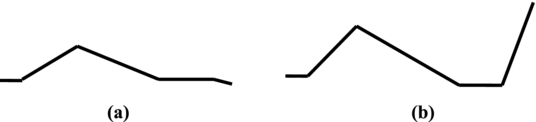
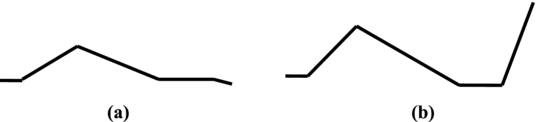
Whereas tone languages mark contrastive use of pitch at the lexical level, intonational languages mark contrastive use of pitch at the pragmatic or utterance-level of phonological analysis. In the latter case, differences in pitch contours are assumed to communicate different sentence or focus types; as has been argued by Ladd (Reference Ladd2008), the properties that govern production in intonation are structural in a way that is analogous to those that govern lexical tones and morphological paradigms. Very often the only difference between a declarative statement and a declarative question is communicated by means of intonation, as in Llegó Juan ‘Juan arrived’. and its lexically and syntactically identical counterpart ¿Llegó Juan? ‘Did Juan arrive?’ (see Figures 1a and 1b, respectively).
Schematic of Spanish declarative statement (a) vs. declarative question (b) inonational contours compared.
In this paper, we consider whether intonational languages use variations in f0 to encode dimensions of linguistic meaning that are not strictly pragmatically-motivated. Specifically, we ask if certain contours may be used according to speaking condition (i.e. read speech vs. task-based dialogue), thus communicating stylistic meaning and signaling distinct social situations (e.g. Yaeger-Dror Reference Yaeger-Dror1985, Reference Yaeger-Dror1996, Reference Yaeger-Dror2002; Hirschberg Reference Hirschberg and Horne2000; Cruttenden Reference Cruttenden2007). We expand on the topic of stylistic variation in Section 2.2.
2.2 Speech style and speaking situations
Speech style is generally understood as the formality with which one speaks, with the choice of speaking very formally or informally being governed by the speaking circumstances or the situation of use (Labov Reference Labov1994). As an example of style-based variation, Schilling-Estes (Reference Schilling-Estes, Chambers, Trudgill and Schilling-Estes2004) notes that speakers may produce variants that are considered to be more ‘formal’ when talking to a colleague about work-related matters than when talking to a friend about entertainment or family. In certain contexts, the act of ‘style-shifting’ (i.e. shifts into and out of different speech varieties and/or shifts in usage levels of features associated with these varieties) may be quite deliberate and involve the self-conscious decision to produce variants of which the speaker is aware. More commonly, style-shifting is subconscious, involving the production of variants that speakers do not even realize that they are using. Categorization of different levels of formality into discrete terms is often complicated (Labov Reference Labov and Labov1972, Finegan & Biber Reference Finegan and Biber1994, Bell Reference Bell, Coupland and Jaworski1997, Coupland Reference Coupland2001), although it is a general assumption that native speakers of all languages control a range of stylistic varieties. It is also often possible to predict which stylistic variants a speaker will employ based on a specific set of speaking situations.Footnote 3
From an empirical standpoint, claims about stylistic variation typically involve speaker participation in a series of oral production tasks ranging from the most casual to the highly formal: casual speech; careful speech; reading passages; and word lists or minimal pairs. The earliest attempts to investigate stylistic variation were advanced by Labov (Reference Labov1966, Reference Labov and Labov1972), who developed a sociolinguistic interview to yield a range of speech styles that could be established a priori by the analyst without great difficulty. In addition to the sociolinguistic interview, more formal tasks (i.e. word lists and reading passages) were devised to elicit speech that was more self-conscious and that also targeted tokens of the linguistic variants relevant to the research study. Underlying this range of oral production tasks was the belief that style-shifts are triggered primarily in response to the amount of attention that people pay to speech itself. According to this ‘attention to speech’ approach, less monitored speech is more casual and closer to the ‘vernacular’ variety than highly monitored speech, which tends to be more formal and closer to a particular ‘standard’ variety. In his investigation of the (th) variable (i.e. [t], [tθ], or [θ]) in New York City English, Labov demonstrated that nonstandard variants were most frequent in casual speech and least frequent in word lists. Not surprisingly, the inverse situation was attested for standard pronunciation variants.Footnote 4
On the other hand, Bell (Reference Bell1984, Reference Bell, Coupland and Jaworski1997) indicates that audience design and response to audience members play a more decisive role in style-shifts than attention paid to speech. This insight came from Bell (Reference Bell1984), who measured the rate of intervocalic /t/ voicing in New Zealand radio newsreaders’ speech as a function of the radio station for which the news was being reported (i.e. the national station or the local community station); results indicated a greater frequency of /t/ voicing in local news reports than in national news reports. Given that audience (i.e. national or radio) was the only variable that correlated with these shifts, Bell argued that audience design – and not attention paid to speech – was the key factor to account for shifts in speech style. The Audience Design model, put forth in Bell (Reference Bell1984), holds that speakers tend to accommodate their speech toward that of their addressees in order to win their approval. Empirical work by Coupland (Reference Coupland1980, Reference Coupland1984, Reference Coupland1985) also helped to support this position.
Other researchers contend that it is the social context (including particular communicative purposes) that motivates use of distinct linguistic structures. The speech variety associated with a particular situation will be referred to as register, and the description of a particular register entails consideration of its social context, its linguistic features, and the functional relationship between these two (Biber Reference Biber1988, Reference Biber1995; Yaeger-Dror Reference Yaeger-Dror, Eckert and Rickford2001). As a general tenet, ‘linguistic features tend to occur in a register because they are particularly well suited to the purposes and situational context of the register’ (Biber & Conrad Reference Biber and Conrad2009: 6). In his earliest work, Biber (Reference Biber1988) employed various multivariate statistical procedures to isolate five dimensions of register analysis. The dimension with the greatest influence on variation, known as ‘Dimension 1’, is posited to vary along two situational poles: from informative (i.e. language-related) to interactive (i.e. interaction-regulated) situations. Situations at the ‘informative’ pole include government documents, academic prose, and isolated sentence reading; situations at the ‘interactive’ pole include face-to-face and phone conversations.
Many studies have now shown the importance of register variables on phonology, especially prosody, although the effects are different for the language under examination (e.g. Yaeger-Dror Reference Yaeger-Dror1985, Reference Yaeger-Dror1996, Reference Yaeger-Dror2002; Hirschberg Reference Hirschberg and Horne2000; Yaeger-Dror et al. Reference Yaeger-Dror, Granadillo, Takano, Gakuen, Hall-Lew, Preston and Niedzielski2010).Footnote 5 Yaeger-Dror (Reference Yaeger-Dror1985, Reference Yaeger-Dror1996), for example, showed the importance of the informative–interactive continuum in her analysis of f0 variation in English negation, revealing that pitch prominence is greater in English negations produced in informative rather than interactional settings. Subsequent work has emphasized further the importance of social situation (as well as ‘audience design’) to stylistic variation, and the claim that attention paid to speech can no longer be regarded as the only critical variable (Yaeger-Dror et al. Reference Yaeger-Dror, Hall-Lew, Deckert and Meyer2003, Coupland Reference Coupland2007, Eckert Reference Eckert2008, Biber & Conrad Reference Biber and Conrad2009).Footnote 6
What remains to be seen is how to interpret style-shifts for a particular sample of speakers, and more broadly, how to extrapolate which intonational variants are formal or nonstandard forms for the speech community in question. This is a gap in our knowledge in need of being addressed: we know clearly that segmental properties vary according to speaking situation and now have initial evidence that intonational properties such as pitch prominence are susceptible to this variation as well, but lack studies that focus on more global melodic properties or f0 gestures (i.e. ‘rises’ or ‘falls’). In this paper, we expand on this last point, that is, whether Manchego speakers vary production of utterance-final gestures according to speaking condition in systematic fashion, as can be gathered from postulates on sociolinguistic variation. The next step will be to understand how tasks are constructed in laboratory and intonation research, summarized briefly in Section 2.3.
2.3 Construction of tasks in laboratory phonology and intonation research
Within the framework of laboratory phonology, researchers typically characterize ‘speech style’ as the difference between ‘clear speech’ (i.e. instructions state to read printed text as if one is talking to someone with a hearing loss) and ‘plain speech’ (i.e. instructions state to read printed text as if one is talking to a friend) (see e.g. Ladefoged, Kameny & Brackenridge Reference Ladefoged, Kameny and Brackenridge1976, Moon & Lindblom Reference Moon and Lindblom1994, Strange et al. Reference Strange, Weber, Levi, Shafiro, Hisagi and Nishi2007, Baker & Bradlow Reference Baker and Bradlow2009). Sociolinguistic interviews are typically avoided in the laboratory setting since it is more practical to study the phonetic implementation of target data on the basis of controlled speech materials rather than to record spontaneous conversations (see Xu Reference Xu2010 for discussion).
Examination of the relatively lesser amount of work carried out on the effect of speech style at the suprasegmental level reveals two important differences compared to work on segmental issues. First, research in intonation is generally less concerned with the phonetic variability that arises in different speaking conditions. The goal is often broader, investigating whether speakers even produce the same melodic contours or tonal targets across tasks. Second, the difference in task conditions is often more extreme than in standard laboratory phonology studies in which all speaking conditions are essentially instances of read speech. Typically, the more ‘casual’ of the two tasks in intonation research involves a meaning-based activity such as an oral narrative, an interactive task-based dialogue, or a spontaneous conversation. However, a problem arises when analyzing spontaneous or unscripted data, namely that voiceless consonants lack vocal fold vibration, complicating the task of quantifying f0 production. Another issue is that different syllable structures (i.e. open vs. closed) and the relative sequencing of stressed and unstressed syllables have been shown to affect the phonetic realization of tonal targets (Grice Reference Grice1995; Arvaniti, Ladd & Mennen Reference Arvaniti, Ladd and Mennen1998, Reference Arvaniti, Ladd, Mennen, Pierrehumbert and Broe2000; Face Reference Face2002; Prieto & Torreira Reference Prieto and Torreira2007), even for different varieties of the same language (e.g. Atterer & Ladd Reference Atterer and Ladd2004). The implication is that researchers in intonation must construct speech materials in which test sentences are controlled to such an extent that task-based differences in f0 may be attributed to speaking condition and nothing else.
Nonetheless, researchers in intonation have not totally ignored the effect that speaking condition may have on f0 production (Hirschberg Reference Hirschberg and Horne2000, Warren & Britain Reference Warren, Britain, Bell and Kuiper2000, see also references in Section 2.2 above). Cruttenden (Reference Cruttenden2007) examined oral data extracted for one female speaker of Glaswegian English in two speaking modes: conversation and read speech. The Glaswegian informant categorically produced a falling default tune, indicative of Urban North British intonation, in a free conversation task, but a rising(-falling) default tune, indicative of Received Pronunciation intonation, in a story reading task. Cruttenden's claim was that different intonational systems motivated differences in tonal production in each task and that the categorical use of different contours based on speaking condition was evidence for two distinct intonational systems, or ‘intonational diglossia’ (p. 257).
Other researchers adhere to semi-controlled dialogue elicitation protocols to record speaker data, framing their experimental designs within the HCRC Map Task (Anderson et al. Reference Anderson, Bader, Bard, Boyle, Doherty, Garrod, Isard, Kowtko, McCallister, Miller, Sotillo, Thompson and Weinert1991). The original HCRC Map Task requires verbal cooperation between two participants: an Information Giver and an Information Follower. The goal is that the Information Giver verbally communicate the route which is printed on his/her map to the Instruction Follower, whose map is without a route, so that the full route can be reconstructed. A number of landmark discrepancies differentiate the two maps, and the speakers must negotiate these differences or ‘gaps’ of information to successfully complete the task. One advantage to this methodology is that question utterances are possible for numerous pragmatic intents of a question type (i.e. information-seeking questions, confirmation questions, echo questions) within a short time span; moreover, question types are functionally comparable across a number of dialogues, speakers and presumably different languages. Many studies have successfully applied this protocol to examine intonational phenomena (Caspers Reference Caspers1998, Reference Caspers2000; Grice & Savino Reference Grice and Savino2003; Fletcher, Grabe & Warren Reference Warren, Daly, Bell, Harlow and Starks2005; Simonet Reference Simonet2008; Savino Reference Savino2012). Lickley et al. (Reference Lickley, Schepman and Ladd2005) compared the alignment patterns of L turning points in Dutch falling-rising questions produced in a reading task with those from a map task setting. Alignment data were consistent across speaking conditions, suggesting that for those interested in acoustic f0 analysis at least, there may be no justification for assuming that semi-spontaneous speech data are any worse than read speech data. In the current study, we propose a modified information ‘gap’ task designed to elicit multiple question productions in a semi-spontaneous speech setting.
Within the Hispanic tradition, research in intonation has traditionally relied on the analysis of multiple repetitions of prepared sentences under some variation of a reading task (see e.g. Prieto, van Santen & Hirschberg Reference Prieto, van Santen and Hirschberg1995; Face Reference Face2002, Reference Face2007; O'Rourke Reference O'Rourke2005; Willis Reference Willis2006/7; Alvord Reference Alvord2010; Simonet Reference Simonet2010). One exception is Prieto & Roseano (Reference Prieto and Roseano2010b), based on Prieto (Reference Prieto, Bover, Lloret and Vidal-Tibbits2001), who present speech data from ten dialects of Spanish in which informants responded to a guided discourse completion questionnaire. This method consists of a role-play interview in which the researcher presents each informant with a series of hypothetical situations, and the informant utters a test sentence based on the pragmatic context. An advantage to the Prieto & Roseano methodology is that it is centered on common everyday contexts designed to elicit realistic communicative answers. A disadvantage is that the questionnaire elicits one token each of different sentence types; an important requirement of the current research design was to elicit repeated tokens of the same sentence type. For this reason, the map task-style protocol was implemented. There is also now evidence from Spanish that speakers accommodate intonational production (phonetic and phonological) based on speech style (Garrido et al. Reference Garrido, Llisteri, de la Mota and Ríos1993, Face Reference Face2003, Sosa Reference Sosa2003, Henriksen Reference Henriksen2009). In the next section, we provide a brief review of Spanish intonational structure.
2.4 Spanish intonation: An overview
In one of the earliest works on Spanish intonation, Navarro Tomás (Reference Navarro Tomás1944) proposed the tonema (toneme) as the basic unit of intonational analysis in the language. The toneme was the tonal melody or set of f0 gestures associated with all post-tonic syllables, and a total of five toneme configurations or levels were argued to comprise a system of contrastive units in the intonational phonology. Experimental and descriptive research in the AM framework documents a rich intonational system not only in terms of the tonal targets that are available (see e.g. Quilis Reference Quilis1993; Sosa Reference Sosa1999, Reference Sosa2003; Willis Reference Willis2003; Face & Prieto Reference Face and Prieto2006/7; Face Reference Face2007), but also in terms of the dialectal variation that is present (Zamora & Guitart Reference Zamora and Guitart1982; Páez Urdaneta Reference Páez Urdaneta1989; Lipski Reference Lipski1994; Beckman et al. Reference Beckman, Díaz-Campos, McGory and Morgan2002; Face Reference Face2002, Reference Face2004, Reference Face2007, Reference Face2008; Willis Reference Willis2003, Reference Willis, Gess and Rubin2005, Reference Willis2006/7; Butragueño Reference Butragueño2004; Colantoni & Gurlekian Reference Colantoni and Gurlekian2004; O'Rourke Reference O'Rourke2005; Alvord Reference Alvord2006, Reference Alvord2010; Simonet Reference Simonet2008; Henriksen Reference Henriksen2009; Prieto & Roseano Reference Prieto and Paolo2010b). Much of this variation has been localized at the utterance-final or tonemic level of intonational analysis, in line with Navarro Tomás’ original proposals. In the current paper we follow this tradition, presenting an acoustic analysis of utterance-final rises and falls produced in declarative questions and wh-questions for speakers of Manchego Spanish.
As for the intonation of Peninsular Spanish, one common assumption is that the patterns attested in the experimental research carried out in Face (Reference Face2002) and in subsequent works (Face Reference Face2004, Reference Face2007, Reference Face2008) are representative of all sub-varieties of the Peninsular Spanish dialect, although work by Face is typically limited to speakers from the area of Madrid, Spain's capital (see also Quilis Reference Quilis1993, Estebas-Vilaplana & Prieto Reference Estebas-Vilaplana and Prieto2010). However, the findings of recent intonation studies on data from areas other than Madrid indicate variability at the phonological and phonetic levels (Elordieta Reference Elordieta2003, Prieto Reference Prieto and Face2004, Simonet Reference Simonet2008, Henriksen Reference Henriksen2009). To date, it remains unclear what findings would result from research on a particular sub-variety of Peninsular Spanish not spoken in Madrid, although there is strong evidence that dialect variation in intonation is a prevalent cross-linguistic phenomenon (e.g. Arvaniti & Garding Reference Arvaniti, Garding, Cole and Hualde2007 for American English; Atterer & Ladd Reference Atterer and Ladd2004 for German; Dalton & Ní Chasaide Reference Dalton and Chasaide2005 for Irish; D'Imperio Reference D'Imperio2002 for Italian; Elordieta & Calleja Reference Elordieta and Calleja2005 for Basque Spanish; Fletcher et al. Reference Fletcher, Grabe, Warren and Jun2005 for English; Gili Fivela Reference Gili Fivela2002 for Pisa Italian; Grabe et al. Reference Grabe, Brechtje, Francis and Farrar2000 for British English; see also Warren Reference Warren2005a for review). A related issue is how to understand the use of variable patterns within a dialect. If speakers were shown to vary intonational production for multiple sentence types, for example, it would be necessary to determine whether these different contexts of variation were motivated by similar or different (socio)linguistic principles. Our aim is to provide insight on two fronts: we will make inferences on the social significance of different intonational contours within the Manchego speech community and also assess this variation within the larger context of pan-Hispanic intonation, making cross-linguistic connections as appropriate.
3 Method
3.1 Speakers
Eight male and eight female speakers of Manchego Spanish were recruited for participation in this study. Their ages were between 18 and 35 years, and the average age was 26 years. All were born and raised until the start of post-secondary education in the town of Socuéllamos, located in the Ciudad Real province of Castile-La Mancha, Spain. All subjects reported that their mother and father were natives of Socuéllamos, and that the native language for both in all cases was Spanish. All participants were concurrently enrolled in post-secondary education in Madrid or Valencia, the first and third most populated cities in Spain, respectively, and were recorded in Socuéllamos during summer vacation from university classes. Some foreign language proficiency is required for post-secondary enrollment in Spain, so no participant was truly monolingual. The decision was made to recruit speakers who attended university away from their hometown/home province since this characteristic reflects a common demographic of post-secondary Manchego adults. In fact, data released by Spain's Ministerio de Educación, Cultura y Deportes [Ministry of Education, Culture, and Sports] (2011: 32) show that Castile-La Mancha is the autonomous community with the second highest index of university-age adults who study and live outside of their region, at 49.7%.
All subjects performed three speaking tasks in addition to filling out a language background questionnaire: a contextualized sentence reading task (Section 3.2), a declarative question gap task (Section 3.3.1); and a wh-question gap task (Section 3.3.2). The two speaking tasks were created to differ in formality (i.e. read speech vs. interactive dialogue) and audience design (i.e. computer screen vs. human interlocutor) under the premise that, if style-shifting were observed, we could infer the patterns more common in the reading task as ‘standard’ variants and the patterns more common in the gap task as ‘vernacular’ variants. Although data produced in the gap tasks cannot be considered truly spontaneous, they are clearly less formal than the reading data given the Labovian speech formality continuum.
3.2 Contextualized sentence reading task
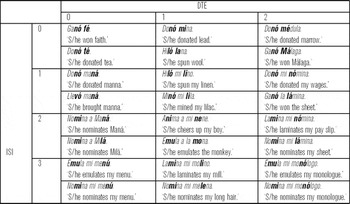
The contextualized sentence reading task was designed to elicit a total of 104 test sentences per subject and was conducted via computer-based prompts. The design of the test sentences was based on 24 unique lexical combinations. These lexical combinations contained two content words each and were manipulated according to two parameters: the number of unstressed syllables between the first and second stressed syllables (i.e. interstress interval (ISI)), which was 0, 1, 2, or 3; and the distance of the last stressed syllable from the end of the utterance (DTE), which was 0, 1, or 2.Footnote 7 Intervocalic voiced consonants were chosen because they permit the entire sentence to be voiced and allow for a continuous pitch track with no f0 breaks. The 24 lexical combinations are given in Table 1.Footnote 8
All lexical combinations, based on interstress interval (ISI) and distance to end of utterance (DTE). Bold indicates stressed syllables.

Each lexical combination was used to create two target sentence types (declarative question and wh-question), and each target sentence was uttered twice, resulting in 96 test sentences per speaker (i.e. 24 lexical combinations × 2 sentence types × 2 repetitions). Sentences created for the (2;1) context were included two extra times per sentence type to meet protocol demands of a parallel research study.Footnote 9 This resulted in eight additional sentences, for a total of 104 test sentences read by each speaker. Distracter sentences were also included (n = 58), and these were imperatives or declarative statements, for a total of 162 sentences in this task. Declarative questions were lexically and syntactically identical to the declarative statements in Table 1. Wh-questions included the wh-word quién ‘who’ utterance-initially.
For the sake of clarity, ‘declarative question’ in this paper refers to information-seeking questions for which two responses are possible (i.e. positive ‘yes’ or negative ‘no’) and for which there are no formal markers of interrogativity. Note that the term ‘yes/no question’ may be appropriate as well from a pragmatic standpoint, although yes/no questions in many Germanic languages are marked by inversion (van Heuven & Haan Reference van Heuven, Haan and Botinis2000, Reference van Heuven, Haan, Gussenhoven and Warner2002; Haan Reference Haan2001: 12) and there is debate on whether declarative questions are truly information-seeking or confirmation-seeking in these languages (Haan Reference Haan2001: 16). It is important to bear in mind that the information-seeking intent of the questions analyzed in this study would seem to be the pragmatic equivalent of yes/no questions in Germanic languages.
The test sentences were embedded in a Microsoft PowerPoint slide presentation, one sentence per slide. Participants read aloud the target sentences preceded by a discourse context designed to elicit a particular pragmatic intent: declarative question or wh-question. As shown in (1), all target sentences were preceded by a contextualized prompt so that the pragmatic intent of the utterance would be clear. All sentences were presented in a neutral context.
(1) Sample lexical combination: Anima a mi nene ‘S/he was cheering up my boy.’
(a) Declarative question
Contexto: María quiere saber qué hace su niña pequeña.
Te pregunta: ‘¿Anima a mi nene?’
Context: María wants to know what her girl is doing.
She asks you: ‘Is she cheering up my boy?’
(b) Wh-question
Contexto: Hay mucho ruido en casa y María quiere saber qué pasa.
Te pregunta: ‘¿Quién anima a mi nene?’
Context: There is a lot of noise at home, and María wants to know what is happening.
She asks you: ‘Who is cheering up my boy?’
Each slide in the Microsoft PowerPoint presentation contained a different context and target sentence, and the order of target sentences was pseudo-randomized throughout the PowerPoint document so that a disproportionate amount of identical sentence types were not presented successively. Subjects read the discourse context after the first click per slide. They saw the target sentence embedded in quotation marks after the second click. They were instructed to read the discourse context in silence, but to read aloud the sentence embedded in quotes. The first six slides served as a practice session so that participants would become familiar with the pragmatic contexts and the design of the task. The researcher remained present during the practice session only.
3.3 Gap task
In contrast to the single version of the contextualized reading task for declarative questions and wh-questions, there were two different versions of the gap task. These were identical in terms of speaking situation and task demands, but different in terms of sentence type (i.e. declarative question or wh-question). Both tasks were entitled ‘gap task’ since these were information gap-style tasks, similar in format to the map task, and were conducted in pairs. For the current study, all participants were paired with the researcher.Footnote 10 Of importance is the fact that the syllabic and segmental content of all gap task target utterances were identical to those of the contextualized sentence reading task. As stated earlier, the gap task may be viewed as a modified version of the HCRC Map Task (Anderson et al. Reference Anderson, Bader, Bard, Boyle, Doherty, Garrod, Isard, Kowtko, McCallister, Miller, Sotillo, Thompson and Weinert1991) since the gap task is designed to elicit question intonation only in a neutral setting.
3.3.1 Declarative question gap task
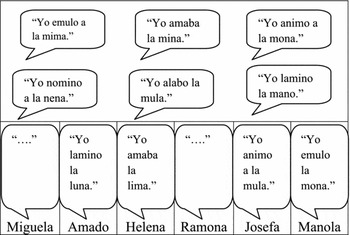
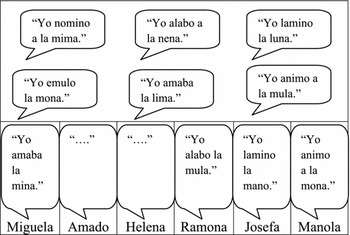
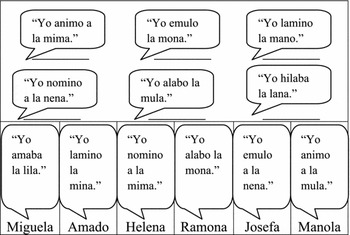
For the declarative question gap task, participants were given five sheets of paper, and each sheet contained a chart partitioned by a horizontal line (see Appendix A for two sample task sheets). The upper panel of the chart consisted of a series of dialogue balloons, and each dialogue balloon contained a declarative statement (e.g. Yo mimaba a la nena ‘I was spoiling the girl’). In the lower panel of the chart, participants saw six fictional cartoon characters. Four of the six characters were linked to a dialogue balloon containing a declarative statement different from those provided in the upper panel of the chart. Two other characters, however, had empty dialogue balloons. Speakers were informed of four important components to the gap task protocol. First, they knew that the goal was to ask the researcher what the two fictional characters with empty dialogue balloons were saying. Second, they knew that the researcher could locate the answer in the lower panel of his task sheet. Third, they knew that the answers to these ‘gaps’ of information (i.e. what the characters with empty balloons were saying) were located in the upper panel of their own task sheets. Finally, speakers were instructed to elicit responses with absolute interrogative syntax, i.e. they had to transform the declarative statements from the upper panel of the sheet into declarative questions. A sample interaction for speaker 2F (based on the task sheets in Appendix A) is provided in (2).
- (2)


Speakers were instructed to inquire about all empty dialogue balloons until the researcher confirmed that the correct response had been provided. The researcher responded to each inquiry by consulting the dialogue balloons in the lower portion of his chart and communicating the answer, which was sí ‘yes’ or no ‘no’. Speakers uttered five or six declarative question utterances per task sheet, for a total of 25–35 target utterances. The researcher also inquired about the dialogue balloons in the upper panels of his task sheets, but did not use absolute interrogative syntax to avoid a priming effect. The subject and the researcher took turns asking about the empty dialogue balloons until the five gap task sheets were complete.
A reviewer asks whether the question intent in the gap task may be interpreted as an echo yes/no question or a neutral (i.e. broad focus) yes/no question. Echo yes/no questions are a subtype of confirmation questions, which are reiterative, used to signal a failure to understand or incredulity about what an interlocutor has just said (Noh Reference Noh1995, see also Estebas-Vilaplana & Prieto Reference Estebas-Vilaplana and Prieto2010: 28). Given the nature of the gap task, it was not possible to inquire about a previous utterance since the protocol of the task required that speakers ask about new information (i.e. the next question in sequence) until the appropriate response was achieved. Moreover, the fact that a new question was asked implied that the response to the previous question (i.e. ‘no’) was clear. Nonetheless, the reviewer touches on a fundamental point in the pragmatics–intonation interface which is that it is never easy to ascertain the true intent of a speaker or whether a speaker intends to communicate the same intonational meaning in two seemingly comparable pragmatic circumstances. Similarly, if two speakers utter different intonational contours in what seems to be the same pragmatic context, it may be that there are extralinguistic differences (i.e. dialect, gender, age, etc.) or slight pragmatic nuances (see Lickley et al. Reference Lickley, Schepman and Ladd2005). Given this caveat, it is imperative to gather a large quantity of intonational contours before assessments can be made. This is precisely the goal of the present research study, where we accumulate approximately 2500 f0 contours among 16 different speakers.
3.3.2 Wh-question gap task
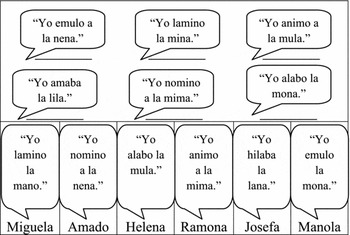
For the wh-question gap task, participants were given five sheets of paper. Each task sheet contained a table partitioned by a horizontal line (see Appendix B for two sample sheets). The upper panel of the chart consisted of a series of dialogue balloons, and each dialogue balloon contained a declarative statement (e.g. Yo mimaba a la nena ‘I was spoiling the girl’). An important difference between the dialogue balloons from the upper panel of the declarative question gap task and those from the wh-question gap task is that in the latter task, a blank line was provided underneath each dialogue balloon. In the lower panel of each task sheet, participants saw six fictional cartoon characters linked to dialogue balloons. The speakers were informed of three important components to the wh-question gap task protocol. First, each speaker knew that the goal was to ask the researcher to which cartoon character each of the dialogue balloons from the upper panel was associated. Second, each speaker knew that the answers to these ‘gaps’ of information (i.e. the names of the characters uttering each statement) were provided in the lower panel of the researcher's task sheet. Finally, each speaker was instructed to elicit responses with pronominal interrogative syntax. That is, they had to transform the declarative statements from the upper panel of the task sheet into wh-questions. A sample interaction of speaker 4F is provided in (3) for the first three of the six questions that were asked for the task sheets in Appendix B.
- (3)

Speakers uttered six wh-question utterances per task sheet, for a total of 30 target productions across the five sheets. The researcher responded to each inquiry by consulting the dialogue balloons in the lower portion of his table and communicating the answer (e.g. ‘Ramona’, ‘Miguela’, etc.). The researcher also inquired about the dialogue balloons in the upper panel of his sheets, but did not use pronominal interrogative syntax to avoid a priming effect. The participant and the researcher took turns asking about the speakers of the unassociated dialogue balloons until the five wh-question gap task sheets were completed.
3.4 Recording protocol
Speakers were recorded in a quiet room in the native dialect area. The two gap tasks were administered, then the sentence reading task, and finally the language background questionnaire. The reading task lasted approximately 16–20 minutes, and the gap tasks lasted 5–6 minutes each, for an approximate total of 30–35 minutes of recording time. The speaking tasks were ordered using the following format: declarative question gap task; wh-question gap task; and sentence reading task. Given the small sample size, the tasks were not counterbalanced and the order was fixed for all speakers.Footnote 11 The data were recorded using a Sony HI-MD MZ-RH1 minidisc recorder and a Shure WH20 head-mounted microphone.
3.5 Data analysis
Sound files were digitally transferred into .wav format using Sony SonicStage 4.3 and analyzed with the acoustic analysis software Praat (Boersma & Weenink Reference Boersma and Weenink2013). The researcher listened to all digitized data and discarded the rare tokens that were produced with hesitation pauses, disfluencies, or improper stress placement (e.g. some speakers uttered intended [mi.lá] as [mí.la]). The researcher also discarded utterances with long stretches of creaky voice that made it impossible to extract reliable f0 measurements. This resulted in 70 eliminated files of 2625 total productions.
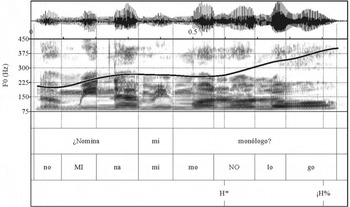
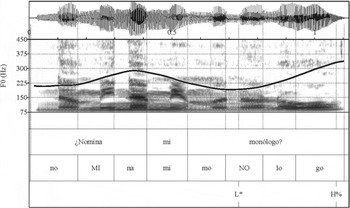
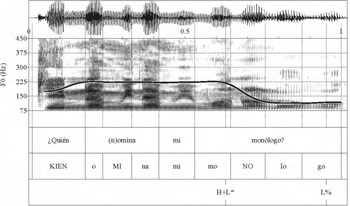
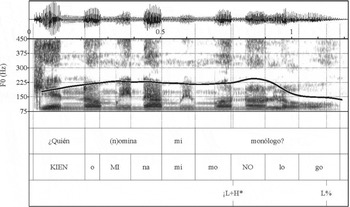
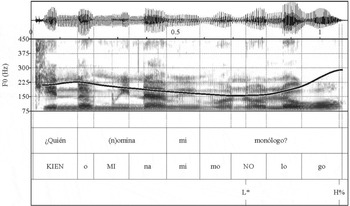
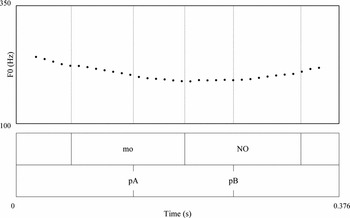
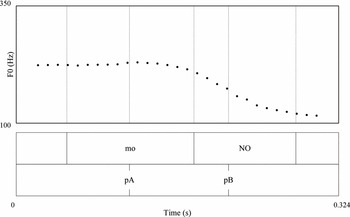
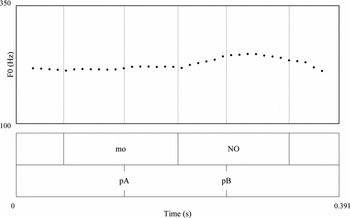
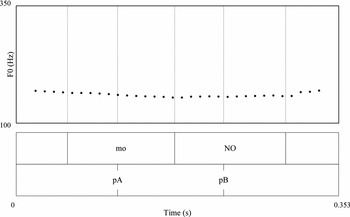
Preliminary inspection of the Manchego corpus revealed an inventory of five different intonational contours between the two question types. On the whole, the most noteworthy differences in the f0 contours were observed at the tonemic (i.e. nuclear and utterance-final) level of analysis. Figures 2–6 show the f0 output of five typical contours: early rise and late rise (limited to declarative questions); and early fall, late fall, and find rise (limited to wh-questions). These intonational contours are widely attested in Spanish intonation (see Section 5.2 for full discussion). ‘Early’ and ‘late’ are descriptive labels that refer to the start of the utterance-final gesture relative to the nuclear syllable: near the nuclear onset (i.e. early within the nuclear syllable), or near the nuclear offset (i.e. late within the nuclear syllable). Thus, for declarative questions, the most notable difference was where the utterance-final rise began within the nuclear syllable. For wh-questions, final falls were observed, and a primary difference was the timing of the fall start relative to the nuclear onset. Also, a final rising contour was observed for wh-questions.
Waveform, spectrogram, and f0 for declarative question early rise contour for ¿Nomina mi monólogo? ‘Does s/he nominate my monologue?’. Stressed syllables are in capital letters. The first stressed syllable is the prenuclear syllable, and the second stressed syllable is the nuclear syllable. Note that interstress interval is 3 and distance to end of utterance is 2.

Waveform, spectrogram, and f0 for declarative question late rise contour for ¿Nomina mi monólogo? ‘Does s/he nominate my monologue?’.

Waveform, spectrogram, and f0 for wh-question early fall contour for ¿Quién nomina mi monólogo? ‘Who nominates my monologue?’.

Waveform, spectrogram, and f0 for wh-question late fall contour for ¿Quién nomina mi monólogo? ‘Who nominates my monologue?’.

Waveform, spectrogram, and f0 for wh-question final rise contour for ¿Quién nomina mi monólogo? ‘Who nominates my monologue?’.

Autosegmental-metrical labels are also given in Figures 2–6 and follow the original Sp_ToBI transcription system (Beckman et al. Reference Beckman, Díaz-Campos, McGory and Morgan2002) and the revised system put forth in Estebas-Vilaplana & Prieto (Reference Estebas-Vilaplana and Prieto2008); the reader is also directed to Henriksen (Reference Henriksen2012, Reference Henriksen2013).Footnote 12
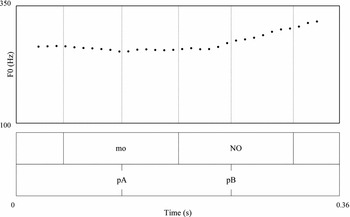
It became necessary to create an objective measure for the acoustic labeling of intonational contours. As argued in Grabe, Kochanski & Coleman (Reference Grabe, Greg and Coleman2007), researchers in intonation can benefit from techniques that connect impressionistic insights with quantitative, objective data. There is growing consensus that labeling prosodic corpora based on f0 trajectory or ‘curvature’ reliably accounts for intonational contrasts (see also Andruski & Costello Reference Andruski and Costello2004). To this end, we manually marked each utterance at two temporal landmarks via simultaneous inspection of sound waves and spectrograms as generated by Praat.
1. Point A (pA): the onset of the vowel in the last pre-stressed syllable.
2. Point B (pB): the onset of the vowel in the last stressed (i.e. nuclear) syllable.Footnote 13
Examples of segmented pitch contours for the last pre-stressed and the last stressed syllables are given in Figures 7–11.
Example of segmented pitch contour (early rise). Pitch values were extracted from the time of pA and pB.

Example of segmented pitch contour (late rise).

Example of segmented pitch contour (early fall).

Example of segmented pitch contour (late fall).

Example of segmented pitch contour (final rise).

Pitch values were extracted from each temporal landmark and were converted from Hz to logarithmic Equivalent Rectangular Bandwidth (ERB) units. The conversion formula was ERB = 21.4 × log10(X × 0.00437 + 1) (Glasberg & Moore Reference Glasberg and Moore1990). As has been argued elsewhere (Arvaniti, Ladd & Mennen Reference Arvaniti, Ladd and Mennen2006, Simonet Reference Simonet2008, Arvaniti & Ladd Reference Arvaniti and Ladd2009), the ERB scale gives a better approximation of the perceptual distance between f0 levels (i.e. measures of f0 magnitude) and allows more easily for the comparison of male and female data.
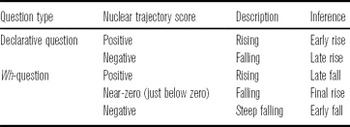
Following this, a nuclear trajectory score was established for each f0 contour by subtracting the ERB value of pA from the ERB value of pB (i.e. pB–pA) to determine the linear shape of the f0 trajectory into the nuclear syllable. This resulted in generally positive (rising f0), negative (falling f0), or zero (flat f0) trajectory scores. For declarative questions, the early rise vs. late rise contrast was assumed by positive (rising) vs. negative (falling) trajectory, respectively. For wh-questions, the presumed classification was: positive (late fall); near-zero (final rise); and negative (early fall). Table 2 schematizes the relationship between the trajectory score possibilities and their linear descriptions. Although curve-fitting procedures may have been desirable to model the curvature shape (concave or convex) of each contour before and after the nuclear syllable (e.g. Simonet Reference Simonet2011), it was not possible to mark the post-stressed vowel in all cases since for some test sentences the utterance-final syllable was the nuclear stressed syllable. Given the scope of this study, we feel that the classification in Table 2 appropriately achieves an objective measure for establishing each toneme that was produced and avoids the issue of impressionistic labeling (del Giudice et al. Reference del Giudice, Shosted, Davidson, Salihie and Arvaniti2007).
Summary of trajectory score possibilities and inferred descriptions.

4 Results
The complete dataset (one dependent variable, i.e. nuclear trajectory score) was submitted to a linear mixed-effects model analysis to explore the interactions of fixed factors, if any, and thus motivate the division of the original dataset into smaller subsets that allow for the examination of the research objectives of this study. An ANOVA summary (df = 1, 2435) of the mixed-effects model with nuclear trajectory score (ERB) as response and speaker set as random factor returned significant effects for the fixed factor sentencetype (F = 339.65, p ≤ .001) and the sentencetype-by-task interaction (F = 153.03, p ≤ .001), but not for the fixed factor task (F = .172, p = .678). Also, Bonferroni post-hoc analysis was used to determine the effects of fixed factors. The fixed factor task did not yield significant results because the overall means for each speaking condition (taking into account both sentence types) were similar (gap task mean = –.201, SD = .668; reading task mean = –.235, SD = .581), although this was most likely a coincidence. The significant effect of sentencetype-by-task indicates that task effects must be taken into account for declarative questions and wh-questions separately. This is explored below in a series of extractions of data subsets from the original dataset: Section 4.1 for declarative questions and Section 4.2 for wh-questions.
4.1 Declarative questions
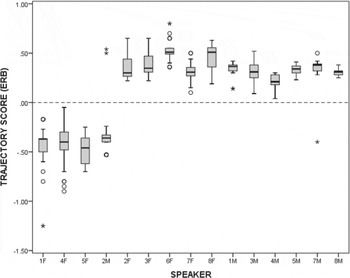
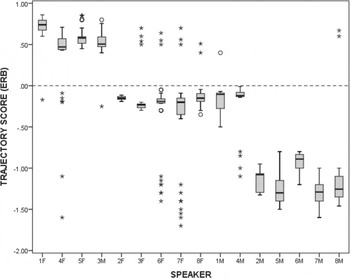
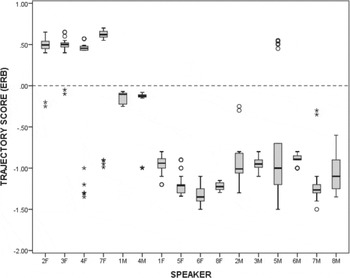
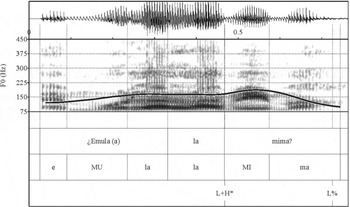
Nuclear trajectory scores are plotted for declarative questions on the y-axes of Figures 12 and 13 for the reading task and gap task, respectively. Positive scores indicate a rising trajectory into the nuclear syllable (i.e. early rise), and negative scores indicate a falling trajectory into the nuclear syllable (i.e. late rise). Each speaker is also listed along the x-axes of both graphs. The figures present a summary of the overall preference for each contour based on speaking condition. Negative distributions (late rise) were more common in the reading task, favored by 10 of the 16 speakers: 1F, 2F, 3F, 4F, 5F, 1M, 2M, 3M, 4M, and 5M. On the other hand, positive distributions (early rise) were more common in the gap task, shown for speakers 2F, 3F, 6F, 7F, 8F, 1M, 3M, 4M, 5M, 7M, and 8M. Gap task data for speaker 6M are not plotted in Figure 13 since he produced a contour with a rise-fall pattern on the nuclear syllable that was not observed for any other speaker in either task. An example is given in Appendix C. This rise-fall (circumflex) pattern has been described elsewhere as the pattern for confirmation questions (of the non-reiterative type) in Peninsular Spanish (Estebas-Vilaplana & Prieto Reference Estebas-Vilaplana and Prieto2010). As an expository convention, speakers coded by ‘F’ are female speakers, and speakers coded by ‘M’ are male speakers.Footnote 14
Nuclear trajectory score distributions (ERB) for declarative questions in reading task.

Nuclear trajectory score distributions (ERB) for declarative questions in gap task.

In order to account for intraspeaker variation (i.e. a speaker may not have produced one intonational melody in consistent fashion throughout the task), extreme outliers were discarded prior to statistical analysis. Extreme outliers were classified as trajectory scores greater than three times the interquartile range for a particular speaker, indicated by asterisks in Figures 12 and 13. A total 38 productions were eliminated based on this criterion. A linear mixed-effects model with trajectory score (ERB) as response and speaker set as random factor returned significant effects for the fixed factor task for declarative questions: F(1,1232) = 576.59, p ≤ .001.Footnote 15
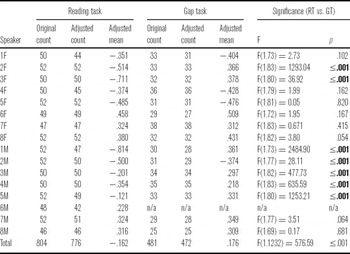
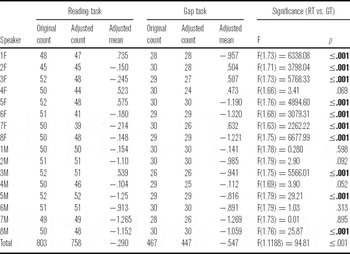
In order to determine the effect of speaking condition for each speaker, 15 separate mixed-effects models were run. Table 3 shows the significance results for the Bonferroni post-hoc contrasts, along with the adjusted count and adjusted mean for each speaker according to speaking condition. In total, eight speakers did not show statistically significant differences between conditions. Five speakers (6F, 7F, 8F, 7M, and 8M) preferred the early rise in both tasks, and three speakers (1F, 4F, and 5F) preferred the late rise in both tasks. The pattern for these eight speakers is consistent use of one contour in both conditions. Speaker 2M also used the late rise contour in both tasks (compare Figures 12 and 13), but his data returned a significant result showing that his trajectory score was lower (i.e. steeper fall) in the reading task. We return to this issue at a later point in the paper.
Original and adjusted counts, adjusted means, and significance test results based on speaking condition for declarative questions. Boldface p-values indicate speakers displaying significant trajectory differences between the speaking conditions.

RT = reading task; GT = gap task
Six other speakers yielded statistically different trajectory scores based on speaking condition: 2F, 3F, 1M, 3M, 4M, and 5M. The inference for these six speakers is a style-shift between speaking conditions.Footnote 16
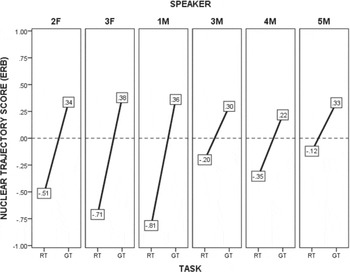
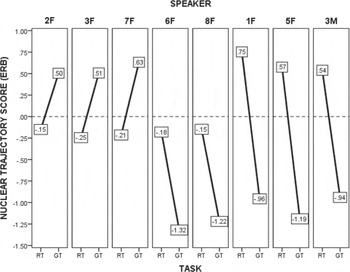
As a way of understanding the style-shifts, mean trajectory scores are plotted in Figure 14 for speakers whose comparisons yielded significant differences based on speaking condition (excluding 2M). The pattern for these six speakers is a consistent shift: falling trajectories in the reading task (indicated by negative scores) and rising trajectories in the gap task (indicated by positive scores), or in other words, a shift from late rise to early rise.
Line graphs comparing mean trajectory scores (ERB) based on speaking condition. RT indicates reading task; GT indicates gap task.

4.2 Wh-questions
Next, nuclear trajectory scores are plotted for wh-questions on the y-axes of Figures 15 and 16 for the reading task and gap task, respectively. Recall that for wh-questions, positive scores indicate a late fall, scores near zero indicate a final rise, and negative scores indicate an early fall. Each speaker is listed along the x-axes in both figures. In the reading task, near-zero distributions (final rise) were most common, shown for seven speakers: 2F, 3F, 6F, 7F, 8F, 1M, and 4M. Negative distributions (early fall) were the second most common, shown for five speakers: 2M, 5M, 6M, 7M, and 8M. Four speakers obtained positive distributions (late fall): 1F, 4F, 5F, 3M.
Nuclear trajectory score distributions (ERB) for wh-questions in reading task.

Nuclear trajectory score distributions (ERB) for wh-questions in gap task.

Distributional data from the gap task were noticeably different. Ten speakers preferred early falls (1F, 5F, 6F, 8F, 2M, 3M, 5M, 6M, 7M, and 8M), four speakers preferred late falls (2F, 3F, 4F, 7F), and two speakers preferred final rises (1M, 4M).
As with declarative questions, it was necessary to account for intraspeaker variation. Prior to statistical analysis, extreme outliers were discarded for trajectory scores that were greater than three times the interquartile range for a particular speaker. A total 65 productions were eliminated based on this criterion. A linear mixed-effects model with trajectory score (ERB) as response and speaker set as random factor returned significant effects for the fixed factor task: F(1,1188) = 94.81, p ≤ .001.
Following this, 16 separate mixed-effects models were run to determine the effect of speaking condition per speaker. Table 4 shows the significance results for the Bonferroni post-hoc contrasts, along with the adjusted count and mean for each speaker according to speaking condition. Six of the speakers did not obtain significantly different mean scores between conditions. Specifically, three speakers (2M, 6M, and 7M) preferred the early fall, one speaker (4F) preferred the late fall, and two speakers (1M and 4M) preferred the final rise in consistent fashion.
Original and adjusted counts, adjusted means, and significance test results based on speaking condition for wh-questions. Bold p-values indicate speakers displaying significant trajectory differences between the speaking conditions.

RT = reading task; GT = gap task
On the other hand, ten speakers showed significant differences between conditions. For speakers 5M and 8M it would seem that the same contour (early fall) was produced in both conditions, but f0 descents were steeper in the reading task. The other eight speakers obtained statistically different means corresponding apparently to different melodic contours between conditions (and confirmed by the boxplots in Figures 16 and 17).
Line graphs comparing nuclear trajectory scores (ERB) based on speaking condition for wh-questions. RT indicates reading task; GT indicates gap task.

Mean trajectory scores are plotted in Figure 17 for speakers whose comparisons yielded significant differences according to speaking condition (excluding 5M and 8M). It is seen that three speakers shifted from near-zero means to positive means (from final rise to late fall), two speakers shifted from near-zero means to negative means (from final rise to early fall), and three other speakers shifted from positive means to negative means (from late fall to early fall).
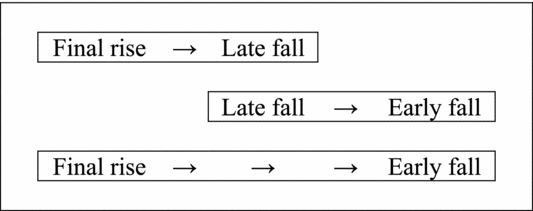
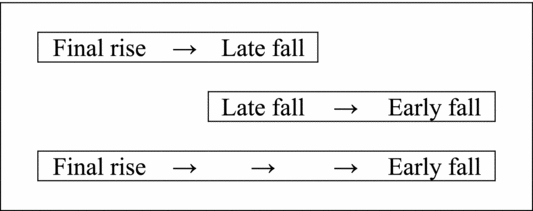
Figure 18 presents a clearer picture of these style-shifts in which switch types are referenced with respect to degree of formality (more formal to less formal). When the final rise contour was involved in a switch, it was always a switch away from the final rise to either the late fall or the early fall. When the early fall was involved in a switch, it was always a switch from another contour to the early fall. When the late fall was involved in a switch, it was either from the final rise or to the early fall. Note that three switch types were never observed: from late fall to final rise, from early fall to final rise, and from early fall to late fall.
Modified schema of switch type (comparing read data to gap task data) for wh-question contours.
4.3 Combined task-based distribution
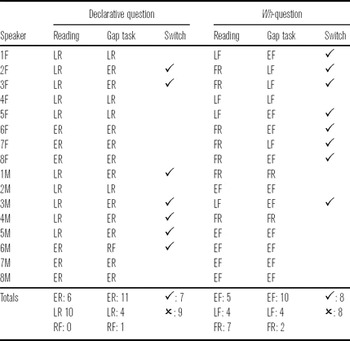
A task-based comparison is given for all speakers based on question type in Table 5 to determine whether the same speakers style-shifted for both question types, or whether certain speakers shifted for one question type only. An initial finding is much interspeaker variation when both question types are taken into account: 12 speakers (7 females and 5 males) exhibited at least one style-shift between conditions. Of these, five (all females) switched contours for wh-questions only, and four others (all males) switched contours for declarative questions only. Three speakers (2 females and 1 male) switched for both question types, although the change itself was not consistent. All three of these switched from a late rise to an early rise for declarative questions, but two of them (2F and 3F) switched from a final rise to a late fall for wh-questions, while the other (3M) switched from a late fall to an early fall for wh-questions. Four speakers (1 female and 3 males) did not exhibit style-shifting at all. Speaker 4F consistently used the late rise for declarative questions and the late fall for wh-questions, regardless of task. On the other hand, speakers 7M and 8M used the early rise for declarative questions and the early fall for wh-questions. These and other findings are discussed in broader terms in the following section.
Task-based comparison for declarative question and wh-question tonemes for all speakers.

EF = early fall; ER = early rise; FR = final rise; LF = late fall; LR = late rise; RF = rise-fall
5 General discussion
5.1 Stylistic variation
The goal of this study was to examine style-shifting in intonation. Although the finding that speakers modify intonational production in accommodation to speaking situations is not without precedent (e.g. Yaeger-Dror Reference Yaeger-Dror1985, Reference Yaeger-Dror1996, Reference Yaeger-Dror2002; Yaeger-Dror et al. Reference Yaeger-Dror, Hall-Lew, Deckert and Meyer2003; Cruttenden Reference Cruttenden2007), a review of the literature on this topic revealed the need for an assessment of how task-based variation in intonation could be understood in variationist terms. We now have strong evidence that differences in speech style – inferred from the different speaking tasks that were created – contribute to differences in the production of intonational categories. Distributional analysis of the declarative question data based on nuclear trajectory score indicated an overall preference for the late rise in the reading task, but the early rise in the gap task. Distributional analysis of the wh-question data indicated an overall preference for the final rise in the reading task, but the early fall in the gap task; the late fall was used in similar fashion both tasks. A single switch type was observed for declarative questions: late rise to early rise. For wh-questions, three switch types were observed: from final rise to late fall, from final rise to early fall, and from late fall to early fall.
In keeping with notions implicit to style variation and style-shifting (i.e. less monitored speech is a closer reflection of the ‘vernacular’ and highly monitored speech is a closer reflection of a particular ‘standard’), we infer the following:
• The contours that predominated in the reading corpus, i.e. the declarative question late rise and the wh-question final rise, are more formal variants and closer to the standard variety of Manchego Spanish.
• The contours that predominated in the dialogue corpus, i.e. the declarative question early rise and the wh-question early fall, are less formal variants and closer to the Manchego Spanish vernacular.
The status of the wh-question late fall would seem to be intermediate between the final rise and the early fall given its distribution and the style-shifts that it exhibited. For those speakers whose shifts included this contour, they exhibited the appropriate shift from a more formal to a less formal style: either from the final rise to the late fall or from the late fall to the early fall. Also, the fact that both high boundary rises (i.e. declarative question late rise and wh-question final rise) may be adduced as formal question variants is not wholly unexpected, since as early as Navarro Tomás (Reference Navarro Tomás1944) this gesture was referenced as ‘courteous’ or ‘polite’ in Spanish intonation (see also Quilis Reference Quilis1993, Cabrera Abreu & Vizcaíno Ortega Reference Cabrera Abreu and Ortega2010).Footnote 17 For Italian, Savino (Reference Savino2012) attributes the high boundary rise in questions as an artifact of read speech protocols, showing that other boundary gestures are more common in map task settings. According to Savino, there is a large misconception in the literature that the terminal rise is the most widespread feature in question intonation in Italian; Savino (Reference Savino2012: 44) attributes this misconception to an ‘underestimation of the role of the “reading style effect”’. The present findings on Manchego Spanish are strong support for this claim: we have pointed out the importance of manipulating the speech style parameter when analyzing question intonation and have shown that for two question types, the boundary rise (L*H%) predominates in read speech.
Style-shifts were not categorical, nonetheless, so a case for intonational ‘diglossia’ (Cruttenden Reference Cruttenden2007) in the strictest sense of the term (see Ferguson Reference Ferguson1959) cannot be made for the current data. In the words of Ferguson (Reference Ferguson1959: 87), ‘a diglossic situation exists in a society when it has two distinct codes which show clear functional separation; that is, one code is employed in one set of circumstances and the other in an entirely different set’. High and low varieties in a diglossic situation are functionally differentiated from one another and are often mutually exclusive to such an extent that attempts to use the high variety in informal, daily conversations are rarely attested and considered pedantic (Wardhaugh Reference Wardhaugh2002). Such a state of affairs could not be inferred based on the present data. In fact, all five question contours were attested to some extent in both tasks, and although the evidence on stylistic variation was clear (see discussion above), no two patterns were ever distributed complementarily between the two speaking conditions, as in Cruttenden (Reference Cruttenden2007). Still, an obvious implication of the present findings is that researchers in intonation must be sure that their data relate directly to how they frame their hypotheses. If the aim is to collect intonational data from a single speaking situation, the sociolinguistic limitation of doing so must be qualified: although there are methodological advantages to using one task type, even when the methodology approaches ‘naturalistic’ (e.g. Prieto & Roseano Reference Prieto and Paolo2010b), the social potential of the data is lost without a task-based comparison.
As for the situational basis of the attested style-shifts, there is the hypothesis that the task distributions were related to differences in the social situations (Yaeger-Dror Reference Yaeger-Dror1985, Reference Yaeger-Dror1996, Reference Yaeger-Dror2002; Biber Reference Biber1988, Reference Biber1995) that were created – i.e. contextualized sentences vs. situated, problem-solving dialogue – however, it is beyond the scope of this paper to tease apart the situational aspects from the attention paid to speech or audience design components of the data elicitation (for discussion, see Yaeger-Dror Reference Yaeger-Dror, Eckert and Rickford2001). On the whole, sentence reading is arguably a more ‘careful’ style than an information gap task which requires speakers to focus less on linguistic form and more on the content of their productions, so we have little justification at this juncture for rejecting the causality of either attention paid to speech or audience design as motivating factors in the variation observed here.
5.2 Speaker sex and dialect variation
We must also consider the possible effect of speaker sex, and there is now a substantial body of research that highlights this social variable as an important motivating factor in intonational variation (Lakoff Reference Lakoff1975; Pauwels Reference Pauwels1987; Britain Reference Britain1992; Warren & Daly Reference Warren, Daly and Holmes2000, Reference Warren2005; Daly & Warren Reference Daly and Warren2001; Warren Reference Warren2005b; Innes Reference Innes2007; Simonet Reference Simonet2008). For declarative questions, men and women produced the early and late rise contours at near identical rates in the reading task and with similar distributions in the gap task. Of the seven speakers who style-shifted, five were men. For wh-questions, women used the final rise most frequently in the reading task and the early fall and late fall at identical rates in the gap task; men showed greater incidence to use the early fall in both tasks. Of the eight speakers who style-shifted, seven were women. Notwithstanding the small sample size, these combined results on style-shifts are initial evidence that declarative questions and wh-questions are on distinct paths of linguistic variation: the number of style-shifts was greater for declarative questions in the male sample, whereas for wh-questions, it was greater for females.
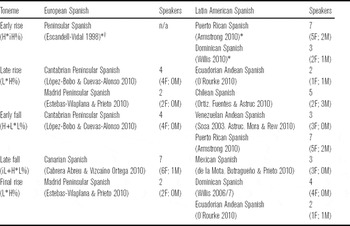
In order to understand more appropriately this inverse behavior, it may be useful to connect our findings to recent data on regional variation in Spanish intonation. A comparison of the present findings with those from closely studied varieties of Spanish prompts the observations in Table 6. As an initial caveat, the information provided there is not meant to be exhaustive; furthermore, straightforward comparisons are not always possible when taking into account such a broad sample of findings based on often dissimilar research methodologies and distinct speaker samples.Footnote 18 For example, it should be noted that for all studies listed in Table 6, the speaker pool was smaller than that of the present study and that in most cases, the speaker sex distribution was not balanced. The purpose, nonetheless, is tenable: to provide a cross-dialectal comparison for the observed Manchego tonemes and to determine if these have been attested for other varieties of Spanish, European and Latin American.
Spanish dialects based on the use of five toneme categories.

* The early rise contour was reported for marked (i.e. not information-seeking) pragmatic intents in declarative questions.
†Escandell-Vidal (Reference Escandell-Vidal, Rouchota and Jucker1998) does not provide information on the sub-variety of European Spanish that was examined in her paper. It was also not clear how many informants were consulted in her study.
Even this cursory cross-dialectal assessment reveals that four of the five Manchego contours are available in European (i.e. Cantabrian, Madrid, and Canarian) and also Latin American Spanish (i.e. Puerto Rican, Dominican, Ecuadorian Andean, Venezuelan, Mexican), with the early rise (H*¡H%) as the one exception. It must be stated, then, that the present variety of contours is not unique to the Manchego dialect; one possibility is that there is a continuum of intonational choices available in the Spanish-speaking world, with certain dialects preferring particular toneme gestures to the dispreference of others. This may be difficult to assess without speech data from multiple comparable speaking situations for each variety. Another possibility is that different dialects ‘cluster’ according to their use of rising or falling boundary tones, as has been suggested elsewhere (Prieto & Roseano Reference Prieto and Roseano2010a: 10–11); such a conclusion may be a precipitate, however, since neither rises nor falls were exclusive to wh-questions in the Manchego data. Perhaps a more convincing solution is that a situation of intonational flux is at work in many of these varieties, working in tandem with factors such as pragmatic nuance, knowledge of the speaker of the intended response (e.g. Escandell-Vidal Reference Escandell-Vidal, Gutiérrez-Rexach and Silva-Villar1996, Reference Escandell-Vidal, Rouchota and Jucker1998), or social variables such as speaking situation and speaker sex. Data on question intonation across varieties of Northern, Central, and Southern Italian would seem to support this last position especially (Savino Reference Savino2012).
Analyzing further the cross-dialectal comparison from Table 6, there is the anomaly of the early rise (H*¡H%) toneme, reported elsewhere in the cross-dialectal data on Spanish as a signal of marked (i.e. not information-seeking) pragmatic intent (e.g. Escandell-Vidal Reference Escandell-Vidal, Rouchota and Jucker1998, Armstrong Reference Armstrong2010, Willis Reference Willis2010). One explanation for the conflicting cross-dialectal results may be that the early rise toneme, frequent in discourse given its multiple marked connotations, was re-analyzed by Manchego speakers as a signal of neutral question intent. Given the cross-dialectal comparison in Table 6, it would seem that such re-analysis has not extended far beyond the Manchego community. Lending support to this idea is the earlier observation that the Manchego men style-shifted more on declarative questions than their female counterparts. As indicated in Chambers (Reference Chambers1992), women style-shift when they adopt innovative linguistic forms from members of their greater range of social contacts; following this, it may be posited that when men style-shift, it is because they adopt forms that innovate from community-internal pressures. The uncommon use of the early rise as a signal of neutral question intent beyond the Manchego area in addition to the greater disposition of the Manchego men to style-shift for this question type motivate the hypothesis that variation in declarative questions developed within and remains specific to the Manchego community. Additional support for this claim is the generally accepted sociolinguistic postulate that men often use local variants to gain ‘covert’ prestige within a local community, whereas women prefer variants of a standard variety to gain social status or ‘overt’ prestige in the wider community (Trudgill Reference Trudgill1972). These last points will need corroboration with a larger speaker sample.
5.3 Some broader implications
Foulkes (Reference Foulkes and Brown2012) points out that researchers in sociophonetics should consider the implications of their data from the perspectives of grammatical and sociolinguistic theory, and we would like to highlight a few insights of the present findings. First, for theories of speech production, the present findings reinforce the notion that different intonational forms may contribute to differences in social or stylistic meaning in addition to pragmatic meaning (e.g. Yaeger-Dror Reference Yaeger-Dror1985, Reference Yaeger-Dror1996, Reference Yaeger-Dror2002; Silverman et al. Reference Silverman, Blaauw, Spitz and Pitrelli1992; Cruttenden Reference Cruttenden2007); an implication is that researchers may want to consider how this can be modeled from the perspective of intonational phonology. It was not our aim to explain how this should be accomplished, and of note, Labov (Reference Labov2006) and Pierrehumbert (Reference Pierrehumbert2006) caution against assuming that all social variation is stored in the cognitive system. Still, it may be relevant to explore if certain models of intonational phonology are more amenable to the inclusion of social factors for modeling f0 production. Specifically, the Parallel Encoding and Target Approximation (PENTA) framework (Xu Reference Xu2005, Xu & Xu Reference Xu2005) specifies mechanisms for the transmission of multiple f0 functions in parallel; these communicative mechanisms (i.e. lexical tone, focus, sentential meaning) are assumed to control f0 through distinctive encoding schemes of pitch target, pitch range, and articulatory strength. Given the parallel nature of PENTA, it seems reasonable to incorporate social or indexical meaning as additional communicative functions of f0. Nonetheless, Arvaniti & Ladd (Reference Arvaniti and Ladd2009) have argued that PENTA does not adequately capture linguistic generalizations of f0 contours beyond phonetic detailing; specifically, PENTA does not generalize phonetic implementation differences that result from utterances of different lengths for a particular melody.
Another finding of the statistical analysis was that trajectory scores for three speakers yielded statistically significant differences between conditions when the same melodic contour was produced (speaker 2M for declarative questions and speakers 5M and 8M for wh-questions); in all cases lower trajectory scores (i.e. steeper falls) were observed in the read data. One implication is that pitch range may have been greater or ‘hyper-articulated’ (Lindblom Reference Lindblom, Hardcastle and Marchal1990) for these speakers since the data were produced in a reading task that elicited clear speech. When and how speakers hyper- or hypo-articulate has been a topic of much recent research (see Baker & Bradlow Reference Baker and Bradlow2009); of relevance is the observation by Uchanski (Reference Uchanski, Pisoni and Remez2005) that larger f0 range in clear speech situations may be a by-product of vocal effort due to increased hyper-articulation. The finding on steeper falls would represent empirical support for this claim as well as additional evidence that speakers in the present study had set themselves in distinct speech styles when performing the two tasks. Along these lines, Yaeger-Dror et al. (Reference Yaeger-Dror, Hall-Lew, Deckert and Meyer2003: 221) show that pitch prominence in negation sentences is more likely to occur in informative/read situations and less likely in interactive/supportive situations. Hirschberg (Reference Hirschberg and Horne2000: 345) notes higher f0 phrase and nuclear accent values in read vs. spontaneous speech data. As a caveat, Yaeger-Dror et al. underscore the importance of considering a speaker's ‘footing’ (Goffman Reference Goffman1981), or the understanding that different speakers have about the type of interaction that they are holding.
6 Conclusion
In this paper we reported on a preliminary analysis of variable intonation patterns in Manchego Spanish. Research on sociophonetic variation in intonation is no doubt on the rise (see Warren Reference Warren2005a, Reference Warrenb; Cruttenden Reference Cruttenden2007; Simonet Reference Simonet2010, Reference Simonet2011), but until now there has been limited data to support the notion that ‘careful’ vs. ‘casual’ speech styles contribute to the use of phonologically distinct intonational contours (see Hirschberg Reference Hirschberg and Horne2000). To achieve this goal on principled grounds, this study has introduced a methodological design for the elicitation of question utterances in a semi-naturalistic speech style that allows for direct comparison with read aloud data, yielding a total 2,555 intonational contours submitted to acoustic analysis. The nuclear trajectory criterion proved an adequate heuristic for acoustic classification of the inventory of melodic contours.
In total, it was shown that 12 of the 16 speakers exhibited at least one style-shift between speaking conditions; the implication was that intonational production can be governed by speaking situation, confirming for Spanish what has been reported preliminarily for French, Italian, and multiple varieties of English (e.g. Yaeger-Dror Reference Yaeger-Dror1985, Reference Yaeger-Dror1996, Reference Yaeger-Dror2002; Cruttenden Reference Cruttenden2007; Savino Reference Savino2012). We also made clear the data using variationist principles, providing empirical assessments about formal and vernacular variants. The high boundary rise (L*H%) was attributed as an artifact of read speech primarily, confirming for Manchego Spanish what is documented for numerous varieties of Italian (Savino Reference Savino2012). Style-shifts were not categorical, precluding the possibility of intonational diglossia that had been confirmed for Glaswegian English (Cruttenden Reference Cruttenden2007). It was shown further that style-shifting occurred in dissimilar fashion for men and women; this led to speculation that Manchego men have adopted the early rise pattern to acquire a status of local identity or covert prestige. Future assessment of a larger corpus of data is necessary to confirm this claim. Some insights were also offered in conclusion on broader implications. In sum, the findings show that sociophonetic research adds important knowledge that, in one way or another, may warrant inclusion in current models of speech production.
The findings also generate hypotheses for testing in future research. In this study we were concerned primarily with shifts in f0 contour usage between speaking conditions and examined one phonetic property; clearly there is scope to enhance this line of research (see Lickley et al. Reference Lickley, Schepman and Ladd2005). There is also a need to develop further protocols that elicit more ‘naturalistic’ discourse (e.g. Prieto & Roseano Reference Prieto and Roseano2010b, Yaeger-Dror et al. Reference Yaeger-Dror, Granadillo, Takano, Gakuen, Hall-Lew, Preston and Niedzielski2010, Prieto et al. Reference Prieto, Estrella, Thorson and del Mar Vanrell2011) so that principled task-based comparisons may be provided with read aloud data. No single study can claim to constitute the final word on how tasks should be constructed, and although this paper seems to provide a coherent account for evidence on task-based and stylistic variation, it is clear that analyzing variation in intonation is not as straightforward as doing so for segmental phenomena. One reason is that intonation conveys a range of paralinguistic meanings such as attitude and emotional involvement in addition to linguistic meanings such as ‘statement’ vs. ‘question’, and the increased collaboration or assumed knowledge on part of the speaker in the gap task may have operated as a confounding factor in the final task-based comparison (see Escandell-Vidal Reference Escandell-Vidal, Rouchota and Jucker1998). Still, researchers should not dismiss the social potential of their f0 data – especially if there is growing evidence for it.
Acknowledgements
This paper has benefited greatly from guidance provided by Dan Dinnsen, Erik Willis, Ken de Jong, and Kim Geeslin. I am also indebted to the anonymous reviewers and to two other colleagues who invested their time to read previous versions of my manuscript and provide highly constructive feedback: Brian José and Miquel Simonet. Stephanie Dickinson, Lorenzo García-Amaya, and Bill Wyatt provided valuable help with statistical analysis. Finally, I am grateful to Juan Garví Medina for assistance with participant recruitment. Portions of this paper were presented at Hispanic Linguistics Symposium held in Bloomington, Indiana in October 2010 and New Ways of Analyzing Variation held in Bloomington, Indiana in October 2012. All shortcomings are my own.
Appendix A
Declarative question gap task (1/2).

Declarative question gap task (2/2).

Appendix B
Wh-question gap task (1/2).

Wh-question gap task (2/2).

Appendix C
Rise-fall pattern in declarative questions for speaker 6M. Waveform, spectrogram, and f0 for declarative question rise-fall contour for ¿Emula a la mima? ‘Does s/he emulate the mime?’.