Introduction
The use of ancient DNA (aDNA) in archaeology has been a significant focus of recent debate (e.g. Carlin Reference Carlin2018; Furholt Reference Furholt2018; Frieman & Hofmann Reference Frieman and Hofmann2019; Hakenbeck Reference Hakenbeck2019; Crellin & Harris Reference Crellin and Harris2020). Discussion has centred on the problematic conflation of genetics with ethnic, cultural and racial identity: biology, these authors argue, does not determine identity. Although most aDNA studies have examined genetic variability at the population level, recent critiques have expressed optimism that fine-grained analysis of genetic relatedness between individuals could facilitate the reconstruction of ancient kinship systems, refocusing discussion from the relatively abstract, large-scale analysis of population dynamics to the lived experiences and inter-personal relations of local communities (e.g. Crellin & Harris Reference Crellin and Harris2020: 39). In this article, I sound a cautionary note regarding the use of aDNA to reconstruct kinship systems. Archaeologists often assume that scientific techniques provide more accurate answers than other types of archaeological evidence (e.g. Kristiansen Reference Kristiansen2014), reflecting the wider valorisation of science over the humanities in contemporary society. In contrast, I argue that there are already many ways in which archaeologists address relationality in the past, and that these allow us to move beyond the biological essentialism that underpins the assumption that family ties are determined by genetics.
Anthropological perspectives on kinship
Anthropological research on kinship indicates significant cross-cultural variability in kinship systems (Holý Reference Holý1996). Descent can be reckoned through the mother's line, the father's line or both. Thus, there is always an element of cultural selection built into kinship systems: some relationships are considered more significant than others. This influences how biological relatedness is understood in different cultural contexts. In matrilineal Trobriand society, for example, fathers are thought to not contribute to the substance (i.e. the essential material constituents) of their children. Instead, through sexual relations, the father ‘opens the way’ for entry of an ancestral spirit into the mother's body, causing her to become pregnant (Malinowski Reference Malinowski1929). Kahn's (Reference Kahn2000) study of the impact of reproductive technologies on the construction of personhood in Israel has shown that because Jewishness is considered to be transmitted exclusively through the mother, and non-Jewish paternity is not recognised under traditional religious law, children born to different Jewish women using sperm from the same non-Jewish donor are considered to be completely unrelated. In southern India, the children of a woman and those of her brother are also considered to be unrelated (Busby Reference Busby1997), as men pass on male substance to their children in the form of semen, while women pass on female substance in the form of blood and breast milk. The children of a brother and sister therefore do not share the same substance. Non-humans can also figure in the reckoning of descent: animal ancestors appear in origin myths in many societies (Lévi-Strauss Reference Lévi-Strauss1963), while Aboriginal groups consider natural features of the landscape to be endowed with the living essence of ancestral beings (Berndt & Berndt Reference Berndt and Berndt1989).
Relationships with biological parents are therefore highly variable. In matrilineal societies, the mother's brother is usually the most important male relative, and the biological father may not be co-resident with his children. Ashanti men in Ghana, for example, live in different households to their wives (Fortes Reference Fortes and Fortes1949). Among the patrilineal Nuer of South Sudan, the relationship between young men and their fathers is often strained, as the former negotiate access to the economic and social resources on which independent adulthood is predicated. In contrast, they have close, affective ties with maternal kin, particularly their mother's brother (Evans-Pritchard Reference Evans-Pritchard1951). In Europe and North America today, same-sex couples are challenging traditional models of parenting, while coming-out stories often describe traumatic disruption of kinship ties that, in contemporary Western ideology, are supposed to be enduring and immutable because they are founded on biological ‘facts’ (Weston Reference Weston1991). Similarly, reproductive technologies call into question what it means to be a mother or a father, highlighting the problematic conflation of biological parenthood and parenting as social practice (Franklin Reference Franklin1997).
Kinship ties may be defined and categorised in different ways. In many societies, same-sex siblings—one's mother and one's mother's sister, for example—are referred to by the same kinship term, while the terms used for siblings and for parallel cousins (the children of same-sex siblings) are also often the same. Thus, direct genetic connections are not given the primacy they are accorded in contemporary Western society (Schneider Reference Schneider1984). Kin relationships may be based on aspects of personhood other than shared genetic links. In early modern South-east Europe, blood brotherhood created links across ethnic, religious and political divides. Here, shared codes of honour and strategies for survival in a challenging environment generated a common sense of identity (Bracewell Reference Bracewell2016). Moreover, there is significant variability in the articulation of inter-personal relations even in societies with similar kinship systems. The position of women in patrilineal societies, for example, is highly variable (Stone Reference Stone2010).
In many societies, although the physical process of procreation is acknowledged, it may not be considered socially salient, and the production of babies may be understood in other ways. Among the Nuer, cattle are said to beget children. Nuer fatherhood is not predicated on sexual relations with the mother, but on the transfer of cattle in bride-wealth transactions (Evans-Pritchard Reference Evans-Pritchard1951). Daughters are therefore highly valued, as they bring in the cattle required to reproduce the patrilineage. If a woman's husband dies, she may take a new partner, but any children from this second relationship are considered to be the children of the man on whose behalf her bride-wealth was originally paid. An infertile Nuer woman can marry another woman, and she is viewed as the father of any children born to her wife, as bride-wealth was paid in her name (Evans-Pritchard Reference Evans-Pritchard1951). Elsewhere, although the centrality of sexual relations is recognised, these may be understood to work in ways that are quite different to the Euro-American model of conception. The concept of plural paternity, for example, is common in Amazonia. All Wari’ men who have sexual relations with a woman during pregnancy are considered to contribute to the making of the baby (Vilaça Reference Vilaça2002): the flesh and bones of the child are made from sperm through repeated acts of sexual intercourse. Wari’ men consider the production of a baby to be an exhausting process, and women may therefore take lovers to ensure the creation of a strong and healthy child.
Kinship, however, is not always evident at birth. In Brazil, Kanamari babies are not kin, but are considered as dangerous ‘others’ (Costa Reference Costa2017), and mothers and fathers must avoid eating certain wild animals for a time after birth to ensure that the baby sheds its animal attributes and becomes fully human. Babies are gradually made into kin by being fed and nurtured by their parents. On the island of Langkawi in Malaysia, kinship is viewed as an ongoing process that involves the sharing of substance (Carsten Reference Carsten1997). By living and eating in the same house, and by having children together, the blood of the husband and wife becomes increasingly similar over time. Foster children and affines (people related by marriage) who eat food together also come to share the same blood. Elsewhere, kinship is also sometimes extended to non-human others through feeding. Guajá women in Amazonia, for example, breastfeed, bathe and carry baby monkeys whose mothers have been killed during the hunt (Cormier Reference Cormier2003). Cared for like children and referred to using same-sex sibling terms, these monkeys are not treated as if they were kin, but actually are kin; as a category, monkeys are thought to have been created from Guajá people in the mythic past. Consubstantial identification of kin and animals is not only evident among hunter-gatherers. Campbell (Reference Campbell and Knight2005: 86), for example, describes how water buffalo cannot be eaten by one Tamang community in Nepal because the orphaned clan founder was fed on the milk of a buffalo.
Elsewhere, too, kinship is viewed as the outcome of social action. By giving cattle to his wife's family, a Nuer man gives part of himself to them. This transfer of vital substance helps make affines into kin (Evans-Pritchard Reference Evans-Pritchard1951). On the island of Yap in the Caroline Islands, membership of a patrilineage is predicated on living and working together on the land: it is land rather than blood that forms the salient link (Schneider Reference Schneider1984). In many parts of highland New Guinea, immigrants are quickly absorbed into local descent groups, as residence is the most important factor in determining kinship (e.g. Held Reference Held1957). Although most societies in this region are patrilineal in principle, in practice co-resident maternal kin and affines may be considered members of the descent group, while agnatic kin (related through the paternal line) who live at a distance may be forgotten. Indeed, some kinship systems facilitate a flexible and strategic reckoning of descent. Maori kinship, for example, is cognatic: here, descent may be traced through either the mother or father, as circumstances require (Scheffler Reference Scheffler1964).
The biogenetic determinism that underlies Euro-American definitions of kinship, therefore, is not universal, as ties based on sexual procreation are not always prioritised as the primary determinant of kinship (Schneider Reference Schneider1984). The idea of kinship being a ‘natural fact’ is a product of an ideological framework that distinguishes nature and culture. Even in a Euro-American context, sexual relations cannot be assigned to the sphere of the ‘natural’, as the choice of sexual partner is influenced by cultural values and aspects of social identity, including class and ethnicity.
Crucially, contemporary Western concepts of relatedness must be understood within the context of colonial ideology. The heteronormative binaries of settler sexuality reinforced the dualistic conceptual frameworks (such as culture-nature and self-other) that underpinned European colonialism (Stoler Reference Stoler2002; Smith Reference Smith2005; TallBear Reference TallBear, Haraway and Clark2018). Monogamous marriage and patriarchal notions of heredity facilitated the control of bodies and land by rendering women, children and natural resources as private property. Concepts of kinship articulated around biological reproduction and the policing of sexual relations ensured not only the transmission of property, but also the maintenance of racial purity. Both of these were key to the colonial endeavour and to the foundation of the modern nation-state (Stoler Reference Stoler2002; Smith Reference Smith2005). The imposition of hierarchical, anthropocentric and heteronormative models of kinship and marriage on indigenous groups was a strategy designed to transform them into productive and disciplined subjects in a capitalist economy. Relations that transgressed the conceptual categories on which colonial power was based were labelled as immoral and barbarous, justifying colonial violence (Stoler Reference Stoler2002; Smith Reference Smith2005).
It is therefore unsurprising that the identification of structured systems of descent and inheritance were central to classic descriptions of kinship in the anthropological literature of the early to mid twentieth century, as those anthropologists were themselves the products of social systems preoccupied with property ownership and social convention (Levine Reference Levine2008). Indigenous scholars, particularly in North America, have challenged such restrictive definitions of kinship, arguing that a more expansive and inclusive concept of relationality is crucial if we are to counter the devastating effects of capitalism on human communities and the environment (e.g. Kimmerer Reference Kimmerer2013). In Native American ecologies, for example, plants, animals and what scientific perspectives would regard as ‘inanimate’ elements of the natural world are viewed as kin, enmeshed with humans in intimate relations of reciprocity, responsibility and respect (Kimmerer Reference Kimmerer2013).
Making relations in Bronze Age Britain
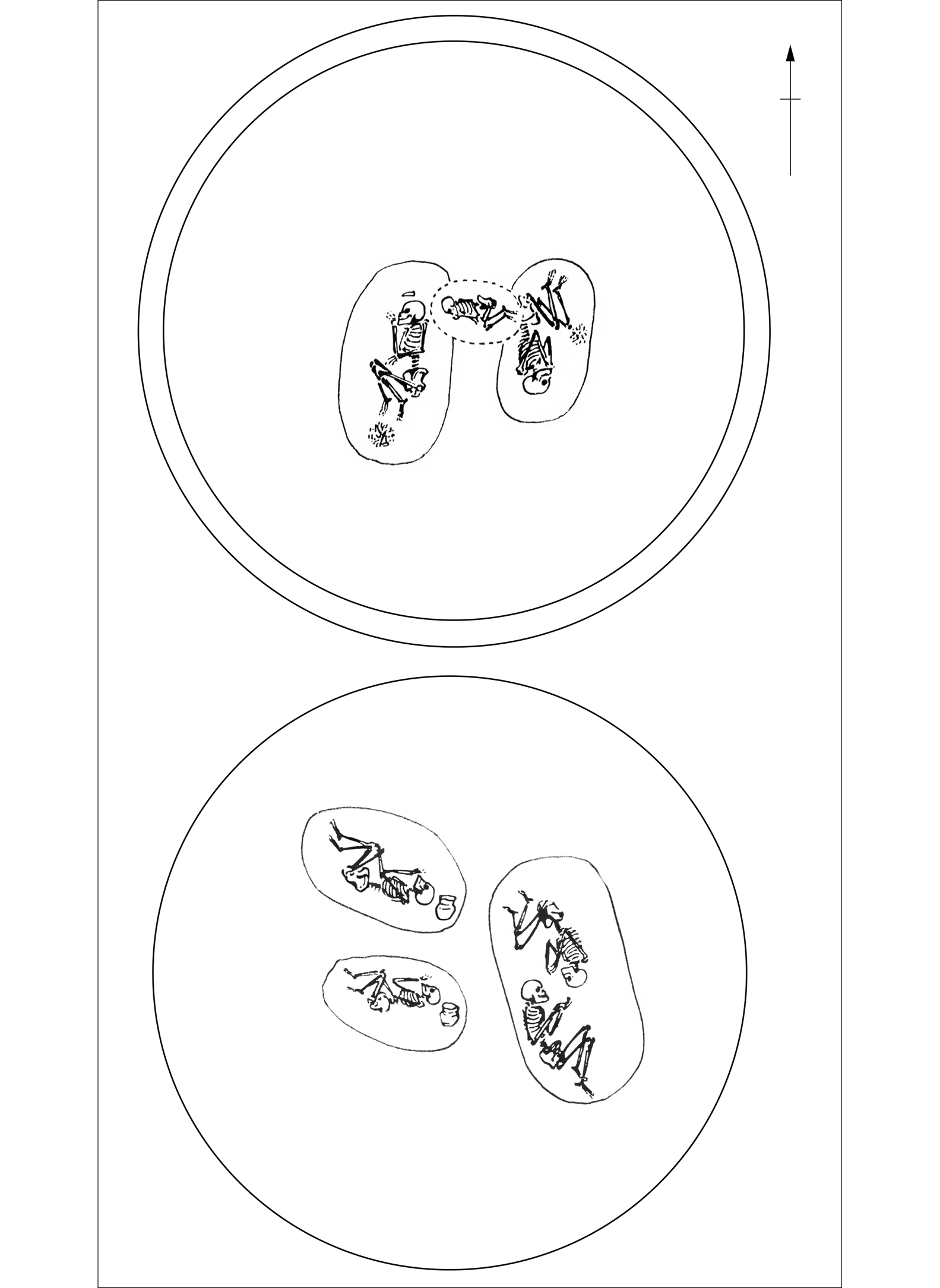
The anthropological examples presented above suggest that analysis of ancient DNA may not be the best or the only way of exploring prehistoric kinship. As part of a broader critique that has sought to understand the impact of Cartesian dualisms (such as nature-culture, or subject-object), archaeologists have for some time been concerned with issues of relationality and how this can be inferred from the archaeological record. For Bronze Age Britain, many different forms of evidence allow us to explore the creation and importance of affective interpersonal bonds that were probably construed in the past as kinship. At Riggs in East Yorkshire, for example, two adult inhumation burials in neighbouring graves were placed facing away from each other: one on its right side with the head to the north, the other on its left side with the head to the south (Figure 1: top; Mortimer Reference Mortimer1905: fig. 461). As mirror images of one another, they resonate but are also quite distinct. The grave of a child cuts across and interconnects these burials. Here, a child constitutes the connection between the adults, who were related but different in the spatial expression of their identities. In contrast, beneath another barrow in the same cemetery, a single grave contained two adults. As with the previous example, the bodies were oriented in opposite directions, but here they were positioned face to face, suggesting an intimate personal connection (Figure 1: bottom; Mortimer Reference Mortimer1905: fig. 431).
Bodily relations at Riggs (after Mortimer Reference Mortimer1905: figs 431 & 461).

Evidence elsewhere suggests the deliberate curation of human bone. At South Dumpton Down in Kent, for example, the inhumation burial of an adult was accompanied by the mandible of another individual (Perkins Reference Perkins1995). A recent programme of radiocarbon dating indicates that such ‘relic’ fragments of human bone were curated for around two generations before final deposition, suggesting that they derived from known individuals, possibly significant ancestors (Booth & Brück Reference Booth and Brück2020). Ideas of shared substance may be reflected in the deliberate commingling of bodies, as seen at West Cotton in Northamptonshire, where a ceramic vessel contained a large quantity of cremated bone belonging to three adults: one male, one female and one of indeterminate sex (Allan et al. Reference Allan, Rault, Humble, Harding and Healy2007: 141).
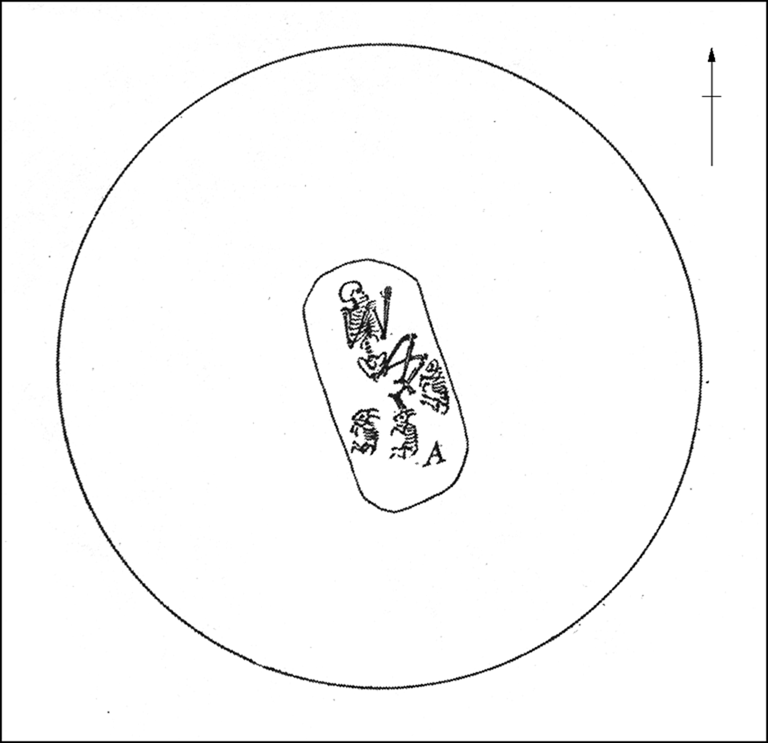
Relations with non-human others can also be inferred from the archaeological record of Bronze Age Britain. On Dartmoor in Devon, a complete pot was found placed in a crevice, part-way up the face of an imposing granite outcrop. This can be interpreted as an offering to ancestral spirits whose powers were vested in this place (Brück Reference Brück2019: 163). At Calais Wold in East Yorkshire, a grave contained a crouched inhumation burial lying on its left side, with its head to the north-north-west (Figure 2; Mortimer Reference Mortimer1905: 163). The remains of a pig and two caprines were placed at the feet of the individual. The animals were positioned on the same orientation, with their heads to the north-north-west. Unlike their human companion, however, they had been laid on their right sides. While it is easy to assume that these animals had been placed in the grave as food offerings for the afterlife, this disregards the similar treatment of all four of these bodies, as well as the close social and emotional bonds between people and animals in many agrarian societies (e.g. Campbell Reference Campbell and Knight2005). Elsewhere in Britain, cremation burials and unburnt human skulls have been found placed at the feet of Bronze Age inhumation burials. If we are willing to entertain the idea of social proximity between human occupants of the same grave, then we should also consider such possibilities for animals.
Animal relations at Calais Wold (after Mortimer Reference Mortimer1905: fig. 411).

Analysis of aDNA undoubtedly has the potential to enrich our understanding, although the resulting data must be treated with caution. A number of recent studies have brought together aDNA, isotope and archaeological evidence to reconstruct kinship and marriage patterns in the Late Neolithic, Chalcolithic and Early Bronze Age of Central Europe (e.g. Haak et al. Reference Haak2008; Mittnik et al. Reference Mittnik2019; Sjögren et al. Reference Sjögren2020). These argue that the primary unit of kinship was the monogamous nuclear family, and that patrilineal descent, patrilocal residence and female exogamy were the norm. Yet, the presence of individuals who are paternally related in the cemeteries analysed in those studies does not tell us how those relationships operated or were conceptualised, how they were thought to be created, or whether they represented the only important familial links. Nor indeed can patrilineality be used to infer particular forms of social relationships, between men and women, for example.
The identification of evidence for patrilineal kinship or patrilocal residence in prehistory is too often interpreted in ways that impose androcentric assumptions onto the past (Frieman et al. Reference Frieman, Teather and Morgan2019). Sjögren et al. (Reference Sjögren2020), for example, explicitly describe the societies of Chalcolithic southern Germany as ‘patriarchal’. According to this vision, women are figured as passive objects of exchange between powerful men, and are valued only for their reproductive potential. Yet, as Frieman et al. (Reference Frieman, Teather and Morgan2019) convincingly argue, on the basis of ethnographic accounts of long-distance marriage and other forms of female mobility, marriage outside of a woman's community of birth is likely to have been a choice in which she was actively involved and that was made with a view to enhancing her social and economic position.
More critical interpretations of the genetic data are, of course, possible. Here, I briefly consider some of the evidence presented in a recent study of genetic change in Chalcolithic and Bronze Age Britain (Olalde et al. Reference Olalde2018). Olalde et al.'s (Reference Olalde2018) supplementary materials identify a number of genetic kin. Amongst these are two adult men buried in neighbouring graves on Amesbury Down in Wiltshire who were the father and paternal uncle, respectively, of an adult woman buried at Porton Down approximately 6km to the south-west. Sjögren et al. (Reference Sjögren2020) argue that these genetic links indicate that the model of patrilineal kinship and female exogamy that they propose for southern Germany was, in fact, common in many parts of Europe, and was the result of large-scale migrations of proto-Indo-European-speaking groups from the Caspian-Pontic Steppe. The androcentric implications of this model, however, are called into question by the archaeological context of the Porton Down female. Hers was one of a group of graves in a segmented ring-ditch containing the bodies of four adult females and six children. She lay approximately 1m to the north-west of a large grave at the centre of the monument that contained the disarticulated remains of another adult female (Andrews & Thompson Reference Andrews and Thompson2016). The central grave had been revisited to access and manipulate this woman's bones; her skull was missing, suggesting that it may have been retrieved for deliberate curation or redeposition elsewhere. Here, then, was a woman who was considered a significant ancestor and who is likely to have occupied a position of authority during life. The women buried in this monument were not accorded social positions relative to men, but rather, on their own terms. There is nothing to indicate that they were dependent economically on male kin for the resources necessary either for the construction of this monument or for the mortuary rites enacted there.
Further evidence from the archaeological record allows us to call into question heteronormative models that prioritise reproductive relations in the definition of kinship. At Needingworth Quarry in Cambridgeshire, for example, an adult female aged 18–25 years was placed on her right side at the base of a deep grave (Olalde et al. Reference Olalde2018: SI2), which was later recut to receive the body of a second adult female over 40 years of age. Radiocarbon dates from the two burials are statistically indistinguishable, suggesting that these women died only a few years apart. They were not, however, genetically related. Here, the positioning of the bodies may be suggestive of an intimate same-sex relationship that was based neither on genetic relatedness nor biological reproduction.
Conclusion
Although recent advances in aDNA analysis have been hailed as providing unique access to scientific truths about past societies, kinship cannot be viewed as a direct reflection of genetic links. Kinship is not a given, or ‘natural fact’, but is a process: the outcome of culturally prescribed social practices that require careful nurture, work and commitment. The literature discussed here challenges us to explore the variety of ways in which kinship may have been defined and constructed in the past. Archaeological evidence provides insights into how relationality was created and maintained, illuminating the diverse ontologies that underpin people's place in the world. The fast-paced development of scientific method means that it can be difficult to reflect adequately on its theoretical underpinnings. aDNA analysis has come to be viewed as the most accurate means of revealing prehistoric kinship structures, yet it is crucial at this point that we avoid reading the genetic evidence in ways that unthinkingly impose modern conceptions of kinship and gender relations onto the past. We must now move beyond biogenetic determinism to consider the ways in which social practice generated enduring affective bonds and the sharing of substance with both human and non-human others.
Acknowledgements
I am grateful to Tom Booth for discussion of the genetic relatives in Olalde et al. (Reference Olalde2018).
Funding statement
This research received no specific grant from any funding agency, commercial or not-for-profit sectors.