The single most important visitor to a developing country was the representative from a western aid agency in the 1960s; the commercial banker eager to recycle OPEC surpluses in the 1970s; the IMF official in the 1980s, the “lost decade.” Since then, it has been the sovereign analyst from one of the leading rating agencies, Moody's Investor Services, Standard and Poor's or Fitch.
–OECD Development Centre1
Reisen 2003.
Since the 1980s, developing countries have increasingly turned to private investors and to the issuance of government bonds for securing capital. This process has created a space for credit rating agencies (CRAs) that assess the ability and likelihood that a government will pay its sovereign bond issues. The information CRAs provide is designed to signal investors about problems or opportunities and it has proven to effect global capital flows.2
When CRAs, for example, downgrade a country's rating, the risk premia increase, resulting in a higher bond spread and greater cost to bond issuers.3 Essentially, CRAs assess government credibility and the likelihood that a state will repay sovereign bonds, making CRAs nothing less than the guardians of the gates of capital to emerging markets.4Sinclair 2005.
Much of the political economy literature has attempted to assess government credibility but with less focus on CRAs and more on the benefits of democratic institutions to attract capital. North and Weingast argue that seventeenth-century England's adoption of more democratic institutions led to better access to capital through borrowing.5
North and Weingast 1989.
Schultz and Weingast 1996.
Tomz 2002.
Saiegh 2005.
For an excellent study that investigates how reputations form in international capital markets and affect the incentives of lenders and borrowers but without considering CRAs, see Tomz 2007.
Given the importance of bond ratings, a CRA literature has developed but, unlike the democratic advantage debate, the literature uses economic determinants to explain different bond ratings.11
See Afonso 2003; Cantor and Packer 1996; Eichengreen and Mody 1998; Nogués and Grandes 2001; and Rowland and Torres 2004.
Among the limited studies on regime type and credit ratings, see Jensen 2003, who finds that democracy enhances bond ratings. See Brewer and Rivoli 1990, who reach opposite conclusions.
Interestingly, the increasing role played by CRAs is at odds with the secrecy surrounding how bond ratings are determined. The three main credit rating agencies, Moody's Investor Services (Moody's), Standard and Poor's (S&P), and Fitch Ratings (Fitch), each claims a unique process whereby government bond issues are assessed. CRAs are information brokers that provide opinions, based on research, about potential risks in investment—and they make profits from clients willing to pay for their expertise. Because of this, their formulas for determining risk are proprietary and secret. Each CRA argues that its risk assessments are projecting the future credibility of a country to pay the obligations it assumes. But what roles do economic and political factors play? What characteristics do CRAs find attractive or problematic in developing countries?
In this article we investigate the role of politics, regime type, and economics on sovereign bond ratings. We present a multivariate analysis of fifty developing countries from 1987 to 2003, to assess bond ratings for Moody's, S&P, and Fitch. Using a panel data set, this study includes three groups of independent variables: (1) regime type and political institutions; (2) macroeconomic conditions; and (3) history of bond default, natural resource stocks, and commitment to trade. We supplement our quantitative research with CRA bond rater interviews.14
Phone interviews by the authors with sovereign bond raters at Fitch Ratings on 20 December 2005; with Moody's Investor Services on 30 November 2005 and 14 December 2005; and with Standard and Poor's on 12 December 2005.
Controlling for macroeconomic and bond default factors, we find that most political variables appear to have little effect on bond ratings. Consistent with research gathered in our interviews, regime type is not a significant factor in the bond rating analysis. Indeed, as mentioned by interviewees, developing countries under authoritarian rule, such as Singapore and China and in the Middle East, often receive fairly high ratings just like stable democracies including Chile, the Czech Republic, and Slovenia.
This suggests some interesting conclusions. First, it is contrary to the broad theoretical literature that suggests democracy helps to bolster government credibility and therefore access to capital markets.15
Second, it is in contrast to the stated methodologies of the agencies. Though each argues it considers political variables, we find that only the length of tenure of the executive's party (and only consistently for Moody's) appears to affect bond ratings. In the narrower literature that addresses bond financing, common political explanations, including undivided government, executive ideology, years remaining in office for the executive, and the inauguration of elected leaders—that is, the honeymoon effect—have no significant impact on bond rating assessments.16 Instead, we find that economic factors such as trade, inflation, gross domestic product (GDP) growth, and bond default strongly affect sovereign ratings. Consistent with the economics literature, countries engaged in trade or with higher growth rates are more likely to improve their bond ratings, while countries under high inflation or a history of bond default are expected to receive lower bond assessments.17See Afonso 2003; Block and Vaaler 2004; Cantor and Packer 1996; Vaaler and McNamara 2004; Vaaler, Schrage, and Block 2006; Eichengreen and Mody 1998; Min 1998; Nogués and Grandes 2001; Rowland 2005; and Rowland and Torres 2004.
Our findings hold important implications on the relationship between bond ratings, economics, and politics. First, our research shows the relevance of specific economic factors for improving bond ratings. As stressed in interviews, CRAs are most concerned about the ability and likelihood that a government will honor its commitment to pay the conditions of its issuances.18
Phone interviews by the authors with sovereign bond raters at Fitch Ratings on 20 December 2005; with Moody's Investor Services on 30 November 2005 and 14 December 2005; and with Standard and Poor's on 12 December 2005.
See Mosley 2003, who also finds that bond default and inflation affect emerging market ratings.
Second, while our results show that most political factors are not significant determinants for bond ratings, the interviews we conducted confirm that political factors are important for CRA assessments. Unlike economic factors that are easily quantifiable and lend themselves to quantitative assessments, political factors are not as simply measured. Instead, bond raters evaluate the overall political context by looking at the entire political picture of a country rather than giving undue attention to one or more political factors. Since context is important, some political factors may have significant effects for assessing repayment in some countries, but those same factors may have less bearing in different contexts. To understand when the political context will override other possible determinants is an important avenue for future research. This line of inquiry is suggested by Tomz, who investigates when domestic groups that favor default are likely to become electorally dominant and encourage nonrepayment of bonds.21
Tomz 2002.
In the first section we present our argument by beginning with an assessment of the three main credit rating agencies and their stated political criteria in assigning ratings. We also describe the determinants discussed in the bond rating literature, identifying the hypotheses we test in our empirical analysis. We present issues of model specification in the second section. In the third section we presents the results. The fourth section interprets and discusses the results. The final section concludes.
CRAs, Political Criteria, and Bond Ratings
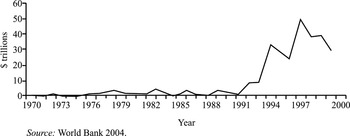
The importance of bond financing for developing countries is evident if one examines the amount of finance developing countries receive through the bond markets. Over the past decade there has been an explosion in bonds purchased by foreign investors in the developing world. As Figure 1 demonstrates, total bond purchases in the developing world rose from about $7.5 billion in 1970 to nearly $50 trillion in 1996.22
World Bank 2004.

Bond issues purchased by foreign investors in developing countries, 1970–99 (current U.S. dollars)
Within countries, the role of sovereign ratings can also affect the ratings of other financial offerings.23
Kaminsky and Schmukler 2002.
Fight 2001, 108.
Developing countries are issuing more bonds to attract foreign investment and are inviting agencies to assess these bonds, but the importance of credit ratings can be seen beyond the developing country markets. CRAs are information brokers in global financial markets where there is increasing disintermediation and a need to differentiate between investment options. CRAs gather and analyze information that would be too costly for every investor to assemble; thus they have emerged as a solution to information problems in the global financial system.25
Sinclair 2001, 444.
Thrift 1996, 223.
The faith that the global financial system has placed in CRAs has been most evident since the Asian financial crisis in 1997. In the wake of the crisis, the Bank for International Settlements (BIS) elevated the importance of CRAs by suggesting they have a regulatory role in assessing the credit risks of banks and ultimately in the prevention of financial crisis. The 1999 Basel Capital Accord (Basel II) relies on CRAs as a source of financial regulation.27
Bank for International Settlements 1999.
See Bank for International Settlements Basel Committee on Banking Supervision 2000; and King and Sinclair 2003.
Since sovereign ratings are important for attracting capital, the manner in which they are determined is critical. But when we look more deeply into the rating agencies it is not clear how the ratings are determined. It is not as simple as a country needing to meet a specific set of economic or political criteria to gain a specific rating. If there are formulas for determining ratings, they are the proprietary information of the rating corporations and not open to public scrutiny. Moreover, each company claims to have a slightly different methodology that is superior to the others so they can argue their ratings are more accurate than the competition.
Most bond issues will come due years from their issuance; thus, the ratings are designed to predict the future about a country's obligations, not to assess its present. Ratings project a three-to-five-year time horizon about the sovereign's ability and willingness to pay the bond it may be issuing today. Several raters we interviewed argued that the goal for the CRAs is to iron out the daily and monthly volatility for investing and to assign a rating that would take into account long-term stability, both economic and political, that would influence the bond's redemption. This has two effects; first, ratings tend toward being static since the agencies are trying to assess trends instead of discrete events.29
After the Enron crisis there was a discussion centering on Moody's about whether rating agencies should update their ratings more frequently to account for periods when markets are under stress. Moody's attempted to create a less static system by adjusting ratings more often, but it wanted to balance more frequent updates with a system that would not lead to volatility. For a further discussion, see Sinclair 2005, 170–71.
Economist, 1997 December 11, 98; Wall Street Journal, East ed., 28 November 1997, C1. See also Kaminsky and Schmukler 2002, who argue that rating changes also contribute to contagion or spillover effects as witnessed in the Asian crisis.
Given the recent importance assigned to CRAs in evaluating government credibility, we might expect an ample literature to study the determinants used by CRAs to rate sovereign bonds. Although each agency has a stated policy of considering the holistic condition of a state, and each policy states political and economic variables for determining their ratings, details about how the political and economic categories and subcategories are weighted relative to other variables are not explicit. In addition, the stated political criteria are quite vague.31
For example, S&P has as a category entitled “stability and legitimacy of political institutions,” which is difficult to measure. For more information on the stated criteria used by CRAs, see Fight 2001, 37; FitchRatings 2002; and Cavanaugh 2003. Moody's is least clear on the qualities they assess for ratings.
See Afonso 2003; Cantor and Packer 1996; Eichengreen and Mody 1998; Nogués and Grandes 2001; and Rowland and Torres 2004.
In contrast, the political economy literature actively attempts to assess government credibility based on political factors. North and Weingast, and Schultz and Weingast claim that there is a “democratic advantage” that attracts greater capital flows to democracies.34
Based on limited government and the dangers of lost constituent support if a country fails to repay its debts, democracies are expected to fare better than other forms of government in access to loans. Although some analysts have questioned the premise of a “democratic advantage,” political factors still take center stage in the literature at the expense of more economic explanations.35Saiegh 2005 empirically shows that the “democratic advantage” depends on development level. Controlling for level of development, Saiegh maintains that developing countries reschedule their debts and pay about the same interest rates regardless of regime type. Tomz 2002 and 2007 show the limits of democracy in constraining leaders to honor international commitments. Using public opinion polls about foreign debt in Argentina from 1999 and 2001, he confirms a conditional, and not direct, relationship between democratic accountability and debt repayment.
See Tomz 2001, which looks at the bond market and the creditworthiness of sovereign borrowers but from the perspective of lenders and not CRAs.
Since the effects of political determinants are largely ignored in the CRA literature and CRAs, bonds, and economic determinants receive limited attention from political economy scholars, it appears warranted that we merge the two literatures. We need to gain a better handle on CRA decision making if we want to understand how regime type and other determinants affect their ratings, which ultimately affects global capital flows. In order to open the CRAs methodological black box, we divide the bond rating determinants into three categories: (1) political factors; (2) macroeconomic issues; and (3) history of bond default, natural resource stocks, and trade commitment.37
In addition, Sinclair 2005 provides a convincing explanation based on what he calls “mental frameworks.” Sinclair suggests that CRAs have certain preconceived models of what constitutes appropriate policies on the part of borrowers, and these may not necessarily be correlated with the economic performance of the real economy. Data limitations prevent us from statistically testing the mental frameworks argument.
Among the political factors we consider are regime type, the president's or chief executive's ideology, the tenure of the executive's party, undivided government, election cycles, and honeymoon effects.38
As previously mentioned, regime type and the “democratic advantage” are central to the literature and it is assumed that democratic regimes will elicit higher ratings. Electoral accountability under democracy gives the populace a means to punish sovereigns that harm the citizenry, such as via debt expansion, which force governments to comply with their debt obligations.39There are many Latin American cases where the domestic population will not punish incumbents who default on external debt. Argentine President Néstor Kirchner is the latest executive to blame external debt crises on creditors to increase popular support.
See Johnson and Crisp 2003, who argue that political ideology, as conditioned by the institutional context, affects economic policy choice.
See Biglaiser and Brown 2003 for a discussion of the honeymoon hypothesis.
Originally, we planned to present findings to test IMF influence. The IMF is predicted to foster higher bond ratings, as IMF agreements require developing countries initiate economic reforms that are anticipated to promote economic development and help repay debt obligations. However, because of selection effects and endogeneity issues, we decided not to present models with an IMF influence measure. See Jensen 2004; and Vreeland 2003. Still, we tested the effects of IMF structural adjustment programs on bond ratings, using a dummy variable coded 1 if a country operated under a stand-by program and 0 if not (see 〈http://www.imf.org/external/np/tre/tad/extarr1.cfm〉, accessed 10 January 2007). The results for the six models remain essentially the same as reported and IMF influence is only significant (negative) in the Moody's nonmoving average model. We also tested a democracy measure based on the age of the political regime (data from Cheibub and Gandhi 2004), which is positive and significant only for Moody's. Results are available from the authors on request.
Most studies on CRAs come from the economics literature. Macroeconomic factors including inflation, current account balance, total external debt, GDP per capita (development), and GDP growth rates are often used to explain bond ratings.43
See Afonso 2003; Cantor and Packer 1996; Eichengreen and Mody 1998; Nogués and Grandes 2001; and Rowland 2005. Country GDP (market size) is also commonly considered in the economics literature. Because of multicollinearity issues, we could not include market size with the other macroeconomic variables. We removed variables that were multicollinear with country GDP and inserted country GDP in the models, and the results remained stable.
Finally, default history, natural resource stocks, and commitment to trade are potential explanations for bond ratings. Bond default is most important as it affects ratings near term and some years after the default. In interviews, bond raters mention default as probably the first factor they consider when assessing the possibility of future default. Natural resource abundance is expected to increase country revenue, helping to ensure debt repayment. Likewise, trade commitment is predicted to raise bond ratings. As the post–World War II experience shows, countries that are more integrated into the world economy usually earn economic rewards. Bond ratings are actually highest for export-oriented countries because they are more likely to meet their debt obligations.
Based on the “democratic advantage” and CRA literatures, this study develops three hypotheses to explain the determinants of bond ratings in developing countries. The first hypothesis claims a positive relationship between democracy and bond ratings. Because of the increased number of veto points, transparency of democratic governments, and their more credible commitments to repay debts, regime type should affect bond ratings. The second hypothesis contends that political factors, and not just regime type, are the important criteria for bond ratings. Election cycles, executive ideology, undivided government, and executive party tenure are strong determinants on bond rating assessments. The third hypothesis posits that macroeconomic policies and bond default history influence bond ratings. Inflation, economic development, bond default, and other domestic economic factors are responsible for CRA evaluations.
Research Design
We collected annual data for fifty developing countries from 1987 to 2003. These years are useful for comparison since developing countries pursued international capital sources from private equity firms during much of this time. The unbalanced data (that is, not all the countries are rated by the three agencies during the entire sixteen years) are comprehensive.44
The unbalanced data are especially pronounced for Fitch. Fitch has risen quickly based on its merger with International Bank Credit Analysis, Duff & Phelps Credit Rating Co., and Thomson Bank Watch between 1997 and 2000.
Dependent Variables
For robustness, we use two different dependent variables based on S&P, Moody's, and Fitch bond ratings. In one set, we use annual bond ratings from the CRAs. In the other set, we use two-year moving averages as prescribed by Block and Vaaler and Vaaler and McNamara.45
Because it is not clear if a rating occurs at the beginning or end of the year, a two-year moving average accounts for the possible time variation.46Rating dates are given if a country's rating changes. However, when the rating stays the same, the CRA provides no information about when the country assessment occurred.
Bloomberg's international bond series was used and data were collected from a Bloomberg International terminal beginning in November 2004.
Independent Variables
Political factors
Complementing work by Jensen and Li and Resnick, which links democratic rule with investor confidence, Schultz and Weingast contend that democracies are better able to make credible commitments to repay their debts.49
In contrast, some scholars suggest that developing countries under authoritarian rule support political stability, an important ingredient for bond rating agencies.50 We control for regime using the lagged polity2 variable in the Polity IV data.51Marshall and Jaggers 2002.
Based on Vaaler and Schrage and Block and Vaaler, we also test political factors including presidential ideology, executive party tenure, undivided government, election cycles, and honeymoon periods to control for domestic political institutions on bond ratings.52
presidential ideology is coded 1 if a leftist president is in charge and 0 if not. For executive party tenure, we examine for how many years the current executive's party has controlled the executive branch. For undivided government, we code 0 during periods of divided government and 1 for undivided governments. For election cycles, we code 1 during the election period and 0 in nonelection years. For honeymoon periods, we count how long the executive has held power. The political variables are lagged a year. We obtained the data from Beck et al.53Beck et al. 2002.
Macroeconomic results
Macroeconomic conditions including total external debt, inflation, current account balance, gdp growth rates, and gdp per capita, are expected to affect bond ratings. High external debt, inflation, and current account deficits increase bond default risk for developing countries correspond to higher debt default risk and thus a lower bond rating. In contrast, positive GDP growth rates and GDP per capita suggest wealthier developing countries that are better risks for investors. Higher growth and income levels reduce debt burdens over time, lessening the bond default risk.54
Cantor and Packer 1996, 39.
History of bond default, natural resources, and trade commitment
bond default history is a clue of a country's probability to default later. As Argentina, Ecuador, Russia, and Venezuela learned in their recent negotiations with bondholders, countries that default gain a high-risk credit reputation.56
See Cantor and Packer 1996.
Block and Vaaler 2004, 925.
Standard and Poor's Financial Services 2004.
Jensen 2003.
World Bank 2004.
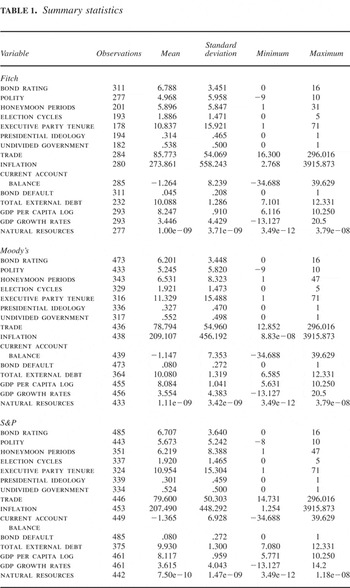
Summary statistics for the variables are presented in Table 1.
Summary statistics

Method
Several prominent studies have used ordinary least squares (OLS) to model the determinants of bond ratings.62
Unfortunately OLS in a cross-sectional time-series setting is susceptible to two problems. First, the method is vulnerable to spatial correlation of the errors across panels and the subsequent inconsistent standard errors. Beck and Katz suggest using panel-corrected standard errors (PCSE) to deal with the former problem.63Beck and Katz 1996.
StataCorp 2003, 150.
See Drukker 2003.
See StataCorp 2003, 202.
To supplement and better understand the findings in our statistical models, we conducted interviews with bond raters at Moody's, Fitch, and S&P. In all cases the raters we interviewed were directly responsible for assigning sovereign ratings at their agency. Our interviews were semi-structured and designed to prompt the raters to consider the general role of politics in their agency's ratings (for example, What kind of political criteria does your firm think is important? Are politics important in your overall ratings?). We also asked about the importance of regime type and democracy. We contacted approximately thirty bond raters by e-mail in November 2005 asking if they would participate in a phone interview and interviewed eight bond raters in November and December 2005. Both S&P and Fitch assigned specific raters for us to talk with, while the raters from Moody's contacted us directly to set up and conduct the interviews.
Findings
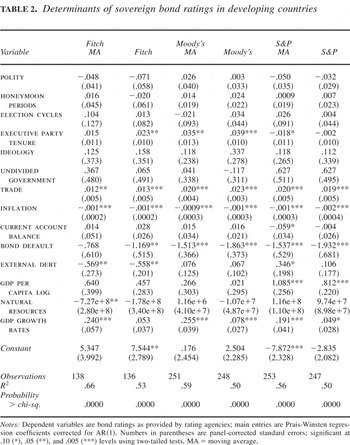
The results from the six models can be seen in Table 2. Each of the models explains a good amount of variation in sovereign bond ratings. In terms of political variables, the tenure of the chief executive's party in power (executive party tenure) is the only one to have a significant impact and there is some evidence that this variable is important for Moody's. It is in the expected positive direction in three models but is negative in the S&P moving average model. The other political variables are not significant in any of the six models.68
We also tested whether democracy has an effect, but only through its impact on economic variables. We lagged polity on the right side of several potentially endogenous measures (for example, debt, inflation, and trade) and carried out Durbin-Wu-Hausman tests. polity had a significant and positive effect on inflation in four of the six models. The argument could be made that democracy has an indirect negative impact on ratings, something Vaaler and McNamara 2004 find. polity had a negative and significant impact on debt in all six models. Struggling or fledgling democracies are more likely than established democracies to spend excessively, especially during electoral years, which exacerbates debt issues. In turn, the impact of debt is positive in one case (S&P) and negative in another (Fitch). Here the indirect effect of polity via debt is unclear. polity had no significant impact on trade. There is also the possible indirect effect democratization has during a period of default. Democratization perhaps enhances government credibility to such an extent that it overrides bond default and leads to a higher rating. We found only one country, Russia, and just for the year 2000, where bond default and democratization improved a credit rating. With only one case to consider it is difficult to generalize but it is plausible that democratization could offset default.
Determinants of sovereign bond ratings in developing countries

In terms of economic factors, each agency seems highly focused on inflation, growth, and trade. Paralleling changes witnessed over the past few decades, when closed economies and high inflation produced crises in much of the developing world, bond raters closely watch such factors. Inflation has a negative effect while trade and economic growth have highly significant positive effects. Debt is negative and significant in the Fitch model. The measure with the biggest impact is history of bond default in the previous five years. Agencies take a dim view of default.69
Although bond default is not significant using the two-year moving average for Fitch, it is in the other model. We suspect that Fitch's smaller sample relative to the others is responsible for the less stable results.
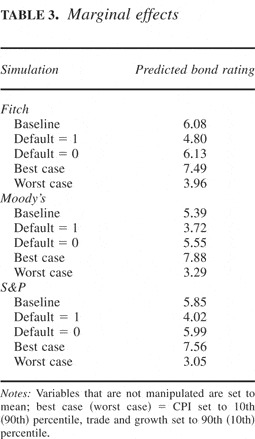
The models can be used to predict ratings after manipulating certain variables (see Table 3). We focus on the four variables with the most consistent impact: trade, gdp growth rates, inflation, and bond default. Default drops a country's predicted rating from baseline levels by almost two points for each of the agencies. Not defaulting is probably the single most obvious policy impact a country can make in terms of keeping up its sovereign bond rating. Creating best- and worst-case scenarios can also be informative. With trade and growth set to their 90th percentiles, inflation set to its 10th percentile, and no default in the previous five years, predicted rating jumps to above 7 in each case. Conversely, worst-case scenarios bring ratings down to between 3 and 4, which strongly indicate the importance of the four variables.
Marginal effects

A few cases highlight our findings. For example, Russia defaulted in 1998 and its rating dropped immediately. With a Fitch rating of 6 in 1996 and 1997, its ratings for the next four years declined to 5, 0, 1, and 3. Venezuela's S&P rating had a similar fall in the mid-1990s after it defaulted. Singapore, Hong Kong, Slovenia, Cyprus, and Malaysia enjoyed ratings of 10 or greater during periods of strong trade, good growth, and low inflation. The average inflation, trade, and growth in the S&P sample for country years with ratings of 11 or above (90th percentile) is 97.3 (near the 25th percentile), 4.5 (between 50th and 75th percentiles), and 131.9 (90th percentile) respectively. Default history and economic indicators are the keys to understanding bond ratings, while political stability (executive party tenure) is important to some extent. executive party tenure and Fitch's emphasis on debt may be indicative of variation in agency rating protocols, which merit further attention. Other political variables seem not important. In the end, there is a marked consistency in the effect of trade, inflation, growth, and default.
Discussion
How do we account for the results from the statistical estimates? First, why do nearly all political factors, including regime type, appear to have little effect on CRA bond ratings for S&P, Moody's, and Fitch? Although the stated methodologies agencies use include political criteria to determine investment risk, most political factors are not statistically significant. Second, why do economic factors such as trade, inflation, and bond default strongly affect sovereign ratings?70
GDP growth is positive and significant in the expected direction. Given that growth is predicted to support debt repayment, we place less emphasis on its explanation.
In our interviews, raters from all three agencies noted the importance of political variables in their ratings decisions. They also suggested that ratings were not determined simply by crunching economic indicators together, but that ratings were holistic and that their approach to each country was complicated. The raters confirmed the role of politics in the stated methodologies of their agencies. Raters seemed proud of the fact that their agencies considered the political situation, historical context, and economic health of a country when assigning ratings. But the raters seemed uncomfortable making broad statements about the political variables we identified, namely democratic systems of government. They had a difficult time defining what they meant by “politics.” There is an apparent disconnect between the importance that the bond raters put on political variables and their ability to identify the specific political variables that they considered relevant for a positive rating. In an IMF study of CRAs in the Asian financial crisis, Adams, Mathieson, and Schinasi argued that the agencies believed in the importance of political factors to ratings, but that political factors may be less influential simply because they are much harder to assess and “less tangible” than the economic and financial risks.71
Adams, Mathieson, and Schinasi 1999.
Our study expected to find that political factors, and especially democratization, would have a positive effect on bond ratings because of the stated policies of the CRAs and because transparency and electoral accountability under democratic rule support credible commitments to repay debts. However, democracy and debt repayment do not necessarily go hand in hand in developing countries. This point was reiterated in several interviews. Raters argued that political stability was their primary motivation for strong ratings, but that this was not tied to regime type. Indeed, some authoritarian governments appeared as stable if not more so than their democratic counterparts.
Just as some authoritarian regimes and democracies are stable, others are not. It comes as little surprise that CRAs score authoritarian (or semi-authoritarian) regimes in Singapore, China, Malaysia, and much of the Middle East with fairly high bond ratings not because the governments uphold democratic practices, but because the governments appear to have maintained stable authoritarian governments for a long time. By contrast, authoritarian regimes in Indonesia, Kazakhstan, Pakistan, and Turkmenistan are not as stable and the bond ratings are less consistent. Democracies also share the variation in bond ratings. Democracies in Eastern Europe, particularly with many now members of the European Union, Chile, and South Korea (preceding and after the Asian financial crisis) receive high and consistent ratings while others (for example, Argentina, Bolivia, Ecuador, Turkey, and Venezuela) earn inconsistent and also lower scores. Political stability, which may have little to do with whether democratic or authoritarian institutions are in place, is a likely determinant for bond ratings.
In many of the interviews it became clear that the bond raters' main concern was policy consistency: that the next government, regardless of regime type or ideology, continues to make good on the state's obligations. This concern can be identified in one of our statistical findings. The length of tenure of the executive's party was significant for Fitch and Moody's ratings, and it was almost the only political factor that had significance for bond ratings. It makes sense that the longevity of the executive's party provides insights about consistent policy choice. It is not clear why this political factor appears to affect Fitch and Moody's but not S&P. In our interviews, raters from all three CRAs identified that it was important for a government to be consistent and for it to “do the right thing,” that is, to uphold its financial commitments.
This helps explain the deeper ambiguity that raters expressed on political institutions. Raters are not at all sure what kind and how political institutions will affect debt repayment. When asked about undivided government and executive ideology, the raters remarked that there was no certainty that either factor would affect the implementation of policies necessary to support debt repayment. The legislature and executive coming from the same party does not assure raters that the government would favor repayment, particularly in a crisis. Similarly, an executive from the left of the political spectrum did not necessarily reduce the chance of honoring obligations and a rightist did not guarantee repayment. Raters recognized that the political rhetoric that politicians use in election campaigns is not a blueprint of the policies politicians later adopt. There are staggering differences between the populist campaign platforms ran on by Carlos Menem in Argentina, Alberto Fujimori in Peru, and Luiz Inácio Lula da Silva in Brazil and their actual policies once in office. Raters recognize that executive ideology does not determine economic policy choice.
The timing of elections did not appear to have much effect on ratings either. This is probably explained by the fact that ratings are meant to be forward-looking and elections, regardless of their timing, would probably happen in any time frame that the raters were considering. The interviews suggested that raters were more concerned about bigger and more permanent political issues linked to institutions that are less fleeting than elections. Raters from both Moody's and Fitch identified their use of World Bank Governance Indicators that measure voice and accountability, political stability and absence of violence, government effectiveness, regulatory quality, rule of law, and control of corruption. Although election cycles might affect these other factors, the measures most used by CRAs are much broader than election timing.
Another reason that the political variables were not significant statistically could be associated with the static nature of the bond ratings. With the exception of a significant economic or political crisis, bond ratings are not volatile. A rise or drop in a rating of one letter is often considered significant because changes of any kind generally signal big events. CRAs are attempting to understand the overall and long-term investment prospects for a country, not account for the monthly or annual changes within a political system. This means that incremental changes in any political variable will have only a minor effect on the ratings for any state.
The effects of bond default, inflation, and trade tend to be associated with big events that can have large effects on bond ratings. Bond default requires little discussion as domestic policy makers realize that default has chilling effects on foreign investor decisions in the near term and shortly thereafter.72
As other studies have found countries that default are not punished forever. Cardoso and Dornbusch 1989; and Jorgensen and Sachs 1989 reported that governments that defaulted during the Great Depression received about the same loan terms as others after World War II. Tomz 2007 also shows that countries are not all treated similarly after defaults, and lending conditions depend on the context in which the arrears occur.
Frieden 1991.
Political instability created by inflation also raises CRA fears.74
Cantor and Packer 1996, 39.
The importance of trade liberalization for higher bond ratings also makes sense based on the commitments associated with trade, especially in the era of customs unions and free trade associations. A concern expressed by raters is whether the country will implement the economic reforms it proposes. Trade reforms are difficult to reverse based on the domestic interests. Once countries liberalize their trade, as has occurred for many developing countries over the past decade, industries are expected to form around the free trade model. Companies that survived on the back of protection will struggle or collapse because of competition and firms develop based on the country's comparative advantage. Over time, businesses that benefit from freer trade should organize to sustain trade reform. Although Olson claims that because the costs to losers from trade opening are concentrated and benefits diffuse protectionists will have more capacity to mobilize and influence politician decisions, the economic crisis associated with protectionist policies for decades in much of the developing world has led to the lifting of tariffs regardless of lobbying efforts.76
Olson 1965.
Moreover, commitments internationally have also cemented trade liberalization. Membership in the World Trade Organization, in regional trade associations, and in bilateral trade agreements shows a credible commitment to maintain open markets. In the context of foreign direct investment, Büthe and Milner have argued that trade treaties create a stable and credible policy environment “because reneging on such commitments made internationally is more costly than simply changing policy at home.”77
Büthe and Milner 2005, 12.
Conclusions
As the importance of CRAs has grown for capital markets, the beliefs of those agencies about regime type and political variables are significant for a current understanding of capital flows. Our findings suggest that CRAs do not strongly consider regime type and other political institutions when assigning ratings, even though each agency formally states the importance of politics and our interviewees confirm these statements. This is contrary to earlier work that has argued that democratic institutions help states have better access to capital—the “democratic advantage.”78
We found much stronger results for CRAs' consideration of macroeconomic conditions including inflation and growth, as well as history of bond default and trade commitment.Although we are not ready to comment on why the length of the executive party's tenure is consistently significant only for Moody's and not for Fitch and S&P, based on our interviews, CRAs appear most concerned about the likelihood that a government will pay the conditions of its issuances.79
Phone interviews by the authors with sovereign bond raters at Fitch Ratings on 20 December 2005; with Moody's Investor Services on 30 November 2005 and 14 December 2005; and with Standard and Poor's on 12 December 2005.
While this study is a start, more work is needed to assess the effects of politics on bond ratings. Qualitative studies and survey work to understand the details of sovereign nation decisions on bond ratings would be helpful. Interviews with public officials in developing countries might provide additional insights into their perspective on the measures needed to improve their credit ratings. More extensive interviews, in this case with the CRA analysts, might help flesh out why the effect of politics appears to vary slightly among rating agencies. Part of the issue may be the difficulty in measuring political factors relative to economic factors that are easily quantifiable. Additional interviews might also help clarify the overall political context that bond raters evaluate in assessing repayment and how politics gets defined by these agencies.
Understanding when the political context will supersede other possible factors is an important avenue for future research. This line of inquiry is suggested by Tomz in his research on the influence of domestic groups that favor default on political leader decisions about whether to repay bonds.80
Tomz 2002.
Stasavage 2002.
See ibid.; and Tomz 2002.
Tomz 2007.