In 1848, at the height of his fame as the greatest pianist in Europe, Liszt made a decision that many of his admirers found incomprehensible: he settled in the small German town of Weimar and shackled himself in service to the court in the role of Kapellmeister of their mediocre orchestra. This decision had been preceded by a highly successful period of relentless concert touring throughout the late 1830s and 1840s. It was a time of financial security, constant adulation and hysterical fans. Yet, in Weimar, Liszt was about to embark on the most fertile period of his life as a composer, completing the B minor Sonata, twelve symphonic poems, the Faust and Dante symphonies, the final versions of his piano concertos, and numerous Lieder.
The Weimar stage offered a rich environment in which Liszt could develop his compositional ideas alongside his regular work in the theatre, conducting opera and occasionally incidental music. Crucially, it provided an important context in which to develop the genre of the symphonic poem (a one-movement orchestral work with an ‘extra-musical’ programme). All but one of the symphonic poems had their premieres in Weimar, and these mostly took place in the context of a festival or dramatic production, to which Liszt's music often functioned as an overture and was tailored in terms of subject matter, form and choice of forces. Yet, this important compositional and performance context has been largely overlooked.Footnote 1
The Weimar Court Theatre also provided the context for the composition of the last of Liszt's Weimar symphonic poems: Hamlet (1858). In this case Liszt's attempt to unite programme with symphonic form resulted in a piece that is unique among the symphonic poems in the sheer detail of its responses to its programme and its attempt to substitute the visual and spoken elements of Shakespeare's play in music. This is reflected in the unusual subtitle that Liszt attached to an early draft of the work: ‘Vorspiel [Prelude] zu Shakespeares Drama’. Since 1854 Liszt had completely given up the use of terms such as ‘overture’ in connection with his symphonic poems, so this return is highly suggestive. Indeed, it seems to have encouraged the listener to hear the piece as an introduction to a (probably imagined) performance of the play.
Nonetheless, the relationship between the world of the theatre (particularly spoken theatre) and the symphonic poems has never before been explored in Liszt scholarship. This article represents a first attempt to begin to fill this lacuna. In doing so it reveals that spoken theatre had a significant influence on Hamlet. Indeed, this article will draw new stylistic and conceptual parallels between this symphonic poem and both melodrama as a genre and its related ‘melodramatic’ style of acting. In this way, this article offers a new way of approaching and positioning Liszt's programme music.
Significantly, Liszt's new striving for dramatic effects and programmatic detail coincided with his meeting the famous Polish actor, Bogumil Dawison. Although Dawison has previously been briefly mentioned in Liszt literature in relation to Hamlet,Footnote 2 his influence on the work has never before been fully explored. Drawing on reviews of Dawison's acting style as well as Liszt's own comments this article will argue that the melodramatic style of Dawison's acting was a major influence on Liszt's symphonic poem. Recently, Dan Wang has considered how the melodramatic mode associated with excess and exaggeration may be related to melodrama as a genre, arguing that there may be something ‘inherently melodramatic about the simple joining of words and music.’Footnote 3 This article builds on this idea, considering the influence of the genre on Hamlet, in terms of both the melodramatic acting style of Bogumil Dawison and the ways in which the symphonic poem is indebted to melodrama as a musical genre in its many manifestations.Footnote 4 Overall, it puts forward a new reading of Hamlet, as a piece highly influenced by stage ideas of movement, scenery and voices – aspects never before considered in studies of the symphonic poems. Furthermore, it highlights passages characterized by melodramatic ‘signifiers’ (such as tremolos and diminished 7ths) reminiscent of the style found in Parisian popular theatres of the first half of the nineteenth century. All of this, coupled with the subtitle, ‘Vorspiel zu Shakespeares Drama’, suggests that the piece was inspired by Hamlet in performance, rather than Hamlet as a text.
Hamlet in Germany
The nineteenth century saw new levels of enthusiasm for Shakespeare sweep across continental Europe. This had been growing since the second half of the eighteenth century among proponents of the Sturm und Drang movement in Germany, particularly Goethe, though his belief that art should be beautiful and have a moralizing effect led him to censor some of the more unsavoury parts of Shakespeare's plays.Footnote 5 In France, Shakespeare mania reached its full height with the performances at the Odéon by Kemble's visiting English company in 1827 and 1828. These were attended by many of Liszt's circle, including Delacroix, Hugo, Vigny, Dumas, Sainte-Beuve and, of course, Berlioz. Hamlet in particular, became one of the most popular of Shakespeare's creations with both GoetheFootnote 6 and the French Romantic school.Footnote 7
In Germany, nineteenth-century portrayals of Hamlet were informed by the idealised but artificial style of acting popular in Germany at the time, which had been handed down from Goethe.Footnote 8 One of the major proponents, Pius Alexander Wolff, who played Hamlet under Goethe, moved gracefully between different postures reminiscent of those in painting or sculpture.Footnote 9 This style, which was concerned primarily with beauty and harmony, continued to be popular for generations after Goethe's death, partly because of the popularity of Goethe himself.Footnote 10 It was particularly prevalent in Weimar, the place where Goethe and Schiller had developed it. Significantly, some of the Weimar company, including the actor and stage manager Eduard Genast, could remember acting under Goethe.Footnote 11 During Liszt's time at Weimar, Genast was responsible for coaching Weimar's actors, and he would surely have promoted the continuation of the style he had learned from Goethe.
Goethe's views also informed the popular German conception of Hamlet at the time, in which the character was presented almost without exception as a weak, sentimental dreamer, and a procrastinator.Footnote 12 Such portrayals stemmed partly from Goethe's views on the play, set down in his novel Wilhelm Meister's Apprenticeship. At one point in the novel, a company of actors who are performing Hamlet discuss the merits of the novel and the drama, how they differ from each other, and how Hamlet has some of the characteristics of a novel:
But in the novel, it is chiefly sentiments and events that are exhibited; in the drama it is characters and deeds. The novel must go slowly forward; and the sentiments of the hero, by some means or another, must restrain the tendency of the whole to unfold itself and to conclude. The drama on the other hand, must hasten, and the character of the hero must press forward to the end; it does not restrain, but is restrained …. These considerations led them [the company] back to the play of Hamlet, and the peculiarities of its composition. The hero in this case, it was observed, is endowed more properly with sentiments than with a character; it is events alone that push him on; and accordingly the piece has in some measure the expansion of a novel.Footnote 13
This interpretation informed many portrayals of Hamlet, including those by Josef Wagner and Emil Devrient. Liszt had seen Josef Wagner perform the role in 1847, and he was acquainted with Emil Devrient.Footnote 14 Devrient's Hamlet was ‘passive’,Footnote 15 and represented ‘slow, agreeable, prudent pathos’Footnote 16 with ‘charm and elegance’.Footnote 17 He brought both Goethe's classical acting style and his conception of Hamlet to his interpretation of the role. According to Rosenberg, ‘He made the role fit his style: smooth, graceful, beautiful, free of indecorous violence. He played for pathos, for touching without disturbing his audiences.’Footnote 18
A similar concern with beauty and regularity is found in the Schlegel and Tieck translations of Shakespeare, which were enormously popular at the time and continued to influence subsequent translations in the nineteenth century and beyond.Footnote 19 The verse of these translations was flexible, smooth and pleasing to the ear. Indeed, the need for harmony prevalent in German theatres at the time led the translations to smooth away the coarser, rougher aspects of Shakespeare's language.Footnote 20 The beauty and harmony of these translations would have further contributed to Liszt's expectations of the role of Hamlet and how it should be portrayed.
Overall, the classical acting style, Goethe's conception, and the Schlegel–Tieck translations themselves, all contributed to an interpretation of Hamlet concerned with beauty and elegance. Accordingly, critics, such as Emil Knetschke expected portrayals to strive for a passive, sweetly melancholic Hamlet, and were critical of actors who moved away from this traditional interpretation.Footnote 21 It was in this context of nineteenth-century German Hamlet reception that Liszt experienced Dawison's very different conception of the role.
Dawison's ‘Melodramatic’ Style of Acting
Liszt first met Bogumil Dawison when the latter came to Weimar in January 1856 to give a series of guest performances.Footnote 22 Polish by birth, Dawison built up a career mostly in Germany. He was most famous for creating such roles as Shylock, Mephistopheles, Richard III and Hamlet. His meeting with Liszt seems to have marked the beginning of a friendship, for the two artists corresponded at least from 1857 to 1860.Footnote 23 Significantly, this period saw Liszt compose not only Hamlet, but also the first of his melodramas. Dawison addressed Liszt affectionately in these letters as ‘Mein vortrefflicher Freund!’ (My excellent friend!),Footnote 24 using the intimate ‘Du’ form to declare ‘Ich bleibe Dir treu und liebe Dich wie ein Bruder’ (I remain loyal to you and love you like a brother).Footnote 25
Liszt's letters reveal that he greatly admired Dawison's acting style and found him particularly effective as a declaimer of melodrama. In a letter to Johann von Herbeck, regarding a performance of the Prometheus Choruses, he suggested, ‘it is desirable that you should get an adequate tragic declaimer. In Dresden Dawison undertook this.’Footnote 26 Indeed, Dawison regularly gave solo recitals at charity benefits, offering climactic scenes from some of his most famous roles. In September 1857, for example, at the celebrations of the centenary of the Grand Duke Carl August's birth and the inauguration of the Goethe and Schiller monument in Weimar, Dawison performed excerpts from Schiller's Don Carlos, Goethe's Torquato Tasso and Goethe's Faust.Footnote 27 Such recitations were common at the time, and actors generally drew on roles that they were known for performing on stage.Footnote 28 Liszt was present on this occasion, conducting a concert of his works the following day.
Dramatic solo recitation inevitably led Dawison to the melodramatic ballad: a recitation of a poem given by an actor, usually with piano accompaniment. The piano might alternate with the recitation or they might be simultaneous. This genre was highly popular during the nineteenth-century. Professional performances would often take place in a concert setting, and, occasionally, ‘magic lantern’ slides would be projected simultaneously. The collection of slides might be sold afterwards for domestic use.Footnote 29 Liszt's melodrama Lenore (1857) achieved much success in the concert hall. Among many other performances, it was declaimed by Dawison in Prague in May 1860 and was well received.Footnote 30 Overall, Liszt's experience of Dawison as an actor was largely in the context of his solo recitations. It was fitting, therefore, that he dedicated his melodrama, Helges Treue, to Dawison.
A closer examination of Dawison's acting style reveals why Liszt found the actor so effective as a declaimer of melodrama. It is also clear that his experiences of Dawison's acting style would have contrasted greatly with the style with which Liszt was familiar in Weimar. Alongside the popularity of the classical acting style, a new school began to grow up in the first half of the nineteenth century that was initially concerned with a more realistic approach,Footnote 31 though the results were associated with excess and exaggeration: the style of melodrama. This was primarily popular in England and France, but also elsewhere in Europe and in America. Melodrama is often used as a pejorative term, however it has recently received renewed scholarly interest. Peter Brooks's The Melodramatic Imagination has been significant in altering perceptions of the genre. Brooks has shown that stage melodrama of the nineteenth century was an important influence on writers such as Balzac and Henry James. He provides a detailed definition of this genre as it grew up in the popular theatre of France at the beginning of the nineteenth century. Brooks argues that melodrama is characterized by excess and heightened dramatization, moral polarization and inflated and extravagant expression. This last characteristic is concerned with a need for clarity. The associated acting style closely supports these characteristics; the actor's exaggerated gestures and facial expressions contribute to the sense of ‘excess’ prevalent in the genre and clarify the already simple plots, as does the music itself.Footnote 32
Several acting manuals were published in the nineteenth century advocating a ‘natural’ approach, but the resulting style was closely related to the exaggerated gestures of melodrama. Indeed, the importance of gesture was particularly privileged. One of the most famous acting manuals, Johann Jacob Engel's Ideen zu einer Mimik, first published in 1785–6 and then in an English translation (Practical Illustrations of Rhetorical Gesture and Action) in 1822, provides detailed examples of appropriate gestures to convey the whole gamut of emotions. It emphasizes that these gestures are based on life, and the book is illustrated with numerous examples to copy, including ‘pride’, ‘hauteur’, ‘phlegm’, and ‘idiotism’. The object is clarity and dramatic expression, and this is achieved through the use of various gestures, facial expressions and the inflection of the voice all working together. Yet, with such techniques also came a danger of over-gesticulation and exaggeration.
Dawison was a highly successful actor, but his style was not to everyone's taste, precisely because it had much in common with the style prescribed in these manuals on ‘natural’ gesture and speech. He was ‘praised for fieriness and natural speech’Footnote 33 and noted for his ‘aggression and energy’Footnote 34 and for the ‘immediacy and potency’ of his stage presence.Footnote 35 This style was closer to melodrama than to Emil Devrient's elegant, almost choreographed technique influenced by Goethe's classicism. In fact, Dawison was criticized by Eduard Devrient for his ‘moderne Englische Manier’ as contributing to the degradation of German acting.Footnote 36 At the time, an English style of acting would have been associated with naturalism,Footnote 37 and perhaps also with the style imported by Kemble's visiting English company in performances of Hamlet and Romeo and Juliet given at the Odéon in 1827 and 1828. These actors exaggerated their gestures and facial expressions to portray nuances of feeling, heighten the drama, and to create clarity because they were acting in English to a predominantly French-speaking audience.Footnote 38 Violaine Anger has suggested that the result was an acting style similar to that of the popular boulevard theatres where melodrama was often performed.Footnote 39
Certainly the English company's exaggeration of gesture allied with the expressive use of the voice is similar to that advocated in handbooks on rhetorical gesture:
the raising or sinking of the voice – by a pronunciation more slow and more imposing – or by a particular tone, marked and emphatical, on the word indicating the idea peculiarly worth of this distinction … action or gesture will certainly have the same effect; as, for example, the hand spread out, the arm extended to its full length …. The gently striking of one hand against the other; a slight movement of the head, which indicates a wish to dwell on such or such a word: all these means may be employed to aid the elucidation of a particular idea.Footnote 40
Expressive facial movements were also recommended:
The countenance is the principal seat of the movements of the soul – the most eloquent parts of the visage are the eyes, the eyebrows, the forehead, the mouth, the nose; in short, the whole head, as well as the neck, the shoulders, the hands, and the feet: there is no change of posture which may not have its particular expression or indication.Footnote 41
Reviews of Dawison's acting show that his style was very similar to the one described in these handbooks. He was known for his vocal flexibility and range of facial expressions.Footnote 42 Descriptions of his acting in certain scenes from Hamlet provide excellent examples. In the ‘play within a play scene’ (Act III, scene ii) his words apparently became ‘more liverish and poisonous, his eyes glowing, everything in him quaked and he finally jumped up with demonic laughter!’Footnote 43 Such a style must have seemed radical, even revelatory, to Liszt when he came to experience it, particularly against the classical acting style of Weimar. Eduard Devrient's diary provides further examples. He made particularly detailed notes after having seen Dawison in Hamlet in Dresden in the summer of 1852. Devrient pays particular attention to Dawison's use of the voice in Act I, scene v where he meets the ghost of his father:
uncertain, with more timid anticipation of the ghost, looking around etc., good, the address to the ghost, as if terror had taken his voice, babbling, – good, Garrick's style of acting, if also not executed completely expertly. But then he should not cry “Angels and messengers of God!” with a strong voice …. Here one should believe that he has peaked and so lost his voice. But the actor wants to preserve both effects, the power and the frailty, and does not respect the nature of the thing.Footnote 44
The reference to Garrick is interesting. Garrick, of course, brought a new sense of realism to the English stage and used his body in performances, demanding great physical exertion.Footnote 45
Dawison attempted to make every nuance of emotion clear, particularly through his voice, in a manner similar to that described by Robert Blackman in his Voice, Speech and Gesture: a Practical Handbook to the Elocutionary Art, which argues that ‘all modifications of attitude and motions of the body depend upon the promptings and co-operation of the mind, and should answer the inflections of the voice.’Footnote 46 Devrient's account of Dawison's acting frequently emphasizes the range of his vocal expression. He notes Dawison's ‘groaning exclamations’, for example, and the gradations of expression in his voice.Footnote 47
Most descriptions of Dawison's acting refer to his tendency for overstatement, which we might associate with melodrama. Genast, who acted alongside him in the Weimar production of Hamlet, remembered how Dawison's portrayal of the shock Hamlet feels on first being told of the appearance of his father's ghost was so excessive that it was not possible for him to seem any more shocked when he encountered the ghost itself.Footnote 48 According to Gustav Freytag, this reaction to the ghost involved both gestural and vocal expression: he extended his hand to the ghost twice and drew back each time, uttering inarticulate sounds.Footnote 49 This is similar to Engel's description of how to suggest agitation and indecision in movement. Engel even suggests that these gestures could be used when portraying the character of Hamlet: ‘the hands are agitated, and move themselves without design, now towards the bosom, now towards the head, the arms fold and loosen…’Footnote 50
Accordingly, a common criticism of Dawison was that his overly elaborate acting drew attention away from the character and towards himself. Overall, Devrient's diary entry suggests that Dawison put his desire to show off the range of his technique above a faithful interpretation of the role. He described Dawison's portrayal as an arrangement of brilliant moments, rather than a depiction of a whole character.Footnote 51 His description of Dawison moving from one expressive gesture to another is highly reminiscent of the melodramatic style of acting. Similarly, Gustav Freytag, again with reference to Hamlet's first encounter with the ghost, suggested that Dawison strained for effect to the detriment of his performance, claiming that: ‘one notices the intention, one sees the work.’Footnote 52 And although Wagner did not name Dawison in the 1869 edition of his article, Judaism in Music, it is highly likely that the actor was the subject of the following passage:
a famous Jewish ‘character-player’ not merely has done away with any representation of the poetic figures bred by Shakespeare, Schiller, and so forth, but substitutes the offspring of his own superficial (effektvollen) fancy that is not quite without an agenda (tendenzlosen) – a thing which gives one the impression as though the Saviour had been cut out from a painting of the crucifixion, and a demagogic Jew stuck in instead.Footnote 53
Although the actor is not mentioned by name, the description of the Jewish character player, who controversially brought so much of himself to these celebrated roles, does seem consistent with what is known of Dawison's practices. Intriguingly, the index prepared by William Ashton Ellis for the volume of Richard Wagner's Prose Works that contains this quotation shows that the translator clearly thought that this passage referred to Dawison, for the page is indexed: ‘Davison, Bogumil (actor), 83’.Footnote 54
Overall, Dawison's highly dramatic, expressive style powerfully contrasted the classical style of acting with which Liszt was familiar in Weimar. It revealed a new and intense approach associated with melodrama. Liszt had not before experienced such a style, and it fired his imagination. His correspondence shows that he greatly admired Dawison's acting and found the actor particularly suited to declaiming melodrama, evidenced in the dedication of Helges Treue. In addition to introducing him to a new style of acting, Dawison also presented Liszt with a new way of interpreting Shakespeare's play: as a melodrama.
Dawison's Hamlet
One of the key ways in which melodrama differs from tragedy is its reliance on two-dimensional, stereotypical character types. Robert Bechtold Heilman suggests that in tragedy we find the characters have an ‘inner conflict’, whereas in melodrama the conflict is ‘between men, or between men and things’.Footnote 55 Peter Brooks also highlights the difference between melodramatic and tragic soliloquies, suggesting that the latter involve attempts to resolve an impossible dilemma, whereas melodramatic soliloquies are ‘pure self-expression’, an opportunity to express who the character is and exactly how he or she feels.Footnote 56 Shakespeare's Hamlet, one of the most celebrated examples of tragedy, famously focuses on the inner dilemma of its title character. There is little action, and long stretches of dialogue in which Hamlet weighs up his alternatives. As such it perhaps does not immediately lend itself to musical interpretation. Certainly this view seems to have been taken by Wagner, for Cosima Wagner recorded in her diaries: ‘In the evening R. plays my father's Hamlet with LuschFootnote 57 as a piano duet and says it arouses the impression of a dishevelled tomcat lying there before him …. Coming back to Hamlet, R. says: ‘Musicians should not concern themselves with things that have nothing to do with them. Hamlet offers nothing to Musicians.’Footnote 58
Clearly Wagner did not consider Hamlet a suitable subject for musical treatment. Cosima did not record his reasons for this, yet it seems fair to speculate that it had to do with the majority of the play concentrating on the vacillation of the protagonist, and the lack of action. However, we will see that Dawison's interpretation of Hamlet focused less on the dilemma of the character, and presented him as a decisive figure. In doing so he brought the tragedy closer in line with melodrama. Indeed, this would not have been the first time that Dawison changed the emphasis, and, in doing so, the genre of a Shakespearian play. For his Weimar performance of The Merchant of Venice he insisted that the whole of Act V be cut,Footnote 59 thereby turning Shylock into the central character, and reconceptulaizing the whole play from a comedy into a tragedy.
There are many detailed accounts of Dawison's approach to the role. His Hamlet contrasted completely with the traditional conception popular in Germany at the time, typified in Emil Devrient's elegant, melancholic dreamer. In contrast, Dawison suppressed these characteristic attributes – his Hamlet was ‘active and certain in his goals’.Footnote 60 His interpretation based itself on long neglected references to Hamlet as a warrior, skilled in swordsmanship.Footnote 61 Consequently, Dawison's Hamlet was ‘aggressive, not overcome by inner weakness’.Footnote 62 He did not procrastinate through indecision, but waited because he wanted to consider all the possible consequences of the act of murdering Claudius.Footnote 63
Liszt's letters show that he was very much aware of Dawison's conception of Hamlet. Dawison was engaged as a ‘guest star’ by the Weimar Court Theatre from 9 to 14 January 1856, performing Hamlet on 9 January, Carlos in Clavigo on the 11th, followed by Bonjour in Wiener in Paris, Mephistopheles in Faust on the 13th, and Shylock in The Merchant of Venice on the 14th.Footnote 64 A letter from Liszt to Agnes Street-Klindworth written on 18 January 1856 has previously led Liszt scholars to believe that he attended Dawison's performance of Hamlet:
When I got back to Weimar I found Dawison there. He is a great artist and there is an affinity between his virtuosity and mine. He creates while reproducing. His conception of the role of Hamlet is completely new.Footnote 65
But another letter to his partner, Princess Carolyne von Sayn-Wittgenstein, dated 8 January, proves that Liszt could not in fact have been present. He was in Berlin on 7 January, attending the premiere there of Tannhäuser. On 8 January (the day before Hamlet was performed), he wrote to the Princess from Berlin, explaining that he had been invited to a court reception by the King and would be extending his stay, lamenting that, ‘It is therefore necessary that I must remain here until tomorrow, it is with some regret that I must miss Dawison's Hamlet’.Footnote 66 Basing her comments on several other Liszt letters, Pauline Pocknell confirms that ‘Liszt returned to Weimar with his daughters on January 10’,Footnote 67 so he may have yet seen Dawison perform in the other plays given that week.
Liszt may not have seen Dawison portray Hamlet on this occasion (and indeed there is no record of his having seen Dawison in a staged performance of Hamlet at all), but the letter to Agnes shows that Liszt and Dawison met and discussed the actor's conception of the role, and that Liszt was highly enthusiastic about it. And it is highly likely that Dawison was received at the Altenburg during his stay, as were many other distinguished visitors to Weimar. Indeed, it is intriguing to speculate whether the two men performed a melodramatic ballad together at the Altenburg, as Liszt would with Marie Seebach when she visited Weimar in January 1857 to give a series of guest appearances.Footnote 68
Liszt's comments on his meeting with Dawison show that he greatly admired his interpretation and was aware of the originality of it (contrasting it with the popular Goethe conception). The great detail of his remarks suggests that he was paraphrasing Dawison himself:
His [Dawison's] conception of the role of Hamlet is completely new. He does not take him for an idle dreamer collapsing under the weight of his task, as he has been viewed conventionally ever since Goethe's theory (in Wilhelm Meister), but rather for an intelligent, enterprising prince, with high political aims, who waits for the propitious moment to avenge himself and to reach at the same time the goal of his ambition, by having himself crowned in his uncle's place. Obviously the latter result could not be achieved in the conventional twenty-four hours.Footnote 69
Such a reading turned the emphasis of the play away from the tragedy of a soul divided, to a melodrama about a wronged Prince trying to find the perfect moment for vengeance. There is no evidence to suggest that Liszt had considered composing a piece based on Hamlet before he met Dawison. It was Dawison's melodramatic approach that made a musical setting possible. As well as changing the emphasis of the play, Dawison brought his unique style to its performance. His acting conveyed clarity, naturalism and dramatic emphasis and lessened the delicate subtleties of the play. He removed Hamlet from the restrictions imposed on it by Romantic sensibilities (such as the smoothing out of coarse aspects) and turned it into something more immediately thrilling and gripping: something from the world of melodrama. It was, therefore, an imagined performance of the play as a melodrama that inspired the symphonic poem, and this is evident in its musical style.
Liszt's Expectations of Melodrama in Music
So far, melodrama has been considered primarily in its theatrical manifestation: as a type of drama with a simple plot and uncomplicated characters who appear in highly charged emotional situations. The associated style of acting, which is synonymous with exaggeration, has also been explored. Accordingly, Dawison's acting style and his original manipulation of the plot and characterization within the play have been identified as the impetus for Liszt interpreting Hamlet as melodrama rather than tragedy.
As a musician, however, Liszt would largely have understood melodrama as a genre in which speech is accompanied by music. He may well have associated this genre with the melodramatic style of acting; the two share common features, and are united in genres such as the melodramatic ballad. His general understanding of melodrama, however, would largely have been influenced by the examples he knew from opera, incidental music and hybrid concert genres. Accordingly, it is necessary to briefly define how Liszt would have conceived of melodrama as a musical genre, before applying this conception to the symphonic poem Hamlet. A concise history of the genre will firstly establish how far the genre had developed when Liszt encountered it.
Jacqueline Waeber has traced the genesis and development of melodrama in its many manifestations in her extensive study, En musique dans le texte; le melodrama, de Rousseau à Schoenberg.Footnote 70 She begins with Rousseau's Pygmalion (1770), which is widely acknowledged as the first melodrama. Text alternates with music in this early melodrama; they are not heard simultaneously,Footnote 71 and the musical matter itself is fragmented and based on repetition rather than exhibiting forward goal-oriented development.Footnote 72
After Pygmalion, the next highly influential examples of the genre are the melodramas of Georg Benda. Benda occasionally presented music and text simultaneously, and he gave music a greater role in supporting the narrative. This was made possible through reminiscence motifs (lending greater continuity to the musical accompaniment),Footnote 73 the use of music as a means of moving the action between real and imagined worlds and different times (and blurring these worlds and times),Footnote 74 distinguishing (sometimes imagined) voicesFootnote 75 and playing a vital role in moments of emotional excess: the points where the story reaches a crisis pointFootnote 76 (here the role of music links to the melodramatic acting style of Dawison and others).
Based on her study of these early melodramas, Waeber puts forward the features outlined above as defining characteristics of the genre. These features were then disseminated in related genres throughout the nineteenth century and beyond, and naturally played an important role in the melodramas that Liszt knew. Other writers have paid more attention to the distinction between melodrama in its French and German manifestations. J. Van der Veen has compared the popular staged melodramas of Paris to the more ‘elite’ variety in Germany. He demonstrates that French melodrama developed from pantomime in the popular theatres and was aimed primarily at the working classes.Footnote 77 In contrast, German melodrama developed from the dramatic ballet, operatic recitative and incidental music. The music accompanying German melodrama was more closely united with the declamation than that of France, which was more concerned with supporting the pantomime.Footnote 78 The melodramatic ballad and other semi-staged concert genres developed by Berlioz and Schumann developed from the elite German type and would have been particularly well known to Liszt, as well as the occasional use of melodrama in opera and incidental music, notably Beethoven's Egmont. All of these genres draw on the ideas developed by Rousseau and Benda. Overall, the purpose of music in all of these manifestations of melodrama was to contribute narrative clarity, dramatic emphasis and expression – goals similar to those of the melodramatic acting style.
Before engaging in his most significant attempts in the genre, Liszt closely studied certain melodramas in the context of incidental music performed on the Weimar stage. He would, of course, have been familiar with the ‘Wolf's Glen’ scene in Weber's Der Freischütz, with the ‘Dungeon scene’ in Beethoven's Fidelio, with Mendelssohn's music to A Midsummer Night's Dream, with Beethoven's music to Egmont, the Ruins of Athens and King Stephen.Footnote 79 He was also heavily involved in productions of innovative hybrid genres, such as Schumann's Manfred and Berlioz's Lélio, both of which contain spoken text accompanied by music. Several of these works were also the subject of articles written for the Neue Zeitschrift für Musik and later published by Lina Ramann as Dramaturgische Blätter. In these articles, Liszt makes it clear that the works under discussion have been chosen because they had a significant impact as pioneering explorations into the fusion of music and drama.
Although Liszt was disparaging of his music,Footnote 80 it is highly likely that Marschner's operas also had an important influence on Liszt's conception of melodrama. Liszt knew Marschner personally, and Der Vampyr and Hans Heiling were highly popular at the time and were performed in Weimar on several occasions during Liszt's tenure.Footnote 81 The playbills for these performances do not specify the conductor, but Liszt was in Weimar at the times of performance. Although Liszt may not have admired Marschner's music he would have been very familiar with the sound world of Hans Heiling and Der Vampyr and their famous use of melodrama. Equally, the operas of Adrien Boieldieu were also performed frequently at Weimar and these too contain melodrama in places. Liszt may also have initially experienced some of Wagner's music dramas as melodrama, with the composer accompanying himself at the piano and half singing, half speaking the vocal parts.Footnote 82 Finally, Liszt would have known the melodramatic ballads of Schumann and Loewe. In fact, Lina Ramann suggests that Schumann's melodramatic ballads may have provided a fruitful model for Liszt's own.Footnote 83 The original treatment of text and music in each of these works may well have peaked Liszt's interest and contributed to his understanding of the genre before he made his own attempts in it.
The music of Liszt's melodramas often functions as incidental music: providing support for a (usually absent) visual element. It creates a sense of atmosphere and is closely concerned with supporting the declamation; it clarifies and draws attention to certain aspects of the text using musical pictorialism and topics. It occasionally suggests movement or gesture, and uses contrasting sonorities to suggest different voices. We hear extensive ‘galloping music’ in Lenore, and also in Liszt's melodramatic arrangement of Felix Draeseke's song, Helges Treue. Much of the music of Liszt's arrangement is taken directly from the song, but he composed new ‘galloping music’ for the section of the text that refers to King Helge riding to find his beloved Sigrun. The equivalent section in Draeseke's song contains no such onomatopoeic effects. A march and fanfare are also used at the beginning of Lenore to depict the soldiers returning from war, whilst repeated quavers mimic the movement of the people hurrying out to greet them. Another common technique is the use of reminiscence motifs to signal the entrance of a character, such as the whole-tone melody associated with the monk in Der traurige Mönch. We do not, however, generally find the thematic transformation prevalent in Liszt's symphonic poems. Motifs generally reappear unchanged, merely signalling the return of a character. All of these techniques support and clarify the narrative, just as incidental music supports staged events, or as Dawison's highly expressive speech, gestures and facial expressions provided emphasis, clarity and drama.
The typical subject matter of melodrama in its manifestation as incidental music within staged genres was often associated with the supernatural, and Sarah Hibberd suggests that melodramatic music was often called upon to transport us between ‘real’ and ‘imagined worlds’.Footnote 84 In Lenore, Liszt achieved this effect by suggesting ‘real’ ‘off-stage’ music, imitating a clock striking midnight. It serves to separate the ‘real world’ of Lenore's grief and curse on God and the wild midnight ride she takes with death in the form of her lover. The supernatural is often depicted by Liszt using typical melodramatic signifiers, such as tremolos and diminished 7ths. Such gestures evolved from the melodramas of Parisian boulevard theatres, but can also be found in elite manifestations, such as in the ‘Wolf's Glen’ scene in Der Freischütz or the melodramas in Marschner's Der Vampyr and Hans Heiling. Tremolos and dissonant harmonies suggest the presence of the monk in Liszt's Der traurige Mönch, and similar effects are used in his ‘Parzenlied’ from Vor hundert Jahren, which accompanies a scene where the three fates are seen spinning the thread of life. Interestingly, Liszt placed more emphasis on tremolos, in his arrangement of Helges Treue, than Draeseke had – suggesting that he thought this device highly appropriate for melodramatic settings. Liszt strongly associated all of these techniques with melodrama, yet several of them feature prominently in Hamlet.
Melodrama in Hamlet
It has generally been assumed that Liszt composed Hamlet in the summer of 1858,Footnote 85 over two years after meeting Dawison. Yet, in a letter from Wagner to Marie von Sayn-Wittgenstein (Princess Carolyne's daughter), there is a suggestion that Liszt was considering writing a Hamlet-inspired work rather earlier than this. On 4 March 1857 Wagner wrote to Marie ‘Bad as things were with me at St Gall, the impression the concert there left upon me is unforgettable. I want to hear everything now, especially Hamlet and Dante; but I haven't even got the scores of them!!’Footnote 86 This would suggest that the gap between Liszt meeting Dawison and considering Hamlet as a potential subject for a composition was actually rather shorter than previously assumed. In the wake of Dawison's influence, Liszt's Hamlet is testament to a new desire to use music to create atmosphere, mimic gesture, suggest voices and closely depict the events of a narrative. The relationship between music and drama is closer in this symphonic poem than in any of the others, paving the way for the melodramas that would follow.
When investigating Liszt's programmatic intentions for Hamlet, the analysis by Lina Ramann, Liszt's ‘official’ biographer, in Franz Liszt als Künstler und Mensch is an essential source of information, yet many recent studies ignore her account. Ramann's contribution is invaluable because it is partially based on Liszt's own comments. On two occasions she claimed in a footnote that her information came directly from Liszt. This is supported by her notes, published as Lisztiana,Footnote 87 as well as in the reminiscences of Liszt's pupil, August Göllerich,Footnote 88 so we can be reasonably confident that they did hear this information from Liszt. Whilst in recent times scholars have generally found that Hamlet is a ‘psychological portrait’ of the protagonist, without being explicitly programmatic,Footnote 89 Ramann attests that Liszt structured the piece around three main scenes from the play: Act I, scene iv; Act III, scene i; and Act III, scene iv.Footnote 90 Tellingly, each of these scenes was considered among the most distinctive of Dawison's Hamlet portrayal,Footnote 91 and it is likely that the actor would have drawn on them in his discussions with Liszt. It is also significant that the three scenes Liszt chose contain the main points of action within the play: the appearance of the ghost of Hamlet's father, Hamlet's rejection of Ophelia, and the stabbing of Polonius. Liszt chooses to depict these events rather than focus on Hamlet's dilemma, thereby translating Dawison's conception into music. Each of these events is portrayed using techniques that Liszt experienced in the melodramas he knew and made use of in his own melodramatic ballads. Finally, the whole work is framed by a ‘To be or not to be’ theme, which ultimately depicts Hamlet's death.
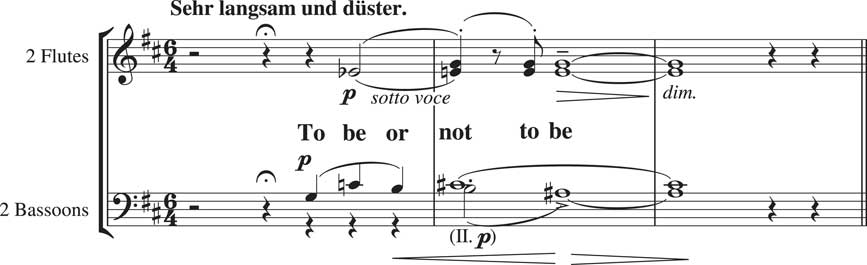
From the opening, a close relationship between music and text is evident in Liszt's Hamlet. Ramann's account begins by informing us that the rhythm of the initial motif neatly matches the words ‘To be or not to be.’Footnote 92 Ramann had this from Liszt himself. She writes that he whispered, ‘To be or not to be’ (in English) to her during the opening at a performance of the piece in the version for two pianos in 1884.Footnote 93 This statement is also supported by Göllerich, who was one of the performers on that occasion.Footnote 94 We are deliberately encouraged, therefore, to imagine these words being declaimed (see Ex. 1).
Liszt, Hamlet, bars 1–3
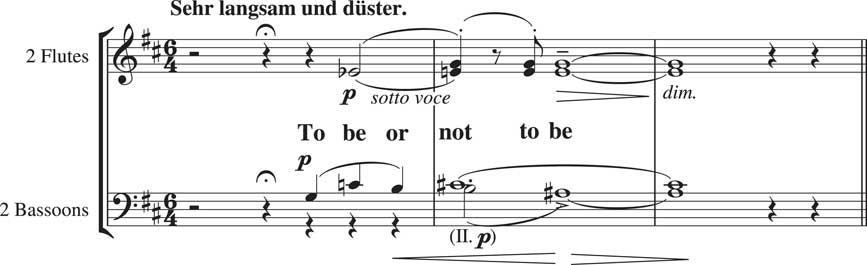
Although in general it appears that it was not Liszt's aim to match the rhythms of speech and accompaniment in his melodramas, this did occasionally occur in Lenore. It also naturally takes place frequently in his arrangement for declamation and piano accompaniment of Draeseke's song, Helges Treue. In Hamlet, the obvious rhythmic connection suggests that we are supposed to imagine the text being recited, particularly as it outlines the most famous line of the play. Liszt could be reasonably confident that the audience would know it. Furthermore, a flexible, expressive voice is suggested. Beginning piano in the bassoon, the motive is taken an octave higher in the upper winds whilst crescendoing over the words ‘not to be’. It then quickly dies away again. Its range is expressive and emphasises particular words in the manner of Dawison's declamation.
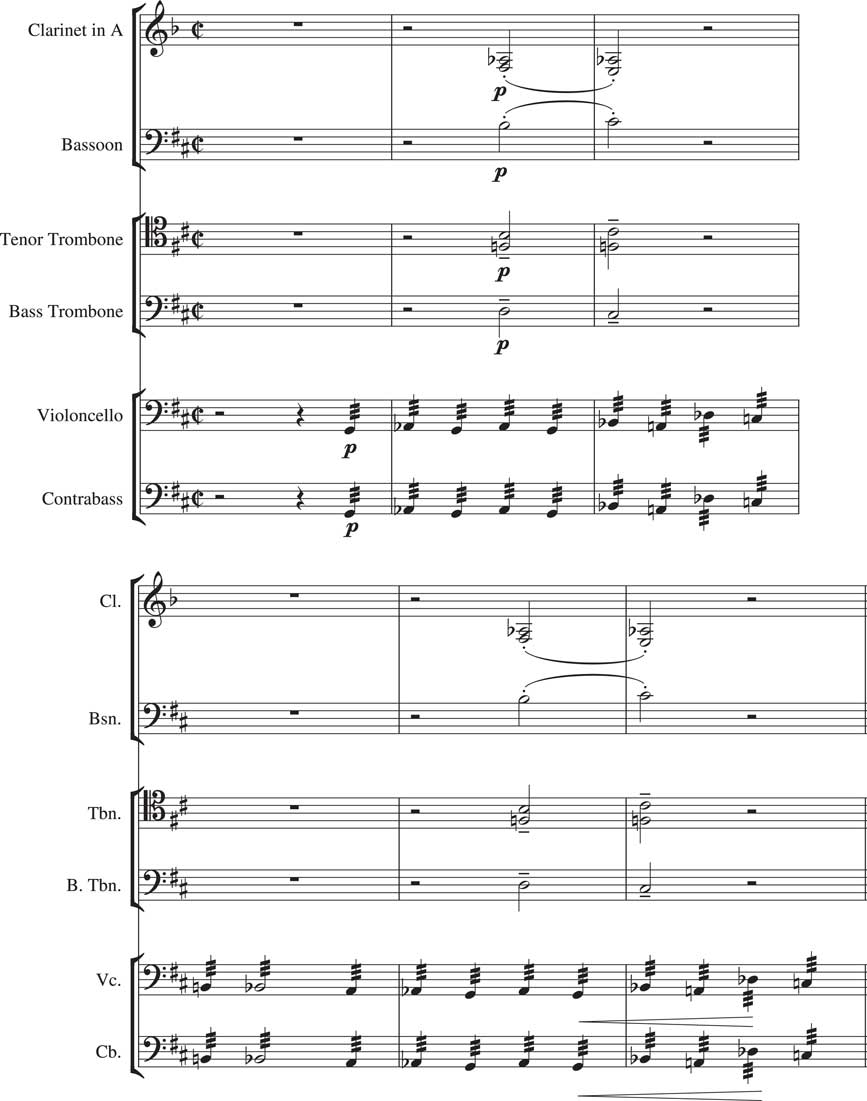
The opening motif twice holds a diminished 7th, and hollow strikes of the timpani followed by timpani rolls appropriately set the scene, drawing on the sound world of popular melodrama. A mournful rising motif repeated sequentially also contributes to the ominous atmosphere. At bar 26 we hear twelve chords alternating between cellos and horn on the one hand and the flute, clarinet and bassoon on the other. These shift from the tonic major to the chord of E♭ major and then to C minor. They represent a period of thematic and harmonic stasis that is not easily accounted for in structural terms. Humphrey SearleFootnote 95 and Keith T. JohnsFootnote 96 have associated the twelve chords with the clock of Elsinore striking midnight, which signals the appearance of the ghost in the play. These bars draw on the world of the theatre, suggesting the use of ‘off-stage’ music. They imitate a diegetic sound and function as a divide between the ‘real world’ of Hamlet's grief and the supernatural world as the ghost of Hamlet's father appears represented by tremolo low register strings in true melodramatic style, in a similar fashion to Liszt's portrayal of the ghost in Der traurige Mönch.
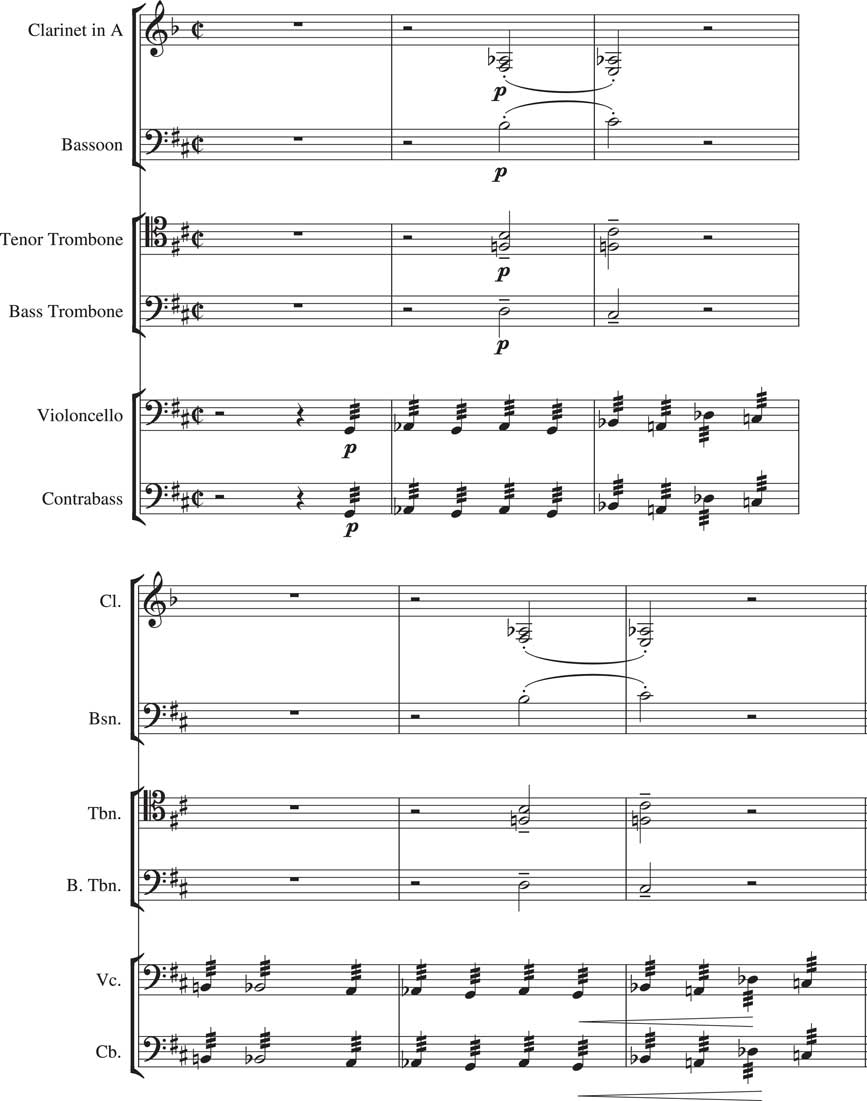
We have seen that tremolos were often used to depict the ‘supernatural’ in the theatre, and indeed, Liszt had experienced a similar effect at a production of Julius Caesar in Weimar in 1851. At this production Liszt conducted Hans von Bülow's overture. Afterwards, Bülow wrote about the production to his father, mentioning other incidental music used during the performance, but the identity of the composer is not clear. He mentions that ‘The theatre music and a well thought-out melodrama for the appearance of the ghost also made a good effect’.Footnote 97 Liszt's intention to depict the ghost from bar 50 is further supported by the marking ‘schaurig’ or ‘eerily’. Two separate voices are suggested in this section (see Example 2). The ghost has the low string sonority, but there are also repeated hesitant woodwind gestures, which, given the narrative, we are probably intended to interpret as a shocked Hamlet, perhaps in Dawison's signature gesture, stretching out his hand, retreating, and then repeating the gesture.
Liszt, Hamlet, bars 50–55
The melodramatic ‘ghost music’ then disappears and is replaced by an agitated motif marked Allegro appassionato ed agitato assai at bar 74. In terms of the musical structure, this is a transitional section, based on the sequential repetition of short motifs. The elevated status of transitional music is familiar in Liszt's symphonic poems, and sections such as this one are extended for programmatic, rather than structural reasons. The disproportionate length of this transitional section and the many changes of mood and tempo of the introduction as a whole make more sense imagined as a background to recitation, rather than as part of a symphonic work. Göllerich recalled that in this section Liszt said ‘seufzend’ (sighing) and also ‘Wohin soll ich mich wenden?’ (‘Where should I turn?’) during the two piano performance. Göllerich also included a reference to this in his notes on Liszt's masterclasses.Footnote 98 This suggests that the section was intended to depict emotional agitation – the music also returns before the stabbing of Polonius. Again, it likely draws on the heightened emotions and corresponding gestures of Dawison's acting.
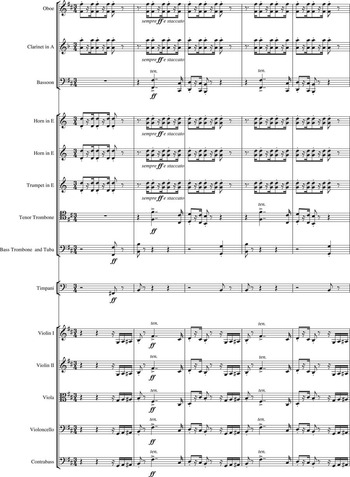
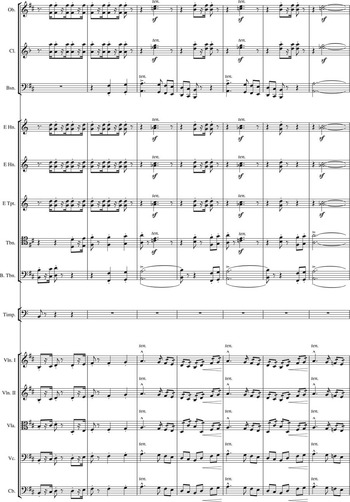
Then at bar 104 we hear a new transformation of the ‘To be or not to be theme’. This seems to depict the energetic, decisive Hamlet of Dawison's portrayal. Aggressive dotted rhythms appear in the trumpets, suggesting battle cries, and aptly conveying Dawison's interpretation of Hamlet as a skilled warrior. An active rather than passive and melancholy Hamlet is made clear to the listener through the use of this ‘topic’ (see Ex. 3).
Liszt, Hamlet, bars 104–115

continued.

The section ends with a new rising arpeggiated theme breaking through the texture, aptly marked risoluto. This theme returns only once more at bar 291, where it heralds the repeated chords at bar 294, which, as we shall see, were intended to represent the stabbing of Polonius.Footnote 99 Liszt therefore seems to use the risoluto theme as a reminiscence motif to signal the moments in the play where Hamlet's resolve is predominant. The motif is not developed: it recurs unchanged. Of course, other motifs in the work are treated to sophisticated thematic transformation, yet the risoluto motif merely provides clarity and emphasis, functioning like a reminiscence motif in melodrama.
A note in the score states that the section that follows refers to Ophelia: ‘This intermediate episode, ( $$$\raster="fx1"$$$
time) must be played extremely quietly and sound like a shadow picture suggesting Ophelia.’Footnote 100 Here Liszt chooses sonorities of upper woodwinds and solo violin (quite a different texture from those associated with Hamlet) to suggest Ophelia's voice. This is contrasted by an interruption from Hamlet: another version of the ‘To be or not to be’ theme now in a distinctively mocking bassoon timbre. This creates a very different voice for Hamlet from the aggressive warrior of the previous blaring brass sounds. The music carefully responds to changes in the character's emotions, presumably creating a similar effect to the flexible and expressive alterations of Dawison's voice. Then we hear Ophelia's drifting upper woodwinds once more.
It would appear from the Klindworth letter that Dawison and Liszt also discussed the relationship between Hamlet and Ophelia, and the remarks Liszt made about this again sound as if he were parroting Dawison's views:
At the same time Dawison also settles very affirmatively the question of whether Hamlet does or does not love Ophelia. Yes Ophelia is loved; but like all exceptional natures, Hamlet demands imperiously the wine of love from her and will not be satisfied with the whey. He wants to be understood by her without yielding to the necessity of explaining himself. Seen in that light, it is Ophelia who corresponds to the generally accepted notion of Hamlet's character; it is she who is crushed beneath the weight of her role through her inability to love Hamlet as he needs to be loved, and her madness is nothing more than the decrescendo of a feeling whose vaporousness does not allow her to remain in Hamlet's sphere.Footnote 101
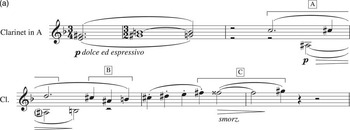
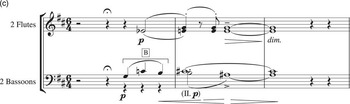
For Dawison, then, Ophelia was not an ‘exceptional character’ like Hamlet; she paled into insignificance beside the Prince. Liszt's term ‘Schattenbild’ (‘shadow-picture’) in the Ophelia section and the music itself seem to correspond to Dawison's interpretation of Ophelia as weak and unequal to Hamlet. Furthermore, Ophelia's main theme (Example 4a) is pieced together from three motifs that we have already heard associated with Hamlet (see Example 4a–d). She truly is a shadow of Hamlet in this sense, in a thematic transformation reminiscent of a single person playing both parts in the style of a reciter of a melodramatic ballad. Two different voices are depicted, but the same thematic material is used, as if both Hamlet and Ophelia were portrayed by the same person.
Liszt, Hamlet, bars 160–65

Liszt, Hamlet, bars 110–115

Liszt, Hamlet, bars 1–3

Liszt, Hamlet, bars 9–12

We have already seen that the first Ophelia passage is interrupted by Hamlet's main theme in the bassoon. According to Ramann this passage depicts Act III, scene i of the play: the point where Hamlet tells Ophelia ‘Get thee to a nunnery’.Footnote 102 It is during this interruption that Liszt uses the unusual marking ironisch. Perhaps unsurprisingly, descriptions of Dawison's interpretation typically focus on his heightened use of bitterness, sarcasm and irony. Emil Knetschke wrote that Dawison's Hamlet placed too much emphasis on scepticism and sarcasm;Footnote 103 Kollek too mentions Dawison's emphasis of sarcastic nuances.Footnote 104 This was particularly evident in Act III, scene i.Footnote 105 Overall, given what is known of Dawison's portrayal of Act III, scene i, Liszt's use of the marking ironisch in this section is intriguing, to say the least.
Liszt had already used the marking ironisch in the Mephistopheles movement of the Faust Symphony. His revival of this unusual term may have been inspired by Dawison's acting, especially as some critics even found ‘a dose of Mephistophelean character’ in his portrayal of Hamlet.Footnote 106 Indeed, it is tempting to speculate whether Liszt may have added the marking ironisch to the Faust score after having seen Dawison play the role of Mephistopheles the day before the Faust premiere in September 1857. In both cases the marking must be intended as a programmatic indication rather than a realizable musical effect, for it is difficult to imagine how a musician would go about playing something ‘ironically’. However that may be, the use of the term in the symphonic poem certainly suggests a close relationship to Dawison's acting style and conception.
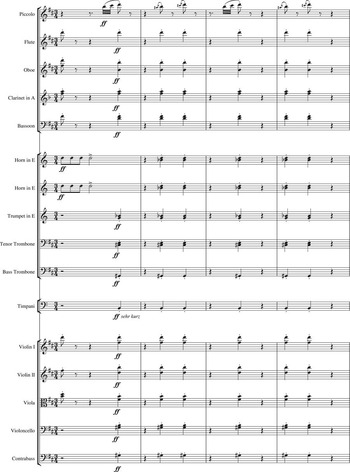
After the ‘Get thee to a nunnery’ scene, earlier themes are revisited between bars 219 and 338, perhaps representing Hamlet arguing with his mother in Act III, scene iv as Ramann suggests (though she does not directly cite Liszt as the source here).Footnote 107 This is interrupted by a piece of musical pictorialism highly suggestive of melodrama and later film music for which melodrama was a precursor: stabbing chords from bar 294. Sarah Hibberd recalls a similar moment in the ‘sleepwalking scene’ from Chelard's Macbeth, which she argues is also highly influenced by melodrama. Here the audience does not see Macbeth stabbing the King, but it is suggested ‘very graphically’ by ‘demisemiquaver arpeggiations on a rising sequence of diminished 7ths’.Footnote 108 At this point during the performance of Hamlet for two pianos Liszt whispered to Ramann, ‘Polonius – die Ratte’ and mimed the intended gesture himself, making a stabbing action with his arm.Footnote 109 This clearly referred to Hamlet stabbing Polonius in Act III, scene iv, and to Hamlet's line ‘How now? A rat! Dead for a ducat, dead.’Footnote 110 The orchestra replaces this missing visual element (see Ex. 5).
Liszt, Hamlet, bars 294–297

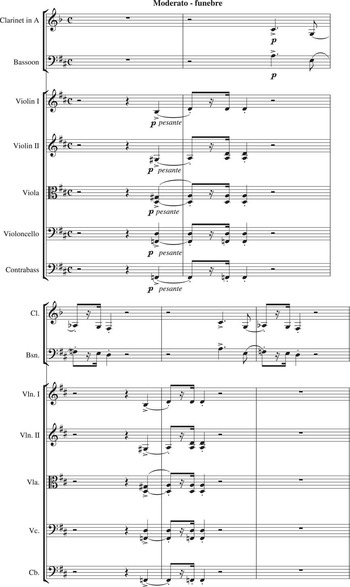
Finally, the piece ends representing Hamlet's own death in a section marked Moderato-funebre. Now Liszt slows Hamlet's main theme down to a dirge (see Ex. 6).
Liszt, Hamlet, bars 347–351

The piece ends as it begins, with more highly atmospheric, dramatic music of wide dynamic contrasts, delivered over a short space of time, reminiscent of the dramatic juxtapositions in Dawison's acting style. We also hear more tremolo effects in the strings, dark lower string sonorities, and hollow strikes of the timpani, all conjuring a sinister atmosphere, drawing heavily on stylistic effects associated with melodrama.
Overall, Liszt's Hamlet aims at conveying the narrative of the play and encourages us to imagine it in performance. Liszt's opening motif was based on the rhythms of speech, he suggested ‘off-stage’ music as the clock of Elsinore struck twelve, melodramatic signifiers depicted the ghost, there was an attempt to represent Ophelia's and Hamlet's ‘voices’, imitation of a stabbing gesture, and a final funeral topic suggested Hamlet's death. Liszt's musical vocabulary, therefore, drew heavily on melodrama. Hamlet is, to some extent, a melodrama as symphonic poem.
The melodramatic acting style as demonstrated by Dawison evidently appealed to Liszt. It must have come as something of a revelation after the more graceful but artificial style popular on the Weimar stage at the time. Liszt perhaps admired the heightened sense of drama and the attempt to depict the inner emotions of the character through gestures, facial expressions and the voice. Accordingly, the influence of Dawison, particularly in the context of his role as a declaimer, is strongly connected to the genesis of not only Hamlet, but also Liszt's melodramas of the late 1850s and early 1860s.
Liszt's correspondence reveals that he did not see Dawison's performance in Hamlet in Weimar in 1856, but he certainly was well acquainted with the actor's conception of the role, and witnessed Dawison's style on other occasions. Liszt greatly admired Dawison's interpretation, which opened up new possibilities within the play. Dawison turned Shakespeare's tragedy into something closer to melodrama, and this interpretation not only made a musical setting possible, it also suggested to Liszt the vocabulary with which he should work. Accordingly, when Liszt came to compose Hamlet he eventually produced not a tragic overture depicting Hamlet's dilemma, but an adapted melodrama focussing on the main points of action and emotional excess, incorporating techniques associated with the melodrama of the theatre.
Liszt's approach to Hamlet resulted in a piece that is unique among the symphonic poems in the sheer detail of its programmatic gestures. It attains arguably the closest mirroring of its subject of all the symphonic poems, precisely because of its connection to theatre, which was initially made apparent in an early draft, through the subtitle, ‘Vorspiel zu Shakespeares Drama’. For later versions the subtitle was removed, but despite this the piece attained an even closer analogy to its subject: further details such as the ‘ghost’ and ‘Ophelia’ were added to later drafts. The work may have lost the subtitle as a direct indicator of its indebtedness to theatre music, but revisions only served to heighten this relationship.
As the last Weimar symphonic poem that he composed and the most programmatic of all of them, Hamlet can be understood as the culmination of Liszt's project. He had gone as far as he could in retaining musical logic whilst depicting an extramusical subject. Indeed, at times the relationship between the two was unequal – the narrative privileged to the detriment of musical logic. In these sections Hamlet revealed a new direction which Liszt would follow in his next attempts to fuse music and poetry. In the years immediately following the completion of Hamlet he would continue to compose melodramas as well as the Two Episodes from Lenaus Faust, which also contain features in this style and exhibit an exceptionally high reliance on texts.
Finally, even though Liszt did not see Dawison's Weimar production of Hamlet in 1856, its influence can be traced on the style of the work and on Liszt's approach in general. As such the symphonic poem can be understood not just as a ‘Vorspiel’ to an imagined production of Hamlet, but as a substitute melodrama, with the remarkable Dawison, a kindred spirit to the composer, declaiming the lead role.