Introduction
HIV/AIDS has increased mortality and morbidity, and reduced life expectancy, in communities in sub-Saharan Africa where its prevalence is high (Ainsworth & Over, Reference Ainsworth and Over1997; Boerma et al., Reference Boerma, Nunn and Whitworth1998). The HIV prevalence rate in Malawi is estimated at 15%, and is among the highest in the world (Kalipeni & Ghosh, Reference Kalipeni and Ghosh2007). Key to limiting the spread of HIV/AIDS is the use of contraceptives, in particular condoms (Meursing & Sibindi, Reference Meursing and Sibinda1995; Noel-Miller, Reference Noel-Miller2003). A number of demographic and social factors influence female and male use of contraceptive methods (Isiugo-Abanihe, Reference Isiugo-Abanihe1994; Gage, Reference Gage1998; Caldwell & Caldwell, Reference Caldwell, Caldwell, Ebigbola and Renne2000; Behrman et al., Reference Behrman, Kohler and Watkins2002). For example, Isiugo-Abanihe (Reference Isiugo-Abanihe1994) showed, in Nigeria, that individual attributes such as age, education, rural or urban residence, as well as social influences through family, social networks, sexual partners and peers are important in decision-making about reproductive and contraceptive behaviours. More recent literature indicates that individual preferences and considerations of costs, benefits and commitments from two partners are associated with contraceptive decisions (Becker, Reference Becker1996; Gage, Reference Gage1998; Miller et al., Reference Miller, Severy and Pasta2004).
In general, though the foregoing literature supports the view that a couple's joint decision-making forms the basis for contraceptive use, scholars have not examined the relationship between HIV/AIDS concerns and couple contraceptive use. An understanding of couple decision-making around family planning in the context of HIV/AIDS is important for more effective programmes and prevention strategies, particularly regarding the message employed and its target. The overall goal of this study, therefore, is to examine how husbands' and wives' concerns about HIV/AIDS and their age difference affect their use of contraception. Data come from the 2001 Malawi Diffusion and Ideational Change Project (MDICP).
Background
The present research explains the pattern of contraceptive use in sub-Saharan Africa by using theories on individual, social, economic, cultural and intra-household factors. Of special interest to the analysis is the evidence for the interaction between couple HIV concerns and spousal age difference for decisions to use contraception.
HIV/AIDS and contraception
Research shows that demand for contraception in sub-Saharan Africa (Barbieri & Hertrich, Reference Barbieri and Hertrich2005) may be determined by desires to limit births, space births (Giusti &Vignoli, Reference Giusti and Vignoli2006) and, more recently, prevent HIV infection (Meursing & Sibindi, Reference Meursing and Sibinda1995; Noel-Miller, Reference Noel-Miller2003). In particular, the use of modern contraceptives such as male condoms is the most common method of HIV protection (Zaba & Gregson, Reference Zaba and Gregson1998; Gregson et al., Reference Gregson, Zaba and Hunter2002). Zaba & Gregson (Reference Zaba and Gregson1998) also point to changes in levels of condom use, delays in sexual activity and increases in separation rates as indications of strategies to alleviate fears of HIV infection.
Further, research shows that increased HIV risk awareness may influence sexual partners to adopt sexual behaviours that curb the spread of HIV/AIDS and initiate communication about family planning (Oheneba-Sakyi & Takyi, Reference Oheneba-Sakyi and Takyi1997; Becker & Constenbader, Reference Solo, Jacobstein and Malema2001; Barbieri & Hertrich, Reference Barbieri and Hertrich2005). Smith & Watkins (Reference Smith and Watkins2005) linked awareness about HIV risks to changes in sexual behaviours between 1998 and 2001. Individuals in Malawi were less concerned about HIV/AIDS in 2001 than they were in 1998, in part due to changes in their behaviour in reducing the spread of HIV/AIDS.
Age differences between spouses, gender and contraceptive behaviour
In a review of evidence for contraceptive use by gender and age, Barbieri & Hertrich (Reference Barbieri and Hertrich2005) pointed out that large age differences between spouses are a feature of traditional African marriages, signifying early entry into union for females and late entry for males. Spousal age difference is also linked to fertility expectations and couple's degree of autonomy (see also Zopf, Reference Zopf1984). The relationship observed is that age is associated with less reported use of contraceptive methods in the case of younger women married to older men (Barbieri & Hertrich, Reference Barbieri and Hertrich2005). Additionally, large age differences between spouses can be indicative of limited conjugal intimacy, especially when family members are involved in defining couple decisions with respect to fertility and contraception (Zopf, Reference Zopf1984; Barbieri & Hertrich, Reference Barbieri and Hertrich2005).
On the other hand, existing gender relations in Africa have an extremely complex relationship with contraceptive use among couples. The findings from the examinations of men's and women's social networks indicate that married couples are more concerned about condom use in extramarital sexual partnerships than in marriage (Chimbiri, Reference Chimbiri2007). Paradoxically, men's decisions focused more on protecting themselves and their spouses from sexually transmitted infections, including HIV, from extramarital sexual partners. Females tended to object to condom use in marriage, even though they know HIV prevalence is high (Kalipeni & Ghosh, Reference Kalipeni and Ghosh2007) and men are widely believed to engage in extramarital sexual activity (Chimbiri, Reference Chimbiri2007).
Intra-household bargaining and contraception
Decision-making around family planning can also be understood in terms of household organization and structure. Previously, investigations of contraceptive use conceptualized reproductive behaviours in individual, social, economic and gender-specific terms. There is now substantial evidence to justify the use of intra-household models to estimate fertility outcomes and behaviours (Becker, Reference Becker1996; Miller et al., Reference Miller, Severy and Pasta2004). The current frameworks recognize that reproductive decisions are between two sexual partners, taking into account their differences, preferences and the extent and nature of participation by each partner (Lundberg & Pollak, Reference Lundberg and Pollak1996).
Additionally, these models demonstrate the role of household organization and structure on family reproductive decision-making. For example, Miller et al. (Reference Miller, Severy and Pasta2004) indicate that the socioeconomic environment in which the couple live has implications for the household decisions they make. Similarly, Lundberg & Pollak (Reference Lundberg and Pollak1996) illustrate how social norms affect the reproductive behaviours of married couples. They explain that cooperative and non-cooperative reproductive outcomes may be prescribed by social norms and institutions. Most importantly in large parts of the developing world, marital choices are not left to the couple to decide. Family members, such as mothers-in-law, mother/fathers and relatives, are involved in defining couples' decisions about fertility and contraception (Zopf, Reference Zopf1984; Gage, Reference Gage1998; Noel-Miller, Reference Noel-Miller2003; Miller et al., Reference Miller, Severy and Pasta2004; Barbieri & Hertrich, Reference Barbieri and Hertrich2005). The family often tends to feel that their interests are best served by large numbers of children and use rewards and punishments to encourage the couple to produce them (Zopf, Reference Zopf1984). If, however, couples are socialized to similar community values and norms, this can result in women and men having similar fertility goals, even though they have different desires and preferences (Mason & Taj, Reference Mason and Taj1987).
Despite the social constraints on couples' degree of autonomy in sub-Saharan Africa, several studies show that couples maintain contraceptive use by obtaining information on sexual matters from different sources and various environmental settings (Isiugo-Abanihe, Reference Isiugo-Abanihe1994; Gage, Reference Gage1998; Caldwell & Caldwell, Reference Caldwell, Caldwell, Ebigbola and Renne2000). These studies show that improved access to reproductive health care and communication between spouses about family planning has contributed to stronger emotional bonds and greater convergence of reproductive interests (Gage, Reference Gage1998; Barbieri & Hertrich, Reference Barbieri and Hertrich2005). Oheneba-Sakyi & Takyi (Reference Oheneba-Sakyi and Takyi1997) demonstrated that contraceptive use is more common in relationships where husband and wife communicate about family planning and make joint decisions about family size.
It is in light of the above evidence that this study uses couple data to clarify the relationship between concerns about HIV/AIDS, couple age difference and contraception.
Data and Methods
Data
The data for this study come from the 2001 MDICP, which interviewed 1571 women and 1097 men. The MDICP is an ongoing panel survey with collaborators from the University of Pennsylvania. It began in 1998 and has interviewed over 4000 married men, women and adolescents in 1998, 2001, 2004, 2006 (Yeatman, Reference Yeatman2007), and recently in 2008. The MDICP is carried out in three distinctive regions of Malawi: Rumphi district in the north, Mchinji district in the central region and Balaka district in the south.
The survey contains information on demographic characteristics, informal networks of family planning, contraceptive decision-making and diffusion of HIV knowledge and prevention strategies (Noel-Miller, Reference Noel-Miller2003). The data were obtained from face-to-face interviews using structured questionnaires. The sample respondents were selected from each district using a two-stage probability sampling design. At the first stage a random sample of villages was selected with probability proportional to size. At the second stage, households were listed and eligible females and their husbands were picked randomly (Noel-Miller, Reference Noel-Miller2003).
The 2001 MDICP includes information about HIV/AIDS concern, which is optimal for assessing decisions on contraceptive use even though the HIV status of the respondents was not known at the time. Noel-Miller (Reference Noel-Miller2003) shows that since people in southern Africa learn of their HIV status late, concern associated with HIV/AIDS can be used to assess changes in reproductive behaviour. Second, support for this perspective is found in Montgomery & Casterline (Reference Montgomery and Casterline1996), who state that perception of levels of a demographic phenomenon can be used to study behaviours in a population. Third, Smith & Watkins (Reference Smith and Watkins2005) indicate that patterns of HIV risk perceptions among respondents in Uganda reflected actual HIV prevalence patterns in the group.
Setting
Malawi provides a good context for this investigation in several ways. First, government investments in public health systems since the early 1990s have increased the use of modern contraceptives. Malawi developed its population policy in the 1990s, after a ban on family planning activities from the late 1960s (Chimbwete et al., Reference Chimbwete, Watkins and Zulu2004). In 2000, 26% of married women aged 15–49 years were using modern contraceptive methods, an increase in use from 7.4% in 1992. Second, there are disparities in contraceptive use between married women in urban and rural areas. Reported contraceptive use in 2000 in cities was 38%, compared with less than 25% in rural areas (Hennink & Madise, Reference Hennink and Madise2005; Solo et al., Reference Solo, Jacobstein and Malema2005).
Variables
The outcome variable is current use of a traditional or modern contraceptive method. Current contraceptive use captures the use of contraception reported by both wife and husband at the time of the survey. The question examined is: ‘Are you and your wife now using any method of child spacing/family planning … both modern and traditional methods?’ The dependent variable is classified as 0 for concordant non-use and 1 for concordant use of contraception. Concordance indicates a similar response on contraceptive use between husband and wife. Discordance indicates a difference on contraceptive use (where husband and wife gave different responses on contraceptive use).
For the analysis, discordant partner use – where the wife reported contraceptive use and the husband reported non-use – was added to category 1 of the dependent variable. The combining of concordant couples and discordant couples (where wife reports contraceptive use and husband does not) has justification in the literature. The literature shows that female's responses are very likely to reflect the actual situation for couples on contraceptive use in comparison with males (Miller et al., Reference Miller, Zulu and Watkins2001). Similarly in their study, Greene & Biddlecom (Reference Greene and Biddlecom2000) chose women over males because their primary responses to questions on fertility and contraceptive use have been linked to the earlier practice of interviewing only women rather than both husbands and their partners in demographic surveys. Nonetheless, this does not mean that the responses for discordant couples where males report contraceptive use and their spouse don't are not valid. In fact in the analysis of couple data, all sources of validity should be explored (Becker & Constenbader, Reference Meursing and Sibinda2001), so this is reported in the Appendix to this paper.
The selection of the explanatory variables was informed by the literature on couple contraceptive use and intra-household decision-making. The explanatory variables include whether husband and wife are concerned about becoming infected with HIV/AIDS, spousal age difference, wife's age, education level of husband and wife, wife's religion and number of living children in the current marriage. A second set of explanatory variables include communication about family planning and if the couple has ever discussed the number of children they would like to have. HIV/AIDS concern has two categories: (1) not concerned about HIV/AIDS and (2) concerned about HIV/AIDS. Couple age is the difference between husband's and wife's age and it is reflected as a dummy variable with three categories. The category is for partners in which the wife is older than her husband; the second category is for couples with similar ages; and the last category is for couples in which the husband is older than his wife. Wife's age was recorded into three categories: (1) 19–24 years, (2) 25–34 years and (3) 35 years and above.
Education is measured as a continuous variable, and it captures the number of years of schooling completed. Primary schooling normally takes 1–7 years, secondary schooling is 8–12 years and tertiary education is more than 12 years. Religion of the wife has two dummies: Catholic and Protestant/other. The dummy Protestant/other religion includes couples with no religion. Number of children is a categorical variable: (1) having none to one child, (2) two to four children and (3) five and more children. Discussions about family planning and ideal number of children are measured with dummies: (1) for Yes and (0) for No.
Statistical analyses
The analyses include descriptive statistics, and multivariate logistic regression. Since the dependent variable is dichotomous, and several variables are used to predict the outcome, multivariate logistic regression is used in preference to multivariate linear regression (Kleinbaum, Reference Kleinbaum, Dietz, Gail, Krickeberg and Singer1994). Multivariate logistic regression is suitable in cases where the dependent variable is predicted from several independent variables that are continuous, dichotomous and/or categorical (Agresti, Reference Agresti1990). The estimated model for the multivariate logistic regression analysis is:

This equation gives the log odds of the outcome variable (Kleinbaum, Reference Kleinbaum, Dietz, Gail, Krickeberg and Singer1994; Allison, Reference Allison1999), where P is the probability of current couple contraceptive use, [P/1−P] is the odds ratio, β 0 is the intercept and β 1 to βk are the coefficients of the explanatory variables. The explanatory variables are denoted by X 1 to Xk and include the variables mentioned above (wife concerned about HIV/AIDS, husband concerned about HIV/AIDS, couple's age difference, wife's age, wife's years of schooling, husband's years of schooling, wife's religion, wife's number of living children, wife discusses family planning, husband discusses family planning, wife talks about ideal family size and husband talks about ideal family size).
Results
Descriptive statistics
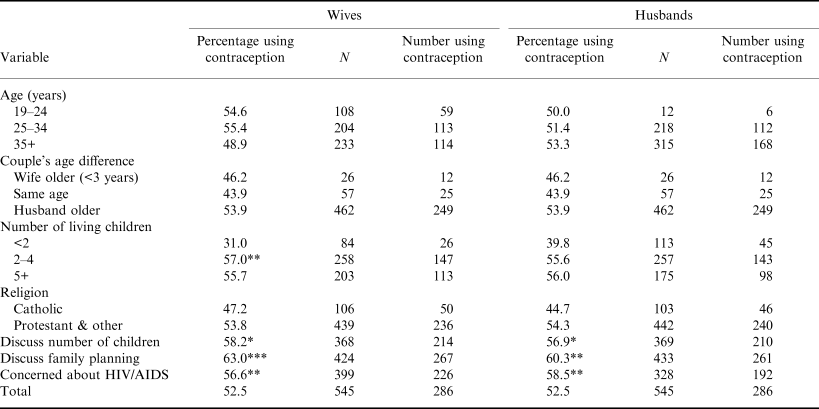
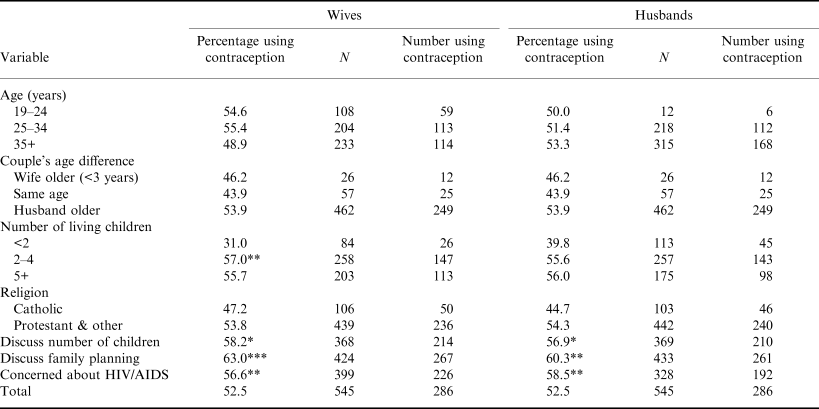
The analysis for this study is based on married couples aged 19–54 years who reported current contraceptive use in 2001. The sample consist of 545 couples, 47.5% of whom reported concordant contraceptive use, 37.1% concordant non-use and 15.4% discordant partner use (wife reports contraceptive use and husband does not). The mean age for males is 37.6 years (SD=8.6) and 32.6 years (SD=8.6) for females. The mean age difference is 5.7 years. The mean number of living children is 3.70 (SD=2.91). Table 1 presents the distribution of contraceptive use by the selected characteristics of the couple. Couple contraceptive prevalence is 52.5%. Contraceptive use is practised by 46.2% of couples in which the wife is older than her spouse, 53.9% in couples where the husband is older than his wife and 43.9% in couples where the wife and husband are of similar ages. The mean number of years of schooling for wives currently using a contraceptive method is 5.30 (SD=2.30) years and 5.44 (SD=2.45) years for husbands.
Percentage and number of wives and husbands who are currently using a contraceptive method by selected variables, Malawi 2001
* p<0.1;
** p<0.05;
*** p<0.001.
Table 1 shows that females in younger and middle age groups and older males are more likely to be using a contraceptive method than those in other age groups. Females aged 19–24 years (54.6%) and 55.4% of the females aged 25–34 years reported contraceptive use compared with 48.9% aged 35 years and above. Males aged 35 years and older (53.3%) were currently using a contraceptive method compared with 51.4% aged 25–34, and 50.0% of the males aged 19–24 years.
Both females and males with large families tend to use a contraceptive method more than couples with smaller families. For instance, females with two to four children and those with five or more children (57.0% and 55.7% respectively) report higher contraceptive use than those with fewer than two children (31.0%). As expected, couples who are of Protestant/other religion tend to use contraceptive methods more than Catholics. Over half of the couples using a contraceptive method are not Catholic (53.8% females and 54.3% males). Table 1 further indicates that most of the couples who were using a contraceptive method had discussed family planning with a spouse. Slightly more females (63.0%) than males (60.3%) currently using a contraceptive method, and had engaged in discussions about family planning with a spouse. Nearly the same proportions of wives (58.2%) and husbands (56.9%) who had discussed the ideal number of children with the spouse were currently using a contraceptive method. With regard to HIV/AIDS concern, a slight majority of females (56.6%) and males (58.5%) using a contraceptive method were concerned about becoming infected with HIV/AIDS.
Multivariate analysis
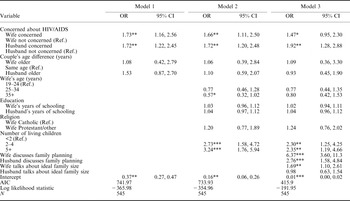
Table 2 presents the results of the multivariate logistic regression. Model 1 examines the influence of husband and wife HIV concern and couple age difference on contraceptive use. Model 1 shows that an increase in HIV/AIDS concern is associated with higher couple contraceptive use. Couples in which the husband (odds ratio (OR) 1.72, p<0.003) and wife (OR 1.73, p<0.007) are concerned about becoming infected with HIV/AIDS are more likely to be using a contraceptive method than couples who are not concerned. Age differences between the spouses are not significantly associated with couple contraceptive use.
Odds ratios and 95% confidence intervals for selected characteristics of wife and husband on couple current contraceptive use in Malawi, 2001, with discordant cases (wife reports contraceptive use and husband does not)

OR, odds ratio; CI, confidence interval; AIC, Akaike information criterion; N, number of cases.
Ref., reference category.
* p<0.1;
** p<0.05;
*** p<0.001.
Model 2 includes wife's age, husband's and wife's education, wife's religion and wife's number of living children in addition to the explanatory variables in Model 1. Husband's age, husband's religion and husband's reported number of living children were excluded from this model because they were highly correlated with those of the wife (r=0.65, r=0.74 and r=0.73, respectively). When wife's age, years of schooling for husband and wife, wife's number of children and religion are controlled for, it is found that the association of husband's HIV concern stays the same at 1.72 (p<0.003). The results in Table 2 further indicate that contraceptive use is associated with wife's HIV concern, wife's age, and wife's number of living children.
The probability of couple contraceptive use increases when the wives are concerned about becoming infected with HIV/AIDS (OR 1.67, p<0.014) and with the number of living children. Women who have two to four children are 2.73 (p<0.001) times more likely to use contraception than those with fewer than two children. Contraceptive use is also higher for wives who have more than five children (OR 3.24, p<0.001), in comparison with couples in which females have fewer than two children. Older women aged 35 years and above (OR 0.57, p<0.060) are less likely to use contraception than females aged 19–24 years. Model 2 further indicates that contraceptive use by couples is not associated with spousal age difference, years of schooling or wife's religion.
Model 3 includes variables in Model 2 and two communication variables: whether husband and wife have discussed family planning and whether they have ever discussed the number of children they would like to have. The results in Model 3 indicate that couple participation in decisions about the use of contraceptives for husbands is associated with HIV concern and discussion of family planning with a spouse. For women, couple participation in decisions about contraceptives is associated with HIV concern, the number of living children she has with her spouse, and if she has ever discussed family planning and ideal number of children with her husband. Husbands who are concerned about HIV/AIDS are 1.92 times (p<0.002) more likely to use contraception than those who are not concerned about HIV/AIDS. Husbands who discuss family planning with their wives are nearly three times (OR 2.76, p<0.001) as likely to use contraception compared with those do not talk to their wives about contraceptives. Wives who are concerned about getting infected with HIV/AIDS are 1.47 times (p<0.087) more likely to practise contraception than those who are not concerned.
Women who discuss family planning with a spouse are over six times (OR 6.37, p<0.001) more likely to practise contraception than those who do not engage in such discussions. It is also clear that women who talk about ideal family size with their spouses are more likely to use a contraceptive method (OR 1.69, p<0.016) than those who don't. The influence of family limitation was associated with contraceptive use among females. Couples in which women have two to four children were 2.30 (p<0.008) more likely to use contraception than those with fewer than two children. Having a large family (five or more children) is associated with greater contraceptive use for females compared with those with fewer than two children (OR 2.35, p<0.014). Explanatory variables that do not significantly predict couple contraceptive use include: wife's age, wife's religion, spousal age difference, years of schooling completed for husbands and wives, and if husbands have ever discussed ideal family size with a spouse.
Discussion
This study examines the relationship between the HIV/AIDS concern, spousal age difference and couple's contraceptive use in Malawi. Using data from a panel survey of married women and their husbands residing in three regions in Malawi, it is found that contraception among husbands is associated with the husband's concern about HIV/AIDS and discussion with a spouse on family planning. Wives tend to have a more complex association: they use contraception more if they are concerned about getting HIV/AIDS, have larger families and discussed family planning and ideal family size with a spouse.
The findings on the gender differences in HIV concern confirm several aspects of the literature. First, engagement in contraceptive decisions can differ in terms of the understanding of the HIV risk of engaging in such behaviours for adults (Varga, Reference Varga1997; Gregson et al., Reference Gregson, Zaba and Hunter2002; Noel-Miller, Reference Noel-Miller2003; Smith & Watkins, Reference Smith and Watkins2005; Chimbiri, Reference Chimbiri2007). In her study, Chimbiri (Reference Chimbiri2007) shows that married men and women view condoms as a method of protection from HIV infection outside rather than in marriage. Additionally, men are concerned about family planning with their spouse to prevent pregnancy rather than about the prevention of HIV/AIDS or other sexually transmitted infections (Chimbiri, Reference Chimbiri2007). Thus a source of fear for HIV risk for both men and women appears to be extramarital sexual partners, hence the use of condoms only with these sexual partnerships.
Second, worry regarding HIV infection has implications for how childbearing is defined at the time. For instance, Noel-Miller (Reference Noel-Miller2003) provides support for reduced childbearing among married women who are worried about HIV infection in the future. It is possible that these women reduced their fertility out of fear of getting infected, a child being born infected and concern for their children's future care (Gregson et al., Reference Gregson, Zhuwau, Anderson and Chandiwana1997; Rutenberg et al., Reference Rutenberg, Biddlecom and Kaona2000). Third, studies on HIV risk perceptions and sexual practices demonstrate that contraceptive choices made by sexual partners are influenced by whether the methods protect against HIV/AIDS infection. In particular, condoms serve both as contraceptives and as a method of protection from HIV in comparison with other contraceptives such as the pill, injectables, depo-provera and female sterilization (Meursing & Sibindi, Reference Meursing and Sibinda1995; Noel-Miller, Reference Noel-Miller2003; Chimbiri, Reference Chimbiri2007).
However, the study did not find a significant association between spousal age difference and contraceptive use. Couple age difference was expected to accelerate or impede contraceptive behaviours (Barbieri & Hertrich, Reference Barbieri and Hertrich2005). As such the study anticipated large age differences to be negatively associated with couple contraceptive use due to one sex having power and control over decisions about contraceptive use (Oheneba-Sakyi & Takyi, Reference Oheneba-Sakyi and Takyi1997). However, the observed finding is not surprising as Barbieri & Hertrich (Reference Barbieri and Hertrich2005) reported that the effect of spousal age difference on contraceptive use in southern Africa remains unclear and ambiguous.
The findings on approval of use of family planning are consistent with previous research, which shows that spousal discussion about family planning has a positive effect on contraceptive use (Oheneba-Sakyi & Takyi, Reference Oheneba-Sakyi and Takyi1997; Becker & Constenbader, Reference Meursing and Sibinda2001; Barbieri & Hertrich, Reference Barbieri and Hertrich2005). Becker & Constenbader (Reference Meursing and Sibinda2001) point out that if spouses have discussed family planning, they are more likely to act jointly in contraceptive decision-making. Additionally, among the females, it is apparent from the data that the pattern of contraceptive use is associated with the number of children in a family. Contraceptive use is higher for wives with a large number of children than among females who have fewer than two children. It is also clear that women who have discussed the ideal family size with their spouses are more likely to use a contraceptive method than those who have not. The implication is that increased support of the husband in contraceptive decisions is important since traditionally it is perceived that the man needs large numbers of children to prove his manhood and for socio-political and economic advancement (Zopf, Reference Zopf1984; Bledsoe, Reference Bledsoe1990).
At the same time the data emphasize the importance of the extent of husband and wife influence on couple contraceptive behaviour. The relationship of the explanatory variables and couple contraceptive use is in the same direction, though the magnitude and significance of the husband and wife HIV/AIDS concern are reduced (see Tables 2 and A1). Oheneba-Sakyi & Takyi (Reference Oheneba-Sakyi and Takyi1997) attest to the influence of household structure and intra-family communication on decisions about contraception.
On a methodological note, the study relies on self-reports about the current use of contraceptives and dates of birth. It is possible that the respondents gave responses that they thought were socially accepted (Becker & Constenbader, Reference Meursing and Sibinda2001). Second, the study is cross-sectional and it does not allow any inference about contraception use over time. Thus, with longitudinal data, how couple perceptions about HIV/AIDS prior to and after 2001 may affect subsequent contraceptive decisions can be explored. Finally, the dependent variable is based on a question that only asks about the use of contraceptive methods. It does not distinguish between condoms and other methods. Only condoms among the various methods protect against the HIV/AIDS virus (Zaba & Gregson, Reference Zaba and Gregson1998; Gregson et al., Reference Gregson, Zaba and Hunter2002). It is certainly likely that some respondents who report using contraceptives are in fact not using condoms but other means of contraception. However, what is clear from the above analysis is that HIV/AIDS concern is associated with ‘increased’ contraceptive use reported for both husband and wife.
Notwithstanding the above shortcomings, the findings of this study provide insights for couple-level research on decision-making about family planning in the context of HIV/AIDS. Few studies have focused on this issue, and the available data on HIV risk perception indicate little relationship with behaviour change in marriage. Clearly, health programmes in Africa need to involve both husbands and wives in the family planning agenda, since their communication and approval affect contraceptive use. Research on the implications of marital concerns about HIV/AIDS for contraceptive behaviours – especially the use of condoms rather than other contraceptive methods and HIV preventive strategies – can further enrich this area of study.
Acknowledgments
An earlier version of this paper was presented to the Graduate Group in Demography, Population Studies Center, at the University of Pennsylvania. The author would like to thank the anonymous reviewers for their useful suggestions.
Appendix
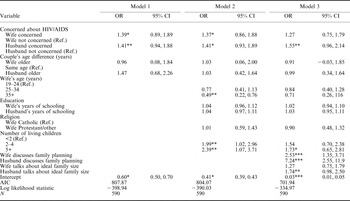
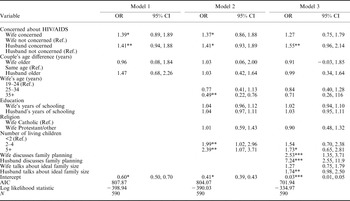
In addition to the results in Table 2, the discordant couples in which husbands reported contraceptive use and wives did not were investigated to validate couple responses (see Table A1) . This sample comprised 590 couples whose contraceptive prevalence was 56.1%. Table A1 shows that the relationship of the explanatory variables and couple contraceptive use is in the same direction as in Table 2. Though the magnitude and significance of the husband and wife HIV/AIDS concerns are reduced, the results demonstrate that contraceptive decisions require input from both the husband and wife.
Odds ratios and 95% confidence intervals for selected characteristics of wife and husband on couple current contraceptive use in Malawi, 2001, with discordant cases (husband reports contraceptive use and wife does not)
OR, odds ratio; CI, confidence interval; AIC, Akaike information criterion; N, number of cases.
Ref., reference category.
* p<0.1;
** p<0.05;
*** p<0.001.
Taking all the variables into account, as in Model 3, it is found that husband's HIV/AIDS concern (OR 1.55, p<0.045), discussion of ideal family size (OR 1.74, p<0.014) and discussion of family planning (OR 7.24, p<0.001) increase the likelihood of couple contraceptive use. Unlike the results in Table 2, wife's concern about HIV/AIDS and wife's engagement in discussion about ideal family size are no longer significant. However, wives who have more than five children (OR 1.73, p<0.08) are more likely to use contraception than those with fewer than two children. Finally, wives who have discussed family planning (OR 2.53, p<0.001) tend to use contraception.